WBTC to BTC Guide: Unwrap Wrapped Bitcoin Safely in 2026

You put Bitcoin to work on Ethereum. Maybe you lent it, maybe you supplied liquidity, maybe a friend sent you WBTC. Now you want real Bitcoin back in a wallet you control, and the first thing you learn is that the "official" way to redeem it is closed to you.
This WBTC to BTC guide is the hub page for that problem. It explains what unwrapping actually means and why most people can't redeem WBTC directly. It also covers the routes that do work, what each one costs, and how to avoid the one mistake nobody can reverse: sending BTC to the wrong address. Each section summarises one sub-topic and points you to the TeleSwap Academy article that covers it in depth.
Key Takeaways:WBTC is an ERC-20 token backed 1:1 by BTC held by custodians such as BitGo and BiT Global, and only approved merchants can burn it for the underlying BTC, according to Coin Bureau.Retail holders unwrap WBTC by swapping it through a bridge or exchange, not by redeeming it with the custodian.On Binance, WBTC closed below 1 BTC on 84% of days in the 12 months to 24 September 2026, so exiting usually costs a small discount, per Upshift.On small amounts, Ethereum gas and route fees usually cost more than the WBTC/BTC exchange rate.TeleSwap has bridged $539.6M across 571,518 transactions on 13 networks, per TeleSwap network stats.
Table of Contents
- What Is WBTC, and Why Would You Unwrap It?
- Can You Redeem WBTC for Bitcoin Directly?
- WBTC to BTC: The 3 Routes That Actually Work
- WBTC to BTC Guide: Step-by-Step With TeleSwap
- How Much Does It Cost to Unwrap WBTC?
- How Do You Unwrap WBTC Safely and Legally?
- Is There a Trustless Alternative to WBTC?
- Going the Other Way: BTC to WBTC
- Frequently Asked Questions
- Conclusion
What Is WBTC, and Why Would You Unwrap It?
Wrapped Bitcoin (WBTC) is an ERC-20 token on Ethereum that represents one bitcoin held in reserve by a custodian. ERC-20 is simply the standard format Ethereum tokens use, so WBTC works anywhere Ethereum tokens work: wallets, decentralized exchanges and lending markets.
Think of a coat check. You hand over your coat (BTC), and the attendant gives you a numbered ticket (WBTC). The ticket is easy to carry around and trade, but it isn't the coat. To get the coat back, someone has to hand the ticket in at the counter.
That's why WBTC exists at all. Native Bitcoin can't run Ethereum smart contracts, so WBTC turns BTC's value into a token that DeFi apps understand, as Coin Bureau's WBTC explainer describes. It's a big market. WBTC was backed by roughly 116,000 BTC on 24 September 2026, according to Upshift, citing CoinGecko.
Most people who now want to unwrap WBTC wrapped it for a reason in the first place. The common ones are covered in our top 5 use cases for WBTC. If you're still holding WBTC in a wallet you set up recently, our 2026 wallet guide to converting BTC to WBTC on Ethereum explains where it lives and how gas works. If your WBTC is locked inside a liquidity position, withdraw it first. The process is the reverse of our walkthrough on bridging BTC to WBTC and providing liquidity on Uniswap.
Why go back to native BTC? There are three usual reasons. You're done with DeFi, you want self-custody without a custodian in the chain, or you want to remove the risk that the wrapper loses its peg.
Can You Redeem WBTC for Bitcoin Directly?
Usually not. Only identity-verified merchants approved by the WBTC DAO can burn WBTC and receive the underlying BTC from the custodian. This is the part most beginner guides gloss over.
WBTC runs on three groups, as laid out by Coin Bureau:
- Custodians (primarily BitGo and BiT Global) hold the BTC reserves.
- Merchants handle minting and redemption and run KYC/AML checks (identity verification).
- The WBTC DAO governs key operations, including the multisig controls. A multisig wallet needs several keyholders to approve each action.
In coat-check terms, only a few people are allowed up to the counter. Everyone else sells their ticket to someone who already has a coat. That's the practical meaning of "redeem WBTC for bitcoin" for a retail user. You swap WBTC for BTC that a liquidity provider already holds.
Holding WBTC means trusting four things at once: the custodian's reserves, the merchant's redemption pipeline, DAO governance, and the market peg. Native BTC asks you to trust only your own key management. Our analysis of WBTC custody risk vs trustless bridges in 2026 goes through each of these layers, and our piece on how to avoid wrapped token risks in a BTC-WBTC swap turns them into a checklist.
A point that often gets missed: unwrapping removes the risks you were carrying, but the route you use to unwrap brings in its own. The question to ask isn't "is this route risk-free?" It's "is this route's trust model weaker than the one I'm leaving?" If you swap WBTC on a fully custodial exchange, you've traded one custodian for another, at least until you withdraw.
WBTC to BTC: The 3 Routes That Actually Work
Retail users can move WBTC to BTC in three ways: through a centralized exchange, a liquidity-based bridge or aggregator, or a bridge that settles on Bitcoin such as TeleSwap. Merchant redemption is a fourth route, but in practice it's limited to approved institutions.
Our beginner article WBTC to BTC swap in minutes: 4 routes for beginners covers each one in plain language. Here's the summary, using the most specific public data we could find:
| Route | Who can use it | Custody during swap | KYC | Typical speed | Main risk |
|---|---|---|---|---|---|
| Merchant burn (official redemption) | Approved institutions only | Custodian releases BTC | Yes | Varies by merchant | Access; custodian dependency |
| Centralized exchange (e.g. Kraken convert) | Account holders | Exchange holds your funds | Typically required | Deposit + withdrawal queues | Exchange custody; withdrawal limits |
| Liquidity bridge / aggregator (e.g. Symbiosis) | Anyone with a wallet | You sign from your own wallet | Not stated | Median 14 min, 90th percentile 39 min (Symbiosis, 90 days to 25 Sep 2026) | Smart contract and liquidity-provider risk |
| TeleSwap (light-client bridge) | Anyone with a wallet | You sign from your own wallet; BTC is released to your address | No account needed | Fast swaps settle in ~10 minutes | Smart contract risk; Lockers are collateral-backed and slashable |
If you want to skip exchanges completely, our guide to bridging WBTC to BTC without a centralized exchange walks through the self-custodial path from start to finish. If you'd rather not compare quotes by hand, bridge aggregators do it for you. TeleSwap is integrated as a Bitcoin swap provider inside Rango, Rubic and DZap, and through the Rango integration it's also available in MetaMask and Trust Wallet.
There's also a growing group of designs that skip classic bridges altogether. We look at these in Bitcoin wrapping without bridges: trustless DEX 2026.
WBTC to BTC Guide: Step-by-Step With TeleSwap
To unwrap WBTC on Ethereum with TeleSwap, you connect your wallet, enter a Bitcoin address you control, sign one Ethereum transaction, and wait for BTC to arrive. Here's the practical part of this WBTC to BTC guide.
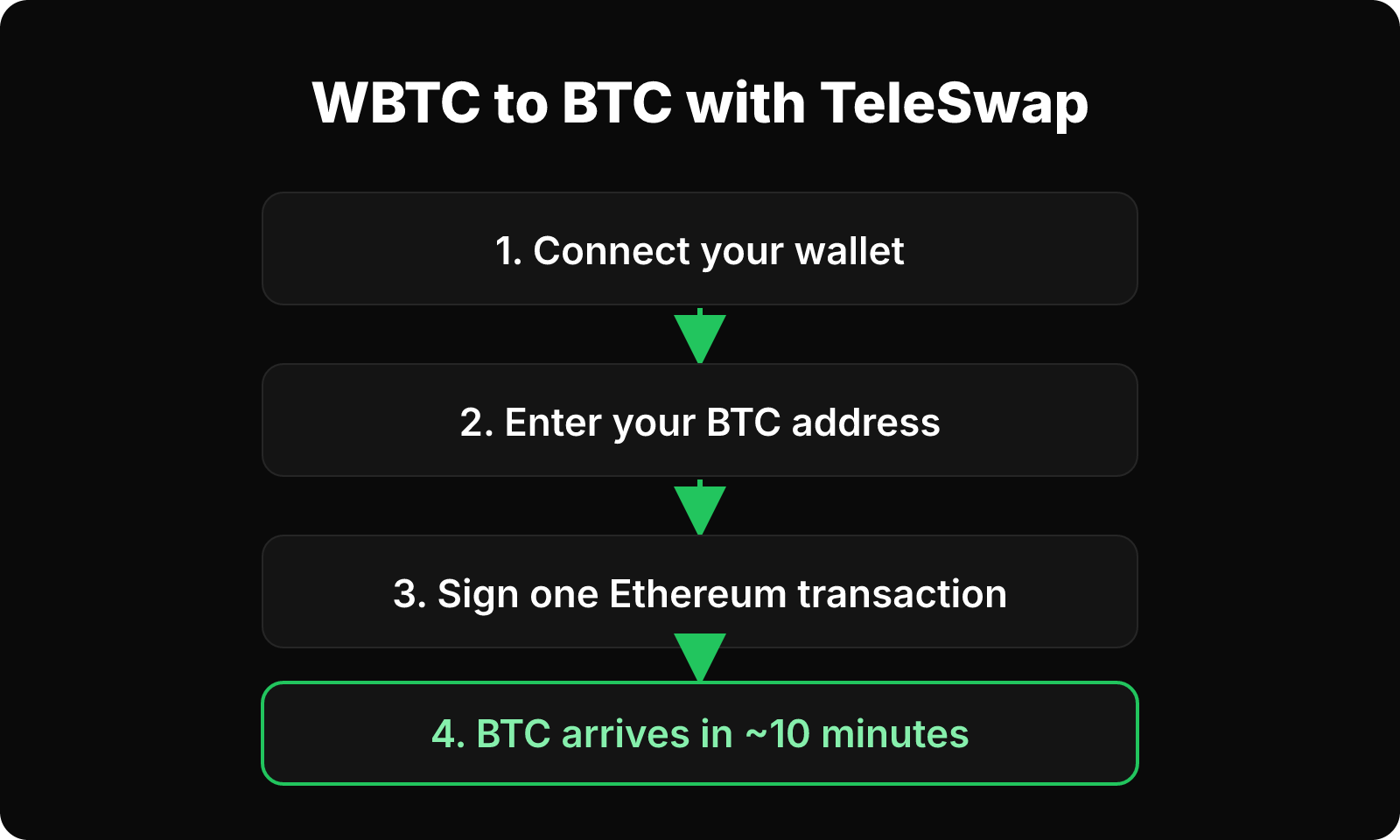
Under the hood, TeleSwap bridges and swaps in one step. Your WBTC is routed through the AMM/DEX and the bridge releases native BTC to your Bitcoin address, with TeleBTC, TeleSwap's 1:1 collateral-backed Bitcoin representation, as the bridged asset. The roles involved are described in the TeleSwap documentation. Lockers hold BTC against slashable collateral, so misbehaving costs them money.
- Check the peg and reserves. Look at the WBTC/BTC rate on a tracker such as CoinGecko (this page tracks Linea-bridged WBTC, so treat it as a rough guide) so you know what a fair quote looks like. Baltex also suggests checking the WBTC reserve attestations before you start.
- Prepare your Bitcoin wallet. Copy a receive address from a wallet you hold the keys to. Avoid exchange deposit addresses.
- Keep a little ETH for gas. Signing on Ethereum mainnet needs ETH for the network fee.
- Open the route. Go to the TeleSwap page to swap WBTC to BTC and connect your wallet. Holding WBTC on Arbitrum? Use the dedicated WBTC (Arbitrum) to BTC route, which avoids mainnet gas.
- Enter the amount and your BTC address, then read the quote. Check how much BTC you'll receive after fees, not just the headline rate.
- Sign and wait. Approve the WBTC spend if asked, sign the swap, and track it. Fast swaps settle in ~10 minutes. Bitcoin's block time sets that floor for any route that waits for an on-chain confirmation.
Want screenshots for every click? Our step-by-step guide to unwrapping WBTC on Ethereum has them. If speed matters most to you, read WBTC to BTC: fastest bridge swap guide.
TeleSwap has processed $539.6M in total bridged volume and $39.6M over the last 30 days, averaging about $1.3M a day with a peak of $2.1M on 8 October 2026, according to TeleSwap network stats.
How Much Does It Cost to Unwrap WBTC?
Unwrapping WBTC costs three things: Ethereum gas, the route's fee or spread, and any gap between WBTC's market price and 1 BTC. For most people the first two matter far more than the third.
Real numbers help here. On 28 September 2026, Symbiosis reported that 0.03 WBTC delivered 0.02986 BTC with a $12.10 fee, and 0.59 WBTC delivered 0.5865 BTC with a $277 fee. That works out to roughly 0.5–0.6% of the amount in both cases. That's one provider on one day, so treat it as a reference point, not a benchmark.
Now the peg. On Binance, WBTC stayed within 0.3% of 1 BTC on 97% of days over the 12 months to 24 September 2026, and it closed below 1 BTC on 84% of those days, per Upshift. The worst moment was an intraday low of 0.992 BTC on 11 October 2025, the day after a market-wide liquidation.
Here's how we read that data: the small, steady discount is consistent with redemption cost and time. Retail users can't redeem directly, so WBTC trades as a ticket for BTC rather than BTC itself. On small exits, fees and gas often matter more than the exchange rate, while large holders should watch slippage and depth.
| Cost component | Who it hurts most | How to reduce it |
|---|---|---|
| Ethereum gas | Small amounts | Swap at quieter times; use an L2 route if your WBTC is already there |
| Route fee / spread | Everyone | Compare quotes; read the "you receive" figure |
| Slippage | Large amounts | Pick deep liquidity; split very large orders |
| Peg discount | Large amounts during market stress | Avoid exiting in the middle of a liquidation cascade |
For deeper dives, our cost series is the place to go. How much does it really cost to bridge BTC and WBTC? breaks down every fee layer. Unwrap WBTC to native Bitcoin: 2026 fee comparison compares providers side by side. WBTC bridge without slippage covers large orders, and cross-chain Bitcoin bridge: the cheapest way to swap BTC looks at the problem across chains.
How Do You Unwrap WBTC Safely and Legally?
The safest WBTC to BTC exit uses a self-custodied Bitcoin address, a route whose trust model you understand, and a quote you've checked against the market. Bitcoin payments can't be reversed once confirmed, so mistakes here are permanent.
Run through this checklist before you sign:
- Address check: Compare the first and last 6 characters of the BTC address. Clipboard malware that swaps in a different address is a real threat.
- Own the destination: Symbiosis warns that sending to an exchange address instead of a self-custodied wallet can lose you funds.
- Distrust "zero fees, instant": Baltex notes that unrealistic promises usually hide risks.
- Use the real URL: Type
teleswap.xyzyourself instead of clicking links in DMs or search ads. - Test with a small amount first if this is your first time using a route.
- Keep records: Save transaction hashes on both chains for your tax records.
Rules on reporting and on swapping without KYC differ by country. Our Bitcoin bridge compliance guide explains what to keep track of so your cross-chain transfers stay legal and documented. It isn't legal advice, so check your local rules.
Is There a Trustless Alternative to WBTC?
Yes. TeleBTC is a 1:1 Bitcoin-backed token secured by SPV light-client proofs instead of a custodian or a multisig committee. SPV (Simplified Payment Verification) means a smart contract checks Bitcoin block headers and transaction proofs directly, so the token inherits Bitcoin's security model instead of trusting a company's word.
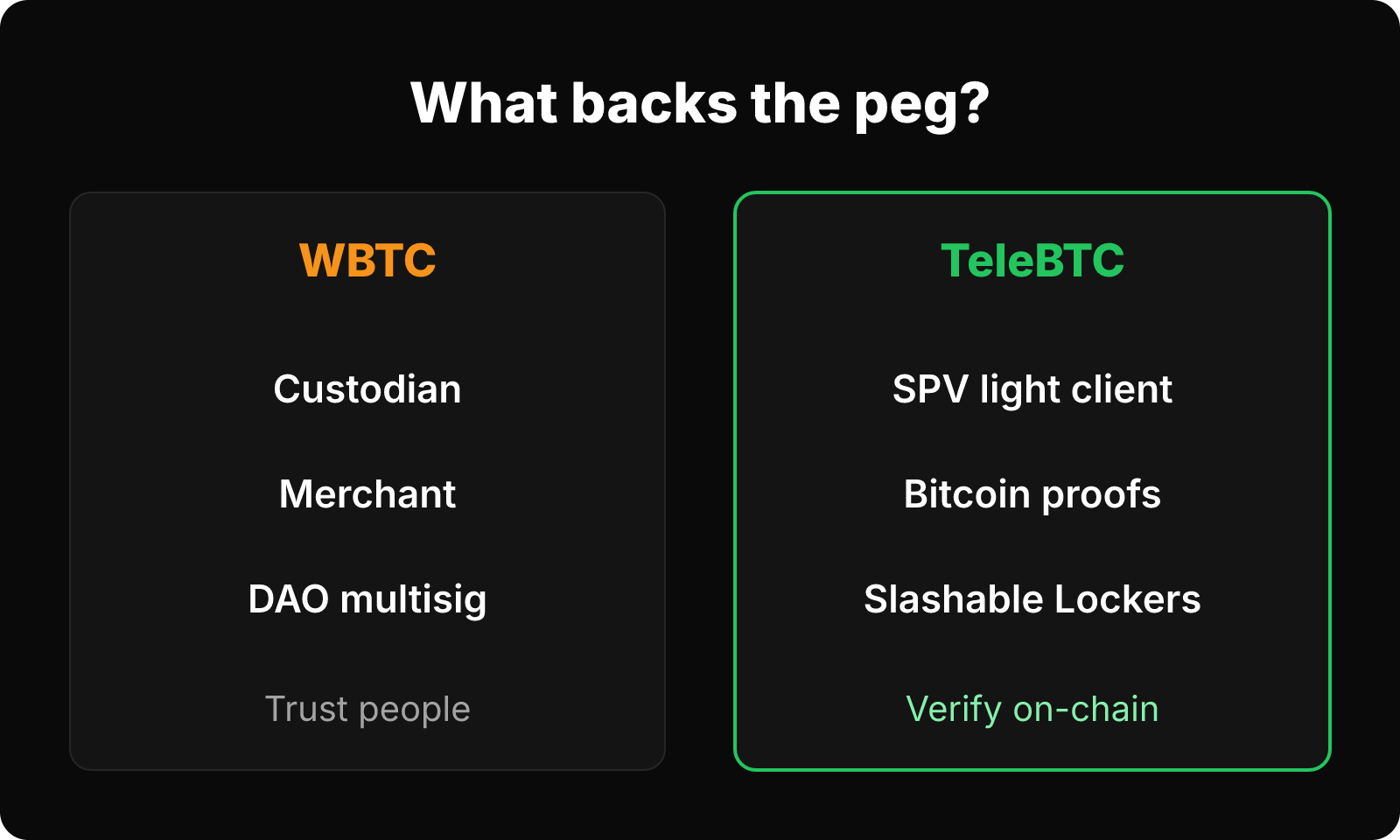
In practice, nothing is minted on the destination chain without a verified Bitcoin transaction. On the redemption side, Lockers hold BTC against collateral that can be slashed. Compare that with WBTC, where the peg ultimately depends on custodians keeping their reserves and the DAO's multisig holders acting honestly, as Coin Bureau notes. Other wrappers like cbBTC (backed by about 98,000 BTC on 24 September 2026, per Upshift) each rely on their own custodian or signer set and redemption route.
That's why many people who unwrap WBTC don't leave DeFi for good. They move to a trust-minimized setup instead. Bitcoin wrapping without custodians explains the light-client model in beginner terms. If you're curious about non-EVM chains, see Bitcoin wrapping on Solana: beginner bridge guide. TeleSwap also supports TON and Solana alongside EVM chains.
Going the Other Way: BTC to WBTC
If you'll need wrapped Bitcoin again later, you can bridge native BTC back into WBTC without going through a merchant. Lots of users do both: they unwrap to rebalance, then wrap again when a DeFi opportunity comes along.
For that direction, read these three:
- BTC to WBTC swap without wrapping fees: a technical look at skipping merchant mint fees.
- Convert BTC to WBTC without KYC: the trustless-bridge route.
- BTC to WBTC bridge: lowest fees and fastest: a comparison of current providers.
Industry data from Upshift puts the top eight Bitcoin wrappers at about 255,000 BTC combined, roughly 1.3% of circulating supply, as of 24 September 2026. That's a meaningful share of Bitcoin sitting in tokens whose design you should understand before you hold them.
Frequently Asked Questions
Can I redeem WBTC for bitcoin directly with BitGo?
No, not as a regular retail user. Only merchants approved by the WBTC DAO, who pass KYC/AML checks, can burn WBTC and receive BTC from the custodians. Everyone else gets BTC by swapping WBTC through an exchange or bridge.
How long does it take to convert WBTC to BTC?
Most bridge routes take about 10 to 40 minutes. TeleSwap's fast swaps settle in around 10 minutes, and Symbiosis reported a 14-minute median and a 39-minute 90th percentile over the 90 days to 25 September 2026. Bitcoin's roughly 10-minute block time sets the practical minimum.
Is 1 WBTC always worth 1 BTC?
Almost, but not exactly. On Binance, WBTC stayed within 0.3% of 1 BTC on 97% of days over the 12 months to 24 September 2026, but it closed slightly below 1 BTC on 84% of days and fell to an intraday low of 0.992 BTC on 11 October 2025, according to Upshift.
What is the cheapest way to unwrap WBTC?
The cheapest route depends on your amount. For small amounts, Ethereum gas can cost the most, so an L2 route or a quieter time of day helps. For large amounts, slippage and liquidity depth matter more. Always compare the final "you receive" figure across providers.
How does TeleSwap convert WBTC to BTC?
TeleSwap routes your WBTC through the AMM/DEX and releases native BTC to the Bitcoin address you provide, all in one flow. You sign from your own wallet with no account. TeleBTC is secured by SPV light-client proofs, and the Lockers who hold BTC post collateral that can be slashed.
Do I need ETH to unwrap WBTC on Ethereum?
Yes, you need a small amount of ETH to pay Ethereum gas when you sign. If your WBTC is on an L2 like Arbitrum, use a route from that chain instead. Gas there is usually lower.
What happens if I enter the wrong Bitcoin address?
The funds are almost certainly lost. Confirmed Bitcoin transactions can't be reversed. Paste the address, check the first and last characters, and send a small test amount the first time.
Conclusion
Three things to take from this WBTC to BTC guide. First, retail holders can't go to the WBTC "counter", so unwrapping in practice means swapping. Second, cost depends on your size: gas and fees for small amounts, slippage for large ones, and the peg discount matters most under stress. Third, pick a route whose trust model is weaker than the one you're leaving, and send BTC only to an address you control.
TeleSwap lets you go from WBTC to native BTC from your own wallet, with fast swaps settling in about 10 minutes. It's built on a light-client bridge that has handled 571,518 transactions across 13 networks, per TeleSwap network stats.