BTC to WBTC Swap Without Wrapping Fees: 2026 Technical Guide

You hold native BTC. The lending market, vault or DEX you want to use on Ethereum only accepts WBTC.
A BTC to WBTC swap is never fully fee-free, but you can skip the custodian and exchange hops. TeleSwap does this by minting TeleBTC against an SPV-verified Bitcoin transaction and swapping it into WBTC in one flow. Fast swaps settle in about 10 minutes.
Somewhere between your Bitcoin UTXO and that ERC-20 balance, people take a cut: a merchant, a custodian, an exchange spread, an AMM pool and two sets of miners or validators. Most guides to a btc wbtc swap treat "wrapping" as one action with one fee. At the protocol level it's a pipeline, and once you can see each stage, you can tell which ones to skip.
This guide is written for developers and advanced users. It walks through how WBTC is minted, where each fee in a BTC→WBTC route comes from, and how an SPV light-client bridge can deliver WBTC to an Ethereum address without the merchant mint step or a custodian holding your coins in transit.
WBTC is minted 1:1 only through approved merchants and a custodian, so most retail users never touch the actual "wrapping" step and buy WBTC on a secondary market instead.WBTC closed at 0.9984 BTC on October 14, 2026 according to Investing.com WBTC/BTC data, so the peg discount can be larger than an explicit wrapping fee.An SPV light client verifies a Bitcoin transaction on-chain by checking proof-of-work on block headers and a Merkle inclusion proof, without trusting any custodian's attestation.TeleSwap turns BTC into WBTC in one flow: it mints TeleBTC against a verified Bitcoin transaction, then routes TeleBTC into WBTC through a DEX, with fees quoted in Bitcoin terms.TeleSwap has processed $517.8M in bridged volume across 548,519 transactions, per TeleSwap network stats.
Table of Contents
- What Actually Happens in a BTC WBTC Swap?
- How Is WBTC Minted? The Custodial Pipeline
- Is a BTC to WBTC Swap Without Fees Possible?
- Can You Wrap BTC to WBTC Trustlessly? SPV Light Clients Explained
- TeleSwap's BTC→WBTC Transaction Flow, Step by Step
- WBTC vs TeleBTC in 2026: Comparing Wrapped BTC Models
- Walkthrough: Swap BTC to WBTC with TeleSwap (UI and SDK)
- Risks and Trade-offs You Should Price In
- Frequently Asked Questions
- Conclusion
What Actually Happens in a BTC WBTC Swap?
A BTC WBTC swap moves value between two ledgers that can't read each other. Bitcoin has no smart contracts that can see Ethereum. Ethereum has no native view of Bitcoin's UTXO set.
So any swap needs a way to prove to Ethereum that BTC moved, and a way to stop the same BTC from backing two tokens.
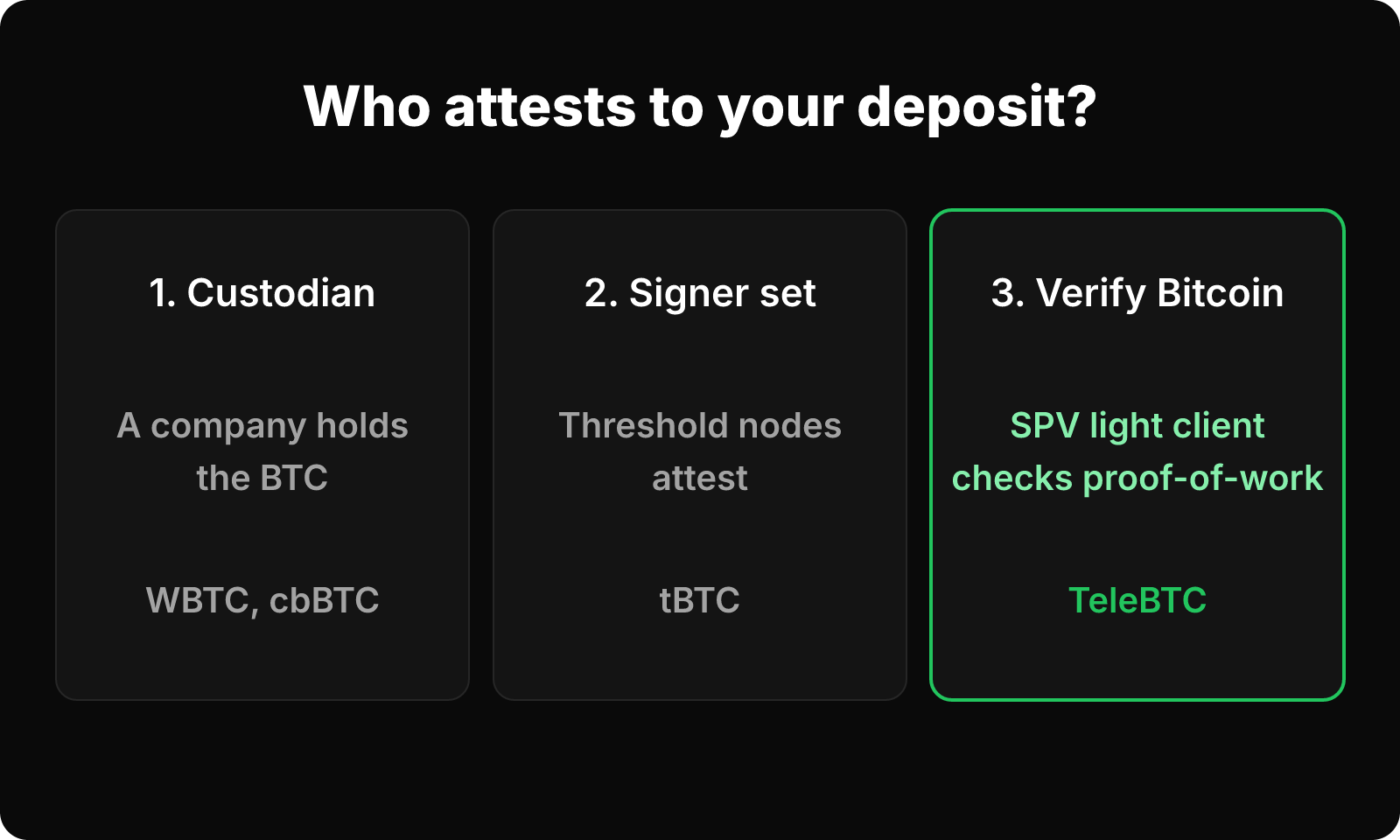
There are three common ways to do this:
- Trust a custodian. A company holds the BTC and authorizes minting. This is WBTC's model and cbBTC's model.
- Trust a signer set. A threshold group of nodes jointly controls the BTC and attests to deposits. This is the model of tBTC on the Threshold Network.
- Verify Bitcoin itself. A smart contract checks Bitcoin's proof-of-work and the transaction's inclusion in a block, then mints. This is SPV light-client verification, which TeleSwap uses for TeleBTC.
WBTC sits at the end of every route discussed here. The question is how you reach it, and how many trust assumptions and fee layers you pick up along the way.
How Is WBTC Minted? The Custodial Pipeline
WBTC is an 8-decimal ERC-20 token on Ethereum, and only a custodian can mint it, at the request of approved merchants. The canonical contract is 0x2260…C599 on Etherscan. Its 8 decimals match Bitcoin's satoshi precision, so 1 WBTC base unit equals 1 sat.
The mint flow, as described by the WBTC network, works like this:
- A merchant (a KYC'd institution) sends a mint request on Ethereum.
- The merchant sends BTC to the custodian's Bitcoin address.
- The custodian waits for confirmations, checks the deposit off-chain, and then calls
minton the WBTC contract. - Burning goes the other way. The merchant burns WBTC, and the custodian releases BTC to the merchant.
No contract verifies the Bitcoin deposit on-chain. The Ethereum side trusts the custodian's key. Proof of Reserve lets outsiders audit the backing after the fact, but it doesn't gate minting at the protocol level.
Governance is also off-chain-heavy. CoinLedger describes a WBTC DAO of 16 stakeholders, including MakerDAO and Gnosis, which votes on membership and contract changes.
None of this makes WBTC broken. WBTC had a market cap of about $9.65B and a circulating supply of roughly 116.13K WBTC on October 13, 2026, according to MetaMask's WBTC price page. It's still the deepest wrapped-BTC liquidity on Ethereum.
The practical takeaway: retail users can't mint WBTC directly. You can only buy it from someone who already holds it, or use a route that converts BTC into WBTC for you. For the reverse direction, see our Unwrap WBTC to Native Bitcoin fee comparison.
Is a BTC to WBTC Swap Without Fees Possible?
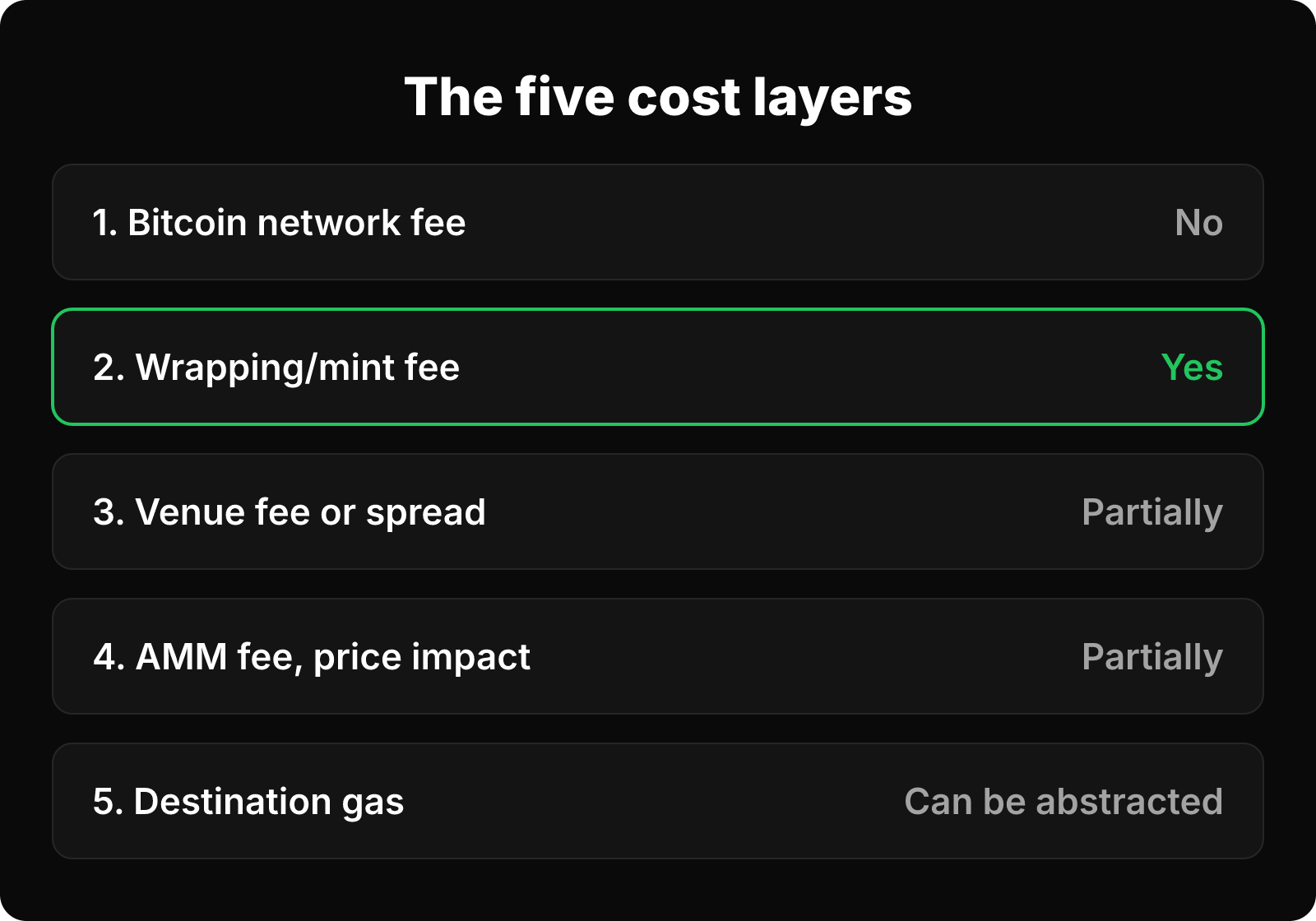
No BTC to WBTC swap is truly fee-free, because at minimum someone pays a Bitcoin miner fee. What you can avoid is the separate wrapping step: merchant mint fees, CEX withdrawal fees and the double-hop of "deposit BTC to an exchange, buy WBTC, withdraw." The full cost stack is below.
The five cost layers
| Layer | What it pays for | Avoidable? |
|---|---|---|
| 1. Bitcoin network fee | Getting your transaction into a block (sat/vB × tx size) | No, but you can choose a fee rate that matches mempool conditions |
| 2. Wrapping/mint fee | Merchant and custodian margin on WBTC mint | Yes. Retail routes never mint directly |
| 3. Venue fee or spread | CEX trading fee, instant-exchange spread, or bridge protocol fee | Partially. Compare quoted totals |
| 4. AMM pool fee and price impact | LP fee tier plus slippage on the WBTC leg | Partially. Depends on pool depth |
| 5. Destination gas | Ethereum execution for minting, swapping and transfer | Can be abstracted: TeleSwap's Teleporter covers it and you pay in Bitcoin terms |
The contrarian point: the peg is the fee nobody quotes
Most "no wrapping fees" articles miss this. On October 14, 2026, WBTC closed at 0.9984 BTC, and over the prior month it ranged from about 0.9980 to 1.0003, per Investing.com.
A 16 basis-point discount changes the math. When WBTC trades below BTC, a buyer on the market gets slightly more WBTC per BTC of value than a 1:1 merchant mint would give, before fees. The discount works for you on entry and against you on exit, and over a round trip the peg can move more than a merchant's wrapping fee.
So the cheapest BTC WBTC swap isn't the one with the lowest headline fee. It's the one with the best all-in WBTC output per satoshi sent. TeleSwap's estimate APIs return fees as a breakdown in Bitcoin terms, per the TeleSwap Fees & Speed documentation.
Can You Wrap BTC to WBTC Trustlessly? SPV Light Clients Explained
You can't create WBTC trustlessly, because only its custodian mints it. But you can get from BTC to WBTC with trust-minimized verification up to the final swap leg.
The approach is to verify your Bitcoin deposit with a light client instead of a custodian, mint a trust-minimized representation, and swap that into WBTC on an AMM. The verification relies on Simplified Payment Verification (SPV), defined in section 8 of the Bitcoin whitepaper. For a step-by-step version, see our Trustless BTC Swap no-KYC guide.
How an SPV light client verifies Bitcoin on another chain
An SPV light client is a smart contract that stores Bitcoin block headers (80 bytes each) rather than full blocks. It checks two things:
- Proof-of-work validity. Each header's double-SHA-256 hash must fall below the target encoded in its
nBitsfield. Headers must also link throughprevBlockHashand respect Bitcoin's difficulty adjustment every 2,016 blocks. Faking a header chain means out-mining the real Bitcoin network. - Transaction inclusion. Every header commits to a Merkle root of its block's transactions. A Merkle proof is the list of sibling hashes from your transaction ID up to that root. It proves your transaction is in a specific block in roughly log₂(n) hashes, where n is the block's transaction count.
Add a confirmation depth check, meaning N headers built on top of the inclusion block. The contract then knows the deposit is buried under real proof-of-work.
It doesn't need a signature from anyone. The security assumption becomes "Bitcoin's honest hashrate majority" instead of "this company's key management."
Why light clients alone aren't enough
Verifying deposits is only half the protocol problem. Someone still has to hold the BTC that backs the token and release it on redemption.
A light client can prove a Bitcoin payment happened, but it can't make one happen. TeleSwap handles this with Lockers: operators who hold the deposited BTC and post collateral on the destination chain.
Per the TeleSwap documentation, custody is collateral-backed and slashable. A Locker that doesn't honor a valid redemption puts its own collateral at risk.
That's the core difference from WBTC. WBTC holders rely on the custodian's reputation and legal agreements. TeleBTC holders rely on on-chain proofs plus economic collateral that the protocol can slash.
TeleSwap's BTC→WBTC Transaction Flow, Step by Step
TeleSwap delivers WBTC by minting TeleBTC against an SPV-verified Bitcoin transaction and routing it through a DEX in the same flow. Fast swaps settle in about 10 minutes. The lifecycle has six stages:
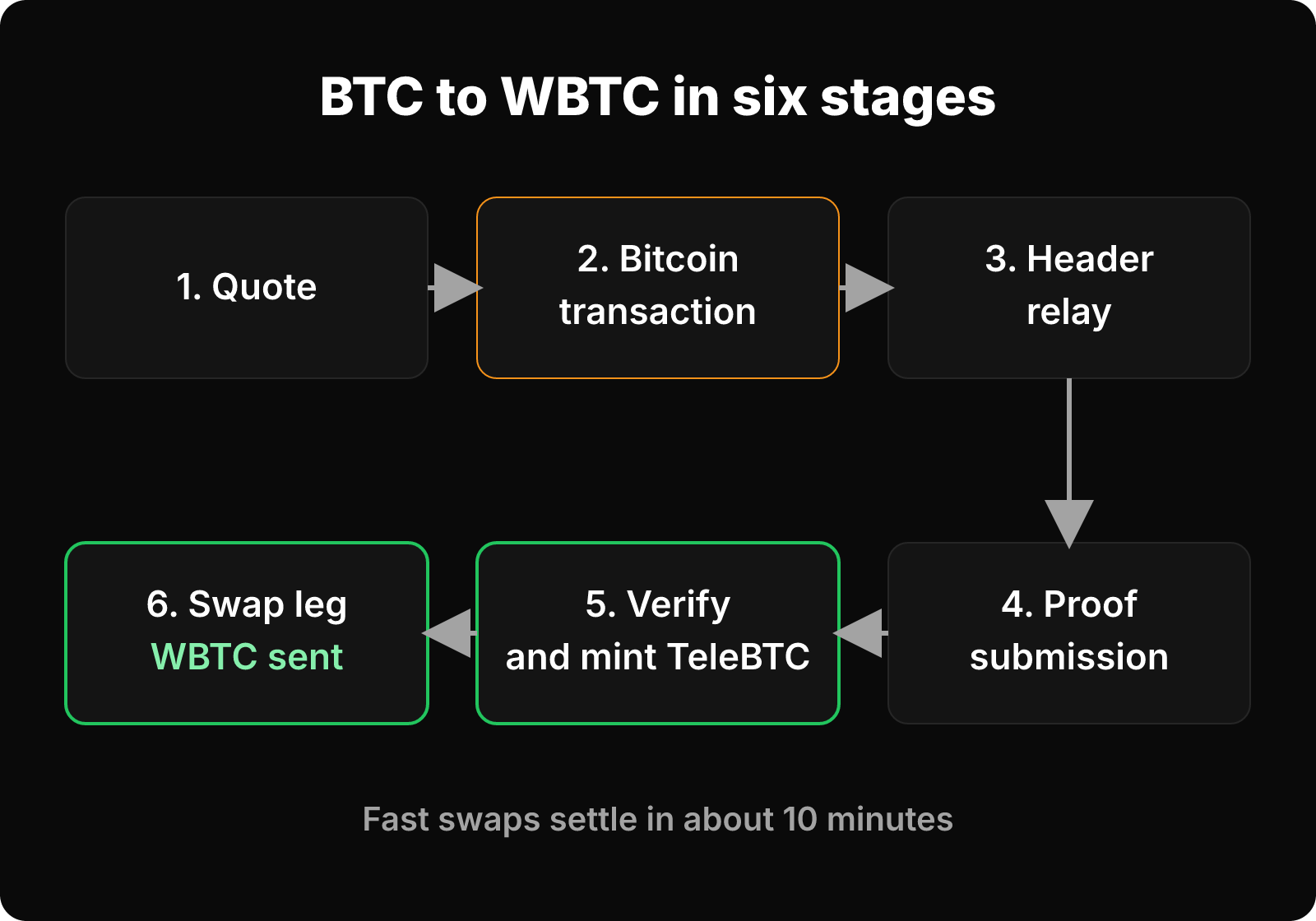
- Quote. You enter a BTC amount and an Ethereum recipient address. The app or SDK returns a quote with the expected WBTC output and a fee breakdown in Bitcoin terms.
- Bitcoin transaction. You send BTC from your own wallet. The transaction carries the swap request and goes to a Locker.
- Header relay. Relayers keep the on-chain Bitcoin light client up to date with new block headers.
- Proof submission. A Teleporter submits your transaction and its Merkle proof to the destination chain and pays the destination-chain gas for you.
- Verification and mint. The light client checks inclusion and confirmation depth. Only then is TeleBTC minted 1:1. Nothing is minted without a verified Bitcoin transaction.
- Swap leg. The minted TeleBTC is routed through the AMM/DEX into WBTC and sent to your address.
The reverse route works in the other direction. You can swap WBTC on Ethereum back to native BTC.
TeleSwap has bridged $517.8M across 548,519 transactions on 13 supported networks.
Over the last 30 days it processed $44.8M, about $1.5M per day, peaking at $2.8M on September 18, 2026, according to TeleSwap network stats.
WBTC vs TeleBTC in 2026: Comparing Wrapped BTC Models
The core difference between WBTC and TeleBTC in 2026 is who attests to the Bitcoin deposit: a custodian for WBTC, Bitcoin's own proof-of-work for TeleBTC. The table compares the four wrapped-BTC designs a DeFi user is most likely to meet.
| Attribute | WBTC | cbBTC | tBTC | TeleBTC (TeleSwap) |
|---|---|---|---|---|
| Deposit attestation | Custodian, off-chain | Coinbase, off-chain | Threshold signer set | SPV light client, on-chain |
| Who holds BTC | Custodian | Coinbase | Threshold wallets | Collateralized, slashable Lockers |
| Retail can mint directly? | No (merchants only) | Via Coinbase account | Yes | Yes: send BTC from a Bitcoin wallet |
| Primary failure mode | Custodian compromise or policy change | Custodian compromise or policy change | Signer collusion above threshold | Bitcoin reorg beyond confirmation depth; Locker default (covered by slashable collateral) |
WBTC and TeleBTC are better understood as layers than as direct competitors on Ethereum. WBTC is where the liquidity is. TeleBTC is the trust-minimized on-ramp that gets you there without handing BTC to a custodian or an exchange first.
If the protocol you're using accepts WBTC only, the cleanest route is BTC → TeleBTC → WBTC. Your exposure to the WBTC custodian then starts when you actually hold WBTC, and not before.
The same SPV-plus-DEX pattern works on L2s. If gas costs matter more than Ethereum mainnet liquidity, you can swap BTC to WBTC on Arbitrum instead.
Walkthrough: Swap BTC to WBTC with TeleSwap (UI and SDK)
Option A: the web app
- Open the swap BTC to WBTC on Ethereum page on teleswap.xyz.
- Connect a Bitcoin wallet, enter the BTC amount, and paste the Ethereum address that should receive WBTC.
- Read the quote. Check the WBTC output, not just the fee line.
- Sign and broadcast the Bitcoin transaction. Pick a fee rate that matches current mempool conditions, because an underpriced transaction delays everything that follows.
- Wait for verification. Fast swaps settle in about 10 minutes, and WBTC lands at your address. You don't need ETH for gas, because the Teleporter covers destination-chain execution.
New to the process? Our Convert BTC to WBTC Without KYC guide covers the same flow with more context.
Option B: inside apps you already use
TeleSwap is integrated as a Bitcoin swap provider in the Rango, Rubic and DZap aggregators. Through the Rango integration, it's also available in MetaMask and Trust Wallet.
Option C: the SDK and REST API for developers
The TeleSwap SDK returns a BTC → EVM/TON/Solana quote in under a minute. It wraps the TeleSwap REST API, so you can integrate over plain HTTP from any stack. A typical integration:
- Request a quote for BTC → WBTC on Ethereum with the amount and recipient.
- Show the user the Bitcoin-denominated fee breakdown and the expected output.
- Have the user's wallet build and sign the Bitcoin transaction from the quote parameters.
- Track status until the destination-chain delivery is confirmed.
Integrators can register a third-party ID to earn a share of fees on the volume they bring. See the TeleSwap documentation for endpoints and parameters.
Risks and Trade-offs You Should Price In
Trust-minimized doesn't mean risk-free. Any BTC→WBTC route carries the following risks:
- Destination-asset risk. Once you hold WBTC, you carry WBTC's custodial and governance risk, however you acquired it. TeleSwap reduces your exposure in transit. It doesn't change what WBTC is.
- Smart contract risk. Light-client contracts, DEX routers and token contracts can all contain bugs. Audits reduce this risk but don't remove it.
- Peg variance. The WBTC/BTC ratio moves. With a 0.9980–1.0003 range over one month (Investing.com), timing affects your realized output.
- Market volatility. In June 2026, BTC fell from about $70,000 to about $60,000 and over $212M in long positions were liquidated, per the WBTC June 2026 update. If you're bridging to post collateral, size your position with that in mind.
- Tax treatment. The IRS hasn't issued specific guidance on wrapping. Some treat BTC→WBTC as a taxable crypto-to-crypto exchange, as CoinLedger notes. Talk to a tax professional.
Frequently Asked Questions
What is the cheapest way to do a BTC WBTC swap?
The cheapest route is the one with the highest WBTC output per satoshi after all fees, not the one with the lowest headline fee. Compare quoted output across venues. Include Bitcoin miner fees, destination gas, AMM fees and the WBTC/BTC peg, which closed at 0.9984 on October 14, 2026. One-step routes like TeleSwap avoid the CEX deposit, trade and withdrawal sequence and its separate fees.
Can I mint WBTC myself without a merchant?
No. Only approved merchants can request WBTC mints, and only the custodian executes them. Retail users get WBTC by buying it on an exchange or DEX, or through a swap protocol that converts BTC into WBTC for them.
Is TeleBTC the same as WBTC?
No. TeleBTC is TeleSwap's 1:1 BTC-backed token, minted only after an SPV light client verifies the Bitcoin deposit on-chain. WBTC is minted by a custodian. TeleBTC custody is collateral-backed and slashable, so it doesn't depend on a centralized custodian or a multi-sig committee.
How long does a BTC to WBTC swap take on TeleSwap?
Fast swaps on TeleSwap settle in about 10 minutes. The time depends on your Bitcoin transaction confirming, so a fee rate that suits current mempool conditions helps avoid delays.
Do I need ETH for gas to receive WBTC?
No. With TeleSwap, a Teleporter covers destination-chain gas, and all fees are paid in Bitcoin terms. You can receive WBTC at a fresh Ethereum address that has never held ETH.
How much volume has TeleSwap processed?
TeleSwap has bridged $517.8M across 548,519 transactions on 13 supported networks, per TeleSwap network stats. Over the last 30 days it processed $44.8M, averaging about $1.5M per day.
Conclusion
"Without wrapping fees" really means skipping the layers you don't need: the merchant mint you can't access anyway, the exchange custody hop, and buying ETH for gas. What's left are the costs no route can avoid: a Bitcoin miner fee, a swap leg, and the WBTC/BTC peg.
The gap between routes comes down to who attests to your deposit. WBTC relies on a custodian, while an SPV light client relies on Bitcoin's proof-of-work.
If you want WBTC on Ethereum without passing your BTC through a custodian or an exchange first, a BTC WBTC swap through TeleSwap mints TeleBTC against a verified Bitcoin transaction and delivers WBTC in about 10 minutes. Read the TeleSwap documentation for technical details before you commit funds.