Convert BTC to WBTC Without KYC: Trustless Bridge Guide

Yes, you can convert BTC to WBTC without KYC. Use a non-custodial Bitcoin bridge such as TeleSwap: you send BTC from your own wallet and receive WBTC at your own Ethereum address in about ten minutes. You don't need an account, and you don't need ETH for gas.
The usual advice is to send your bitcoin to a big exchange. The exchange then wants a passport scan, a selfie and a utility bill before it lets you withdraw anything. This guide covers the other route, where no company holds your coins partway through and no account sits between you and your funds. It explains what WBTC is, what "trustless" means in practice, how the main options compare, and how to do the conversion step by step.
Key Takeaways:Most centralized exchanges require identity verification (KYC) before you can withdraw WBTC, but a non-custodial Bitcoin bridge needs no account at all.TeleSwap is a non-custodial Bitcoin bridge that converts native BTC into WBTC on Ethereum by verifying transactions with an SPV light client, then routing TeleBTC through a DEX swap—with zero KYC required.With TeleSwap, all fees are paid in Bitcoin assets and a Teleporter covers Ethereum gas, so you don't need to hold ETH first.TeleSwap has processed $501.5M in bridged volume across 532,851 transactions on 12 supported networks, according to TeleSwap network stats (retrieved October 4, 2026).A no-KYC conversion gets you a no-KYC entry, but WBTC itself is still custodial—redeeming WBTC for BTC at the source requires going through verified merchants.
Table of Contents
- Can You Convert BTC to WBTC Without KYC?
- What Is WBTC? The Coat-Check Analogy
- What Does "Trustless BTC to WBTC" Actually Mean?
- How a Non-Custodial Bitcoin Bridge Works
- 5 Ways to Get WBTC, Compared
- How to Convert BTC to WBTC Without KYC (Step by Step)
- WBTC Bridge, No Verification: What Still Gets Checked
- Should You Hold WBTC or TeleBTC?
- Frequently Asked Questions
- Conclusion
Can You Convert BTC to WBTC Without KYC?
Yes. The catch is that you have to skip the middleman, not just the paperwork.
KYC stands for "Know Your Customer." It's the identity check that regulated companies run before they handle your money. KYC applies to companies, not to software. So any route that sends your BTC to a company for the swap will usually involve KYC at some point, whether at sign-up, at withdrawal, or when a transaction gets flagged.
The routes that avoid it are the ones where code does the work instead of a company. Your options fall into three groups:
- Custodial routes (exchanges, many instant-swap services): a company holds your BTC during the swap. KYC is common.
- DEX routes (Uniswap and similar): no KYC, but you need to already have assets on Ethereum. A DEX can't take native bitcoin.
- Non-custodial bridge routes: you send BTC from your own wallet and receive WBTC at your own Ethereum address. There's no account, and a smart contract checks your Bitcoin payment instead of a company.
Only the third group goes straight from native BTC to WBTC without an account. The rest of this guide focuses on that group.
What Is WBTC? The Coat-Check Analogy
Bitcoin can't move onto Ethereum. The two blockchains are separate ledgers that can't read each other directly. So the crypto industry uses "wrapped" tokens: tokens on Ethereum that stand in for bitcoin held somewhere else.
Think of a coat check. You hand over your coat (BTC) and get a ticket (WBTC). The ticket is easy to carry around and trade, and anyone holding it can claim the coat later. But the ticket is only worth something if the coat-check attendant is honest and still has the coat.
WBTC (Wrapped Bitcoin) is an ERC-20 token on Ethereum backed 1:1 by bitcoin held by a custodian. It launched in January 2019, and BitGo has served as its main custodian, according to the official WBTC project site.
New WBTC is created ("minted") by approved merchants who deal with the custodian, and those merchants go through identity checks. That's why ordinary users almost never mint WBTC themselves. They buy it from someone who already has it.
In August 2024, BitGo announced it was moving WBTC custody into a joint venture with BiT Global, and several DeFi protocols reviewed their exposure to WBTC as a result. The episode makes the key point about WBTC: whoever controls the custody controls the backing. You can follow WBTC's on-chain supply on DefiLlama's WBTC page.
What Does "Trustless BTC to WBTC" Actually Mean?
A trustless BTC to WBTC conversion is one where no single person or company can take your bitcoin, freeze it, or mint fake tokens while the conversion is happening. Math and economic penalties provide the safety, not anyone's good intentions.
You can see why this matters by looking at bridges that aren't trust-minimized. About $2 billion was stolen in 13 separate cross-chain bridge hacks in 2022 (counted up to August of that year), according to Chainalysis research.
The largest was the Ronin bridge exploit in March 2022. It happened because attackers got control of 5 of the 9 validator keys that approved withdrawals. Once enough keys were compromised, nothing else stopped the theft. That's the weakness of a multi-signature committee: it's only as secure as a handful of key holders are honest and careful. A trust-minimized design checks the evidence directly and doesn't depend on a group vote.
How a Non-Custodial Bitcoin Bridge Works
A non-custodial Bitcoin bridge relies on Simplified Payment Verification (SPV), an idea from the Bitcoin whitepaper (Section 8, 2008). SPV proves that a transaction is included in Bitcoin's blockchain without downloading the whole chain.
You only need the block headers, which are short summaries of each block secured by proof-of-work, plus a small proof that links your transaction to one of those headers. A light client is a program that tracks those block headers. Put a Bitcoin light client inside an Ethereum smart contract, and the contract can confirm on its own that "this BTC payment really happened, in this block, buried under this much proof-of-work."
Back to the coat check: instead of trusting the attendant's word that your coat arrived, a notary looks at the security camera footage before issuing your ticket.
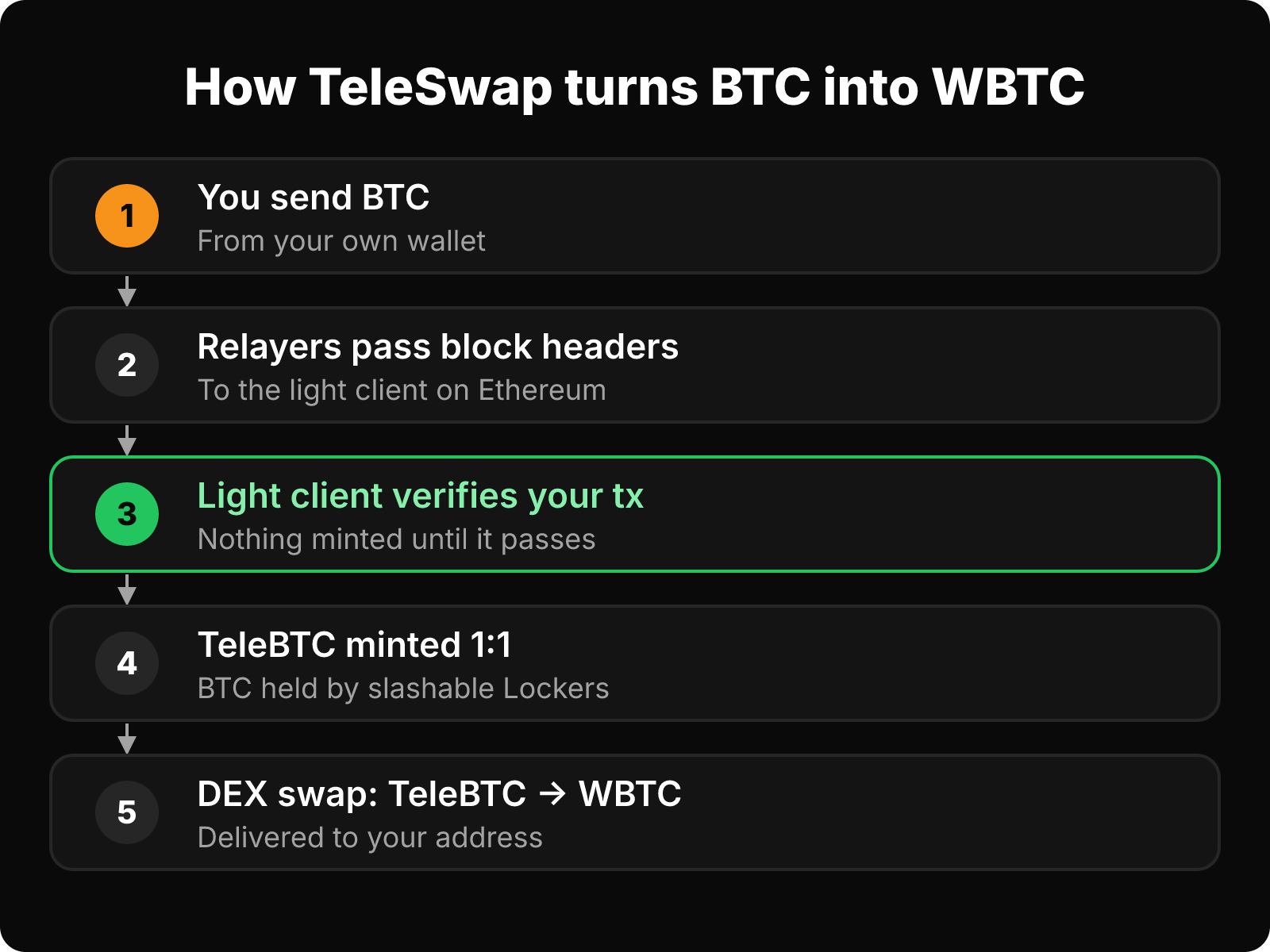
TeleSwap is a non-custodial Bitcoin bridge that uses SPV light client proofs to mint TeleBTC, a 1:1 collateral-backed representation of BTC, only after a Bitcoin transaction has been verified. Here's how it works, per the TeleSwap documentation:
- You send BTC from your own wallet.
- Relayers pass Bitcoin block headers to the light client on the destination chain.
- The light client checks that your transaction is included in Bitcoin's chain. Nothing is minted until this check passes.
- TeleBTC is minted 1:1. The BTC is held by Lockers, who post collateral that can be slashed if they misbehave.
- For a swap, TeleBTC is routed through an AMM/DEX into the token you asked for, such as WBTC, and delivered to your address.
This split matters. The verification doesn't depend on a committee vote, and the custody is backed by collateral that a Locker loses if it cheats. Neither part asks you to trust a company's promise.
5 Ways to Get WBTC, Compared
The table below compares five common ways to get WBTC on the points that matter to a no-KYC user. Fees and limits change often, so it compares how each method works rather than quoting prices.
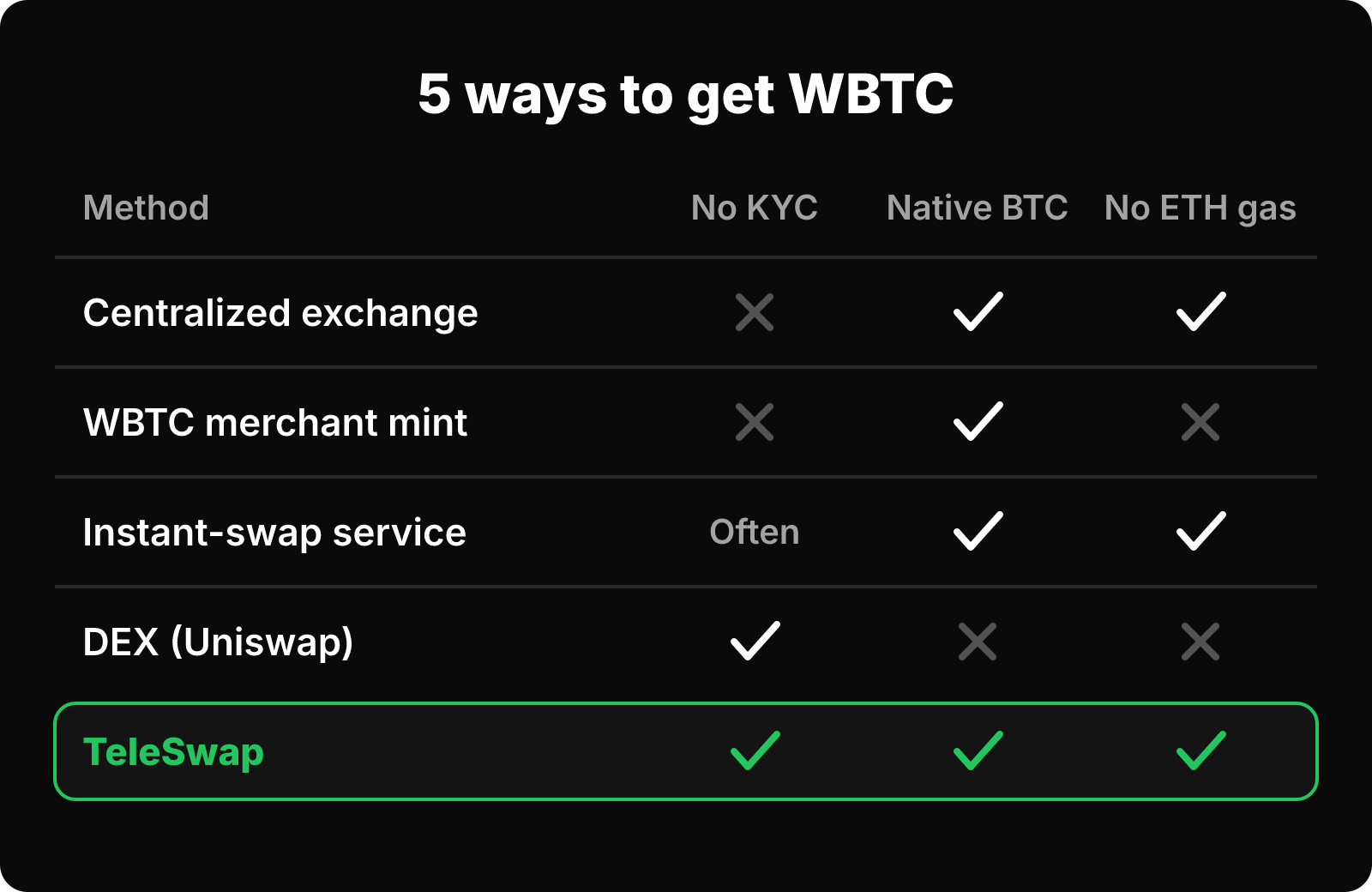
| Method | KYC / account? | Who holds your BTC mid-swap? | Starts from native BTC? | Need ETH for gas? | Typical time |
|---|---|---|---|---|---|
| Centralized exchange | Yes for most users and withdrawals | The exchange | Yes | No (withdrawal fee instead) | Depends on deposit confirmations and withdrawal queues |
| Official WBTC merchant mint | Yes (merchants are verified) | WBTC custodian | Yes | Yes | Varies by merchant |
| Instant-swap service | Often no account, but may ask for KYC on flagged transactions | The service | Yes | No | Varies |
| DEX (e.g., Uniswap) | No | You (smart contract swap) | No (you need an Ethereum asset first) | Yes | ~12-second Ethereum block once funded |
| TeleSwap | No account | Collateral-backed, slashable Lockers; minting verified by light client | Yes | No (Teleporter covers gas; fees paid in BTC) | ~10 minutes (fast swap) |
Beginners tend to miss the problem with the DEX row. Uniswap is fully non-custodial, but it can't receive bitcoin from the Bitcoin network. You'd need ETH or another ERC-20 token first, and getting those usually means an exchange, which brings you back to KYC.
TeleSwap fills that gap. It moves native BTC to Ethereum with no account, and the bridge and the DEX swap happen in one step. It also has real usage behind it: TeleSwap has processed $501.5M in total bridged volume across 532,851 transactions on 12 supported networks, according to TeleSwap network stats. That includes $42.6M in the last 30 days, or about $1.4M per day, with a peak of $2.8M on September 18, 2026.
How to Convert BTC to WBTC Without KYC (Step by Step)
Here's the full walkthrough using TeleSwap's BTC → WBTC (Ethereum) route. You need two things: a Bitcoin wallet you control and an Ethereum address. You don't need ETH.
Step 1: Prepare your Bitcoin wallet
Use any self-custodial Bitcoin wallet that lets you send BTC to an address. It needs enough balance for the amount plus the Bitcoin network fee. You can check current Bitcoin fee rates on mempool.space before you start.
Step 2: Get an Ethereum receiving address
Any Ethereum wallet works. MetaMask is the most common. Copy your public address, which starts with 0x. A Teleporter pays the destination-chain gas for you, so this wallet can have a balance of zero.
Step 3: Open the BTC → WBTC route
Go to the TeleSwap page to swap BTC to WBTC on Ethereum. Enter how much BTC you want to convert. The quote shows how much WBTC you'll receive and the fees, all in Bitcoin terms.
Step 4: Check the quote for price impact
The last leg of the route is a DEX swap from TeleBTC to WBTC, so large amounts can move the price, and the quote will show it. If the output looks noticeably lower than your input, try splitting the conversion into smaller amounts.
Step 5: Enter your Ethereum address and send BTC
Paste your 0x address, confirm, and send BTC from your Bitcoin wallet as instructed. Double-check the address. Blockchain transactions can't be reversed.
Step 6: Wait about ten minutes and verify
Bitcoin produces a block roughly every 10 minutes, and TeleSwap's fast swaps settle in about that time. Once your transaction is confirmed and the light client verifies it, TeleBTC is minted, swapped to WBTC, and sent to your address. To confirm it arrived, search for your address on Etherscan.
Prefer to stay inside an app you already use? TeleSwap is integrated as a Bitcoin swap provider in the Rango Exchange, Rubic, and DZap aggregators, and in MetaMask and Trust Wallet through the Rango integration. To go the other way later, use the WBTC to BTC route.
WBTC Bridge, No Verification: What Still Gets Checked
People searching for a "WBTC bridge, no verification" usually mean no identity verification. The safest no-KYC bridge actually does more verification than anyone else. It checks your transaction, not your identity.
- Identity verification answers "Who are you?" It protects the company's regulatory standing, not your funds.
- Cryptographic verification answers "Did this BTC payment really happen?" It protects every TeleBTC holder from tokens being minted with nothing behind them.
Two reality checks for beginners:
- No-KYC doesn't mean anonymous. Bitcoin and Ethereum are public ledgers. Anyone can see your transactions on explorers like mempool.space and Etherscan. Skipping KYC means you don't hand your passport to a third party. It doesn't make you invisible.
- Your obligations don't go away. Using non-custodial software doesn't change your local tax or reporting duties. Check the rules where you live. This guide isn't legal or financial advice.
Should You Hold WBTC or TeleBTC?
Converting to WBTC without KYC gets you a no-KYC entry, but WBTC is still a custodial asset. A custodian holds its backing, and redeeming WBTC for BTC at the source goes through verified merchants. If you're avoiding KYC because you don't want to depend on trusted third parties, holding WBTC brings that dependency back after the swap.
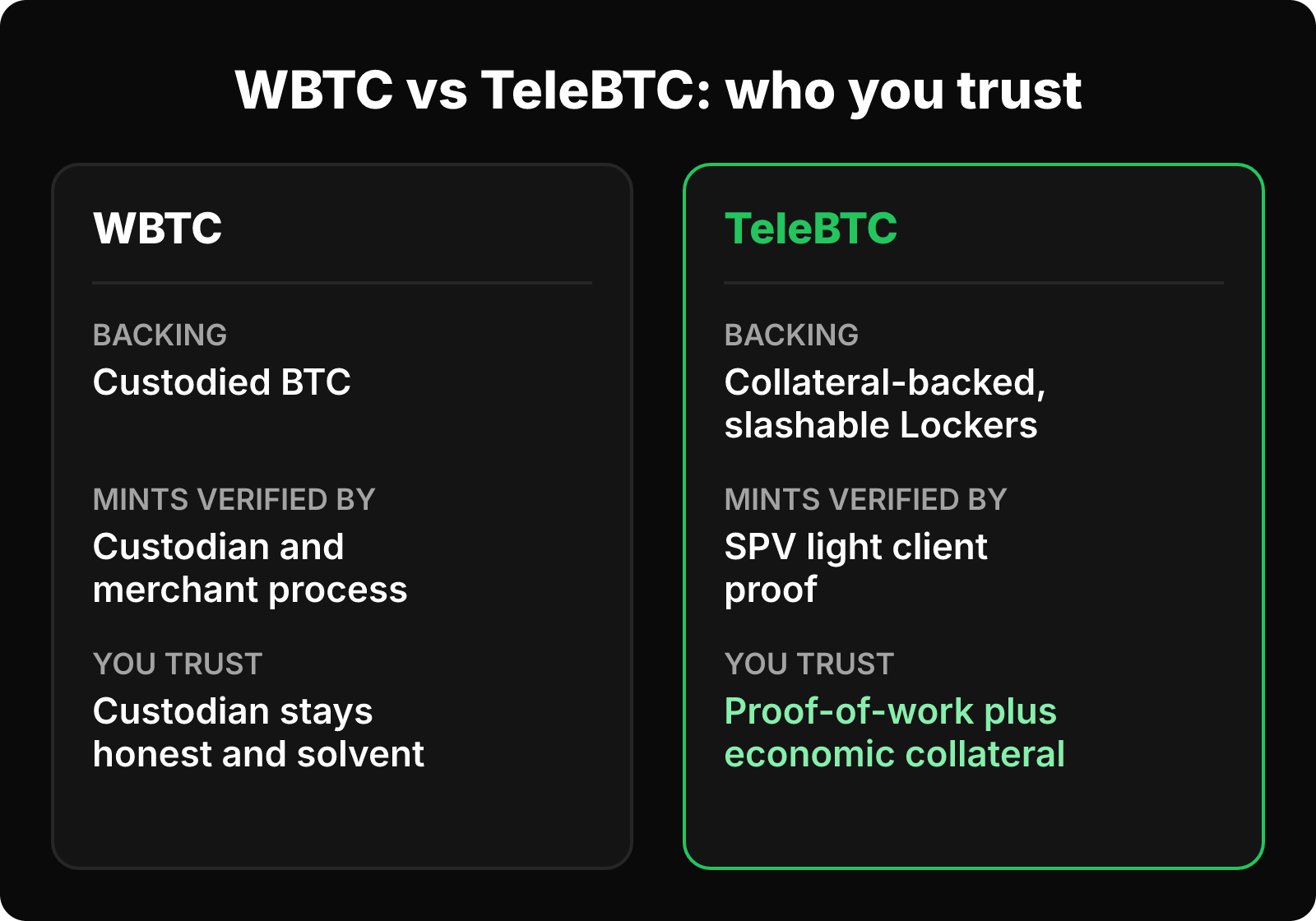
TeleBTC is the trust-minimized alternative. It's backed 1:1 by real BTC and secured by SPV light client proofs, not by custodians or a multi-sig committee, so it inherits Bitcoin's own security model. Here's how the main wrapped bitcoin designs compare:
| Token | Backing model | How mints are verified | Main trust assumption |
|---|---|---|---|
| WBTC | Custodied BTC | Custodian and merchant process | Custodian stays honest and solvent |
| cbBTC | BTC custodied by Coinbase | Issuer attestation | A single corporate custodian |
| tBTC | BTC held by a threshold signer group | Threshold signing among selected operators | An honest majority of the signer group |
| TeleBTC | BTC held by collateral-backed, slashable Lockers | SPV light client proof of the Bitcoin transaction | Bitcoin's proof-of-work plus economic collateral |
So which should you hold? If a specific DeFi app only accepts WBTC, WBTC is the practical choice, and TeleSwap gets you there without an account. If you just want BTC exposure on Ethereum with as few trusted parties as possible, TeleBTC's trust-minimized model is worth a look. For more background, see our guide on Ethereum Validator Security & Bitcoin Bridge Risks.
Frequently Asked Questions
Can I convert BTC to WBTC without KYC?
Yes, by using a non-custodial Bitcoin bridge instead of a centralized exchange. Bridges like TeleSwap need no account. You send BTC from your own wallet, the bridge verifies the transaction cryptographically, and WBTC is delivered to your Ethereum address. See our detailed comparison in BTC to WBTC Bridge: Lowest Fees & Fastest 2026 for more options.
Is WBTC itself trustless?
No, WBTC is a custodial token backed by bitcoin held by a custodian. You can acquire it without KYC, but its 1:1 backing depends on the custodian staying solvent and honest. TeleBTC, by contrast, is minted only after an SPV light client verifies the Bitcoin transaction, and it is backed by collateral that can be slashed if a Locker misbehaves.
Do I need ETH for gas to receive WBTC?
No, not when you use TeleSwap. A Teleporter covers the Ethereum gas for you, and all fees are paid in Bitcoin assets, so your receiving wallet can start with a zero balance.
How long does a BTC to WBTC conversion take?
TeleSwap's fast swaps settle in about 10 minutes. Most of that time is Bitcoin's own block interval (roughly 10 minutes per block). Once your transaction is confirmed and verified, TeleBTC is minted, swapped to WBTC, and delivered.
What is TeleSwap?
TeleSwap is a non-custodial Bitcoin bridge that lets you bridge, swap, and earn on Bitcoin across EVM chains, TON, and Solana without KYC. It mints TeleBTC, a 1:1 collateral-backed representation of BTC, only after an SPV light client verifies the Bitcoin transaction on-chain. According to TeleSwap network stats, it has processed $501.5M in bridged volume across 532,851 transactions on 12 supported networks.
Can I convert WBTC back to native BTC without KYC?
Yes, TeleSwap supports the reverse route from WBTC on Ethereum to native BTC. You send WBTC from your Ethereum wallet and receive BTC at a Bitcoin address you control, with no account required.
Is converting crypto without KYC legal?
Using non-custodial software is generally a different activity from using a regulated exchange, but the rules depend on your jurisdiction. Skipping KYC doesn't remove your tax or reporting obligations, and blockchain transactions stay publicly visible. Check your local rules. This guide isn't legal or financial advice.
Conclusion
To convert BTC to WBTC without KYC, you need a route where code verifies your payment and no company holds it. Exchanges and most swap services hold your BTC mid-swap and ask who you are. DEXs don't, but they can't take native bitcoin. A non-custodial Bitcoin bridge does both: it takes native bitcoin and needs no account.
Three points to remember:
- TeleSwap converts native BTC to WBTC in about 10 minutes, with fees paid in BTC and no ETH needed for gas.
- Its security comes from SPV light client proofs and slashable collateral, not from a custodian's promise or a multi-sig vote.
- WBTC is still custodial. If trust minimization is your goal, consider whether TeleBTC alone covers what you need.
Ready to make the move with a quote in hand and no sign-up form?