Unwrap WBTC to Native Bitcoin: 2026 Fee Comparison

You can unwrap WBTC to native Bitcoin through the official merchant redemption, an exchange, an aggregator, or a trustless bridge. Symbiosis's published September 2026 samples show an all-in cost of about 0.46%–0.59%, but the routes differ most on who holds your coins in transit.
Unwrapping means redeeming a wrapped token for the native asset it represents. For WBTC, that means turning an ERC-20 token on Ethereum back into BTC on the Bitcoin network. Some routes charge a percentage, some charge gas, and some take custody of your coins.
This guide uses fee samples from September 2026, compares five routes side by side, and walks through a trust-minimized way to get native BTC back.
WBTC is a custodial IOU: each token is backed 1:1 by BTC held by custodians, according to DEXTools' 2026 WBTC guide.In Symbiosis's own published examples from 28 September 2026, converting WBTC to native BTC cost about 0.46%–0.59% all-in (our calculation from the input and output amounts).In that small sample, the largest conversion had the highest percentage cost. Three data points can't prove a trend.The total cost of unwrapping has three layers: source-chain gas, the route's fee and slippage, and the Bitcoin network fee to deliver your coins.TeleSwap has processed $516.3M in bridge volume across 547,087 transactions and supports 13 networks, according to TeleSwap network stats.
Table of Contents
- What it means to unwrap wrapped Bitcoin
- Why convert WBTC back to native BTC?
- What unwrapping costs in 2026
- Bitcoin bridge fees 2026: five routes compared
- The costs that never make the headline
- How TeleSwap handles WBTC to BTC conversion
- Step-by-step walkthrough
- Frequently Asked Questions
- Conclusion
What Does It Mean to Unwrap Wrapped Bitcoin?
Unwrapping wrapped Bitcoin means trading a token that represents BTC on another blockchain for actual BTC on the Bitcoin network.
A coat check is a good way to picture it. You hand over your coat (BTC), and you get a numbered ticket (WBTC). The ticket is handy because you can carry it around Ethereum, use it as collateral, or trade it on a DEX. But to get your coat back, someone has to take the ticket and return the coat.
For WBTC, that "someone" is a set of institutions. DEXTools describes the official model like this:
- Custodians hold the real BTC behind every WBTC.
- Merchants handle minting (creating) and burning (destroying) WBTC for their customers.
- A DAO handles governance.
To redeem through the official route, WBTC is sent to a merchant and burned. The custodian checks the burn on-chain and then releases BTC to a Bitcoin address. While you hold WBTC, you are trusting the custodian, the smart contract, and the consensus of whatever chain the token lives on.
On 13 October 2026, WBTC had a market cap of about $9.65B and a circulating supply of 116.13K WBTC, priced at $83,137, according to MetaMask's WBTC price page.
Why Convert WBTC Back to Native BTC?
Most people unwrap for one of four reasons:
- Self-custody. Native BTC in your own wallet doesn't rely on any custodian staying solvent.
- Leaving DeFi. The lending position or yield farm is finished, and you want to go back to plain Bitcoin.
- Bitcoin-native features. Lightning payments, multisig vaults and long-term cold storage all need real BTC. Baltex's 2026 conversion guide lists these as common motivations.
- Lowering wrapped-token risk. DEXTools flags depeg risk, custodian risk and smart-contract risk as things WBTC holders should watch in 2026.
Market conditions play a part too. WBTC was down 28.53% year over year as of 13 October 2026 (from $116,319.77 on 13 October 2025, per MetaMask). We aren't predicting where the price goes next. In a drawdown, holders tend to care more about custody than about yield.
How Much Does It Cost to Unwrap WBTC in 2026?
In Symbiosis's published samples, unwrapping cost about half a percent on an aggregator route. That number is made of three separate costs that behave differently. For a fuller comparison of bridge economics, see our Symbiosis Bridge vs TeleSwap fees and speed breakdown.
The three layers of unwrap cost
- Source-chain gas. You sign at least one transaction on the chain your WBTC sits on, and you pay its native gas token (ETH on Ethereum). Baltex says gas "often needs the equivalent of 0.01–0.05 ETH" in mid-2026 conditions; this is a vendor estimate with no gas data cited. Layer 2s like Arbitrum, Optimism or Polygon generally have lower gas than Ethereum mainnet.
- Route fee plus slippage. This covers what the protocol, aggregator or merchant charges, plus any price impact from swapping through liquidity pools. Slippage grows with trade size.
- Bitcoin network fee. Someone has to pay miners to put your BTC payout into a block. This is usually built into the quote, but it rises when the mempool (Bitcoin's waiting room for unconfirmed transactions) is congested. You can check current conditions on mempool.space.
Real fee samples from September 2026
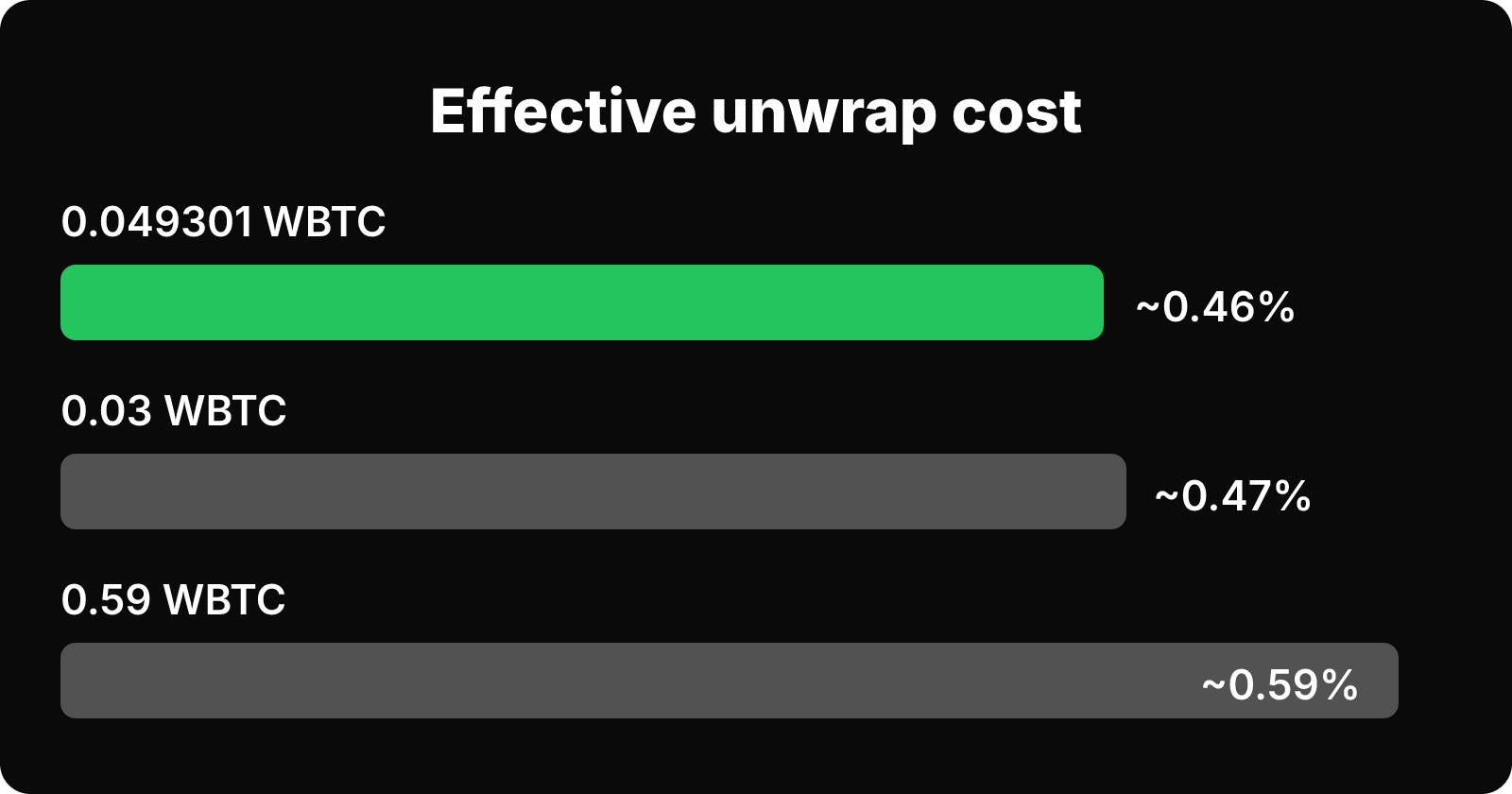
Symbiosis, a cross-chain liquidity aggregator, published three WBTC-to-BTC examples on its WBTC bridge page. We worked out the percentage cost from their input and output figures:
| WBTC sent | BTC received | Fee stated (USD) | BTC lost | Effective cost (derived) |
|---|---|---|---|---|
| 0.03 | 0.02986 | $12.10 | 0.00014 | ~0.47% |
| 0.049301 | 0.049073 | Not stated | 0.000228 | ~0.46% |
| 0.59 | 0.5865 | $277 | 0.0035 | ~0.59% |
The biggest trade paid the highest percentage. Three data points from one vendor, mostly from a single day (28 September 2026), can't establish why, and it may reflect route selection or liquidity. Still, it runs against the common belief that bigger trades always get better rates.
For a sense of scale, unwrapping 0.1 WBTC at ~0.5% would cost about 0.0005 BTC, or roughly $42 at the 13 October 2026 price of $83,137. That's an illustrative calculation, not a quote.
Bitcoin Bridge Fees 2026: Five Routes Compared
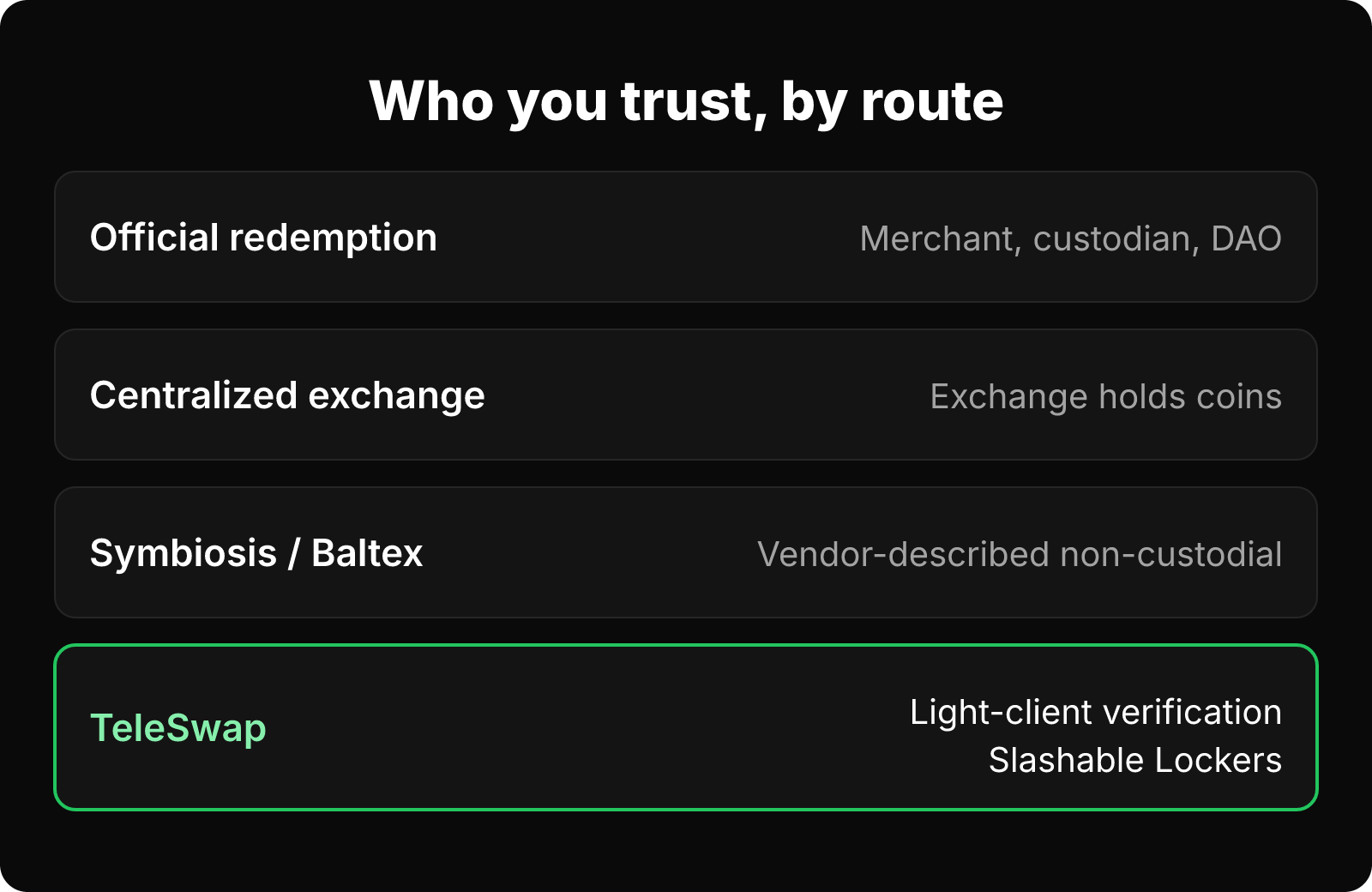
Here's how the main options compare on fees, speed, what you end up holding, and who you have to trust. Where a source gives no number, we say so rather than guess. If you're also weighing other decentralized bridges, our ThorSwap vs TeleSwap comparison covers fees and speed in more detail.
| Route | What you receive | Fee signal | Speed | Who you trust |
|---|---|---|---|---|
| Official WBTC redemption | Native BTC | Merchant fee + Ethereum gas (no public retail schedule found) | Not published | Merchant, custodian, DAO |
| Centralized exchange (Coinbase, Kraken, Bitget) | Exchange balance, then a BTC withdrawal | Trading fee + BTC withdrawal fee (check current schedules) | Often fast internally; withdrawal adds time | The exchange holds your coins |
| Symbiosis (aggregator) | Native BTC | ~0.46%–0.59% all-in (derived, Sep 2026) | Median ~14 min; 90th percentile ~39 min (Symbiosis) | Vendor-described as non-custodial; route chosen automatically |
| Baltex (swap service) | Native BTC | Not published | "Minutes to an hour" (Baltex) | Vendor-described as non-custodial |
| TeleSwap | Native BTC | Quote shown before you sign | Fast swaps settle in ~10 min | Bitcoin light-client verification + collateral-backed, slashable Lockers |
If all you care about is the headline fee, exchanges and official redemption can look cheap, but both involve a custodian somewhere along the way. If you care about who holds your bitcoin in transit, the decentralized routes are the ones to compare, and the real question becomes how each secures the BTC side.
The Costs That Never Make the Headline
The fee is only one part of what an unwrap costs you. Here are three others that experienced users price in.
1. Trust is a cost, even when nothing goes wrong
Selling WBTC on an exchange swaps one custodian (WBTC's) for another (the exchange's). You pay a fee and still don't hold your own keys. If the goal is to stop depending on custodians, that route doesn't get you there.
2. Time is a cost when markets move
While your trade is in flight, you hold neither WBTC nor BTC in a form you can use. In June 2026, BTC slid from about $70,000 to briefly under $58,000, and more than $212M in long positions were liquidated, per the WBTC June 2026 update.
You end up with bitcoin either way, so price exposure is mostly neutral. The real risk is a route with a long 90th-percentile settlement time, because it leaves funds unavailable while you might need them, for example to top up collateral elsewhere.
3. The peg is "close", not "exact"
Baltex says WBTC trades "very close to BTC, with only small premiums or discounts based on liquidity" (Baltex 2026 guide). When a route swaps WBTC through a DEX, any small discount comes out of your output. That's another reason to compare the BTC you receive rather than the fee label.
Our rule of thumb: judge every route by one number, BTC out divided by WBTC in, and by one question: who holds the bitcoin before it reaches my address?
How TeleSwap Handles WBTC to BTC Conversion
TeleSwap is a Bitcoin bridge and swap protocol that moves value between native BTC and EVM chains, TON, and Solana, using Bitcoin SPV light-client proofs instead of a custodian or multi-sig committee. Its wrapped token, TeleBTC, is backed 1:1 by real BTC, and none of it is minted without a verified Bitcoin transaction.
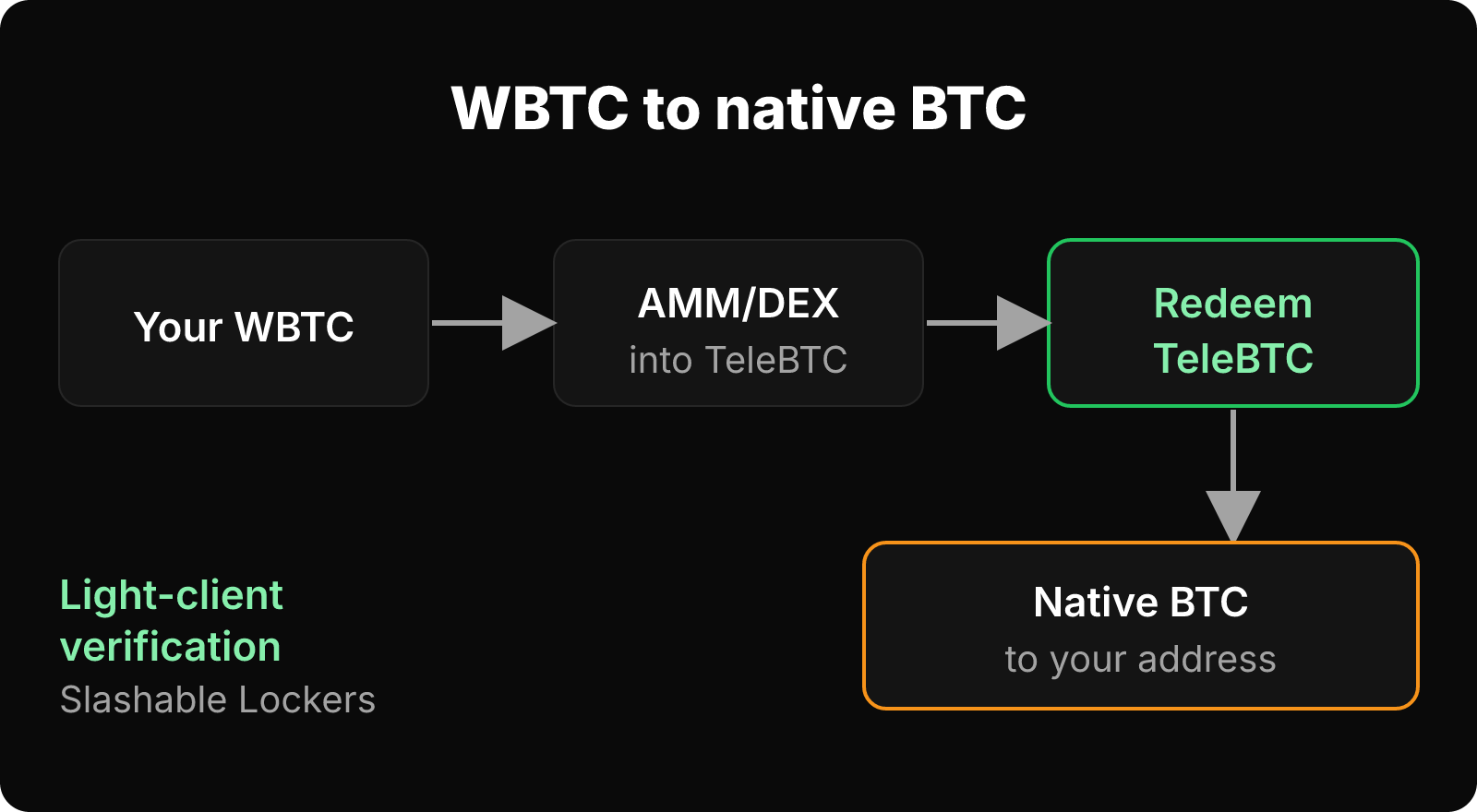
When you convert WBTC to native BTC with TeleSwap, the swap and bridge happen in one flow: your WBTC is routed through the AMM/DEX into TeleBTC, and the TeleBTC is redeemed for native BTC sent to your Bitcoin address. BTC-side custody is handled by Lockers, who post collateral that can be slashed.
This is where TeleSwap differs from WBTC's model. WBTC asks you to trust a custodian that the BTC is there. TeleSwap's bridge verifies Bitcoin transactions with a light client, an on-chain verifier that checks Bitcoin's proof-of-work headers directly. The TeleSwap documentation covers each role in the system: Lockers, Teleporters, Relayers and Fillers.
TeleSwap has bridged $516.3M in total volume across 547,087 transactions and supports 13 networks. In the last 30 days it handled $45.2M, averaging about $1.5M per day, with a peak of $2.8M on 18 September 2026, per TeleSwap network stats (retrieved 14 October 2026).
TeleSwap is also integrated as a swap provider in the Rango, Rubic and DZap aggregators, and reachable from MetaMask and Trust Wallet through the Rango integration. For a broader look at how Rango routes Bitcoin swaps, see Rango Exchange vs TeleSwap: Bitcoin Swaps Compared.
How to Unwrap WBTC With TeleSwap: Step by Step
Our example converts 0.05 WBTC on Ethereum to native BTC.
- Prepare two wallets. You need an EVM wallet holding your WBTC (MetaMask works) and a Bitcoin wallet whose address you control, ideally a native SegWit address starting with
bc1. - Keep a little gas on hand. You'll sign on the source chain, so keep a small amount of its native token (ETH on Ethereum) to cover the approval and swap transactions.
- Open the right pair. Go to the WBTC (Ethereum) → BTC page. If your WBTC is on Arbitrum or Optimism, use the WBTC (Arbitrum) → BTC or WBTC (Optimism) → BTC route.
- Enter the amount and your Bitcoin address. Paste the address, then check the first and last four characters. Bitcoin transactions can't be reversed.
- Read the quote, not the label. Look at the exact BTC you'll receive. Divide it by 0.05 to get your effective rate, and compare it against the ~0.5% Symbiosis sample above.
- Approve and confirm. Your wallet will first ask you to approve WBTC spending, then to confirm the swap.
- Wait for settlement. Fast swaps settle in about 10 minutes. You can follow your BTC payout on any Bitcoin block explorer once it's broadcast.
New to cross-chain transfers? Our 7-step trustless BTC swap guide walks through the same kind of flow with more screenshots and context.
Before you click: a quick safety checklist
- Bookmark
teleswap.xyzand type it yourself. Never follow links from DMs. - Test with a small amount first if this is your first cross-chain transfer.
- Never send WBTC directly to a Bitcoin address. Always go through the swap interface.
- Check that your WBTC is on the chain you've selected (Ethereum, Arbitrum and Optimism are separate networks).
- If the network is busy, check mempool.space so the wait doesn't catch you off guard.
Frequently Asked Questions
What is the cheapest way to convert WBTC to BTC in 2026?
The cheapest route is the one that gives you the most BTC per WBTC after every fee, so compare final output amounts, not fee labels. In Symbiosis's September 2026 samples, the all-in cost worked out to about 0.46%–0.59%. Gas is generally lower on Layer 2s than on Ethereum mainnet.
How long does WBTC to BTC conversion take?
Most decentralized routes take somewhere between 10 minutes and an hour. TeleSwap's fast swaps settle in about 10 minutes. Symbiosis reports a median of about 14 minutes and a 90th percentile of about 39 minutes. Bitcoin block times and mempool congestion affect every route.
Is it safe to unwrap WBTC through a bridge or aggregator?
It can be, but safety depends on who holds the BTC during the transfer. Exchanges hold it for you. Many aggregators describe themselves as non-custodial, but those claims aren't independently verified in our sources. TeleSwap verifies Bitcoin transactions with SPV light-client proofs and backs BTC custody with slashable collateral, so you aren't relying on a custodian's promise. Smart-contract risk still applies to any bridge.
Do I need ETH to convert WBTC to BTC?
Yes, if your WBTC is on Ethereum, because you have to sign transactions there and pay gas in ETH. On other EVM chains you need that chain's native gas token instead. Baltex estimates 0.01–0.05 ETH for Ethereum in mid-2026 conditions, though actual gas changes from minute to minute.
What is the difference between WBTC and TeleBTC?
WBTC is backed by BTC held by custodians, while TeleBTC is backed 1:1 by BTC and verified by Bitcoin SPV light-client proofs. With WBTC, you trust custodians and merchants to keep and release reserves. With TeleBTC, none is minted without a verified Bitcoin transaction, and custody is backed by slashable collateral. For background on the WBTC side, see Convert BTC to WBTC Without KYC: Trustless Bridge Guide.
Can I convert WBTC on Arbitrum or Optimism to native BTC?
Yes. TeleSwap has WBTC-to-BTC pages for Ethereum, Arbitrum, Polygon and Optimism. Pick the route that matches the chain your WBTC is on. Sending tokens on the wrong network is one of the most common beginner mistakes.
Is WBTC always worth exactly 1 BTC?
No. WBTC trades very close to BTC, but small premiums or discounts can appear depending on liquidity. If your route swaps through a DEX, any discount reduces your BTC output, which is one more reason to judge routes by the final amount you receive.
Conclusion: Pick the Route by What You Receive and Who You Trust
In Symbiosis's September 2026 samples, unwrapping cost about half a percent, made up of gas, route fees and slippage, and the Bitcoin network fee. Bigger trades didn't automatically get a better rate.
The detail most fee comparisons skip is custody: an exchange or official redemption may look cheaper on paper, but someone else holds your coins until they reach you.
If you want to unwrap WBTC without handing it to a custodian, TeleSwap gives you native BTC through light-client verification and collateral-backed Lockers. It has handled $516.3M across 547,087 transactions, per TeleSwap network stats. Check the quote, look at the BTC you'll receive, and decide for yourself.
This article is for educational purposes only and is not financial advice. Fees, speeds and market data reflect the dates cited and can change.