ThorSwap vs TeleSwap: Bitcoin Bridge Fees & Speed 2026

ThorSwap vs TeleSwap comes down to how you pay and how long you wait. TeleSwap charges a flat 0.1% Locker fee plus a network fee, and gets BTC to other chains in about 10 minutes (fast swap) or about 20 minutes (standard). ThorSwap is a front end for THORChain. It charges a slip-based liquidity fee that grows with trade size, plus an outbound fee, and it also has to wait for Bitcoin confirmations, with larger deposits waiting for more of them.
Both let you turn BTC into tokens like USDC on Arbitrum or ETH on Base without an exchange account, but each asks you to trust something different. This guide assumes you're new to crypto. We explain each piece, put the fee and timing numbers side by side, and finish with a step-by-step walkthrough for your first swap.
Key Takeaways:TeleSwap charges a flat 0.1% Locker fee on the bridged amount, plus a network fee for destination-chain gas, according to the TeleSwap fees documentation.THORChain, the protocol behind ThorSwap, charges a slip-based liquidity fee that grows as your trade gets larger relative to pool depth, as described in the THORChain documentation.Every swap that starts on Bitcoin has to wait for Bitcoin blocks, which arrive about every 10 minutes on average, so no protocol can make a BTC deposit truly instant.A TeleSwap fast swap delivers after one Bitcoin confirmation (about 10 minutes), and a standard swap waits for two (about 20 minutes).As of October 9, 2026, TeleSwap has processed $510.3M in volume across 540,257 bridge transactions, according to TeleSwap network stats.
Table of Contents
- What Are ThorSwap and TeleSwap?
- What Makes a Trustless BTC Bridge? How Each One Stays Secure
- ThorSwap vs TeleSwap Fees: What Will You Actually Pay?
- ThorSwap vs TeleSwap Speed: How Long Does a BTC Swap Take?
- Bitcoin Bridge Comparison Table: Side by Side
- Which Is the Lowest Fee Crypto Swap for Your Trade?
- How to Swap BTC With TeleSwap: Step-by-Step
- Frequently Asked Questions
- Conclusion: Picking the Right Bitcoin Bridge
What Are ThorSwap and TeleSwap?
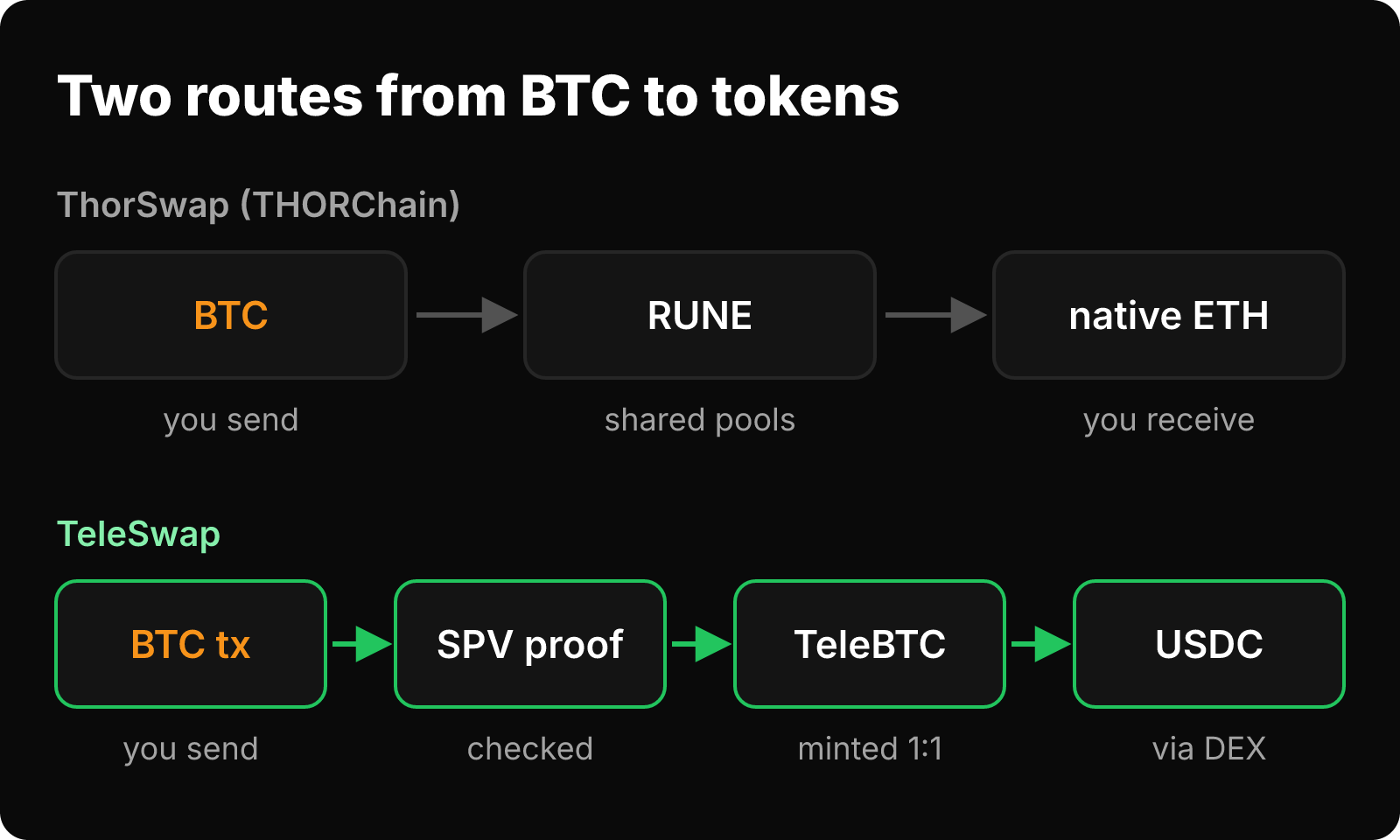
ThorSwap is an interface for THORChain's shared liquidity pools. TeleSwap is a light-client Bitcoin bridge that mints collateral-backed TeleBTC and can swap it into other tokens. Both solve the same problem. Bitcoin lives on its own blockchain, and that chain can't talk directly to Ethereum, Arbitrum, Solana, or anything else. To turn BTC into a token on another chain, something has to watch Bitcoin, confirm you really paid, and then release value on the other side. The two tools do that watching in very different ways.
ThorSwap: a front end for THORChain's shared liquidity pools
ThorSwap is a user interface built mainly on top of THORChain, a separate blockchain whose node operators jointly control vaults on Bitcoin, Ethereum, and several other networks. In THORChain, each asset sits in a liquidity pool paired with THORChain's own token, RUNE. A BTC → ETH swap actually happens in two hops, BTC → RUNE and then RUNE → ETH, and you end up holding native ETH. The mechanics are explained in the THORChain documentation, and the interface itself lives at thorswap.finance.
Here's an analogy. Picture a currency exchange booth where the cash drawers are shared and guarded by a rotating group of guards. Each guard has put down a large deposit that they lose if they steal. You trust the group as a whole, and the money they'd lose, to keep the drawers honest.
TeleSwap: a light-client Bitcoin bridge with built-in swaps
TeleSwap is a trust-minimized Bitcoin bridge that lets you bridge, swap, and earn on Bitcoin. It moves BTC to EVM chains, TON, and Solana, and along the way it can swap into those chains' tokens (ERC-20s, Jettons, and SPL tokens). When you bridge, TeleSwap mints TeleBTC, a 1:1, collateral-backed representation of BTC. TeleBTC is only minted after a smart contract on the destination chain checks proof that your Bitcoin transaction really happened, as described in the TeleSwap documentation. If you asked for USDC or ETH instead of TeleBTC, the protocol routes the swap through a DEX in the same flow, so you receive the token you picked.
The analogy here is a notary. You aren't trusting a group of people. The notary looks up your receipt in Bitcoin's own public records and only acts once the receipt checks out.
Usage is substantial. According to TeleSwap network stats (retrieved October 9, 2026), the protocol has bridged $510.3M across 540,257 transactions on 13 supported networks. Over the last 30 days it handled $45.8M in volume, about $1.5M per day, with a peak of $2.8M on September 18, 2026.
What Makes a Trustless BTC Bridge? How Each One Stays Secure
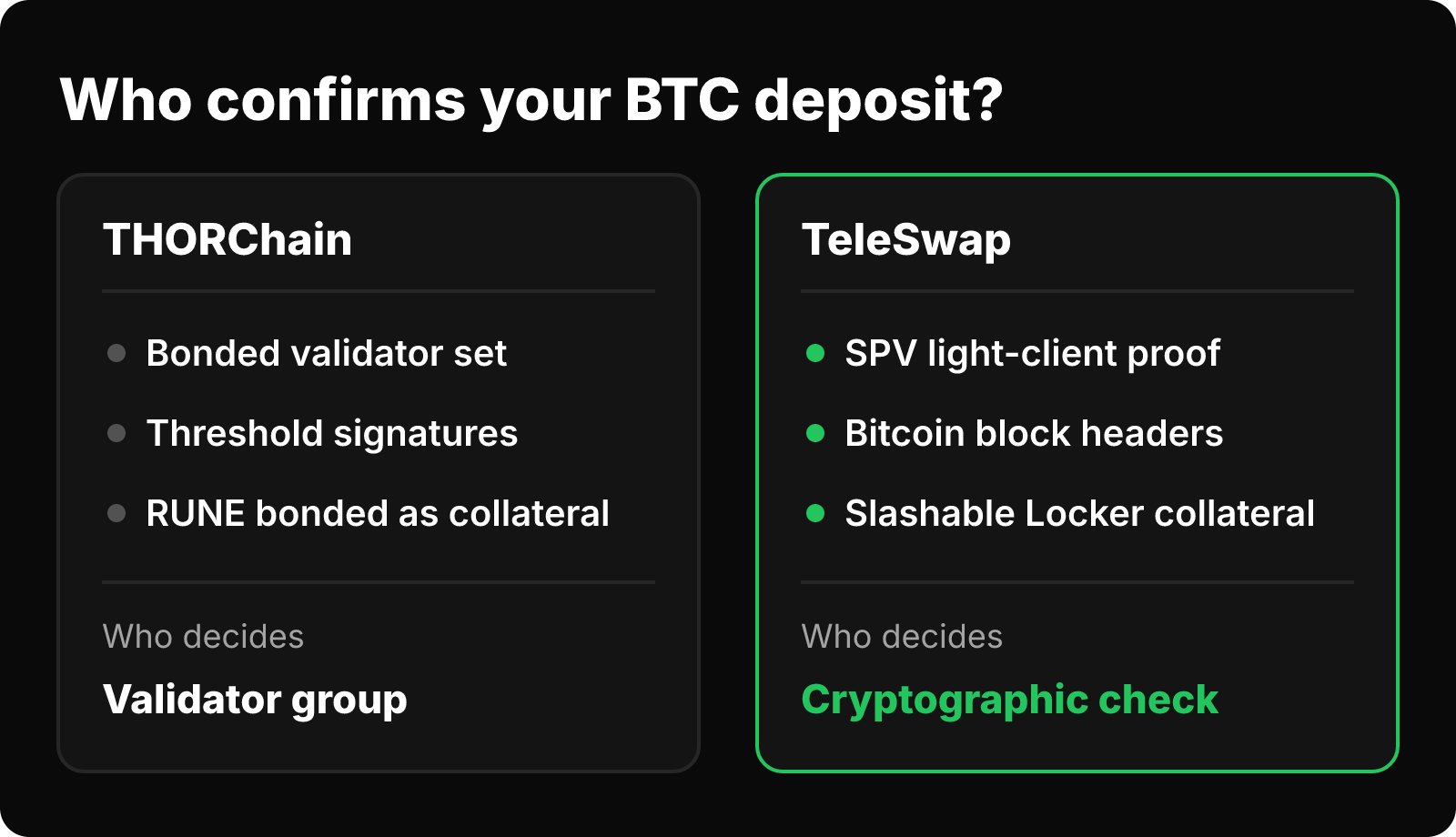
THORChain secures deposits with a bonded validator set. TeleSwap secures them with an SPV proof checked against Bitcoin's own chain. "Trustless" is a word that gets stretched in crypto, and in practice it's a spectrum. The useful question is: who or what decides that your Bitcoin deposit is real?
THORChain: economic security from bonded validators
THORChain's vaults are controlled through threshold signatures. A key is split across many node operators, and a large enough group of them has to cooperate to move funds. Each operator bonds RUNE as collateral, so in theory stealing costs more than it's worth. It's a serious design, and it lets THORChain deliver native coins without wrapping.
The trade-off is that your safety depends on the validator set and the code that coordinates it. THORChain suffered a pair of exploits in July 2021, documented by Rekt News. In January 2025 it paused its THORFi lending and savings products after problems with their liabilities. That was a lending-product issue, separate from the core swap function. Neither event means ThorSwap is unsafe today. What they show is where the risk sits: with people and coordination software, not with Bitcoin's own consensus.
TeleSwap: SPV light-client proofs
TeleSwap verifies Bitcoin transactions using Simplified Payment Verification (SPV), the method Satoshi Nakamoto described in Section 8 of the Bitcoin whitepaper. A light client tracks Bitcoin block headers, which are compact summaries of each block that carry their own proof-of-work. It then checks a Merkle proof showing your transaction is included in one of those blocks. If the proof doesn't check out, no TeleBTC gets minted.
The BTC backing TeleBTC is held by Lockers. Every Locker has posted collateral that can be slashed (confiscated) if it misbehaves, so custody is backed by collateral, not by trust in a custodian or a multi-sig committee. Minting is decided by a cryptographic check against Bitcoin's own chain, with no vote involved.
Here's the nuance most comparisons miss. Neither design gets rid of trust entirely. THORChain bets that bonded validators won't collude. TeleSwap bets that Bitcoin's proof-of-work holds and that slashable collateral keeps Lockers honest. If you already trust Bitcoin's security, TeleSwap's model asks you to add less on top of it.
ThorSwap vs TeleSwap Fees: What Will You Actually Pay?
TeleSwap's bridge fee is a flat 0.1% Locker fee plus a network fee. ThorSwap's main fee is a slip-based liquidity fee that grows with trade size, plus an outbound fee. Both protocols share one cost: you pay a normal Bitcoin miner fee to send your BTC. That fee depends on how busy the network is and has nothing to do with how much you send. You can check current rates on mempool.space.
TeleSwap's fee breakdown
TeleSwap charges everything in Bitcoin terms and breaks the fee into its parts in the estimate. The four components, taken from the TeleSwap Fees & Speed docs:
| Fee | What it covers | How much |
|---|---|---|
| Network fee | For BTC → another chain, the destination-chain gas a Teleporter pays for you. For another chain → BTC, the Bitcoin fee the Locker pays to send your payout. | Depends on network congestion; not a % of your amount |
| Locker fee | Pays the Locker for custody and collateral | 0.1% of the bridge amount |
| Protocol fee | Protocol treasury | May be 0 |
| Third-party fee | A share for an integrator, if you came through one | 0 if none |
A practical bonus for beginners: you don't need ETH, MATIC, or any other gas token to receive funds. A Teleporter covers the destination gas, and that cost is folded into the BTC-denominated network fee.
ThorSwap's fee breakdown
According to the THORChain documentation, a swap through ThorSwap includes:
- Liquidity fee (slip-based): grows with your trade size relative to the depth of the pools you pass through. A small trade in a deep pool pays little, and a large trade pays proportionally more.
- Outbound fee: taken from your output to cover the gas THORChain spends sending you the coin you bought. It follows that chain's gas costs, not your trade size.
- Affiliate fee: an extra cut the interface (ThorSwap) can add on top of protocol fees.
What the 0.1% Locker fee looks like in BTC
TeleSwap's Locker fee is a flat percentage, so you can work it out before you start:
| Amount bridged | TeleSwap Locker fee (0.1%) | Plus |
|---|---|---|
| 0.01 BTC | 0.00001 BTC | Network fee + your Bitcoin miner fee |
| 0.1 BTC | 0.0001 BTC | Network fee + your Bitcoin miner fee |
| 1 BTC | 0.001 BTC | Network fee + your Bitcoin miner fee |
An honest caveat. The 0.1% Locker fee covers the bridge part. If you ask for USDC or ETH instead of TeleBTC, the swap part runs through a DEX on the destination chain, and a very large order can move the price in that pool too. So don't compare fee percentages. Compare the final amount you receive for the same input.
ThorSwap vs TeleSwap Speed: How Long Does a BTC Swap Take?
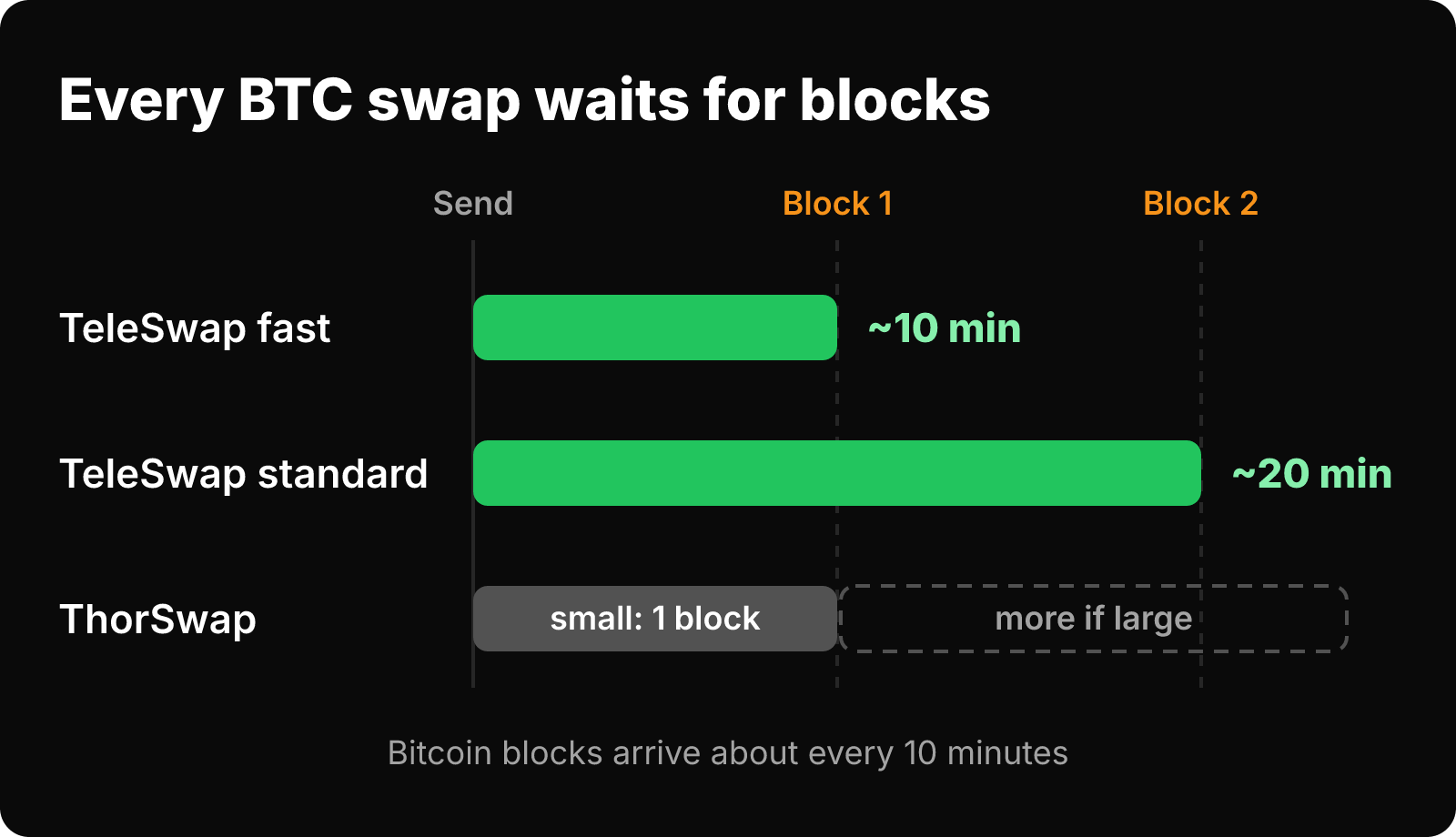
For BTC deposits, both are tied to Bitcoin's block time. TeleSwap takes about 10 minutes (fast) or about 20 minutes (standard), and THORChain waits for one or more Bitcoin confirmations depending on deposit size. Bitcoin produces a block about every 10 minutes on average, a target that goes back to the original whitepaper design. Any honest Bitcoin bridge has to wait for at least one block before it acts on your deposit. Otherwise a block could be reversed in a chain reorganization ("re-org"), and the bridge would have paid out against money that no longer exists.
TeleSwap timing
According to the TeleSwap docs:
- Standard swap, Bitcoin → EVM/TON/Solana: waits for two Bitcoin confirmations before minting TeleBTC. About 20 minutes.
- Fast swap, Bitcoin → other chains: a Filler delivers after one confirmation, at the best rate available at that moment. About 10 minutes. In effect, you pay the Filler to take on the extra re-org risk.
- EVM/TON/Solana → Bitcoin: after the destination-chain confirmation, the Locker broadcasts your BTC payout, and you can see it in the mempool within a few minutes.
ThorSwap timing
You'll often see comparisons saying ThorSwap settles in 1–3 minutes. That's realistic between fast chains. When Bitcoin is the input, THORChain also has to wait for Bitcoin blocks. It uses "confirmation counting," which means larger deposits wait for more confirmations, as described in the THORChain docs. Large outbound payments can also be held back on purpose as a security throttle, and big orders may be split into "streaming swaps" that run over a longer window to cut slippage.
So for BTC → anything, the real gap between the two is smaller than the marketing suggests. Both run on the same 10-minute Bitcoin clock. ThorSwap may need just one block for small amounts. TeleSwap lets you choose between about 10 minutes (fast) and about 20 minutes (standard).
Bitcoin Bridge Comparison Table: Side by Side
Here's the whole picture in one place. TeleSwap figures come from the TeleSwap documentation and live network stats. THORChain details come from its official docs.
| Factor | ThorSwap (THORChain) | TeleSwap |
|---|---|---|
| What it is | Interface for a cross-chain liquidity network | Light-client Bitcoin bridge with built-in swaps |
| How deposits are verified | Bonded validator set using threshold signatures | SPV light-client proof of your Bitcoin transaction |
| Main swap/bridge fee | Slip-based liquidity fee (grows with size) + outbound fee + interface fee | Flat 0.1% Locker fee + network fee; protocol fee may be 0 |
| Destination gas | Outbound fee deducted from output | Paid by a Teleporter, charged in BTC; no gas token needed |
| BTC → other chain | At least one Bitcoin block; more for large amounts | ~10 min (fast) / ~20 min (standard) |
| Other chain → BTC | Varies; large payouts may be delayed | A few minutes to appear in the mempool |
| Where it takes BTC | Native coins on THORChain-supported chains (e.g., ETH, LTC, DOGE, BCH) | Tokens on EVM chains, TON, and Solana (e.g., USDC, USDT, ETH, WBTC) |
| Public usage figures | See THORChain explorers | $510.3M bridged, 540,257 transactions, 13 networks (TeleSwap network stats) |
Which Is the Lowest Fee Crypto Swap for Your Trade?
The cheapest route depends on where your BTC is going, how big the trade is, and which trust model you're comfortable with. Here's a three-question framework for real swap routes.
1. Where does your BTC need to end up?
If you want native Dogecoin, Litecoin, or Bitcoin Cash, ThorSwap is the right tool, because TeleSwap doesn't serve those chains. If you want stablecoins or ETH on Ethereum, Arbitrum, Optimism, Base, Polygon, or BNB Chain, or USDC on Solana, TeleSwap is built for that route. The supported assets page lists the current tokens per chain.
2. How big is the trade?
- Small trades (a few hundred dollars): fixed costs dominate. Your Bitcoin miner fee may cost more than either protocol's percentage fee, so send when mempool fees are low.
- Medium to large trades: this is where a flat 0.1% Locker fee is easiest to plan around. A slip-based fee keeps growing with size and a flat bridge fee doesn't, though the DEX leg on the destination chain still has its own price impact.
3. Which trust model are you comfortable with?
If your instinct is "I trust Bitcoin's proof-of-work, not committees," TeleSwap's SPV model fits that instinct. If you're comfortable relying on a bonded validator network in exchange for native-coin payouts across many chains, ThorSwap is a reasonable choice. For a deeper dive into BTC swap fee structures, see our L2 fee comparison guide.
A practical tip: aggregators show you several routes for the same trade. TeleSwap is integrated as a Bitcoin swap provider in Rango, Rubic, and DZap, so you can compare quotes by output amount on one screen. Through the Rango integration, TeleSwap routes are also available inside MetaMask and Trust Wallet.
How to Swap BTC With TeleSwap: Step-by-Step
Here's what a first BTC → USDC swap on Arbitrum looks like, following the TeleSwap user quickstart. You can also open this route directly on the BTC to USDC (Arbitrum) page.
- Get your wallets ready. You need a Bitcoin wallet holding the BTC you want to swap and a wallet on the destination chain to receive it. Check the "Supported wallets" list in the docs for each chain. You don't need ETH for gas.
- Open teleswap.xyz and choose BTC as the source, then pick your destination chain and token, such as USDC on Arbitrum.
- Enter your amount and read the estimate. The quote breaks out the network fee, the 0.1% Locker fee, and any protocol or third-party fee, all in BTC terms. Focus on the amount you'll receive.
- Pick standard or fast. Standard waits for two Bitcoin confirmations (~20 minutes). Fast uses a Filler and delivers after one (~10 minutes).
- Confirm and send your BTC from your Bitcoin wallet. Set a reasonable miner fee so your transaction gets into a block quickly.
- Wait for confirmation. Once your Bitcoin transaction is verified, TeleBTC is minted and swapped into USDC, and the USDC arrives in your destination wallet.
Going the other way works the same way in reverse. Choose your token as the source and BTC as the destination. After the destination-chain confirmation, the Locker broadcasts your BTC payout, which shows up in the mempool within a few minutes. Popular routes include BTC to WBTC bridges and trustless BTC to WBTC conversion guides.
For developers: TeleSwap's SDK returns a BTC → EVM/TON/Solana quote in under a minute and wraps a plain REST API. Integrators can register a third-party ID to earn a share of fees on the volume they bring.
Frequently Asked Questions
Is TeleSwap cheaper than ThorSwap?
For BTC → EVM, TON, or Solana routes, TeleSwap's fees are usually easier to predict, because its bridge fee is a flat 0.1% Locker fee rather than a slip-based fee that grows with trade size. The total cost of either route also includes network fees and any price impact on the destination DEX, so compare the final amount each one quotes for the same input.
Which is faster for Bitcoin swaps, ThorSwap or TeleSwap?
When Bitcoin is the input, the speed difference is small, because both have to wait for Bitcoin blocks, which average about 10 minutes. A TeleSwap fast swap delivers after one confirmation (~10 minutes) and a standard swap after two (~20 minutes). THORChain scales confirmations with deposit size, so larger BTC deposits can take longer.
Is TeleSwap a trustless BTC bridge?
TeleSwap is a trust-minimized bridge: nothing is minted unless a Bitcoin transaction has been verified with an SPV light-client proof. The BTC backing TeleBTC is held by Lockers whose collateral can be slashed, so no centralized custodian or multi-sig committee decides what gets minted.
What is TeleBTC?
TeleBTC is TeleSwap's 1:1, collateral-backed representation of BTC on other chains. It's minted only after the light client verifies your Bitcoin deposit. If you choose a token such as USDC or ETH as your output, TeleBTC is swapped automatically in the same flow, so you only hold TeleBTC if you choose it as your output.
Do I need ETH or another gas token to use TeleSwap?
No. You pay all fees in BTC, and a Teleporter covers the destination-chain gas for you. Your first transaction on Arbitrum, Base, or Polygon doesn't require buying that chain's native token first.
Can I swap BTC to Dogecoin or Litecoin with TeleSwap?
No. TeleSwap focuses on moving BTC to EVM chains, TON, and Solana. For native DOGE, LTC, or BCH, a THORChain-based interface like ThorSwap is the more suitable tool.
Can I use TeleSwap from MetaMask or Trust Wallet?
Yes, through TeleSwap's integration with the Rango aggregator. TeleSwap is also integrated as a Bitcoin swap provider in Rubic and DZap, or you can use it directly at teleswap.xyz.
Conclusion: Picking the Right Bitcoin Bridge
The honest answer to ThorSwap vs TeleSwap depends on where your bitcoin is going. Three things are worth remembering:
- Fees: TeleSwap's flat 0.1% Locker fee, with gas paid in BTC, is easy to predict. THORChain's slip-based fee rises with trade size. Either way, judge by the final amount you receive.
- Speed: Bitcoin's ~10-minute block time limits everyone. TeleSwap's fast swap delivers after one confirmation, and a standard swap waits for two.
- Trust: ThorSwap relies on bonded validators. TeleSwap verifies your Bitcoin transaction with an SPV proof before minting anything, which carries Bitcoin's own security model over to the destination chain.
If you're moving BTC into stablecoins, ETH, or wrapped BTC on Ethereum, its L2s, BNB Chain, or Polygon, or into USDC on Solana, TeleSwap is built for that route. According to TeleSwap network stats, $510.3M has already been bridged across 540,257 transactions.
Ready to make your first Bitcoin bridge transfer? Learn how to swap BTC to USDT with no KYC requirements, or explore how Bitcoin bridges enable daily DeFi use cases.