Swap BTC DeFi: 2026 Bitcoin L2 Fee Comparison

The cheapest way to swap BTC DeFi-style in 2026 is usually to bridge native BTC to a deep-liquidity Ethereum Layer 2 such as Arbitrum or Base, where typical swaps cost under $0.30. The network fee is only part of the bill. The Bitcoin transaction, the bridge fee and slippage usually decide what you actually pay.
Say you hold 0.05 BTC and it's sitting idle. You could lend it, earn yield on it, or swap it for stablecoins without selling on an exchange. But Stacks, Rootstock, Bitlayer, Lightning, Citrea, Arbitrum and Base all say they're "low fee." This guide breaks down what a BTC-to-DeFi swap really costs, compares Bitcoin Layer 2s with Ethereum Layer 2s, and walks through one full example swap.
Key Takeaways:Every BTC-to-DeFi swap has four costs: the Bitcoin network fee, the bridge fee, the destination swap fee, and slippage. The destination-chain gas fee is usually the smallest of the four.Typical Ethereum Layer 2 swaps cost less than $0.30 in 2026, and an Arbitrum swap runs about $0.27, according to Spark's fee tracker.Stacks has the most DeFi TVL of any Bitcoin Layer 2 at $129.5M, according to Stacks, but Bitcoin L2 liquidity is still thin next to Ethereum L2s.TeleSwap has bridged $506.2M in volume across 537,163 transactions on 13 supported networks, according to TeleSwap network stats.TeleBTC is minted only after an SPV light client verifies the underlying Bitcoin transaction, so no custodian or multisig committee is involved.
Table of Contents
- What Does "Swap BTC DeFi" Actually Mean?
- Bitcoin Layer 2 Swaps, Explained Simply
- The Four Tolls: How BTC Swap Fees Really Add Up
- 2026 Fee Comparison: Bitcoin L2s vs Ethereum L2s
- Why the Lowest Fee BTC Swap Isn't Always the Cheapest
- DeFi Bitcoin Bridges in 2026: Who Do You Have to Trust?
- Walkthrough: How to Swap BTC Into DeFi With TeleSwap
- Frequently Asked Questions
- Conclusion
What Does "Swap BTC DeFi" Actually Mean?
To swap BTC DeFi-style means turning your Bitcoin into a token that works inside decentralized finance apps, or trading BTC for another asset through those apps, without a centralized exchange holding your funds.
Here's an analogy. Bitcoin is a very secure vault that only stores gold bars. It is excellent at that. What it can't do is the more complicated work: lending, automated trading, interest-bearing accounts. That work happens in other cities, on blockchains like Ethereum, Arbitrum, Base, or Bitcoin-focused networks like Stacks and Rootstock.
To use your gold in one of those cities, you need a ferry. In crypto the ferry is called a bridge. You lock BTC on Bitcoin, and a matching token, a "wrapped" BTC, appears on the other chain. Once it's there, you can swap it on a DEX (decentralized exchange: an app where code, not a company, matches your trade) or deposit it into a lending protocol.
Why can't Bitcoin do this by itself? Its scripting language is intentionally limited, which is one reason it has stayed so secure since 2009. Most DeFi happens on other chains, and growth there has been fast. Eco's 2026 BTCfi report puts total Bitcoin DeFi value in the tens of billions of dollars, and wrapped BTC on Ethereum and its Layer 2s holds the largest share.
Bitcoin Layer 2 Swaps, Explained Simply
A Layer 2 (L2) is a separate network built on top of a base blockchain to make transactions cheaper and faster, while relying on the base chain for some or all of its security.
Think of a highway with a toll lane. Bitcoin, the "Layer 1," is the main highway. It is extremely safe, but it handles only a handful of transactions per second, so fees go up when traffic builds. An L2 works like an express lane: you get on, make lots of cheap trips, and settle back on the main highway when you're finished.
There are two kinds of "L2" you'll see when you research Bitcoin Layer 2 swaps:
- Bitcoin L2s are networks built specifically around Bitcoin, such as Stacks, Rootstock, Bitlayer, Citrea, and Lightning.
- Ethereum L2s are networks like Arbitrum, Base, and Optimism. They aren't built for Bitcoin, but they host the deepest DeFi markets, and bridged BTC trades there actively.
The main Bitcoin L2s, as of 2026:
- Stacks runs smart contracts in a language called Clarity, anchors to Bitcoin, and offers sBTC as its Bitcoin representation. It has the most DeFi TVL of any Bitcoin L2 at $129.5M, according to Stacks' L2 overview.
- Rootstock (RSK) is a sidechain merge-mined with Bitcoin. Bitcoin miners secure it at the same time as they mine Bitcoin. It is EVM-compatible, so Ethereum-style apps run on it, and blocks arrive about every 30 seconds. Its DeFi TVL is about $109M, according to our guide to Bitcoin L2 trading fees.
- Bitlayer is an EVM-compatible L2 that has processed 97.27M total transactions, at roughly 80K–100K a day.
- Citrea is a zero-knowledge rollup that uses a BitVM2-based bridge. It launched in January 2026 and holds about $1.56M in TVL.
- Lightning Network uses payment channels to make near-instant, near-free BTC transfers. It has about $500M in channel liquidity, but it is designed for payments, not DeFi smart contracts.
The Four Tolls: How BTC Swap Fees Really Add Up
The biggest mistake beginners make is comparing networks by gas fee alone. In a cross-chain swap, the destination chain's gas is rarely the biggest cost. We use a simple framework called the Four Tolls. Every BTC-to-DeFi swap pays some version of all four:
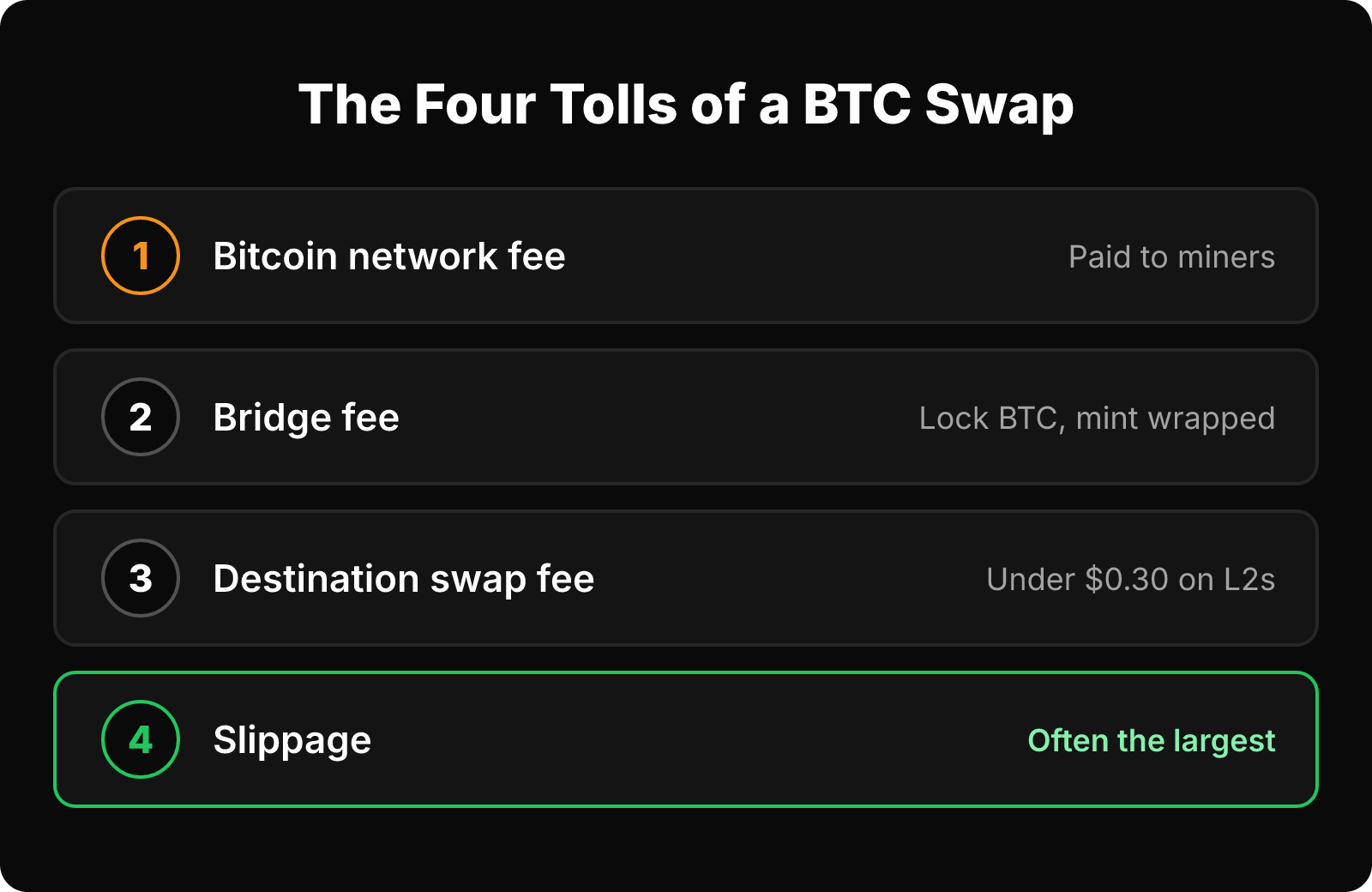
- Toll 1: The Bitcoin network fee. Every route begins with a Bitcoin transaction that moves your BTC into a bridge. You pay miners per virtual byte of data, and the rate rises and falls with mempool congestion. You can see live rates on mempool.space. Every bridge charges this toll, because they all start on Bitcoin.
- Toll 2: The bridge fee. The bridge protocol charges for locking your BTC and minting a wrapped version. Depending on the design, this can be a percentage fee, a flat fee, or a spread built into the exchange rate.
- Toll 3: The destination swap fee. If you want USDC or ETH instead of wrapped BTC, a DEX makes the trade. You pay the DEX's trading fee and the destination chain's gas. On Ethereum L2s, typical swaps cost under $0.30.
- Toll 4: Slippage. This is the difference between the price you were quoted and the price you actually got. It depends on the size of your trade relative to the size of the liquidity pool. Slippage appears on no fee schedule, and on thin pools it is often the largest cost of all.
There is a fifth, hidden toll if you ever want to go back to native BTC. The exit route pays its own bridge fee and Bitcoin network fee. When you compare routes, compare the round trip.
2026 Fee Comparison: Bitcoin L2s vs Ethereum L2s
The table below compares nine networks you might use to swap BTC DeFi assets in 2026. One caveat first: most Bitcoin L2s don't publish standard per-swap fee figures, so for them we give the qualitative fee tier from ecosystem reports instead of inventing exact numbers. The Ethereum L2 figures come from Spark's Bitcoin vs Ethereum fee tool.
| Network | Type | Typical Tx/Swap Cost | DeFi Liquidity Depth | How BTC Gets There |
|---|---|---|---|---|
| Bitcoin L1 | Base chain | Variable, set by mempool demand | No native DeFi | Native |
| Lightning | Payment channels | Near-zero | Payments only, not DeFi | Open a channel (on-chain tx) |
| Stacks | Bitcoin-anchored L2 (Clarity) | Low–medium | $129.5M DeFi TVL | sBTC peg |
| Rootstock | Merge-mined EVM sidechain | Low | ~$109M DeFi TVL | PowPeg (RBTC) |
| Bitlayer | EVM Bitcoin L2 | Low | $93.75M YBTC family TVL | Native bridge |
| Citrea | ZK rollup (BitVM2) | Low | ~$1.56M TVL (launched Jan 2026) | BitVM2 bridge |
| Arbitrum | Ethereum L2 | ~$0.27 per swap | Deep | Wrapped BTC (TeleBTC, WBTC, tBTC) |
| Base | Ethereum L2 | $0.01–$0.02 per USDC transfer | Deep | Wrapped BTC (TeleBTC, cbBTC) |
| Optimism | Ethereum L2 | Under $0.30 per swap | Moderate–deep | Wrapped BTC |
What does this tell you? On the third toll, the destination swap, Ethereum L2s and Bitcoin L2s are both cheap. Spark reports that Ethereum L2 gas stayed below 0.5 gwei in June 2026, which keeps typical swaps under $0.30. The networks really differ on liquidity depth, and that feeds straight into the fourth toll, slippage.
Why the Lowest Fee BTC Swap Isn't Always the Cheapest
Here's the point most fee comparisons miss: gas is a rounding error, and liquidity is the real fee.
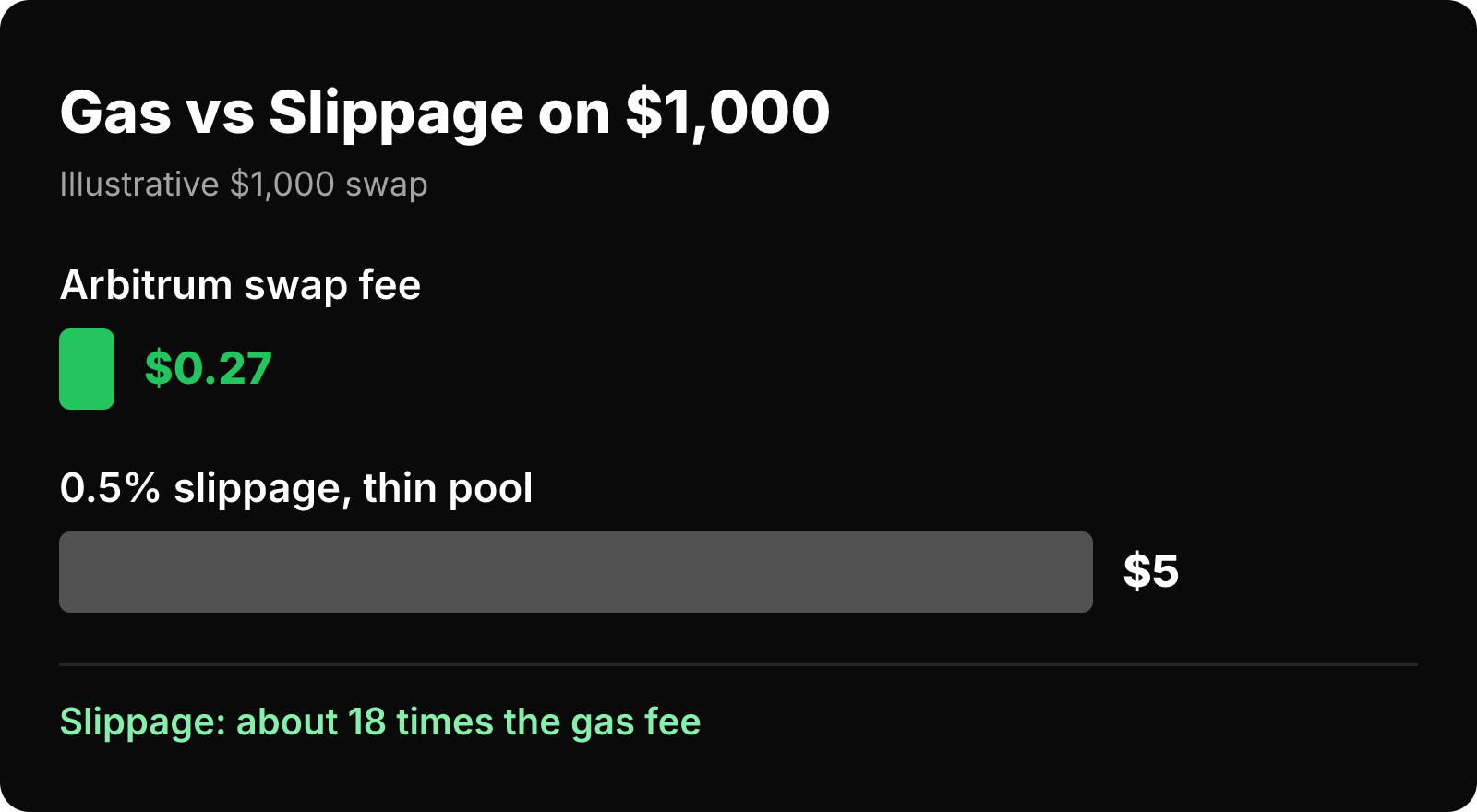
Here's an illustrative calculation. On a $1,000 swap, a $0.27 Arbitrum swap fee is 0.027% of the trade. If you route the same $1,000 through a thin pool on a newer network and get 0.5% slippage, you lose $5. That's about 18 times the gas fee. The network with the lowest advertised fee can end up costing more overall.
Three more factors decide whether a swap is really the lowest fee BTC swap for you:
- Trade size. For small trades, flat costs dominate (Bitcoin network fee, gas). For large trades, percentage costs dominate (bridge fee, slippage). A route that's cheapest for $200 may be expensive for $20,000.
- Hidden gas tokens. On many chains you need the native token, such as ETH, RBTC, or STX, just to pay for your first transaction. Buying that token is one more step and one more fee. Some bridges remove this step completely.
- Exit cost. Getting out of some Bitcoin L2s back to native BTC can involve waiting periods or peg-out queues. Time costs something too, especially in a moving market.
Our take: for most beginners in 2026, the cheapest total route goes to a deep Ethereum L2 like Arbitrum or Base through a bridge that lets you pay everything in Bitcoin. Bitcoin-native L2s are improving fast and are worth watching, especially Stacks and Rootstock. But on most of them today, thinner liquidity cancels out the low gas. See our decentralized Bitcoin exchange vs CEX comparison for a deeper cost breakdown.
DeFi Bitcoin Bridges in 2026: Who Do You Have to Trust?
Fees aren't the only price you pay. Every bridge asks you to trust something, and that trust carries a cost if it fails. Stacks' own 2026 L2 review notes that most BTC locked in L2s passes through some kind of bridge, so a major bridge failure would set the whole ecosystem back.
The wrapped-BTC market is also crowded. Eco's 2026 BTCfi analysis counts Coinbase's cbBTC (launched September 2024), Threshold's tBTC, FBTC, and Circle's newly announced cirBTC. Here is how the main DeFi Bitcoin bridges of 2026 compare on trust:
| Token | Who Holds the BTC? | How Minting Is Verified | Main Trust Assumption |
|---|---|---|---|
| WBTC | Centralized custodians (BitGo and partners) | Custodian attests to deposits | Trust the custodians |
| cbBTC | Coinbase | Coinbase mints against its reserves | Trust Coinbase |
| tBTC | Rotating group of threshold signers | Threshold signature scheme | Trust that a majority of signers stays honest |
| sBTC (Stacks) | Signer set | Signer threshold | Trust the signer set |
| TeleBTC (TeleSwap) | Collateral-backed Lockers (slashable) | SPV light client proof of the Bitcoin transaction | Bitcoin's proof-of-work plus slashable Locker collateral, with no custodian or multisig committee |
What's an SPV light client? SPV stands for Simplified Payment Verification, a method Satoshi Nakamoto described in the original Bitcoin whitepaper. A light client is a small program running on the destination chain that tracks Bitcoin's block headers. When you send BTC, the bridge submits cryptographic proof that your transaction is included in a real Bitcoin block. The light client checks that proof against Bitcoin's proof-of-work, and only then is TeleBTC minted.
That's the core difference. Unlike custodial bridges, TeleSwap mints nothing without a verified Bitcoin transaction, and the Lockers holding BTC are collateral-backed and slashable if they misbehave, according to the TeleSwap documentation. TeleBTC is the trust-minimized option: it inherits Bitcoin's security model directly instead of depending on a company's promise. For more on bridge security models, read our guide on cross-chain bridge security.
Walkthrough: How to Swap BTC Into DeFi With TeleSwap
Let's put this into practice. TeleSwap is a trustless Bitcoin bridge and swap protocol. It lets you move native BTC to EVM chains, TON, and Solana and swap into their tokens in one step. It has processed $506.2M in total volume across 537,163 bridge transactions and supports 13 networks, according to TeleSwap network stats. In the last 30 days it handled $44.3M in volume, about $1.5M a day, with a peak of $2.8M on September 18, 2026.
Here's how it handles each of the Four Tolls:
- Toll 1 (Bitcoin fee): You pay it once, from your own Bitcoin wallet, like any BTC transaction.
- Toll 2 + 3 (bridge and swap): Bridging and swapping happen in a single flow. BTC becomes TeleBTC, which is routed through a DEX into your chosen token. You pay all fees in Bitcoin assets.
- The hidden gas-token toll: Gone. A Teleporter pays the destination-chain gas for you, so you don't need ETH just to receive tokens on Arbitrum.
Example: Swap 0.01 BTC to USDC on Arbitrum
- Open the route. Go to the BTC to USDC on Arbitrum page on teleswap.xyz. Arbitrum is a strong default because its swaps cost about $0.27 and its liquidity is deep.
- Enter your amount. Type 0.01 BTC. The quote shows how much USDC you should receive after fees, so you see the total cost before you commit.
- Add your destination address. Paste your Arbitrum wallet address, for example from MetaMask. Double-check it. Crypto transactions can't be reversed.
- Send BTC from your own wallet. Confirm the Bitcoin transaction as instructed. Your BTC never sits in an exchange account.
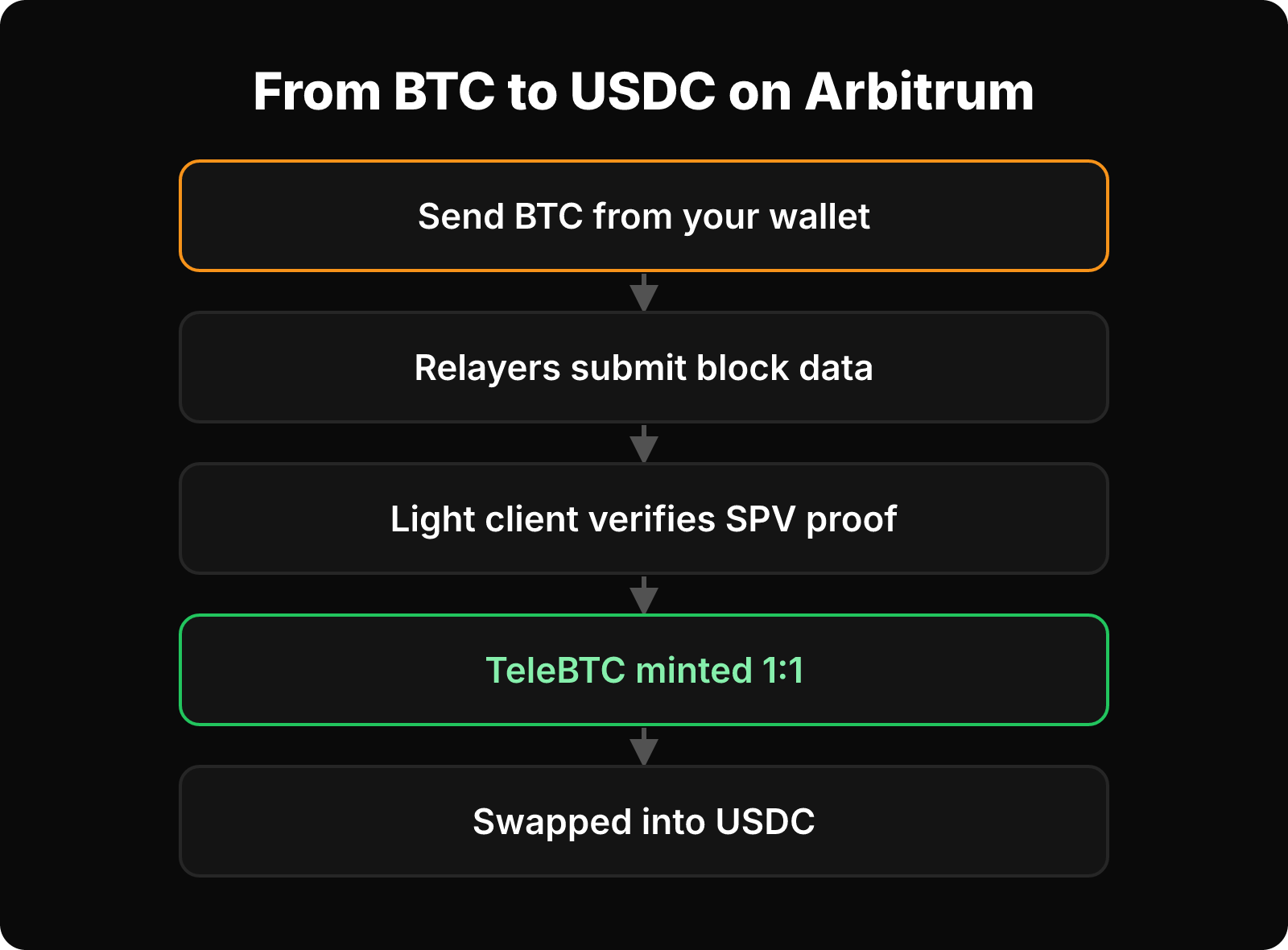
- Let the protocol verify. Once your transaction is in a Bitcoin block, Relayers submit the block data and the on-chain light client verifies the SPV proof. TeleBTC is minted 1:1 and swapped into USDC.
- Receive USDC. Fast swaps settle in about 10 minutes. Your USDC lands in your Arbitrum wallet, ready to lend, provide as liquidity, or hold.
Want to go back to Bitcoin later? The reverse route, USDC on Arbitrum to BTC, works the same way and returns native BTC to your Bitcoin address. If you'd rather use Base, where USDC transfers cost a cent or two, use the BTC to USDC on Base route instead.
Already using an aggregator? TeleSwap is integrated as a Bitcoin swap provider on Rango, Rubic, and DZap. You can compare its quote side by side with other routes through DEX routing platforms like Rango. That's a practical way to check you're getting the lowest total cost for your trade size.
Frequently Asked Questions
What is the cheapest way to swap BTC into DeFi in 2026?
For most people, the cheapest total route is bridging native BTC to a deep-liquidity Ethereum L2 like Arbitrum or Base, where swaps cost under $0.30. Compare the full round trip: Bitcoin network fee, bridge fee, swap fee, and slippage. Gas alone doesn't tell you much. Bitcoin L2s also have low gas, but thinner liquidity can mean more slippage on larger trades.
Do I need ETH to pay gas when swapping BTC to Arbitrum?
Not with TeleSwap: a Teleporter pays the destination-chain gas, and you pay all fees in Bitcoin assets. With some other routes, you first have to get the destination chain's native token (ETH on Arbitrum) to complete or claim the transfer, which adds a step and another fee.
Can I use the Lightning Network for DeFi swaps?
Mostly no. Lightning is built for fast, near-free BTC payments, not smart-contract DeFi. It's excellent for sending Bitcoin, but lending, liquidity pools, and token swaps happen on smart-contract chains such as Stacks, Rootstock, or Ethereum L2s.
What is TeleSwap?
TeleSwap is a trustless protocol for bridging, swapping, and earning on Bitcoin, using SPV light client verification to mint TeleBTC. When you bridge to swap BTC DeFi-style, it moves BTC to EVM chains, TON, and Solana by minting TeleBTC (a 1:1 collateral-backed representation of BTC) and can swap it into tokens like USDC or ETH in the same step. According to TeleSwap network stats, it has bridged $506.2M across 537,163 transactions on 13 networks.
Is wrapped BTC safe?
It depends on who you have to trust. WBTC and cbBTC rely on centralized custodians, and tBTC relies on a threshold signer group. TeleBTC is minted only after an on-chain light client verifies the Bitcoin transaction, and it is backed by slashable collateral. No bridge is risk-free, so check each design before you deposit. Our guide on bridge security and validator risks covers these trade-offs in depth.
How long does a BTC-to-DeFi swap take?
A TeleSwap fast swap settles in about 10 minutes. Bitcoin produces a block roughly every 10 minutes on average, and a bridge that verifies Bitcoin deposits has to wait for your transaction to be included on Bitcoin before minting anything on the destination chain.
What are the four hidden costs of a BTC swap?
The four tolls are: Bitcoin network fee, bridge fee, destination swap fee, and slippage. Most users focus only on the destination chain's gas fee, but that's usually the smallest cost. Slippage on thin liquidity pools often costs more than all the published fees combined.
Conclusion
The cheapest way to swap BTC DeFi assets in 2026 isn't the network with the lowest gas sticker price. It's the route with the lowest total across all Four Tolls. In practice, that usually means:
- Prioritize liquidity over gas. On a deep pool, a $0.27 swap beats a near-free swap that loses 0.5% to slippage.
- Cut out hidden steps. Routes that let you pay in Bitcoin and skip buying gas tokens save both money and hassle.
- Price in trust. An SPV-verified bridge like TeleSwap removes the custodian from the equation.
If you're ready to put idle BTC to work, start with a small amount, check the quote, and follow the walkthrough above.
This article is for educational purposes only and is not financial advice. Fees, liquidity, and network conditions change constantly, so always check live quotes before swapping.