Cross Chain BTC Swap Without KYC: 2026 DeFi Guide

A cross chain BTC swap without KYC lets you send Bitcoin from your own wallet and receive a token on another blockchain, such as USDC on Arbitrum or ETH on Base, without opening an account or handing over ID. The safest versions are non-custodial: code, not a company, decides whether the swap completes.
The usual alternative is a big exchange: make an account, upload your passport, take a selfie, wait for approval, deposit, trade, withdraw. That's a lot of paperwork just to move your own money from one blockchain to another. This guide covers how no-KYC swaps work, the main ways to do one in 2026, which of them can still freeze your money halfway through, and how to do your first cross chain BTC swap without KYC step by step.
Key Takeaways:A no-KYC swap is only as safe as whoever holds your coins mid-swap, so "non-custodial" matters more than "no ID required." This distinction separates trustless protocols from policy-dependent services.Several instant-swap services tightened their rules in 2026, and ChangeNOW now applies conditional identity checks based on location and activity flags. According to a StealthEX review last verified in August 2026, policies can change while your BTC sits in their deposit address.Classic Bitcoin atomic swaps are trustless but rarely practical in 2026, because you need a counterparty who wants the exact opposite trade at the same moment. Hash time-locked contracts enforce safety, but matching orders remains the bottleneck.TeleSwap is a non-custodial Bitcoin bridge that only mints TeleBTC after a light client on the destination chain has verified your Bitcoin transaction. This verification happens on-chain, without relying on a committee or custodian.As of October 5, 2026, TeleSwap has bridged $503.0M across 534,252 transactions on 12 supported networks, per TeleSwap network stats. This demonstrates real-world adoption of light-client-verified Bitcoin bridges at scale.
Table of Contents
- What Is a Cross Chain BTC Swap Without KYC?
- Non-Custodial Bitcoin Swap vs Custodial: Who Holds Your Coins?
- The Main Ways to Swap BTC Across Chains in 2026
- How Do the No-KYC BTC Swap Options Compare?
- How a Decentralized BTC Bridge Swap Works on TeleSwap
- Step by Step: How to Do a Cross Chain BTC Swap Without KYC
- What "No KYC" Doesn't Protect You From
- Frequently Asked Questions
- Conclusion
What Is a Cross Chain BTC Swap Without KYC?
A cross chain BTC swap without KYC is a trade where you send native Bitcoin from one blockchain and get an asset on another (USDC on Arbitrum or ETH on Base, for example) without opening an account or proving who you are.
Here are the three ideas behind it in plain language:
- KYC ("Know Your Customer") is the ID check banks and centralized exchanges run before they let you trade. Think of it as showing your passport at the bank counter.
- Cross-chain means moving value between two separate blockchains. Bitcoin and Ethereum don't talk to each other. They're like two countries with different currencies and no shared border control.
- A swap is the exchange itself: BTC goes in, a different token comes out.
Why is this hard? Bitcoin was built as a standalone payment network, as the Bitcoin whitepaper describes. It has no built-in way to "see" what happens on Ethereum, and Ethereum can't natively read Bitcoin. Every cross-chain swap needs something in the middle that convinces chain B that something really happened on chain A. What that "something" is decides everything else: whether you need ID, who can freeze your funds, and what can go wrong.
Non-Custodial Bitcoin Swap vs Custodial: Who Holds Your Coins?
Whether you need ID is a policy. Whether someone can hold your coins is a design choice. Policies can change overnight, so the design matters more.
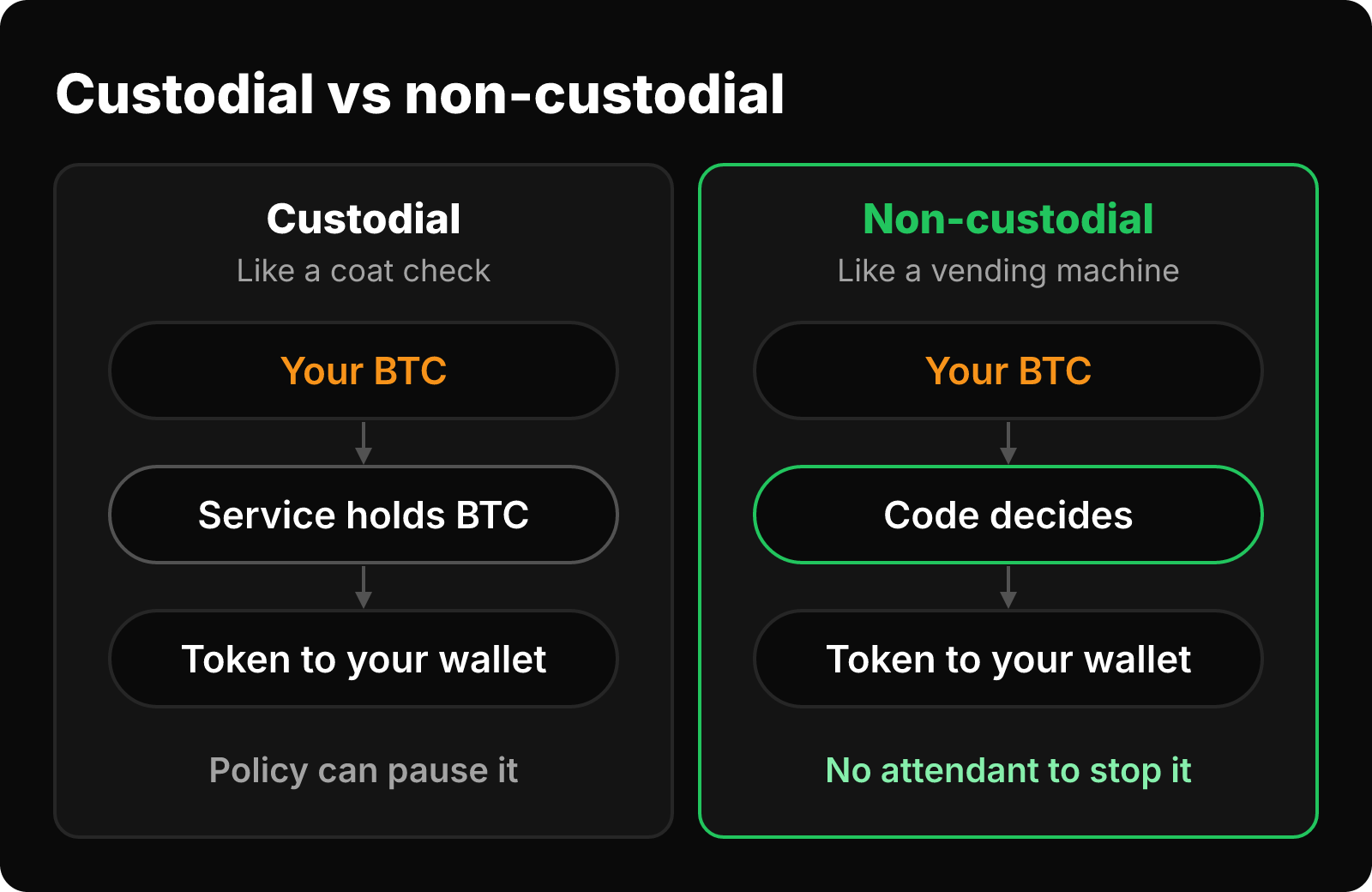
An analogy helps. A custodial swap is a coat check: you hand over your coat, get a ticket, and trust the attendant to give it back. Today the attendant doesn't ask for ID. Tomorrow they might, while your coat is still behind the counter. A non-custodial Bitcoin swap works more like a vending machine: you put money in, code decides what comes out, and there's no attendant who can change the rules mid-transaction.
This isn't hypothetical. In 2026, several popular "no-KYC" instant-swap services moved to risk-based identity checks. According to a StealthEX roundup last verified in August 2026, ChangeNOW revised its AML/KYC policy on July 17, 2026, so identity checks now depend on location and activity flags. Testing by GODEX's 2026 platform review put ChangeNOW's practical no-KYC threshold at roughly $2,000 and StealthEX's at about €700 before an ID request.
That doesn't make these services bad. It means "no KYC" there really means "no KYC unless we decide otherwise," and that decision can come while your BTC is already in their deposit address.
From where we sit as a cross-chain infrastructure team, the question we'd ask first isn't "do they ask for ID?" It's: at every second of this swap, is there a person or company who could stop it? If the answer is no, a change in someone's KYC policy can't trap your funds mid-swap.
The Main Ways to Swap BTC Across Chains in 2026
Almost every way to swap Bitcoin without KYC falls into one of four groups. Each one solves the "two countries, no border" problem differently.
1. Instant swap services (ChangeNOW, StealthEX, GODEX, Changelly)
Instant swap services take your BTC at a deposit address they provide and send the target token to your wallet. They're quick to use and support hundreds of assets. GODEX lists 934 cryptocurrencies and ChangeNOW 850+, according to GODEX's 2026 review. Changelly added a DeFi swap flow and business API on April 16, 2026. Several of these services describe themselves as non-custodial because they don't keep account balances for you. The trade-off: while the swap is in progress, your BTC sits at an address the service controls, and its compliance team can pause the swap.
2. Atomic swap Bitcoin 2026: trustless but niche
An atomic swap is a direct trade between two people on two blockchains, enforced by a "hash time-locked contract" (HTLC), so either both sides get paid or both get refunded. Picture two lockboxes that open with the same secret code: when one person opens their box to claim coins, the code becomes public, and the other person can use it to open theirs. If nobody opens anything before a deadline, both get their money back. The Bitcoin Wiki's atomic swap entry explains the mechanism in more detail.
In principle, atomic swaps are the most trustless option there is. In practice, you have to find someone who wants the exact opposite trade, at the same size, at the same time. Refund timeouts can also leave your BTC locked for hours if the other side walks away. That's why atomic swaps remain mostly a tool for enthusiasts.
3. Liquidity networks (THORChain)
THORChain swaps native assets using shared vaults controlled jointly by a network of bonded node operators. According to the THORChain documentation, those vaults are managed with threshold signatures, so no single node can move funds alone. It's permissionless at the protocol level and supports native BTC. You are trusting that the node set stays honest and well-run, though, and individual chains can be halted during emergencies.
4. Decentralized BTC bridge swap (TeleSwap)
A decentralized BTC bridge swap locks your Bitcoin, mints a 1:1 representation on the destination chain, and swaps it into the token you want, all in one flow. What matters is how the bridge confirms your BTC really arrived. Bridges secured by a small group of key-holders have been the industry's weak spot. Chainalysis reported in August 2022 that roughly $2 billion had been stolen across 13 bridge hacks that year, about 69% of all crypto stolen in 2022 up to that point. TeleSwap takes a different approach: the destination chain checks Bitcoin's own proof-of-work, so there's no committee whose approval it relies on. More on that below.
There's also a fifth, indirect route many beginners end up on: buying a custodial wrapped token like WBTC or cbBTC on a DEX. That avoids KYC for the trade itself, but the BTC behind those tokens is held by custodians (BitGo and its custody partners for WBTC, Coinbase for cbBTC), and minting or redeeming goes through the custodian's approved process.
How Do the No-KYC BTC Swap Options Compare?
The routes differ most on who holds your coins during the swap and whether anyone can stop it. Figures for instant-swap services come from GODEX's 2026 tested-platform review. TeleSwap figures come from its documentation.
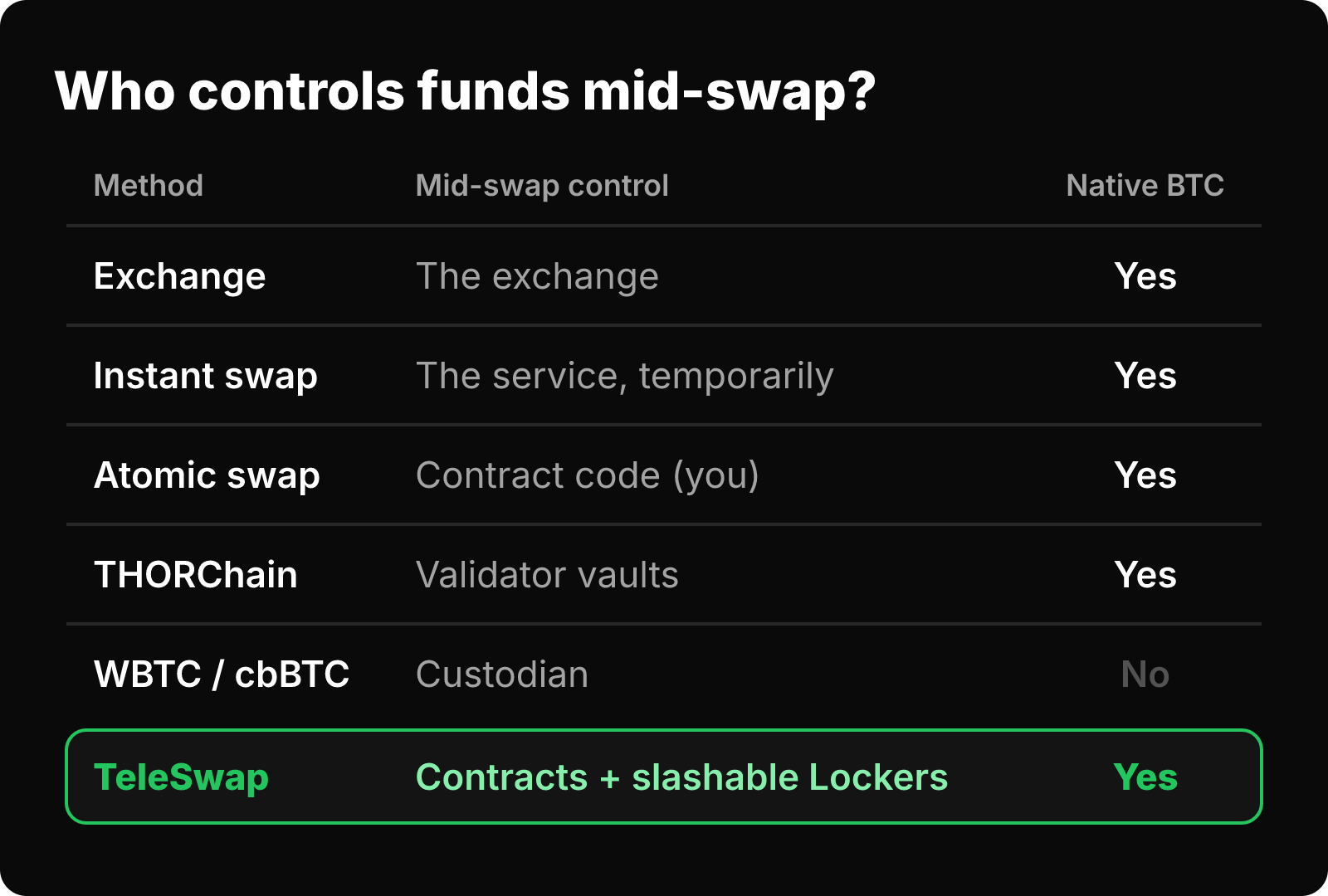
| Method | ID required? | Who controls funds mid-swap | Native BTC in/out | Typical speed |
|---|---|---|---|---|
| Centralized exchange (baseline) | Yes, full KYC | The exchange | Yes | Trade in under 1 min, plus deposit/withdrawal confirmations |
| Instant swap (ChangeNOW / StealthEX / GODEX) | Usually not, below thresholds (~$2,000 ChangeNOW, ~€700 StealthEX) | The service, temporarily | Yes | ~15 min (ChangeNOW, StealthEX); 5–30 min (GODEX) |
| Atomic swap (HTLC) | No | Contract code (you) | Yes | Varies; refunds can take hours if counterparty fails |
| THORChain | No (protocol level) | Validator vaults (threshold signatures) | Yes | Depends on chain confirmations |
| WBTC / cbBTC bought on a DEX | No for the DEX trade | Custodian holds the underlying BTC | No, needs a separate redemption path | Seconds to minutes on the DEX |
| TeleSwap | No account. Permissionless protocol | Smart contracts + collateral-backed, slashable Lockers | Yes (BTC in, BTC out) | ~10 min for fast swaps |
Instant-swap services are convenient but rely on someone's policy. Atomic swaps are trustless but impractical. TeleSwap aims for the middle: verification is done by code, like an atomic swap, and it's as easy to use as an instant swap.
How a Decentralized BTC Bridge Swap Works on TeleSwap
TeleSwap is a non-custodial Bitcoin bridge that lets you bridge, swap, and earn on Bitcoin, moving BTC to EVM chains, TON, and Solana, verified by a Bitcoin light client instead of a custodian or multi-sig committee.
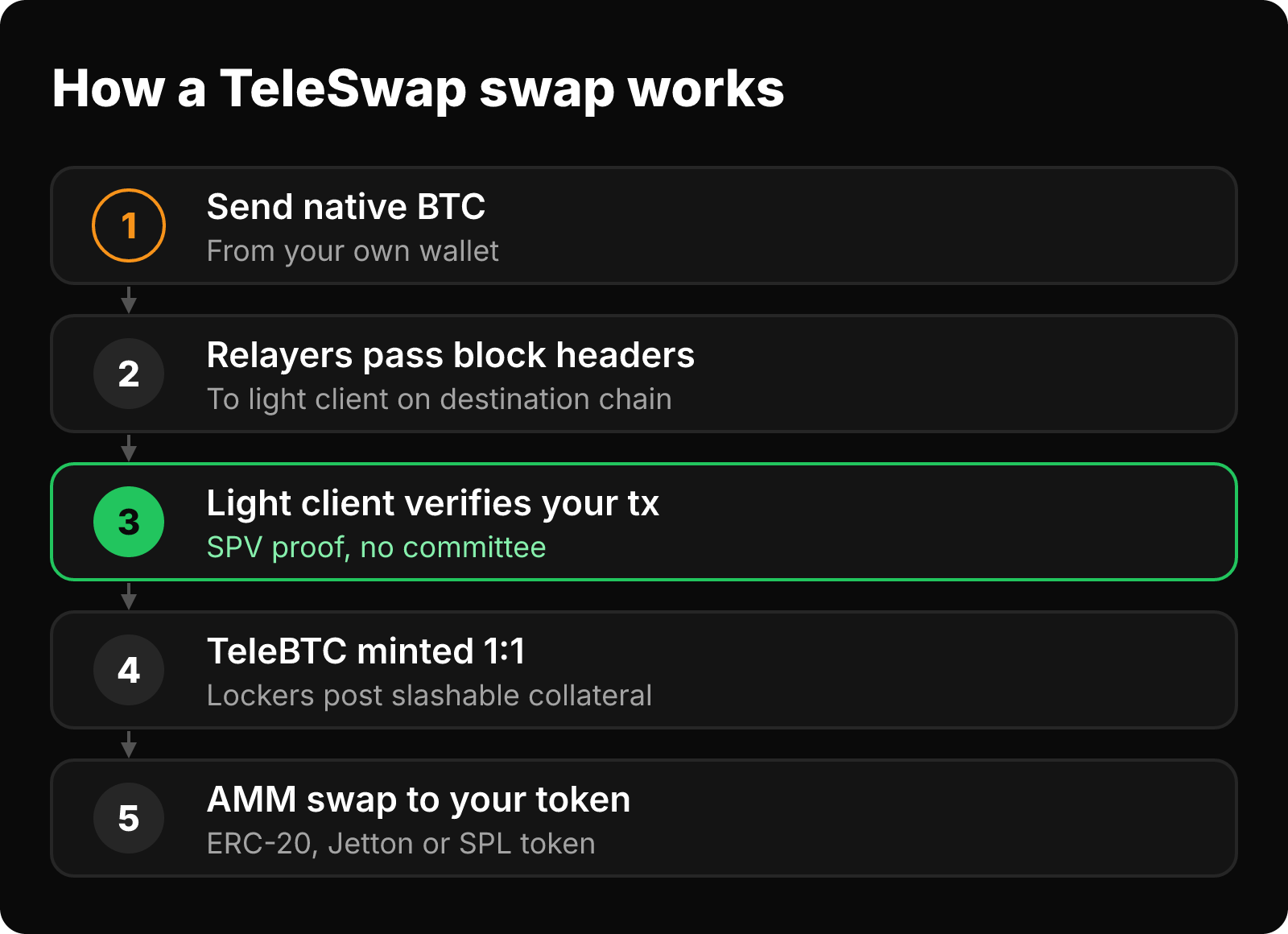
The key piece is the light client. Here's the analogy: you don't need to read an entire library to check that a book is real. You check the publisher's stamp and its place in the catalogue. A Bitcoin light client works the same way. It tracks Bitcoin's block headers (the "stamps," each backed by real proof-of-work mining), then checks a short SPV proof (Simplified Payment Verification) showing your transaction is included in one of those blocks. If the proof checks out, the contract knows your BTC really moved, without asking anyone.
Here's what happens behind the scenes when you execute a cross chain BTC swap without KYC on TeleSwap, per the TeleSwap documentation:
- You send native BTC from your own wallet, with your swap request attached.
- Relayers pass Bitcoin block headers to the light client contract on the destination chain.
- The light client verifies that your transaction is in a valid Bitcoin block. Nothing is minted without a verified Bitcoin transaction.
- TeleBTC is minted 1:1. TeleBTC is TeleSwap's trust-minimized wrapped Bitcoin. The BTC behind it sits with Lockers, permissionless operators who must post collateral that the protocol can slash if they misbehave.
- The AMM/DEX swap runs automatically, turning TeleBTC into the token you picked (an ERC-20, Jetton, or SPL token) and sending it to your address.
Two features make this especially friendly for beginners. First, you pay all fees in Bitcoin assets. A Teleporter covers destination-chain gas for you, so you don't need ETH in your wallet before you can receive anything. Second, the whole route is one click: bridge and swap happen together, and fast swaps settle in about 10 minutes.
People are using it at scale. As of October 5, 2026, TeleSwap network stats show $503.0M in total volume bridged across 534,252 transactions on 12 supported networks. In the last 30 days alone, $43.0M moved through the protocol, about $1.4M per day, peaking at $2.8M on September 18, 2026.
You don't even need to start at teleswap.xyz. TeleSwap is built in as a Bitcoin swap provider on the aggregators Rango, Rubic, and DZap, and through the Rango integration it's reachable from MetaMask and Trust Wallet.
Step by Step: How to Do a Cross Chain BTC Swap Without KYC
Here's a realistic example. Maya is a freelance designer who gets paid in Bitcoin. She wants $500 worth of USDC on Arbitrum to pay a contractor, and she doesn't want to open an exchange account just for that. Here's how she'd do a cross chain BTC swap without KYC on TeleSwap.
Step 1: Set up two self-custody wallets
Maya needs a Bitcoin wallet where she controls the keys (any reputable self-custody BTC wallet works) and a destination wallet, such as MetaMask, for Arbitrum. "Self-custody" means only she holds the recovery phrase. Write it down offline, and never type it into a website.
Step 2: Choose the route
She opens teleswap.xyz and picks BTC → USDC on Arbitrum. If she wanted gas money on a different chain instead, a route like BTC → ETH on Base works the same way.
Step 3: Enter the amount and review the quote
She types the BTC amount and checks the quote: the estimated USDC she'll receive, the fees (paid in Bitcoin assets), and the expected settlement time. If she's swapping a meaningful amount for the first time, a small test swap first is a sensible habit.
Step 4: Paste the destination address and double-check it
She pastes her Arbitrum address. Then she checks the first and last few characters against MetaMask. Crypto transactions can't be reversed, and clipboard-hijacking malware is real.
Step 5: Send the BTC from her own wallet
She signs and sends the Bitcoin transaction. From here on, verification is done by code. No support agent has to approve anything.
Step 6: Wait for verification and delivery
Once her Bitcoin transaction is in a block, the light client verifies it, TeleBTC is minted and swapped, and USDC lands in her Arbitrum wallet. Fast swaps take around 10 minutes. She doesn't need ETH on Arbitrum for gas, because a Teleporter covers it.
Step 7: Going back to Bitcoin
Later, if Maya wants her savings back in BTC, she runs the reverse route, USDC on Arbitrum → BTC, and receives native Bitcoin at her own BTC address. For more on bridge-related topics, see our guide to BTC to WBTC bridges and fees.
Compare that with the exchange route from the intro: no account, no document upload, no withdrawal review, and no compliance desk that can pause the swap partway through.
What "No KYC" Doesn't Protect You From
Skipping KYC removes paperwork, not risk. Here's what can still go wrong:
- No KYC isn't the same as anonymous. Bitcoin and EVM chains are public ledgers. Anyone can see transactions, and analytics firms specialize in linking addresses. Your privacy depends on how you use your wallets, not just on whether you showed ID.
- Smart contract risk exists. Even trust-minimized designs run on code, and code can have bugs. Bridges have been a major target: Chainalysis counted around $2 billion stolen from bridges in 2022 by August of that year. Prefer designs that don't depend on a small group of key-holders, and only swap amounts you're comfortable with.
- Phishing is one of the most common everyday threats. Bookmark the real site (teleswap.xyz) and never enter your seed phrase anywhere. For more on bridge security, read our article on Ethereum validator security and bridge risks.
- Laws and taxes still apply. Using non-custodial software doesn't change your local legal or tax obligations. Swapping one crypto asset for another can be a taxable event in many countries. This article isn't legal or tax advice.
- Front-ends can vary by region. As the 2026 StealthEX review notes for Uniswap, interface-level restrictions can differ by jurisdiction even when the protocol itself is permissionless.
And one honest point: atomic swaps remain the gold standard for trustlessness. If you're technical, have a counterparty, and don't mind waiting, they're worth learning. For most people who need to move BTC across chains today, a light-client bridge gets close to that level of trust while being far easier to use.
Frequently Asked Questions
Is it legal to swap BTC across chains without KYC?
In many countries, using non-custodial software to swap your own crypto is legal, but rules vary by jurisdiction. KYC requirements usually apply to companies that hold customer funds, like exchanges, not to self-custody wallets or smart contracts. You're still responsible for following local laws and reporting taxes. Check with a qualified professional where you live.
What is the safest way to do a cross chain BTC swap without KYC?
The safest approach is a non-custodial method where code, not a company or committee, confirms your Bitcoin transaction. Atomic swaps and light-client bridges such as TeleSwap both fit that description. Instant-swap services can be convenient, but they can pause swaps for compliance reviews while your funds sit at their deposit address.
Are atomic swaps for Bitcoin still used in 2026?
Yes, but mostly by technical users. Atomic swaps use hash time-locked contracts so both sides either get paid or get refunded. They need a counterparty who wants the opposite trade at the same moment, and refund timeouts can lock funds for hours. That's why much of everyday cross-chain BTC activity goes through bridges and liquidity networks instead.
Does TeleSwap require KYC or an account?
No. TeleSwap is a permissionless, non-custodial protocol, so you swap directly from your own wallets with no account to open. Smart contracts carry out the swap after a Bitcoin light client verifies your transaction. As of October 5, 2026, TeleSwap had processed 534,252 bridge transactions on 12 networks, according to TeleSwap network stats.
How long does a cross-chain BTC swap take on TeleSwap?
Fast swaps on TeleSwap settle in about 10 minutes. The time includes your Bitcoin transaction being included in a block and verified by the light client, then the TeleBTC mint and DEX swap on the destination chain. Fees are paid in Bitcoin assets, and a Teleporter covers destination-chain gas.
What is TeleBTC and how is it different from WBTC?
TeleBTC is TeleSwap's 1:1 Bitcoin-backed token, minted only after an SPV light client verifies a real Bitcoin transaction. WBTC and cbBTC rely on custodians (BitGo and its partners for WBTC, Coinbase for cbBTC) holding the underlying BTC. TeleBTC instead inherits Bitcoin's security model directly, and the Lockers holding the BTC must post slashable collateral. Learn more in our comparison of BTC to WBTC conversion without KYC.
Is a no-KYC swap anonymous?
No. A no-KYC swap means you don't hand over ID, but every transaction is still recorded on public blockchains. Anyone can trace the path between addresses, and blockchain analytics firms do this professionally. Treat no-KYC as "no paperwork," not "invisible." For privacy-focused approaches, explore private Bitcoin transfers.
Conclusion
Swapping Bitcoin across chains without KYC is easy in 2026. Picking the right method is the harder part. Remember three things:
- Custody matters more than KYC policy. Ask who could stop your swap halfway through, not just whether they ask for ID today.
- Atomic swaps are trustless but impractical, and instant-swap services are easy but rely on someone else's policy.
- Light-client bridges like TeleSwap verify Bitcoin's proof-of-work on-chain, mint TeleBTC 1:1, and deliver your target token in about 10 minutes on fast swaps. TeleSwap has done this for $503.0M in volume across 534,252 transactions, per TeleSwap network stats.
Start with a small amount to get comfortable: pick a route, paste your address, send BTC from your own wallet, and watch it arrive.