Bitcoin Wrapping on Solana: Beginner Bridge Guide 2026

Bitcoin wrapping on Solana means locking real BTC on the Bitcoin network and receiving a token on Solana that represents it 1:1. Native BTC can't sit in a Solana wallet, and there's no "receive BTC" button to look for. Every route from Bitcoin to Solana goes through a bridge, an exchange, or a swap protocol.
Most guides skip one point: every wrapped Bitcoin token on Solana depends on someone or something being honest. Who that is changes from token to token, and it's the most important thing to check before you bridge. This guide explains how wrapping works, compares the main ways to get Bitcoin onto Solana in 2026, and walks through a swap from start to finish.
Key Takeaways:Native BTC cannot sit in a Solana wallet, so every route from Bitcoin to Solana uses a bridge, an exchange, or a swap protocol.A wrapped Bitcoin token is a claim on BTC held somewhere else, and it is only as safe as whoever (or whatever) controls that BTC.Bitcoin bridges fall into three trust models: a single custodian, a committee of signers, or on-chain light-client verification of Bitcoin's own proof-of-work.TeleSwap verifies Bitcoin transactions with SPV light-client proofs and, according to its documentation, delivers tokens on Solana in about 20 minutes, or about 10 minutes with a fast swap.According to TeleSwap network stats, the protocol has bridged $504.3M across 535,653 transactions on 13 supported networks.
Table of Contents
- What Is Bitcoin Wrapping on Solana?
- Why Move Bitcoin to Solana? Cross-Chain Bitcoin in 2026
- How Does a Bitcoin Bridge to Solana Work?
- Wrapped Bitcoin on Solana: 4 Options Compared
- The Three-Question Test for Any Bitcoin Bridge
- Do You Need a Wrapped Token at All?
- Step-by-Step: Swapping BTC to Solana with TeleSwap
- Risks to Understand Before You Bridge
- Frequently Asked Questions
- Conclusion
What Is Bitcoin Wrapping on Solana?
Bitcoin wrapping on Solana means locking real BTC on the Bitcoin network and creating a matching token on Solana that represents it, 1:1. The Solana token is the "wrapped" Bitcoin. It follows Solana's rules, so it fits in Solana wallets and works with Solana apps. Solana calls this kind of token an SPL token, the same way Ethereum calls its tokens ERC-20s.
Think of a coat check. You hand over your coat (BTC), get a numbered ticket (the wrapped token), and later trade the ticket back for the coat. The ticket only has value if the coat is still on the rack and the attendant gives it back.
Almost every wrapped asset follows the same four steps, usually called lock–mint–burn–unlock:
- Lock: You send BTC to an address the bridge controls on Bitcoin.
- Mint: Once the bridge sees the deposit, it creates ("mints") the same amount of wrapped BTC on Solana.
- Burn: When you want out, you destroy ("burn") the wrapped tokens on Solana.
- Unlock: The bridge releases the same amount of real BTC back to your Bitcoin address.
The Backpack Exchange bridging guide describes the same model and names the catch: wrapped tokens carry counterparty risk if the bridge is compromised. Every bridge uses these four steps. Bridges differ in two places: who decides the deposit actually happened before minting, and who controls the locked BTC.
Why Move Bitcoin to Solana? Cross-Chain Bitcoin in 2026
People move BTC to Solana so they can use it in fast, cheap apps that don't exist on Bitcoin. Bitcoin is very good at being secure, hard money. Its base layer isn't built for trading, lending, or stablecoin payments. Solana is.
Solana's infrastructure got faster again in 2026. According to CoinMarketCap's Solana update tracker, block production (slot time) dropped from 300ms to 250ms on 18 September 2026. The maximum transaction size grew from 1,232 bytes to 4,096 bytes with the Transaction V1 format on 9 September 2026. Block compute capacity was raised to 100M compute units on 29 July 2026.
Liquidity matters too. A 2026 ecosystem review put Solana's stablecoin supply at more than $14 billion. That's why "BTC to Solana USDC" is one of the most common cross-chain Bitcoin requests: people want spendable dollars on a fast chain without first selling on a centralized exchange.
For comparison, Bitcoin produces a block about every 10 minutes on average, per the Bitcoin whitepaper. Solana produces one about every quarter of a second. A bridge has to connect these two very different speeds, and how it handles that gap tells you a lot about how safe it is.
How Does a Bitcoin Bridge to Solana Work?
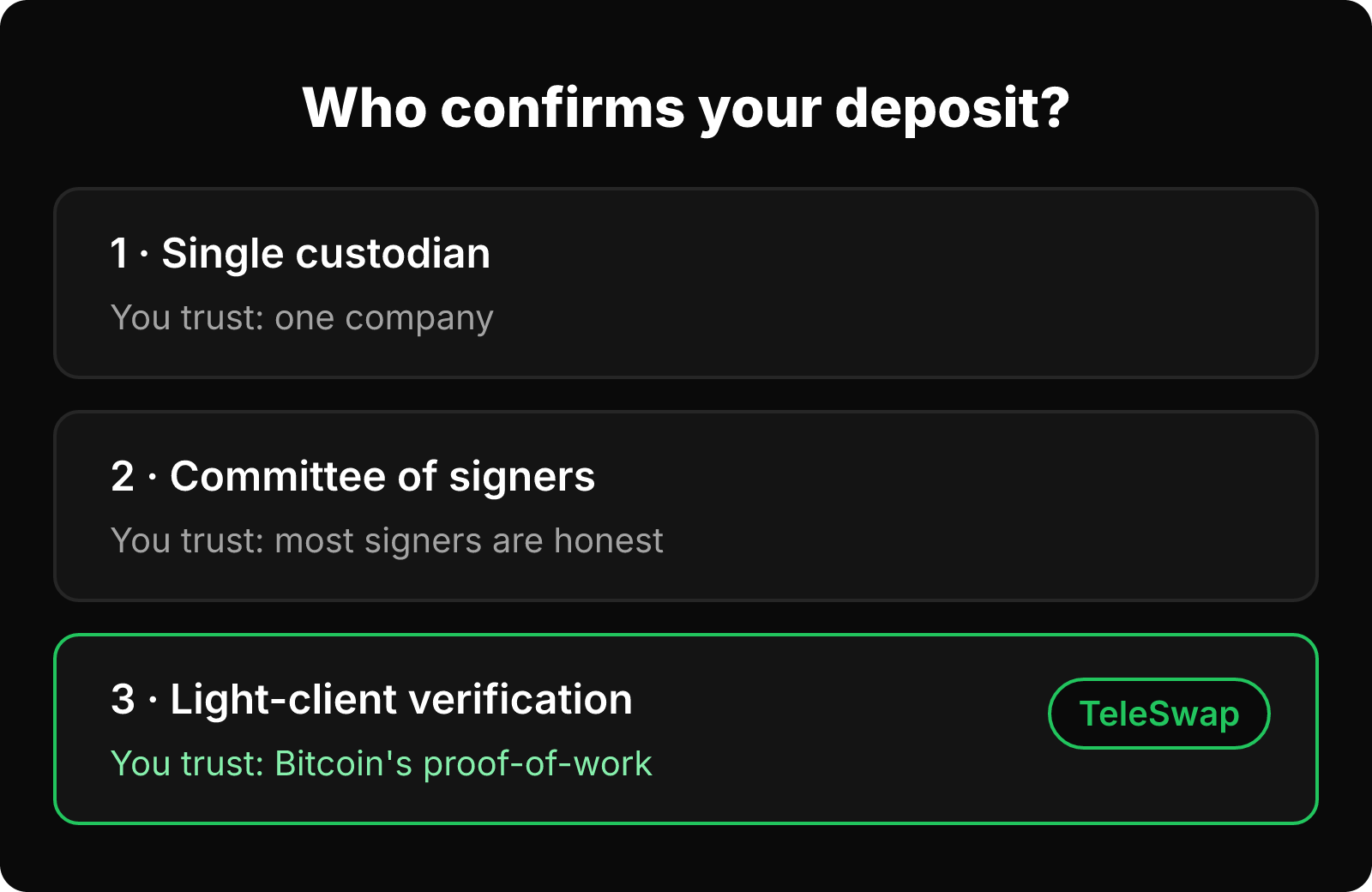
A Bitcoin bridge to Solana watches the Bitcoin blockchain for your deposit and then authorizes a matching action on Solana. Your safety depends on how it watches and who authorizes. There are three basic designs.
Model 1: The single custodian
One company holds the BTC and mints the wrapped token. It's simple and usually very liquid, but you trust that company completely: its solvency, its security, and its willingness to redeem. This is the bank-deposit model.
Model 2: The committee
A group of signers must agree before tokens are minted or BTC is released. The group can be a multi-signature wallet, a guardian network, or a threshold-signature group. Spreading control across several parties removes the single point of failure, but you still trust that most of the committee is honest and stays secure. Wormhole's documentation describes a network of 19 "guardians," and a supermajority of them must sign each message.
Model 3: Light-client verification
In this model, code on the destination chain checks Bitcoin's own proof directly. A light client is a small program that stores Bitcoin's block headers (short summaries of each block) and checks them against Bitcoin's consensus rules. An SPV proof (Simplified Payment Verification, described in section 8 of the Bitcoin whitepaper) is a compact proof that a specific transaction is included in one of those blocks.
TeleSwap uses this third model. According to the TeleSwap light-client bridge documentation, a Relay contract on the destination chain stores Bitcoin block headers. Relayers keep submitting new headers, and the contract checks each one against Bitcoin's consensus rules. Anyone can then submit an SPV proof for a specific transaction. The contract does the checking, not a trusted validator set, so nothing is minted unless a real Bitcoin transaction is proven.
In short: Model 1 asks you to trust a company to confirm deposits, and Model 2 asks you to trust a committee. Model 3 relies on Bitcoin's proof-of-work, the same security that protects the BTC you already hold.
Wrapped Bitcoin on Solana: 4 Options Compared
"Wrapped Bitcoin on Solana" isn't one asset. It's several different claims, each with its own issuer and trust model. Two tokens can both have "BTC" in the name and carry very different risks. Here's how the main routes compare on the points that matter most.
| Option | Who controls the locked BTC | Who confirms your deposit | How it reaches Solana | What lands in your Solana wallet |
|---|---|---|---|---|
| cbBTC (Coinbase) | Coinbase (centralized custodian) | Coinbase | Issued on Solana by Coinbase | cbBTC (SPL token) |
| WBTC via Wormhole | WBTC custodians (BitGo-led custody) | Custodian, then Wormhole's guardian network | Lock-and-mint across Wormhole from Ethereum | Wormhole-wrapped WBTC (a wrapped token of a wrapped token) |
| tBTC (Threshold Network) | Rotating group of threshold signers | Threshold signers / Ethereum contracts | Bridged via Wormhole | tBTC (SPL token) |
| TeleSwap | Collateral-backed, slashable Lockers | Bitcoin light client checking SPV proofs on-chain | Direct Bitcoin → Solana route in one step | USDC today (more SPL tokens coming, per TeleSwap docs) |
Look at the WBTC row. WBTC on Solana stacks two trust layers: the original WBTC custody arrangement and the bridge that moved it from Ethereum. If either layer fails, the token can lose its backing.
Two lessons Solana users already learned the hard way
Past incidents show why the trust question matters. In February 2022, an attacker exploited Wormhole's Solana contracts and minted about 120,000 wrapped ETH with no backing, worth roughly $320 million at the time, as reported by CoinDesk. The flaw was in signature verification: the bridge accepted a forged approval. Wormhole's backers replaced the funds, and the bridge has been heavily audited since. The lesson is about design: if a bridge mints based on an approval message, a forged approval can mint tokens out of nothing.
The second lesson came in November 2022. Sollet-wrapped Bitcoin (soBTC), one of Solana's early BTC tokens, was tied to FTX and Alameda. When they collapsed, soBTC lost its peg because holders could no longer count on redemption. The token itself kept working on Solana. The problem was the BTC behind it.
The Three-Question Test for Any Bitcoin Bridge
Our view at TeleSwap: bridge marketing focuses on speed and fees, but whether your BTC survives usually comes down to how the bridge fails. Before you use any bitcoin bridge on Solana, ask three questions:
- Who can say "no" to my redemption? If one company can freeze or refuse it, you hold an IOU from that company. If a committee can, you're trusting most of its members.
- What proves my deposit happened? A signature from a group of people is not the same as a cryptographic proof checked against Bitcoin's proof-of-work chain. The first can be forged or coerced. Faking the second would require out-mining the Bitcoin network.
- What happens if the operator misbehaves? Look for consequences enforced by code, such as collateral that can be taken ("slashed"), not just legal or reputational ones.
Here's how TeleSwap answers them. Deposits are proven with SPV proofs against Bitcoin headers stored on-chain (question 2). Lockers hold the BTC and post collateral, and the TeleSwap documentation says anyone can submit proof that a Locker moved BTC without a valid unwrap, which triggers slashing (question 3). On the way out, a Locker pays your BTC and has to prove that payment to the light client to complete the request. The protocol's roles are permissionless, so no single gatekeeper decides who can run them (question 1).
No bridge is risk-free, and smart-contract bugs are a real risk for every design. But a bridge that verifies Bitcoin's proof directly doesn't need you to trust whoever approves deposits. It also backs custody with slashable collateral rather than reputation alone.
Do You Need a Wrapped Token at All?
Often you don't. Many people who search for bitcoin wrapping on Solana actually want something else on Solana, usually stablecoins. If you'll swap your wrapped BTC into USDC as soon as it arrives, holding the wrapped token in between only adds an extra transaction and an extra issuer to trust.
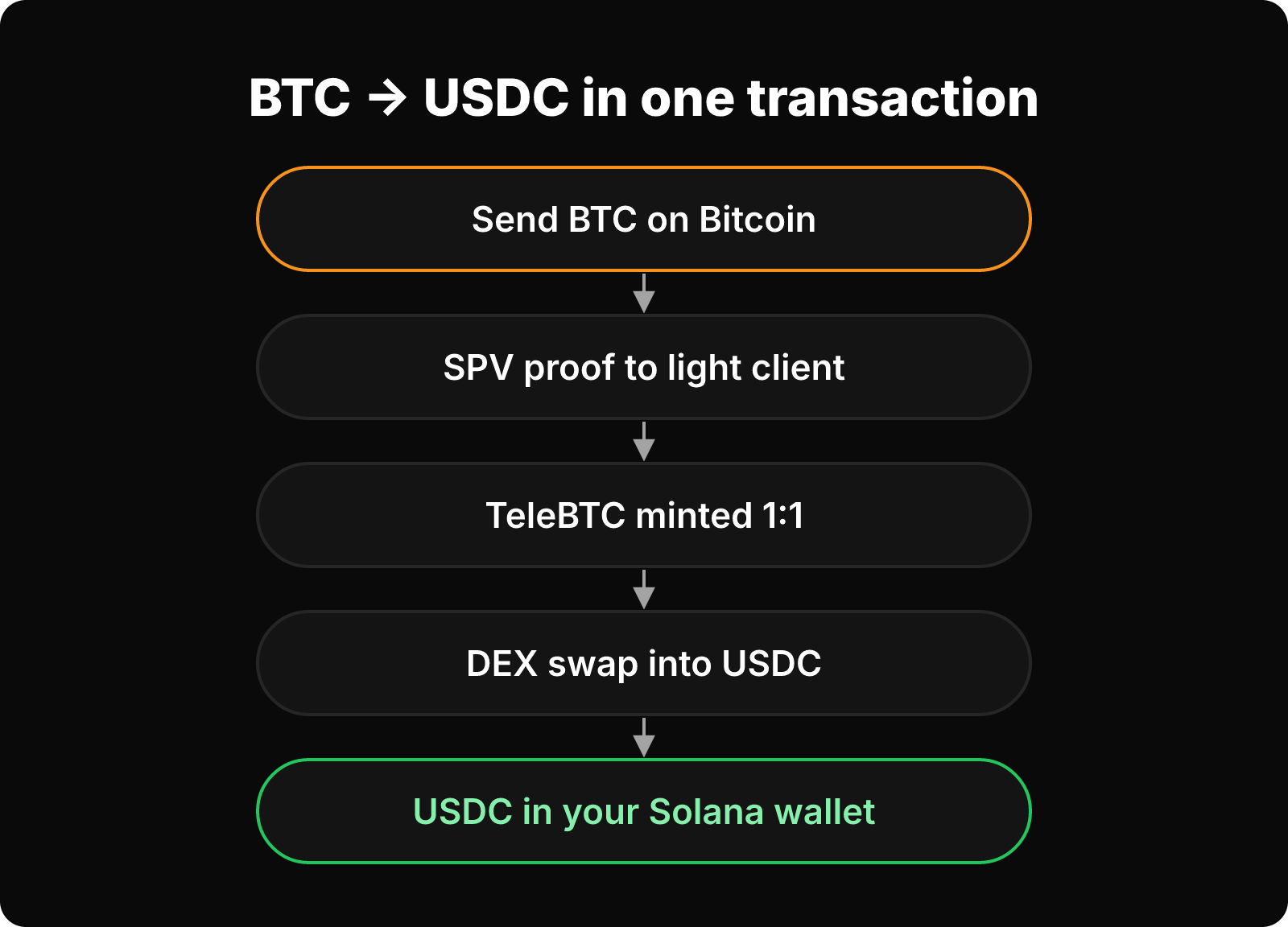
TeleSwap does both steps at once. You send BTC on Bitcoin, and the protocol verifies the transaction and mints TeleBTC (its 1:1 collateral-backed representation of BTC) behind the scenes. It then routes the TeleBTC through a DEX into the token you picked. On Solana, that token is USDC today, according to the supported assets page. You get spendable dollars on Solana from one Bitcoin transaction, and no custodial wrapped token passes through your wallet.
If you want a BTC-pegged token to hold on a smart-contract chain, TeleSwap's Solana route doesn't offer that yet, but its EVM routes do. For example, you can go BTC → WBTC on Arbitrum or BTC → cbBTC on Base through the same light-client-verified bridge. Pick a route based on what you'll actually do with the funds.
Step-by-Step: Swapping BTC to Solana with TeleSwap
Here's the full flow for moving BTC to USDC on Solana with TeleSwap. As an example, we'll send 0.05 BTC.
Before you start
- A Bitcoin wallet holding the BTC you want to move, plus enough extra for the Bitcoin network fee.
- A Solana wallet address you control to receive the USDC. Copying the address wrong is the most common beginner mistake.
The walkthrough
- Open teleswap.xyz. There's no separate app subdomain. Everything runs on the main site.
- Pick your route. Choose Bitcoin as the source, Solana as the destination, and USDC as the token to receive. The app always shows the routes and tokens that are currently live.
- Enter your amount. Type 0.05 BTC. The quote shows the estimated USDC you'll receive and a fee breakdown.
- Check the fees. Per the TeleSwap fees documentation, the Locker fee is 0.1% of the bridged amount, which is 0.00005 BTC on 0.05 BTC. A network fee covers the Solana-side gas. A Teleporter pays that gas upfront for you, so you don't need SOL in advance. The protocol fee may be 0.
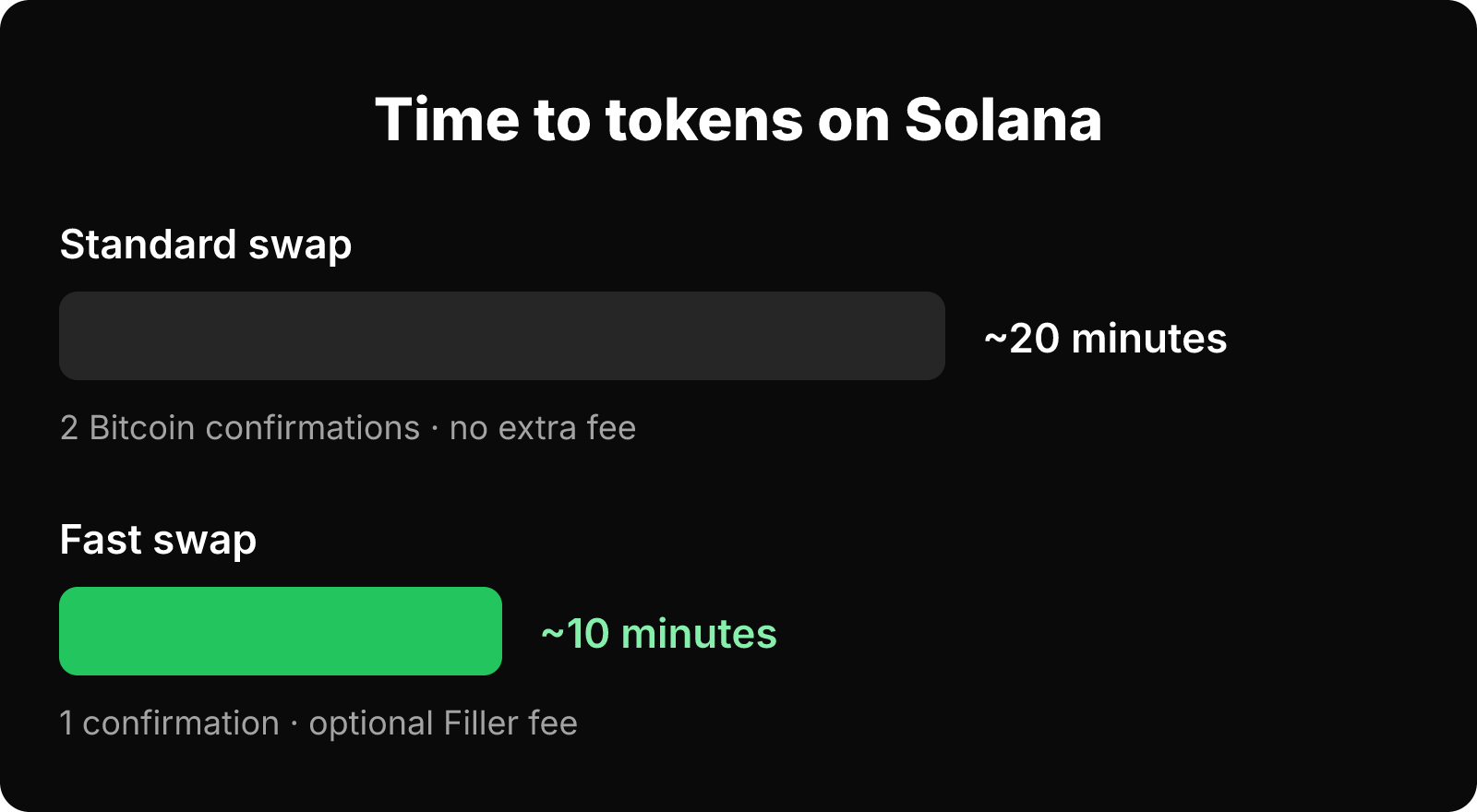
- Choose your speed. A standard swap waits for two Bitcoin confirmations (about 20 minutes). A fast swap delivers after one confirmation (about 10 minutes) for an optional Filler fee.
- Enter your Solana address and send the BTC. Sign the Bitcoin transaction from your wallet. It's the only transaction you send.
- Wait for verification. Once your transaction confirms, it's proven to the light client with an SPV proof. TeleBTC is minted, swapped into USDC, and delivered to your Solana address.
Fees and timing at a glance
| Item | Standard swap | Fast swap |
|---|---|---|
| Bitcoin confirmations required | 2 | 1 |
| Typical time to tokens on Solana | ~20 minutes | ~10 minutes |
| Locker fee | 0.1% | 0.1% |
| Destination gas | Paid upfront by a Teleporter, charged in BTC terms | Paid upfront by a Teleporter, charged in BTC terms |
| Extra speed fee | None | Optional Filler fee |
Source: TeleSwap Fees & Speed and Fast Swaps documentation.
Why does a fast swap cost extra?
Waiting for confirmations protects you. If TeleSwap minted before your Bitcoin transaction was final, a chain reorganization (a "re-org," when recent blocks get replaced) could leave unbacked TeleBTC behind. In a fast swap, a Filler watches the Bitcoin mempool (the queue of pending transactions), spots your request, locks in your rate, and pays you after one confirmation. When the second confirmation arrives, the minted TeleBTC goes to the Filler to repay it. The Filler takes on the re-org risk, and its fee covers that risk.
Going back to Bitcoin
The return trip runs in reverse. After your Solana transaction confirms, a Locker sends native BTC to your Bitcoin address, and the payout shows up in the mempool within a few minutes, per the documentation. The Locker then has to prove that payment to the light client to complete the request.
The system already handles real volume. TeleSwap network stats show $504.3M in total volume bridged across 535,653 transactions. In the last 30 days alone it handled $43.6M, about $1.5M a day, with a peak of $2.8M on 18 September 2026. TeleSwap is also a Bitcoin swap provider inside the Rango, Rubic, and DZap aggregators, and it's available through Rango in MetaMask and Trust Wallet.
Risks to Understand Before You Bridge
Every cross-chain transfer carries some risk, and beginners should know what it is before sending real money. These are the main ones, whichever bridge you use:
- Smart-contract risk: Bridge code can have bugs. The 2022 Wormhole exploit described in CoinDesk's coverage came from a verification bug, not a stolen key.
- Issuer risk: With custodial wrapped tokens, your redemption depends on one organization staying solvent and cooperative. For more on this, see our guide on cross-chain bridge security.
- Slippage: When a route includes a swap (BTC into USDC, for example), the final amount can differ slightly from the quote if prices move. Always check the minimum amount you'll receive, as Rango's bridge guide recommends.
- Address errors: Funds sent to the wrong chain or a mistyped address usually can't be recovered.
- Fake tokens: Anyone can create an SPL token called "BTC." Check the token's mint address against the issuer's official documentation.
A good habit is to send a small test amount first, confirm it arrives, and then send the rest. It costs a little more in fees and protects you from an expensive mistake.
Frequently Asked Questions
Can I send native Bitcoin directly to a Solana wallet?
No. Solana wallets can't hold native BTC, so you need a bridge, an exchange, or a swap protocol. The bridge locks BTC on Bitcoin and delivers a token on Solana. That token is either a wrapped BTC token or, with TeleSwap, USDC swapped directly from your BTC. For more detail, see our guide to trustless BTC to USDC swaps.
Is wrapped Bitcoin on Solana the same as real Bitcoin?
No. Wrapped Bitcoin is a token that represents BTC held somewhere else, so its value depends on that backing. If the custodian or bridge fails, the wrapped token can lose its 1:1 peg, as Sollet-wrapped BTC did after FTX collapsed in November 2022. See our guide on converting BTC to WBTC without KYC for trustless alternatives.
What is the safest bitcoin bridge to Solana?
No bridge is risk-free. Bridges that verify Bitcoin transactions with light-client proofs mean you don't have to trust a custodian or committee to confirm deposits. TeleSwap checks SPV proofs against Bitcoin block headers stored on-chain, so nothing is minted without a verified Bitcoin transaction. Smart-contract risk still applies, so start with a small test amount. To see how it stacks up, read our comparison of TeleSwap with other Bitcoin swap services.
How long does it take to move BTC to Solana with TeleSwap?
About 20 minutes for a standard swap, or about 10 minutes with a fast swap. Standard swaps wait for two Bitcoin confirmations. Fast swaps pay out after one confirmation because a Filler takes on the re-org risk for an optional fee.
What fees does TeleSwap charge for a Bitcoin to Solana swap?
A 0.1% Locker fee plus a network fee for Solana-side gas. The protocol fee may be 0. All fees are charged in Bitcoin terms. A Teleporter pays the destination gas upfront, so you don't need to hold SOL first. Fast swaps add an optional Filler fee. For detailed fee comparisons, see our guide to lowest-fee BTC bridges.
Which tokens can I receive on Solana through TeleSwap?
USDC is the supported output on Solana today, and more SPL tokens are planned. The TeleSwap app always shows the currently live routes, and the SDK provides up-to-date token lists for each chain. Check the TeleSwap supported assets documentation for the latest list.
How do I convert back from Solana to Bitcoin?
Use the reverse route: send your tokens on Solana, and a Locker sends native BTC to your Bitcoin address. According to TeleSwap's documentation, the BTC payout appears in the Bitcoin mempool within a few minutes of the Solana-side confirmation. You don't need to hold a wrapped BTC token yourself for the return trip.
Conclusion: Choose Your Bridge by Its Trust Model
Bitcoin wrapping on Solana gives your BTC access to one of the fastest chains in crypto, but every wrapped BTC token is a claim on Bitcoin held somewhere else. Remember three things:
- Choose a bridge by asking who can block your redemption and what proves your deposit, not just by its fees.
- Light-client verification relies on Bitcoin's own proof-of-work, not a company or a committee, to confirm deposits.
- If what you really want is stablecoins on Solana, a one-step BTC → USDC swap means you never hold a custodial wrapped token in between.
TeleSwap checks every Bitcoin deposit with SPV proofs, charges fees in BTC, pays your Solana gas upfront, and delivers USDC in about 10 to 20 minutes. Its record of 535,653 transactions is public on its network stats page.