Bitcoin Daily Use Cases: How Bridges Make BTC Spendable

The most practical bitcoin daily use cases come from converting BTC, not spending it directly. A bridge moves Bitcoin onto other blockchains, where it can become the stablecoins, gas tokens, loan collateral, or tokenized gold that apps and merchants already accept. That's how bridges make BTC spendable for bills, remittances, travel, and borrowing without going through a centralized exchange.
Plenty of holders need this. Say you've held Bitcoin for three years. Your landlord wants dollars, the café down the street takes cards, and the freelancer you just hired wants to be paid in USDC. Meanwhile your "digital money" sits in a wallet and does nothing.
In a survey of more than 5,700 Bitcoin holders reported by Yahoo Finance, 79% said they support wider crypto adoption, but 55% said they rarely or never use Bitcoin for everyday payments. People believe in Bitcoin, but the network was never built to connect to every app, shop, and financial service by itself.
This guide covers what Bitcoin bridges are, seven everyday tasks they make possible, and how to tell a safe bridge from a risky one. You don't need any crypto background to follow it.
Key Takeaways:In a survey of 5,700+ Bitcoin holders reported by Yahoo Finance, 79% support crypto adoption but 55% rarely or never use Bitcoin for everyday payments.A Bitcoin bridge locks BTC on the Bitcoin network and issues an equal, redeemable token on another blockchain, so Bitcoin can work inside apps it can't reach by itself.Often the most practical daily use of Bitcoin isn't spending BTC directly but converting it when needed into stablecoins, gas tokens, or loan collateral.Bridges have been one of crypto's biggest security weak spots. Cross-chain bridge hacks were among the largest sources of stolen crypto in 2022, according to Chainalysis.A trustless bitcoin bridge checks Bitcoin transactions with light-client (SPV) proofs instead of taking a custodian's or a committee's word for it.
Table of Contents
- Why Don't More People Use Bitcoin Every Day?
- What Is a Bitcoin Bridge? Bridge Technology Explained Simply
- Bitcoin Practical Applications: 7 Daily Use Cases Bridges Unlock
- What Makes a Trustless Bitcoin Bridge Different?
- How Do Bitcoin Bridging Options Compare?
- How Do You Use Bitcoin for Everyday Tasks? A Beginner Walkthrough
- Frequently Asked Questions
- Conclusion
Why Don't More People Use Bitcoin Every Day?
Bitcoin was designed to be the most secure money network possible. Being the most convenient was not the goal. Those two aims pull against each other, and you notice it when you try to buy a sandwich with it.
Here's what happens under the hood. A new block of Bitcoin transactions arrives roughly every 10 minutes. Fees go up and down depending on how busy the network's waiting room (the mempool) is. And Bitcoin's scripting language is deliberately limited, so the lending, trading, and payment apps found on other blockchains can't run directly on it. That limitation is a design choice. Fewer moving parts means fewer ways for things to break.
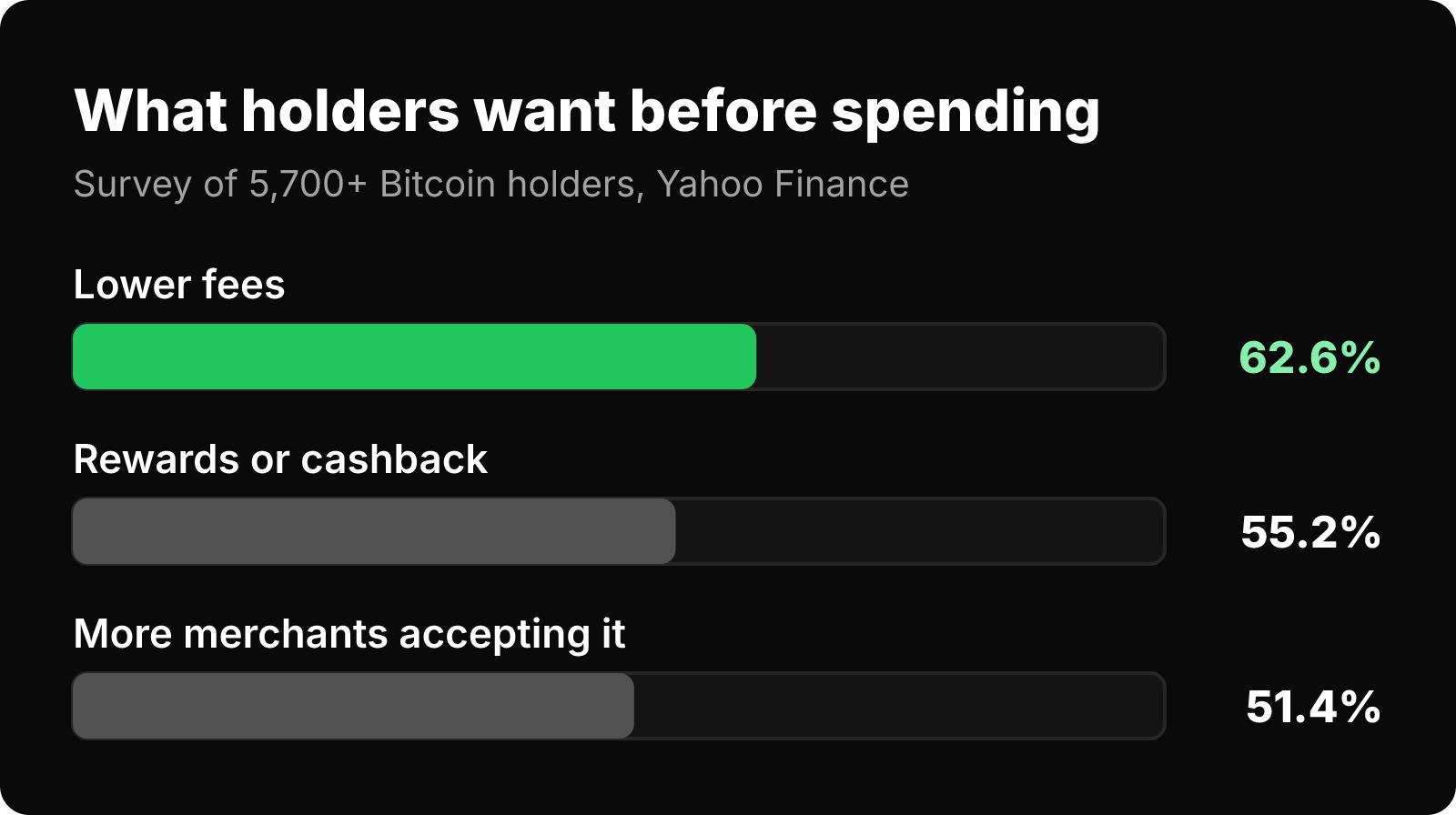
The holders surveyed by Yahoo Finance named their biggest obstacles directly:
- 62.6% want lower fees
- 55.2% expect rewards or cashback, like they get with a credit card
- 51.4% want more merchants to accept it
About 365 million people held Bitcoin in 2025, out of roughly 741 million crypto owners worldwide, according to Datawallet's adoption statistics. Think of Bitcoin as a gold bar in a bank vault. It's very secure and widely trusted, but it's awkward to cut into coffee-sized pieces and take to the shop.
Getting every coffee shop to accept BTC isn't the only way to fix this. The Lightning Network handles small, near-instant Bitcoin payments well, but the merchant still has to accept Lightning. The other approach is to bring Bitcoin to where people already spend and use money. Bridges do exactly that: they connect Bitcoin to other blockchains and the apps that run on them.
What Is a Bitcoin Bridge? Bridge Technology Explained Simply
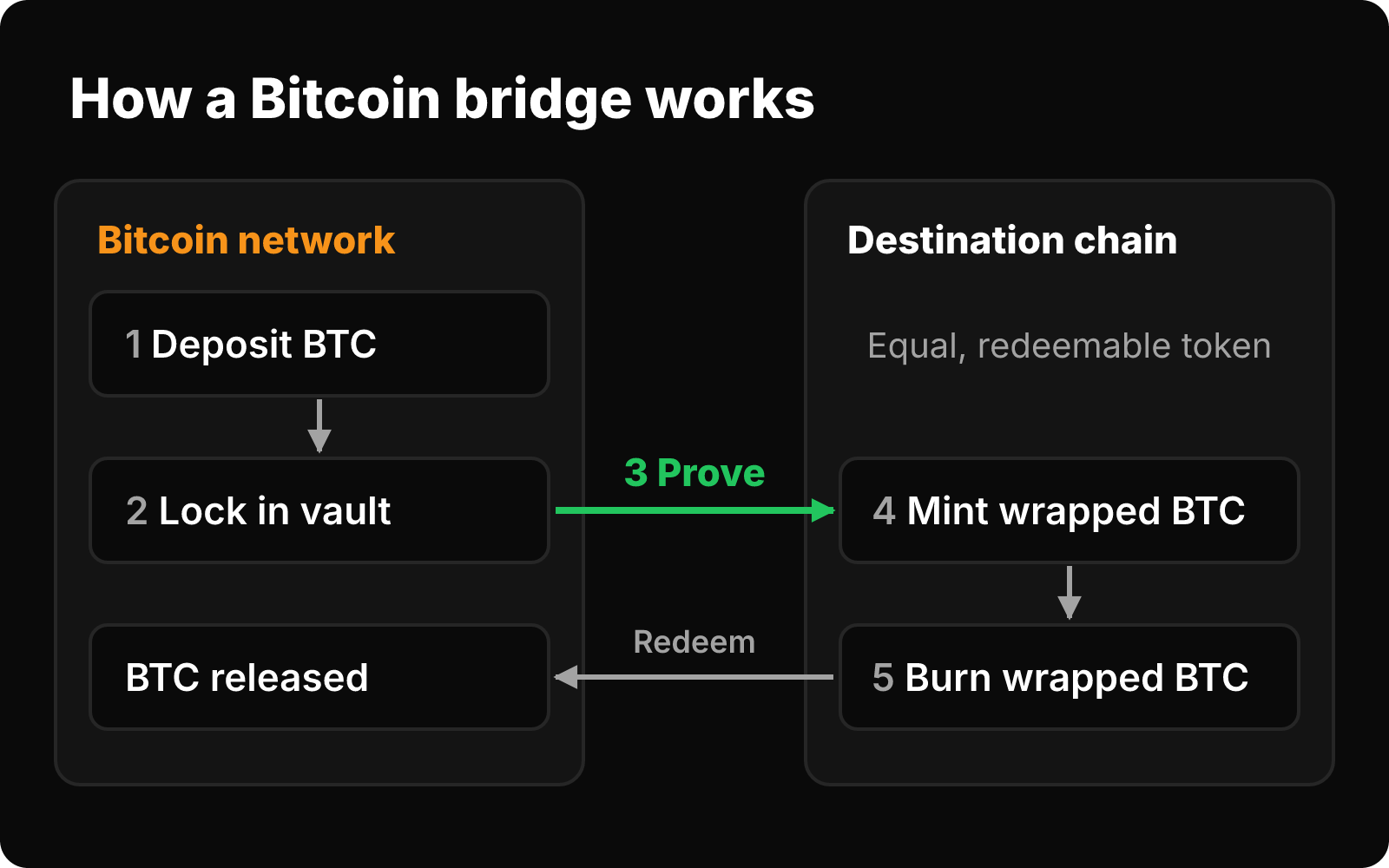
A Bitcoin bridge is a system that locks your BTC on the Bitcoin network and gives you an equal, redeemable token on another blockchain, such as Ethereum, Base, or BNB Smart Chain. That token, often called "wrapped Bitcoin," follows BTC's price and can be used in that chain's apps.
A coat check is a good comparison. You hand over your coat (BTC) and get a numbered ticket (the wrapped token). Inside the venue (the other blockchain), the ticket is what counts. When you leave, you hand the ticket back and get your coat. Everything depends on one question: who looks after the coat room, and how do you know your coat is still there?
CoinGecko's guide to crypto bridges describes a basic cycle of deposit, lock, mint, and reverse. Broken out a little further, it looks like this:
- Deposit: You choose an amount of BTC and give a receiving address on the destination chain.
- Lock: Your BTC goes to a vault, which might be run by a custodian, a group of signers, or collateral-backed operators.
- Prove: The destination chain gets confirmation that the deposit really happened. This step is where bridge technology designs differ the most.
- Mint: An equal amount of wrapped BTC is created and sent to your address.
- Redeem: To get your BTC back, you send the wrapped token back. It's destroyed ("burned") and the original BTC is released.
Why bridge technology matters for crypto adoption
Blockchains are like countries with different power sockets. Ethereum, Solana, and the many networks built on Ethereum each have their own apps, tokens, and users, and Bitcoin can't plug into any of them directly. That matters, because a lot of activity happens there. Tokenized real-world assets such as bonds and funds were worth an estimated $31–34 billion in 2026, with Ethereum hosting about 65% of them, according to Yahoo Finance.
A bridge works like a travel adapter. Bridge technology turns crypto from a collection of separate systems into something closer to one connected economy, and Bitcoin, the largest crypto asset, gains the most from that.
Bitcoin Practical Applications: 7 Daily Use Cases Bridges Unlock
In practice, people rarely bridge Bitcoin to buy a coffee directly. They bridge to get BTC into whatever form a task needs, whether that's a stablecoin, a gas token, or collateral. Here are seven practical uses for Bitcoin that bridges make possible.
1. Paying bills and freelancers in stablecoins
Stablecoins like USDC and USDT track the US dollar, so you don't get a price swing between sending and receiving. Freelancers and online businesses increasingly invoice in them. With a bridge-and-swap you can keep most of your savings in BTC and convert only what you need, when you need it. For example, a BTC-to-USDC route on Base turns Bitcoin into dollars on a low-fee network in one step.
2. Sending money across borders
International bank transfers can take days and lose a cut to middlemen. Many people who send money home now use USDT on the Tron network because transfers are cheap and quick. If your savings are in Bitcoin, a BTC-to-USDT route on Tron gets your money into the stablecoin your family may already be using. Our guide to BTC-to-USDT swaps covers this route in more detail.
3. Booking travel and buying goods
Some merchants already accept crypto at real scale. Travala, a crypto-native travel booking service founded in 2017, passed $100 million in gross yearly revenue in 2024. It lists more than 2.2 million properties in 230 countries and 600+ airlines, and accepts more than 100 cryptocurrencies, according to Business Insider. Bridges matter here because a checkout may accept a stablecoin or another token you don't currently hold.
4. Borrowing against Bitcoin instead of selling it
Need cash but don't want to sell your Bitcoin? Lending protocols on Ethereum and other chains accept wrapped BTC as collateral and let you borrow stablecoins against it. It works like a home-equity loan for your BTC. The catch is that if Bitcoin's price falls far enough, your collateral can be automatically sold (liquidated). Borrow well below the maximum allowed.
5. Putting idle BTC to work
Bitcoin in a cold wallet earns nothing. Once it's bridged, BTC can be supplied to lending markets or liquidity pools in exchange for a share of fees. These are mechanisms, not guarantees. Returns change, and you take on smart-contract risk and, in liquidity pools, the risk of ending up with a different mix of assets than you put in.
6. Diversifying in one step
Some holders want part of their portfolio in something that doesn't move with crypto. Tokenized gold is one option. A BTC-to-XAUt route on Ethereum converts Bitcoin into a token backed by physical gold, without first selling to dollars on an exchange.
7. Paying network fees so you can use apps at all
This one catches many beginners out. To do anything on Ethereum, you need a small amount of ETH to pay transaction fees (called "gas"). If all you own is BTC, you're stuck. Bridging and swapping a small amount of BTC into the destination chain's gas token gets you in.
What Makes a Trustless Bitcoin Bridge Different?
A trustless bitcoin bridge only creates wrapped BTC after the destination blockchain checks, by itself, that the Bitcoin deposit really happened. It doesn't rely on a company or a group of signers to say so. This distinction matters more than any other feature, and the history of bridge hacks shows why.
Cross-chain bridge hacks were among the largest sources of stolen crypto in 2022, according to Chainalysis. The biggest was the Ronin bridge exploit in March 2022, where attackers compromised enough of the bridge's validator keys to approve fake withdrawals. When a few keys control the vault, those keys are what attackers go after. Our guide to cross-chain bridge security explains how these attacks work.
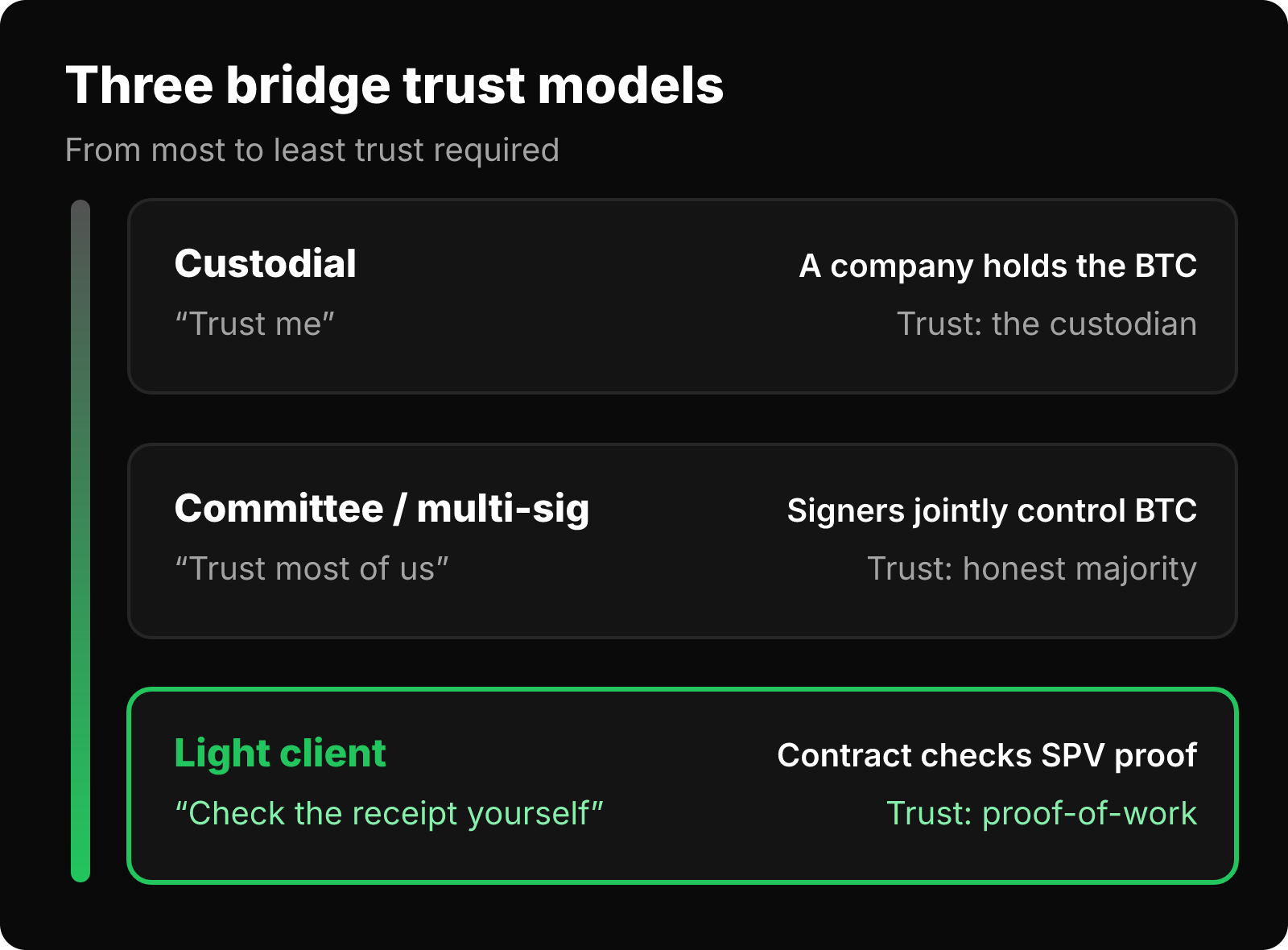
Bridges fall into three broad trust models:
- Custodial ("trust me"): A company holds the BTC and mints tokens. It's simple, but you depend on that company staying solvent, honest, and compliant.
- Committee or multi-sig ("trust most of us"): A group of signers jointly controls the BTC. It's safer than a single custodian, but if enough signers collude or get hacked, the funds are gone.
- Light client ("check the receipt yourself"): A smart contract on the destination chain follows Bitcoin's block headers and checks a mathematical proof that your transaction is included in a block.
That third approach uses Simplified Payment Verification (SPV), a method described in Section 8 of Satoshi Nakamoto's Bitcoin whitepaper. It lets a lightweight verifier confirm a payment without downloading the whole blockchain. To fake a deposit, an attacker would have to fake Bitcoin's proof-of-work, which means outspending the world's Bitcoin miners.
TeleSwap is a Bitcoin bridge built this way. It mints TeleBTC, a 1:1 collateral-backed representation of BTC, only after a light client verifies the Bitcoin transaction. Custody sits with collateral-backed Lockers whose collateral can be slashed (confiscated) if they misbehave, so neither a single custodian nor a multi-sig committee controls the coins. It also removes a common beginner hurdle: you pay fees in Bitcoin assets, and an operator called a Teleporter covers the destination-chain gas for you. According to TeleSwap network stats, the protocol has processed $504.3M in total bridged volume across 535,653 transactions on 13 supported networks. That includes $43.6M over the last 30 days, averaging about $1.5M per day, with a peak of $2.8M on September 18, 2026.
One caveat. "Trustless" means trust-minimized, not risk-free. Smart contracts can have bugs, and someone still has to hold the locked BTC. A light-client design doesn't make risk disappear. It replaces "trust a person" with "trust Bitcoin's proof-of-work plus slashable collateral," which is a much stronger basis. For deeper technical analysis, see how intent-based security mechanisms block hacker swaps.
The 3-question bridge check
Before you bridge, ask these three questions in order:
- Who holds the BTC? A company, a committee, or collateral-backed operators?
- What proves the deposit happened? Someone's signature, or a proof checked against Bitcoin itself?
- What happens if someone cheats? Is there collateral that can be slashed to repay users, or do you just hope?
If you can't find clear answers in a bridge's documentation, take that as a warning sign.
How Do Bitcoin Bridging Options Compare?
There are several ways to make Bitcoin useful day to day, and each fits a different job. The table compares seven options across four questions that matter to beginners.
| Option | Who holds your BTC | Best for | Main trust assumption | Typical speed |
|---|---|---|---|---|
| Native BTC (on-chain) | You | Savings, large transfers | Bitcoin itself | ~10 min per block; merchants may wait for several confirmations |
| Lightning Network | You (in payment channels) | Small BTC payments | Channel liquidity; merchant must accept Lightning | Seconds |
| Exchange account or crypto card | The exchange | Card spending | Exchange solvency and honesty | Instant at checkout |
| WBTC | Institutional custodian (BitGo-led) | DeFi on Ethereum and other chains | Custodian | Varies by custodian process |
| cbBTC | Coinbase | DeFi on Base and Ethereum | Coinbase as custodian | Varies |
| tBTC | Rotating group of threshold signers | DeFi on Ethereum | Honest majority of signers | Varies |
| TeleBTC | Collateral-backed Lockers; minting verified by an SPV light client | Swapping BTC into tokens across 13 networks | Bitcoin proof-of-work plus slashable collateral | ~10 min for fast swaps |
No single option is best at everything. Lightning is unbeatable for a quick BTC tip. A card is the most convenient at a supermarket till. When the task is getting Bitcoin into another chain's apps, such as stablecoin payments, borrowing, or diversifying, the deciding factor is the trust assumption, and on that measure the light-client model asks the least of you.
How Do You Use Bitcoin for Everyday Tasks? A Beginner Walkthrough
To use Bitcoin for an everyday task through a bridge, you choose a destination chain and token, get a quote, send BTC to the deposit address shown, and receive the tokens in your wallet once the Bitcoin transaction confirms. Here's how that looks for Sam, who needs $500 in USDC to pay a designer.
- Pick the destination. The designer accepts USDC on Base, so that's Sam's target: the token (USDC) and the chain (Base).
- Set up a receiving wallet. Sam installs a wallet that supports Base, such as MetaMask, and copies his Base address.
- Get a quote. The bridge shows how much BTC to send, the fees, and how much USDC will arrive. Sam checks that the figures make sense.
- Send BTC. From his Bitcoin wallet, Sam sends the exact amount to the deposit address the bridge gives him.
- Wait for confirmation. Bitcoin blocks arrive about every 10 minutes, so Sam makes a coffee while the deposit confirms.
- Receive and use. USDC shows up in Sam's Base wallet, and he sends $500 to the designer.
- Reverse when needed. If he has USDC left over, Sam can swap it back to native BTC later.
Safety habits for beginners
- Send a small test amount first. A $20 trial costs little and shows you how the whole process works.
- Check addresses twice. Crypto transactions can't be reversed. Compare the first and last few characters.
- Run the 3-question bridge check before trusting any bridge with a meaningful amount.
- Watch out for fake websites. Bookmark the real site and never type your seed phrase into a webpage.
- Know your local tax rules. In many countries, swapping BTC for another token counts as a disposal for tax purposes.
Frequently Asked Questions
Can you actually use Bitcoin for everyday purchases?
Yes, though for most people today the easiest way is indirect: you convert BTC into stablecoins or tokens that merchants accept, rather than spending BTC directly. You can pay some merchants in BTC directly or through the Lightning Network, but many daily tasks, such as paying freelancers, sending money abroad, or covering app fees, work better once BTC is converted into stablecoins or other tokens through a bridge or swap.
What is a Bitcoin bridge in simple terms?
A Bitcoin bridge locks your BTC on the Bitcoin network and gives you an equal, redeemable token on another blockchain. It works like a coat check: you hand over your coat and get a ticket that's valid inside the venue. What matters most is who looks after the coat room and how that custody is verified.
What makes a bitcoin bridge "trustless"?
A bridge is trustless, or more precisely trust-minimized, when the destination blockchain verifies the Bitcoin deposit itself using a light client and SPV (Simplified Payment Verification) proofs, rather than relying on a custodian or committee's signature. Custodial and multi-sig bridges ask you to trust that a company or a group of signers will act honestly. Light-client bridges check the proof against Bitcoin's proof-of-work instead, which is mathematically verifiable.
Is wrapped Bitcoin the same as real Bitcoin?
No. Wrapped Bitcoin is a token on another blockchain that represents BTC locked elsewhere, not the original asset itself. It should be redeemable 1:1 for real BTC, but its safety depends entirely on how the bridge holds and verifies the locked coins, which is why the trust model matters.
Are Bitcoin bridges safe?
Safety varies significantly by design. Bridges have historically been a major target for hackers, and cross-chain bridge hacks were among the largest sources of stolen crypto in 2022, according to Chainalysis. Bridges that verify Bitcoin transactions cryptographically and back custody with slashable collateral reduce these risks substantially, though no smart contract is completely risk-free.
How long does bridging Bitcoin take?
Bridging Bitcoin takes at least one Bitcoin block (about 10 minutes) and can take longer, depending on the bridge design and how many confirmations it waits for. The main factor is Bitcoin's roughly 10-minute block time. TeleSwap's fast swaps settle in about 10 minutes, while custodial minting processes can take longer.
What's the difference between a bridge and a decentralized exchange?
A bridge locks your BTC on one blockchain and mints a wrapped token on another, so the same asset can work across multiple chains. A DEX swaps one token for a different token (or stablecoin) on the same or a connected blockchain. Bridges are infrastructure for moving assets between chains, while DEXs are liquidity venues for trading tokens.
Conclusion
Bitcoin's daily use problem isn't really about belief. It's about plumbing. Most holders support adoption but don't spend their BTC, because Bitcoin was built to be secure, not to connect to every app or checkout. Bridges solve that by moving Bitcoin to where people already pay and borrow, in whatever form the task needs, from stablecoin invoices to tokenized gold.
Three things to remember: a bridge is only as safe as its answer to "who holds the BTC, and how is that proven?"; the most practical daily use of Bitcoin is often converting it when needed rather than spending it directly; and trust-minimized, light-client designs remove the single points of failure behind past bridge hacks.
If you'd like to try a light-client bridge, start with a small test swap at teleswap.xyz, where you can swap native BTC into tokens across 13 networks and pay fees in Bitcoin assets. You can also read how the verification works in the TeleSwap docs.