Delivery vs Payment in Crypto: DvP Settlement Explained

Delivery vs payment (DvP) is a settlement rule that makes the transfer of an asset depend on the transfer of payment, so neither party can end up giving without receiving. In crypto, a blockchain can enforce that rule in code: both legs of a trade settle together in one transaction, or neither settles.
The rule exists because of a hard lesson. On June 26, 1974, German regulators shut down a small Cologne bank called Bankhaus Herstatt at the end of the German business day. Its trading partners had already paid it Deutsche marks and were waiting for US dollars to arrive later that day in New York. The dollars never came. The losses rippled through the banking system, and the problem got a name of its own: Herstatt risk, as Investopedia explains, is the risk that you deliver your side of a trade and never get the other side back. DvP is the standard fix. Banks coordinate it through back offices. A blockchain can guarantee it in code.
This guide starts from zero. You'll learn what DvP is, why finance spent decades building it, how blockchains do it, where it gets hard (moving between different blockchains), and how to judge whether a crypto swap really gives you DvP protection.
Key Takeaways:Delivery vs payment (DvP) is a settlement rule where the asset and the payment move at the same time, or neither moves at all.The Bank for International Settlements formally defined three DvP models in its September 1992 report on securities settlement.A token swap that runs as one transaction on a single blockchain is atomic: if any step fails, the whole transaction reverts.Cross-chain DvP is much harder than single-chain DvP because no single ledger can see both sides of the trade.DvP removes the risk of losing your principal to the other side of a trade, but it does not remove price risk, smart-contract bugs, or custodian risk.
Table of Contents
- What Is Delivery vs Payment (DvP)?
- Why Does Settlement Risk Matter So Much?
- How Does DvP Work in Traditional Finance?
- How Does DvP Settlement Work on a Blockchain?
- Is Atomic Settlement the Same as DvP?
- Why Is Cross-Chain DvP So Hard?
- Settlement Methods Compared
- What Doesn't DvP Protect You From?
- The Four-Question DvP Test
- Frequently Asked Questions
- Conclusion
What Is Delivery vs Payment (DvP)?
"Delivery" is the asset side (a share, a bond, a token). "Payment" is the money side (dollars, a stablecoin, BTC). DvP links the two so one cannot move without the other.
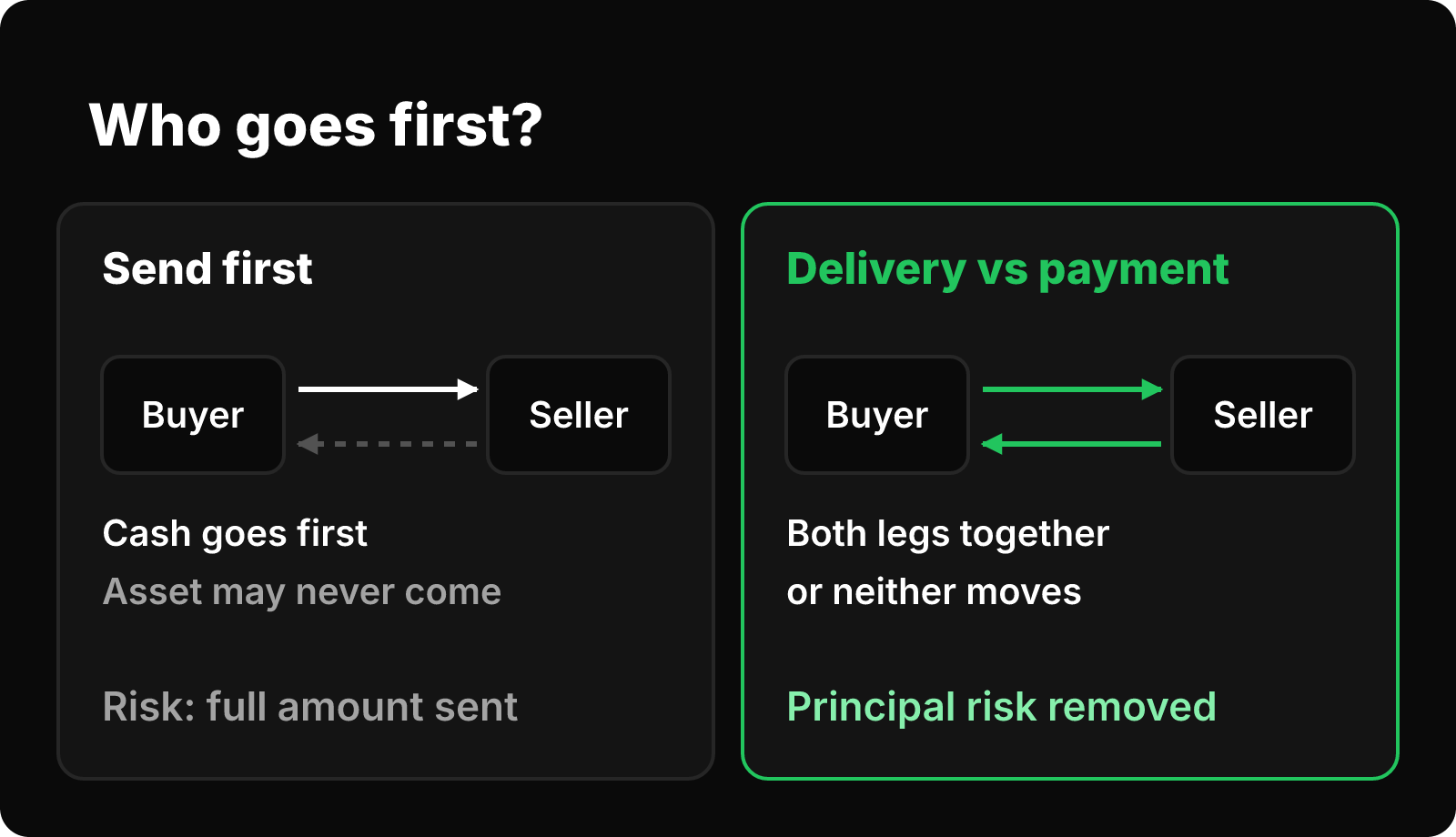
Picture buying a used car from a stranger in a parking lot. You have cash. They have the keys and the title. Who goes first?
- If you hand over the cash first, they could drive off with your money and the car.
- If they hand over the keys first, you could drive off without paying.
Whoever goes first is taking a risk. In everyday life we solve this with trust, with a handshake, or with an escrow agent who holds both items and swaps them at the same moment. DvP works like that escrow agent. As enterprise blockchain firm Kaleido describes it, the asset and the payment move together or not at all, so neither side is left exposed after its leg settles.
Two terms will come up again and again:
- Settlement is the moment ownership actually changes hands. Agreeing on a price is the trade. Moving the assets is the settlement.
- Counterparty risk is the risk that the other side of your deal fails to deliver.
DvP exists to remove one specific kind of counterparty risk, called principal risk: losing the full value of what you sent.
Why Does Settlement Risk Matter So Much?
Settlement risk matters because the gap between "I paid" and "I received" is where large, sudden losses happen. Herstatt is the textbook case. Its counterparties lost money because the two legs of the currency trade settled hours apart, in different time zones, through different systems.
The longer that gap lasts, the more can go wrong. A firm can go bankrupt, a payment can get frozen, or someone can simply refuse to pay. That is a big part of why US regulators keep shortening the gap. The SEC adopted rules in February 2023 that moved most US securities trades from two-day settlement (T+2) to one-day settlement (T+1), starting May 28, 2024.
Crypto users know this risk too, under different names. If you send funds to a person on a forum and they never send back what they promised, that's settlement risk. If you leave assets on an exchange that later collapses, as FTX did in November 2022, the trade may have "happened" on the exchange's screen while the real assets were never safely yours.
The lesson: when you send first and trust the other side to follow, your risk is the full amount you sent.
How Does DvP Work in Traditional Finance?
In traditional markets, DvP is enforced by a chain of institutions: clearinghouses, central securities depositories (CSDs), and settlement banks. A CSD is the official record-keeper for who owns which securities. A settlement bank, often the central bank, moves the cash.
A typical flow looks like this:
- Trade execution: buyer and seller agree on price and quantity.
- Matching: clearing and settlement institutions confirm both sides' details agree.
- Checks: the system confirms the seller holds the securities and the buyer has the cash.
- Simultaneous exchange: the CSD moves the securities and the settlement bank moves the cash, linked so that one cannot happen without the other.
The Bank for International Settlements' 1992 report on DvP sorted real-world systems into three models, and they are still the standard reference:
| BIS DvP model | Securities leg | Cash leg | Plain-English meaning |
|---|---|---|---|
| Model 1 | Gross (trade by trade) | Gross (trade by trade) | Each trade settles on its own, both legs at once |
| Model 2 | Gross | Net (end of cycle) | Securities move per trade; cash differences are totaled and paid later |
| Model 3 | Net | Net | Both sides are totaled up and settled in batches |
Most blockchain swaps are effectively Model 1: every trade settles on its own, with both legs final at the same moment. Netting (Models 2 and 3) saves cash and paperwork, but it brings back a delay. Blockchains don't need that delay.
How Does DvP Settlement Work on a Blockchain?
On a blockchain, DvP is enforced by code rather than by process. Both legs of the trade are bundled into a single transaction, and that transaction either executes completely or fails completely. This is how Liquid Mercury's glossary describes tokenized DvP: the workflow checks that the seller controls the tokens and the buyer has the payment, then releases both legs together. If either is missing, neither settles.
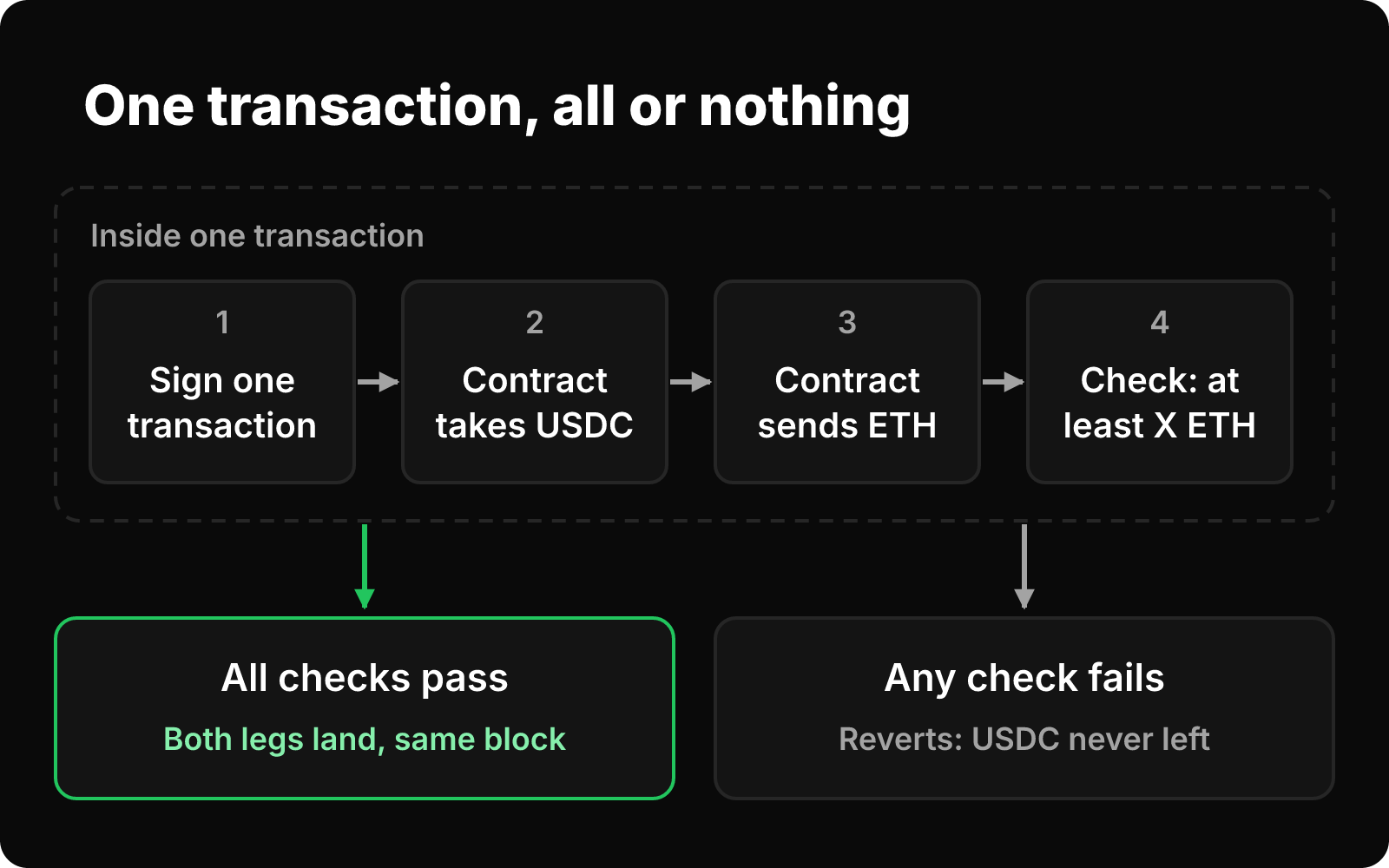
The key property is that blockchain transactions are all-or-nothing. On Ethereum, if any step inside a transaction fails, the whole transaction is reverted and every balance goes back to where it started. Ethereum's developer documentation covers how transactions work in detail.
Here's what happens when you swap USDC for ETH on a decentralized exchange (DEX) like Uniswap:
- You sign one transaction saying: "Take my 1,000 USDC and give me at least X ETH."
- The DEX smart contract takes your USDC.
- The contract calculates how much ETH you get and sends it to you.
- The contract checks that you received at least X ETH (your slippage limit).
- If any check fails, the whole transaction reverts. Your USDC never left.
Notice what is missing: an escrow agent, a clearinghouse, and a settlement window. Delivery and payment land in the same block, and nobody had to go first. A vending machine is a good mental model. It won't release the snack until it has your coins, and if it can't release the snack, it hands the coins back.
This is also why banks and central banks are paying attention. The BIS Innovation Hub's Project Helvetia tested settling tokenized assets against central bank money. Across chains, light-client bridges such as TeleSwap apply the same "no release without proof" idea using on-chain cryptographic verification.
Is Atomic Settlement the Same as DvP?
Not exactly. Atomic settlement is a technique, and DvP is the goal it achieves. "Atomic" comes from computer science, where it describes an operation that can't be split: it either completes in full or doesn't happen. Atomic settlement in cryptocurrency means a group of transfers is treated as one unit.
The two ideas overlap a lot, but they aren't identical:
- DvP is a policy: don't release the asset unless payment is released too.
- Atomic settlement is a mechanism that guarantees the policy, because both legs share the same fate.
DvP can also be achieved without full atomicity. Traditional systems do it with institutional plumbing and legal agreements. Some cross-chain systems do it by verifying that one leg happened before releasing the other. That approach is "conditional" rather than strictly simultaneous.
Terminology is loose here as well. When both legs are money, as in a currency trade, finance calls it payment vs payment (PvP). Swapping USDC for ETH is closer to PvP than to DvP, but crypto writers usually call any "both-or-neither" swap DvP, and this guide follows that habit.
Why Is Cross-Chain DvP So Hard?
Cross-chain DvP is hard because no single blockchain can see, or reverse, what happens on another blockchain. Ethereum can bundle two Ethereum transfers into one atomic transaction. It cannot bundle an Ethereum transfer with a Bitcoin transfer, because the Bitcoin network keeps its own separate ledger.
Take an example. You want to swap 0.1 BTC for USDC on Ethereum. Your BTC lives on the Bitcoin blockchain. The USDC lives on Ethereum. Neither chain can reach into the other. So how do you avoid going first? The industry has tried three main approaches.
1. Hash time-locked contracts (HTLC atomic swaps)
An HTLC locks funds behind a secret and a deadline. Both parties lock their coins on their own chains using the same secret. When one party reveals the secret to claim funds on one chain, that reveal lets the other party claim on the other chain. If nobody claims before the deadline, both sides get refunds. The Bitcoin script pattern is described in BIP 199.
Here's a point most beginner guides skip: HTLC swaps protect your principal, but they hand the initiator a free option. Once both sides have locked funds, the party holding the secret can watch the price during the timelock window. If the trade moves against them, they can simply walk away and let it refund. The swap is safe, but it isn't fair. Add the need for both parties to stay online and the hours-long refund windows, and it's clear why HTLC swaps never became mainstream.
2. Trusted custodians (wrapped tokens)
The simplest approach is to give your BTC to a custodian, which then issues a token on the other chain, such as WBTC on Ethereum. Inside Ethereum, every later swap of WBTC is atomic. But the step where BTC becomes WBTC isn't DvP at all. You are trusting a company to hold your coins and issue the token. The counterparty risk hasn't disappeared. It has been moved onto the custodian.
3. Light-client verification
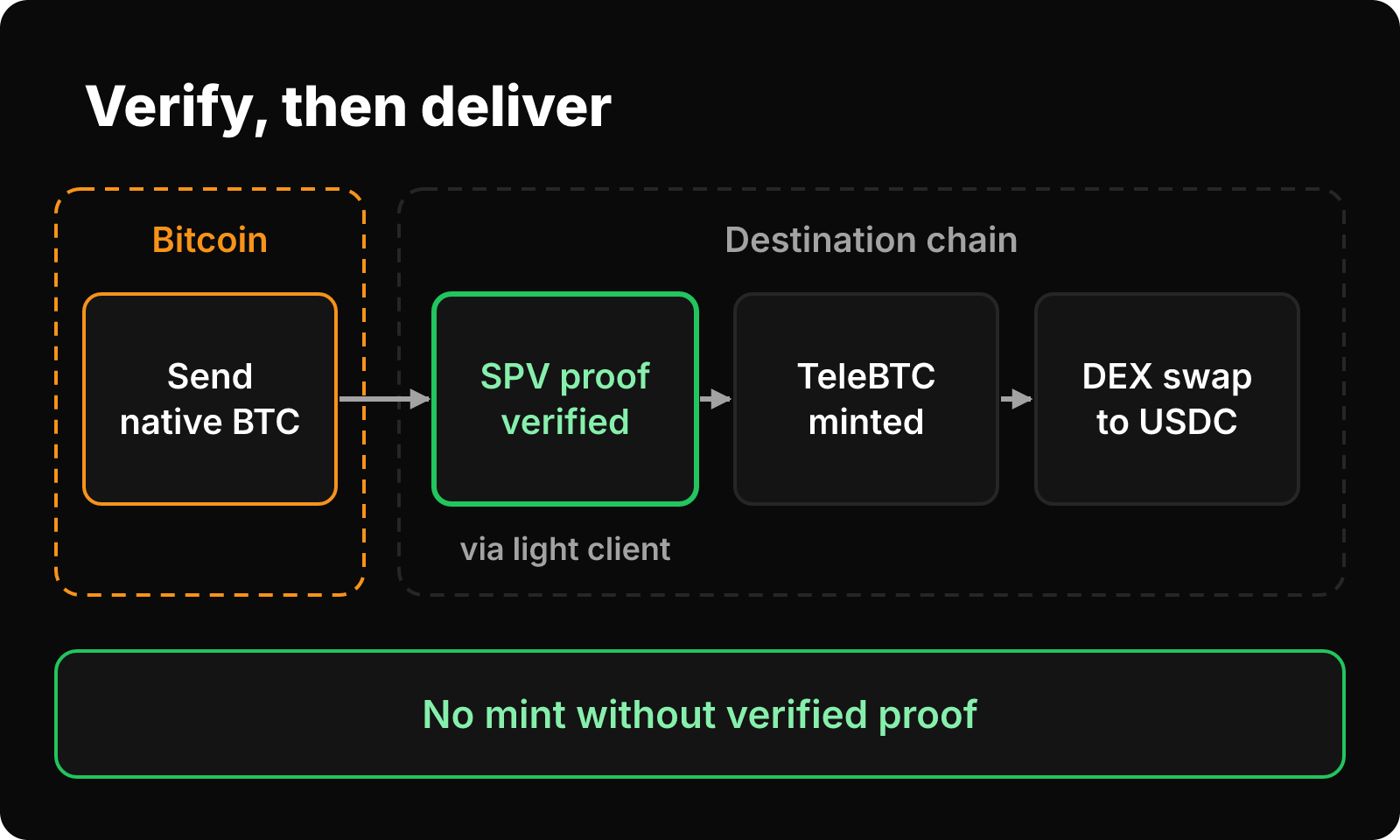
The third approach lets the destination chain check the Bitcoin transaction for itself. A light client is a small program that tracks Bitcoin's block headers (the compact fingerprints of each block). With those headers, a smart contract can confirm, using an SPV (Simplified Payment Verification) proof, that a specific Bitcoin payment really was included in a block.
This is the model behind TeleSwap, a trust-minimized Bitcoin bridge secured by light-client verification and SPV proofs rather than a custodian or multi-sig committee. When you send BTC, nothing is minted on the destination chain until a smart contract has verified that Bitcoin transaction through an SPV proof. Then TeleBTC, a 1:1 collateral-backed representation of BTC, is minted and can be swapped through a DEX into tokens like USDC or ETH as part of the same flow. To be precise, this is "verify, then deliver" rather than both legs landing in the same instant. For a cross-chain trade, though, it closes the most dangerous gap: the destination side only releases value after cryptographic proof that the Bitcoin payment happened. In practice, a route like BTC to USDC on Ethereum lets you go from native BTC to a stablecoin without handing your coins to an exchange. According to TeleSwap network stats, the protocol has bridged $506.2M in total volume across 537,163 bridge transactions.
Settlement Methods Compared
Here is how six common settlement methods compare on the question that matters: who enforces "both or neither," and what can still go wrong?
| Settlement method | Who enforces DvP? | Main remaining risk | Typical speed |
|---|---|---|---|
| Traditional securities DvP | CSD + settlement bank | Operational and institutional failure | T+1 for most US securities since May 2024 |
| Centralized exchange trade | The exchange's internal database | Exchange insolvency or withdrawal freezes | Instant on-platform; withdrawals vary |
| Single-chain DEX swap | Smart contract; transaction reverts on failure | Contract bugs, slippage, front-running | One block (~12 seconds on Ethereum) |
| HTLC atomic swap | Hashlocks + timelocks on both chains | Free option for initiator; both parties must stay online | Multiple confirmations; refund windows often span hours |
| Custodial wrapped BTC (e.g., WBTC) | A custodian's internal process | Custodian failure or censorship | Depends on custodian processing |
| Light-client bridge (TeleBTC) | On-chain SPV verification before minting | Smart-contract risk; Locker risk backed by slashable collateral | ~10 minutes for fast swaps |
Ethereum's ~12-second block time comes from its post-Merge slot design, per ethereum.org's documentation on blocks.
The pattern: DvP is easy when both assets live on the same ledger, and every cross-chain design is a trade-off over who or what confirms the other ledger's events. A person, a committee, or a cryptographic proof. The more that confirmation depends on math instead of people, the closer you get to trustless settlement.
What Doesn't DvP Protect You From?
DvP protects your principal from a counterparty who fails to deliver. It does not protect you from a bad deal. People get this wrong about trustless settlement more than anything else, so here is what DvP doesn't cover:
- Price risk: an atomic swap at a terrible price still settles perfectly. Slippage limits are your protection here, not DvP.
- Smart-contract bugs: if the code enforcing DvP is flawed, the guarantee is only as good as the code. Audits and track record matter.
- Front-running (MEV): bots can see your pending swap and trade ahead of it. Your trade still settles atomically, just at a worse price.
- Asset quality: DvP guarantees you receive the token. It doesn't guarantee the token is worth anything, or that a wrapped token's backing is solid.
- Data inputs: when DvP depends on off-chain information, as in oracle-based systems, the result is only as reliable as that data source.
The fourth point deserves extra attention. A swap into a custodial wrapped token can be perfectly atomic on-chain while the token itself depends on a custodian off-chain. The settlement was DvP. The asset you received may not be.
The Four-Question DvP Test
Before you trust any swap, bridge, or OTC deal, run it through these four questions. Together they tell you whether you're really getting delivery vs payment, or just a promise.
- Is it one transaction or two? If both legs happen in a single on-chain transaction, you have atomic DvP. If there are two separate steps, find out what links them.
- Who holds the assets in between? If it's "the exchange" or "a custodian," your risk is that entity. If it's "a smart contract with a refund path," your risk is the code.
- What happens if one side fails? Look for an automatic refund or revert. "Contact support" is not a settlement guarantee.
- What confirms the other chain's event? For cross-chain deals, this is the question that matters most. A human operator, a multi-signature committee, and an SPV proof checked on-chain carry very different levels of trust.
Practical habits that follow from the test:
- Set a slippage limit on every DEX swap. It's the price-side protection DvP doesn't give you.
- Avoid peer-to-peer deals where you have to send first, unless an escrow contract holds both sides.
- When moving BTC to another chain, read the bridge's documentation for how it verifies Bitcoin deposits.
- Keep assets on centralized exchanges only as long as you need to. Their internal DvP is only as safe as their balance sheet.
Frequently Asked Questions
What does delivery vs payment mean in crypto?
Delivery vs payment in crypto means a trade where the token and the payment transfer together, or neither transfers. On a blockchain, this is usually enforced by a smart contract or a single atomic transaction, so neither party has to send first and trust the other to follow. This eliminates principal risk, the danger of losing your full amount to a counterparty who fails to deliver.
Is a DEX swap a DvP settlement?
Yes, a swap on a single-chain DEX like Uniswap is a form of DvP settlement. Both legs execute inside one transaction, and if any step fails, the entire transaction reverts. Strictly speaking, swapping one token for another is closer to payment vs payment (PvP), but the both-or-neither guarantee is the same. Your funds return untouched if the swap cannot complete.
What is the difference between DvP and atomic settlement?
DvP is the goal (no asset moves without payment), and atomic settlement is one way to achieve it. Atomic settlement bundles multiple transfers into one indivisible operation. Traditional finance achieves DvP through institutions instead, and some cross-chain systems achieve it by verifying one leg before releasing the other.
What are the three DvP models defined by the BIS?
The three DvP models, defined by the BIS in 1992, are gross-gross (Model 1), gross securities with net cash (Model 2), and net-net (Model 3). Model 1 settles each trade individually with both legs final at once. Model 2 settles securities per trade but batches cash payments. Model 3 batches both sides. Most blockchain swaps behave like Model 1 because each trade settles individually and with finality.
Can Bitcoin be swapped across chains with DvP protection?
Yes, though cross-chain DvP needs extra machinery because no blockchain can directly see another. The main options are HTLC atomic swaps (which require both parties to stay online), custodial wrapped tokens (which shift trust to a custodian), and light-client bridges like TeleSwap that verify the Bitcoin transaction with an SPV proof before releasing value on the destination chain.
Does DvP eliminate all risk?
No. DvP removes principal risk, meaning losing what you sent to a counterparty who doesn't deliver, but nothing else. You still face price and slippage risk, smart-contract bugs, front-running, and the quality of the asset you receive. DvP is a guarantee about settlement process, not about price or asset value.
How does light-client bridge verification improve DvP?
Light-client bridges like TeleSwap use on-chain SPV (Simplified Payment Verification) proofs to verify a Bitcoin transaction cryptographically before minting the wrapped token. This closes the dangerous gap in cross-chain settlement: the destination blockchain confirms the source-chain transaction through math rather than trusting a custodian or operator. TeleBTC is only minted after that proof is verified on-chain.
Conclusion
Delivery vs payment is a decades-old answer to a very old question: who goes first? Traditional finance answered it with clearinghouses and settlement windows. Blockchains answer it with code, so that both legs of a trade settle together in one transaction or not at all.
Keep three ideas in mind. Single-chain swaps give you true atomic DvP almost for free. Cross-chain DvP is where designs differ, and the deciding question is what verifies the other chain: a person, a committee, or a proof. And DvP protects your principal, not your price, so slippage limits and asset quality still matter.
For a deeper look at how atomic settlement works in practice across different chains, read our guide to atomic settlement in cryptocurrency. If you hold Bitcoin and want to see proof-based settlement in action, explore layer-2 solutions for Bitcoin or learn about converting BTC to WBTC without KYC using trustless bridges.