Layer 2 Tokens in an Oil Rally: Why L2s Drop Harder Than BTC

Layer 2 tokens drop harder than Bitcoin in an oil rally because they sit at the riskiest end of the crypto market. When oil spikes, bond yields and the dollar rise, investors cut risk, and leveraged bets get liquidated. Thin, speculative L2 tokens take the biggest hit. On October 7, 2026, reports of Iranian attacks on tankers in the Strait of Hormuz pushed Brent crude above $101 a barrel. Within 24 hours Bitcoin had fallen below $84,000, and Optimism's OP token had lost about 10%, roughly four times as much as Bitcoin.
This explainer starts from the basics and walks through how an oil rally reaches layer 2 tokens, step by step. It covers how oil prices reach crypto, why smaller tokens fall harder than Bitcoin, and what a selloff like this means for people using Bitcoin in DeFi (decentralized finance: lending, trading and earning on blockchains without a bank in the middle).
Key Takeaways:On October 7, 2026, Brent crude rose above $101 a barrel and Bitcoin fell below $84,000, according to CoinDesk.Layer-2 tokens fell the most that day: Optimism (OP) lost about 10%, Mantle (MNT) 9.7% and Arbitrum (ARB) 7%, compared with roughly 2.5% for Bitcoin.Crypto liquidations jumped 235% to $547 million in 24 hours as leveraged bets were closed by force, per The Cryptonomist.Oil shocks reach crypto indirectly, through inflation fears, higher bond yields, a stronger dollar and forced selling of leveraged positions.When an L2 token falls, the L2 network hasn't necessarily stopped working, because the token is a bet on the network's future rather than the network itself.
Table of Contents
- Why Bitcoin Dropped in October 2026: The Oil Shock Timeline
- What Are Layer 2 Networks and Their Tokens?
- How Can Oil Prices Move Crypto? The 5-Step Chain
- How Does Bitcoin Price Correlation Spread Across Crypto?
- Why Do Layer 2 Tokens Fall Harder Than Bitcoin?
- Was October 7 a Layer 2 Crypto Market Crash?
- What Does an Oil Shock Mean for Bitcoin DeFi?
- Practical Takeaways: How to Read the Next Oil Shock
- Frequently Asked Questions
- Conclusion
Why Bitcoin Dropped in October 2026: The Oil Shock Timeline
On October 7, 2026, Bitcoin fell because a sudden jump in oil prices made investors around the world cut back on risky assets, and crypto was part of that cutback.
- The trigger: Reports of Iranian attacks on tankers in the Strait of Hormuz, a narrow sea lane that carries a large share of the world's seaborne oil.
- The oil move: Brent crude, the global benchmark price for oil, rose above $101 per barrel.
- The Bitcoin move: BTC fell below $84,000, ending the day at about €74,795, according to Trending Topics.
- The forced selling: Liquidations reached $547 million over 24 hours, CoinDesk reported.
Bitcoin's drop was mild compared with the rest of the market. It fell about 2.4% to 2.8% over the day. Most of the damage was in smaller tokens, and layer-2 tokens were hit hardest.
Something else happened that week too. Abstract, the layer-2 network behind the Pudgy Penguins ecosystem, was shutting down. It was the second L2 network to close within a week. The oil shock started the fire, but news like that made the layer-2 part of it burn faster.
What Are Layer 2 Networks and Their Tokens?
A layer 2 (L2) is a separate network built on top of a main blockchain (the "layer 1") to make transactions faster and cheaper. It still relies on the main chain for security.
Here's an analogy. Picture Ethereum as the main road through a crowded city: it's safe and well policed, but traffic is slow and tolls are high. An L2 is an express bus line. It picks up hundreds of passengers (transactions), drives them in a group, and then hands the city one summary of who went where. The city checks that summary, so the bus line gets the city's security without clogging its streets.
The two main designs, explained in more detail on ethereum.org's layer-2 guide, are:
- Optimistic rollups (Arbitrum, Optimism): they assume transactions are valid and allow a challenge window, usually about seven days, during which anyone can prove fraud.
- Zero-knowledge (ZK) rollups (StarkNet, zkSync): they post a mathematical proof that every transaction in the batch is valid, so they don't need a challenge window.
L2s now do a lot of work. Combined, they handle around 2 million transactions a day, roughly double Ethereum mainnet's volume, according to Phemex.
The token is not the network
Beginners often miss this. Most L2s have a token, such as ARB, OP or MNT, but transaction fees on those networks are usually paid in ETH. The token is mostly a governance token, which works like a vote in a homeowners' association. You get a say in how the network is run, but that doesn't automatically give you a share of its income.
So the price of an L2 token is the market's guess about the network's future value. It doesn't measure how well the network is running today. That distinction matters when you're reading price movements: an L2 token can fall sharply while the network itself keeps running. For the other side of this volatility, see why layer 2 tokens can outperform Ethereum.
How Can Oil Prices Move Crypto? The 5-Step Chain
Oil prices affect crypto through a chain of knock-on effects, each one setting off the next, much like dominoes. Oil doesn't hit Bitcoin directly. Analysis from The Cryptonomist traced roughly this sequence on October 7:
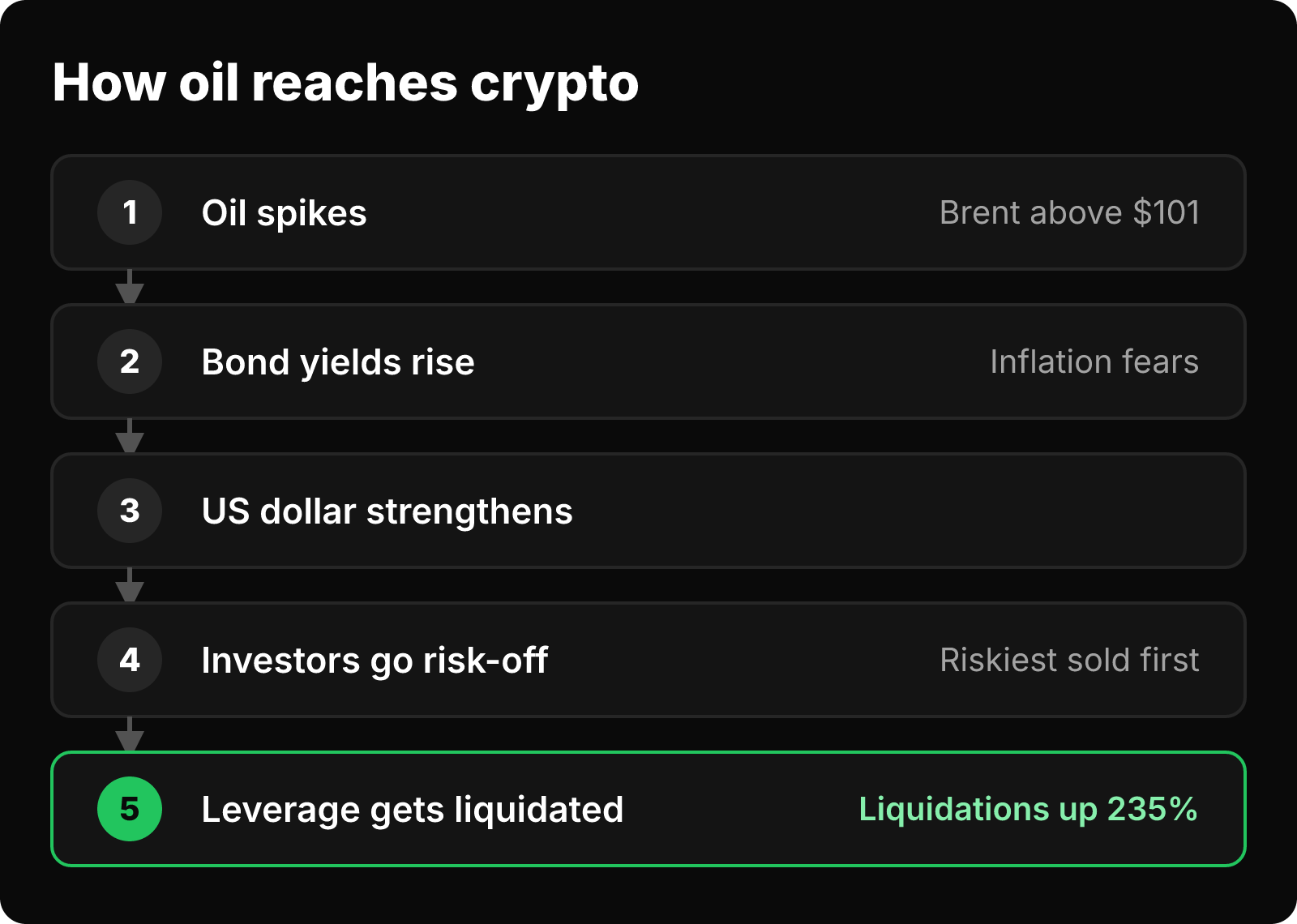
- Oil spikes on geopolitical risk. Oil goes into almost everything: shipping, plastics, food delivery, flights. When it gets more expensive, people expect prices across the economy to rise.
- Bond yields rise. If inflation looks likely, investors expect central banks to keep interest rates high for longer. US Treasury yields, the return on government debt, go up.
- The US dollar strengthens. Higher yields draw money into dollar assets. A stronger dollar usually puts pressure on assets priced in dollars, including Bitcoin.
- Investors move "risk-off." When a safe government bond pays more, holding something volatile looks less attractive. Fund managers sell their riskiest holdings first.
- Leverage gets liquidated. Crypto traders often borrow to make bigger bets. When prices fall far enough, exchanges close those positions automatically. That selling pushes prices down further, which triggers more liquidations.
The fifth step is where crypto stands out. Stocks also drop during oil shocks, but crypto markets run around the clock with very high leverage, so a small macro push can become a cascade. On October 7 liquidations rose 235% in a single day, and futures turnover climbed 16%, per The Cryptonomist.
How Does Bitcoin Price Correlation Spread Across Crypto?
Most crypto assets move in the same direction as Bitcoin, but by different amounts. Smaller and more speculative tokens usually move further. Traders call this sensitivity beta. A token with a beta of 3 tends to move about three times as much as Bitcoin, in either direction.
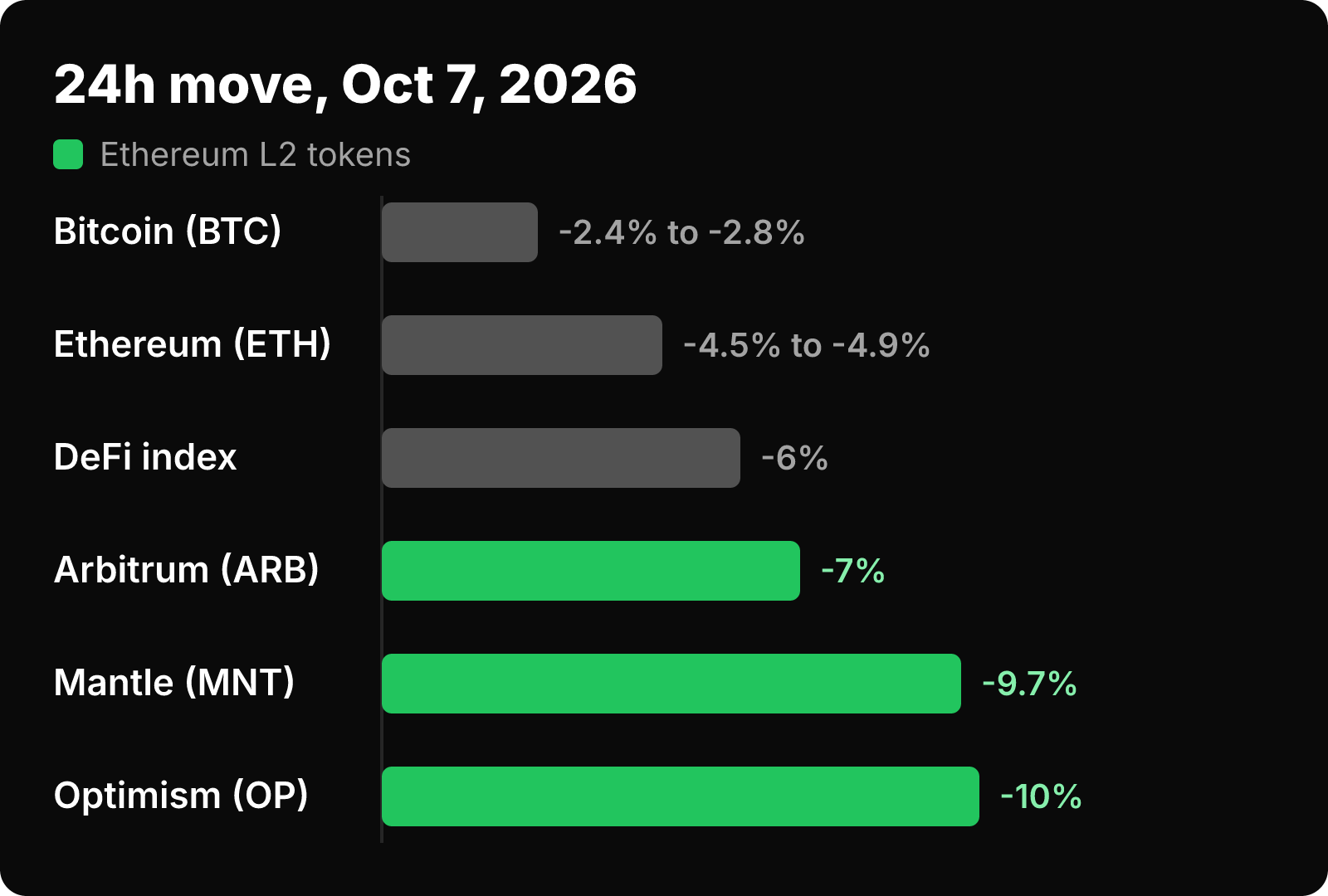
A useful way to picture it is a risk ladder. Bitcoin is on the bottom rung: it's the largest and most liquid asset, and it's the one big institutions hold. Ethereum is a rung above. Large-cap altcoins come next. At the top, swaying the most, are layer-2 tokens, DeFi tokens and memecoins. When the ground shakes, the people at the top feel it most.
October 7 matched this pattern closely:
| Asset / Index | Category | 24h move (Oct 7, 2026) | Approx. multiple of BTC's drop |
|---|---|---|---|
| Bitcoin (BTC) | Layer 1, largest asset | -2.4% to -2.8% | 1x |
| CoinDesk 5 | Large-cap index | -2.5% | ~1x |
| CoinDesk 80 | Smaller-cap index | -4% | ~1.6x |
| Ethereum (ETH) | Layer 1, smart contracts | -4.5% to -4.9% | ~1.8x |
| Memecoin index | Speculative | -5% | ~2x |
| DeFi index | Protocol tokens | -6% | ~2.4x |
| Arbitrum (ARB) | Ethereum L2 | -7% | ~2.8x |
| Pudgy Penguins (PENGU) | NFT ecosystem token | -7.1% | ~2.8x |
| Mantle (MNT) | Ethereum L2 | -9.7% | ~3.9x |
| Optimism (OP) | Ethereum L2 | -10% | ~4x |
Sources: CoinDesk, Trending Topics, The Cryptonomist. Multiples are our own calculation, using ~2.5% as the BTC baseline.
OP was the worst performer in the whole CoinDesk 100 that day. Correlation isn't perfect, though. Stacks (STX), a Bitcoin-focused layer 2, reportedly gained about 4% during the same downturn. One day isn't a trend. Still, tokens tied to different ecosystems can behave differently even when the whole market is under stress.
Why Do Layer 2 Tokens Fall Harder Than Bitcoin?
Layer 2 tokens fall harder because of six factors that pile on top of each other: thinner liquidity, leverage concentrated in the Ethereum ecosystem, an indirect link to fees, ongoing token unlocks, their position at the end of a chain of bets, and bad news specific to the sector.
1. Thinner liquidity
Liquidity means how much can be bought or sold without moving the price. Bitcoin's markets are deep, so a $50 million sell order makes a ripple. The same order in a mid-cap L2 token makes a wave.
2. Leverage clusters around Ethereum
L2s are part of Ethereum's ecosystem, and on October 7 a lot of the forced selling happened there. Ethereum positions accounted for $174 million in liquidations, 31.8% of the total, according to The Cryptonomist. When ETH is under pressure, assets that depend on Ethereum take the hit along with it.
3. Indirect value capture
The Arbitrum DAO earned $6.19 million in revenue in the first half of 2026, as reported via Yahoo Finance. That's real money, but it goes to a treasury governed by token holders. It isn't paid out to them like a dividend. When fear takes over, assets whose value story needs explaining are the first to be sold.
4. Ongoing supply unlocks
Many L2 tokens release new supply on a schedule to early investors and team members. Arbitrum unlocks 92.65 million ARB every month, about 1.4% of circulating supply, per 24/7 Wall St. In a calm market buyers can absorb this. In a panic it adds to the selling.
5. A "bet on a bet"
An L2 token's value depends on L2 usage. L2 usage depends on Ethereum activity, and Ethereum activity depends on how much appetite there is for crypto overall. Each link multiplies the swing, so the token sits at the far end of a long chain.
6. Sector-specific bad news
Abstract's shutdown, the second L2 closure in a week, raised a hard question for holders: if L2s can disappear, how many of today's dozens will still be around in a few years? Trackers like L2BEAT list a long tail of rollups. The market is starting to price in that some of them will consolidate or close.
Was October 7 a Layer 2 Crypto Market Crash?
No. October 7 was a sharp one-day selloff, not a structural crash, and the evidence points to traders repositioning rather than leaving the market.
Three data points support that view:
- Open interest barely moved. Total open interest, the value of outstanding futures bets, slipped only about 1%, per The Cryptonomist. Ether futures open interest actually rose 5.8%, from 12.5 million to 13.22 million ETH. Traders were opening new positions, not just exiting.
- High beta works in both directions. Just three weeks earlier, on September 18, 2026, Ethereum L2 tokens rallied as much as 26% in a day while ETH gained only 7%, per 24/7 Wall St. ARB had roughly doubled since August, even with its monthly unlocks.
- The selloff was in the tokens. None of the market reports described Arbitrum or Optimism halting. The tokens went down; nothing reported suggested the networks did.
Token price and network health are two separate measurements, and beginners often confuse them. A 10% drop in OP tells you about trader sentiment. It doesn't tell you whether your transaction on Optimism will settle. The real warning sign from October 7 wasn't the price action. It was the shutdowns. A network closing means users have to move their assets out by a deadline, and that is an operational risk, not a price risk.
What Does an Oil Shock Mean for Bitcoin DeFi?
For Bitcoin holders using DeFi, an oil shock matters most through collateral: if you've borrowed against wrapped BTC, a fast price drop can trigger liquidation even when Bitcoin's own decline is modest.
Bitcoin can't run smart contracts the way Ethereum can. To use BTC on an L2 like Arbitrum or Base, you hold a wrapped version, which is a token on that chain backed by real BTC held somewhere else. People deposit wrapped BTC into lending apps to borrow stablecoins. If BTC falls past a set threshold, the app sells the collateral automatically. It's the same forced-selling logic behind the $547 million in exchange liquidations on October 7, applied on-chain.
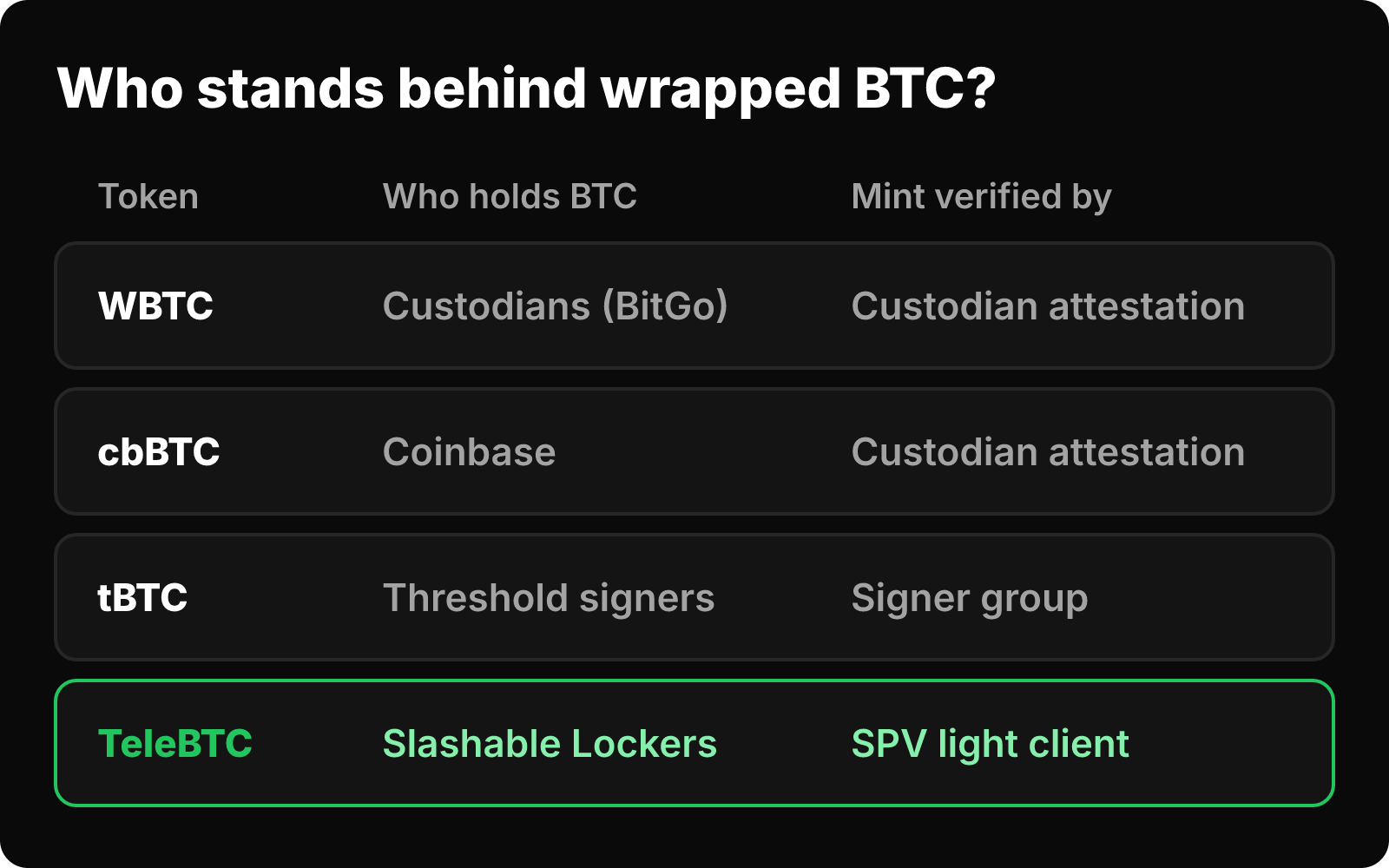
There's a second, quieter risk: who or what actually holds the BTC behind your wrapped token. In calm markets nobody thinks about it. In a crisis it decides whether your token can always be redeemed for real Bitcoin. The trust model behind converting BTC to wrapped versions varies widely across bridges and custodians.
| Wrapped BTC | Who secures the underlying BTC | How minting is verified | Main trust assumption |
|---|---|---|---|
| WBTC | Centralized custodians (BitGo and partners) | Custodian attests to deposits | Custodians stay solvent and honest |
| cbBTC | Centralized custodian (Coinbase) | Custodian attests to deposits | Single company's custody and compliance |
| tBTC | Decentralized threshold-signer network | Signer group sweeps deposits into threshold-controlled wallets | Honest majority of signers |
| TeleBTC | Collateral-backed Lockers (slashable) | SPV light client verifies the Bitcoin transaction on-chain | Bitcoin's proof-of-work for verification; slashable Locker collateral for custody |
TeleSwap, a trust-minimized Bitcoin bridge, is built around that last row. Nothing is minted until a Bitcoin transaction has been verified by an SPV light client, which is a compact on-chain check of Bitcoin's proof-of-work. TeleBTC is backed 1:1 by real BTC, and the Lockers who hold the underlying BTC post collateral that can be slashed if they misbehave. That matters on volatile days, when you might want to move from native BTC straight into a stablecoin such as USDC on Arbitrum or USDC on Optimism without going through a centralized exchange. Fast swaps settle in about 10 minutes. For the step-by-step mechanics, see the guide to cross-chain BTC swaps without KYC.
For a sense of scale, TeleSwap has bridged $508.2M across 538,604 transactions on 13 supported networks, according to TeleSwap network stats. Over the last 30 days it handled $44.9M, about $1.5M a day, with a peak of $2.8M on September 18, 2026. That was the same day L2 tokens rallied as much as 26%, a coincidence worth noting rather than proof of cause and effect.
Practical Takeaways: How to Read the Next Oil Shock
None of this is investment advice. These are ways to understand what's going on, so the next headline doesn't catch you off guard.
- Expect L2 tokens to move several times as much as Bitcoin. On October 7 the multiple ranged from about 2.8x (ARB) to 4x (OP). The same thing happens on the way up.
- Watch the early dominoes. Brent crude, the 10-year Treasury yield and the dollar index often move before crypto does. If all three are rising together, risk-off pressure is building.
- Leverage is what turns a dip into a wipeout. The $547 million in liquidations were all leveraged positions. A spot holder who doesn't borrow can't be force-sold.
- Keep token price and network health separate. Check activity and risk data on a tracker like L2BEAT before deciding a network is in trouble because its token fell.
- Know which wrapped BTC you hold. Custodian, signer committee or light-client verification: each one handles a crisis differently.
- Watch for shutdown notices. If an L2 you use announces it's closing, the withdrawal deadline matters far more than the token's price.
Frequently Asked Questions
Why do layer 2 tokens drop during oil rallies?
Layer 2 tokens drop during oil rallies because rising oil feeds inflation fears, higher yields and a stronger dollar, and investors respond by selling their riskiest assets first. L2 tokens are near the top of crypto's risk ladder. They have thinner liquidity, depend on Ethereum activity and face ongoing supply unlocks, so they tend to fall several times as much as Bitcoin. On October 7, 2026, OP fell about 10% while BTC fell roughly 2.5%.
Why did Bitcoin drop in October 2026?
Bitcoin dropped below $84,000 on October 7, 2026, after tanker attacks in the Strait of Hormuz pushed Brent crude above $101 a barrel. The oil spike set off risk-off selling across global markets, and $547 million in crypto liquidations made the move bigger. Bitcoin's 24-hour loss of about 2.4–2.8% was still much smaller than the losses in altcoins and layer-2 tokens. The connection runs through Treasury yields, dollar strength and the unwinding of leveraged positions, not through any direct link between oil and Bitcoin.
Is Bitcoin correlated with oil prices?
Bitcoin isn't directly tied to oil, but sudden oil spikes often push it down by tightening financial conditions. The link runs through inflation expectations, bond yields and the US dollar. Sudden geopolitical shocks tend to matter more than gradual price changes. When higher Treasury yields look more attractive than volatile assets, capital moves away from crypto.
Does a falling L2 token mean the network is unsafe?
No, a falling L2 token reflects market sentiment, not whether the network works or is secure. On October 7, 2026, ARB and OP fell 7–10%, and none of the market reports described Arbitrum or Optimism halting. Network shutdowns, like Abstract's that week, are a more meaningful risk signal than price drops. Token prices are speculative bets on future value; infrastructure reliability is about whether transactions are processed and finalized on schedule.
How much did liquidations contribute to the October 7 selloff?
Liquidations were a major amplifier, reaching $547 million in 24 hours, a 235% increase. Ethereum positions made up $174 million, or 31.8%, of the total. Forced selling of leveraged positions pushed prices lower, which triggered more liquidations, and that hit smaller tokens especially hard. Because crypto trades 24/7 with high leverage, a single macro shock can compound within hours.
How does an oil shock affect Bitcoin DeFi users?
An oil shock mainly affects Bitcoin DeFi users through liquidation of wrapped-BTC collateral in lending apps. If you've borrowed against wrapped BTC and the price drops past your threshold, your collateral is sold automatically. The trust model behind your wrapped BTC (custodian, signer network or light-client verification) also matters during periods of market stress. Custodian-backed models depend on institutional solvency, while decentralized models rely on economic incentives and cryptographic proofs.
What are the safest ways to bridge or swap Bitcoin on-chain?
The main choice is between decentralized verification (SPV light clients, threshold signers) and established centralized custodians. tBTC (threshold-signer backed) and TeleBTC (SPV light-client verified and collateral-backed) don't require trusting a single company. Centralized options like WBTC and cbBTC shift trust to custodians such as BitGo or Coinbase, but offer scale and liquidity. For a chain-specific walkthrough, see our guide on Bitcoin wrapping on Solana.
Conclusion
The October 7, 2026 oil shock showed clearly how macro events move through crypto. A geopolitical incident lifted oil, oil lifted yields and the dollar, and leverage made the rest worse. Bitcoin dropped about 2.5%, while layer-2 tokens like OP and MNT fell close to 10%. That's what high beta looks like, and the same tokens had risen up to 26% in a single day just three weeks before.
Two lessons from October 7 apply to the next shock. First, a token's price and its network's health are different things, so treat them separately. Second, if you use Bitcoin in DeFi, find out exactly what secures the BTC behind the token you hold before markets turn volatile.
If you want to move native BTC on-chain without relying on a centralized custodian, you can get a quote on teleswap.xyz and see how SPV light-client verification works in practice.