Ethereum Glamsterdam Upgrade vs Bitcoin: 2026 DeFi Guide

The Ethereum Glamsterdam upgrade is a coordinated set of protocol changes, planned as a hard fork for Q4 2026, that aims to make Ethereum's base layer faster, cheaper for complex transactions, and less dependent on outside block-building services. Bitcoin isn't changing anything. If you hold BTC and use DeFi, both of those facts matter to you.
The Ethereum Glamsterdam upgrade combines two protocol layers: "Amsterdam" (execution layer) and "Gloas" (consensus layer). No mainnet date had been confirmed as of October 2026. The upgrade changes who builds blocks, how many transactions fit inside them, and what it costs to store data on-chain. This guide explains each change in plain English, compares Ethereum's approach to Bitcoin's, and shows why the biggest open question for Bitcoin holders sits outside Ethereum entirely.
Key Takeaways:Glamsterdam combines the "Amsterdam" execution-layer upgrade and the "Gloas" consensus-layer upgrade, and it is targeted for Q4 2026, according to Cryptowisser and HokaNews.Glamsterdam's headline feature, enshrined proposer-builder separation (EIP-7732), writes block building into Ethereum's own protocol so validators no longer depend on third-party relays.Ethereum developers have tested a 200-million-gas block limit on the Platåberget testnet, roughly 3x the current ~60 million, though that figure is not committed for mainnet, per crypto.news.ETH holders do not need to take any action for Glamsterdam, and anyone telling you to "migrate" or "upgrade" your tokens is running a scam.No Ethereum upgrade changes the trust model of wrapped Bitcoin, so BTC holders still have to judge each bridge on how it verifies and secures their coins.
Table of Contents
- What Is the Ethereum Glamsterdam Upgrade?
- What Does Glamsterdam Actually Change?
- Ethereum vs Bitcoin 2026: Why Do They Upgrade So Differently?
- What Are the Cross-Chain DeFi Implications?
- Bitcoin Bridge Updates: Where Does BTC Fit In?
- What Should DeFi Users Do Before Glamsterdam?
- Frequently Asked Questions
- Conclusion
What Is the Ethereum Glamsterdam Upgrade?
Glamsterdam is Ethereum's next scheduled hard fork: one bundle of execution-layer and consensus-layer changes that every node switches to at the same moment. A "hard fork" just means every node operator updates their software so the whole network moves to new rules together.
The name joins two words. Ethereum runs as two connected layers, and each one gets its own upgrade name, as Cryptowisser explains:
- Amsterdam, the execution layer: where transactions run and smart contracts (programs that live on the blockchain) execute.
- Gloas, the consensus layer: where validators, the computers that stake ETH to secure the network, agree on which blocks are final.
Put them together and you get "Glamsterdam." It follows Fusaka, which shipped in late 2025 with PeerDAS (a more efficient way for nodes to check data) and more room for the "blobs" that Layer 2 networks use to post data, according to Formo's upgrade overview.
The upgrade after Glamsterdam, Hegotá, is expected around Q2 2027. Ethereum ships a named upgrade roughly every year, and that pace is one of the sharpest differences from Bitcoin. We'll come back to it.
What Does Glamsterdam Actually Change?
Glamsterdam makes four changes that matter to everyday DeFi users: it builds block production into the protocol, lets transactions run in parallel, reprices on-chain storage, and logs every ETH transfer.
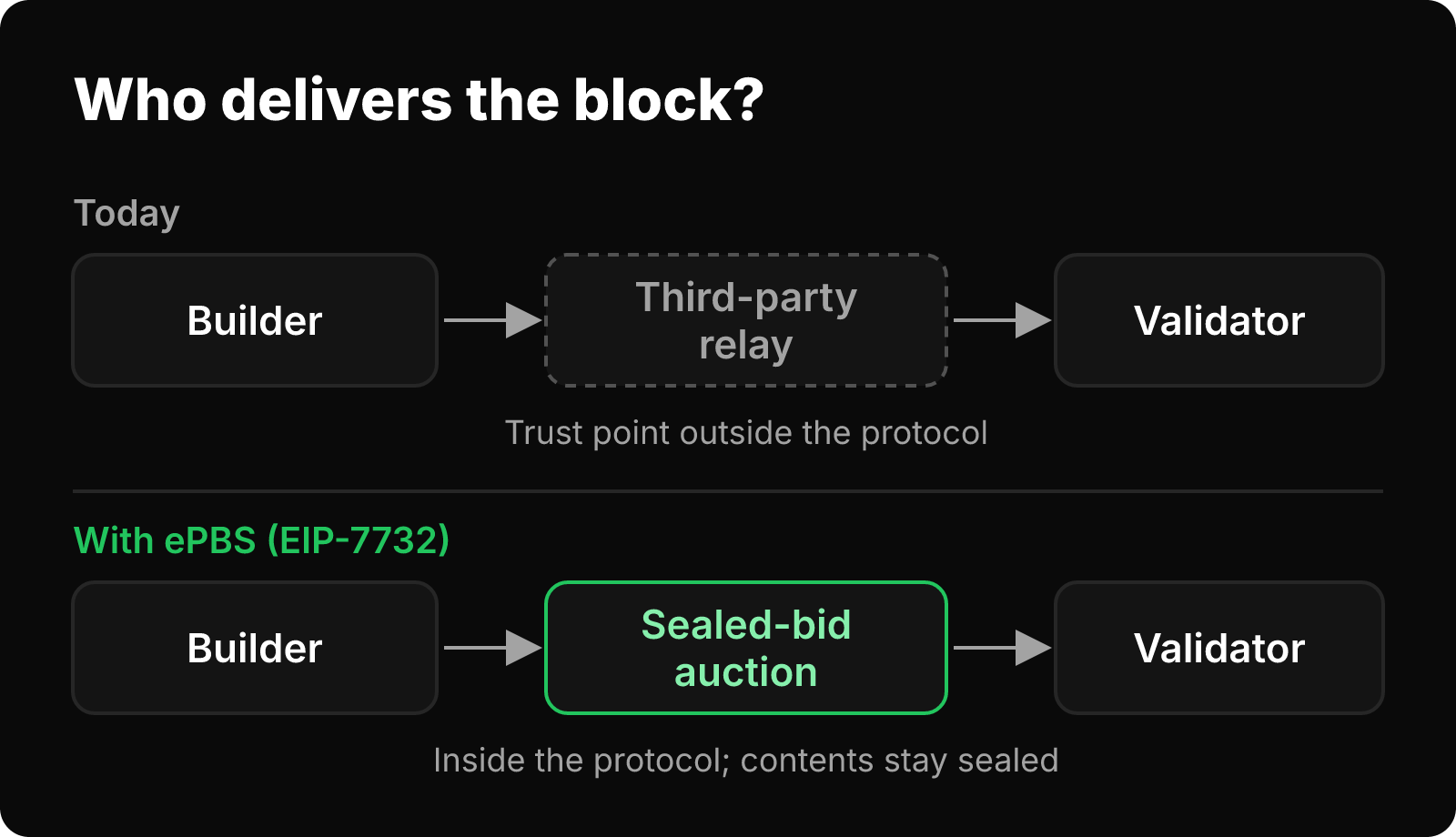
1. Enshrined Proposer-Builder Separation (ePBS): a sealed-bid auction
Most Ethereum blocks today are put together by specialized "builders" and handed to validators through third-party middlemen called relays. It works, but the relays are a trust point that isn't part of the protocol. If a relay misbehaves or goes offline, validators have little recourse.
EIP-7732 moves that process into Ethereum itself. Think of a sealed-bid auction: builders submit sealed envelopes (blocks with their contents cryptographically committed). The validator picks the highest bid without opening the envelope, so it can't peek inside and tamper with the transactions. Formo notes the change also widens the block propagation window from about 2 seconds to roughly 9 seconds, which gives the network more breathing room to pass blocks around.
A caveat most coverage skips: ePBS doesn't abolish MEV (maximal extractable value), the profit someone can squeeze out by reordering your transactions, such as "sandwiching" your swap between two of their own trades. What ePBS changes is who you have to trust in the block-building pipeline. Sandwich bots won't vanish on upgrade day, so your slippage settings still matter.
2. Parallel processing (EIP-7928): more checkout lanes
Ethereum currently processes the transactions in a block one after another, like a supermarket with a single checkout lane. EIP-7928's block-level access lists attach a map to each block showing which accounts and storage slots every transaction touches.
When two transactions don't touch the same things, nodes can process them side by side. More lanes open, but only for shoppers who aren't reaching for the same item on the shelf. The point is higher gas limits, meaning more work per block, while still letting ordinary computers verify the chain.
3. State pricing reforms (EIP-8037 and EIP-8038): charging for warehouse space
Every account balance and contract variable that Ethereum stores is called "state," and every full node has to keep all of it forever. EIP-8037 introduces a cost-per-byte model aimed at capping state growth at about 120 GiB per year, and EIP-8038 reprices state-access operations to match modern hardware. Picture a warehouse that finally starts charging rent that reflects what the shelf space really costs.
The catch: Curve Finance has cautioned that revised state charges could increase gas requirements for some transactions. Glamsterdam is not a blanket fee cut.
4. ETH transfer logs (EIP-7708): automatic receipts
Under EIP-7708, every non-zero ETH transfer or burn produces a standard log event. Tokens like USDC already leave these receipts, but plain ETH moving inside contracts has needed custom tracing to follow. Bridges, exchanges, and wallets get cleaner accounting with no extra effort. You won't see this change directly, but it removes a quiet source of bugs in the infrastructure you depend on.
| Change | Plain-English version | What it means for DeFi users |
|---|---|---|
| ePBS (EIP-7732) | Block building becomes a sealed-bid auction inside the protocol | Less reliance on third-party relays; MEV risk reduced but not gone |
| Block-level access lists (EIP-7928) | Non-conflicting transactions run in parallel | Paves the way for bigger blocks and less congestion |
| State repricing (EIP-8037/8038) | Storage costs reflect real-world hardware costs | Some operations get cheaper, some may cost more gas |
| ETH transfer logs (EIP-7708) | Every ETH movement leaves a receipt | Bridges and wallets track funds more reliably |
Ethereum vs Bitcoin 2026: Why Do They Upgrade So Differently?
Ethereum upgrades often because it's built to be a general-purpose computer. Bitcoin upgrades rarely because it's built to be a predictable monetary base layer. Neither approach is "better." They're optimized for different jobs.
Here's an analogy. Ethereum is a growing city that runs roadworks every year to add lanes, reroute traffic, and change zoning. Bitcoin is a bank vault whose locks are deliberately hard to change. You can't redesign the vault every year without making people nervous about what's inside.
Bitcoin's monetary rules have stayed fixed since the 2008 whitepaper: a block roughly every 10 minutes, a hard cap of 21 million coins, and a block reward that halves about every four years. The April 2024 halving cut it to 3.125 BTC, and the next one is expected around 2028. Its last major upgrade, Taproot, activated in November 2021.
New proposals such as covenant opcodes have been debated for years. As of this writing, they have not been activated on mainnet.
| Feature | Ethereum (post-Glamsterdam) | Bitcoin |
|---|---|---|
| Primary role | Programmable settlement for DeFi, stablecoins, and Layer 2s | Store of value and final settlement |
| Block time | ~12 seconds | ~10 minutes |
| Consensus | Proof-of-stake | Proof-of-work (SHA-256 mining) |
| Supply | No fixed cap | 21 million hard cap |
| Upgrade cadence | Named hard fork roughly every year | Rare soft forks (SegWit 2017, Taproot 2021) |
| Native smart contracts | Full, general-purpose | Limited scripting |
| Native DeFi | Deep: lending, AMMs, derivatives | Minimal on the base layer; mostly reached via bridges |
The Bitcoin Foundation's analysis frames Glamsterdam as Ethereum trying to "catch up" with Bitcoin. From a protocol design standpoint, that framing misses the point. Ethereum isn't trying to become sound money. It's competing to be the best place to use assets, including Bitcoin. That's the angle DeFi users should focus on. For more on how Layer 2 networks relate to Bitcoin DeFi, see our guide on Layer 2 tokens and Bitcoin DeFi correlation.
What Are the Cross-Chain DeFi Implications?
Glamsterdam's main cross-chain effect is to make Ethereum and its Layer 2s roomier and cheaper places to run complex DeFi strategies, which raises the value of getting assets like BTC onto them safely.
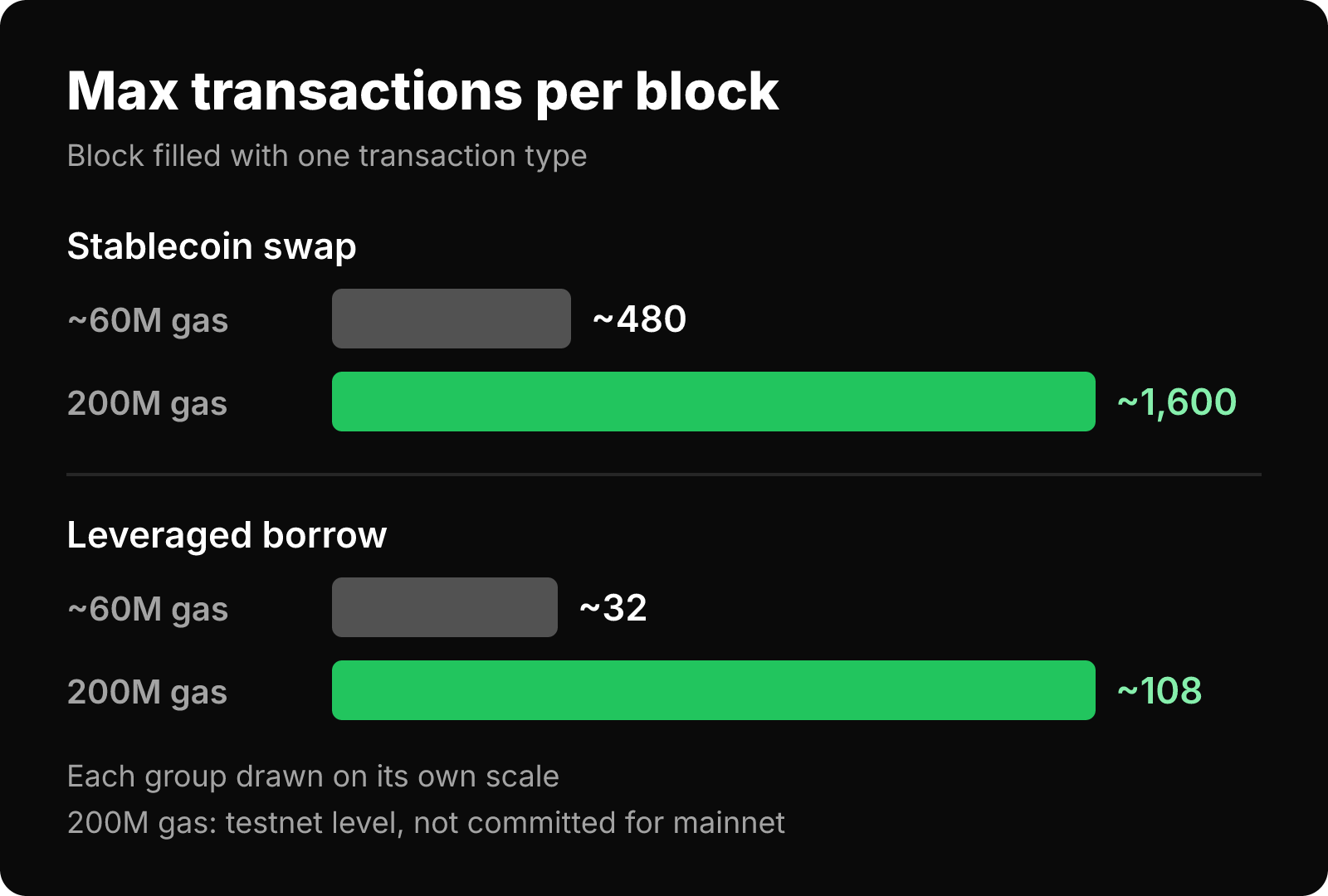
Look at how much work different DeFi actions take. In Curve Finance's analysis, reported by crypto.news, a leveraged borrow consumes about 1.84 million gas, while a direct stablecoin swap uses about 125,000. That's roughly 14.7x more. "Gas" is simply the unit Ethereum uses to measure computational work.
We ran the numbers to see what a bigger block would mean in practice. This is a simplified ceiling: it assumes a block filled with only one kind of transaction.
| Transaction type | Gas per tx | Max per block at ~60M gas | Max per block at 200M gas (testnet level) |
|---|---|---|---|
| Stablecoin swap | 125,000 | ~480 | ~1,600 |
| Leveraged borrow | 1,840,000 | ~32 | ~108 |
The 200-million-gas figure comes from testing on the Platåberget testnet and is not committed for mainnet. Still, the direction is clear. Curve expects longer swap routes and smaller arbitrage trades to become economical, and opening or unwinding positions during busy periods should get less painful.
Three ripple effects reach beyond Ethereum mainnet. First, Layer 2s benefit. Networks like Arbitrum, Base, and Optimism settle back to Ethereum, and a more efficient base layer means more capacity for the rollups where much retail DeFi activity happens. Second, bridges get better plumbing. EIP-7708's ETH transfer logs make it easier for bridge operators to track funds without custom tracing. Third, infrastructure has homework. Wallets, RPC providers, and indexers need to update their gas estimation, according to a 2026 roadmap summary. Fee estimates may be unreliable for a while after activation.
For Bitcoin holders, one of the most practical questions is how BTC moves across chains. Our breakdown of Bitcoin L2 fee comparisons for 2026 covers the routing costs involved.
Bitcoin Bridge Updates: Where Does BTC Fit In?
Glamsterdam makes Ethereum a better destination for Bitcoin, but it does nothing about the hardest part of using BTC in DeFi: getting it there without handing your coins to someone you have to trust.
Bitcoin and Ethereum can't natively see each other. Ethereum smart contracts have no built-in way to confirm that a Bitcoin transaction happened. So BTC reaches Ethereum as a wrapped token, an IOU backed by real BTC held somewhere else. Cheaper Ethereum gas makes that IOU more useful once you have it. It doesn't make the IOU any safer.
Every wrapped BTC token answers one question differently: who, or what, guarantees the real Bitcoin is there?
| Wrapped BTC | How minting is verified | Who holds the BTC | Main trust assumption |
|---|---|---|---|
| WBTC | Custodian confirms deposit | Centralized custodian (BitGo-led) | The custodian stays solvent and honest |
| cbBTC | Coinbase confirms deposit | Coinbase | A single regulated company |
| tBTC | Threshold signer network | A rotating group of signers (t-of-n) | A majority of signers don't collude |
| TeleBTC | On-chain Bitcoin light client checks SPV proofs | Collateral-backed, slashable Lockers | Bitcoin's proof-of-work, enforced by smart contracts |
As the Bitcoin developer documentation describes, SPV (Simplified Payment Verification) lets software confirm that a transaction is buried in Bitcoin's proof-of-work chain without downloading the whole blockchain. TeleSwap, a non-custodial Bitcoin bridge using SPV light client verification, puts that check inside smart contracts. Nothing is minted until a real Bitcoin transaction is verified, and the BTC is backed by collateral that gets slashed if a Locker misbehaves. That makes TeleBTC the trust-minimized option in the table: it inherits Bitcoin's own security model rather than relying on a custodian's word or a committee's signatures. According to TeleSwap network stats, the protocol has bridged $510.3M across 540,257 transactions on 13 supported networks, including $45.8M in the 30 days before October 9, 2026.
Post-Glamsterdam, this matters more, not less. If complex strategies become cheaper on Ethereum and its rollups, more BTC is likely to move there, and the weakest link will be the bridge, not the gas bill. In practice, users can bridge and swap in one step, for example BTC to ETH on Ethereum or BTC to USDC on Arbitrum. Fast swaps settle in about 10 minutes, fees are paid in Bitcoin assets, and a Teleporter covers destination-chain gas. For a related look at how settlement guarantees work, see our guide on delivery versus payment settlement in crypto.
What Should DeFi Users Do Before Glamsterdam?
Most DeFi users don't need to do anything with their funds, but a few precautions will keep you safe around activation day. Balances and existing contracts are unaffected, according to the published roadmap.
- Don't "migrate" anything. Your ETH and tokens carry over automatically. Any site, DM, or "support agent" asking you to swap or upgrade your tokens for Glamsterdam is a scam.
- Update your wallet app. Wallets will ship new gas-estimation logic. An outdated wallet might overpay or underprice transactions for a while.
- Avoid big moves on activation day. Infrastructure bugs tend to show up in the first hours. Leveraged positions near liquidation deserve extra margin.
- Check announcements from your dApps. Contracts with unusual gas needs or heavy state use may need updates. Follow the official channels of the protocols you use.
- Keep slippage protection on. ePBS changes the trust model for block building, but sandwich attacks don't disappear overnight.
- Audit your wrapped BTC. If you hold Bitcoin on Ethereum, look up how your wrapped token is verified and who holds the underlying coins. Use the table above as a checklist.
Frequently Asked Questions
When is the Ethereum Glamsterdam upgrade happening?
Glamsterdam is targeted for Q4 2026, but no mainnet date had been confirmed as of October 2026. It is being tested on the Platåberget testnet, and dates usually firm up only after testnets run smoothly. The next upgrade, Hegotá, is expected around Q2 2027.
Do I need to do anything with my ETH for Glamsterdam?
No, ETH holders don't need to do anything. Balances and existing smart contracts carry over automatically. Treat any request to "upgrade" or "migrate" your tokens as a scam.
Will Glamsterdam make Ethereum gas fees cheaper?
It should ease congestion and lower costs for many complex transactions, but cheaper fees aren't guaranteed. Parallel processing paves the way for higher gas limits, which usually reduces fee pressure. However, state repricing under EIP-8037 and EIP-8038 could raise gas costs for some storage-heavy operations. The net effect on your typical transaction depends on its type and complexity.
Does the Glamsterdam upgrade affect Bitcoin?
No, Glamsterdam changes nothing on the Bitcoin network itself. It matters to Bitcoin holders only indirectly: Ethereum and its Layer 2s become more capable places to use wrapped BTC, which puts more weight on choosing a secure bridge. See our primer on how bridges make Bitcoin spendable in DeFi.
What is ePBS in simple terms?
ePBS (enshrined proposer-builder separation) is a sealed-bid auction for building blocks, written directly into Ethereum's protocol. Builders submit committed blocks, and validators pick the best bid without seeing or changing the contents. This removes the need for today's third-party relays, so the process is enforced by consensus rules rather than by external middlemen.
Is Ethereum replacing Bitcoin after Glamsterdam?
No, the two networks do different jobs. Bitcoin is optimized as a fixed-supply, rarely changing settlement layer. Ethereum is optimized as a programmable platform for DeFi. Many users hold BTC as their base asset and use it on Ethereum through bridges.
How can I use Bitcoin in Ethereum DeFi safely?
You use Bitcoin in Ethereum DeFi through a wrapped BTC token, so safety depends on how that token is backed and verified. Custodial tokens rely on a company staying honest and solvent. Threshold tokens rely on a group of signers not colluding. Light-client bridges verify Bitcoin transactions on-chain with SPV proofs before minting, so you don't have to take a custodian's word for it, and security is anchored to Bitcoin's own proof-of-work. Use the comparison table earlier in this article to match each option to your risk tolerance.
Conclusion
The Ethereum Glamsterdam upgrade is mostly good news for DeFi users. Block building moves into the protocol, parallel processing opens the door to bigger blocks, and bridges and wallets get cleaner accounting. It isn't a magic fee cut, though, and it doesn't wipe out MEV.
For Bitcoin holders, the takeaway is simple. Glamsterdam improves the destination but leaves the road to it untouched. As Ethereum DeFi gets more capable, the trust model of the bridge you use matters more than ever.
If you want to put BTC to work on Ethereum, its Layer 2s, or other chains without trusting a custodian, you can bridge and swap Bitcoin through a light-client bridge at teleswap.xyz. You can read how the verification works in the docs.