What Is Stacks STX? Bitcoin Layer 2 for DeFi Explained (2026)

Bitcoin is the largest crypto asset in the world, yet you can't natively lend it, borrow against it, or trade it on code-run markets. That gap is why Stacks was built.
So what is Stacks STX, the Bitcoin layer 2 people keep mentioning? Stacks is a separate blockchain that runs next to Bitcoin, anchors its history to Bitcoin, and adds the smart contracts Bitcoin doesn't have. That lets developers build lending markets, exchanges, and other DeFi (decentralized finance) apps that settle back to Bitcoin. This guide covers what Stacks is, how STX works, how sBTC brings real bitcoin into the system, and where the trade-offs are.
Key Takeaways:Stacks is a smart-contract blockchain that anchors every block to Bitcoin, so undoing Stacks history would require reorganizing Bitcoin, according to Phemex.Stacks uses a consensus mechanism called Proof of Transfer (PoX), where miners spend real BTC for the right to produce Stacks blocks.STX holders who lock ("stack") their tokens receive the BTC that miners spend, so stacking rewards are paid in bitcoin, not STX.sBTC is a 1:1 BTC-backed token on Stacks whose peg is controlled by a set of signers, which makes it a bridge with its own trust assumptions.Stacks is not an Ethereum-style rollup, and Coin Bureau's review cautions against comparing it with rollups as if they were the same thing.
Table of Contents
- What Is Stacks (STX) in Plain English?
- Where Did Stacks Come From?
- How Does Stacks STX Work? Proof of Transfer in 4 Steps
- What Is the STX Token Used For?
- What Is sBTC, and Is It Really Bitcoin DeFi Without Bridging?
- Stacks Bitcoin Layer 2 Explained: Is It Really a Layer 2?
- How Does Stacks Compare to Other Ways of Using BTC in DeFi?
- What Are the Risks of Using Stacks?
- How Can a Beginner Get Started Safely?
- Frequently Asked Questions
- Conclusion
What Is Stacks (STX) in Plain English?
Stacks is a blockchain built to add smart contracts and apps to Bitcoin without changing Bitcoin itself. Bitcoin's base layer is deliberately simple, and its developers are cautious about adding features. Stacks puts the extra functionality on its own chain and uses Bitcoin as the final record.
Think of Bitcoin as a national land registry: slow, conservative, extremely hard to tamper with. Stacks is a busy marketplace next door. Deals happen quickly there, and a record of them gets stamped into the registry. Once a deal is in the registry, undoing it means undoing the registry too.
That's the basic idea behind Stacks as a Bitcoin layer 2. It has its own blocks, its own token (STX), and its own programming language (Clarity), but its history is written into Bitcoin blocks. Phemex's explainer puts it this way: Stacks blocks are treated as final once their hashes are confirmed on Bitcoin, so an attacker would have to reorganize Bitcoin itself to rewrite Stacks.
Key terms in one line each
- Smart contract: a program on a blockchain that runs automatically when its conditions are met, like a vending machine for money.
- Layer 2: a system built on top of a base blockchain (the "layer 1") to add speed or features.
- DeFi: financial services such as lending, trading, and earning yield that run on smart contracts instead of banks.
- Clarity: the smart-contract language Stacks uses.
Where Did Stacks Come From?
Stacks started in 2013 as a Bitcoin-based identity project and grew into a smart-contract network. Founders Muneeb Ali and Ryan Shea first built Onename, a Bitcoin-based identity system. The project was later called Blockstack and took the name Stacks in 2020.
| Date | Milestone | Source |
|---|---|---|
| 2013 | Onename (later Blockstack) founded by Muneeb Ali and Ryan Shea | DennTech |
| 2018 | STX token released with an initial supply of 1.32 billion | Kraken Learn |
| 2020 | Rebranded from Blockstack to Stacks | Polkastarter |
| January 14, 2021 | Stacks 2.0 mainnet launches with Proof of Transfer | Polkastarter |
| Late 2024 | Nakamoto upgrade: faster blocks, Bitcoin finality, and groundwork for sBTC | Polkastarter |
The Nakamoto upgrade was the big one. It delivered faster blocks and Bitcoin finality, and laid the groundwork for sBTC. Those changes are what make the network more practical for trading-style DeFi.
How Does Stacks STX Work? Proof of Transfer in 4 Steps
Stacks reaches consensus through Proof of Transfer (PoX): miners spend BTC to earn STX, and that BTC goes to STX holders who lock their tokens. This is the part of Stacks most beginners get wrong, so start here.
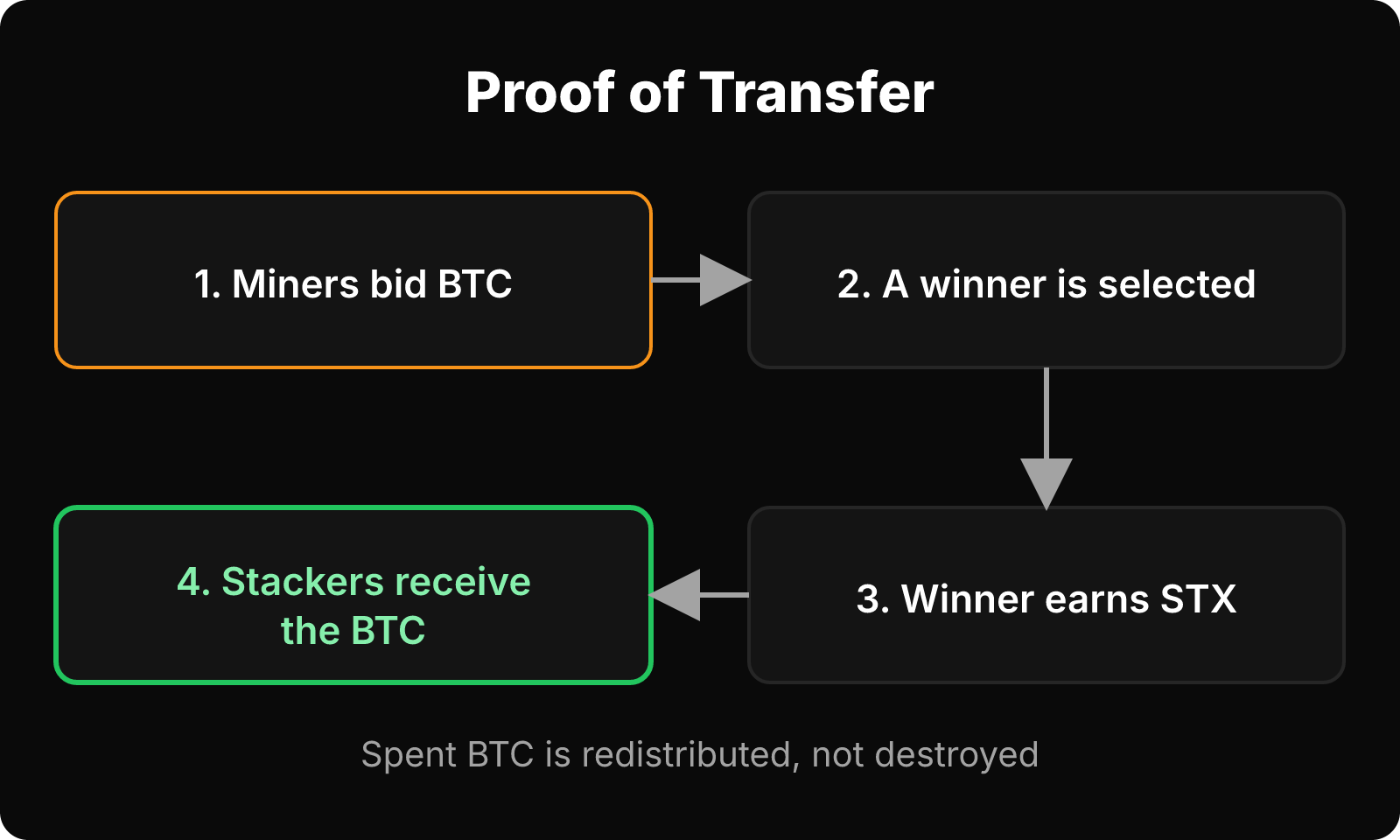
For comparison, Bitcoin uses proof-of-work, where miners spend electricity. PoX swaps the electricity for bitcoin: Stacks miners "spend" BTC instead of energy.
- Miners bid BTC. Each Stacks miner sends a Bitcoin transaction that commits some BTC as a bid for the right to produce the next Stacks block, as Kraken explains.
- A winner is selected. The winning miner earns the right to produce the block.
- The winner earns STX. The winning miner is paid in STX for committing the block.
- Stackers receive the BTC. The bitcoin miners spent isn't destroyed. It's redistributed to STX holders who locked their tokens to support consensus. This locking is called stacking.
Picture an auction. Bidders pay in dollars for the right to print a new kind of coupon. The dollars go to the coupon holders who agreed to keep their coupons locked away and help run the auction. Miners want STX, stackers want BTC, and the auction connects the two.
How does stacking work?
You lock STX to support consensus and earn a share of the BTC that miners spent. Most beginners join a stacking pool, which combines smaller holdings; check the Stacks documentation for current minimums and cycle length.
Don't treat any yield figure as fixed. Rewards depend on how much BTC miners spend, so yield is variable. In practice, it tracks network activity and the STX market.
What Is the STX Token Used For?
STX pays for transactions on Stacks, rewards miners, and earns BTC when stacked. Its main jobs are:
- Gas fees: every Stacks transaction pays a fee in STX.
- Miner rewards: miners are paid in STX for producing blocks.
- Stacking: locking STX earns a share of miners' BTC.
- DeFi collateral and trading: STX can be lent, borrowed, and traded inside Stacks apps, per OKX Learn.
On supply, sources don't agree. Kraken describes a maximum of about 1.81 billion STX reached around 2050, while Polkastarter says there is no fixed maximum. Check the tokenomics documentation at docs.stacks.co before relying on any single number.
What Is sBTC, and Is It Really Bitcoin DeFi Without Bridging?
sBTC is a token on Stacks backed 1:1 by real bitcoin, and it's how actual BTC gets into Stacks DeFi. You deposit BTC, receive sBTC, use it in Stacks apps, and later redeem it for BTC.
According to DennTech, the peg is controlled by a decentralized set of Stacks signers, the same entities that validate Stacks blocks, rather than a single entity or multisig. The size of the signer set and the approval threshold aren't confirmed in the sources, so check the Stacks docs. For a wider look at how validator trust can fail, see Ethereum validator security and the risks it creates for Bitcoin bridges.
Some marketing calls this "Bitcoin DeFi without bridging." That's not quite accurate.
Our take: sBTC is a bridge. Your BTC leaves your wallet and is held under control of a signer set. That's more decentralized than a single company holding coins, but your funds still depend on those signers. The real question is never "bridge or no bridge." It's "what exactly am I trusting?"
Coin Bureau's review lists these signer assumptions as one of Stacks' main trade-offs. Every way of using BTC outside the Bitcoin chain falls somewhere on a range: a single custodian, a committee or multisig, a signer set, or cryptographic verification of Bitcoin transactions themselves.
Stacks Bitcoin Layer 2 Explained: Is It Really a Layer 2?
Stacks is commonly called a Bitcoin layer 2, but Coin Bureau stresses it doesn't work like an Ethereum rollup. The label matters because it shapes what you expect.
Stacks differs from Ethereum-style rollups in its finality, execution, and signer assumptions. What Bitcoin gives Stacks is finality: once Stacks blocks are anchored in Bitcoin blocks, reversing them requires reorganizing Bitcoin.
A fair summary: Stacks inherits Bitcoin's resistance to history being rewritten, but it relies on its own miners, signers, and STX economics for the rest. BitVM-based designs are proposed as offering stronger trust assumptions for Bitcoin computation, but how they compare with Stacks isn't settled.
How Does Stacks Compare to Other Ways of Using BTC in DeFi?
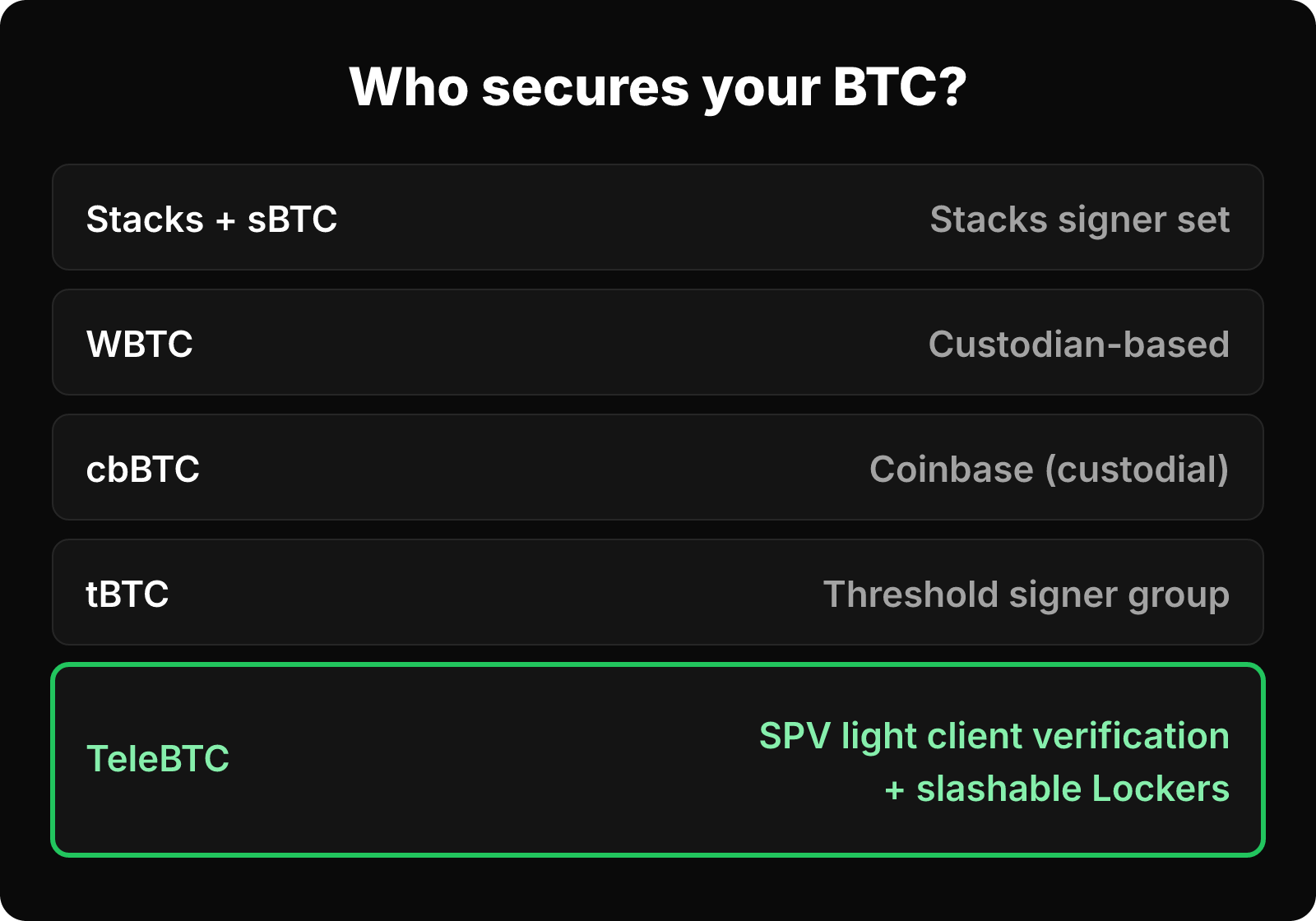
Stacks is one of several ways to put bitcoin to work, and each makes a different trade-off between features, liquidity, and trust. The table below compares the main options.
| Option | What it is | Who secures your BTC | Smart contracts? |
|---|---|---|---|
| Stacks + sBTC | Bitcoin-anchored chain with a 1:1 BTC-backed token | Stacks signer set | Yes (Clarity) |
| Lightning Network | Payment channels on Bitcoin | You (via channel contracts) | No (payments and simple transfers) |
| WBTC | Wrapped BTC on Ethereum and other chains | Custodian-based | Yes (EVM) |
| cbBTC | Coinbase-issued wrapped BTC | Coinbase (custodial) | Yes (EVM) |
| tBTC | Threshold Network wrapped BTC | Threshold signer group | Yes (EVM) |
| TeleBTC (TeleSwap) | 1:1 BTC-backed token minted after on-chain Bitcoin verification | SPV light client verification plus collateral-backed, slashable Lockers | Yes (EVM, TON, Solana) |
To check how much capital is actually deployed in Stacks apps today, look at DefiLlama's Stacks dashboard. Ethereum L2s generally offer deeper liquidity and stronger developer tooling, according to CoinStats.
The trust column is where these options really differ. Rather than building a new chain, TeleSwap brings BTC to chains that already have deep liquidity. Its TeleBTC token is minted only after a verified Bitcoin transaction, secured by SPV light client proofs rather than custodians or multi-sig committees.
According to TeleSwap network stats, the protocol has handled $516.3M in bridged volume across 547,087 transactions on 13 supported networks. Stacks asks you to move into a new ecosystem. Light-client bridges let BTC go to ecosystems that already exist, for example swapping BTC directly to USDC on Arbitrum. For a step-by-step version, see this trustless BTC swap guide.
Neither approach is the answer for everyone. If you want apps built specifically for Bitcoin and a way to earn BTC by stacking, Stacks fits. If you want the deepest stablecoin and DEX liquidity, bridging to EVM chains usually fits better.
What Are the Risks of Using Stacks?
The main risks with Stacks are STX price volatility, variable stacking yields, sBTC signer trust, and thinner liquidity than Ethereum. In more detail:
- Volatility: CoinStats' June 2026 analysis describes STX as a leveraged expression of Bitcoin and layer-2 sentiment, which tends to underperform when markets turn risk-off.
- Yield variability: stacking rewards depend on miner bidding activity. A high yield one cycle says nothing about the next.
- Lock-up: stacked STX is locked, so you can't react quickly to market moves.
- Peg risk: sBTC security depends on the signer set and the contracts around it.
- Smart-contract risk: individual DeFi apps can have flaws in their logic.
- Liquidity risk: CoinStats rates STX liquidity as not especially strong, which means more slippage and fewer exits under stress.
Ignore price predictions, including the ones that show up in Stacks search results. Nobody can reliably forecast token prices, and this article gives no investment advice.
How Can a Beginner Get Started Safely?
Start small, use a Stacks-compatible wallet, and learn one feature at a time. A practical order:
- Install a Stacks wallet. For larger holdings, Kraken recommends cold storage such as Ledger or Trezor.
- Get a small amount of STX for fees, from a major exchange.
- Read before you stack. If you join a pool, check its fee, payout history, and cycle length so you know when your STX unlocks.
- Test sBTC with a small deposit. Do a full round trip, BTC to sBTC and back, before committing meaningful funds. If you're new to onchain BTC transfers, this onchain BTC swap guide covers the basics.
- Check app TVL and audits on DefiLlama and the project's own docs before using any lending or trading protocol.
Before you deposit, write down in one sentence who you're trusting. If you can't, you don't understand the product well enough yet.
Frequently Asked Questions
What is Stacks (STX) in simple terms?
Stacks is a blockchain that adds smart contracts and DeFi apps to Bitcoin by anchoring its history to Bitcoin blocks. STX is its native token. It pays transaction fees, rewards miners, and earns BTC when holders lock it through stacking.
How does Stacks STX work?
Stacks works through Proof of Transfer: miners spend BTC to win the right to produce Stacks blocks and earn STX in return. The BTC they spend goes to STX holders who lock their tokens, and every Stacks block is anchored to Bitcoin for finality.
Is Stacks a true Bitcoin layer 2?
Stacks is widely called a Bitcoin layer 2, but it isn't a rollup in the Ethereum sense. Bitcoin gives it finality, meaning anchored history can't be rewritten without reorganizing Bitcoin. Stacks also depends on its own miners and signers.
Can I earn bitcoin by stacking STX?
Yes, stacking STX pays rewards in BTC, not STX. The amount varies because it depends on how much BTC miners spend, so treat any quoted APY as variable, not a promise.
Is sBTC the same as real bitcoin?
No. sBTC is a token on Stacks backed 1:1 by real BTC and controlled by Stacks signers. You can redeem it for BTC, but while you hold sBTC you're relying on the signer set and the peg's smart contracts.
Does Stacks let you do Bitcoin DeFi without bridging?
Not entirely. Using real BTC in Stacks DeFi requires depositing it into sBTC, which works as a bridge. What differs between options is the trust model: sBTC uses a signer set, WBTC uses custodians, and SPV light-client bridges verify Bitcoin transactions cryptographically.
Conclusion
Stacks is one of the most established attempts to make Bitcoin programmable. It anchors a smart-contract chain to Bitcoin, pays stackers in real BTC through Proof of Transfer, and brings bitcoin into its apps through sBTC. Its security mixes Bitcoin finality with its own miners, signers, and STX economics.
Three points to remember: PoX turns miners' BTC into stackers' rewards, stacking yields vary, and sBTC is a bridge with a signer-based trust model. If you'd rather take your BTC to chains that already have deep DEX liquidity, with mints verified by SPV proofs instead of a committee, you can see how it works at teleswap.xyz.