Swap BTC to Stablecoin on Polygon: 2026 Beginner Guide

Say you hold some Bitcoin and want to lock in its dollar value without selling on an exchange. Maybe you need to pay a bill, or you want a steady balance for a few weeks while the market swings. The obvious answer is to swap BTC to stablecoin on Polygon. With TeleSwap's fast swap you can do it in about 10 minutes, going straight from BTC in your wallet to USDC or USDT on Polygon.
The catch is that Bitcoin and Polygon don't share a language. Bitcoin can't send coins to a Polygon wallet directly, any more than a fax machine can send you a text message. Something has to translate between them. A bridge is a system that moves value from one blockchain to another, and a wrapped token is a stand-in for BTC on a different chain. Which translator you choose decides how much you pay, how long you wait, and who you have to trust in the meantime.
This guide starts from the basics, compares the real options side by side, and then walks through a swap step by step.
Key Takeaways:Bitcoin can't live on Polygon natively, so every BTC-to-stablecoin swap on Polygon needs a bridge, a wrapped token, or a custodial exchange in between.TeleSwap's fast swap delivers after one Bitcoin confirmation, typically in about 10 minutes, according to the TeleSwap fees and speed docs.TeleSwap charges a 0.1% Locker fee on the bridged amount, plus a network fee that rises and falls with congestion rather than with the size of your swap.A Teleporter fronts the Polygon gas for you, so you don't need to own any POL (formerly MATIC) to receive your USDC or USDT.TeleSwap has processed $514,909,453 in total bridged volume across 545,686 transactions, per TeleSwap network stats.
Table of Contents
- What Does It Mean to Swap BTC to a Stablecoin?
- Why Swap BTC to Stablecoin on Polygon?
- How Does a Polygon Bridge BTC Swap Work?
- Is an Instant BTC to Stablecoin Swap Really Possible?
- Comparing 4 Ways to Get Stablecoins on Polygon
- How to Swap BTC to USDC on Polygon: Step by Step
- Understanding Fees and Rates
- Risks Beginners Should Know
- Frequently Asked Questions
- Conclusion
What Does It Mean to Swap BTC to a Stablecoin on Polygon?
A stablecoin is a crypto token built to hold a steady value, usually $1. USDC is issued by Circle and USDT by Tether. When you swap BTC for a stablecoin, you trade a volatile asset for one meant to stay flat, and you keep it all on-chain instead of cashing out to a bank.
Think of it like changing money at an airport. You hand over one currency and get another. Here, though, the two currencies are on different "countries" (blockchains), so you also need to cross a border.
A few terms will come up a lot:
- Blockchain: a shared public record of transactions. Bitcoin and Polygon are two separate ones.
- Bridge: a system that moves value from one blockchain to another.
- Wrapped BTC: a token on another chain that stands for real BTC held somewhere else. WBTC and TeleBTC are both examples, but they're secured in very different ways.
- Gas: the small fee you pay a network to process your transaction. On Polygon that fee is paid in POL, which used to be called MATIC.
Why Swap BTC to Stablecoin on Polygon?
Polygon has become one of the busiest networks for stablecoin payments, and its fees are low. CoinGecko's Polygon Ecosystem Report found that stablecoin supply on Polygon hit an all-time high of $3.28B in February 2026. It also found that payment-processor volume on the network reached $1.98B by January 2026.
By September 28, 2026, DefiLlama data cited by CryptoTicker showed $2.99B in stablecoins on Polygon. The two figures may reflect different methodologies, but either way it's a deep pool.
The mix of stablecoins matters too. CoinGecko puts USDC at 51.1% of Polygon's stablecoin supply, USDT at 27.8%, and USDS (formerly DAI) at 19.5%. USDC and USDT hold most of the stablecoin supply, so they're the natural choices for a swap.
Polygon has also been upgrading quickly. The "Ithaca" hard fork went live on July 29, 2026, the fourth update in five months according to CryptoTicker. Keep your wallets and apps current.
How Does a Polygon Bridge BTC Swap Work?
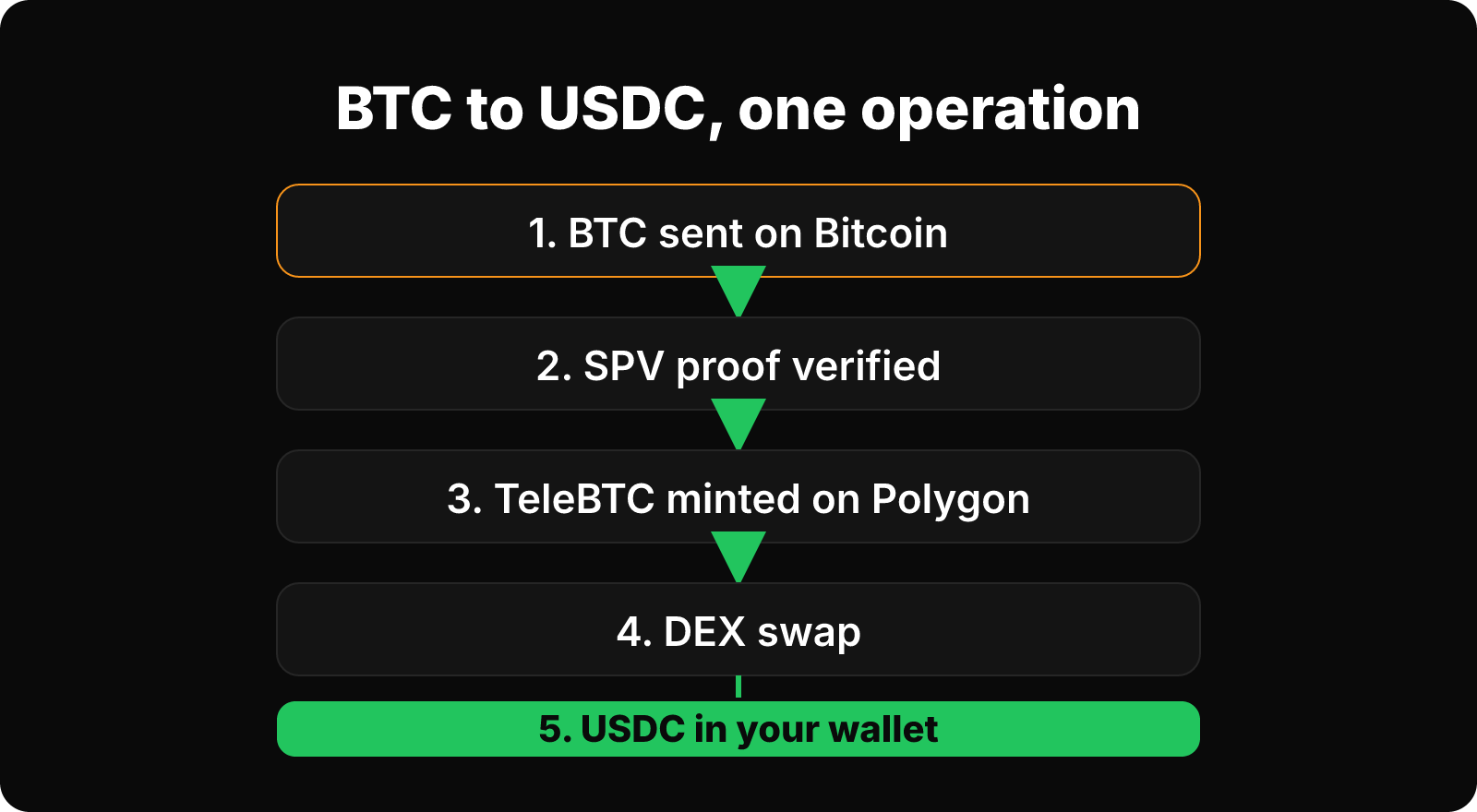
A Polygon bridge BTC swap has three parts: lock real BTC, create a matching token on Polygon, then trade that token for a stablecoin. The main difference between providers is who verifies the first part.
Picture a coat check. You hand over your coat (BTC) and get a ticket (a wrapped token) that you can spend in the building (Polygon). The question is whether you trust the person behind the counter, or whether the ticket comes with proof that your coat is really on the rack.
The custodial approach
With WBTC, a custodian holds the BTC and issues the token, so you're trusting that company's records. Centralized exchanges work the same way: they hold your BTC, credit you with stablecoins in their own database, and then let you withdraw to Polygon.
The light-client approach (TeleSwap)
TeleSwap uses SPV (Simplified Payment Verification) light-client proofs. A smart contract on the destination chain checks that your Bitcoin transaction really happened before it mints TeleBTC, a 1:1 collateral-backed representation of BTC. If there's no verified Bitcoin transaction, no TeleBTC gets minted.
The BTC is held by Lockers, whose custody is collateral-backed and slashable, meaning they can lose their collateral if they misbehave. For a step-by-step look at a trustless flow, see our Trustless BTC Swap: 7-Step No-KYC Guide (2026).
From there, TeleSwap routes through the AMM/DEX on Polygon and delivers your chosen token to your wallet as one operation. The TeleSwap supported-assets docs list these Polygon tokens: USDT, USDC, USDC.e, WBTC, WETH, MATIC, WMATIC, and TeleBTC.
The important point for beginners is that you never touch the wrapped token. You send BTC and receive USDC. The bridging and trading happen out of sight.
Is an Instant BTC to Stablecoin Swap Really Possible?
Not truly instant. Any honest route still has to wait for the Bitcoin network, and the fastest TeleSwap option takes about 10 minutes. Bitcoin adds a new block roughly every 10 minutes, as the Bitcoin developer documentation explains. Until your transaction is in a block, it can still be reversed.
When a service credits you within seconds of you sending BTC, one of two things is usually going on:
- It's custodial and fronting you money out of its own balance, so you're trusting it to sort out any problems.
- It's acting before your transaction is confirmed, which is a risk somebody pays for eventually.
TeleSwap is open about this trade-off. Per the TeleSwap fees and speed documentation:
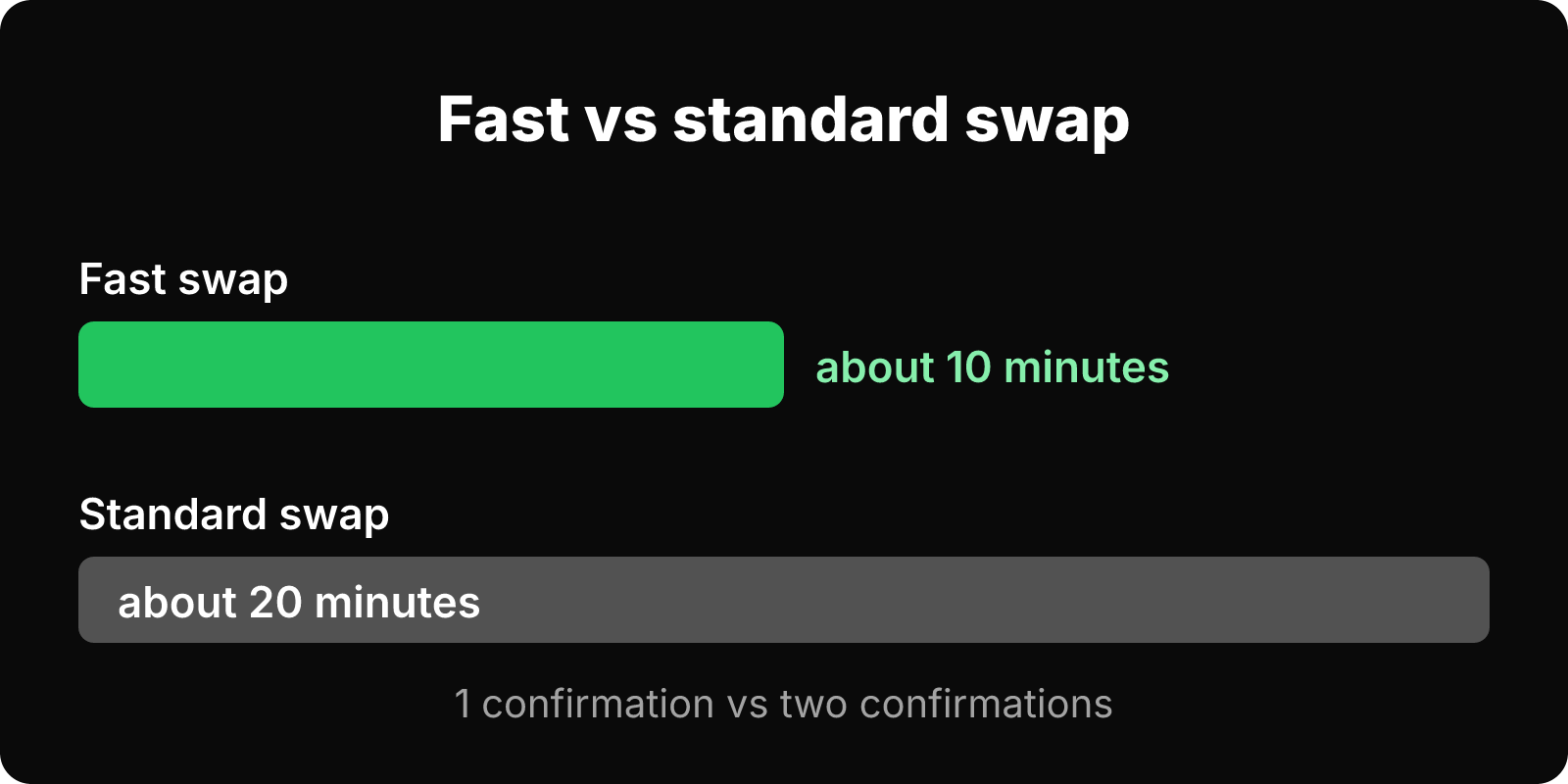
- Standard swap: waits for two Bitcoin confirmations before minting TeleBTC, about 20 minutes.
- Fast swap: a Filler prepares your swap and delivers after one confirmation, about 10 minutes, at the best rate available at that moment. The Filler is paid to take on the extra risk of a Bitcoin reorganization (a "re-org", when the network briefly rewrites its latest blocks).
So "instant" really means about 10 minutes, with your rate locked as soon as the Filler acts.
Comparing 4 Ways to Swap BTC to Stablecoin on Polygon
There are four main ways to swap BTC to stablecoin on Polygon, and they differ mostly in custody, number of steps, and whether you need gas.
| Method | Who holds your BTC? | Steps for you | Need POL for gas? | Account/KYC | Typical speed |
|---|---|---|---|---|---|
| TeleSwap (bridge + swap) | Collateral-backed, slashable Lockers; minting verified by SPV light client | 1 (send BTC, receive stablecoin) | No (Teleporter fronts gas) | No account needed | ~10 min fast / ~20 min standard |
| Centralized exchange (sell, then withdraw) | The exchange | 3+ (deposit, trade, withdraw) | No | Usually required | Depends on the exchange's deposit and withdrawal rules |
| Custodial instant exchange (e.g., Paybis) | The service | 1–2 | No | Often required | Fixed-rate windows of ~10–30 min are common, per GoDEX |
| Wrap to WBTC, then DEX swap | WBTC custodian | 3+ (wrap, bridge, swap) | Yes | Depends on the wrapping route | Varies; several transactions |
Each option has its place. A centralized exchange makes sense if you already keep funds there and want a bank cash-out later. Custodial instant exchanges give you a fixed quote. The WBTC route gives experienced DeFi users control over each step, but it costs the most in time and gas.
If you want to start with BTC in your own wallet and end with stablecoins in your own Polygon wallet, with no POL and no custodian, TeleSwap is the most direct route of the four. If you're comparing it with another bridge, read ThorSwap vs TeleSwap: Bitcoin Bridge Fees & Speed 2026.
How to Swap BTC to USDC on Polygon: Step by Step
To swap BTC to USDC on Polygon with TeleSwap, you need a Bitcoin wallet with funds and a Polygon wallet address. Here's the process:
- Get a Polygon wallet address. Any EVM wallet works, such as MetaMask or Trust Wallet. Copy the address that starts with 0x. You don't need to hold any POL.
- Open the swap route. Go to the BTC to USDC on Polygon swap page. If you'd rather have Tether, use the BTC to USDT on Polygon page instead.
- Enter your amount and Polygon address. Check the address twice. Crypto transactions can't be undone.
- Review the quote. You'll see the estimated amount you'll receive and the fee breakdown: network fee, Locker fee, and any protocol or third-party fee.
- Choose fast or standard. Fast delivers after one confirmation (~10 minutes). Standard waits for two (~20 minutes).
- Send the BTC from your Bitcoin wallet as instructed. When the swap finishes, USDC shows up in your Polygon wallet. If you don't see it, add the USDC token to your wallet's display.
Prefer to keep Bitcoin exposure on Polygon instead of moving to dollars? The same process works if you swap BTC to WBTC on Polygon. Wanting ETH instead? See Convert BTC to ETH on Polygon: Lowest Fees in 2026.
TeleSwap is also built into other apps. You'll find it as a Bitcoin swap provider on aggregators such as Rango, Rubic, and DZap, and, through the Rango integration, inside MetaMask and Trust Wallet.
USDC or USDC.e: which should you pick?
For most beginners, native USDC is the better choice. USDC.e is an older, bridged version of USDC on Polygon, while native USDC is issued directly by Circle. Yahoo Finance reported that Polymarket is switching from bridged USDC.e to native USDC through a partnership with Circle. TeleSwap supports both, so pick USDC.e only if a specific app requires it.
Understanding Fees and Rates for an Instant BTC to Stablecoin Swap
Your total cost has three parts: a percentage fee, a network fee, and price movement while you wait.
The TeleSwap fee docs list these components, all charged in Bitcoin terms:
| Fee | What it covers | Size |
|---|---|---|
| Network fee | Destination-chain gas that the Teleporter fronts for you | Varies with congestion; not a % of your amount |
| Locker fee | Pays the Locker for custody and collateral | 0.1% of the bridge amount |
| Protocol fee | Protocol treasury | May be 0 |
| Third-party fee | Integrator's share, if a third-party ID is set | 0 if none |
A simple worked example: if you bridge 0.05 BTC, the 0.1% Locker fee comes to 0.00005 BTC. The network fee isn't a percentage of your amount, so on a small swap it can be the biggest cost.
Price impact is the other thing to watch. It's the difference between the market price and what you actually get once your trade moves the pool. Always compare the final "you receive" number, not just the headline rate.
Risks Beginners Should Know
Switching into a stablecoin lowers your exposure to price swings, but it doesn't remove all risk. Keep these in mind:
- Stablecoin issuer risk: a stablecoin only holds its peg as long as the issuer's backing does. As CryptoTicker notes, a stablecoin on Polygon is no bank deposit and has no deposit insurance.
- Bridge and smart-contract risk: every cross-chain route depends on code. TeleSwap reduces trust in third parties through SPV verification and slashable collateral, but no smart contract is completely risk-free. For past failures, see Bridge Security Exploit: How the €332M Hack Happened.
- Wrong address or wrong network: sending to the wrong address can't be reversed. Paste carefully and check the first and last characters.
- Price movement during the wait: BTC can move during the ~10–20 minutes your swap takes. A fast swap locks the rate when the Filler acts, which narrows that window.
- Taxes: in many countries, swapping BTC for a stablecoin is a taxable event. Check your local rules.
Nothing here is financial advice.
Frequently Asked Questions
Can I swap BTC to stablecoin on Polygon without a centralized exchange?
Yes. A light-client bridge like TeleSwap lets you go straight from BTC in your own wallet to USDC or USDT in your own Polygon wallet. You send BTC on the Bitcoin network, TeleSwap verifies the transaction with an SPV proof, mints TeleBTC, swaps it on Polygon, and delivers the stablecoin. You don't need an exchange account.
How long does it take to swap BTC to USDC on Polygon?
About 10 minutes with TeleSwap's fast swap, or about 20 minutes with a standard swap. Fast swaps deliver after one Bitcoin confirmation because a Filler takes on the re-org risk. Standard swaps wait for two confirmations before minting TeleBTC.
Do I need POL (MATIC) to receive stablecoins on Polygon?
Not with TeleSwap. A Teleporter fronts the Polygon gas for you, and that cost is charged as a network fee in Bitcoin terms. This is a big help for beginners, who often get stuck holding tokens they can't move because they have no gas.
What fees does TeleSwap charge for a Polygon bridge BTC swap?
TeleSwap charges a 0.1% Locker fee plus a network fee that depends on congestion. There may also be a protocol fee (which can be 0) and a third-party fee if you use TeleSwap through a partner app. The full breakdown appears in your quote before you send any BTC.
Which stablecoins can I get on Polygon through TeleSwap?
USDT, USDC, and USDC.e. On Polygon, TeleSwap also supports WBTC, WETH, MATIC, WMATIC, and TeleBTC, according to the TeleSwap supported-assets documentation. For most users, native USDC or USDT is the simplest stablecoin choice.
Is TeleBTC the same as WBTC?
No. TeleBTC is minted only after a smart contract verifies your Bitcoin transaction with an SPV light-client proof, while WBTC depends on a custodian. Both are designed to track BTC 1:1. TeleBTC's minting is checked against Bitcoin itself, and its Lockers' custody is collateral-backed and slashable, rather than resting on a custodian's records.
How much volume has TeleSwap processed?
TeleSwap has bridged $514,909,453 in total volume across 545,686 transactions, according to TeleSwap network stats. Over the last 30 days it processed $45.4M, averaging about $1.5M per day, with a peak of $2.8M on September 18, 2026. It supports 13 networks.
Conclusion: The Simplest Way to Swap BTC to Stablecoin on Polygon
To swap BTC to stablecoin on Polygon, something has to connect two blockchains that can't talk to each other. Custodial routes ask you to trust a company. Multi-step WBTC routes ask you to pay gas on several transactions. TeleSwap does it in one step, with minting verified by an SPV light client, so nothing is created on Polygon without a verified Bitcoin transaction behind it.
Three things to remember:
- The fastest honest "instant" swap still waits for Bitcoin: about 10 minutes with a fast swap.
- Your cost is a 0.1% Locker fee plus a network fee, and you never need to hold POL.
- Native USDC and USDT make up most of Polygon's stablecoin supply.
The protocol has handled $514,909,453 in total bridged volume, per TeleSwap network stats. Ready to try it yourself?