Exit Liquidity Protocol Explained: EXIT House Guide 2026

An exit liquidity protocol takes crypto assets the market no longer wants and pays you a set amount of a token for them. EXIT HOUSE launched on Ethereum on October 9, 2026, and works this way. You hand over an eligible NFT or ERC-20 token. It gets permanently retired on-chain, and you receive the protocol's own token, EXIT, in an amount based on the asset's market value, according to Crypto Briefing's launch coverage.
In crypto slang, "exit liquidity" is an insult. It means you're the buyer someone else dumps their bags on. EXIT HOUSE turns the phrase around and serves the people stuck holding the bags: the NFT that hasn't had a bid in a year, or the token whose chart went flat in 2022.
The short answer: EXIT House can turn an asset you can't sell into something you can sell. But you get paid in a brand-new token whose price nobody knows yet, and you pay a 2% fee in real ETH. It's useful in some cases and a bad idea in others. Here's a quick guide before the details:
- Best if your asset still has buyers: sell it on a marketplace or DEX for ETH or stablecoins.
- Best if your asset truly has no buyers: EXIT House, as long as you understand you're being paid in EXIT, not dollars.
- Best for a clean wallet with zero cost beyond gas: burn it or hide it.
- Best for moving leftover stablecoins into Bitcoin: a direct cross-chain swap to native BTC using a light-client-verified Bitcoin bridge.
Key Takeaways:EXIT House is an Ethereum protocol launched October 9, 2026, that permanently retires eligible NFTs and ERC-20 tokens in exchange for EXIT tokens at a rate of 1,000 EXIT per $1 until November 8, 2026, then 100 EXIT per $1 thereafter.Every exit carries a 2% fee on the asset's qualifying value, paid in ETH on top of gas, with half going to the EXIT liquidity pool and half to the EXIT House treasury.EXIT has a fixed supply of 10 billion tokens with no mint function, split as follows: 45% for exit rewards, 15% for staking rewards, 15% for the founder, 10% for liquidity, 10% for the treasury, and 5% for the ecosystem.The dollar value of your EXIT reward depends entirely on what EXIT trades for; the only price reference at launch was a Uniswap v3 pool seeded at $0.0005 per EXIT, which is not a floor or guarantee.Alternative exit strategies include NFT marketplace sales, DEX token swaps, asset burning, or consolidating leftover stablecoins into native Bitcoin via light-client-verified bridges.
Table of Contents
- What Is an Exit Liquidity Protocol?
- How Does the EXIT House Token Redemption Mechanism Work?
- How Much Is Your Unwanted NFT Worth in EXIT?
- What Are the Risks Most Guides Skip?
- 5 Ways to Liquidate Unwanted Tokens and NFTs
- Which NFT Exit Strategy Fits You? Comparison Table
- Wallet Cleanup Combo: A Step-by-Step Example
- Frequently Asked Questions
- Conclusion
What Is an Exit Liquidity Protocol?
An exit liquidity protocol is a smart contract system that buys back or permanently retires crypto assets the open market no longer wants, and pays the holder a predictable token amount rather than cash.
Liquidity means how easily you can sell something without crashing its price. A popular token like ETH is very liquid, because thousands of buyers are always waiting. An obscure NFT from a collection that never took off is illiquid: you could list it for months and get no offers at all.
The usual way to sell is to find another person who wants the asset. Marketplaces like OpenSea and decentralized exchanges (DEXs, apps where people trade tokens directly from their wallets) like Uniswap all depend on that. When nobody shows up, you're stuck.
Think of a government "cash for clunkers" program. Nobody wants to buy your 20-year-old car, but the program takes it, scraps it so it never goes back on the road, and gives you a fixed credit. EXIT House works the same way for digital assets. The asset is destroyed so it never comes back to market, and the credit is paid in EXIT tokens.
EXIT House's own description of the problem, as reported by Investing.com, is that "many NFTs and tokens sit in wallets with thin markets and little chance of recovering their past highs."
How Does the EXIT House Token Redemption Mechanism Work?
EXIT House uses a signed-quote system. The price is locked before you commit, and your reward arrives in the same transaction that retires your asset. According to the launch details published via Chainwire on TradingView, the process has six steps:
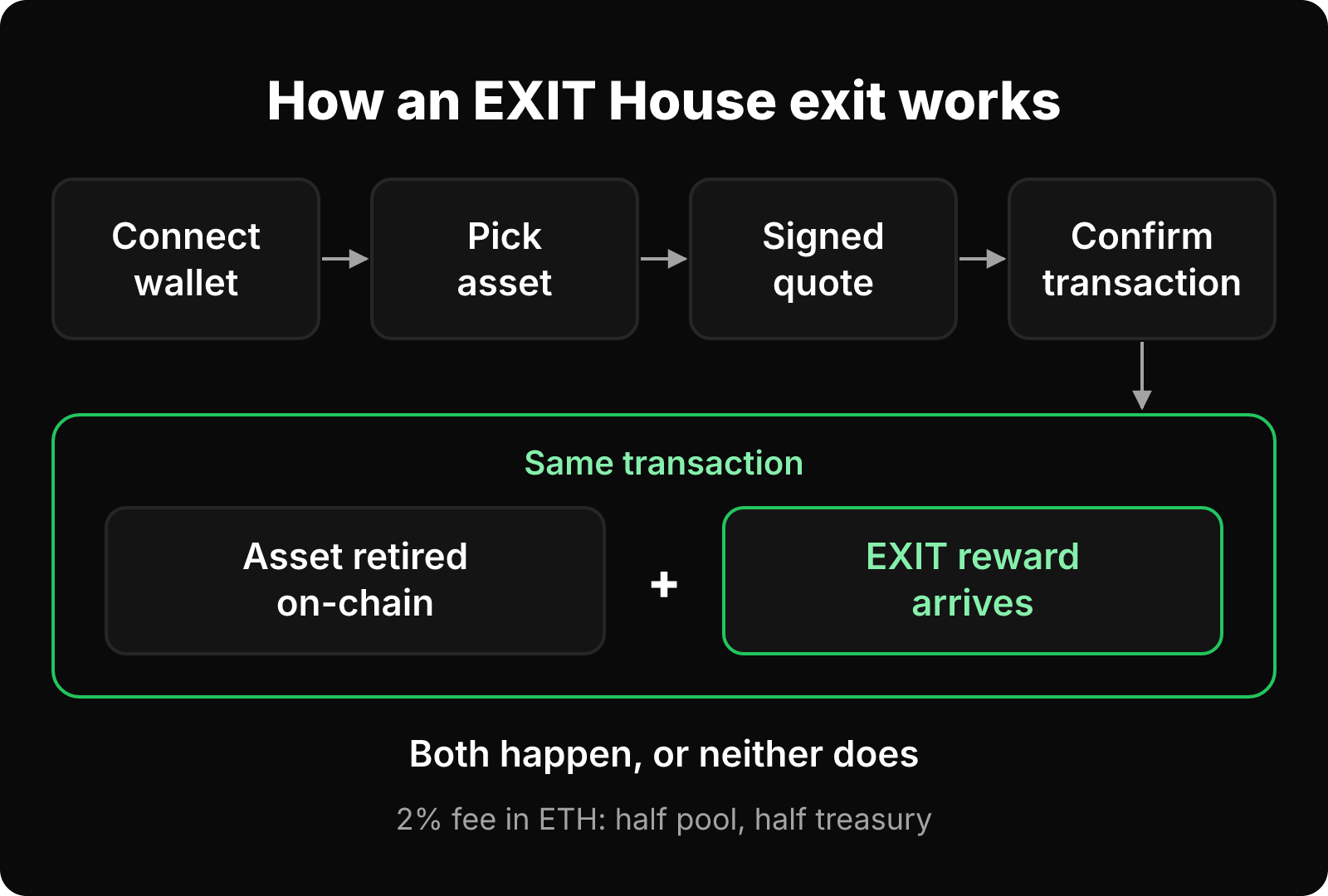
- Connect an Ethereum wallet. You don't need to create an account.
- Pick the asset. Choose an eligible NFT, or an amount of an eligible ERC-20 token.
- Receive a signed quote. EXIT House's pricing service fixes three numbers: the asset's value, the reward rate, and the exact EXIT amount you'll get.
- Check the binding. The quote only works for your wallet and that specific asset, so nobody else can use it.
- Act fast. Quotes expire within minutes, so the price can't go stale.
- Confirm the transaction. Your asset is retired on-chain and the EXIT reward arrives in the same transaction.
The last step matters. The asset goes out and the reward comes in within one transaction, so the deal is atomic: either both happen or neither does. You can't end up with your NFT gone and no reward.
What happens to the EXIT you receive?
You can keep it, trade it, or stake it for fixed terms. The project describes EXIT as a utility token, not an investment contract or a promise of profits. It is a standard ERC-20 token, so it shows up in any normal Ethereum wallet.
Where does the 2% fee go?
Each exit costs 2% of the asset's qualifying value, paid in ETH on top of normal network gas. The fee does not come out of your EXIT reward. Half goes into the EXIT liquidity pool and the other half goes to the EXIT House treasury.
How Much Is Your Unwanted NFT Worth in EXIT?
The number of EXIT tokens you receive is predictable. Their dollar value is not, because it depends entirely on what EXIT trades for on the open market. It helps to look at the two separately.
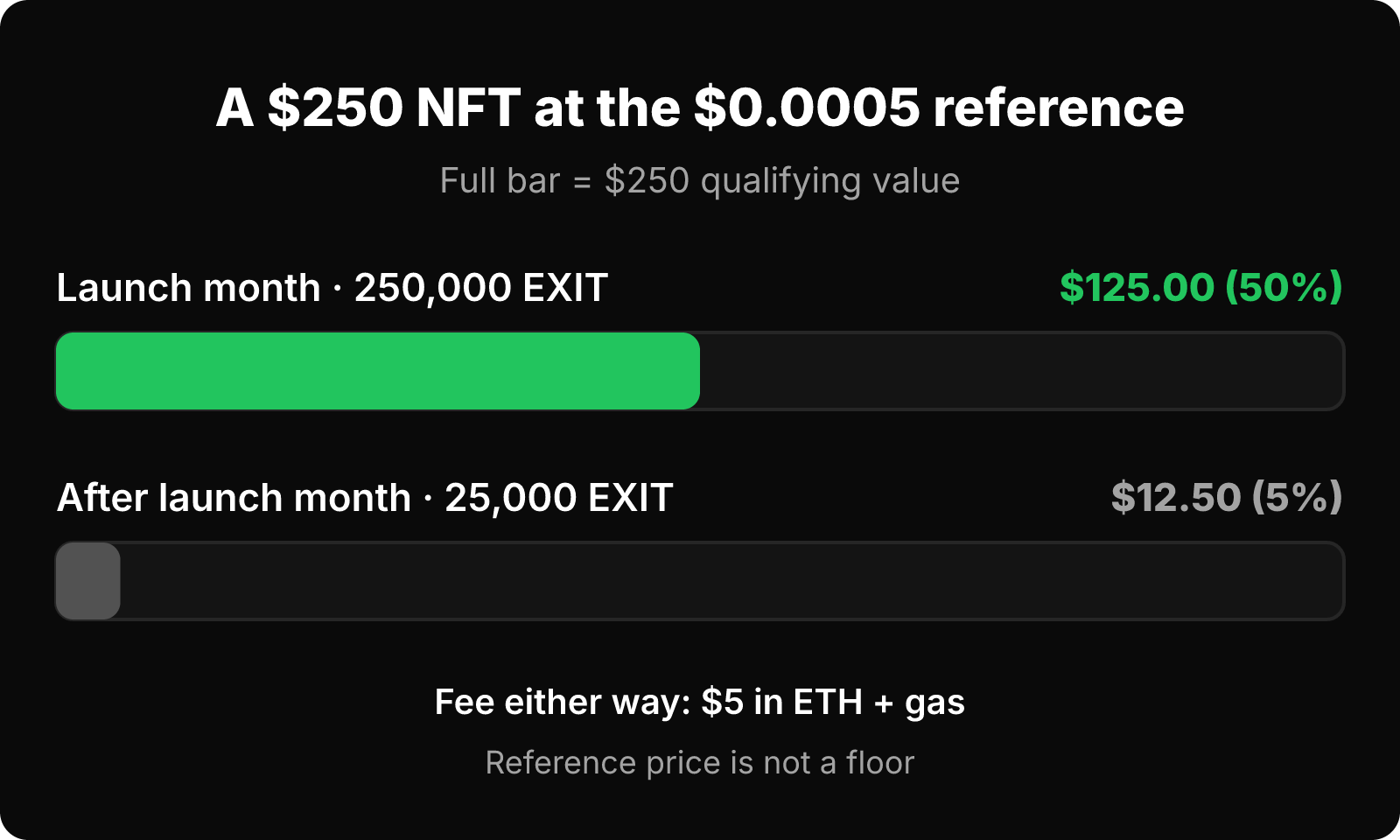
The reward schedule has two phases. From October 9 to November 8, 2026, you get 1,000 EXIT per $1 of qualifying value. After that, it falls to 100 EXIT per $1. Total supply is fixed at 10 billion EXIT, split as follows: 45% for exit rewards, 15% for staking rewards, 15% for the founder, 10% for liquidity, 10% for the treasury, and 5% for the ecosystem, per the launch announcement.
The only public price anchor at launch was a Uniswap v3 pool seeded at $0.0005 per EXIT, according to TradingView's analysis. That was a starting point for price discovery. It is not a promise or a floor. Here's what the reward on a $250 NFT looks like if you value EXIT at that reference price:
| Scenario ($250 qualifying value) | EXIT received | Value at $0.0005 reference | Fee paid in ETH | Reference value as % of quote |
|---|---|---|---|---|
| Launch month (to Nov 8, 2026) | 250,000 | $125.00 | $5 + gas | 50% |
| After launch month | 25,000 | $12.50 | $5 + gas | 5% |
Two things stand out. First, at the reference price you get back about half the quoted value during launch month and about a twentieth afterwards. Second, the fee is fixed in real ETH, while the reward's dollar value moves with the market. If EXIT trades above $0.0005, the math gets better for you. If it trades below, it gets worse. Nobody can tell you which will happen, and we won't try.
Daily and per-wallet caps
TradingView's analysis lists three limits: a 100M EXIT daily reward cap across the protocol, a $5,000 maximum per exit, and a $25,000 per-wallet daily cap. That analysis describes them as a way to limit whales and spread participation more widely.
Here's the math. At the launch-month rate, 100M EXIT per day covers only $100,000 of asset value per day across every user combined. At the post-launch rate, the same cap covers $1M per day. Even if the daily cap were hit every day, the 4.5 billion EXIT reserved for rewards would last at least 45 days. If demand is high during launch month, the daily cap could fill up. The launch materials don't say how exits are handled once it does.
What Are the Risks Most Guides Skip?
The biggest risk is that EXIT House doesn't give you cash. It swaps one hard-to-sell asset for another whose sellability depends on the depth of a single new Uniswap pool. Every other risk follows from that trade-off.
- Pricing depends on EXIT House. The "qualifying value" comes from the protocol's own pricing service, which signs each quote off-chain. The launch materials don't explain how it values an NFT with no recent sales. You have to trust that service's judgement.
- Selling pressure is built in. People who use the protocol are, by definition, people who want out of something. If many of them sell their EXIT straight away, that selling hits one Uniswap pool. Fee income adds ETH to that pool over time, but that's a design choice, not a price guarantee.
- Retirement is permanent. If a "dead" collection comes back to life next year, there's no undo. That's the whole point of the protocol, but it also means you give up any chance of a recovery.
- The fee is charged on the quote, not on what the asset would actually sell for. If the quote values your NFT at $250 but you couldn't sell it for $20 on the open market, you still pay $5 in ETH. Sometimes that's a good trade and sometimes it isn't. Run the numbers each time.
A basic safety rule also applies: new launches attract copycat sites. The official domain is exit.house. Never enter a seed phrase anywhere, and read every approval your wallet asks you to sign.
5 Ways to Liquidate Unwanted Tokens and NFTs
EXIT House is one option among several. Here are five NFT exit strategies and token clean-up methods, each laid out the same way so you can compare them.
1. Sell on an NFT marketplace
What it is: Listing your NFT on a platform such as OpenSea, or accepting a collection-wide bid there.
How it works: A buyer pays you in ETH or WETH. The marketplace takes a platform fee, and some collections also charge creator royalties.
Pros and cons: You get paid in an established asset. But thin markets can mean weeks of waiting, or a "fire sale" at a fraction of what the NFT once traded for.
Best for: NFTs that still get at least occasional bids.
2. Sell tokens on a DEX
What it is: Swapping an ERC-20 for ETH or a stablecoin on a DEX like Uniswap.
How it works: You trade against a liquidity pool, a smart contract holding both tokens. Uniswap v3 pools charge fee tiers such as 0.05%, 0.3%, or 1%, per Uniswap's documentation.
Pros and cons: It's instant and needs nobody's permission. In a shallow pool, though, slippage (the price moving against you as your own trade goes through) can wipe out most of the value.
Best for: Tokens with an active pool, even a small one.
3. Exit through EXIT House
What it is: The exit liquidity protocol covered above.
How it works: You get a signed quote, the asset is retired, and EXIT arrives in the same transaction. You pay a 2% fee in ETH plus gas.
Pros and cons: It pays out even when there are no buyers, and you know the number of tokens in advance. But the reward is a new token with an uncertain price, and the protocol controls the pricing.
Best for: Assets with no realistic market, when you're comfortable holding or selling EXIT.
4. Burn or hide the asset
What it is: Sending the asset to a "burn" address that nobody controls, or simply hiding it in your wallet app.
How it works: A burn is a normal transfer that costs only gas. Hiding is free and only changes the wallet interface. The asset stays on-chain.
Pros and cons: It's cheap and clears the clutter. You get nothing back.
Best for: Spam airdrops and genuinely worthless tokens. Don't interact with spam tokens. Just hide them, because some are traps.
5. Consolidate liquid leftovers into Bitcoin
What it is: Once you've sold what you can, swapping the leftover stablecoins or ETH into native BTC instead of keeping them spread across several chains.
How it works: Bitcoin bridges like TeleSwap use light-client verification (SPV proofs) to swap ERC-20 tokens such as USDC to native BTC in one step. SPV light client proofs verify Bitcoin transactions directly, with no custodian involved. TeleSwap has bridged $513.7M in total volume across 543,973 bridge transactions and supports 13 networks, per TeleSwap network stats.
Pros and cons: You end up holding the most liquid crypto asset there is, and fast swaps settle in about 10 minutes. However, it only works for tokens that already have a market. It can't price a dead NFT.
Best for: Holders who want to simplify a messy multi-chain portfolio.
Which NFT Exit Strategy Fits You? Comparison Table
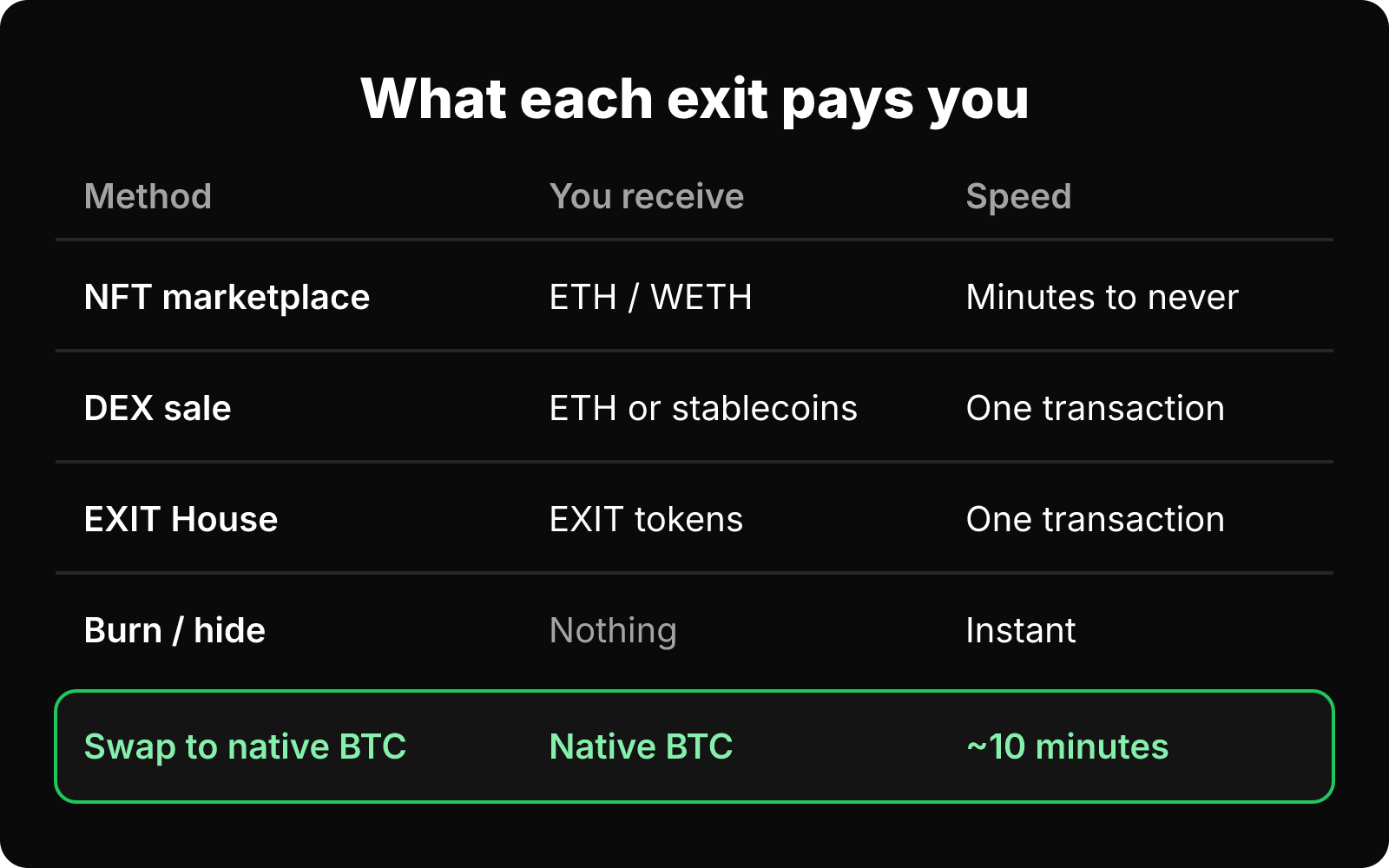
The table compares the five options on fees, speed, trust model, and chain coverage. Pick the method that fits each asset.
| Method | Fees | Speed | Trust model | What you receive | Chains |
|---|---|---|---|---|---|
| NFT marketplace | Platform fee + possible royalties + gas | Minutes to never (needs a buyer) | Non-custodial listing; depends on the marketplace | ETH / WETH | Ethereum and the chains each marketplace supports |
| DEX sale | 0.05%–1% pool fee + slippage + gas | One transaction | Non-custodial smart contract | ETH or stablecoins | Wherever the token's pool lives |
| EXIT House | 2% of qualifying value in ETH + gas | One transaction (quote valid for minutes) | Non-custodial settlement; protocol-controlled pricing | EXIT tokens | Ethereum mainnet |
| Burn / hide | Gas only (burn) or free (hide) | Instant | None needed | Nothing | Any |
| Swap to native BTC | Swap and bridge fees + source-chain gas | ~10 minutes for fast swaps | Light-client verified, collateral-backed | Native BTC | Bitcoin ↔ 13 supported networks |
A simple rule of thumb: always check whether a real market exists before you exit through a protocol. Even a weak market usually pays you in something more established than a protocol's own token. EXIT House makes the most sense once you've confirmed there's no market at all.
Wallet Cleanup Combo: A Step-by-Step Example
Imagine an Ethereum wallet holding three things: a 2022 profile-picture NFT with no bids in 14 months, two small-cap ERC-20s from old airdrops, and $400 in USDC. Here's one sensible order of operations:
- Take inventory and revoke old approvals. Use the Etherscan token approval checker to see which contracts can still move your tokens, and revoke the ones you don't recognize. Forgotten approvals are a common route for wallet drains.
- Test the market first. Look up both ERC-20s on Uniswap. Say one has a small pool and the other has none. Sell the first one there and accept some slippage.
- Price the stuck NFT on EXIT House. Connect your wallet at exit.house and request a quote. If it values the NFT at $250, you'd receive 250,000 EXIT during launch month (25,000 after November 8, 2026) and pay $5 in ETH plus gas. Compare that to doing nothing.
- Decide about the token with no market. If it qualifies, request a quote for it too. Check the $5,000 per-exit limit if the quote is large. If the fee is more than the token is worth to you, just hide it.
- Choose what to do with EXIT. You can keep it, stake it for a fixed term, or trade it. That depends on your own situation, and we can't decide it for you.
- Consolidate the stablecoins. Move the $400 of USDC, plus whatever the DEX sale brought in, into Bitcoin with TeleSwap's USDC (Ethereum) → BTC route, which delivers native BTC to a Bitcoin address. For a closer look at how the bridge works, see our light-client-verified bridge guide.
- Keep records. Save transaction hashes and the quote values. You'll need them for taxes.
The result is a clean wallet with no forgotten approvals. Every asset has been dealt with on purpose, and your remaining value sits in one place.
Frequently Asked Questions
What is EXIT House protocol?
EXIT House is an Ethereum protocol, launched October 9, 2026, that permanently retires eligible NFTs and ERC-20 tokens in a single atomic transaction and pays holders in EXIT tokens based on the asset's market value as determined by the protocol's pricing service. It uses signed, wallet-specific quotes that expire within minutes, and the reward arrives in the same transaction that retires the asset. It was founded by Anthony Anger and runs at exit.house.
How much EXIT do I get for my NFT?
You get 1,000 EXIT per $1 of qualifying value until November 8, 2026, and 100 EXIT per $1 after that. A $250 NFT therefore earns 250,000 EXIT during launch month or 25,000 EXIT afterwards. You also pay a 2% fee in ETH on top of gas, and that fee doesn't reduce your EXIT reward.
What does exit liquidity mean in crypto?
"Exit liquidity" in crypto slang usually refers to the buyers that early investors or founders dump their holdings on when they want to cash out, often to those buyers' disadvantage. An exit liquidity protocol flips that meaning: the protocol itself acts as the counterparty for assets no real buyer wants, so holders can leave positions that would otherwise be trapped.
Can I get my money back from a dead NFT?
Usually not in full, but if the NFT qualifies, an exit liquidity protocol can often recover something. First check for bids on marketplaces and DEX pools. If there are none, a protocol like EXIT House pays in its own token. What that's worth in dollars depends on EXIT's market price, which started from a $0.0005 reference point on Uniswap. There's no guarantee it stays there or moves in any particular direction.
Is exiting an NFT to EXIT House a taxable event?
In most countries, disposing of a crypto asset is a taxable event, and exchanging one crypto asset for another token generally counts as a disposal. In the United States, the IRS treats digital assets as property, so exchanging one for another generally counts as a disposal subject to capital gains tax. Rules vary by country, so speak with a tax professional. Keep records of every quote, transaction, date, and value.
How does EXIT House compare to other token redemption mechanisms?
EXIT House stands out because it uses a signed-quote system with per-exit, per-wallet, and daily caps, pays in a newly launched token rather than stablecoins, and permanently retires assets instead of holding them in reserve. Wrapped asset bridges maintain collateral reserves, but EXIT House destroys the underlying asset. Because it pays in its own token rather than reselling what it receives, it can pay holders even when there's zero open-market demand.
What happens if EXIT token price crashes after I exit?
If EXIT crashes after you receive it, your EXIT is worth less in dollar terms, but you still hold the same number of tokens on-chain and can sell them whenever liquidity exists. That's why EXIT House suits holders who plan to hold EXIT, accept the token-price risk, or are ready to sell right away into whatever liquidity is available.
Conclusion
EXIT House offers a real answer to an old crypto problem: what to do with assets nobody will buy. It is a quote-based exit liquidity protocol that retires the asset and pays you in EXIT within a single transaction. The launch-month rate of 1,000 EXIT per $1 runs until November 8, 2026, and then drops tenfold.
Remember three things. You're paid in a new token, not in dollars or stablecoins. The 2% fee is paid in real ETH on top of gas. And a working market, if one exists, usually beats a protocol exit. Sell what you can, retire or hide what you can't, and consolidate the rest on purpose.
If consolidating means turning leftover USDC or ETH into native Bitcoin, light-client-verified Bitcoin bridges like TeleSwap route EVM tokens to BTC, with fast swaps settling in about 10 minutes. For more on how on-chain swaps and bridges work, see the supported routes at teleswap.xyz.