Trustless BTC Swap: 7-Step No-KYC Guide (2026)

A trustless BTC swap lets you trade Bitcoin for another asset, such as USDC or ETH, straight from your own wallet. Code and cryptographic proofs, not a company, make sure both sides of the deal happen. You don't open an exchange account, you don't upload a passport photo, and you don't have to hope a custodian stays solvent while it holds your coins.
This guide is for beginners. It explains what "trustless" actually means, what "no KYC" can and can't do for your privacy, and how four real methods compare. Then it walks through a trustless BTC swap step by step.
Quick picks if you're short on time:
| Best for… | Pick | Why |
|---|---|---|
| Trustless BTC → stablecoins/ETH, fast | TeleSwap | Bitcoin light-client verification, settles in about 10 minutes, no custodian |
| BTC ↔ Monero privacy swaps | HTLC/adaptor-signature atomic swaps (UnstoppableSwap, BasicSwap) | Fully peer-to-peer, but liquidity is thin and swaps are slow |
| BTC ↔ cash or bank transfer | P2P marketplaces (Bisq, RoboSats) | No central exchange, though you deal with a human counterparty |
| Raw speed, if you accept custody risk | Instant swap services | Done in minutes, but they hold your coins while the swap runs |
Key Takeaways:A trustless BTC swap uses code and cryptographic proofs, not a company's promise, to make sure you get paid—the protocol verifies payment automatically before releasing funds."No KYC" means you don't hand over identity documents, but Bitcoin's ledger stays public, so your on-chain privacy still depends on your own habits.TeleSwap verifies Bitcoin transactions with SPV light-client proofs and has bridged $513.7M in total volume across 543,973 bridge transactions, according to TeleSwap network stats.Classic atomic swaps are the purest peer-to-peer option, but they suit BTC ↔ Monero much better than BTC ↔ stablecoins.Instant swap services feel trustless because they skip sign-ups, but they take custody of your BTC for the length of the swap.
Table of Contents
- What Is a Trustless BTC Swap?
- Bitcoin Swap No KYC: What It Does (and Doesn't) Mean
- 4 Ways to Swap BTC Without an Exchange Account
- Comparison Table: Trust, Speed, Privacy
- How Does TeleSwap Make the Trustless BTC Swap Trustless?
- Trustless BTC Swap Step-by-Step (7 Steps)
- Private BTC Exchange Habits That Actually Matter
- Frequently Asked Questions
- Conclusion
What Is a Trustless BTC Swap?
A trustless BTC swap is an exchange of Bitcoin for another crypto asset where no third party ever holds your funds or decides whether you get paid. The rules sit in software that anyone can inspect, and the software only releases funds once it can verify that the other side did their part.
Think of a cashier and a vending machine. With a cashier, you hand over your money and trust them to give you the right change. A vending machine has no opinion about you. Put in the coins and the snack drops, every time, because that's how it's built.
Centralized exchanges work like the cashier. That's fine until the cashier walks out with the till, which is roughly what happened to FTX customers when the exchange filed for bankruptcy in November 2022. Trustless protocols work like the vending machine.
Two pieces of jargon you'll keep seeing:
- Non-custodial: you keep your private keys, the secret that controls your coins, the whole time.
- Decentralized Bitcoin trading: trades are matched and settled by open protocols or peer networks instead of one company's order book.
Bitcoin Swap No KYC: What It Does (and Doesn't) Mean
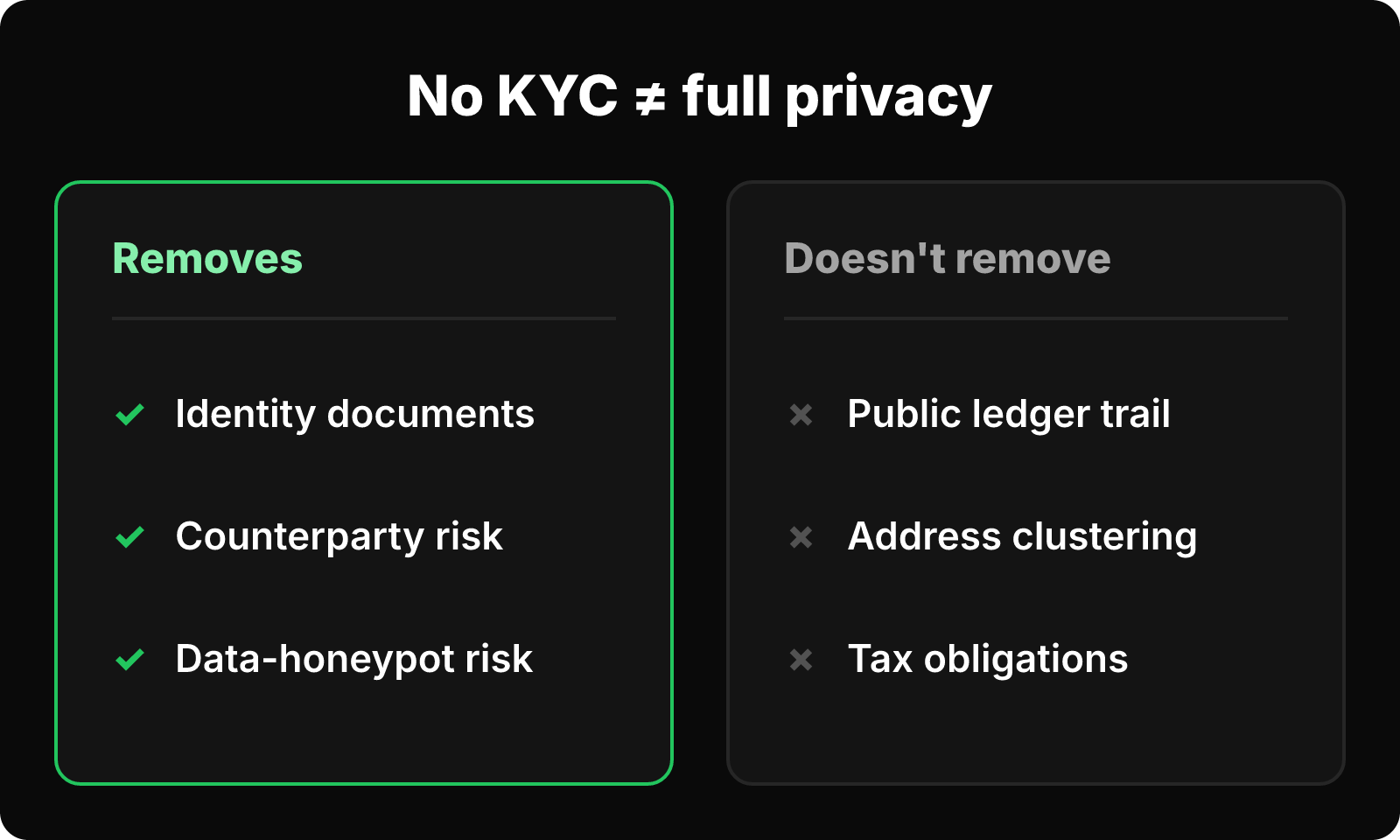
A bitcoin swap with no KYC means you don't give identity documents to an intermediary. It does not make your Bitcoin anonymous. KYC stands for "Know Your Customer": the identity checks regulated exchanges must run. In the EU, the Markets in Crypto-Assets Regulation (MiCA) requires crypto-asset service providers to be licensed and meet compliance duties, and companion EU transfer rules require providers to link transfers to identities.
With a non-custodial protocol there's no intermediary holding your funds in the first place. You connect your own wallet and the smart contracts do the rest.
Here's the honest part most "anonymous swap" guides leave out.
No KYC is not the same as full privacy. Bitcoin is a public ledger. Every transaction, amount and address is visible forever, and blockchain-analytics firms make their living clustering addresses into identities. If you buy BTC on a KYC exchange and send it straight into a swap, the trail starts with your name.
We work on cross-chain infrastructure, and from that seat the realistic way to frame it is this: trustless swaps get rid of counterparty risk and data-honeypot risk. Nobody can freeze your trade halfway through, and no database with your passport scan can leak. On-chain privacy is a separate job, and your wallet habits handle it (covered below). Anyone promising "full privacy" from a single click is overselling.
One more note: skipping KYC doesn't change your tax obligations. In most jurisdictions a crypto-to-crypto swap is a taxable event, so keep your own records.
4 Ways to Swap BTC Without an Exchange Account
The four options are an SPV light-client protocol (TeleSwap), classic atomic swaps, P2P marketplaces and instant swap services. Each gets the same treatment: what it is, how it works, pros and cons, and who it suits.
1. TeleSwap (SPV light-client bridge and swap)
What it is: TeleSwap is a non-custodial Bitcoin bridge and swap protocol. It moves BTC to EVM chains, TON and Solana, and swaps it into their tokens, such as USDC, USDT or ETH, in one step.
How it works: You send BTC from your own wallet. Smart contracts on the destination chain check that payment with SPV light-client proofs (details in the next section). Only then do they mint TeleBTC, a 1:1 Bitcoin-backed token, and route it through a DEX into the token you picked.
- Pros: nothing is minted without a verified Bitcoin transaction. Fast swaps settle in about 10 minutes. Fees are paid in Bitcoin assets, and a Teleporter covers destination-chain gas, so you don't need ETH in your wallet beforehand. The protocol runs on 13 supported networks per TeleSwap network stats.
- Cons: it's built for BTC ↔ smart-contract-chain tokens, not BTC ↔ Monero. You still need a destination-chain wallet.
- Best for: beginners who want BTC → stablecoins or ETH without handing coins to a custodian.
2. Classic atomic swaps (HTLCs and adaptor signatures)
What it is: a direct peer-to-peer trade between two blockchains with no middleman at all.
How it works: both sides lock funds in contracts tied to the same secret. If one side claims, the secret is revealed and the other side can claim too. If nobody claims before a deadline, everyone gets refunded. The Bitcoin Wiki's atomic swap entry covers the mechanics. Tools like UnstoppableSwap and BasicSwap use this model, and BTC ↔ XMR swaps rely on a cryptographic cousin called adaptor signatures.
- Pros: the cleanest trust model there is, and it pairs well with Monero for privacy.
- Cons: few trading pairs, thin liquidity for stablecoins, swaps often take 20–60 minutes, and you may need to stay online until the swap finishes.
- Best for: privacy-focused users swapping BTC ↔ XMR.
3. Peer-to-peer marketplaces (Bisq, RoboSats)
What it is: decentralized venues where you trade BTC with another person, often for fiat payment methods.
How it works: Bisq runs as desktop software. It locks both traders' security deposits in a 2-of-2 multisig and falls back on mediation if a dispute comes up. RoboSats does something similar over the Lightning Network using hold invoices.
- Pros: no central company, and you can trade into fiat.
- Cons: you deal with real people and payment rails, so there's scam and chargeback risk. Disputes need a human mediator, which means it isn't fully trustless.
- Best for: going between BTC and cash or bank money.
4. Instant swap services
What it is: websites where you paste an address, send BTC to a deposit address, and receive another coin a few minutes later.
How it works: the service takes your BTC into its own wallet, then pays you out of its own reserves.
- Pros: often the fastest option, with many pairs and no sign-up for small amounts.
- Cons: it's custodial while the swap runs. Many of these services reserve the right to pause a transaction and ask for verification under their AML policies, so "no KYC" depends on their discretion.
- Best for: small, one-off swaps where speed matters more than trust.
Comparison Table: Trust, Speed, Privacy
Only atomic swaps and SPV-verified protocols keep your BTC out of a single party's hands. Here are the four methods side by side.
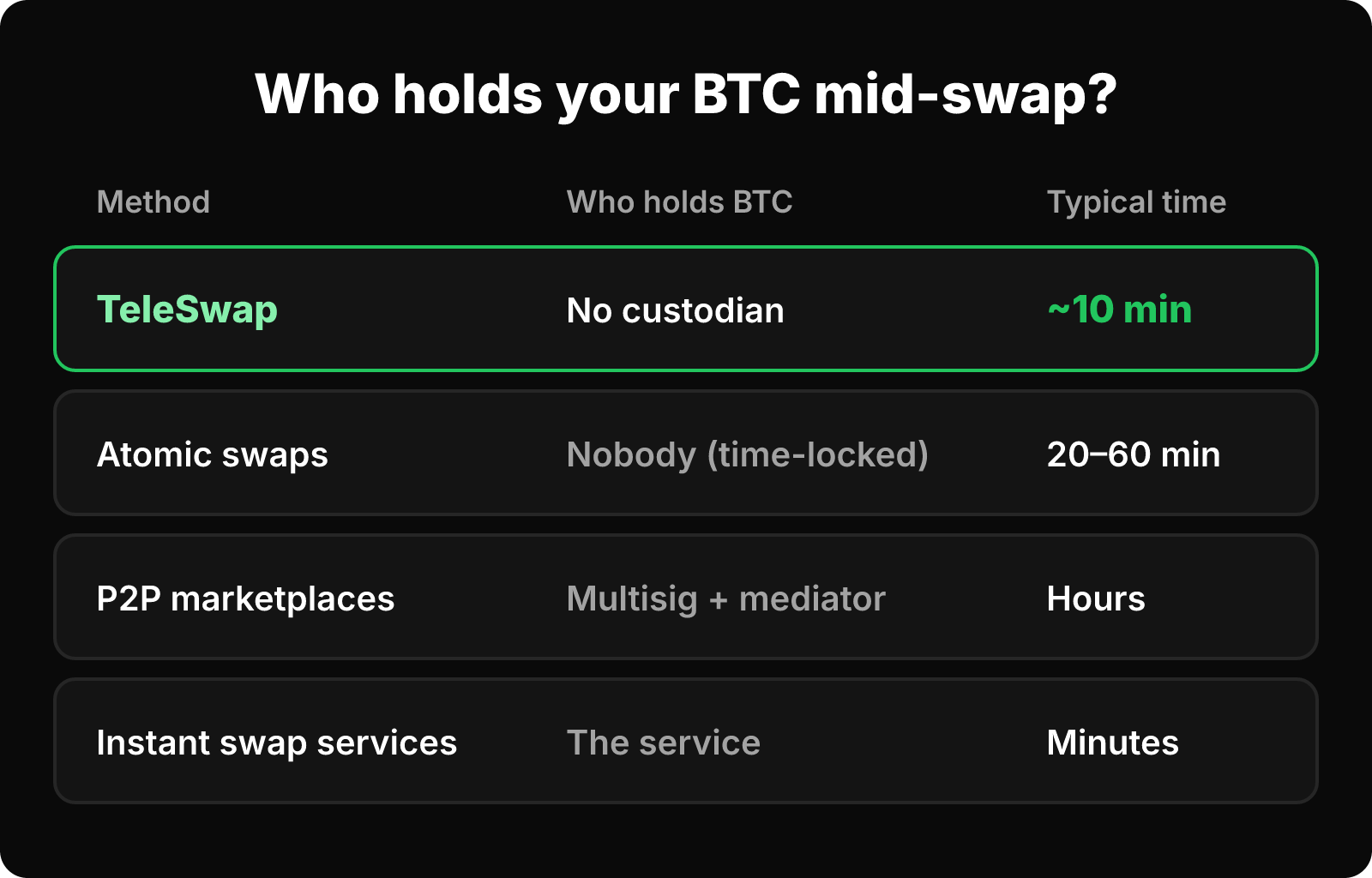
| Method | Who holds your BTC? | Typical time | Pairs | Identity checks | Main risk |
|---|---|---|---|---|---|
| TeleSwap | No custodian; SPV-verified, collateral-backed Lockers | ~10 min (fast swaps) | BTC ↔ tokens across 13 networks | None. You connect your own wallet | Smart-contract risk |
| Atomic swaps | Nobody (hash/time-locked) | 20–60 min | Narrow (mostly BTC/XMR, BTC/LTC) | None | Liquidity, staying online |
| P2P marketplaces | Multisig escrow + mediator | Hours (fiat legs) | BTC ↔ fiat | None by the platform | Human counterparty, payment fraud |
| Instant swap services | The service, during the swap | Minutes | Wide | Discretionary under AML policy | Custody, frozen swaps |
A contrarian point: people usually rank swap options by speed. For anything bigger than pocket money, what happens if something goes wrong is the better question. With an instant service the answer is "open a support ticket." With an atomic swap it's "you get a refund after the timelock runs out." With TeleSwap it's "nothing gets minted unless your Bitcoin payment is proven on-chain, and Locker collateral can be slashed if a Locker misbehaves."
How Does TeleSwap Make the Trustless BTC Swap Trustless?
TeleSwap is trustless because the destination chain checks Bitcoin's own proof-of-work. It doesn't take anyone's word that you paid.
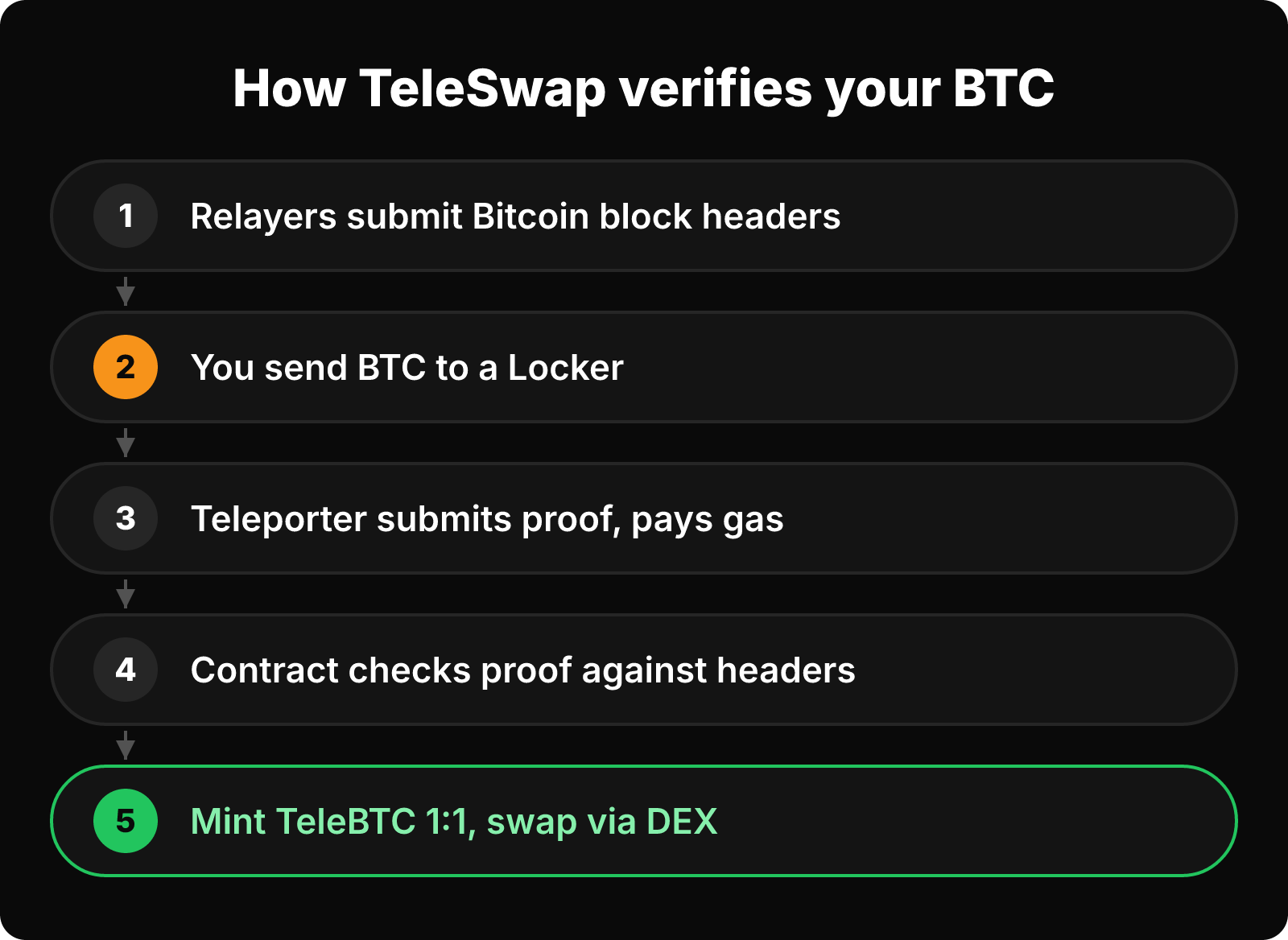
The method is called SPV (Simplified Payment Verification), and it comes straight from Section 8 of the original 2008 Bitcoin whitepaper. An SPV client keeps Bitcoin's block headers, which are small summaries of each block secured by SHA-256 mining work. It can then confirm that a specific transaction is included in a block without downloading the entire blockchain.
TeleSwap runs that logic as a light client inside smart contracts. Here's what happens, in plain terms:
- Relayers submit Bitcoin block headers to the light-client contract on the destination chain.
- You send BTC to a Locker. Lockers are operators who post collateral, and that collateral can be slashed if they misbehave.
- A Teleporter submits proof of your transaction and pays the destination-chain gas for you.
- The contract checks the proof against the stored headers. If it's valid, it mints TeleBTC 1:1 and, for a swap, routes it through a DEX into your chosen token.
The full role breakdown is in the TeleSwap documentation. This is the distinction that matters when you compare wrapped Bitcoin options. WBTC and cbBTC depend on custodians to hold the BTC. TeleBTC's minting depends on a verified Bitcoin transaction, so it inherits Bitcoin's security model directly.
The system is used at scale. TeleSwap has bridged $513.7M in total volume across 543,973 bridge transactions, including $44.8M over the last 30 days (around $1.5M a day, peaking at $2.8M on 2026-09-18), per TeleSwap network stats.
Trustless BTC Swap Step-by-Step (7 Steps)
The short version: send BTC from your own wallet on teleswap.xyz, wait about 10 minutes, and receive the token in your destination wallet. Example scenario: you hold 0.05 BTC in a self-custody wallet and want USDC on Arbitrum, a low-fee Ethereum layer-2. We'll use the BTC → USDC (Arbitrum) route. The same flow works for other pairs, such as BTC → ETH on Ethereum.
- Get your BTC into a wallet you control. Use a self-custody Bitcoin wallet where you hold the seed phrase, not an exchange account. If your coins sit on an exchange, withdraw them first.
- Set up your destination wallet. Install an EVM wallet such as MetaMask or Trust Wallet and copy your Arbitrum address. You don't need ETH for gas, because the Teleporter covers destination-chain gas and fees are paid in Bitcoin assets.
- Open teleswap.xyz. Pick Bitcoin as the source and USDC on Arbitrum as the destination. Make sure you're on the real domain, teleswap.xyz, and bookmark it.
- Enter the amount and review the quote. Check the estimated USDC you'll receive, the fees, and the destination address. Bigger trades should get extra attention for price impact on the DEX leg.
- Send your BTC. Confirm the transaction in your Bitcoin wallet exactly as the app instructs, with the exact amount and to the address shown. Bitcoin transactions can't be reversed.
- Wait about 10 minutes. Once your transaction is confirmed on Bitcoin, the light client verifies it, TeleBTC is minted, and the swap into USDC runs automatically. You don't need to babysit it.
- Check that you received it. Look for the USDC in your wallet, or search your address on Arbiscan. Done.
Going the other way? The reverse route, USDC (Arbitrum) → BTC, swaps your tokens into TeleBTC, burns it, and releases native BTC to your Bitcoin address.
Prefer your usual app? TeleSwap is integrated as a Bitcoin swap provider in the Rango, Rubic and DZap aggregators, and through Rango it's also reachable from MetaMask and Trust Wallet.
Private BTC Exchange Habits That Actually Matter
A private BTC exchange setup comes down to habits more than platforms. These six make the biggest difference:
- Use a fresh receiving address for every swap. Address reuse is the easiest way for analytics tools to connect your activity. Most modern wallets generate a new address automatically.
- Don't swap straight out of a KYC exchange withdrawal. That link stays on-chain permanently. Know where your coins came from.
- Control your UTXOs. A UTXO is one "coin" in your Bitcoin wallet. Wallets with coin control let you avoid merging coins from different sources into one transaction, which would reveal they share an owner.
- Keep separate wallets for separate purposes. A destination wallet used only for swaps leaks less than your everyday wallet.
- Mind network-level privacy. Your IP address can be logged by websites and wallet backends. Wallets that connect to your own node, or over Tor, cut that exposure.
- Watch out for phishing. Fake swap sites are the most common way beginners lose funds. Type the URL yourself and never share your seed phrase. No real protocol will ever ask for it.
If Monero-level privacy is your main goal, an atomic swap into XMR is the purpose-built tool. If your goal is getting BTC into DeFi on smart-contract chains without a custodian, the SPV-verified route fits better. Choose based on your goal, not on marketing.
Frequently Asked Questions
Can I swap bitcoin without KYC legally?
In most countries, yes. Using non-custodial software to swap your own coins is generally legal, but rules differ by jurisdiction. KYC obligations usually fall on regulated service providers such as exchanges and custodians, not on open-source protocols you interact with from your own wallet. Your tax reporting obligations still apply, so keep records of every swap.
What is the safest trustless BTC swap method?
The safest method is one where no third party ever holds your BTC and payment is verified cryptographically. Classic atomic swaps and SPV light-client protocols like TeleSwap both meet that bar. Atomic swaps suit BTC ↔ Monero. TeleSwap suits BTC ↔ stablecoins, ETH and other tokens across 13 supported networks.
How long does a trustless bitcoin swap take?
A TeleSwap fast swap settles in about 10 minutes, while classic atomic swaps typically take 20–60 minutes. Most of the wait is for the Bitcoin network to confirm your transaction. P2P marketplaces involving bank transfers can take hours.
Is TeleSwap custodial?
No. TeleSwap is a non-custodial protocol that mints TeleBTC only after verifying your Bitcoin transaction with SPV light-client proofs. BTC is held by collateral-backed Lockers whose collateral can be slashed for misbehavior, and you keep control of your own wallets from start to finish. It has bridged $513.7M in total volume across 543,973 bridge transactions per TeleSwap network stats.
Does a no-KYC swap make my bitcoin anonymous?
No. A no-KYC swap removes identity checks, but Bitcoin's blockchain is public, so your transactions remain traceable. Privacy depends on habits such as fresh addresses, coin control and not swapping directly from a KYC exchange withdrawal.
What are the fees for a trustless BTC swap?
Fees vary by method, route and network. On TeleSwap you pay all fees in Bitcoin assets, and a Teleporter covers the destination-chain gas, so you don't need the destination chain's native token. The quote screen shows the exact fees and expected output before you send. With atomic swaps, the maker's rate includes their margin and you pay network fees on both chains. Instant swap services build their margin into the exchange rate. For more on how costs compare, see the Bitcoin L2 Fee Comparison.
Can I use a trustless BTC swap on my phone?
Yes, if your wallet supports it. Through its Rango integration, TeleSwap is reachable from MetaMask and Trust Wallet, both of which have mobile apps. You can also open teleswap.xyz in a mobile browser. Many atomic swap tools are desktop-first, so check each tool's supported platforms before you start.
Conclusion: Your First Trustless BTC Swap
A trustless BTC swap swaps "trust us" for "verify it." Three things to remember:
- Trustless means no one holds your funds mid-trade. No KYC means no documents. Real privacy comes from your own habits.
- Atomic swaps are best for BTC ↔ XMR. Instant services are fast but custodial. P2P marketplaces cover fiat.
- For BTC → stablecoins, ETH and other tokens, TeleSwap verifies your Bitcoin payment with SPV light-client proofs and settles fast swaps in about 10 minutes, with $513.7M already bridged per TeleSwap network stats.
To try it, start small: run a test amount through the seven steps above, check that it arrives, and scale up from there.