Convert BTC to ETH on Polygon: Lowest Fees in 2026

The cheapest way to convert BTC to ETH on Polygon is the route with the fewest hops. Gas is no longer the expensive part in 2026. A token swap on Polygon PoS costs about $0.006, according to eco.com's 2026 Ethereum vs. Polygon fee comparison. Most of what you pay comes from the path: the Bitcoin network fee, protocol fees, exchange spreads and slippage. You pay those again at every platform you pass through. A one-step route like TeleSwap turns native BTC into WETH on Polygon in about 10 minutes, so you only pay them once.
Bitcoin and Polygon are separate blockchains with no direct link between them, so many guides send you through two exchanges, a bridge and four separate fees. This guide explains what "ETH on Polygon" actually is, where the fees come from, and five ways to make the conversion. It ends with a step-by-step walkthrough of the shortest route.
Key Takeaways:In 2026, a token swap on Polygon PoS costs about $0.006 in gas, compared with $0.17–$0.31 on Ethereum mainnet, according to eco.com."ETH on Polygon" almost always means WETH, an ERC-20 token that tracks ETH 1:1, because Polygon's own gas token is POL.When you swap BTC for ETH across chains, most of the cost comes from the Bitcoin network fee, exchange spreads and slippage, not Polygon gas.TeleSwap turns native BTC into WETH on Polygon in one step. Fast swaps settle in about 10 minutes, and you pay fees in Bitcoin assets.TeleSwap has bridged $512.6M in total volume across 542,865 transactions, according to TeleSwap network stats.
Table of Contents
- What Does It Mean to Convert BTC to ETH on Polygon?
- Why Use Polygon? 2026 Network Fees Compared
- Where Do the Lowest BTC-to-ETH Fees Actually Come From?
- Cross-Chain BTC-to-ETH Routes Compared
- How a Polygon Bridge Swap Works With TeleSwap
- Step by Step: How to Convert BTC to ETH on Polygon With TeleSwap
- 7 Ways to Cut Your Fees Further
- What Risks Should Beginners Know About?
- Frequently Asked Questions
- Conclusion
What Does It Mean to Convert BTC to ETH on Polygon?
When you convert BTC to ETH on Polygon, two things happen at once. Your value moves from the Bitcoin blockchain to the Polygon blockchain, and it changes from Bitcoin into Ether.
Here's an analogy. Bitcoin is a country with its own currency and its own border. Ethereum is a second country, and Polygon is a busy, cheaper city linked to Ethereum by a fast highway. You can't spend bitcoin in that city. You need to cross the border, and you need to exchange currency. Every method in this guide is a different way of doing both.
Why "ETH on Polygon" is usually WETH
Every blockchain has a native coin that pays for transactions. On Polygon PoS that coin is POL. POL replaced MATIC in a 1:1 migration that is now complete, as CryptoTicker's September 2026 Polygon fee guide confirms. ETH isn't Polygon's native coin, so the ETH you hold on Polygon is a token called WETH (Wrapped Ether). WETH is an ERC-20 token pegged 1:1 to ETH and bridged over from Ethereum.
When an app, exchange or wallet shows "ETH on Polygon," it almost always means WETH. That's the token you'll receive, and it's the one Polygon DeFi apps accept.
Make sure you're on Polygon PoS
Polygon used to run a second network, Polygon zkEVM. It shut down on July 1, 2026, and the main Polygon PoS chain kept running unchanged. When you set up a wallet, use Polygon PoS (chain ID 137). Old tutorials that mention zkEVM are out of date.
Why Use Polygon? 2026 Network Fees Compared
Polygon PoS is one of the cheapest EVM networks to use, with swaps costing well under a cent. EVM stands for Ethereum Virtual Machine, so an EVM network runs Ethereum-style apps and tokens. Here's how fees compare as of autumn 2026:
| Network | Simple transfer | Token swap | Gas token | Source |
|---|---|---|---|---|
| Ethereum mainnet | $0.06–$0.25 | $0.17–$0.31 | ETH | eco.com |
| Polygon PoS | ~$0.002 | ~$0.006 | POL (~$0.11, Oct 2026) | eco.com / CryptoTicker |
| Ethereum mainnet, 2021 peak | $50–$100+ | ETH | Bitcoin Foundation | |
A big part of that drop came from Ethereum's Dencun upgrade in March 2024. Its EIP-4844 change cut Layer 2 data costs by more than 90%, according to the Bitcoin Foundation's 2026 gas fee review.
Ethereum mainnet is also cheap in 2026. Base fees were around 0.3 gwei in September 2026, down from double-digit gwei peaks in 2023–2024 (eco.com).
On a single conversion, Polygon saves you at most about thirty cents in gas compared with mainnet. Polygon pays off when you plan to use your ETH afterwards for lots of small transactions, like DeFi deposits, trades and transfers, where each action costs a fraction of a cent.
Where Do the Lowest BTC-to-ETH Fees Actually Come From?
The lowest fees come from the route you choose, not the chain you land on. Every BTC-to-ETH conversion pays some mix of five costs, which we call the fee stack:
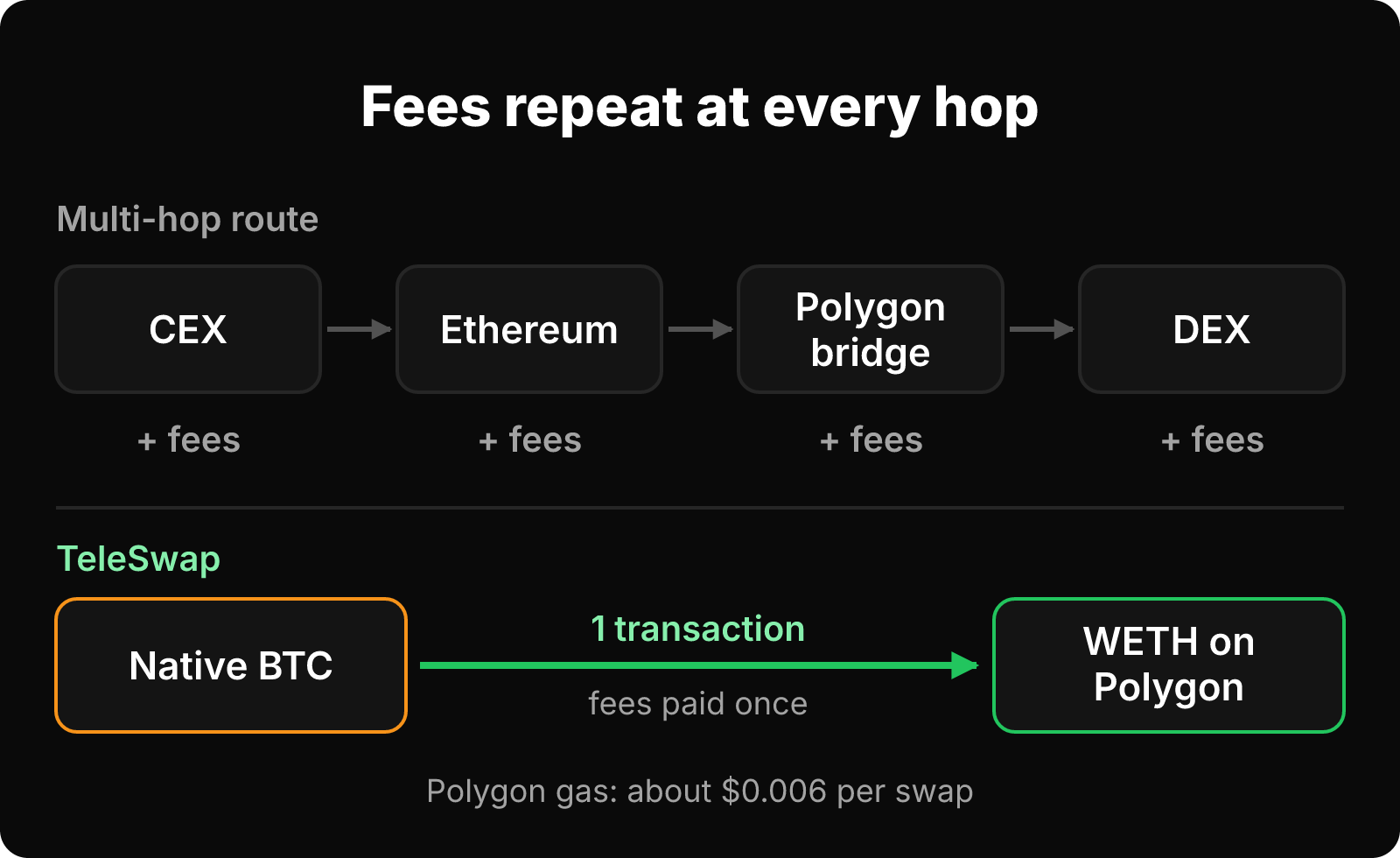
- Bitcoin network fee. This is what you pay miners to include your transaction in a block. It goes up and down with demand in the mempool, Bitcoin's waiting room for unconfirmed transactions. You can check current rates on mempool.space.
- Bridge or protocol fee. This is what the service that moves your value between chains charges.
- Exchange spread. This is the gap between the market price and the price you actually get. Centralized exchanges and "instant swap" services often hide part of their fee here.
- Slippage. The price can move against you while your order fills, especially in thin markets.
- Destination gas. On Polygon this rounds to zero: about $0.006 per swap.
Polygon gas, the cost people worry about most, is actually the smallest. Most of your money goes to costs 1 through 4, and you pay each of them again at every hop. A route of CEX → Ethereum → Polygon bridge → DEX can pay spreads and withdrawal fees three or four times over.
A nuance: liquidity on Polygon is thinner
A popular DIY route is "get WBTC on Polygon, then swap it for WETH on a DEX." But WBTC on Polygon is a fairly small market.
CoinGecko listed about 2,221 WBTC in circulation and roughly $903k in 24-hour trading volume on October 11, 2026 (CoinGecko, Polygon-bridged WBTC). That's fine for small swaps. On a large order, slippage in a market that size can easily cost more than all the gas you saved by picking Polygon.
The rule of thumb: count the hops, then check the slippage. The cheapest route is usually the one with the fewest steps and a quote that shows what you'll receive before you commit.
Cross-Chain BTC-to-ETH Routes Compared
There are five realistic ways to go from BTC to ETH (WETH) on Polygon. They differ in who holds your BTC, how many steps they take, how fast they are and which fees you pay.
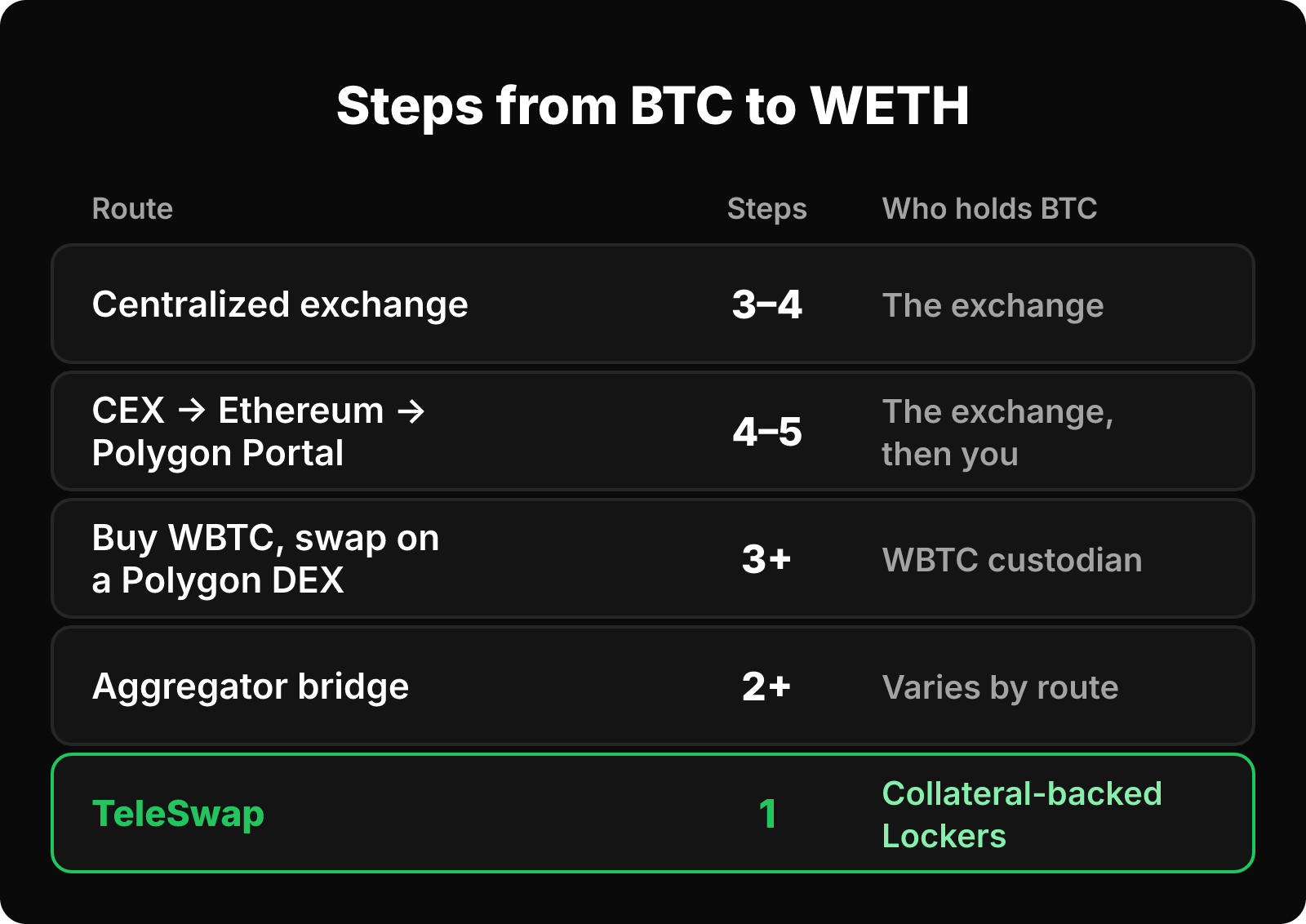
| Route | Who holds your BTC? | Steps | Typical time | Main fees | Need POL first? |
|---|---|---|---|---|---|
| 1. Centralized exchange (sell BTC, withdraw to Polygon) | The exchange (custodial, KYC) | 3–4 | Deposit confirmations plus withdrawal queue | Trading fee, spread, withdrawal fee | No, but you need it later |
| 2. CEX → Ethereum → Polygon Portal | The exchange, then you | 4–5 | Plus 20–30 min for the Portal deposit (eco.com) | CEX fees plus Ethereum gas | Yes, for later actions |
| 3. Buy WBTC, swap on a Polygon DEX | WBTC custodian (BitGo-led) | 3+ | DEX swap 5–30 sec after you hold WBTC | Purchase spread, DEX fee, slippage | Yes |
| 4. Aggregator bridge (Across, LI.FI, Jumper) | Varies by route | 2+ (needs EVM assets first) | Under 30 sec to 5 min for WETH (eco.com) | Solver spread plus source gas | Yes |
| 5. TeleSwap (native BTC → WETH on Polygon) | Collateral-backed Lockers; minting verified by SPV light client | 1 | ~10 min (fast swap) | Bitcoin network fee plus protocol fee, paid in BTC | No. A Teleporter covers destination gas |
Routes 1 to 4 all assume you've already turned your Bitcoin into something else, such as an exchange balance, WBTC or an EVM token. Only route 5 starts from native BTC in your own Bitcoin wallet and ends with WETH in your Polygon wallet. In between, there's one transaction and one quote.
How a Polygon Bridge Swap Works With TeleSwap
TeleSwap is a trust-minimized Bitcoin bridge and swap protocol. It moves native BTC to EVM chains, TON and Solana, and it uses SPV light client proofs where other bridges rely on custodians or multi-sig committees. A Polygon bridge swap with TeleSwap handles the border crossing and the currency exchange in a single step.
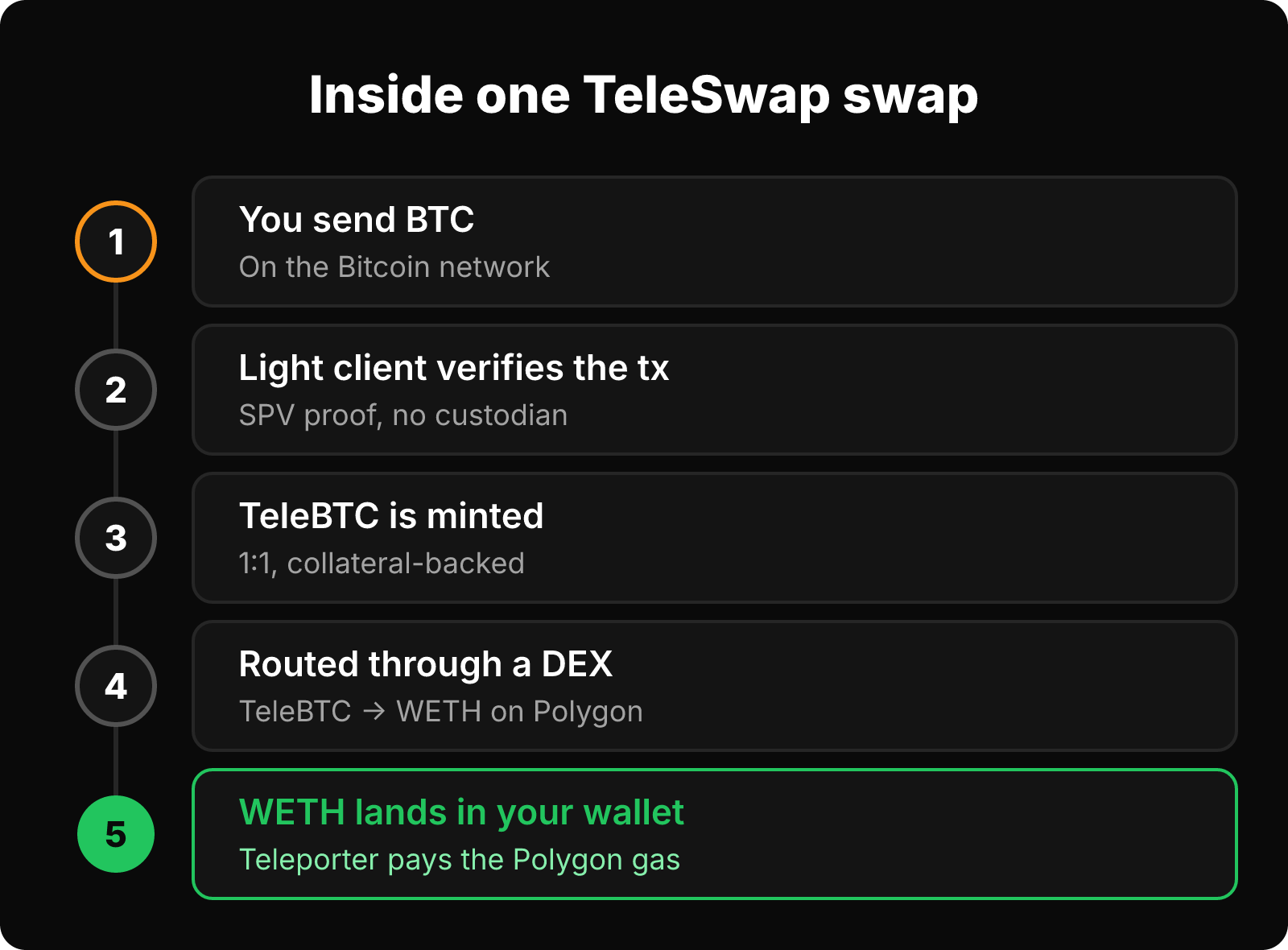
Here's what happens behind the scenes, as described in the TeleSwap documentation:
- You send BTC on the Bitcoin network, following the swap's instructions.
- The Bitcoin transaction is verified. A light client on the destination side checks proof that your transaction is really in the Bitcoin blockchain. Nothing is minted without a verified Bitcoin transaction.
- TeleBTC is minted. TeleBTC is TeleSwap's 1:1, collateral-backed representation of BTC.
- TeleBTC is routed through a DEX into the token you chose, in this case WETH on Polygon.
- WETH lands in your wallet. A Teleporter pays the Polygon gas for you, so you don't need POL to receive.
What is an SPV light client, in plain English?
SPV (Simplified Payment Verification) is a cryptographic proof method from the Bitcoin whitepaper that verifies transactions without trusting intermediaries. Think of checking that a receipt is real by matching it against the store's sealed daily summary, without reading every receipt in the ledger. A light client tracks Bitcoin's block headers, which are compact summaries secured by proof-of-work. With a short cryptographic proof called a Merkle proof, it can confirm that a specific transaction is included in a block. You don't have to trust anyone's word. You check the math. The approach is set out in the Bitcoin whitepaper.
How TeleBTC compares with other wrapped Bitcoin
| Token | How BTC backing is secured | Trust assumption |
|---|---|---|
| WBTC | BTC held by a custodian (BitGo-led) | Trust the custodian |
| cbBTC | BTC held by Coinbase | Trust Coinbase |
| tBTC | BTC controlled by a rotating group of threshold signers | Trust that a majority of signers act honestly |
| TeleBTC | Minted only against Bitcoin transactions verified by an SPV light client; custody is collateral-backed and slashable | Inherits Bitcoin's proof-of-work security for verification |
The protocol is already widely used. TeleSwap has bridged $512.6M in total volume across 542,865 transactions on 13 supported networks. In the last 30 days alone it processed $44.7M, or about $1.5M per day, with a peak of $2.8M on September 18, 2026. All figures come from TeleSwap network stats.
You don't have to visit TeleSwap directly, either. It's built in as a Bitcoin swap provider in the Rango, Rubic and DZap aggregators, and it's available in MetaMask and Trust Wallet through the Rango integration.
Step by Step: How to Convert BTC to ETH on Polygon With TeleSwap
You'll need a Bitcoin wallet holding the BTC you want to convert, plus an EVM wallet like MetaMask or Trust Wallet to receive WETH.
- Set up your Polygon wallet. In MetaMask or Trust Wallet, add or select the Polygon PoS network (chain ID 137). Copy your wallet address, which starts with
0x. - Open the right swap page. Go to TeleSwap's BTC to WETH on Polygon swap page. If you'd rather keep Bitcoin exposure on Polygon, use the page to swap BTC to WBTC on Polygon instead.
- Enter your amount and destination address. Paste your Polygon address and double-check it. Crypto transactions can't be reversed.
- Review the quote. It shows the estimated WETH you'll receive after fees. This is your all-in number, so compare it with what other routes would give you, not with headline gas prices.
- Send the BTC. Confirm the Bitcoin transaction from your Bitcoin wallet as the interface instructs. All fees are paid in Bitcoin assets, so you don't need to buy POL or ETH first.
- Wait about 10 minutes, then check your wallet. Fast swaps settle in roughly 10 minutes. If WETH doesn't show up in MetaMask, import the WETH token contract on Polygon so your wallet displays it.
A worked example
Say you convert 0.05 BTC. On October 11, 2026, CoinGecko showed 1 WBTC ≈ 33.2 ETH (CoinGecko). At that rate, 0.05 BTC is worth about 1.66 ETH before fees and slippage. Your TeleSwap quote shows the exact WETH you'd receive after the Bitcoin network fee and protocol fee. On the Polygon side, you don't need to buy POL or use a second bridge.
Prices move all the time, so treat this as an illustration, not a forecast.
7 Ways to Cut Your Fees Further
- Send when the mempool is quiet. Bitcoin fees go up when blocks are full. Check mempool.space and avoid busy periods if you aren't in a hurry.
- Cut out hops. Every extra exchange or bridge adds a spread. A one-step route is usually cheapest overall.
- Compare the amount you receive, not the fee label. A "zero-fee" service with a wide spread can cost more than one with a visible fee.
- Watch slippage on large orders. Polygon's WBTC market is fairly thin, so very large amounts may do better split into several swaps.
- Avoid tiny conversions. The Bitcoin network fee is roughly fixed per transaction, so it takes a bigger share of small amounts.
- Keep a little POL for later. You don't need it to receive with TeleSwap, but any later Polygon transaction needs POL for gas. A euro or two covers many transactions (CryptoTicker).
- Plan your exit. Withdrawing from Polygon to Ethereum through the Polygon Portal takes 45 minutes to 3 hours, plus L1 exit gas (eco.com). If you'll want BTC again later, TeleSwap also lets you swap WETH on Polygon back to BTC directly.
What Risks Should Beginners Know About?
No cross-chain route is risk-free, so be wary of any guide that claims one is. The main risks are:
- Wrong address or network. Sending to the wrong address is usually permanent. Always confirm you're on Polygon PoS.
- Price movement. BTC and ETH prices can shift during the roughly 10 minutes a swap takes.
- Smart contract risk. Every bridge and DEX runs on code, and code can have bugs. Read the protocol's documentation and start with a small test amount.
- Custodial risk on other routes. Exchanges and custodial wrapped tokens add counterparty risk. This is the main reason trust-minimized designs like TeleBTC exist.
Frequently Asked Questions
Is ETH on Polygon the same as ETH on Ethereum?
No. ETH on Polygon is WETH, an ERC-20 token pegged 1:1 to ETH, not native Ether. It tracks ETH's value and can be bridged back to Ethereum, but on Polygon you pay gas in POL, not ETH.
What is the cheapest way to convert BTC to ETH on Polygon?
The cheapest way is usually the route with the fewest hops, because spreads and fees stack up at every step. Polygon gas is only about $0.006 per swap, so focus on the Bitcoin network fee, the protocol fee and slippage. A one-step route like TeleSwap's native BTC → WETH swap means you don't pay exchange and bridge fees several times over.
How long does it take to swap BTC for ETH on Polygon?
With TeleSwap, fast swaps settle in about 10 minutes. Exchange-based routes depend on deposit confirmations and withdrawal queues. The Polygon Portal takes 20–30 minutes for deposits and 45 minutes to 3 hours for withdrawals to Ethereum.
Do I need POL to receive WETH on Polygon?
Not with TeleSwap, because a Teleporter covers the destination-chain gas for you. You will need a small amount of POL for anything you do afterwards on Polygon, such as sending, swapping or depositing into DeFi apps.
Is TeleSwap custodial?
No single custodian or multi-sig committee holds your BTC. TeleSwap is a trust-minimized Bitcoin bridge that checks Bitcoin transactions with SPV light client proofs before it mints TeleBTC. TeleBTC is backed 1:1 by BTC, custody is collateral-backed and slashable, and nothing is minted without a verified Bitcoin transaction. TeleSwap has processed 542,865 bridge transactions to date, according to TeleSwap network stats.
What happened to MATIC and Polygon zkEVM?
MATIC has been replaced by POL in a 1:1 migration, and Polygon zkEVM shut down on July 1, 2026. Polygon PoS, the network used in this guide, is unaffected and runs as normal.
Can I convert my ETH on Polygon back to BTC?
Yes. TeleSwap supports WETH on Polygon → native BTC as a direct route. That means you can leave Polygon and go straight back to Bitcoin without bridging to Ethereum mainnet first.
Conclusion
In 2026, gas has little to do with what it costs to convert BTC to ETH on Polygon. Polygon swaps cost under a cent. Your final price depends on how many platforms you pass through and how much each one takes along the way. Fewer hops means fewer spreads, fewer chances to make a mistake, and more WETH in your wallet.
For the shortest path from native Bitcoin to WETH on Polygon, TeleSwap does it in one transaction, verified by an SPV light client. Fees are paid in BTC and Polygon gas is covered for you. TeleSwap has bridged $512.6M across 13 networks so far (TeleSwap network stats). Start with a small test amount, check your quote, and see how it compares with the route you use now.