DeFi Suite Explained: Pepeto's Launch & Bitcoin Bridges

A DeFi suite is a bundle of decentralized finance tools that work together under one interface, usually a cross-chain bridge, a decentralized exchange and a safety scanner, all run by smart contracts instead of a company. This article gives you the DeFi suite explained from scratch. It uses one of this month's launches, Pepeto, as the example. Picture a mall with robot kiosks and a moving walkway to another mall in a different city. The kiosks are the exchange, and the walkway is the bridge. Then we get to the question beginners rarely think to ask: who is actually guarding the walkway between the malls?
On October 9, 2026, Pepeto said its DeFi suite was in its "final launch steps." The suite bundles a cross-chain bridge, a decentralized exchange and an AI contract scanner, according to a press release carried by The Manila Times. You don't need to care about Pepeto in particular to get something out of it. The bundle is a handy way to learn how DeFi fits together, and why moving Bitcoin between blockchains is a harder problem than most announcements let on.
Key Takeaways:A DeFi suite is a bundle of decentralized finance tools, usually a bridge, an exchange and a safety tool, run by smart contracts rather than a company.Pepeto announced on October 9, 2026 that its suite (a lock-and-mint bridge, a DEX and an AI contract scanner) was in final launch steps, with bridge routes covering Ethereum, BNB Chain and Solana.Cross-chain bridges are among the riskiest parts of DeFi. The best-known bridge hacks, such as the 2022 Ronin exploit, came from compromised verifiers, not broken vaults.Bitcoin is harder to bridge than Ethereum-style chains because its scripting language can't run a vault contract that watches another blockchain.Light-client Bitcoin bridges like TeleSwap only mint wrapped BTC after a Bitcoin transaction has been cryptographically verified on-chain. TeleSwap has processed $512.6M in total bridged volume across 542,865 transactions, per TeleSwap network stats.
Table of Contents
- What Is a DeFi Protocol?
- DeFi Suite Explained: What's Inside the Bundle?
- What Exactly Did Pepeto Announce?
- How Does a Lock-and-Mint Bridge Work?
- Why Is Bitcoin Harder to Bridge Into DeFi?
- How Do Bitcoin Bridge Models Compare?
- What Makes Cross-Chain Trading Trustless?
- 6 Questions to Ask Before Using Any DeFi Suite
- What Does Pepeto's Launch Mean for Bitcoin Bridges?
- Frequently Asked Questions
- Conclusion
What Is a DeFi Protocol?
A DeFi protocol is a set of smart contracts on a blockchain that provides a financial service, such as trading, lending or bridging, without a bank or company in the middle. DeFi is short for "decentralized finance."
A vending machine is a good mental model. You put in money, press a button, and the machine follows its programmed rules to hand you a snack. Nobody behind the counter can refuse you, and nobody can quietly change the price halfway through. A smart contract is a vending machine made of code that lives on a blockchain. Once it's deployed, anyone can use it and it behaves the same way for everyone.
DeFi has grown fast. The number of DeFi coins listed on CoinGecko rose from 549 in January 2024 to 2,328, a 324% increase, according to the Bitcoin Foundation's DeFi explainer. Total value deposited across DeFi protocols sits somewhere between $130 billion and $149 billion in 2026, per Dwellir's State of DeFi 2026 report.
The other piece you need to understand is the wallet. In DeFi you connect your own non-custodial wallet, which means you hold the keys and no exchange holds them for you. You then approve each action yourself. The usual flow is: connect, grant permission, approve the specific swap or deposit, let the contract execute, and revoke permissions when you're finished, as Cobo's guide to DeFi wallets describes.
DeFi Suite Explained: What's Inside the Bundle?
A DeFi suite is several DeFi protocols packaged under one brand and interface, so users can bridge, trade and check safety without hopping between unrelated apps. Think of it as a Swiss Army knife instead of a drawer full of loose tools.
Most suites include three core components:
- A bridge. This moves tokens from one blockchain to another. Blockchains don't natively talk to each other, much like two countries with different currencies and no shared bank.
- A decentralized exchange (DEX). This lets you swap one token for another straight from your wallet. Most DEXs use an automated market maker (AMM), a pool of two tokens where a formula sets the price according to how much of each is in the pool.
- A safety or analytics tool. This could be a contract scanner, a portfolio tracker or a risk dashboard. It's meant to help users avoid scams.
For a beginner, the bundle is convenient: one login, one interface, fewer chances to paste the wrong address.
The catch is that bundling hides how differently each tool is built. A DEX and a bridge can sit side by side on the same website and still carry very different levels of risk. We'll come back to this, because it's the most important point in the article.
What Exactly Did Pepeto Announce?
Pepeto, a presale crypto project, said in October 2026 that its three-part DeFi suite was nearly ready to launch: a cross-chain bridge connecting Ethereum, BNB Chain and Solana; a DEX; and an AI contract scanner. The details below come from the project's own press releases. Treat them as self-reported claims, not independent verification.
- Bridge: It uses a lock-and-mint design with routes between Ethereum, BNB Chain and Solana. The project also confirmed an upgrade adding a new chain, with "new vault contracts deployed on each side." It advertises zero gas costs for transfers, according to a release syndicated on Business Insider Markets.
- DEX: Users trade from their own wallets through AMM liquidity pools.
- AI contract scanner: The project describes it as "removing bad contracts before they list," meaning it screens tokens before they appear on the exchange.
- Presale figures: The project reports more than $11 million raised and more than 40,000 holders as of October 9, 2026, per the Manila Times release cited above. A separate release says an audit has been completed, per a press release on My Malone Telegram.
One thing worth flagging: these announcements were distributed as paid newswire releases. That's normal for crypto projects, but it means nobody independently tested the claims. Presale tokens also tend to be very speculative. Nothing in this article is a recommendation to buy or avoid any token. We're using Pepeto as a teaching example because its suite neatly shows the standard DeFi protocol bundle. For what it costs to take BTC itself into DeFi, see our Bitcoin DeFi and L2 fee comparison.
How Does a Lock-and-Mint Bridge Work?
A lock-and-mint bridge locks your original tokens in a vault on Chain A and creates ("mints") an equal amount of stand-in tokens on Chain B. When you go back, the stand-ins are destroyed ("burned") and your originals are released.
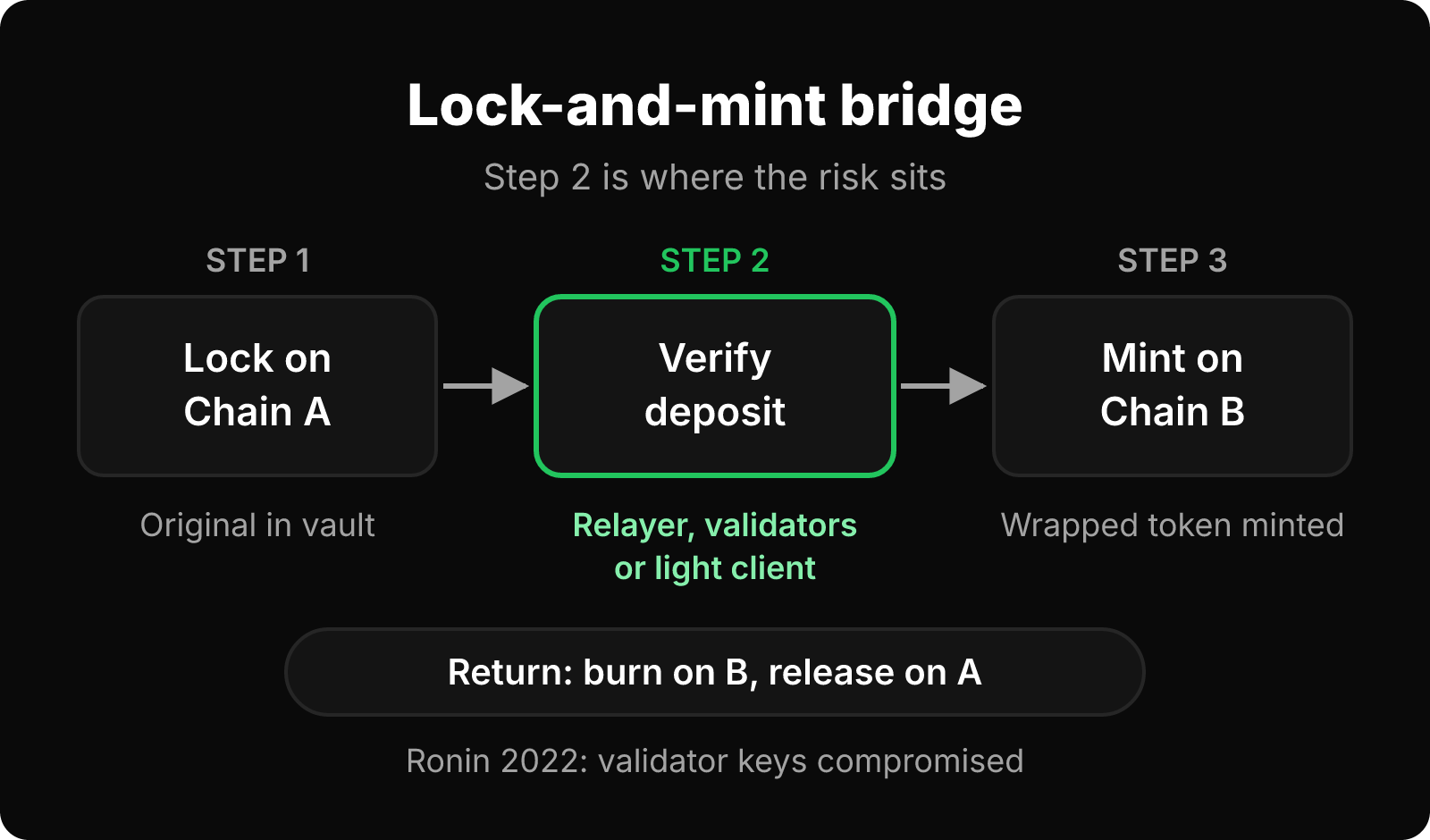
Here's the coat-check analogy. You hand your coat (your tokens) to the attendant, who hangs it up (locks it in the vault) and gives you a numbered ticket (the minted token). You walk around with the ticket, and later you hand it back to collect your coat. The ticket is only worth something if the coat is really on the rack and the attendant only hands out tickets for coats they have actually received.
Step by step:
- You send 1 token to the bridge's vault contract on Chain A.
- Something has to notice and verify that deposit: a relayer, a validator group or a light client.
- Once the deposit is confirmed, a contract on Chain B mints exactly 1 wrapped token to your wallet.
- To return, you burn the wrapped token on Chain B, step 2 happens in reverse, and the vault on Chain A releases your original.
Step 2 is where the risk sits. Lock-and-mint really is the industry standard, but the label tells you nothing about who confirms deposits or what stops them from lying. Pepeto's releases mention a "monitoring layer extended to read the new network" without saying how that layer is secured. You can ask that of any bridge, Pepeto included.
The risk is real. Cross-chain bridges have been behind some of the largest thefts in crypto. The best-known case, the 2022 Ronin bridge exploit, worked because attackers took control of enough of the validator keys that approved withdrawals. The vault was fine. The coat-check attendant had been compromised.
Why Is Bitcoin Harder to Bridge Into DeFi?
Bitcoin is harder to bridge because its scripting language is deliberately limited and can't host a vault contract that watches what happens on another blockchain. On Ethereum, BNB Chain or Solana, a bridge can deploy smart contracts on both sides. Bitcoin doesn't give you that option.
That leaves every Bitcoin bridge with two questions to answer. First, who holds the BTC on the Bitcoin side? Second, how does the destination chain find out that the BTC really arrived? The answers fall into roughly three groups:
- Custodial: A company holds the BTC and mints tokens when it's satisfied. This is simple, but you're trusting that company.
- Committee or threshold signers: A group of independent operators shares control of the BTC and must reach a majority to act. You're trusting that most of them stay honest.
- Light-client (SPV) verification: The destination chain checks a cryptographic proof that the Bitcoin transaction was included in Bitcoin's proof-of-work chain. This is the Simplified Payment Verification idea from Section 8 of the original Bitcoin whitepaper. It removes the "trust me, it arrived" step.
There's plenty of demand for Bitcoin in DeFi. Babylon, a Bitcoin staking protocol, holds $4.29 billion in native BTC staked, according to Dwellir. As more BTC flows into DeFi, the verification question carries more weight.
TeleSwap is a trust-minimized Bitcoin bridge built on the light-client model. It mints TeleBTC, a 1:1 collateral-backed representation of BTC, and only does so after an SPV proof confirms the Bitcoin transaction. The operators who hold BTC (called Lockers) post collateral that can be slashed if they misbehave. TeleSwap has processed $512.6M in total bridged volume across 542,865 transactions on 13 supported networks, including $44.7M in the last 30 days, according to TeleSwap network stats. You can see the model in a real route such as BTC to USDC on Ethereum, or read our guide to converting BTC to WBTC without KYC.
How Do Bitcoin Bridge Models Compare?
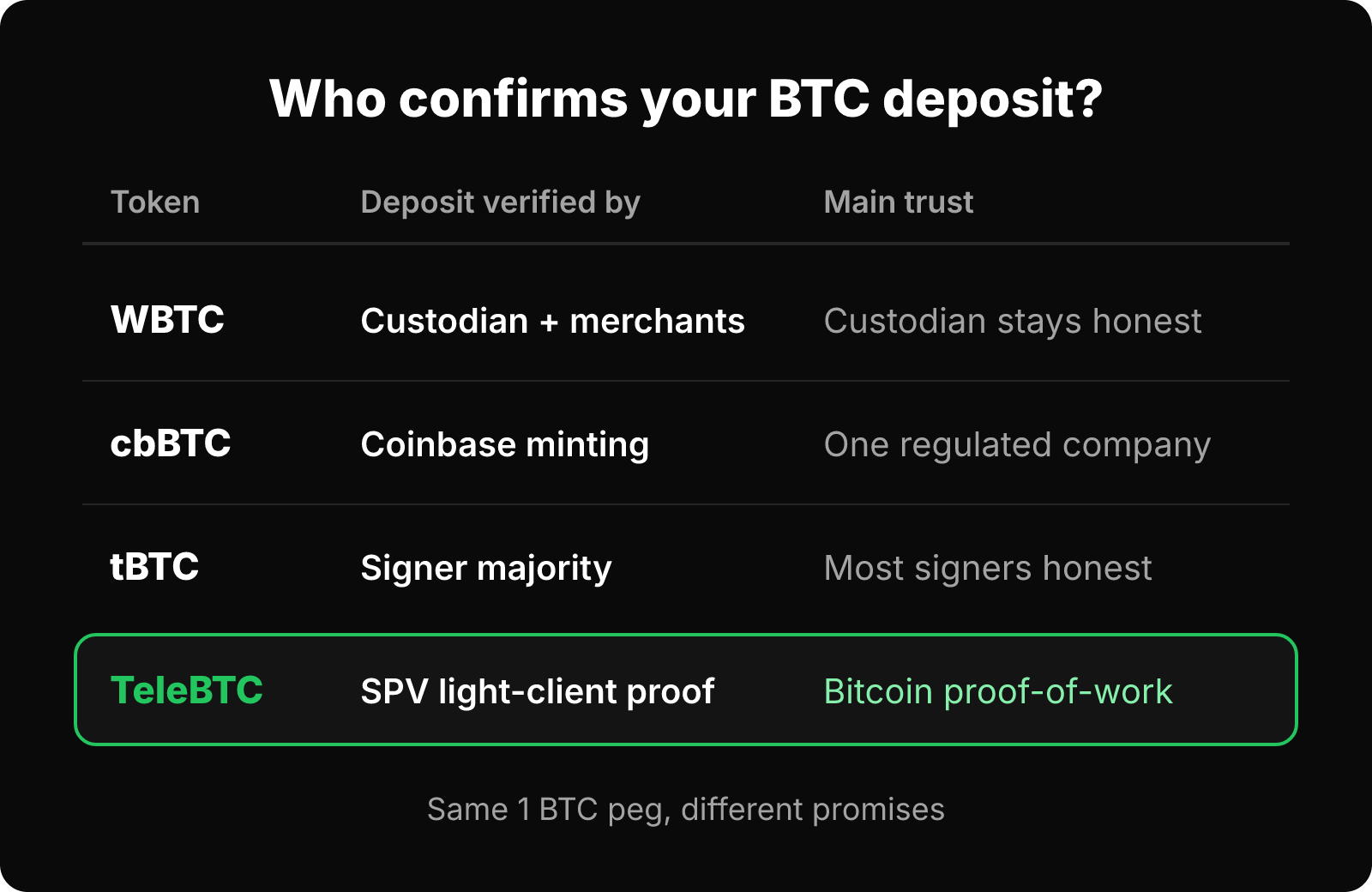
The biggest difference between Bitcoin bridges is who you have to trust to confirm your BTC deposit. The table below compares the major wrapped-BTC options and a generic lock-and-mint token bridge on four trust questions, based on each project's public documentation.
| Solution | Who holds the BTC? | How is the deposit verified? | Main trust assumption | Accepts native BTC? |
|---|---|---|---|---|
| WBTC | Custodian (BitGo and partners) | Custodian and merchant process | The custodian stays solvent and honest | Yes, via merchants |
| cbBTC | Coinbase | Coinbase's own minting process | A single regulated company | Yes, via a Coinbase account |
| tBTC | Rotating group of threshold signers | Signers reach a majority threshold | Most of the signer group is honest | Yes |
| TeleBTC | Collateral-backed, slashable Lockers | SPV light-client proof of the Bitcoin transaction | Bitcoin's proof-of-work and the on-chain light client | Yes |
| Generic lock-and-mint token bridge (e.g., EVM ⇄ Solana) | Vault contract on the source chain | Varies: relayers, validators or a monitoring layer | Depends entirely on the verifier design | Usually no |
The table shows that "wrapped BTC" isn't a single product. Every token in it is meant to be worth 1 BTC, but each rests on a different promise. A custodial token's peg is a legal and operational promise. A light-client token's peg comes from a cryptographic check against Bitcoin's own chain. For a deeper dive, see our guide on BTC to WBTC bridges and fee comparison.
What Makes Cross-Chain Trading Trustless?
Cross-chain trading is trustless when no single person, company or small group can mint, freeze or steal funds by lying about what happened on another blockchain. "Trustless" doesn't mean risk-free. It means the risks come from code and math, not from someone's good behavior.
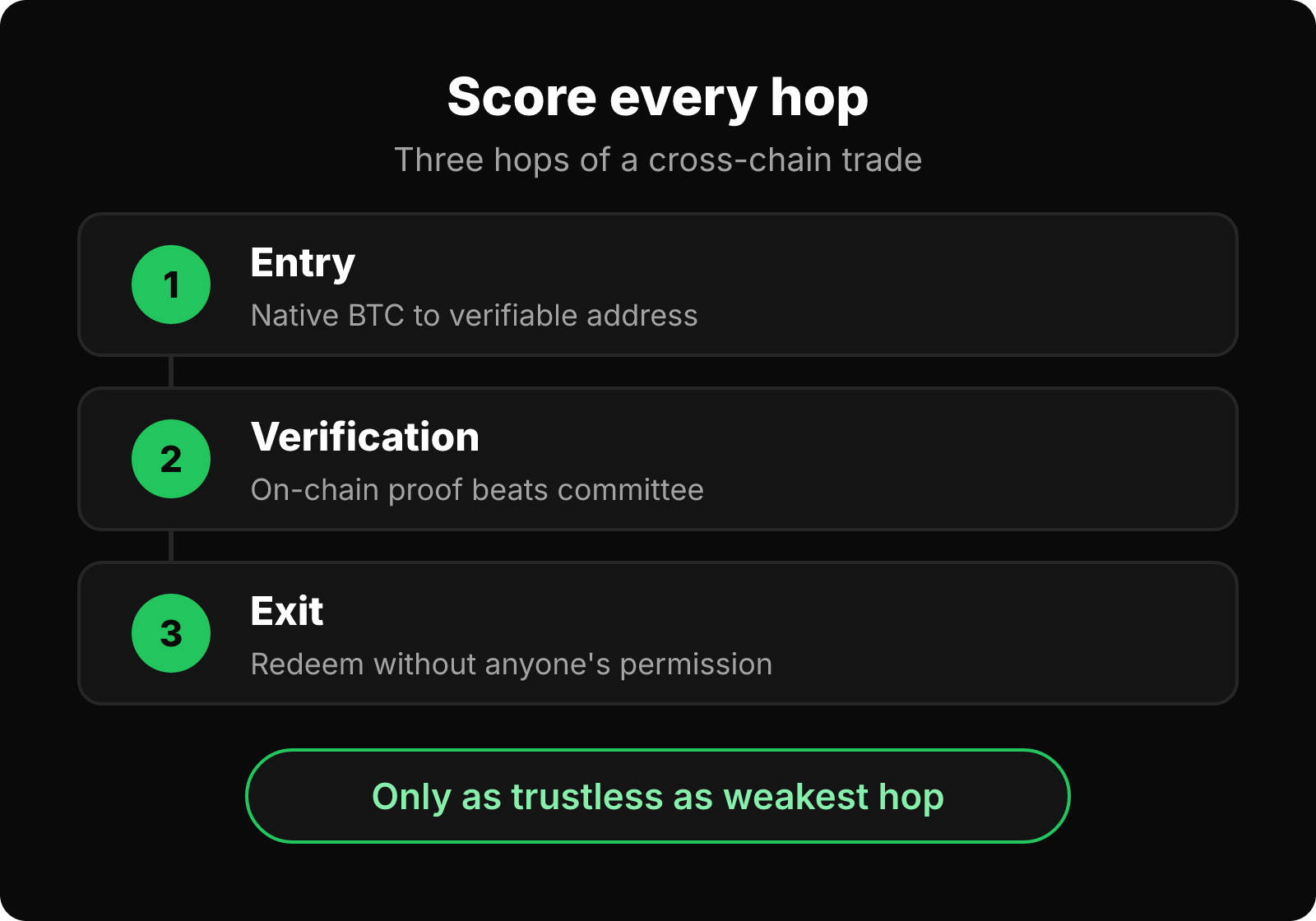
A practical way to judge any cross-chain trade is to break it into three hops and score each one:
- Entry: How does your asset get onto the bridge? Sending native BTC to a verifiable address is better than handing it to an exchange first.
- Verification: How does the other chain learn about your deposit? A proof checked on-chain beats a signature from a committee, and a committee beats a company's say-so.
- Exit: Can you redeem back to the original asset without anyone's permission? If redemption requires a customer support ticket, the trade wasn't trustless.
Your trade is only as trustless as its weakest hop. A fully decentralized DEX doesn't help much if the bridge feeding it relies on a handful of keys. Beginners looking at a DeFi suite miss this more than anything else.
"Zero gas" bridges are common in marketing, but blockchains always charge gas. Someone pays it: the protocol, a subsidy, or a fee folded in somewhere else. That isn't necessarily bad. TeleSwap, for example, has an operator called a Teleporter cover destination-chain gas, so you pay all fees in Bitcoin assets. Still, ask where the cost actually goes, and remember that low fees tell you nothing about security. For more, see the mechanics of on-chain BTC swaps.
6 Questions to Ask Before Using Any DeFi Suite
Before connecting your wallet to any DeFi suite, check who verifies bridge deposits, whether audits are public, and how you can exit. You can run this checklist on Pepeto, TeleSwap or any other project:
- Who confirms bridge deposits? Look for a clear answer in the docs: custodian, multi-sig, validator set or light client. If you can't find one, treat that as your answer.
- Is the audit report public? "Audit completed" means little without a published report naming the auditor and the issues they found.
- Can I redeem without permission? Try a small round trip first, such as swapping a small amount out and back.
- What does the wallet approval actually allow? Read the permission prompt, avoid "unlimited" token approvals where you can, and revoke them afterward.
- Is the token I'm receiving widely accepted? A wrapped asset that only one app recognizes is hard to exit in a hurry.
- Is there a usage track record? Live, public transaction data tells you more than presale numbers or follower counts.
If you only check two things, make them the first and fourth questions. If you want a low-stakes way to practice the round-trip habit, a simple stablecoin route such as BTC to USDT on BNB Smart Chain and back shows you the whole bridge-and-swap flow.
What Does Pepeto's Launch Mean for Bitcoin Bridges?
Pepeto's launch shows that bundled DeFi suites are now the expected product shape, and that makes bridge security more important, not less. Here's how we read it from a cross-chain infrastructure point of view.
1. Bundling is now standard
Even meme-branded presale projects now ship a bridge, a DEX and a safety tool together. As the Dwellir report notes, activity in 2026 is spread across Ethereum layer-2s like Arbitrum, Optimism and Base, alongside newer chains. Users want one place to move between all of them. Bridges are no longer niche infrastructure. They're the front door.
2. The bridge is the weakest link in most suites
An AI contract scanner protects you from bad tokens, but it can't protect you from a bad bridge. The biggest bridge losses, such as Ronin, didn't come from scam tokens. They came from compromised verifiers. A suite that heavily markets its scanner and says little about its bridge verifier has its security priorities backwards.
3. Most suite bridges don't actually touch Bitcoin
Pepeto's announced routes link Ethereum, BNB Chain and Solana, which are all smart-contract chains. Moving between them is a different, easier engineering problem than moving native BTC. As more suites appear, expect "cross-chain" to get used loosely. If your goal is to put actual Bitcoin to work, check whether a suite accepts native BTC and how it verifies the deposit. Don't assume it does just because "multi-chain" is in the headline. See our article on Bitcoin wrapping across different networks for practical examples.
4. Verification is becoming the differentiator
Once every suite offers similar features, the real difference is how each bridge proves its deposits. For Bitcoin, the most direct proof is the one Satoshi described in 2008: check the transaction against Bitcoin's proof-of-work chain. Approaches that inherit Bitcoin's security, rather than asking users to trust a custodian or committee, are better placed as the market matures.
Frequently Asked Questions
What is a DeFi suite?
A DeFi suite is a bundle of decentralized finance tools, typically a cross-chain bridge, a decentralized exchange and a safety or analytics tool, offered under one interface. Each tool runs on smart contracts, not a company, and users connect their own non-custodial wallets to use them. The bundle is convenient: one login, one interface, and fewer chances to enter the wrong address.
Is Pepeto's bridge a Bitcoin bridge?
Based on its public announcements as of October 11, 2026, Pepeto's bridge connects Ethereum, BNB Chain and Solana and does not advertise a native Bitcoin route. It uses a lock-and-mint design between smart-contract chains. That's a different engineering problem from bridging native BTC, because Bitcoin can't host vault contracts of the same kind. If you need to move native Bitcoin into DeFi, look for a bridge that specifically accepts Bitcoin transactions.
What does lock-and-mint mean in a crypto bridge?
Lock-and-mint means your original tokens are locked in a vault on one blockchain while an equal number of wrapped tokens are created on another. When you return, the wrapped tokens are burned and the originals are released. Its security depends entirely on whoever verifies the deposits (a company, a group of signers or a light client) and how well those verifiers are protected against compromise.
What makes cross-chain trading trustless?
Cross-chain trading is trustless when no single party can mint, freeze or steal funds by falsely reporting what happened on another chain. In practice, that means deposits are verified on-chain with cryptographic proofs (such as SPV light-client proofs for Bitcoin) and users can redeem back to the original asset without anyone's permission. If a bridge requires you to contact customer support to withdraw, it is not trustless.
Are zero-gas-fee bridges really free?
No. Blockchains always charge gas, so a "zero gas" bridge means someone else covers the cost or it's built into other fees. That can be a real convenience, but the fee level says nothing about security. Check how the bridge verifies deposits before you look at what it costs. A low-fee bridge with poor verification is still a risky bridge.
How can I move native BTC into DeFi without a custodian?
You can use a light-client Bitcoin bridge, which verifies your BTC deposit with an SPV proof before minting a wrapped token on the destination chain. TeleSwap works this way. It mints TeleBTC 1:1 only after a verified Bitcoin transaction and can swap into tokens on supported chains in one step, with fast swaps settling in about 10 minutes. Because the BTC is held by collateral-backed, slashable Lockers, you don't have to trust a single company or a multi-sig committee with your Bitcoin.
What's the difference between a lock-and-mint bridge and a light-client bridge?
Lock-and-mint is a design pattern (tokens locked on one chain, wrapped tokens minted on another), while light-client is a verification method (cryptographic proof of the source transaction). A lock-and-mint bridge can use light-client verification, custodial holding or multi-sig verification. TeleSwap, for example, uses light-client verification for Bitcoin together with collateral-backed Lockers, which makes it a trust-minimized alternative to custodial and committee-based designs.
Conclusion
With the DeFi suite explained, the takeaway is simple. A suite is a bundle of a bridge, an exchange and a safety tool, and the bundle is only as strong as its weakest piece, which is usually the bridge. Pepeto's October 2026 launch shows where DeFi products are heading. It also shows that "lock-and-mint" and "zero gas" describe convenience, not security. For Bitcoin in particular, what matters is how the destination chain learns your BTC really arrived.
If you'd like to see light-client verification in practice, start small. Bridge a modest amount of BTC on teleswap.xyz, follow how TeleBTC is minted against a verified Bitcoin transaction, and read the details in the TeleSwap docs. Check the security details before you bridge larger amounts.