Ethereum Upgrades 2026: What They Mean for Bitcoin DeFi

Ethereum has changed a lot since early 2024, but nothing you'd notice from the outside. No new coin appeared and nobody had to "migrate" anything. The network kept running while its rules were rewritten underneath it. Those rewrites, called Ethereum upgrades, decide how much it costs to use Ethereum, how fast your transaction lands, and who can quietly block it.
If you hold Bitcoin and want to use it in decentralized finance (DeFi), which means apps for trading, lending, and earning that run on code instead of banks, the ethereum upgrades 2026 calendar matters to you. A large share of "Bitcoin DeFi" happens on Ethereum and on the cheaper networks built on top of it.
This guide starts from the basics: what an upgrade is, what changed between 2024 and 2026, what's coming next, and what each change means for your BTC.
Key Takeaways:Ethereum shipped three major upgrades in under two years: Dencun (March 2024), Pectra (May 2025), and Fusaka (December 2025), and most of their changes made Layer 2 networks cheaper.Glamsterdam is Ethereum's next major upgrade, and as of October 2026 it targets Q4 2026 with no confirmed mainnet date, according to Binance's upgrade tracker.Glamsterdam's two headline features are enshrined proposer-builder separation (EIP-7732) and block-level access lists (EIP-7928), which let Ethereum process non-conflicting transactions in parallel.Ethereum upgrades make Bitcoin DeFi cheaper and harder to censor on the Ethereum side, but they cannot change how Bitcoin gets onto Ethereum or who holds it, which is still the biggest risk for any BTC holder.A faster Ethereum does not make Bitcoin bridges faster, because the waiting is set by Bitcoin's roughly 10-minute block time, not by Ethereum.
Table of Contents
- What Is an Ethereum Upgrade?
- What Changed Between 2024 and 2025?
- What Are Glamsterdam and Hegotá?
- Ethereum Protocol Changes at a Glance
- How Does Bitcoin DeFi Cross-Chain Actually Work?
- What Do Ethereum Upgrades Mean for Your Bitcoin?
- Why Does a Trustless Bridge on Ethereum Matter More Than Speed?
- A Beginner's Checklist for Bitcoin DeFi in 2026
- Frequently Asked Questions
- Conclusion
What Is an Ethereum Upgrade?
An Ethereum upgrade is a coordinated change to the rules that every computer running Ethereum agrees to follow. The technical name is a "hard fork." It means that from a certain block onward, every node (a computer keeping a copy of the blockchain) applies the new rules.
Think of Ethereum as a city whose traffic laws live in thousands of identical rulebooks, one in every car. To change the speed limit, you can't repaint one sign. Every driver has to swap in the new rulebook at the same moment. That's why upgrades are planned months ahead, tested on practice networks (testnets), and given names.
Each upgrade bundles several EIPs (Ethereum Improvement Proposals). An EIP is a written design document for one specific change, published openly in the official EIP repository. When you see "EIP-4844," it's just a reference number for one idea.
The funny names combine two parts. One is a city name, used for the execution layer that runs smart contracts. The other is a star name, used for the consensus layer that agrees on blocks. Prague plus Electra gave "Pectra." Fulu plus Osaka gave "Fusaka."
What Changed Between 2024 and 2025?
The 2024–2025 upgrades mostly made Ethereum's Layer 2 networks cheaper and Ethereum wallets smarter. To see why that matters, you first need to know what a Layer 2 is.
First, a 30-second primer on Layer 2s
Ethereum's main chain, called Layer 1, is secure but crowded. Layer 2 networks (L2s) such as Arbitrum, Base, and Optimism act like express lanes. They process transactions on their own, bundle thousands together, and post a compressed summary back to Ethereum for safekeeping.
Ethereum's official roadmap calls this a "rollup-centric" strategy. Most everyday activity moves to L2s, and Layer 1 serves as the final judge and record-keeper.
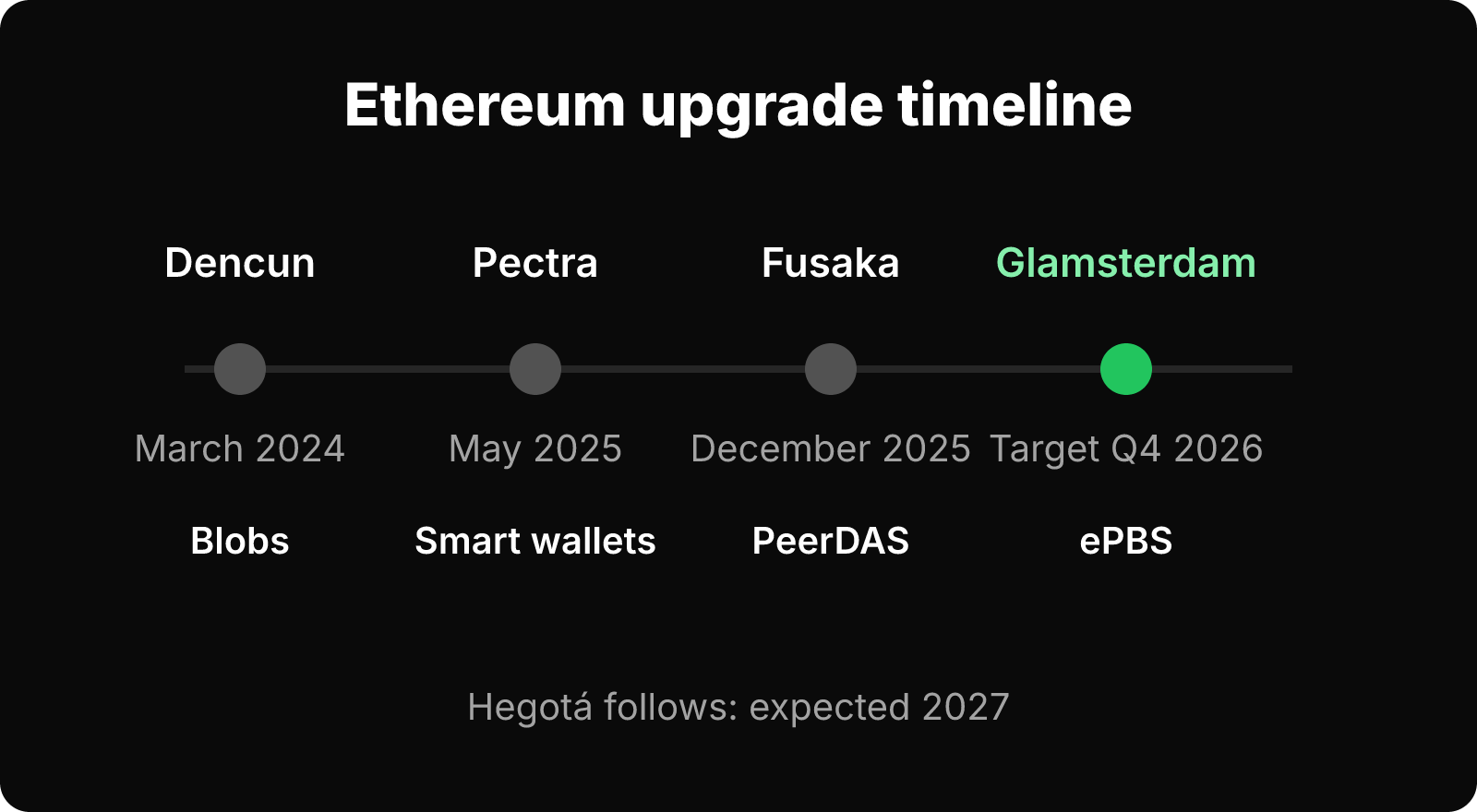
Dencun (March 13, 2024): cheaper data for L2s
Dencun introduced EIP-4844, nicknamed "proto-danksharding." It created a new kind of storage called blobs.
Picture shipping containers that Ethereum agrees to hold for about 18 days and then throws away. L2s only need their data to be available long enough for anyone to check it, so temporary storage was enough, and it costs far less than permanent storage. L2 fees dropped sharply after the upgrade.
Pectra (May 2025): smarter wallets
Pectra's best-known change for regular users was EIP-7702. It lets a normal wallet temporarily act like a smart contract wallet. That enables features like batching several actions into one click, or having someone else pay your gas (the fee you pay to use the network).
Pectra also raised blob capacity and made life easier for large validators (the computers that propose and confirm blocks).
Fusaka (December 2025): more room for blobs
Fusaka shipped PeerDAS ("peer data availability sampling"). Instead of every node downloading every blob, each node checks small random samples. Think of a quality inspector who tests a handful of items from every box rather than opening every box.
Ethereum can then safely carry more blobs, which leaves more room and lower costs for L2s. Both Pectra and Fusaka were primarily Layer 2-oriented upgrades, as Bitfinex's research team summarizes.
What Are Glamsterdam and Hegotá?
Glamsterdam is Ethereum's next big upgrade and focuses on the main chain itself. Hegotá follows it and focuses on censorship resistance and wallet flexibility. The previous upgrades widened the express lanes. These two rebuild the main highway.
Glamsterdam's timing is uncertain
Glamsterdam was once expected in the first half of 2026. As of October 2026, it targets Q4 2026, and Binance's upgrade page notes no confirmed mainnet date.
That slip is normal. Ethereum upgrades ship once client teams and testnets are ready, not on a fixed calendar. Treat any specific date you read online as a target, not a promise. For context on how this upgrade compares with Bitcoin's design, see our Ethereum Glamsterdam upgrade vs Bitcoin DeFi guide.
Feature 1: Enshrined proposer-builder separation (ePBS, EIP-7732)
Today, most Ethereum blocks are assembled by specialized "builders" and handed to validators through outside middlemen called relays. Think of a restaurant where the chef (builder) cooks the meal and the waiter (proposer) serves it.
Right now, the hand-off between them happens through a third-party delivery service that everyone has to trust. EIP-7732 moves that hand-off into Ethereum's own rules, which is intended to reduce reliance on trusted intermediaries.
Feature 2: Block-level access lists (EIP-7928)
Under EIP-7928, transactions declare in advance which accounts and storage they will touch. It works like a grocery store where every shopper hands over their list at the door.
Shoppers who don't want the same items can go to different cashiers at the same time. Ethereum nodes can then process non-conflicting transactions in parallel instead of one by one.
CoinMarketCap says Glamsterdam aims to significantly raise the gas limit, meaning more capacity per block. No figure is final, so treat that as a target, not a commitment.
Hegotá (expected 2027): guaranteed inclusion and flexible accounts
The upgrade after Glamsterdam, Hegotá, is expected in 2027. Its planned features include FOCIL (EIP-7805), which stands for fork-choice enforced inclusion lists.
The simple version: a committee of validators publishes a list of waiting transactions that the next block must include. If a block builder leaves them out, the network rejects that block. It's like a bouncer who can no longer turn away people already on the guest list.
Hegotá is also expected to bring "frame transactions" (EIP-8141), which give wallets more flexible ways to prove who is sending a transaction.
Ethereum Protocol Changes at a Glance
The table below lists each upgrade, the plain-English change, and the part that matters for Bitcoin DeFi. Future dates are targets.
| Upgrade | Date | Headline change | Beginner analogy | Why a BTC holder should care |
|---|---|---|---|---|
| Dencun | March 2024 | Blobs (EIP-4844) | Cheap temporary shipping containers | Made small BTC swaps on L2s cheaper |
| Pectra | May 2025 | Smart wallet features (EIP-7702), more blobs | Your regular wallet gains autopilot | Easier one-click flows and sponsored gas |
| Fusaka | December 2025 | PeerDAS data sampling | Inspectors sample boxes instead of opening all | More L2 capacity, which helps keep fees low |
| Glamsterdam | Target Q4 2026 | ePBS (EIP-7732), access lists (EIP-7928) | Built-in chef-to-waiter hand-off; parallel checkout lanes | Fewer trusted middlemen; more main-chain capacity |
| Hegotá | Expected 2027 | FOCIL (EIP-7805), frame transactions (EIP-8141) | A guest list the bouncer must honor | Harder to censor bridge and swap transactions |
How Does Bitcoin DeFi Cross-Chain Actually Work?
Bitcoin DeFi cross-chain works by representing your BTC as a token on another blockchain, usually Ethereum or an L2, where smart contracts can use it. Bitcoin's own blockchain deliberately keeps its programming language simple. It's built to be extremely secure money, not a platform for complex apps.
So to lend, trade, or earn with BTC, most people move a representation of it to a chain that supports those apps. The BTC is locked, and an equivalent token is minted on the other chain.
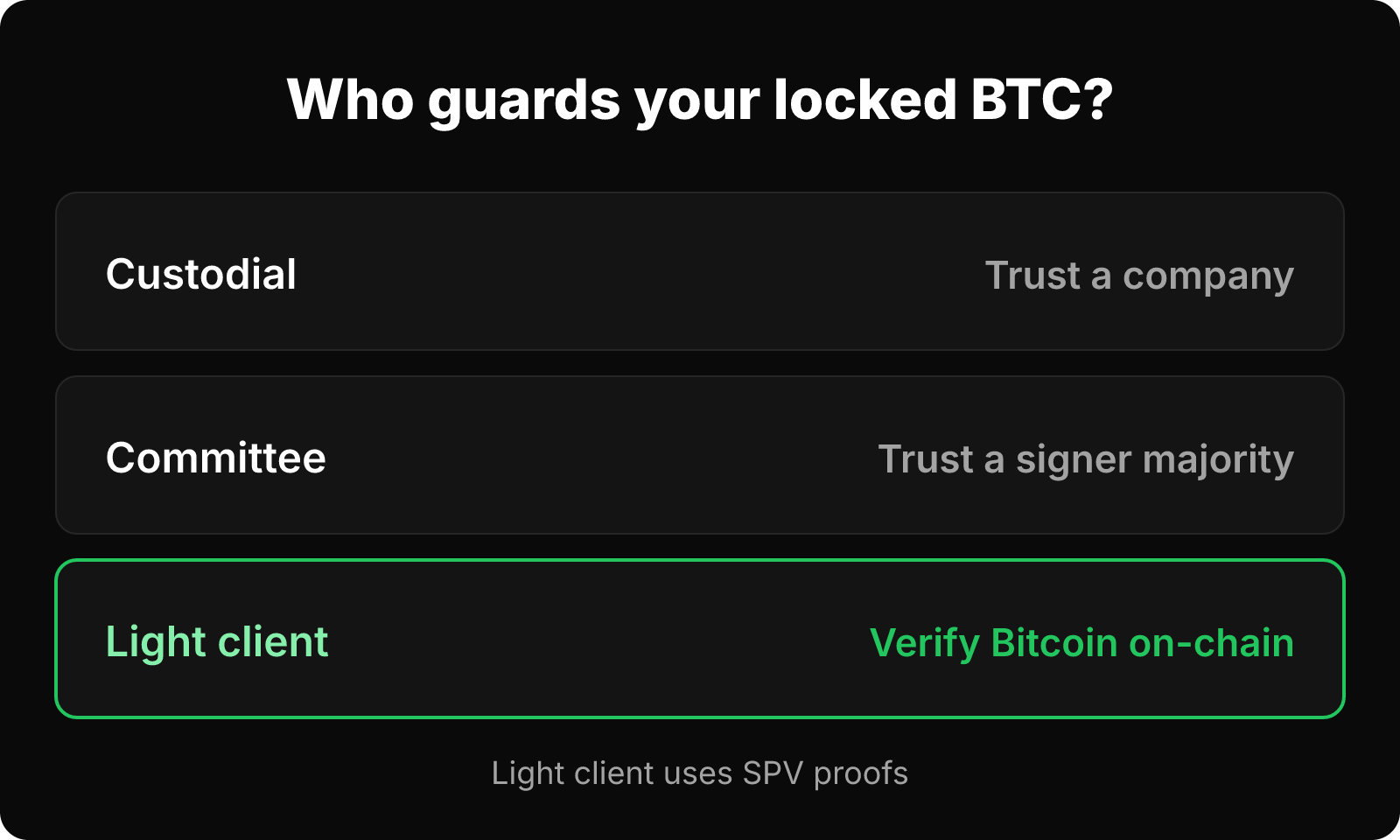
The big question is: who or what makes sure the locked BTC is really there? That question separates the main types of "Bitcoin on Ethereum":
- Custodial tokens such as WBTC and cbBTC. A company or group of companies holds the real BTC, and you trust them to keep it. WBTC's custody moved to a joint venture involving BiT Global in August 2024, as reported by CoinDesk. Coinbase launched cbBTC in September 2024 and is its custodian.
- Committee-based tokens such as tBTC. A group of signers jointly controls the BTC using threshold cryptography, so a majority of them must cooperate honestly.
- Light-client-verified tokens. A smart contract on the destination chain checks Bitcoin's own proof-of-work record directly, using an SPV (simplified payment verification) proof. Nothing gets minted unless the contract can see that a real Bitcoin transaction happened.
A light client is like a notary who doesn't need the whole library of Bitcoin history. It keeps just the "spine" of each book (the block headers) and can still verify that a specific page, your transaction, is genuine. You can check how much BTC sits in each wrapped token today on DefiLlama.
What Do Ethereum Upgrades Mean for Your Bitcoin?
Ethereum upgrades aim to lower the cost of using BTC on Ethereum and its L2s, and to make your transactions harder to block. They don't change how much you have to trust whoever holds the underlying Bitcoin. Here's the breakdown, using a three-question framework.
Question 1: Does it change the cost?
Mostly on L2s, and this is where 2024–2025 delivered the most. Dencun's blobs and Fusaka's extra blob capacity cut the cost of posting L2 data to Ethereum, and that saving flows through to users as lower L2 fees.
That changes who Bitcoin DeFi is for: you no longer need a large balance for fees to make sense. Check current fees on your chosen network before you transact, since they vary.
There's a less obvious benefit too. Light-client bridges have to post Bitcoin block headers and check proofs inside Ethereum smart contracts, and each step costs gas. Cheaper, roomier blocks can make it cheaper to verify Bitcoin directly on-chain, so Ethereum's scaling can help the most trust-minimized bridge designs.
Question 2: Does it change who can censor or reorder you?
This is Glamsterdam's and Hegotá's territory. Bridge and swap transactions are time-sensitive. A proof that shows up late, or a swap that gets front-run (someone jumps ahead of your trade for profit), costs real money.
ePBS is meant to remove trusted relays from block building, and FOCIL is meant to force blocks to include transactions that are waiting in line. Together they aim to shrink the room for anyone to quietly drop or delay a Bitcoin bridge transaction. These mechanisms are new and haven't been tested on mainnet, so judge them by how they perform after launch, not by how they look on paper.
Question 3: Does it change the trust in the bridge?
No. Many explainers blur this point for beginners. No Ethereum upgrade can audit a custodian's vault or make a multi-signature committee more honest.
If your "Bitcoin on Ethereum" depends on a company, a faster and cheaper Ethereum just lets you reach that same company dependency more cheaply. Validator-level exposure is a separate question, covered in our Ethereum Validator Security & Bitcoin Bridge Risks guide.
The contrarian take: speed is not the bottleneck
Few articles say this plainly: Ethereum getting faster does not make Bitcoin bridging faster.
Bitcoin produces a block roughly every 10 minutes. A careful bridge waits for confirmations so it doesn't credit a transaction that might later be reversed. Ethereum could finalize in one second and you'd still be waiting on Bitcoin. The variable that separates BTC bridges is how they verify that Bitcoin moved, not how fast they settle.
Why Does a Trustless Bridge on Ethereum Matter More Than Speed?
A trustless bridge on Ethereum matters because upgrades harden Ethereum but not the gateway your BTC passes through. Here's how the main options compare on the questions that count.
| Token | Who secures the BTC | How minting is verified | Main trust assumption |
|---|---|---|---|
| WBTC | Custodian joint venture | Custodian attests to deposits | Custodians stay solvent and honest |
| cbBTC | Coinbase | Coinbase mints against its holdings | A single regulated company |
| tBTC | Threshold signer network | Signer committee | An honest majority of signers |
| TeleBTC | Collateral-backed, slashable Lockers | SPV light client checks Bitcoin's proof-of-work | Bitcoin's own consensus and economic collateral |
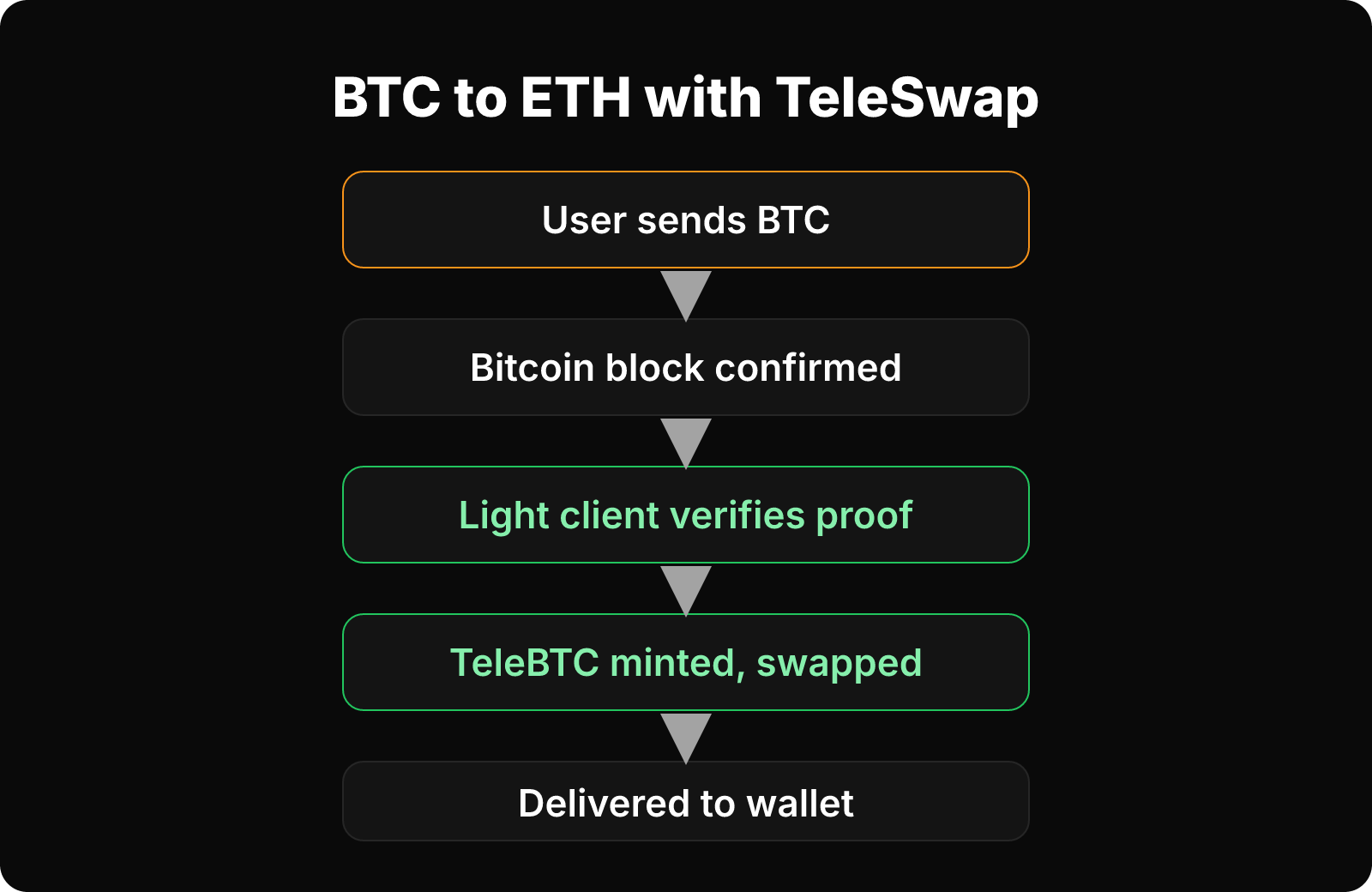
TeleSwap, a Bitcoin bridge using SPV light client verification, takes the last approach. It mints TeleBTC 1:1 only after a light client on the destination chain verifies a real Bitcoin transaction.
The BTC is backed by collateral that can be slashed if a custodian misbehaves. There's no multi-sig committee or central custodian to trust.
TeleSwap also lets you bridge and swap in one step, so BTC can become ETH on Base with fees paid in Bitcoin assets, while a Teleporter covers destination-chain gas. For a step-by-step walkthrough, read our 7-step trustless BTC swap guide. You can also go straight to the BTC → ETH (Base) page.
Per TeleSwap network stats retrieved on October 13, 2026, the protocol has bridged $514.9M across 545,686 transactions on 13 supported networks. Over the last 30 days it handled $45.4M, averaging about $1.5M a day, with a peak of $2.8M on September 18, 2026.
Ecosystem builders see the same direction of travel. "In a word: unification," Aerodrome's Alex Cutler said of 2026, arguing that siloed ecosystems would come back together, in a January 3, 2026 CoinDesk piece. For Bitcoin, unification only helps if the bridges joining these ecosystems don't bring back the custodial risk Bitcoin was designed to remove.
A Beginner's Checklist for Bitcoin DeFi in 2026
You don't need to follow every Ethereum core developer call. Use these steps instead:
- Pick the network before you pick the app. For small amounts, an L2 like Arbitrum, Base, or Optimism usually costs much less than Ethereum mainnet.
- Ask "who holds the BTC?" Before you use any Bitcoin token, find out whether it relies on a custodian, a committee, or on-chain verification of Bitcoin. Check the protocol's own docs.
- Plan around Bitcoin's clock. Expect bridging from Bitcoin to take roughly one or more Bitcoin blocks (about 10 minutes each). Don't panic if it isn't instant.
- Don't time your moves around upgrade dates. Glamsterdam's date has already shifted. Major upgrades are designed so users don't need to do anything, and you shouldn't trust anyone who asks you to "migrate" your coins because of one.
- Watch for scams on upgrade day. Fake "upgrade your ETH" or "claim your new token" messages show up around every hard fork. Ethereum upgrades never require you to send funds anywhere.
- Start small. Make your first cross-chain transaction with an amount you're comfortable learning on, and confirm it arrives before you move more.
Frequently Asked Questions
What are the Ethereum upgrades in 2026?
The main Ethereum upgrade of 2026 is Glamsterdam, which targets Q4 2026 but had no confirmed mainnet date as of October 2026. Its headline features are enshrined proposer-builder separation (EIP-7732) and block-level access lists (EIP-7928). It builds on Fusaka, which shipped in December 2025, and comes before Hegotá, expected in 2027.
Do I need to do anything with my ETH or BTC when Ethereum upgrades?
No. Ethereum upgrades don't require ordinary users to move, swap, or "upgrade" their coins. Node operators update their software, and your balances carry over automatically. Any message asking you to send funds to "upgrade" is a scam.
Will Ethereum upgrades make Bitcoin bridges faster?
Not much, because Bitcoin's roughly 10-minute block time is what sets bridge speed. Ethereum upgrades lower fees and add capacity on the destination side. But a secure bridge still has to wait for Bitcoin confirmations before it mints tokens.
What is a trustless bridge on Ethereum?
A trustless bridge on Ethereum mints Bitcoin-backed tokens only after a smart contract verifies, on-chain, that the Bitcoin transaction really happened. It usually does this with an SPV light client that checks Bitcoin's block headers and proof-of-work. That's different from custodial models like WBTC and cbBTC, where you trust a company to hold the BTC.
What is EIP-4844 in simple terms?
EIP-4844 added "blobs," cheap temporary data storage that Layer 2 networks use to post their transaction data to Ethereum. It shipped in the Dencun upgrade in March 2024. Blobs are deleted after about 18 days, which keeps them cheap, and that's the main reason L2 fees fell sharply.
How do Glamsterdam and Hegotá reduce censorship?
Glamsterdam's ePBS is designed to take trusted relays out of block building, and Hegotá's FOCIL is designed to force blocks to include transactions that are waiting in line. Together they aim to make it harder for any single party to delay or drop transactions, including time-sensitive bridge and swap transactions. Both mechanisms are new, and how well they work will only become clear after launch.
Conclusion
Ethereum's 2024–2025 upgrades made using Bitcoin on L2s cheaper. Glamsterdam and Hegotá aim to make Ethereum's main chain roomier and harder to censor.
Through all of it, one thing stays the same: an Ethereum upgrade can't make your bridge more trustworthy. That depends on whether your BTC is guarded by a company, a committee, or Bitcoin's own proof-of-work.
If you want to try Bitcoin DeFi on Ethereum and its L2s without handing your BTC to a custodian, go to teleswap.xyz to bridge or swap BTC in one step, and read how the light-client verification works in the docs.