WBTC Bridge Custody Risk vs Trustless Bridges in 2026

You hand your coat to a cloakroom attendant and get a paper ticket back. For the rest of the night that ticket is your coat. You can show it to people and trade it, but it's only worth something while the cloakroom is open, honest, and still has your coat on the rack.
Wrapped Bitcoin works the same way. When you hold WBTC on Ethereum, you hold a ticket. The real bitcoin sits in a vault run by a company. WBTC bridge custody risk is the chance that the vault, or the people running it, fails you. That could be a hack, a bankruptcy, a change of ownership, or a regulator. This guide explains that risk from first principles. It shows how a trustless bitcoin bridge removes the need to trust the attendant, and it walks you through moving BTC to another chain without handing it to a custodian.
Key Takeaways:WBTC is an IOU for bitcoin held by a custodian, BitGo, so its value depends on that custodian staying solvent, secure, and honest.Regular users can't mint or redeem WBTC directly, because only approved merchants can, which adds another gatekeeper between you and your BTC.A trustless bitcoin bridge like TeleSwap, which supports 13 networks, mints TeleBTC only after a smart contract checks an SPV proof against Bitcoin block headers, according to the TeleSwap documentation."Trustless" doesn't mean risk-free: the September 11, 2026 Symbiosis exploit showed that bridge code which checks messages badly can mint tokens backed by nothing, per Shattered's bridge security report.TeleSwap has processed $519.1M in total bridged volume across 549,959 transactions, per TeleSwap network stats.
Table of Contents
- What Is WBTC Bridge Custody Risk?
- How Does the WBTC Bridge Actually Work?
- WBTC vs Native Bitcoin: What Changes When You Wrap?
- 5 Ways a Custodial Bridge Can Fail You
- What Makes a Trustless Bitcoin Bridge Different?
- The Three-Question Test for Any Bitcoin Bridge
- WBTC, cbBTC, tBTC and TeleBTC Compared
- How to Bridge BTC Without a Custodian: Step by Step
- Frequently Asked Questions
- The Bottom Line
What Is WBTC Bridge Custody Risk?
WBTC bridge custody risk is the risk that the company holding the real bitcoin behind WBTC loses it, freezes it, or can't give it back, which would leave WBTC holders with tokens worth less than the BTC they're supposed to stand for.
Start with the basic problem. Bitcoin lives on its own blockchain. Ethereum, Arbitrum, BNB Chain, and Solana can't "see" Bitcoin directly.
So if you want to use your BTC in a lending app or a decentralized exchange on those chains, someone has to build a bridge. A bridge locks your BTC on one side and creates a matching token on the other.
WBTC, launched on Ethereum in 2019, takes the simplest route: a trusted company holds the coins. According to WBTC's June 2026 update, the work is split up. Custodians secure the BTC, merchants mint and burn tokens, and a DAO (a group of token holders who vote on rules) handles governance.
That's a reasonable design. It's also one where everything depends on the custodian.
The scale is why this matters. A large amount of bitcoin, on the order of 100,000 BTC by recent third-party estimates, depends on the same small set of promises.
How Does the WBTC Bridge Actually Work?
The WBTC bridge is a "lock-and-mint" system run by known institutions. Here's the full cycle:
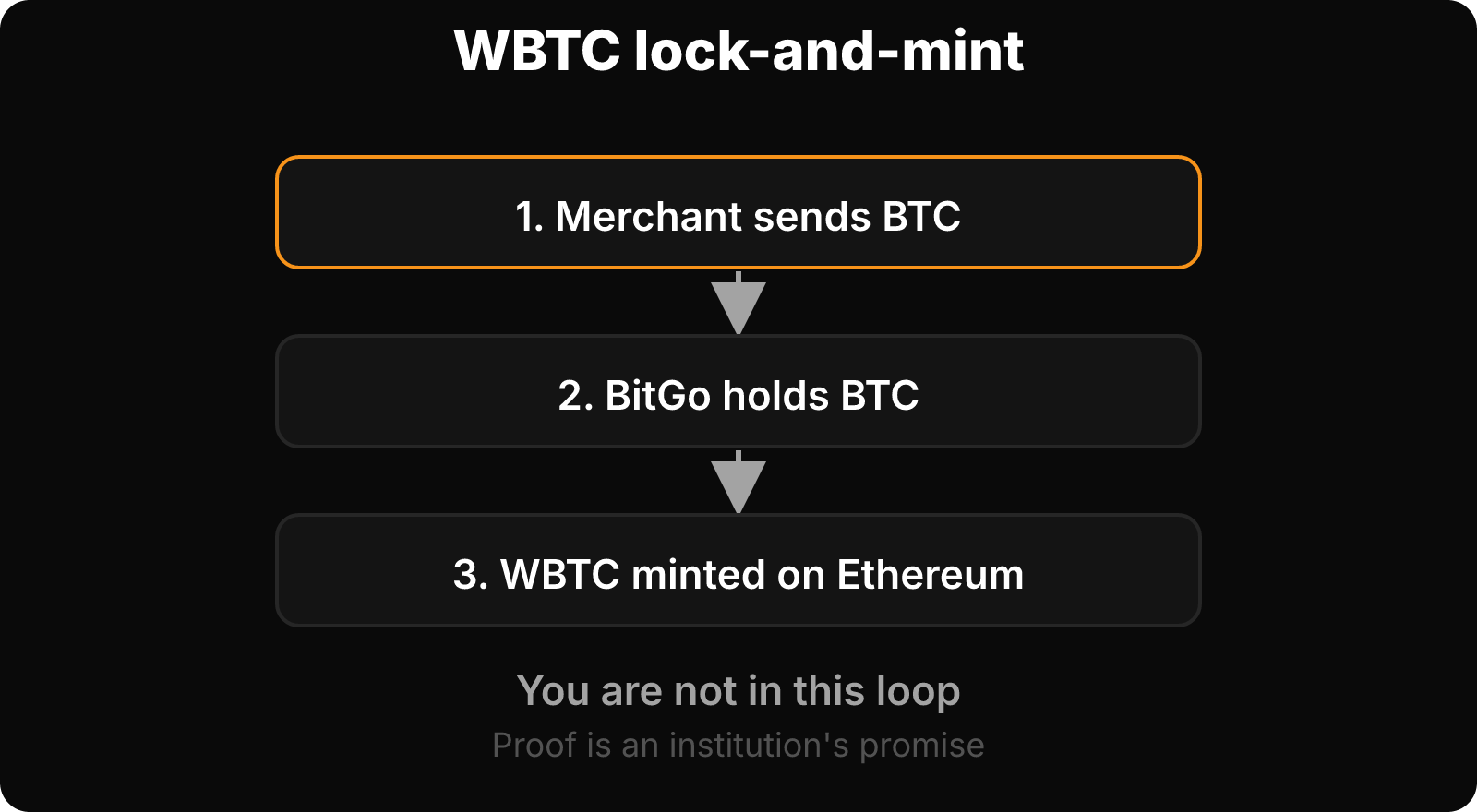
- Deposit: An approved merchant sends BTC to the custodian.
- Custody: The custodian (BitGo) holds that BTC in its vaults.
- Mint: The matching amount of WBTC is created on Ethereum and given to the merchant.
- Redeem: To get real BTC back, a merchant burns (destroys) WBTC, and the custodian releases the bitcoin.
Notice who's missing from that list: you.
Ordinary users usually can't mint or redeem WBTC themselves. They buy it on an exchange or a DEX from someone who got it from a merchant. So in practice, a retail holder's link to the real bitcoin passes through several parties: the market, a merchant, and the custodian.
The important point for beginners is this. WBTC's minting relies on the custodian and merchant process, not on an on-chain check of the Bitcoin blockchain. The proof that the BTC exists is an institution's promise, backed by audits and its reputation.
WBTC vs Native Bitcoin: What Changes When You Wrap?
Native bitcoin has no counterparty, and WBTC does. That one difference explains most of the WBTC vs native Bitcoin debate.
When you hold native BTC in your own wallet, the only things protecting it are your private key and Bitcoin's proof-of-work network. Proof-of-work means miners spend real electricity to order transactions, which makes rewriting history very expensive. No company has to stay in business for your BTC to keep its value.
Once you wrap, you add new assumptions:
- Custodian risk: The vault has to stay secure and solvent.
- Process risk: Merchants and governance have to keep minting and redeeming honestly and on time.
- Smart contract risk: The token contract on Ethereum has to be bug-free.
- DeFi stacking risk: If you deposit WBTC into a lending app, that app's code risk sits on top of everything above.
None of this makes wrapping a bad idea. Wrapping is the only way to use BTC in most DeFi apps. The real question is which risk you accept, and whether you can check it yourself.
| Property | Native BTC (self-custody) | WBTC |
|---|---|---|
| Who controls the coins | You (private key) | Custodian (BitGo) |
| Usable in Ethereum DeFi | No | Yes |
| Depends on a company's actions | No | Yes, the underlying BTC depends on the custodian |
| Who can redeem directly | N/A | Approved merchants |
| How backing is proven | Bitcoin ledger | Custodian attestations and reporting |
5 Ways a Custodial Bridge Can Fail You
Custodial risk is a "low-probability, high-severity" risk. Day to day, it stays out of sight. When it does show up, it tends to show up all at once. Here are the five ways it usually goes wrong.
1. The vault gets hacked
Every pool of BTC held by one party is a target. Crypto's history is full of custodial and bridge losses. The 2022 Wormhole bridge exploit, for example, was roughly $325M on its own.
2. Ownership or control changes
You don't pick who runs the vault next year. WBTC's custody arrangements drew scrutiny in 2024 when plans were reported to shift part of its custody structure, and several DeFi protocols reviewed their WBTC exposure.
Since then, WBTC has said it is exploring multi-custodian Bitcoin reserves. That would spread custody across more firms, but it doesn't remove custody from the model.
3. Regulators step in
Custodians are regulated businesses, which helps with accountability. It also means they can be ordered to act. The EU's MiCA transition period ended on July 1, 2026, and crypto service providers in the EU now face full licensing and operating requirements, per WBTC's June 2026 update. New rules can change how custodians operate, sometimes with little warning.
4. Redemption bottlenecks
If only merchants can redeem, then in a panic the exit is only as wide as the merchants' capacity and willingness to process redemptions. Retail holders have to sell on the open market instead, where prices can slip below the peg.
5. You can't verify the backing yourself
A custodian can publish wallet addresses and proof-of-reserves reports. Still, what's being promised is "we hold the BTC and we'll give it back," and no code enforces that promise. You are trusting the audit.
The biggest custody risk usually isn't theft. It's governance drift. Over the years, the people, owners, and legal entities behind a custodial wrapper can change while the token looks the same.
What Makes a Trustless Bitcoin Bridge Different?
A trustless bitcoin bridge replaces "trust the custodian's word" with "check the Bitcoin blockchain in code." No new tokens get minted until a smart contract has verified that real BTC moved.
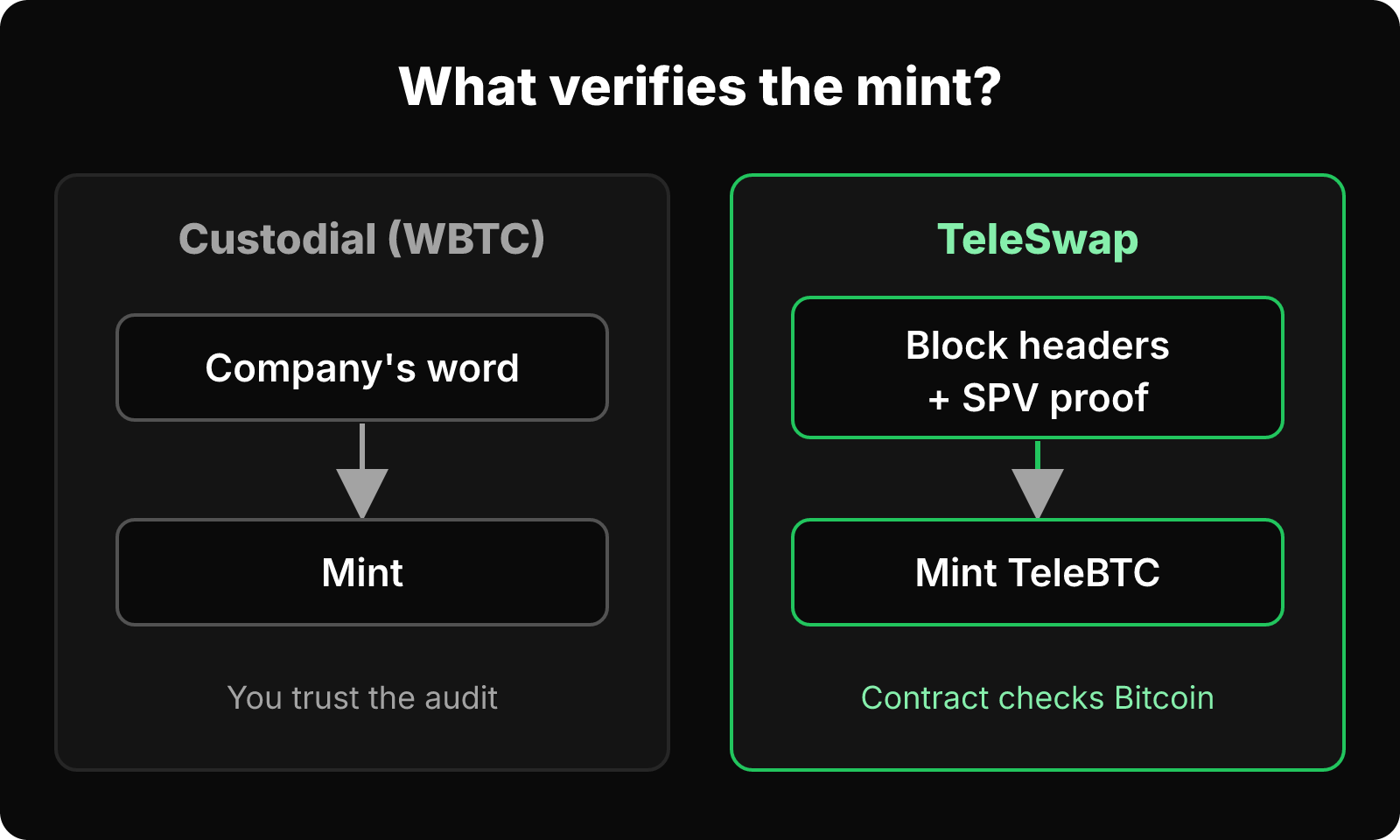
Back to the cloakroom. Imagine the attendant can only hand out a ticket after a machine at the door watches your coat go onto the rack. Now add one more rule: the attendant has paid a security deposit that gets taken away if your coat ever leaves without your ticket. That's roughly how TeleSwap works.
Per the TeleSwap light client documentation, the process works like this:
- A light client on the destination chain: A "Relay" smart contract stores Bitcoin's block headers. Relayers keep submitting new headers, and the contract checks them against Bitcoin's consensus rules.
- SPV proofs: An SPV (Simplified Payment Verification) proof is a short piece of cryptographic evidence that a particular transaction is inside a particular Bitcoin block. Anyone can submit one, and the contract checks it against the stored headers.
- Mint only when verified: TeleBTC, TeleSwap's 1:1 BTC-backed token, is minted only if the user really sent BTC on Bitcoin.
- Slashable collateral: BTC sits with Lockers, who post collateral. If anyone proves that a Locker moved BTC without a valid unwrap, that Locker gets slashed.
Because the contract does the checking, rather than a trusted group of validators or a single company, TeleBTC inherits Bitcoin's security model directly. That's what separates it from custodial wrappers like WBTC and cbBTC, and from bridges secured by multi-sig committees.
A contrarian point: "trustless" bridges fail too, just differently
We'd be doing beginners a disservice if we called any bridge risk-free. On September 11, 2026, an attacker exploited a message-validation flaw in Symbiosis's BridgeV2 contract on BNB Chain and minted about 46.1 billion units of syBTC. About 4.39 WBTC was sold through Uniswap v4, according to Shattered's analysis. Realized losses were estimated at about $336K, or about $770K depending on how transfers are counted.
Symbiosis is a message-based bridge, not an SPV light-client design, so the hack doesn't directly test SPV assumptions. The lesson is wider than that. What matters most is what verifies a mint.
A bridge that checks "a message says BTC arrived" is weaker than one that checks "Bitcoin's proof-of-work says BTC arrived." The same Shattered report summarizes an October 2026 academic study of 588 audit reports across 36 bridge projects. It found 830 vulnerability instances that fell into 11 recurring verification patterns. Audits help, but the verification design matters more. For a closer look at how a single flaw can drain a bridge, see Bridge Security Exploit: How the €332M Hack Happened.
Smart contract risk is still there for any on-chain bridge, TeleSwap included. A trust-minimized design shrinks the attack surface. It can't make it zero. Our Ethereum Validator Security & Bitcoin Bridge Risks guide covers how the underlying chain's security feeds into that risk.
The Three-Question Test for Any Bitcoin Bridge
You don't need to read smart contract code to judge a bridge. Three questions reveal most of a bridge's risk:
- Who holds the BTC? One company, a group of companies, a distributed signer set, or collateral-backed operators?
- Who decides that a deposit happened? An institution's database, a committee's signatures, or a contract that checks Bitcoin itself?
- What happens if they lie or disappear? Lawsuits and reputation, or automatic slashing that anyone can trigger?
For WBTC the answers are: BitGo; the custodian and merchant process; and legal recourse. For TeleBTC they are: Lockers who post collateral; a light-client contract checking SPV proofs; and permissionless slashing. Neither set of answers is magic. But only one of them lets an ordinary user check the backing without trusting anyone's word.
WBTC, cbBTC, tBTC and TeleBTC Compared
Each wrapped BTC comes with a different custody arrangement. Here's how the main options compare on what actually matters:
| Token | Who holds the BTC | What verifies the mint | Main failure mode | Typical user access |
|---|---|---|---|---|
| WBTC | BitGo (multi-custodian being explored) | Custodian + merchant process | Custodian hack, insolvency, or governance change | Buy on market; merchants mint/redeem |
| cbBTC | Coinbase | Coinbase internal systems | Single-company custody and regulatory exposure | Via Coinbase or market |
| tBTC | Distributed threshold signers | Signer group (threshold signatures) | Collusion among enough signers | Mint via the Threshold Network |
| TeleBTC (TeleSwap) | Collateral-backed, slashable Lockers | On-chain Bitcoin light client + SPV proofs | Smart contract bugs | Anyone, directly from a Bitcoin wallet |
Fees and speed matter too. Per TeleSwap's fees and speed docs:
| TeleSwap route | What you wait for | Typical time |
|---|---|---|
| Bitcoin → EVM/TON/Solana (standard) | Two Bitcoin confirmations before TeleBTC is minted | ~20 minutes |
| Fast swap (Bitcoin → other chains) | One confirmation; a Filler delivers and takes on the re-org risk | ~10 minutes |
| EVM/TON/Solana → Bitcoin | Destination-chain confirmation, then the Locker broadcasts your BTC | A few minutes |
Costs are shown in bitcoin terms. There's a 0.1% Locker fee and a network fee that depends on congestion.
On BTC → other chain routes, the network fee covers destination gas that a Teleporter fronts for you. A protocol fee may be zero, and an integrator fee applies only if you come through a partner app that sets a third-party ID.
Those confirmation waits are deliberate. Acting before a Bitcoin transaction is final could mint TeleBTC with nothing behind it.
How to Bridge BTC Without a Custodian: Step by Step
Let's go through a real example. Say you hold 0.05 BTC in a normal Bitcoin wallet and want WBTC on Ethereum so you can use a lending app, without trusting an intermediary on the way there. If you'd rather compare the no-KYC options first, read Convert BTC to WBTC Without KYC: Trustless Bridge Guide.
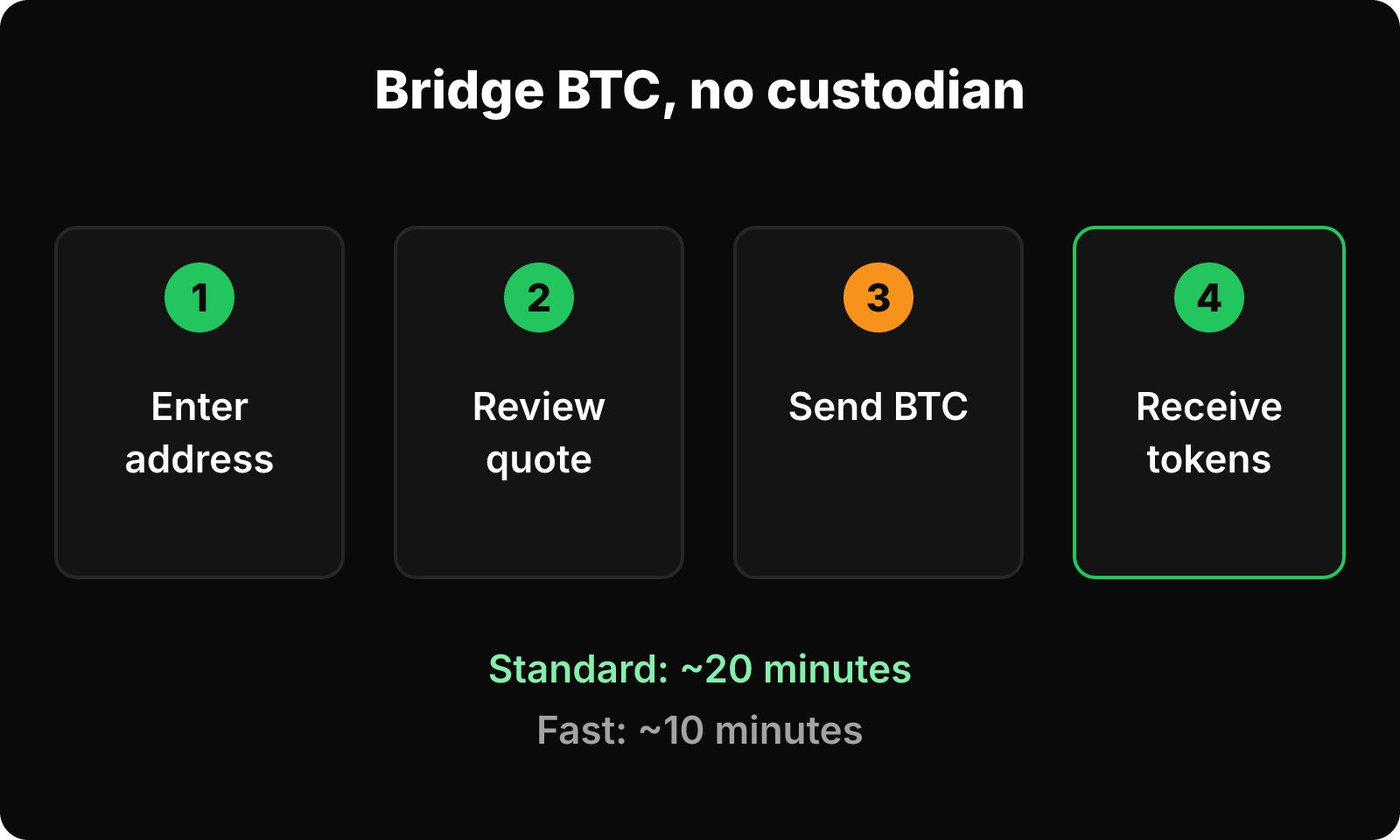
- Open TeleSwap. Go to the BTC → WBTC (Ethereum) route on TeleSwap. You can also pick a different destination chain or token, such as USDC or ETH.
- Enter the destination address. This is the EVM wallet (for example, MetaMask) where the tokens should arrive.
- Review the quote. Check the fee breakdown (network fee, 0.1% Locker fee, any protocol fee) and the estimated amount you'll receive.
- Choose standard or fast. Standard waits for two confirmations (~20 minutes). Fast uses a Filler after one confirmation (~10 minutes) at the best rate available at that moment.
- Send BTC from your Bitcoin wallet. You pay in bitcoin, so you don't need ETH for gas. A Teleporter covers the destination-chain gas.
- Verification happens on-chain. An SPV proof of your Bitcoin transaction is checked against the Relay contract's stored headers. Only then is TeleBTC minted and swapped into your chosen token through a DEX.
- Receive your tokens. They arrive in your wallet, ready to use.
Want to go back to native BTC later? The reverse route, WBTC (Ethereum) → BTC, sends real bitcoin to your Bitcoin address after a Locker broadcasts the payout. That usually takes a few minutes. The Locker's payment is then proven on-chain to complete the request. For fee details on that exit, see Unwrap WBTC to Native Bitcoin: 2026 Fee Comparison.
A trustless bridge gives you an exit that doesn't need a merchant. If you already hold WBTC and are worried about custody risk, that matters. Once you're out, you hold native BTC again.
TeleSwap currently supports 13 networks. It has processed $519.1M in total volume over 549,959 bridge transactions, and $44.8M in the last 30 days alone, peaking at $2.8M on September 18, 2026, per TeleSwap network stats. It's also built into aggregators such as Rango, Rubic, and DZap, and through Rango it's reachable from MetaMask and Trust Wallet.
Frequently Asked Questions
Is WBTC safe to hold in 2026?
WBTC is widely used and well established, but it's only as safe as its custodian and governance process. Its backing depends on BitGo holding the BTC securely and redemptions working. For small amounts used briefly in DeFi, many users accept that. For large, long-term positions, think about custody concentration.
What is the main WBTC bridge custody risk?
The main risk is that the custodian holding the real BTC loses it, freezes it, or can't redeem it. That could come from a hack, insolvency, regulatory action, or a change in who controls the custodian. If it happens, WBTC could trade below the price of BTC.
What is a trustless bitcoin bridge?
A trustless bitcoin bridge mints tokens only after a smart contract checks, against Bitcoin's own blockchain data, that real BTC was sent. It does this with a light client that stores Bitcoin block headers and checks SPV proofs, so no custodian or committee has to vouch for the deposit.
Is a trustless bridge completely risk-free?
No. Trustless bridges remove custodian risk but still carry smart contract risk. The September 2026 Symbiosis exploit, caused by a message-validation flaw, showed that bridge code can be attacked. Designs that check Bitcoin's proof-of-work directly shrink the attack surface, but no on-chain system is risk-free.
How is TeleBTC different from WBTC?
TeleBTC is minted only after an on-chain SPV proof confirms a real Bitcoin transaction, while WBTC is minted through a custodian and merchant process. TeleBTC's BTC sits with collateral-backed Lockers who can be slashed if anyone proves they misbehaved. That makes it a trust-minimized alternative that inherits Bitcoin's security model.
How long does a TeleSwap bridge take, and what does it cost?
A standard BTC-to-EVM bridge takes about 20 minutes, and a fast swap about 10 minutes. Fees are paid in bitcoin terms: a 0.1% Locker fee, a variable network fee, a protocol fee that may be zero, and an integrator fee only if one applies, per the TeleSwap documentation.
Can I convert my existing WBTC back to native bitcoin without a merchant?
Yes. You can swap WBTC on supported chains into native BTC through TeleSwap. The Locker broadcasts a real bitcoin payout to your Bitcoin address, usually within a few minutes after the destination-chain transaction confirms, per the TeleSwap docs.
The Bottom Line
WBTC solved a real problem: it made bitcoin usable in DeFi. It did that by asking you to trust a custodian, a merchant network, and a governance process that can change over time. That's what WBTC bridge custody risk means in practice. Your "bitcoin" is a ticket, and its value depends on the cloakroom.
Three things to remember:
- Always ask who holds the BTC, who verifies the deposit, and what happens if they fail.
- Trustless bridges swap custodian risk for smart contract risk, and the strongest designs check Bitcoin's proof-of-work directly.
- You can use BTC on other chains, and exit back to native BTC, without handing your coins to a custodian.
If you want bitcoin on Ethereum, Arbitrum, BNB Chain, Solana, or another of 13 supported networks, with every mint checked against Bitcoin itself, TeleSwap is built for that.
This article is for educational purposes only and isn't financial advice. All bridges and DeFi protocols carry risk, so do your own research before moving funds.