Swap BTC to ETH Without KYC: Trustless Walkthrough (2026)

You can swap BTC to ETH without KYC by sending native Bitcoin from your own wallet to a non-custodial protocol such as TeleSwap and receiving ETH in your own Ethereum wallet. Fast swaps settle in about 10 minutes, with no account, no ID and no company holding your funds in the middle.
This guide is a swap BTC to ETH without KYC trustless walkthrough. KYC means "Know Your Customer," the identity checks centralized exchanges are legally required to run. Many people don't want a database linking their name to every coin they own, and that's the problem this route avoids. Every step below says what the screen shows, what it costs, and how long it takes.
Key Takeaways:A trustless BTC to ETH swap lets you send native Bitcoin from your own wallet and receive ETH in your own wallet, with no account, no ID upload, and no custodian holding your funds.The question that matters is who controls your coins during the swap, not whether a website asks for ID.TeleSwap only mints TeleBTC after a light client has verified the matching Bitcoin transaction, and that TeleBTC is then swapped to ETH in the same flow.TeleSwap has processed $538.3M in total bridged volume across 570,135 transactions, according to TeleSwap network stats (retrieved 2026-10-31).A fast BTC to ETH swap on TeleSwap settles in about 10 minutes, and you don't need any ETH for gas beforehand because a Teleporter pays the destination-chain gas.
Table of Contents
- What You'll Need (and What You'll Have at the End)
- What Does "Trustless" Actually Mean for a BTC to ETH Swap?
- The Swap BTC to ETH Without KYC Trustless Walkthrough: 6 Steps
- How Much Does It Cost and How Long Does It Take?
- Ways to Swap BTC to ETH Without KYC: 6 Routes Compared
- Common Problems and How to Fix Them
- Frequently Asked Questions
- Conclusion: Your Next Step
What You'll Need (and What You'll Have at the End)
Plan on about 20 minutes, most of it spent waiting for a Bitcoin block. Here's the checklist:
- Bitcoin in a self-custody wallet. That's a wallet where you control the recovery phrase, not an exchange account. If your BTC is still on an exchange, Step 1 explains how to move it.
- An Ethereum wallet such as MetaMask or Trust Wallet. It's free and takes about five minutes to set up.
- A browser to open TeleSwap's swap BTC to ETH page.
- Enough BTC to cover a Bitcoin network fee on top of the amount you're swapping. Very small swaps can get eaten up by fees, so check the quote before you commit.
Here's what you won't need: ETH for gas, an email address, a username, or a photo of your driver's license.
When you're done, native ETH will be sitting in your Ethereum wallet. You'll be able to look up the transaction on a block explorer, and you'll have a repeatable process you can use again.
What Does "Trustless" Actually Mean for a BTC to ETH Swap?
A trustless swap is one where code verifies the Bitcoin payment instead of a company or committee holding your funds. This matters because Bitcoin and Ethereum are separate blockchains that can't see each other directly. A smart contract on Ethereum has no built-in way to know that you sent Bitcoin, so swapping between the two has always needed some kind of go-between.
There are three common ways to fill it:
- A company holds your coins. This is how exchanges and most instant-swap brokers work. You deposit, they trade, they send. You're trusting them not to freeze, lose, or hold onto your funds.
- A committee holds your coins. Many bridges keep deposits behind a multi-signature wallet run by a fixed group of signers. That's safer than one company, but if enough signers' keys are compromised, the funds go with them. Bridge hacks have been costly, and several have targeted exactly this kind of signer setup.
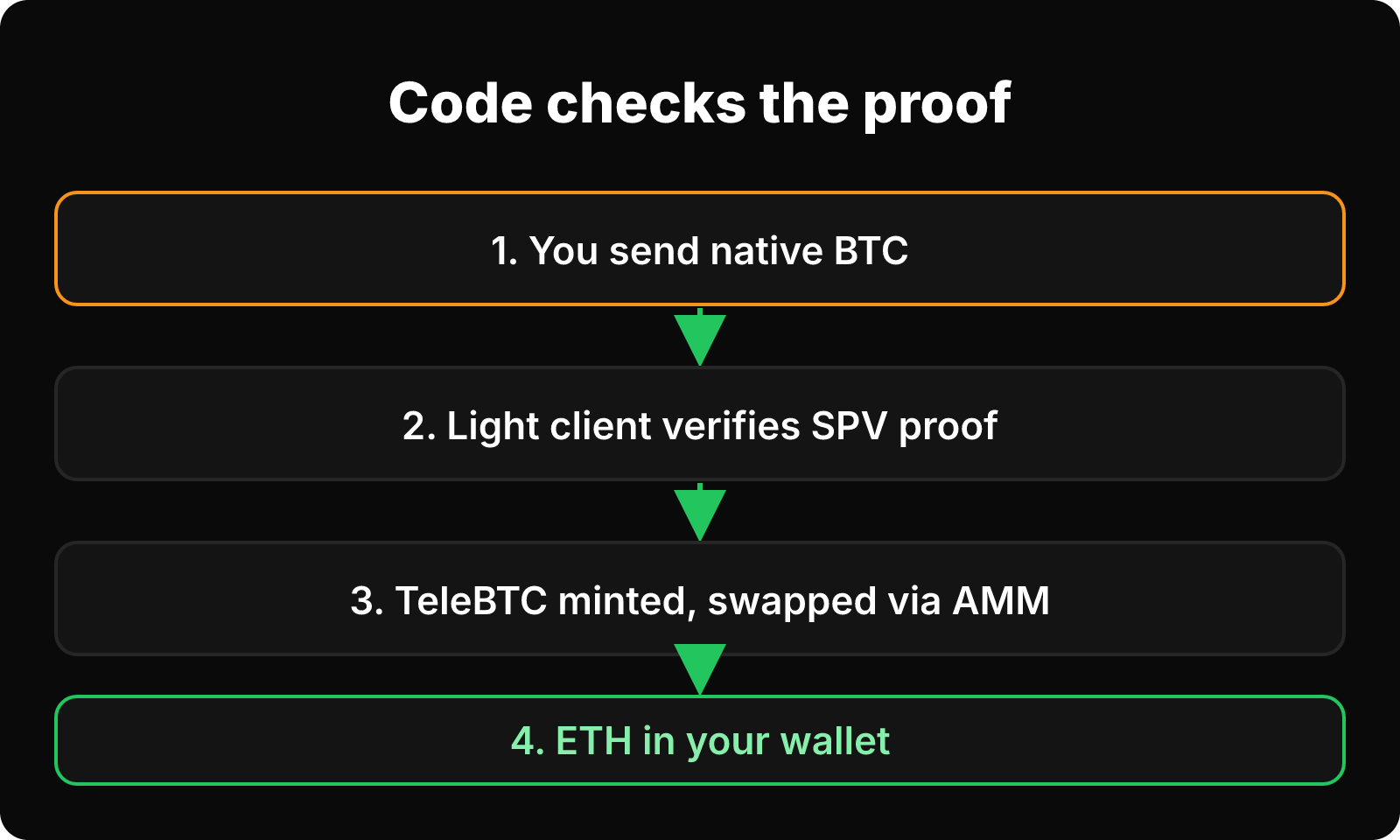
- Code checks the proof. This is the trustless option. A smart contract on the destination chain checks for itself that your Bitcoin transaction happened before it releases anything.
TeleSwap uses the third approach. It runs a Bitcoin light client on the destination chain. A light client is a small program that follows Bitcoin's block headers and can check an SPV proof (Simplified Payment Verification), which is a short cryptographic receipt showing that a transaction is included in a Bitcoin block. Satoshi described SPV in section 8 of the original Bitcoin whitepaper. For more depth, see how Bitcoin bridges work with SPV light clients.
Here's an analogy. A custodial swap is like handing cash to a stranger who promises to post you a check. A trustless swap is like a vending machine that counts your coins itself before it drops the snack.
In practice, when you send BTC through TeleSwap, the light client verifies your Bitcoin transaction. Only after that does the protocol mint TeleBTC, a 1:1 collateral-backed representation of your BTC, and swap it for ETH through an on-chain AMM (automated market maker, a pool-based exchange run by smart contracts). The BTC itself is held by Lockers. These are permissionless operators who post collateral, and that collateral can be slashed if they misbehave. You can find the full design in the TeleSwap documentation.
A nuance most no-KYC guides skip: "no KYC" and "trustless" are different things. Plenty of instant-swap services don't ask for ID at signup but still hold your coins mid-swap. If their compliance policy changes, they could in principle stop your transaction and ask for documents before releasing funds. If you care about privacy, look first at who holds your coins during the swap, and only then at whether there's a signup form. For more on this, see no-KYC Bitcoin trading limits, risks and tax basics.
The Swap BTC to ETH Without KYC Trustless Walkthrough: 6 Steps
We'll use TeleSwap for the walkthrough because it takes native BTC, outputs ETH on Ethereum, and handles the bridge and the swap in one flow.
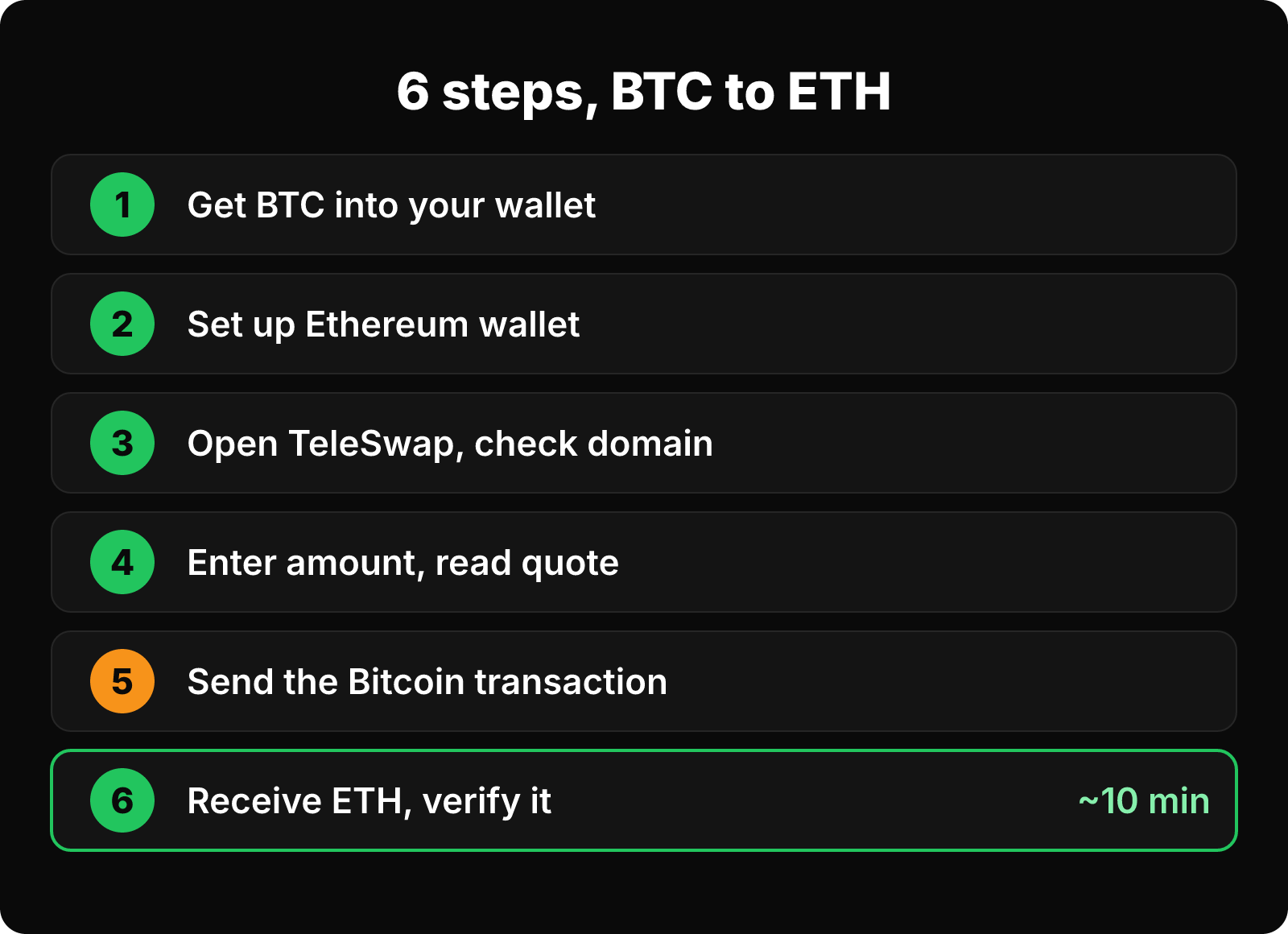
Step 1: Get your BTC into a wallet you control
What you see: Your Bitcoin wallet's main screen showing your balance, plus a "Send" button. If your coins are on an exchange, you'll see the exchange's withdrawal screen asking for a destination address.
What to do: If your BTC is on an exchange, withdraw it to your own Bitcoin wallet first. Don't send directly from an exchange into a swap. Exchanges batch withdrawals, the sending address isn't yours, and if anything needs to come back to you, it won't reach the right place.
Cost: Whatever withdrawal fee the exchange charges. Time: Varies by exchange.
One honest caveat: if you originally bought your BTC on a KYC exchange, that exchange already knows about it. This walkthrough makes sure the swap doesn't add a new identity checkpoint. It can't undo history.
Step 2: Set up your Ethereum wallet
What you see: MetaMask or Trust Wallet asking you to create a new wallet and showing a recovery phrase.
What to do: Write the phrase on paper and store it offline. Never type it into a website. Then copy your Ethereum address, the string starting with 0x.
Cost: Free. Time: About 5 minutes. You don't need to buy any ETH for gas, and Step 6 explains why.
Step 3: Open TeleSwap and check the domain
What you see: A swap form with a "From" field (BTC on Bitcoin) and a "To" field, where you select ETH on Ethereum.
What to do: Type teleswap.xyz into your address bar yourself rather than clicking a search ad. Phishing sites that copy swap interfaces are common. Then go straight to the BTC to ETH route. If you want lower costs on the Ethereum side, the same flow also works for ETH on layer-2 networks, for example BTC to ETH on Arbitrum.
Cost: Free. Time: 1 minute.
Step 4: Enter your amount and read the quote
What you see: Once you type a BTC amount, the interface shows a quote: the estimated ETH you'll receive, the fees, and a field for your destination address.
What to do: Paste your 0x address and compare the first and last six characters with your wallet. Some clipboard malware swaps addresses silently, and a Bitcoin or Ethereum transaction can't be reversed. Then read the quote line by line. The ETH amount is an estimate, because the AMM price can move slightly between quoting and settlement.
Cost: Fees are paid in Bitcoin assets and shown in the quote before you commit. Nothing is charged at this stage. Time: 2 minutes.
Step 5: Send the Bitcoin transaction
What you see: A confirmation prompt with the exact BTC amount and transaction details. Your Bitcoin wallet then asks you to approve the send and choose a network fee.
What to do: Follow the interface's prompt to send from your self-custody wallet, and send the exact amount shown. Pick a network fee that will confirm reasonably fast. You can check current rates on mempool.space.
Cost: The Bitcoin network fee, which goes to miners, not TeleSwap. Time: The swap starts once your transaction confirms. Bitcoin produces a block roughly every 10 minutes on average.
Step 6: Receive your ETH and verify it
What you see: The TeleSwap interface moves through statuses as your Bitcoin transaction is verified, TeleBTC is minted, and the swap to ETH runs. Then your Ethereum wallet balance goes up.
What to do: Open your wallet and make sure it's set to the network you picked (Ethereum mainnet for this route). To double-check, paste your address into Etherscan and you'll see the incoming transfer.
Cost: Nothing extra. A Teleporter, one of TeleSwap's permissionless protocol roles, covers the destination-chain gas, and you pay fees in Bitcoin assets. This fixes the usual "I need ETH to get ETH" problem. Time: Fast swaps settle in about 10 minutes.
How Much Does It Cost and How Long Does It Take?
Here's the whole route on one page. Timings are typical, not guaranteed, because Bitcoin block times vary.
| Step | What you pay | Who receives it | Typical time |
|---|---|---|---|
| 1. Exchange withdrawal (if needed) | Exchange withdrawal fee | Exchange | Varies |
| 2. Ethereum wallet setup | Free | — | ~5 min |
| 3. Open TeleSwap | Free | — | ~1 min |
| 4. Quote review | Nothing yet (fees shown upfront) | — | ~2 min |
| 5. Send BTC | Bitcoin network fee | Bitcoin miners | Until first confirmation |
| 6. Receive ETH | Fees paid in Bitcoin assets (gas covered by Teleporter) | Protocol roles and liquidity pool | ~10 min for fast swaps |
For a reference point from another service: on 6 October 2026, Symbiosis quoted 0.3758 ETH for 0.012 BTC, with $11.67 in combined fees and gas and about 560 seconds estimated. Prices change by the minute, so the only quote that counts is the live one on your screen.
The most expensive mistake in a BTC to ETH swap is rarely the fee. It's sending to the wrong network, or setting a Bitcoin fee so low that the transaction sits in the mempool (Bitcoin's waiting room for unconfirmed transactions) for hours.
Ways to Swap BTC to ETH Without KYC: 6 Routes Compared
TeleSwap isn't the only way to swap BTC to ETH without KYC. Here's how the main routes compare on who holds funds mid-swap and whether you need ID.
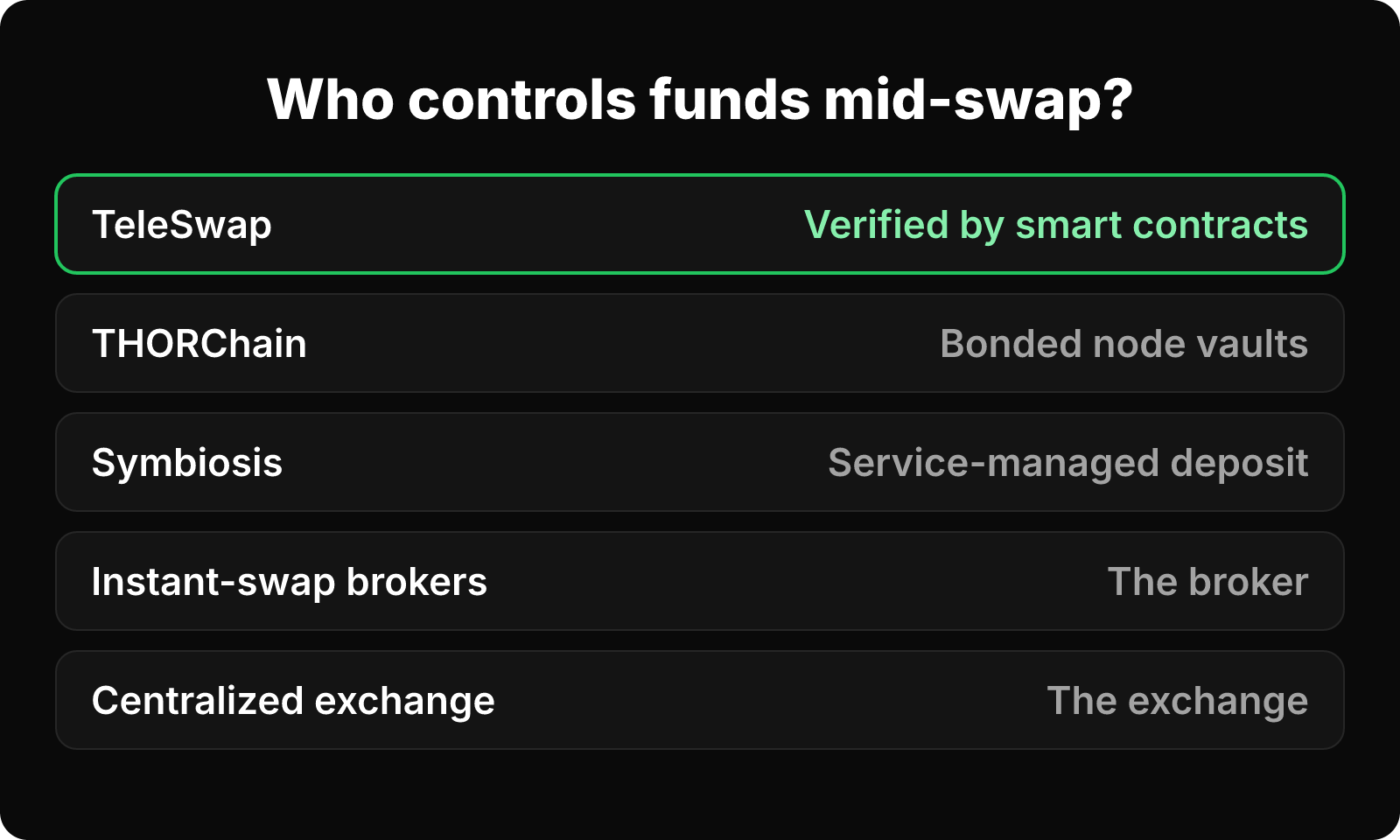
| Route | Native BTC in? | Who controls funds mid-swap | Account / ID? | Need ETH for gas? | Typical time |
|---|---|---|---|---|---|
| TeleSwap | Yes | Smart contracts verifying SPV proofs; BTC held by collateralized, slashable Lockers | No account | No (Teleporter pays) | ~10 min (fast swaps) |
| THORChain | Yes | Vaults run by bonded node operators | No account | No | Varies |
| Symbiosis (BTC route) | Yes | Service-managed deposit flow until settlement | No account; refund address required | No | ~9 min median, 90% within 29 min (90 days to 29 Sep 2026, per Symbiosis) |
| Instant-swap brokers (e.g. ChangeNOW, SimpleSwap) | Yes | The broker | Usually none at signup; policies can change | No | Minutes to hours |
| P2P markets (e.g. Bisq) | Yes | Escrow with security deposits | No | No | Slower; depends on finding a counterparty |
| Centralized exchange | Yes | The exchange | Full KYC required | No | Depends on account approval and withdrawals |
Each route makes a different tradeoff. P2P markets give strong privacy but lower liquidity and longer trade times. Brokers are fast and cover many coins but ask you to trust an operator. THORChain is a non-custodial design built on an economic security model. TeleSwap's approach is that nothing is minted until a Bitcoin transaction has been cryptographically verified by a light client, rather than trusting a set of signers. For head-to-head views, see Chainflip vs TeleSwap.
TeleSwap has processed $538.3M in total volume across 570,135 transactions on 13 supported networks, with $40.1M in the last 30 days (about $1.3M a day, peaking at $2.1M on 2026-10-08), according to TeleSwap network stats retrieved on 2026-10-31. These figures are live, so check the dashboard yourself.
You can also reach TeleSwap from apps you might already use. It's integrated as a Bitcoin swap provider in the Rango, Rubic, and DZap aggregators, and through the Rango integration it's available inside MetaMask and Trust Wallet.
Common Problems and How to Fix Them
These are the issues beginners run into most often, and what to do about each one.
- "My Bitcoin transaction is stuck unconfirmed." The fee was too low for current demand. If your wallet supports Replace-By-Fee (RBF), use it to raise the fee. If not, a CPFP (Child-Pays-For-Parent) transaction can push it through. Look up your transaction ID on mempool.space.
- "I don't see ETH in my wallet." Your wallet is probably showing a different network. Switch MetaMask to Ethereum mainnet, or to whichever network you picked, such as Arbitrum. Then check your address on a block explorer.
- "I sent from an exchange." Exchange withdrawals come from addresses you don't control. Check the transaction status in the TeleSwap interface and the TeleSwap documentation. Next time, route through your own wallet first (Step 1).
- "The ETH I received is a bit less than the quote." That's slippage, meaning the AMM price moved between your quote and settlement. It matters most on larger swaps, where splitting into smaller swaps can reduce price impact.
- "The fees ate most of my swap." Bitcoin network fees don't shrink with the amount you send, so tiny swaps are costly in percentage terms. Check the quote, and if fees are too high relative to your amount, swap more or wait for a quieter mempool.
- "It's taking longer than 10 minutes." Bitcoin blocks arrive at random intervals that average out to 10 minutes, so a slow block is normal. Once your transaction confirms, the rest of the flow continues automatically.
- "I'm not sure the site is real." Close the tab and type
teleswap.xyzby hand. TeleSwap's documentation lives atteleswap.xyz/docs. Any URL that looks slightly off is a red flag.
A note on rules: "no KYC" doesn't mean "no rules." Tax and reporting obligations depend on where you live and apply no matter which route you use. Nothing here is legal or financial advice.
Frequently Asked Questions
Can I swap BTC to ETH without KYC?
Yes. Non-custodial protocols let you swap native BTC to ETH without creating an account or submitting ID. With TeleSwap you send Bitcoin from your own wallet and receive ETH in your own Ethereum wallet. The swap is enforced by smart contracts that verify your Bitcoin transaction.
What makes a BTC to ETH swap "trustless"?
A swap is trustless when code verifies each step instead of a person or company holding your funds. TeleSwap runs a Bitcoin light client on the destination chain that checks SPV proofs of your Bitcoin transaction. TeleBTC is minted only after that check passes, and it's then swapped to ETH on-chain.
Do I need ETH to pay gas when swapping BTC to ETH?
No, not on TeleSwap. A Teleporter, one of the protocol's permissionless roles, covers destination-chain gas, and you pay fees in Bitcoin assets. That means a brand-new, empty Ethereum wallet can receive ETH.
How long does a native BTC to ETH swap take?
Fast swaps on TeleSwap settle in about 10 minutes. Bitcoin blocks average 10 minutes but vary, and a very low Bitcoin network fee can add delay, so pick a fee that matches current mempool conditions.
Is TeleBTC the same as WBTC?
No. TeleBTC is a trust-minimized alternative to WBTC, which relies on a custodian. TeleBTC is a 1:1 collateral-backed representation of BTC, minted only after a light client verifies the Bitcoin deposit. It doesn't rely on a central custodian or a multi-sig committee.
Which networks can I receive ETH on with TeleSwap?
TeleSwap has BTC to ETH routes on Ethereum as well as layer-2 networks such as Arbitrum, Base, and Optimism. Overall, TeleSwap supports 13 networks according to TeleSwap network stats.
Can I swap ETH back to BTC the same way?
Yes, the route works in reverse. TeleSwap's ETH to BTC route converts ETH on Ethereum back to native BTC, delivered to the Bitcoin address you provide.
Conclusion: Your Next Step
You don't need an exchange account or an ID upload to get from BTC to ETH. Hold your BTC in your own wallet, set up an Ethereum wallet, and let a protocol that verifies Bitcoin transactions cryptographically handle the rest.
- Choose routes based on who controls your coins mid-swap, not just whether there's a signup form.
- TeleSwap mints TeleBTC only after a light client verifies your Bitcoin transaction, then swaps it to ETH. Fast swaps finish in about 10 minutes, with gas covered.
- Most failed swaps come from avoidable user errors: sending from an exchange, picking the wrong network, or setting a Bitcoin fee too low.
Start with a small amount, check that the ETH arrives, and then scale up.