5-Minute Bitcoin Prediction Markets: A Polymarket Guide (2026)


Polymarket's 5-minute crypto predictions are tiny yes-or-no markets on one question: will Bitcoin's price be higher or lower five minutes from now? You buy an "Up" share or a "Down" share. When the window closes, each winning share pays $1 and each losing share pays nothing. Then a new window opens. That is the whole product, and it is why 5-minute bitcoin prediction markets went from launch in February 2026 to a reported $60 million in daily volume about a month later.
The more useful question for a beginner is what you are actually buying when you click "Up," who is on the other side of the trade, and why the format is harder to win than it looks. This guide covers all three without assuming you know any crypto jargon.
Key Takeaways:Polymarket's 5-minute Bitcoin markets are binary contracts that pay $1 per share if BTC finishes the window higher (or lower) than where it started, and $0 if it doesn't.Polymarket launched its Bitcoin 5-minute prediction market in February 2026, according to CryptoRank.By March 2026, Polymarket's five-minute crypto markets were reportedly doing about $60M in daily volume, as reported by BitcoinWorld via CoinMarketCap.A share's price, between $0 and $1, works as the market's estimate of the probability that the outcome happens.A study reported by Bitcoin Foundation found the 5-minute window makes the settlement moment predictable enough to invite manipulation, and that 15-minute windows almost entirely remove the effect.
Table of Contents
- What Is a Prediction Market, in Plain English?
- How Do Short-Term Crypto Prediction Markets Work?
- How Much Can You Win or Lose? The Payout Math
- Why Did Polymarket's Bitcoin 5-Minute Markets Take Off?
- Prediction Markets vs Crypto Derivatives: What's the Difference?
- What Are the Risks of 5-Minute Bitcoin Prediction Markets?
- What Can You Actually Do With This?
- Frequently Asked Questions
- Conclusion
What Is a Prediction Market, in Plain English?
A prediction market is a marketplace where people buy and sell shares in the outcome of a future event. If the event happens, the share pays out. If it doesn't, the share is worth nothing.
Think of a county fair where people guess the weight of a prize pig. Now imagine each guess has a price tag and you can trade your guess with a stranger before the pig gets weighed. The prices people pay tell you what the crowd collectively believes. That is a prediction market.
Polymarket is a crypto-native one. It runs markets on elections, sports, economic data, and, since early 2026, very short-term crypto prices. Trades are recorded on a blockchain, which is a shared public ledger nobody can quietly edit. Positions are paid in USDC, a stablecoin, meaning a crypto token designed to stay worth $1.
The one idea to hold on to: every share is priced between $0 and $1, and the price reads as a probability. If "Up" trades at $0.55, the market as a whole thinks there is roughly a 55% chance Bitcoin finishes the window higher.
How Do Short-Term Crypto Prediction Markets Work?
Short-term crypto prediction markets open on a fixed schedule, lock in a starting price, and settle automatically against a price feed when the clock runs out. Polymarket's Bitcoin 5-minute markets repeat this all day: 24 hours × 60 minutes ÷ 5 = 288 separate markets every day.
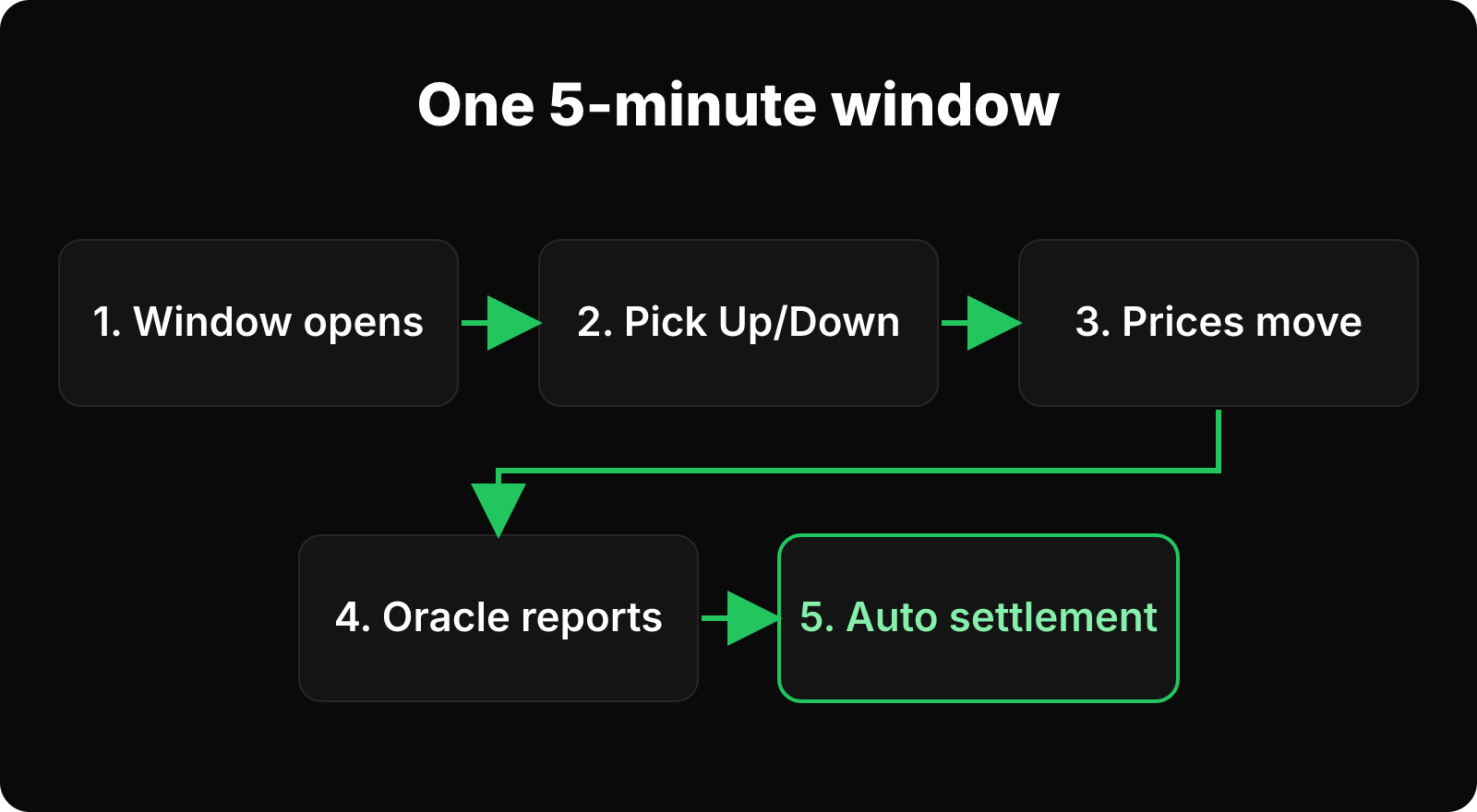
The lifecycle of one 5-minute window
- The window opens. A new market appears for, say, 14:00–14:05. Bitcoin's price at the start becomes the reference level.
- Traders pick a side. You buy "Up" shares if you think BTC will finish above the reference, or "Down" shares if you think it will finish below.
- Prices move as people trade. If Bitcoin jumps in the first two minutes, "Up" shares get more expensive because the outcome looks more likely. You can sell before the close to lock in a gain or cut a loss.
- The window closes. An oracle, which is a service that brings outside data like asset prices onto the blockchain, reports Bitcoin's price at the end of the window. Some coverage points to Chainlink price feeds as the source, but check each market's resolution rules for the exact one.
- Settlement happens automatically. Winning shares become redeemable for $1 USDC each. Losing shares go to zero. The next window is already running.
Who is on the other side of your trade?
This is the part most beginners get wrong. Polymarket is not the house. It runs an order book, which is a list of open buy and sell offers, and matches you with other traders. If you buy "Up" at $0.52, someone else is effectively taking "Down" at $0.48. Together the two sides fund the $1 payout.
That has a direct consequence. Your profit is another trader's loss, minus any fees. In 5-minute markets, many of those other traders are likely automated bots, which is why speed matters (more on that below).
What about the 15-minute version?
Polymarket also lists 15-minute crypto contracts. Turnover across the 5- and 15-minute BTC markets reached up to $60M a day, according to GuruFocus via Yahoo Finance, which cited user-compiled Dune Analytics data. The mechanics are the same. The window is just three times longer, and as the risks section explains, that longer window matters.
How Much Can You Win or Lose? The Payout Math
Your maximum loss is what you paid for your shares, and your maximum gain is $1 per share minus what you paid. There is no leverage and no margin call. Here is a worked example.
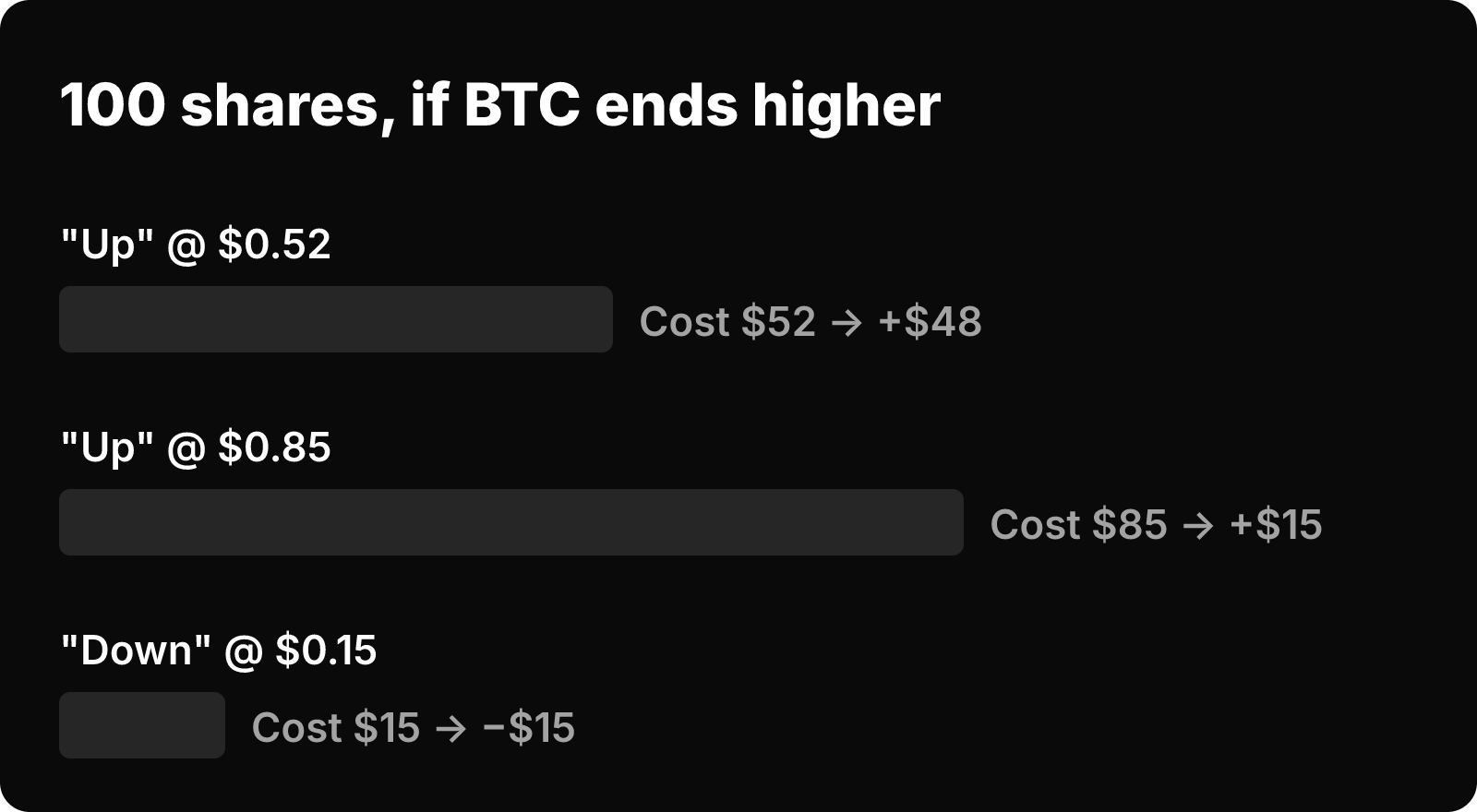
| Scenario | You buy | Cost | If BTC ends higher | If BTC ends lower |
|---|---|---|---|---|
| Near coin-flip odds | 100 "Up" @ $0.52 | $52 | Receive $100 → +$48 | Receive $0 → −$52 |
| Strong favorite | 100 "Up" @ $0.85 | $85 | Receive $100 → +$15 | Receive $0 → −$85 |
| Long shot | 100 "Down" @ $0.15 | $15 | Receive $0 → −$15 | Receive $100 → +$85 |
Look at the first row. Paying $0.52 for a payout of $1 means you need to be right more than 52% of the time just to break even before fees. The price you pay is your break-even win rate.
Over a window this short, price moves are mostly noise: order flow, a big trade on one exchange, a liquidation somewhere. Windows tend to be priced near 50/50 at the open. So the question isn't "Do I think Bitcoin will go up?" It's "Do I know something about the next 300 seconds that the other traders don't?" For most people, the honest answer is no.
Rule of thumb: Share price = break-even probability. Buy at $0.60 and you need to win 6 out of every 10 times, plus enough to cover fees, just to stay flat.
Why Did Polymarket's Bitcoin 5-Minute Markets Take Off?
The markets took off because they resolve fast, cost little to enter, and repeat constantly, which creates a steady loop of activity that long-dated markets can't match. The timeline shows how quickly it happened.
- February 12, 2026: Polymarket launches its Bitcoin 5-minute market, per CryptoRank.
- March 11, 2026: Five-minute crypto markets reportedly reach about $60M in daily volume, according to BitcoinWorld.
- March 16, 2026: Fortune calls 5-minute Bitcoin swing bets "the hot new thing on prediction markets."
For context, Polymarket's longer-dated daily crypto markets often generate less than $1M a day, according to GuruFocus. A product that resolves 288 times a day recycles the same dollars far more often than one that resolves once.
That's why the volume figure needs careful reading. High volume in a 5-minute market doesn't mean a large amount of money at risk. A trader with $500 who plays every window for an hour has "generated" $6,000 of volume while never risking more than $500. Much of the reporting also traces back to a single BitcoinWorld article syndicated across aggregators, so treat the $60M as one reported figure, not several independent confirmations.
Prediction Markets vs Crypto Derivatives: What's the Difference?
A prediction market gives you a fixed, capped payout on a yes-or-no question, while crypto derivatives like perpetual futures and options give you exposure that grows or shrinks with every dollar the price moves. A derivative is just a contract whose value comes from another asset, in this case Bitcoin.
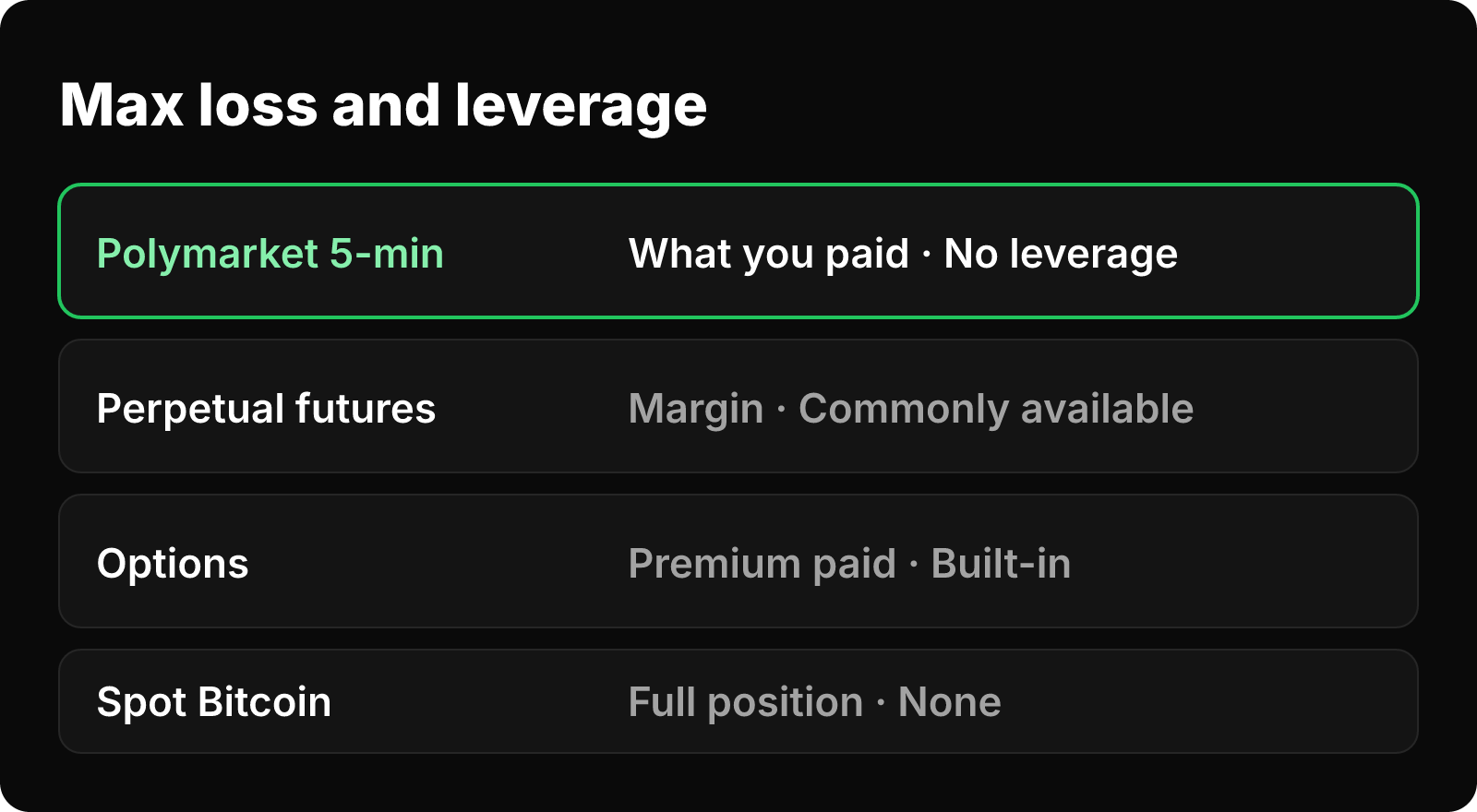
A 5-minute prediction market is like betting on whether a coin lands heads. A perpetual future is like owning a slice of the coin's value that you can multiply with borrowed money. The first has a known worst case. The second can wipe you out fast if you use leverage.
| Feature | Polymarket 5-min market | Perpetual futures | Options | Spot Bitcoin |
|---|---|---|---|---|
| What you're betting on | Higher or lower at a set time | Price direction, continuously | Price above/below a strike by expiry | Owning the asset |
| Payout shape | Fixed: $1 or $0 per share | Linear, scaled by leverage | Non-linear | Linear, 1:1 |
| Max loss | What you paid | Your margin (can be liquidated) | Premium paid (if buying) | Your full position |
| Leverage | None | Commonly available | Built-in | None |
| Time horizon | 5 minutes (15-min variant exists) | No expiry | Hours to months | Unlimited |
| Settlement | Oracle price at window close | Mark price + funding payments | Index price at expiry | Immediate |
| Main beginner pitfall | Treating noise as signal | Liquidation from leverage | Misreading time decay | Volatility |
The 5-minute prediction market sits closest to a binary option, a contract that pays a fixed amount if a condition is met. The difference is the wrapper. It runs on a public blockchain, settles against an oracle, and lets anyone with USDC take either side.
The capped downside is real, but "capped" isn't the same as "safe." Losing $20 in each of 288 windows adds up to $5,760 in a day. Frequency is the risk multiplier that a per-bet cap hides.
What Are the Risks of 5-Minute Bitcoin Prediction Markets?
The biggest risks are settlement manipulation, competing against faster automated traders, oracle dependency, smart contract risk, and regulatory uncertainty. Here are all five.
1. Predictable settlement invites manipulation
A study reported by Bitcoin Foundation found that the short 5-minute window makes the settlement moment predictable, which opens the door to manipulating Bitcoin's price right around the close. The authors stress that prediction markets aren't inherently vulnerable. The problem is the timing. Their findings suggest that extending contracts to 15 minutes almost entirely eliminates the effect, and that settling on a time-weighted average price (TWAP), an average of prices over a period instead of one snapshot, could reduce the risk further.
2. You may be trading against faster bots
A 5-minute market is less a test of your view on Bitcoin than of speed and data access. Automated traders watching live order books can update quotes in milliseconds, while a person looking at a phone app is slower. The edge in these markets plausibly goes to infrastructure rather than insight.
3. Oracle dependency
Settlement depends on the price feed being accurate and on time. If an oracle reports late or wrong, the outcome can resolve differently from what you saw on your exchange of choice. Before trading, read the market's resolution rules to see exactly which price source and timestamp it uses.
4. Smart contract risk
Smart contracts are programs that run on a blockchain and handle the money automatically. Like all software, they can contain bugs. The sources reviewed for this article cite no specific incidents in Polymarket's 5-minute markets, but the risk exists for any on-chain product.
5. Regulatory uncertainty
Several US states have sued Kalshi and Polymarket over alleged unlicensed sports betting. The CFTC argues that federally regulated event contracts fall under its exclusive jurisdiction, and conflicting appellate rulings could send the question to the US Supreme Court, according to Bitcoin Foundation's reporting. Whether crypto-price contracts will face the same challenges is still unresolved. Access also varies by country, so check whether Polymarket is available where you live.
What Can You Actually Do With This?
The most valuable thing most readers can do with 5-minute markets is watch them, not trade them. Here are four practical ways to use them.
- Use them as a sentiment gauge. Watching how "Up" prices move during big news, such as an inflation print or a large liquidation, shows how quickly the market absorbs information.
- Learn probability pricing with small stakes. If you do trade, the $0–$1 format is a clear way to internalize that price equals implied probability. Set a hard budget before you start and stick to it.
- Read the resolution rules first. Check the oracle source, the exact start and end timestamps, and the current fee schedule before placing anything.
- Prefer the 15-minute variant if you're curious. Based on the manipulation study, longer windows are much less exposed to settlement gaming.
Getting USDC on Polygon if you hold Bitcoin
Sources describe Polymarket positions as funded with USDC on Polygon, a lower-cost network that runs alongside Ethereum, so confirm the funding network in Polymarket's own docs. If your crypto sits in Bitcoin, you have to move value across chains first. TeleSwap, a Bitcoin bridge that verifies every BTC transaction with SPV light client proofs, lets you go from native BTC to USDC on Polygon in a single step, with fees paid in Bitcoin assets and fast swaps settling in about 10 minutes. It has handled 568,493 bridge transactions and $536.9M in total volume across 13 networks, per TeleSwap network stats. The reverse route, USDC on Polygon back to BTC, works the same way when you want to exit. To understand the verification model, see how Bitcoin bridges work with SPV light clients, and for a walkthrough of this route read Swap BTC to Stablecoin on Polygon.
Frequently Asked Questions
What are Polymarket's 5-minute Bitcoin markets?
They are binary markets that ask whether Bitcoin's price will be higher or lower at the end of a five-minute window than at the start. Winning shares pay $1 in USDC and losing shares pay $0. A new market opens every five minutes, which works out to 288 a day.
How do short-term crypto prediction markets work?
They lock a starting price, let traders buy "Up" or "Down" shares priced between $0 and $1, and settle automatically using an oracle price when the window closes. Traders are matched with one another through an order book, so Polymarket isn't betting against you. You can also sell your shares before the window ends.
How much money can you lose on a 5-minute Bitcoin prediction?
On any single market, you can lose at most what you paid for your shares. There's no leverage or liquidation. Because markets repeat 288 times a day, though, total losses can grow quickly if you trade window after window.
How are prediction markets different from crypto derivatives?
Prediction markets pay a fixed amount on a yes-or-no outcome, while derivatives like perpetual futures give exposure that scales with every price move and often involve leverage. A 5-minute prediction market behaves much like a binary option. Your downside is capped at your stake, while a leveraged futures position can be liquidated.
Can 5-minute Bitcoin prediction markets be manipulated?
A study reported by Bitcoin Foundation found that the 5-minute window makes settlement predictable enough to allow Bitcoin price manipulation. The same study found that 15-minute contracts almost entirely eliminate the effect, and that TWAP-based settlement could reduce the risk further.
What does the share price mean in a prediction market?
The share price is the market's implied probability that the outcome happens. An "Up" share at $0.55 means traders collectively see about a 55% chance Bitcoin finishes higher. It's also your break-even win rate before fees.
What currency do Polymarket's crypto prediction markets use?
Polymarket markets are funded and settled in USDC, a dollar-pegged stablecoin. If you hold Bitcoin, you have to convert it to USDC on the network Polymarket uses before you can take a position.
Conclusion
Five-minute Bitcoin prediction markets are one of the simplest trading products in crypto to understand: a $0-to-$1 share, two outcomes, and a five-minute clock. The catches are real, though. The share price is your break-even win rate, most moves in so short a window are noise, and researchers report the fixed settlement moment can be gamed.
Three things are worth remembering. Price equals probability. A capped loss per bet isn't capped across 288 bets a day. And the 15-minute format is structurally more robust than the 5-minute one.
If you want to explore prediction markets and your funds are in Bitcoin, you can bridge and swap native BTC into USDC on Polygon, and back again, at teleswap.xyz.