Private Key Hack Crypto Bridge Attacks: How They Work (2026)

On April 1, 2026, an attacker who had spent months working toward an admin key at Drift Protocol emptied roughly $285M in 128 seconds, according to CryptoTicker's incident summary. The code didn't fail. A valid signature from a valid key did exactly what the contract was built to allow.
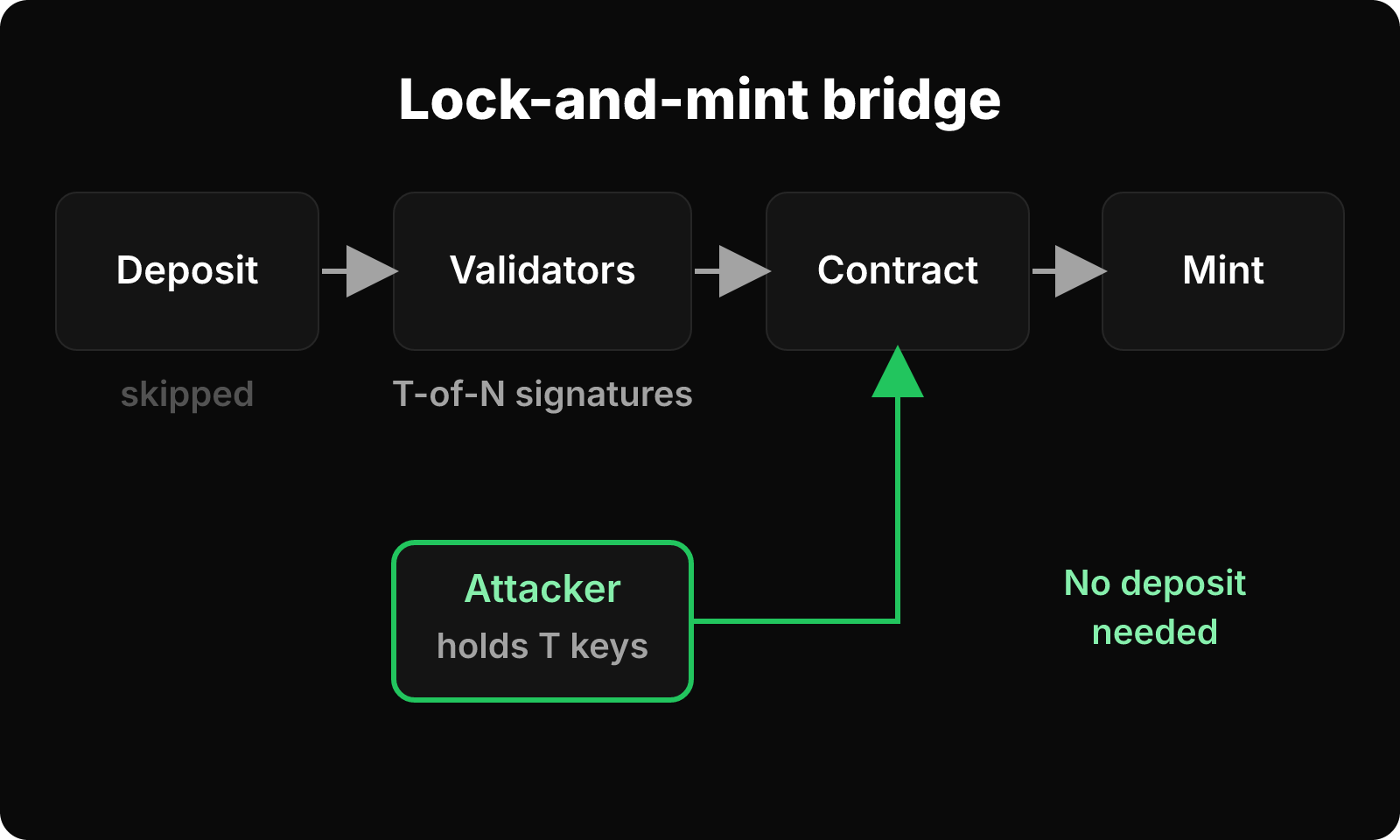
That's how a private key hack crypto bridge attack works: the attacker gets the keys a bridge trusts, signs withdrawals that have no real deposit behind them, and the contract pays. Roughly 40% of the ~$16.69B lost to crypto hacks traces to stolen private keys rather than smart-contract bugs, CoinDesk reported in June 2026. Bridges are prime targets because they combine big pooled balances, authority to release funds on one chain based on claims about another, and a small set of keys that hold that authority.
This deep-dive covers what a signature actually proves, how bridge verification is built, the five attack patterns we keep seeing, and a framework for judging any bridge's exposure before you send it money.
Key Takeaways:About 40% of the ~$16.69B in cumulative crypto hack losses came from stolen private keys, not smart-contract flaws, per CoinDesk (June 2026).QuillAudits traced 82.7% of the $935.3M lost across 87 DeFi incidents in H1 2026 to private-key compromise or bridge verification failure.The 2022 Ronin hack needed only 5 of 9 validator keys, and one operator controlled 4 of those 5 directly plus a 5th through a delegation nobody revoked.A multisig is exactly as strong as how its keys are spread across operators, devices, and organizations; the signature scheme itself is almost never what breaks.Bridges that check source-chain proofs (such as SPV light clients for Bitcoin) take signing keys out of the mint path, so no key set can authorize minting without a real deposit.
Table of Contents
- What Does a Private Key Actually Authorize on a Bridge?
- How Do Crypto Bridge Hacks Happen? Five Attack Patterns
- Which Bridge Hacks Were Private-Key Compromises?
- How Do Attackers Steal Bridge Keys in the First Place?
- The Key Blast Radius Framework for Bridge Security
- How Does Trustless Bitcoin Bridge Security Remove the Key?
- How Can Bridge Teams Prevent Private Key Compromise?
- How Can Users Prevent Crypto Wallet Private Key Theft?
- Frequently Asked Questions
- Conclusion
What Does a Private Key Actually Authorize on a Bridge?
A private key authorizes whatever the contract trusts its signature to mean, and nothing tells the contract whether the person signing is the intended owner. Bitcoin and every EVM chain use ECDSA over the secp256k1 curve. A private key is a 256-bit integer d. The public key is the curve point Q = d·G, where G is the curve's fixed generator point. Getting d back from Q means solving the elliptic-curve discrete logarithm problem, which can't be done with current computers.
That math is solid. In bridge hacks, it's almost never what fails.
To sign, the holder picks a nonce k, computes R = k·G, takes r as R's x-coordinate, and outputs s = k⁻¹(z + r·d) mod n, where z is the message hash. On Ethereum, the ecrecover precompile takes (z, v, r, s) and returns the 20-byte address that must have signed. The contract compares that address to its stored list of validators. If it matches, the message is treated as authentic.
That check establishes only that someone holding d signed z. It says nothing about whether a deposit happened on the source chain. In a committee-based bridge, the validators' signature is the only evidence the destination contract ever sees.
The multisig verification loop
A typical lock-and-mint bridge (lock assets on the source chain, mint a wrapped version on the destination) checks withdrawals with logic like this:
function withdraw(Withdrawal calldata w, Sig[] calldata sigs) external {
    bytes32 digest = _hashTypedData(w);          // EIP-712 digest
    require(!processed[digest], "replay");
    uint256 valid; address last;
    for (uint i; i < sigs.length; i++) {
        address s = ecrecover(digest, sigs[i].v, sigs[i].r, sigs[i].s);
        require(s > last && isValidator[s], "bad sig"); // sorted, unique
        last = s; valid++;
    }
    require(valid >= threshold, "quorum");
    processed[digest] = true;
    token.transfer(w.recipient, w.amount);       // or mint()
}
Each line guards against something real: replay, duplicate signers, unknown signers. None of them guards against the honest-majority assumption being false. Once an attacker holds threshold keys, they can build any Withdrawal struct they like and the contract will pay it.
How Do Crypto Bridge Hacks Happen? Five Attack Patterns
Crypto bridge hacks happen when an attacker gets the destination chain to release or mint assets with no matching deposit on the source chain. Merkle Science describes the common outcome as tokens "released on one blockchain without a corresponding deposit on the other." Getting there takes one of five routes:
- Threshold key compromise. The attacker gets k ≥ T validator keys and signs fake withdrawals. Examples: Ronin (2022), Harmony Horizon (2022), and AFX Bridge, where compromised validator hot keys reached quorum and ~$24.15M USDC was drained, per SlowMist's bridge incident database.
- Admin key takeover. The attacker skips the validator set and takes the key that can upgrade the contract, change the validator set, or sweep funds. Drift (April 2026) fits here: months of escalation, then a drain in seconds. Our Drift hack explainer covers it in more depth.
- Forged cross-chain messages. The attacker builds a message that passes verification without holding keys. Taiko's ERC20 Vault bridge lost ~$1.7M in June 2026 after forged SGX attestations registered a malicious prover. SlowMist logs it as "Private Key Leakage," but the description points to an attestation compromise, and the full post-mortem was still pending.
- Verification-logic flaws. The keys are honest but are fed bad inputs. On the Coreum–XRPL bridge (August 9, 2026), fake self-transfer deposits carrying valid memos fooled relayers into authorizing withdrawals across 94 multisig transactions over 97 minutes, about 200,000 XRP in total, per SlowMist.
- Privilege reassignment. The attacker uses a code path to replace the trusted key set with their own. In Poly Network (2021), the attacker brute-forced a string whose 32-bit method selector collided with the keeper-update function, then routed a call through
verifyHeaderAndExecuteTxto reassign the keeper role, as HackenProof's breakdown documents.
Patterns 1, 2 and 5 all end with the attacker holding a key the contract trusts. Patterns 3 and 4 exploit flawed verification or trick honest keys into signing. In every case, the bridge relied on a signature standing in for a fact. For a wider incident list, see Biggest Crypto Bridge Hacks: What Went Wrong.
Which Bridge Hacks Were Private-Key Compromises?
The biggest bridge losses on record cluster around key compromise and verification failure. The table below covers the incidents with the clearest public records.
| Incident | Date | Approx. loss | Trust model | Root cause |
|---|---|---|---|---|
| Poly Network | 2021 | Not stated in our sources | Keeper key set | Keeper reassignment via selector collision |
| Wormhole | 2022 | ~$320M | Guardian signatures | Signature-verification exploit |
| Ronin | Mar 2022 | 173,600 ETH + 25.5M USDC (~$526M–$624M depending on ETH price) | 5-of-9 validators | 5 validator keys compromised |
| Harmony Horizon | Jun 2022 | ~$100M | Validator keys | Validator private keys compromised |
| Nomad | 2022 | ~$190M | Optimistic messaging | Not detailed here |
| Drift Protocol | Apr 1, 2026 | ~$285M | Admin key | Admin key reached over months; 128-second drain |
| Taiko ERC20 Vault | Jun 21–22, 2026 | ~$1.7M | SGX attestation | Forged attestations registered malicious prover |
| Coreum–XRPL | Aug 9, 2026 | ~200,000 XRP | Relayer multisig | Fake deposits accepted by relayers |
Sources: arXiv bridge-security survey, HackenProof, SlowMist, CryptoTicker. Loss figures differ between trackers because they use different token prices.
Ronin: how a 9-validator set came down to 2 operators
On paper, Ronin needed 5 of 9 validators. In practice, Sky Mavis controlled 4 of them. In November 2021, Axie DAO had delegated signing to Sky Mavis, and that delegation was never revoked. The attacker took the 4 Sky Mavis keys and used the stale delegation to obtain a 5th signature, per HackenProof. Two transactions forged the withdrawals.
The takeaway: 5-of-9 only means something if the 9 keys are independent. Ronin's real threshold was "1 compromised company plus 1 forgotten permission."
Harmony: validator keys compromised
Harmony's Horizon bridge lost about $100M in June 2022 after bridge validator private keys were compromised, per the sources above. The lesson is the same: when a small set of keys controls the vault, one good phishing campaign or one misconfigured server can be enough.
How Do Attackers Steal Bridge Keys in the First Place?
Attackers rarely break cryptography to get bridge keys. They break the people, machines, and processes around the keys. Merkle Science notes that attacks on network design are "frequently accomplished through social engineering." The extraction methods we see most often:
- Targeted social engineering. Fake job offers, booby-trapped files, or "partner" messages sent to engineers with production access. Actors linked to North Korea's TraderTraitor/Lazarus cluster have been tied to at least $575M in 2026, including Drift and KelpDAO, per crypto.news figures relayed by CryptoTicker. That attribution is not independently confirmed.
- Hot keys on networked servers. A validator that signs automatically has to keep its key reachable by software. Once an attacker has code execution on that host, they can read the key or simply ask the signer to sign.
- Weak key generation. The arXiv bridge-security survey warns against vanity-address tools like Profanity "without a thorough examination of the code," since weak tooling can undermine any admin key created with it.
- ECDSA nonce reuse or bias. If two signatures share a nonce k, the private key can be recovered with simple algebra. Even a slightly biased k can leak d through lattice attacks over many signatures. That's why RFC 6979 deterministic nonces exist, and why a custom signing service is a liability.
- Insiders and stale permissions. Ex-employees, contractors, and delegations nobody remembers. Humanity Protocol's $30–32M loss in June 2026 involved a stolen private key, and ZachXBT raised possible insider involvement, according to altFINS. That remains unconfirmed.
Drift's attacker spent months positioning and 128 seconds withdrawing. By the time anyone sees the theft on-chain, there's nothing left to stop. Defenses have to act before the signature is produced or in the delay between signature and settlement.
The Key Blast Radius Framework for Bridge Security
The useful question about a bridge isn't "is it multisig?" but "what's the most a minimal set of compromised keys can take, and how fast?" We use four questions, scoring each from 0 (safe) to 3 (catastrophic), to judge bridge security against private key compromise:
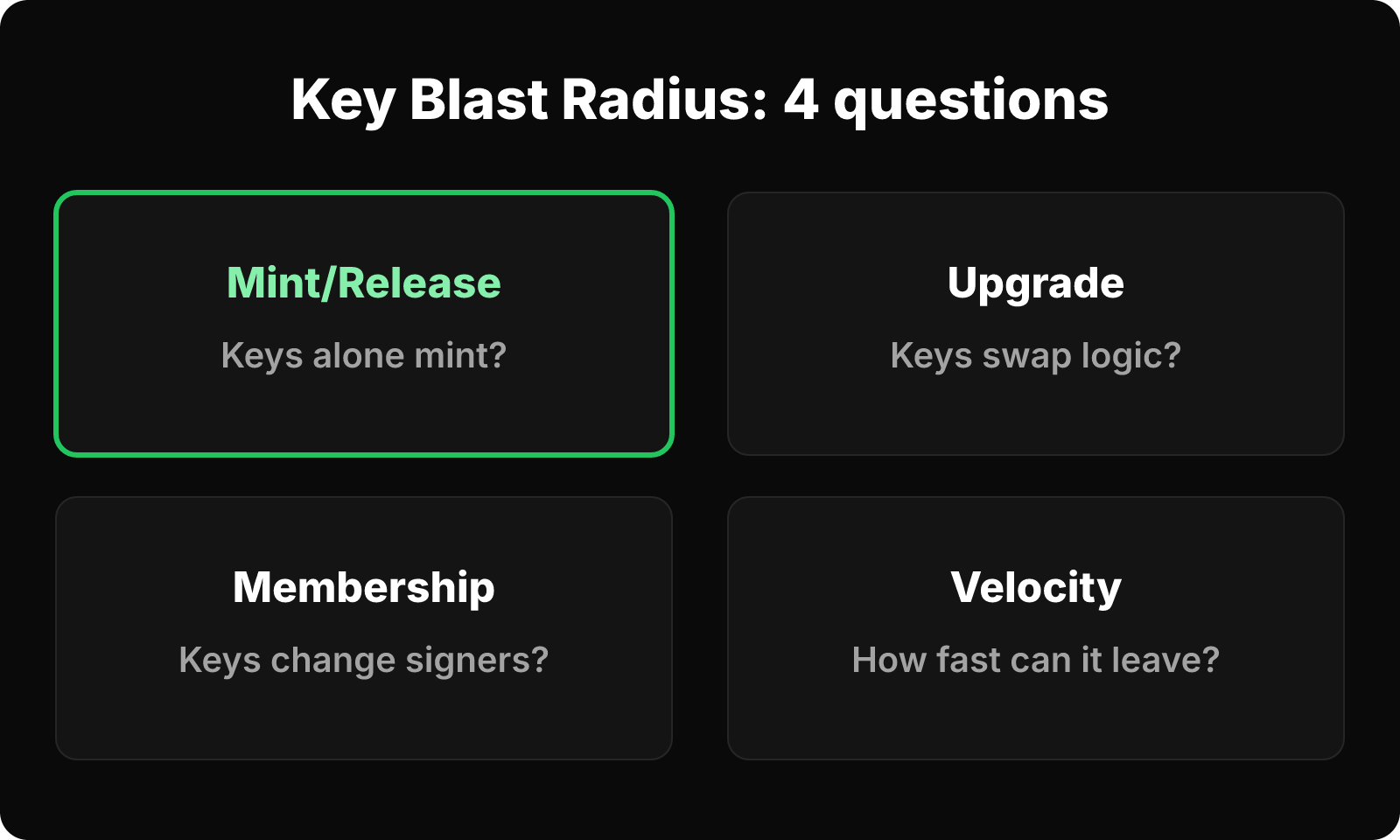
| Authority | Question | 0 — Minimal | 3 — Catastrophic |
|---|---|---|---|
| Mint/Release | Can keys alone authorize minting or releasing funds? | Only a verified source-chain proof can | T-of-N signatures with no proof |
| Upgrade | Can keys swap the contract logic? | Immutable, or long timelock with exit window | Instant upgrade by a single key |
| Membership | Can keys change who the trusted signers are? | Permissionless set, bonded entry | Admin can replace the validator set instantly |
| Velocity | How much can leave per unit of time? | Rate limits plus per-operator collateral caps | Entire vault in one transaction |
Every key compromise in the case-study table scores a 3 on Mint/Release or Upgrade. Velocity sets how bad things get. The other three set whether a bad outcome is possible at all.
Most security discussion stops at "add more signers" or "use MPC." Those changes lower the probability of compromise. They don't touch the Mint/Release score, because a threshold of keys can still authorize a mint. Only changing what the contract checks, from signatures to proofs, moves that row to 0.
How Does Trustless Bitcoin Bridge Security Remove the Key?
A trustless Bitcoin bridge replaces "validators say a deposit happened" with "here is cryptographic proof that a deposit is buried under real proof-of-work," so no private key can authorize a mint. The method is Simplified Payment Verification (SPV), described in Section 8 of the Bitcoin whitepaper. For a fuller walkthrough, see How Bitcoin Bridges Work: SPV Light Clients Explained.
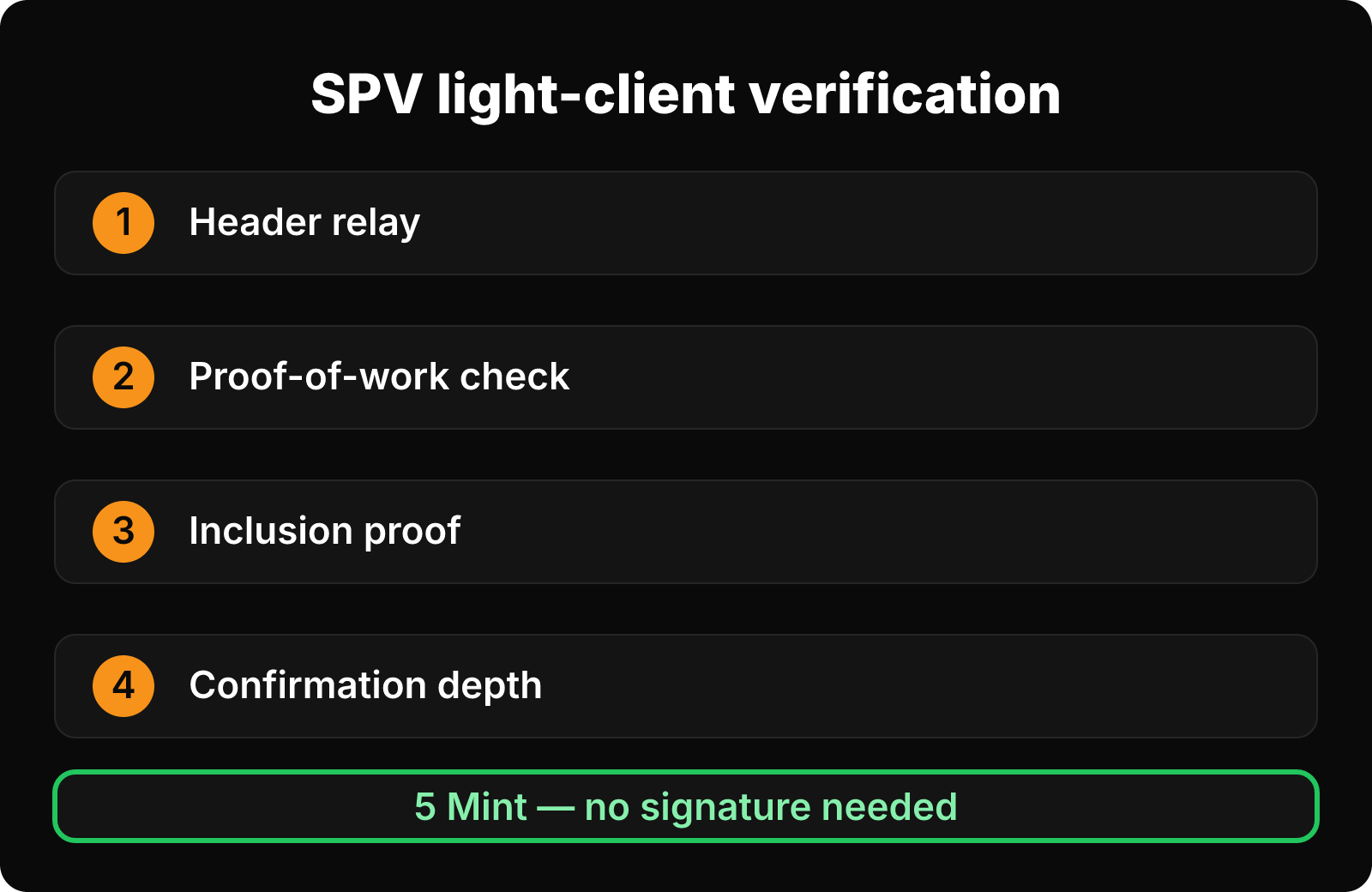
SPV light-client verification, step by step
- Header relay. Relayers submit 80-byte Bitcoin block headers to a light-client contract on the destination chain.
- Proof-of-work check. The contract computes double-SHA-256 of each header and confirms the result is below the target. A fake header would need real Bitcoin-scale hashpower to produce.
- Inclusion proof. The deposit transaction is submitted together with a Merkle branch up to the block's Merkle root.
- Confirmation depth. The contract requires the block to have a set number of headers on top of it, which makes a reorg or forged branch too expensive to pull off.
- Mint. Only after these checks pass does the contract mint the wrapped asset.
Notice what the relayer role does not do. A relayer can only submit headers, and fake headers fail the PoW check. A malicious relayer can delay things but can't forge a deposit, because no signature appears anywhere in the mint condition.
This is the design behind TeleBTC, the 1:1 BTC-backed token minted by TeleSwap. Nothing is minted without a Bitcoin transaction verified by the light client. Custody is collateral-backed and slashable, and the protocol roles are permissionless (details in the protocol docs). In Blast Radius terms, the Mint/Release score drops toward 0.
The caveat: proofs move the trust, they don't erase it
Light clients aren't magic. Taiko's June 2026 incident shows that a proof system is only as strong as its root of trust. There, the root was SGX attestation, and forging it opened the door. For Bitcoin SPV, the root is cumulative proof-of-work, but you still need the right confirmation depth and correct verification code. Audit upgrade controls and timelocks as carefully as the cryptography.
| BTC on other chains | Primary trust assumption |
|---|---|
| WBTC | Custodial institutions |
| cbBTC | Coinbase custody and controls |
| TeleBTC | SPV proof of Bitcoin deposit; collateral-backed, slashable custody |
For deeper comparisons, see WBTC Bridge Custody Risk vs Trustless Bridges.
Real usage matters for this design: TeleSwap network stats show $534,452,909 in total volume bridged across 566,174 bridge transactions on 13 supported networks, with $40.4M in volume over the last 30 days (as of October 28, 2026).
How Can Bridge Teams Prevent Private Key Compromise?
Bridge teams prevent private-key losses by taking keys out of the value path first, then making the keys that remain hard to steal and slow to use. Ordered by impact:
- Verify proofs instead of signatures wherever the source chain supports it. This is the only measure that lowers the Mint/Release score.
- Make operators actually independent. No operator should hold more than T−1 keys, counting delegations. Ronin is the example of what happens otherwise.
- Revoke stale delegations automatically. Give every signing permission an expiry. HackenProof blames Ronin's backdoor on a delegation that was never revoked.
- Use threshold signatures (MPC/TSS) over raw multisig where keys must exist. CoinDesk identifies MPC and account abstraction as industry moves to reduce single-key reliance. This lowers the chance of theft, not the blast radius once theft happens.
- Put signing keys in HSMs with policy engines that refuse oversized withdrawals or unknown destinations.
- Rate-limit outflows on-chain. Per-epoch caps turn a 128-second drain into a slower one that can be stopped.
- Timelock upgrades and membership changes with a public queue, so users and monitors have time to react.
- Add independent watchers with pause authority. A pause key that can only stop things is a low-risk key. Taiko and AFX both paused operations after their incidents; the aim is to pause during the drain.
- Generate keys properly. Use audited randomness, offline ceremonies, and no unvetted vanity tooling.
- Validate inputs, not just signers. Coreum's relayers authorized withdrawals based on fake deposits. Check every observed deposit for finality, destination, and canonical event type.
How Can Users Prevent Crypto Wallet Private Key Theft?
Users prevent private-key theft by keeping keys off internet-connected devices, refusing to blind-sign, and choosing bridges whose security doesn't depend on someone else's keys. Your own key and the bridge's keys are separate risks. For a related case, read Hardware Wallet Security Breach: 7 Lessons From Keystone.
Protecting your own keys
- Hardware wallet for anything you can't afford to lose. The key stays in a secure element, and the host only sees signatures.
- Seed phrase offline, never photographed, never typed into a website. No legitimate bridge, wallet, or support agent will ask for it.
- Read what you sign. Prefer typed-data prompts that show the spender and amount. Reject opaque
eth_signrequests and unlimited approvals. - Revoke old token approvals regularly.
- Check URLs and contract addresses before connecting. Bookmark official sites.
Picking a bridge
- Run the Blast Radius test: what authorizes a mint, who can upgrade, and how quickly?
- Look at the signer set. How many independent operators are there, and is the threshold public?
- Prefer native-chain proofs. In the AFX incident, Arbitrum's native bridge was unaffected while a third-party custody bridge on the same chain was drained, per SlowMist.
- Don't leave wrapped assets sitting in bridge contracts longer than you need to.
Frequently Asked Questions
What is a private key hack on a crypto bridge?
It's an attack where someone steals enough of a bridge's signing keys to authorize withdrawals or mints that have no real deposit behind them. The bridge contract can't tell the attacker's valid signatures from honest ones. Ronin (2022, 5 of 9 keys) is the textbook case.
Why are bridges targeted more than other DeFi protocols?
Bridges hold large pooled balances that a small set of keys can release. One compromise can unlock an entire vault. In May 2026, cross-chain bridges accounted for 42% of losses, according to altFINS.
Does multisig make a bridge safe from key theft?
No. Multisig raises the number of keys an attacker needs, but it doesn't change what those keys can do. Security depends on how independent the key holders are. Ronin's 5-of-9 failed because one company controlled 4 keys directly and a 5th through a stale delegation.
Is MPC better than multisig for bridge security?
MPC makes theft harder by making sure the full key never exists on any single device. It still produces a signature that the contract trusts. If an attacker compromises a threshold of share holders, the bridge drains the same way.
How does an SPV light-client bridge prevent key-based drains?
It mints only after verifying a Merkle proof that the Bitcoin deposit sits in a block with valid proof-of-work and enough confirmations. Signatures aren't part of the mint condition, so stolen keys can't fake a deposit.
How can I protect my own private keys when using bridges?
Use a hardware wallet, keep your seed phrase offline, and never blind-sign transactions. Also revoke unused token approvals, check site URLs before connecting, and limit how much you keep parked in any bridge contract.
Conclusion
Three points from the 2022–2026 record:
- Bridge hacks are mostly key-management and verification failures, not cryptographic breaks.
- More signers and MPC lower the odds of compromise. Only proof-based verification removes keys from the mint path.
- Velocity controls (rate limits, timelocks, pause-only keys) help decide how large a compromise becomes.
If you're moving Bitcoin to other chains, choose a route where a deposit has to be proven, not just signed for. You can try BTC → USDC on Ethereum or BTC → WBTC on Ethereum at teleswap.xyz, and read the verification design in the docs before you bridge.