Hardware Wallet Security Breach: 7 Lessons From Keystone

Picture this: you buy a hardware wallet so your crypto stays safe offline. Months later, an email tells you the company that sold it has been hacked. Your name, home address, and the fact that you own crypto are now in a stranger's hands. Is your money gone?
For Keystone customers, that was October 2026. The short answer: this hardware wallet security breach did not expose anyone's seed phrase or private keys, according to Keystone, so funds on a genuine, properly set-up Keystone device are not at risk from the hack itself. The real danger comes next: targeted phishing, fake "replacement" devices, and possibly physical threats.
Your device is fine. You are now the target.
This guide explains what happened in plain language, why one stolen file (the "WebAuth key") matters more than the leaked addresses, and the 7 steps that protect you no matter which brand you use.
Key Takeaways:Keystone detected suspicious activity on its website on October 20, 2026, and attackers accessed customer names, contact details, shipping addresses, and order records, according to Bitcoin.com News.On October 26, 2026, Keystone disclosed that attackers also obtained the WebAuth authentication key used to verify that a Keystone device is genuine.Keystone states that recovery phrases, private keys, wallet passwords, and payment card details were not compromised in the breach.The biggest practical risk after a hardware wallet data leak is social engineering: fake refunds, fake replacement devices, and requests for your seed phrase.Recorded wrench attacks (physical coercion of crypto holders) rose from 39 in H1 2025 to 52 in H1 2026, citing CertiK data reported by The Record.
Table of Contents
- What Happened in the Keystone Wallet Breach?
- Did Hackers Get Anyone's Crypto?
- Why Does the Stolen WebAuth Key Matter?
- Is This Part of a Bigger 2026 Pattern?
- The 4 Layers of Hardware Wallet Security
- 7 Lessons: How to Protect Your Hardware Wallet From a Supply Chain Attack
- Worked Example: Should You Move to a New Seed?
- Crypto Wallet Security Lessons for 2026, Beyond the Device
- Frequently Asked Questions
- Next Steps
- Conclusion
What Happened in the Keystone Wallet Breach?
Attackers broke into Keystone's website, not its wallets. As reported, they exploited a weakness in a third-party data monitoring tool connected to the site, then used it to gain more access than the tool should ever have had. Security professionals call this "privilege escalation."
Keystone confirmed the intrusion exposed customer shipping and order data, as reported by crypto.news.
Here is the timeline, using the dates available as of October 28, 2026:
| Date | What happened |
|---|---|
| Oct 20, 2026 | Keystone detects suspicious activity, disables vulnerable website functions, starts a forensic investigation |
| Following days | Keystone confirms exposure of names, contact details, shipping addresses, products bought, and prices paid; begins emailing affected customers |
| Oct 26, 2026 | Keystone discloses attackers also obtained the WebAuth authentication key |
| Pending | A fuller incident report, which Keystone has promised "in the near term" |
Keystone says it has cut off the unauthorized access and fixed the vulnerability, according to Crowdfund Insider. The sources we reviewed do not include a final count of affected customers.
Did Hackers Get Anyone's Crypto?
No crypto theft linked to the Keystone breach appears in the sources reviewed as of October 28, 2026. To see why, it helps to know what a hardware wallet actually guards.
Every crypto wallet comes down to one secret: the private key, usually backed up as a seed phrase (12 or 24 ordinary words). Whoever has those words controls the funds. A hardware wallet is a small device built to create that secret and keep it locked inside, so it never touches your internet-connected computer.
Think of it like a bank. The vault holds the money. The front office holds the customer list. In this breach, thieves raided the front office. They now know who the customers are and where they live, but according to Keystone they never touched the vault.
Keystone also runs "air-gapped," meaning the device is typically used without a direct internet connection. Transaction data moves through QR codes, and private keys never leave the device, per Crowdfund Insider. Nothing reported so far suggests that design was compromised.
Still, a list of verified crypto owners with home addresses attached is among the most valuable things a scammer can obtain.
Why Does the Stolen WebAuth Key Matter?
The WebAuth key is what Keystone uses to prove a device is genuine. With it, an attacker could in principle build counterfeit devices that pass that check. This is the part of the story that moves it from a privacy problem toward a possible security problem.
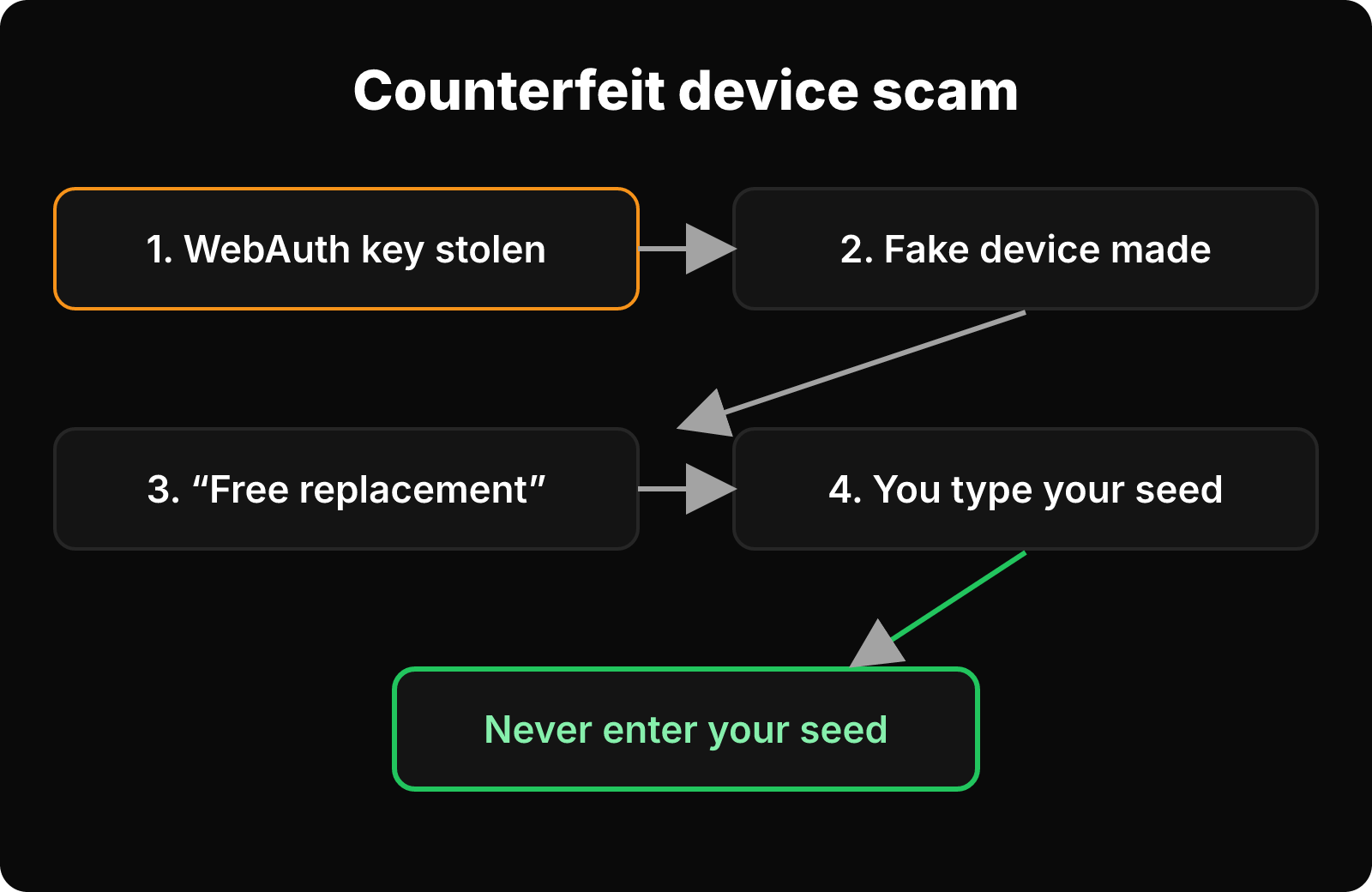
Back to the bank analogy. The WebAuth key is like the stamp that prints an official hologram seal. Leaked customer addresses tell a criminal where to send a package. A stolen hologram stamp means that package can look real.
This is a supply chain attack: instead of hacking your device, the attacker tampers with it, or swaps it out, somewhere between the factory and your hands. The scam usually goes like this:
- You get a call, email, or letter: "Due to the recent breach, we are sending you a free replacement device."
- A device arrives that looks real and may even pass the usual authenticity check.
- The instructions ask you to "restore" your wallet by typing in your existing seed phrase.
- The device quietly sends your seed to the attacker, who empties your wallet.
The key was obtained. The sources we reviewed show no reports of counterfeit Keystone devices actually circulating. Even so, assume the authenticity check is weaker than it was a month ago.
Don't treat it as your only defense.
Keystone has warned that scammers may pose as the company by phone, text, email, or mail. It says it will not reach out to offer refunds, replacements, or address corrections, and it will never ask for your recovery phrase or private keys. The official support address cited is support@keyst.one.
Is This Part of a Bigger 2026 Pattern?
Yes. Keystone is one of at least six hardware wallet brands to disclose a security problem in 2026, according to BeInCrypto's October 2026 tally. Gizmodo has described it as the worst year on record for hardware wallet makers.
| Brand | 2026 incident | Layer attacked | Funds lost? |
|---|---|---|---|
| Keystone | Website breach; WebAuth key stolen (Oct) | Company data and authenticity system | None reported |
| Ledger | Payment processor leak (Jan); device with a hardware implant sold via reseller CryptoBilis (Oct) | Third-party vendor; supply chain | Yes, reseller case |
| Trezor | ShipMonk logistics breach, ~80,000 customers; Brevo phishing emails | Third-party vendors | None reported |
| Coldcard (Coinkite) | Firmware weak-randomness bug; Wallets drained Jul 30–Aug 4 | Firmware | Yes |
| SafePal | Data breach, ~40,000 customers (orders Mar 2025–Apr 2026) | Company data | None reported |
| BitBox | Affected by the Brevo email incident | Third-party vendor | None reported |
Sources: Gizmodo, The Record, Shattered, BeInCrypto. BeInCrypto reports that Galaxy Research puts Coldcard losses above $115 million.
Look at the "Layer attacked" column. Only one incident, Coldcard, was a flaw in the wallet's own code. Most of the rest hit something around the device: a shipping partner, an email provider, a payment processor, a reseller, or a website plugin.
The 4 Layers of Hardware Wallet Security
Asking "is brand X safe?" produces a misleading answer. A better question is which layer of your setup is weakest. We split hardware wallet security into four layers:
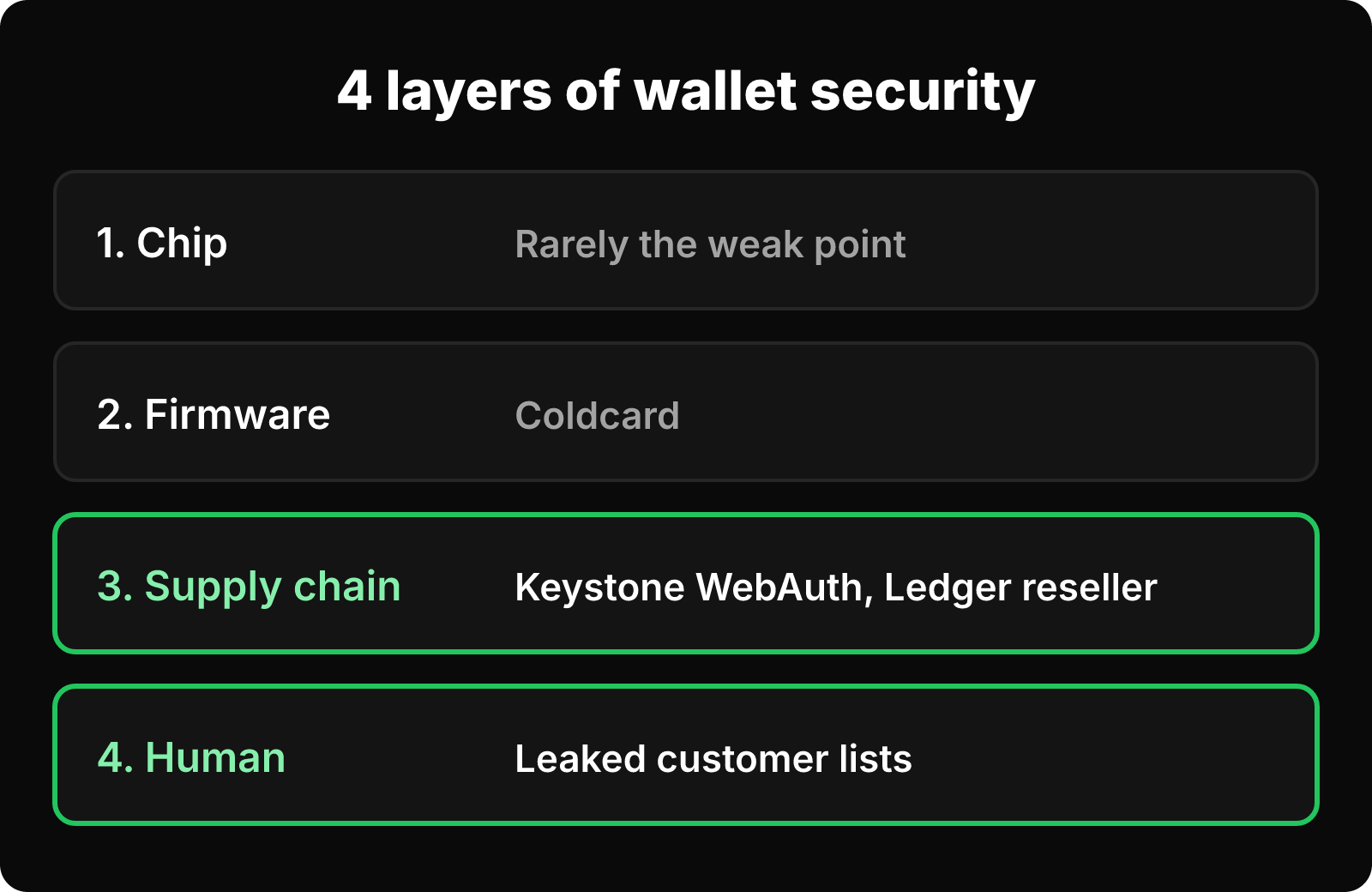
- The chip: the secure hardware that stores your key. Rarely the weak point.
- The firmware: the software running on the device. Coldcard's 2026 bug lived here. It replaced strong hardware randomness with a weaker software version for more than five years, which made seeds guessable, per Shattered.
- The supply chain: everything between factory and your desk, including resellers, couriers, and authenticity checks. Both the Ledger reseller case and the stolen Keystone WebAuth key sit here.
- The human: you, your seed backup, your inbox, and your front door. Every leaked customer list lands here.
A data breach like Keystone's doesn't weaken your device's key storage. It moves the attack onto you. Most hardware wallet marketing focuses on layers 1 and 2. In 2026, many attacks went after layers 3 and 4, where a secure chip can't help.
Layer 4 includes physical safety too. Security developer Taylor Monahan warned that leaked shipping data could enable robbery and kidnapping, crypto.news reported. A hardware wallet protects keys. It doesn't protect people.
7 Lessons: How to Protect Your Hardware Wallet From a Supply Chain Attack
These steps work for any brand, whether or not you were caught up in a breach.
1. Never type your seed phrase into anything you didn't order yourself
This one rule defeats almost every counterfeit-device scam. Real manufacturers don't send surprise replacements, and none will ever ask for your recovery phrase.
2. Buy only from the manufacturer or its listed official resellers
The tampered Ledger devices confirmed in October 2026 were all tied to one reseller, CryptoBilis, according to BeInCrypto. A "discount" from a marketplace seller isn't worth the risk.
3. Generate a fresh seed on the device, every time
If a device arrives with a seed phrase already written on a card, or asks you to "import" one at first setup, stop. A genuine new wallet creates its own seed in front of you.
4. Verify the device, and don't rely on the check alone
Follow the manufacturer's official verification steps and check the packaging for tampering. Since Keystone's WebAuth key leaked, treat a passing check as necessary but not sufficient. Where you bought the device matters just as much.
5. Treat every breach-related message as hostile
Phone calls, texts, emails, and even paper letters may use your real name and order details. Don't click links. Type the company's address yourself, or email official support directly.
6. Add a passphrase and keep your backups apart
Many wallets support an optional passphrase (sometimes called a "25th word"). It creates a separate wallet that the seed alone can't open. Store the seed and passphrase in different places.
7. Shrink your physical footprint
For future orders, consider shipping to a pickup point or office instead of home. Don't discuss your holdings in public, and keep crypto packaging out of your trash. This is a cheap defense against the rise in wrench attacks.
Worked Example: Should You Move to a New Seed?
Most Keystone users who bought a device directly and generated their own seed don't need to move funds. Moving makes sense if you have doubts: you bought from a third party, you received an unexpected "replacement," or you ever typed your seed into something you're unsure of.
Here's what moving costs, with illustrative assumptions only (not live data):
- Scenario: 0.5 BTC held in one address (one UTXO, which is a single "coin" in Bitcoin's accounting).
- Transaction size: about 110 virtual bytes for a one-input, one-output native SegWit transfer.
- Fee rate: 10 satoshis per vbyte (an assumed rate; check a mempool tracker for the live figure).
- Network fee: 110 × 10 = 1,100 sats, or 0.000011 BTC.
- At an assumed BTC price of $100,000 (illustrative only, not a forecast): about $1.10.
- Time: Bitcoin blocks arrive roughly every 10 minutes, so expect about 10 minutes for one confirmation, about an hour for six.
For about a dollar in fees under these assumptions, plus the cost of a new device bought from the official store if you want one, you remove any doubt about your current seed. If your wallet holds many small UTXOs, the transaction gets bigger and costs more.
The steps:
- Set up the new wallet (genuine, bought directly) and write down its fresh seed offline.
- Send a small test amount from the old wallet to a receive address on the new one.
- Confirm on the new device's screen that the address matches what you pasted.
- Send the rest once the test shows up.
- Retire the old seed. Don't reuse it.
Crypto Wallet Security Lessons for 2026, Beyond the Device
Breach headlines leave out some perspective. Hardware wallet incidents hurt the people affected, but they're a small share of total crypto losses. Of roughly $1.31 billion lost across 344 incidents in H1 2026, most came from smart contract exploits and bridge failures, according to Shattered's summary of CertiK data. For how one exploit unfolded, see DeFi Exploit Explained: The Drift Hack and Tornado Cash, and for a broader tally of bridge failures, see Biggest Crypto Bridge Hacks: What Went Wrong (2026).
That points to a habit that's easy to miss. Many people lock their seed in a steel plate, then send their Bitcoin to a service run by a small group of key-holders the moment they want to use it in DeFi. The question you ask about your hardware wallet, "who can move my coins besides me?", applies to every app you connect it to.
When you move BTC to other chains, check how the bridge decides your deposit is real. TeleSwap mints TeleBTC (a 1:1, collateral-backed BTC token) only after an SPV light-client proof verifies your Bitcoin transaction.
No custodian or multi-sig committee sits in between. Lockers' collateral can be slashed if they misbehave. For the trust-model differences, read WBTC Bridge Custody Risk vs Trustless Bitcoin Bridges in 2026 and How Bitcoin Bridges Work: SPV Light Clients Explained.
According to TeleSwap network stats, $533.6M has been bridged across 565,248 bridge transactions on 13 supported networks. A BTC-to-stablecoin route, such as BTC to USDC on Polygon, still begins with a normal Bitcoin transaction.
The lesson is the same one Keystone teaches: find the weakest layer in your setup and fix that first.
Frequently Asked Questions
Was my Keystone seed phrase stolen in the breach?
No. Keystone states that recovery phrases, private keys, and wallet passwords were not compromised. The attackers got into the company's website and order systems, which are separate from the device. Seed phrases are created and stored only on the wallet itself.
What is the Keystone WebAuth key?
It is the cryptographic key Keystone uses to confirm a device is genuine. Because attackers obtained it, they could in theory make fake devices that pass the authenticity check. Only use devices you ordered directly, and never enter an existing seed into a device you didn't buy yourself.
Should I stop using my Keystone wallet?
Not if you bought it from an official channel and generated the seed on it yourself. The device's security model wasn't reported as breached. Stay alert for phishing, and consider moving funds to a fresh seed only if you have specific doubts about how you got or set up your device.
How do I protect my hardware wallet from a supply chain attack?
Buy directly from the manufacturer, generate a fresh seed on first setup, and never type your seed into a device or website you didn't choose yourself. Also check the packaging, follow the official verification steps, and ignore unexpected "replacement" or "refund" offers.
Are hardware wallets still worth using after the 2026 breaches?
Yes. Most 2026 incidents hit company data and vendors, not the devices' key storage. Of six brands with disclosed problems, BeInCrypto counted only two cases (Coldcard and a Ledger reseller) where users actually lost crypto. A hardware wallet is still a strong tool, as long as you also handle the supply chain and personal-safety risks around it.
Next Steps
- WBTC Bridge Custody Risk vs Trustless Bitcoin Bridges in 2026: see how custody models differ once your BTC leaves your hardware wallet.
- How Bitcoin Bridges Work: SPV Light Clients Explained: a plain-language guide to bridging BTC without handing over custody.
- Biggest Crypto Bridge Hacks: What Went Wrong (2026): the failure patterns to avoid when moving coins between chains.
Conclusion
Keystone's breach illustrates how hardware wallet risk works in 2026. Attackers didn't touch the vault. They took the customer list and the stamp used for authenticity seals. The risk now is phishing, counterfeit devices, and physical targeting, not a broken chip.
Three things to remember: never enter your seed into a device you didn't order, buy only from official channels, and treat every message about the breach as a possible scam. If you have doubts about your device, a single Bitcoin transaction can move you to a fresh seed.
When you're ready to put that well-protected BTC to work on other chains, use the same standard: choose a bridge that checks Bitcoin's own proofs instead of asking you to trust a committee. You can see how TeleSwap's light-client bridge works at teleswap.xyz.