DeFi Exploit Explained: The Drift Hack and Tornado Cash

On April 1, 2026, someone emptied Drift, a Solana trading platform, of roughly $270–285 million in about 12 minutes. Afterward, the attacker sent 25,700 ETH into Tornado Cash within two hours, according to Yahoo Finance, citing Lookonchain. If you've seen those headlines and wondered how this happens, this DeFi exploit explained guide walks through the attack, the laundering, and what protocols and users can do about it.
The short answer: a DeFi exploit is when an attacker finds a weak spot in a crypto protocol (in its code, its data feeds, or the people who control it) and uses it to take out more money than the system was built to release. Laundering comes next: the stolen coins get swapped, moved to other blockchains, and run through mixers like Tornado Cash so the trail is harder to follow. Drift is a useful example because its code wasn't the problem. Its people were the target.
Key Takeaways:A DeFi exploit is the abuse of a weakness in a decentralized finance protocol, such as a code bug, bad price data, or compromised admin keys, to withdraw more funds than the system intends.The April 1, 2026 Drift exploit drained roughly $270–285 million in about 12 minutes, per TRM Labs and Travers Smith, and was linked to North Korean group UNC4736.The Drift attacker moved 25,700 ETH (about $61.6 million) into Tornado Cash within two hours and still held 81,864 ETH afterward, according to Lookonchain data reported by Yahoo Finance.Tornado Cash breaks the on-chain link between deposit and withdrawal addresses using zero-knowledge proofs, but timing and amount patterns often still let investigators trace funds.April 2026 crypto hack losses reached about $606.7 million, and the Drift and KelpDAO incidents made up most of that total, according to NOMINIS.
Table of Contents
- What Is a DeFi Exploit, in Plain English?
- What Are the 6 Main Types of DeFi Exploits?
- How Did the Drift Hack Actually Work?
- How Are Crypto Hacker Funds Laundered?
- How Does the Tornado Cash Mixer Work?
- Can Stolen Crypto Be Traced on Ethereum?
- How Can Protocols Prevent Exploits?
- What Can Regular Users Do to Stay Safe?
- Frequently Asked Questions
- Next Steps
- Conclusion
What Is a DeFi Exploit, in Plain English?
A DeFi exploit is when someone tricks a crypto protocol into handing over money it shouldn't. DeFi (decentralized finance) means financial apps like exchanges and lending markets that run on blockchains instead of inside a bank.
These apps are built from smart contracts: programs that hold funds and follow their rules automatically, with no human approving each transaction. Think of a vending machine. Put in the right coins and press B4, and you get chips. Nobody at the counter checks your ID.
Now picture a vending machine with a flaw. Pressing B4 and B5 at once releases every bag in the machine. That's a code-level exploit. Or say you steal the owner's master key and open the front panel. That's a key compromise. Either way the machine "worked as designed." It just did what it was told by the wrong person.
Two things make DeFi exploits fast and hard to undo, as Sardine's DeFi exploit guide points out:
- The code is public. Anyone, attackers included, can read it and look for weak spots.
- Transfers are final. No bank can reverse a confirmed blockchain transaction, so stolen funds can be gone in minutes.
What Are the 6 Main Types of DeFi Exploits?
Most DeFi exploits fit into six categories, and only one of them is a pure code bug. This table maps each type to real incidents from 2026, drawn from Halborn's April 2026 hack review and other reporting.
| Exploit type | Plain-English meaning | 2026 example | Reported loss |
|---|---|---|---|
| 1. Smart-contract bug | A mistake in the code itself | Rhea Finance (slippage protection bug) | ~$18.4M (~$10M recovered) |
| 2. Oracle / price manipulation | Feeding the protocol a fake price | Flash-loan attacks on price feeds | Varies |
| 3. Admin / governance compromise | Taking control of the protocol's privileged settings | Drift | ~$270–285M |
| 4. Bridge / verifier failure | Faking a message between two blockchains | KelpDAO (rsETH) | ~$292M |
| 5. Key / signer compromise | Stealing private keys or multisig approvals | Volo Protocol (likely key theft) | ~$3.5M |
| 6. Social engineering / DNS hijack | Fooling people or redirecting a website | CoW Swap (DNS registrar attack) | ~$1.2M |
One pattern stands out. The two biggest exploits of 2026 were not classic code bugs. Law firm Travers Smith notes that both Drift and KelpDAO came down to operational and governance weaknesses: who held the keys, and who checked the messages.
For a timeline of other bridge incidents, read Biggest Crypto Bridge Hacks: What Went Wrong (2026).
Many people treat a security audit as a seal of approval. An audit reads the code. It doesn't check whether a core contributor's laptop is infected, or whether a bridge depends on a single verifier. The riskiest part of many protocols is often everything around the code.
How Did the Drift Hack Actually Work?
Attackers spent about six months earning the trust of Drift contributors, then used compromised devices and pre-signed transactions to take admin control and drain funds in roughly 12 minutes. Drift is a decentralized exchange on Solana for perpetual futures, a kind of leveraged trading contract.
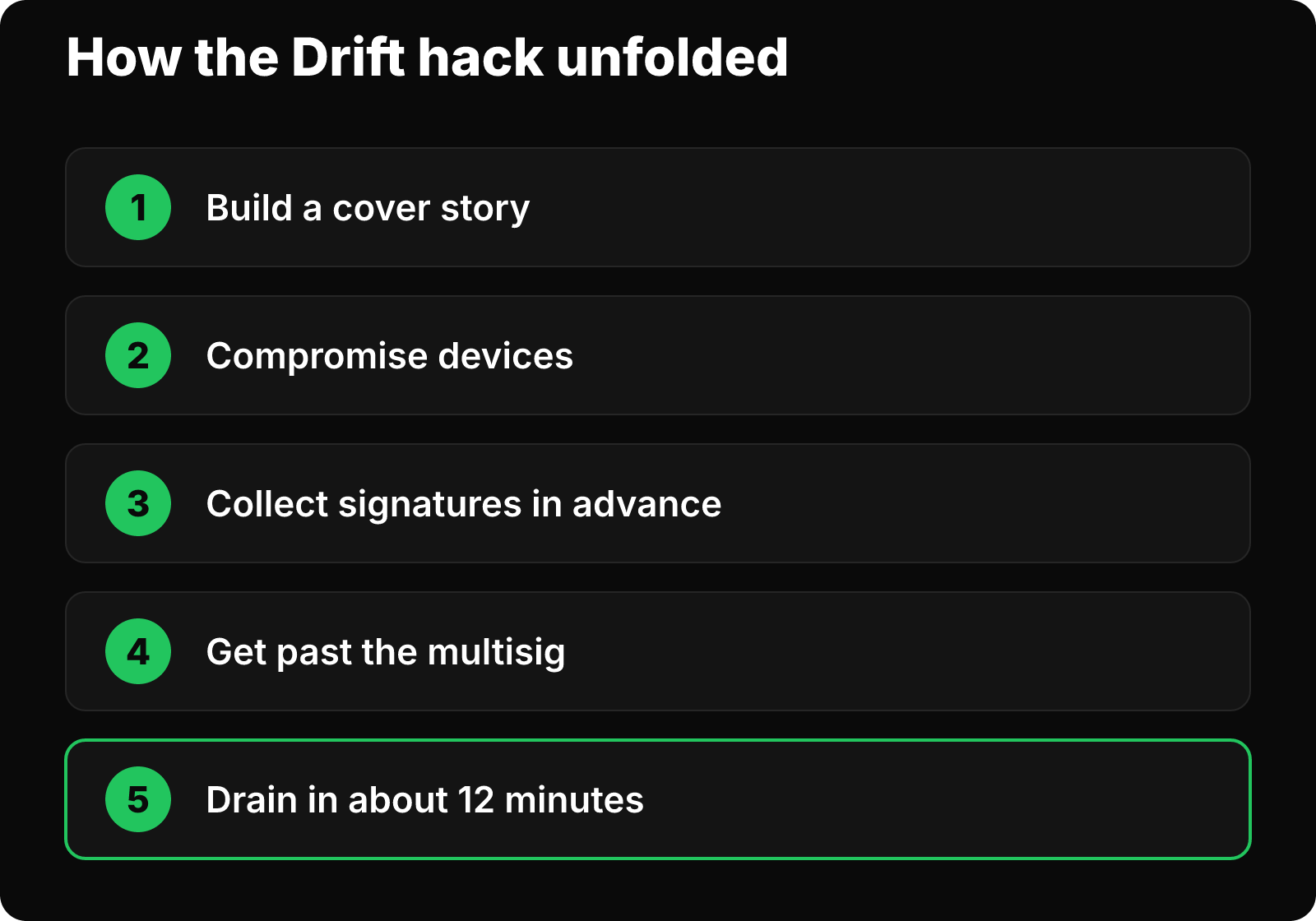
Here is the sequence as reported by Yahoo Finance:
- Build a cover story. The attackers posed as a quantitative trading firm. They attended industry conferences and reportedly put more than $1M of their own money into the ecosystem to look legitimate.
- Compromise devices. Once they had relationships with contributors, they got into those contributors' devices, the computers used to approve transactions.
- Collect signatures in advance. Solana supports "durable nonces," which let someone sign a transaction now and submit it later. That's handy for offline or scheduled signing. It also means a signature can be collected under false pretenses and used later.
- Get past the multisig. A multisig wallet needs several people to approve an action, like a bank vault that takes three keys. If enough key-holders are deceived or compromised, the protection stops working.
- Drain and move fast. TRM Labs says the theft took about 12 minutes. The funds were then moved to Ethereum, where they sat as ETH.
On April 5, 2026, Drift said the attack was a six-month operation by North Korean intelligence. Investigators linked it to the group tracked as UNC4736, also known as AppleJeus or Citrine Sleet. Early coverage, such as CryptoRank's first report, called it a "potential" exploit before it was confirmed, and reported totals vary between $270M and $285M depending on the source.
Victims got a partial lifeline. On April 16, 2026, Tether announced a $127.5M commitment, part of a broader package, to fund a revenue-linked recovery pool. Affected users receive transferable recovery tokens that represent a claim on it, per Travers Smith.
How Are Crypto Hacker Funds Laundered?
Crypto hacker funds are laundered in stages: swap into liquid assets, move across blockchains, wait, then run the funds through mixers before trying to cash out. The aim isn't to make the money vanish. It's to make the trail long and confusing enough that exchanges can't confidently freeze it.
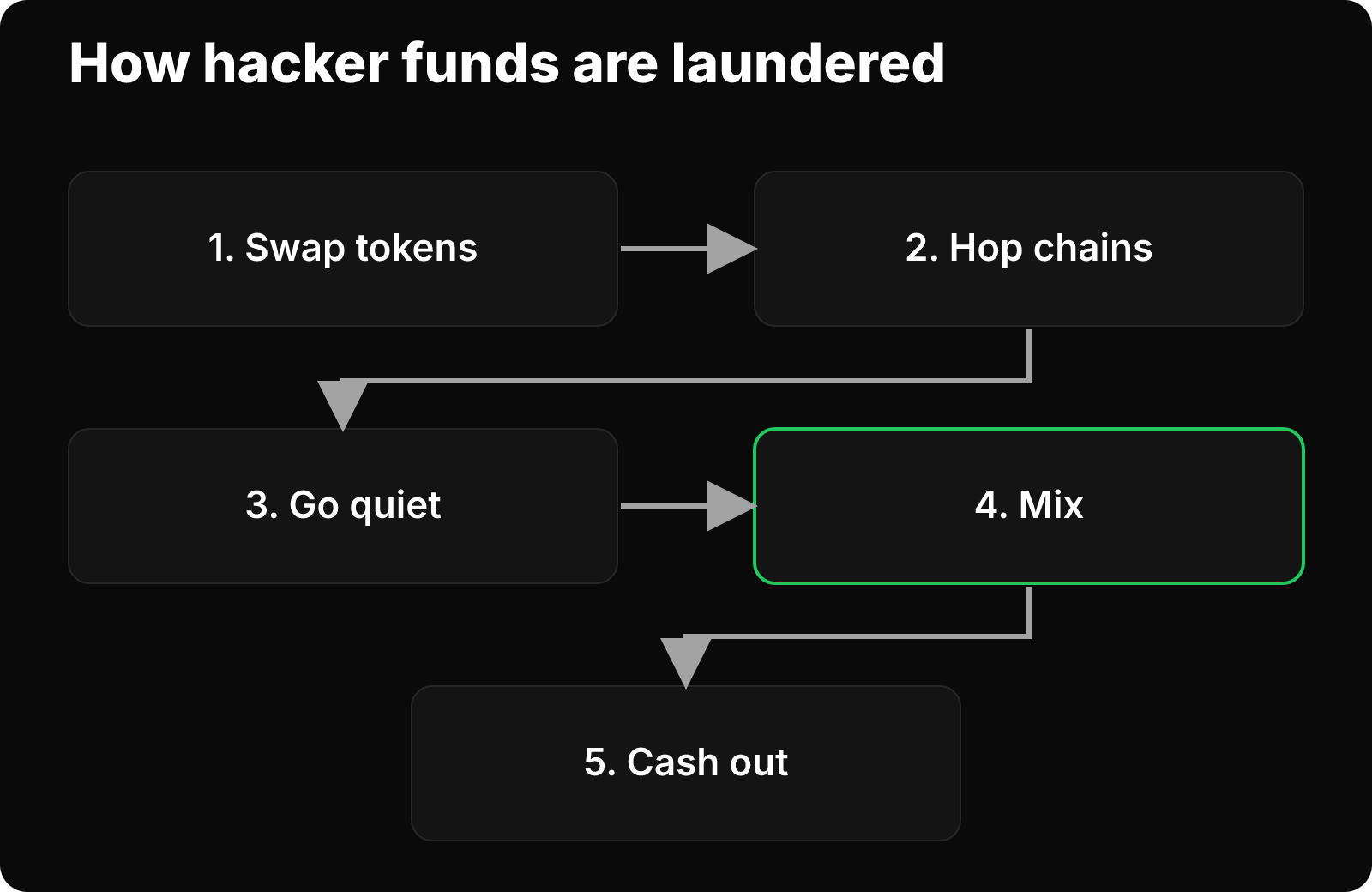
The usual playbook, which the Drift case follows closely:
- Swap out of freezable tokens. Stablecoins like USDT and USDC can be frozen by their issuers, so attackers typically swap into assets with no central off switch, such as ETH.
- Hop chains. Drift's stolen funds left Solana for Ethereum. Each hop adds another explorer and another set of records investigators have to stitch together.
- Go quiet. The Drift attacker was reportedly inactive for roughly two months before the Tornado Cash move. Waiting lets public attention fade and lets watchlists go stale.
- Mix. Funds go into a mixer like Tornado Cash in a concentrated burst: 25,700 ETH in about two hours.
- Cash out. The last and hardest step is turning crypto into usable money through over-the-counter brokers, loosely regulated exchanges, or networks of intermediaries.
KelpDAO's attacker followed a similar route. After minting fake rsETH and borrowing real ETH against it, the stolen ETH was sent to Tornado Cash, according to the Bank Policy Institute.
How Does the Tornado Cash Mixer Work?
Tornado Cash is a set of Ethereum smart contracts that pools many users' deposits and lets each user withdraw to a fresh address, without revealing which deposit was theirs. No company holds the funds. The contracts do everything.
A good analogy is a coat check with no attendant. You drop a standard black coat on a rack with hundreds of identical black coats and get a secret ticket. Later, anyone holding a valid ticket can take a black coat. Nobody watching can tell which coat was yours.
In technical terms:
- Fixed denominations. Deposits go into pools of set sizes. Identical amounts make deposits hard to tell apart.
- A secret note. When you deposit, you keep a private secret. A cryptographic fingerprint of it gets recorded on-chain.
- Zero-knowledge proof. To withdraw, you submit a proof that you know the secret behind one of the deposits in the pool, without revealing which one. The contract checks the math and pays out to any address you name.
What the Drift numbers imply
The reported figures, all from Lookonchain via Yahoo Finance, give a sense of scale. How the attacker split deposits across Tornado Cash pools hasn't been confirmed in our sources, so we don't estimate deposit counts.
| Metric | Value | How we got it |
|---|---|---|
| ETH deposited | 25,700 ETH | Lookonchain via Yahoo |
| Reported USD value | ~$61.6M | Lookonchain via Yahoo |
| Implied ETH price | ~$2,397 | $61.6M ÷ 25,700 |
| Time window | Within two hours | Lookonchain via Yahoo |
| ETH still held afterward | 81,864 ETH (~$195M) | Lookonchain via Yahoo |
A mixer's privacy depends on how many unrelated users share a pool. A single wallet depositing a very large amount in a short window can make up a big share of that pool's activity, which weakens its own anonymity.
Is Tornado Cash legal?
Its legal status has changed over time. The U.S. Treasury's OFAC sanctioned Tornado Cash in August 2022. The sanctions were later lifted, in March 2025, following litigation. Delisting doesn't make laundering legal. Knowingly moving stolen funds is still a crime, and many exchanges flag deposits with Tornado Cash history.
Can Stolen Crypto Be Traced on Ethereum?
Yes, often. Ethereum is a public ledger, so every movement of stolen funds stays visible, and a mixer hides only one link in a longer chain. On-chain analysts at firms like TRM Labs and Chainalysis, and independent trackers such as Lookonchain, follow these flows in real time. That's how the public learned of the Drift attacker's Tornado deposits.
Investigators get past mixers with a few common techniques:
- Timing analysis. If a large batch of deposits goes in on Tuesday and a cluster of brand-new addresses withdraws similar totals on Wednesday, the link is statistically strong even without cryptographic proof.
- Amount patterns. Withdrawn funds that are later recombined into the same odd totals give themselves away.
- Gas funding. A fresh withdrawal address needs ETH to pay transaction fees. Where that first bit of gas comes from can connect it to known wallets.
- Off-ramp chokepoints. Eventually the money has to touch an exchange or broker that knows its customers, and that's where freezes happen.
Mixing buys time more than it buys permanent anonymity. The decisive question is whether the funds get frozen at an off-ramp before they're cashed out.
How Can Protocols Prevent Exploits?
The most effective protection is removing single points of failure: one verifier, one key-holder, or one trusted data feed that an attacker can compromise to take everything. The 2026 incidents show what happens when those choke points exist.
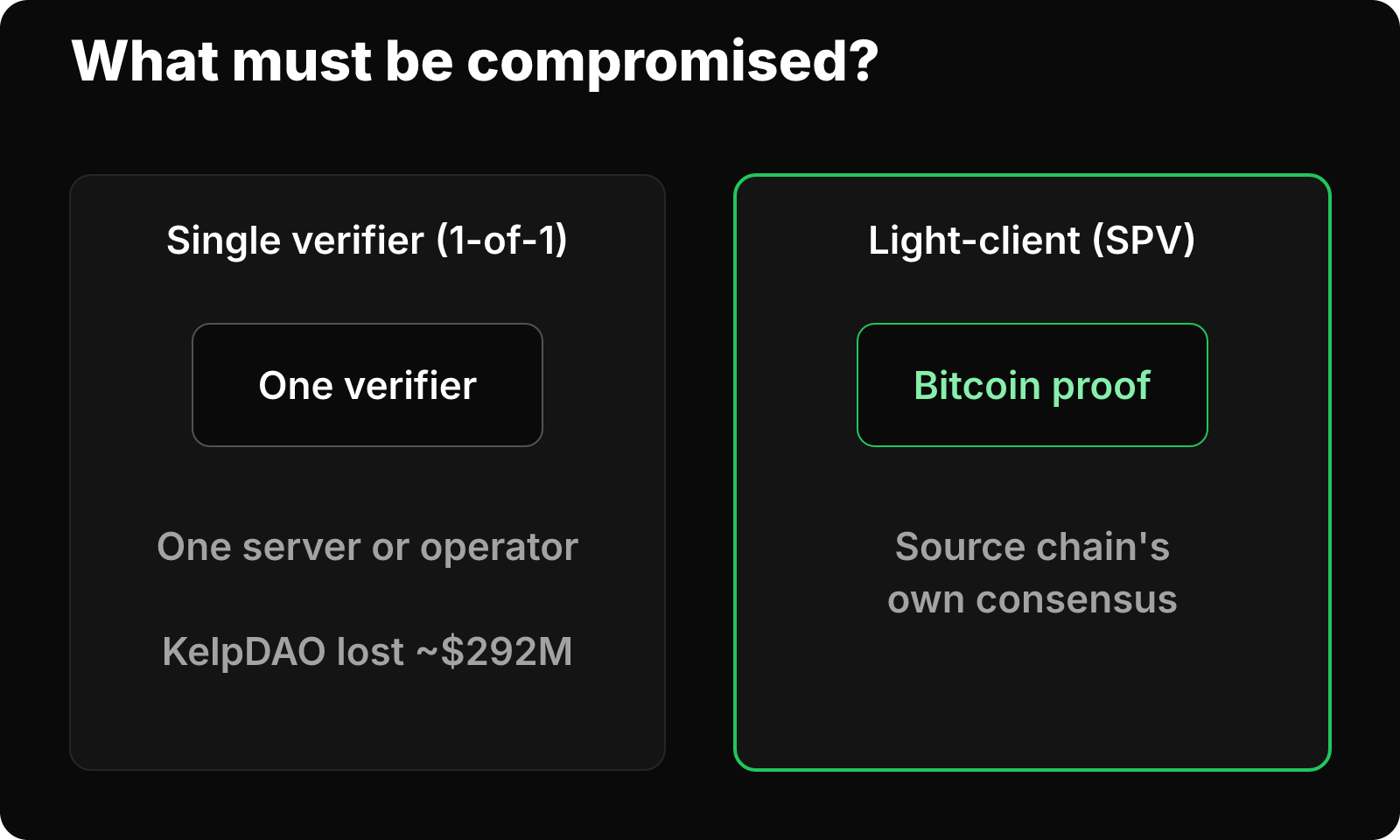
KelpDAO is the clearest case. Its cross-chain setup relied on a 1-of-1 verifier, a single approver for messages between chains. Attackers compromised the RPC nodes (the servers that feed blockchain data) supplying that verifier and launched DDoS attacks against honest nodes. The verifier accepted a forged transfer, as Koinly's breakdown describes. Fake rsETH was then posted as collateral on Aave to borrow real ETH, which left lenders holding worthless collateral.
| Security model | What has to be compromised | 2026 lesson |
|---|---|---|
| Single verifier (1-of-1) | One server or operator | KelpDAO lost ~$292M |
| Multisig | Enough signers | Drift showed signers can be socially engineered |
| Pre-signed / durable-nonce transactions | A signature collected earlier | Convenient, but creates a delayed-execution window |
| Light-client (SPV) verification | The source chain's own consensus | The bridge checks the blockchain's proof itself instead of trusting a messenger |
Protocol exploit prevention in Bitcoin DeFi
For Bitcoin DeFi, the core question is how a bridge decides that a Bitcoin deposit really happened. Custodial wrapped tokens rely on a company. Many bridges rely on a committee of signers. Both are versions of the trust problem Drift and KelpDAO ran into.
The light-client approach checks the evidence directly. TeleSwap, a Bitcoin bridge using SPV light-client verification, mints TeleBTC only after a verified Bitcoin transaction. TeleBTC is a 1:1, collateral-backed representation of BTC, and custody is collateral-backed and slashable. According to TeleSwap network stats, the protocol has processed $532.2M in total bridged volume across 563,986 bridge transactions on 13 supported networks. Light clients don't make a system invulnerable, though. Contract code and operations still need audits and monitoring. What light clients remove is the single-messenger trust assumption.
To see how this trust model differs from custodial wrapping, read How Bitcoin Bridges Work: SPV Light Clients Explained.
Other practices would have blunted the 2026 attacks:
- Hardware-isolated signing. Keep multisig signing devices off everyday laptops.
- Timelocks on admin actions. A delay on privileged changes gives the community time to react.
- Collateral discipline for lenders. Cap how much of any bridged token can be borrowed against, so one forged asset can't drain a whole market.
- Real-time monitoring. Shattered, a vendor of monitoring tools, argues that most victims learned of breaches from social media rather than their own dashboards.
What Can Regular Users Do to Stay Safe?
You can't audit a protocol yourself, but you can limit how much one failure can cost you. April 2026 alone saw about $606.7M in hack losses, according to NOMINIS, so these steps are worth taking:
- Spread your funds out. Don't keep everything in one protocol, bridge, or wrapped token.
- Ask "who can move my money?" Look for timelocks, the number of multisig signers, and whether a single verifier or custodian is involved.
- Watch for contagion. Aave lenders were hit in the KelpDAO case without ever touching KelpDAO. Find out what collateral your lending market accepts.
- Check URLs every time. The CoW Swap incident was a DNS registrar social-engineering attack. Bookmark the official sites you use.
- Revoke old token approvals. Wallet permissions you granted months ago can be abused if a contract is compromised.
- Follow security trackers. Accounts that post breaches in real time give you minutes to act, and minutes can matter.
If you hold wrapped Bitcoin, compare custody models before you deposit. WBTC Bridge Custody Risk vs Trustless Bitcoin Bridges in 2026 covers the trade-offs.
Frequently Asked Questions
What is a DeFi exploit in simple terms?
A DeFi exploit is when an attacker abuses a weakness in a crypto protocol to withdraw more money than the system intends. The weakness can be a code bug, manipulated price data, a forged message between blockchains, or stolen admin keys. Blockchain transfers are final, so stolen funds usually can't be reversed.
How much was stolen in the Drift hack?
Roughly $270–285 million was stolen from Drift on April 1, 2026, depending on the source. Yahoo Finance and CryptoRank report about $270M, and Travers Smith reports about $285M. Drift linked the attack to North Korean intelligence, with investigators tying it to UNC4736, and Tether committed $127.5M to a recovery pool for affected users.
Why do hackers use Tornado Cash?
Hackers use Tornado Cash to break the visible on-chain link between stolen funds and where they end up. Deposits of identical sizes are pooled, and withdrawals to new addresses are authorized with zero-knowledge proofs that don't reveal which deposit they came from. Large, concentrated deposits still leave timing and amount patterns that investigators can analyze.
Can stolen crypto be recovered?
Sometimes, but usually only partly and slowly. Rhea Finance recovered about $10M of an $18.4M loss in 2026, and Drift victims are relying on an issuer-funded recovery pool. Recovery is most likely when funds are frozen at stablecoin issuers or exchanges before the attacker cashes out.
Are Bitcoin bridges safe from exploits?
No bridge is risk-free, but bridges without single points of failure are much harder to exploit. Bridges that depend on one verifier or a small signer group can be forged or socially engineered, as KelpDAO showed. Bridges that verify Bitcoin transactions with SPV light clients remove the trusted-messenger risk, though code and operational risks still apply.
Is Tornado Cash legal to use?
Its legal status has changed, but laundering stolen funds through it is still a crime. OFAC sanctioned Tornado Cash in August 2022, and the sanctions were lifted in March 2025 following litigation. Many exchanges still flag deposits with Tornado Cash history.
Next Steps
- How Bitcoin Bridges Work: SPV Light Clients Explained: see how lock-and-mint, custodial, and light-client bridges compare.
- WBTC Bridge Custody Risk vs Trustless Bitcoin Bridges in 2026: understand the trust model behind the wrapped Bitcoin tokens you might hold.
- Biggest Crypto Bridge Hacks: What Went Wrong (2026): review how verifier and key failures played out in other incidents.
Conclusion
DeFi exploits rarely look like movie hacking. The two biggest of 2026 were a six-month social engineering campaign (Drift) and a single verifier fed fake data (KelpDAO). The laundering that followed, with chain hops, long waits, and a burst of deposits into Tornado Cash, is designed to slow investigators down, and on a public ledger it rarely makes the money disappear completely.
The main lesson is to look for the single point of failure. Whatever protocol, bridge, or wrapped token you use, ask what one person, key, or server would have to be compromised to drain it. If you're moving Bitcoin across chains, you can explore a light-client bridge at teleswap.xyz.