Lowest Fee Swap BTC No KYC: 4 Options Compared (2026)

You have some Bitcoin and want to turn it into dollars-on-chain (USDC or USDT) or ETH. You don't want to upload a passport, wait for an account review, or leave your coins on an exchange. So you search for the lowest fee swap BTC no KYC option and find dozens of sites, each saying it's "0.5%" or "zero fees."
Most of those numbers leave something out. The fee on the homepage is rarely what you actually pay.
The short answer: if you want to swap BTC into tokens on Ethereum, Arbitrum, Base, BNB Chain, Polygon and similar networks, a protocol-based route like TeleSwap is a strong choice. You send BTC from your own wallet, and there's no account to open. The swap runs through smart contracts and on-chain liquidity instead of a company's order desk.
If you need a privacy coin like Monero, TeleSwap doesn't offer it, so an instant swap service is the realistic choice. Test with a small amount first. Below we compare all four routes and show where the hidden costs are.
Key Takeaways:In a vendor-run 2026 test of a $1,000 BTC swap, the effective cost at instant swap services was 0.8%–1.5%, even though each one advertised about 0.5% (GODEX test)."No KYC" usually means "no KYC unless something triggers a review," and ChangeNOW, StealthEX and SimpleSwap all reserved that right in their July 2026 terms.Centralized exchanges list the lowest trading fees, such as 0.05% taker at MEXC, but they hold your coins, and sources disagree on whether unverified accounts can trade or withdraw at all.TeleSwap has processed $533.6M in total volume across 565,248 bridge transactions on 13 supported networks (TeleSwap network stats, October 2026).To find the cheapest BTC swap, compare what you actually receive after network fees, provider fees and the spread, not the headline percentage.
Table of Contents
- No KYC Crypto Exchange Comparison: 4 Routes Side by Side
- What Does "Swap BTC No KYC" Actually Mean?
- Bitcoin Swap vs Exchange Fees: Where Does Your Money Go?
- 4 Routes for the Lowest Fee Swap BTC No KYC
- How to Swap BTC Without KYC in 2026: TeleSwap Walkthrough
- BTC Swap Without KYC 2026: 5 Risks to Check First
- Frequently Asked Questions
- Conclusion: Pick the Route, Then Check the Final Amount
No KYC Crypto Exchange Comparison: 4 Routes Side by Side
Here are the four main ways to swap BTC without a full identity check. Fee figures come from the sources linked below. Treat third-party numbers as vendor claims and get a live quote before you swap.
| Route | Examples | Headline fee | Effective cost / extras | Speed | Trust model | Best use |
|---|---|---|---|---|---|---|
| Instant swap service | GODEX, ChangeNOW, StealthEX, SimpleSwap | ~0.5% | ~0.8%–1.5% including spread (vendor test) | ~5–30 min | Company receives your deposit and sends the output | Small one-off swaps, including to privacy coins |
| Centralized exchange (CEX) | MEXC, KuCoin, Gate.io, HTX | 0.05%–0.2% trading fee | + withdrawal fee (e.g., 0.00002 BTC at MEXC); unverified access disputed | Depends on deposit confirmations and withdrawal queue | Custodial: the exchange holds your coins | Frequent traders who accept custody risk |
| DEX | Uniswap, PancakeSwap | 0.05%–1% pool fee (Uniswap v3 tiers); 0.25% PancakeSwap | + gas ($15–50 on Ethereum mainnet per GODEX; under $1 on BNB Chain); you need wrapped BTC first | Seconds once you hold the token | Self-custodial smart contracts | Users who already hold tokens on that chain |
| TeleSwap (protocol) | teleswap.xyz, Rango, Rubic, DZap | Live quote in the app | Bitcoin network fee + protocol fee + DEX pool fee; destination gas covered by a Teleporter, paid in BTC | ~10 min for fast swaps | Trust-minimized: SPV light-client verification, collateral-backed TeleBTC | Native BTC → tokens on EVM chains, TON and Solana |
Sources: GODEX 12-platform comparison, Coingape no-KYC exchange review, TeleSwap documentation.
What Does "Swap BTC No KYC" Actually Mean?
KYC ("Know Your Customer") is the identity check a regulated financial company runs before it serves you. Usually that means an ID document, a selfie and sometimes proof of address. Exchanges that hold customer money generally have to do this.
To swap BTC with no KYC means converting Bitcoin into another asset without opening a verified account. In practice there are two quite different versions:
- "No KYC by default." A company runs the swap and doesn't ask for ID on routine transactions, but it can ask later. Think of a currency exchange booth that waves small customers through and stops you when the amount gets large or something looks unusual.
- "No account to verify." A protocol of smart contracts runs the swap from your own wallet. This is closer to a vending machine. You put something in, the rules are written into the machine, and nobody stands behind the counter.
The difference matters. StealthEX's July 2026 terms say standard swaps have no routine KYC, but risk-based controls can still require identity, transaction-purpose or source-of-funds evidence (StealthEX summary of provider terms). ChangeNOW's policy, updated July 17, 2026, says checks are "not continuous" but can be triggered by unusual activity or fiat partners. SimpleSwap's terms, effective July 20, 2026, say it can freeze suspected funds for enhanced checks.
None of this is sinister. These companies hold your money in the middle of the swap, so they carry compliance duties.
It does change how you should read the word "lowest." A swap that gets frozen halfway can cost far more than its listed fee.
One note: "no KYC" is not a way around the law. Tax and reporting duties still apply wherever you live. For the tax side, see No KYC Bitcoin Trading Limits 2026: Risks & Tax Basics. This guide is about avoiding unnecessary custody and paperwork, not about hiding anything.
Bitcoin Swap vs Exchange Fees: Where Does Your Money Go?
The fee you see is usually only part of what you pay. Every BTC swap can include up to four separate costs:
- Bitcoin network fee. This goes to Bitcoin miners to include your transaction in a block. It depends on how busy the network is, and you can check current rates on mempool.space. Every route that starts from native BTC pays it once.
- Provider or protocol fee. This is the headline percentage, for example "0.5%."
- Spread or slippage. The gap between the fair market price and the rate you actually get. This is the one most people miss.
- Destination costs. Gas on the receiving chain, or a withdrawal fee if an exchange holds your coins.
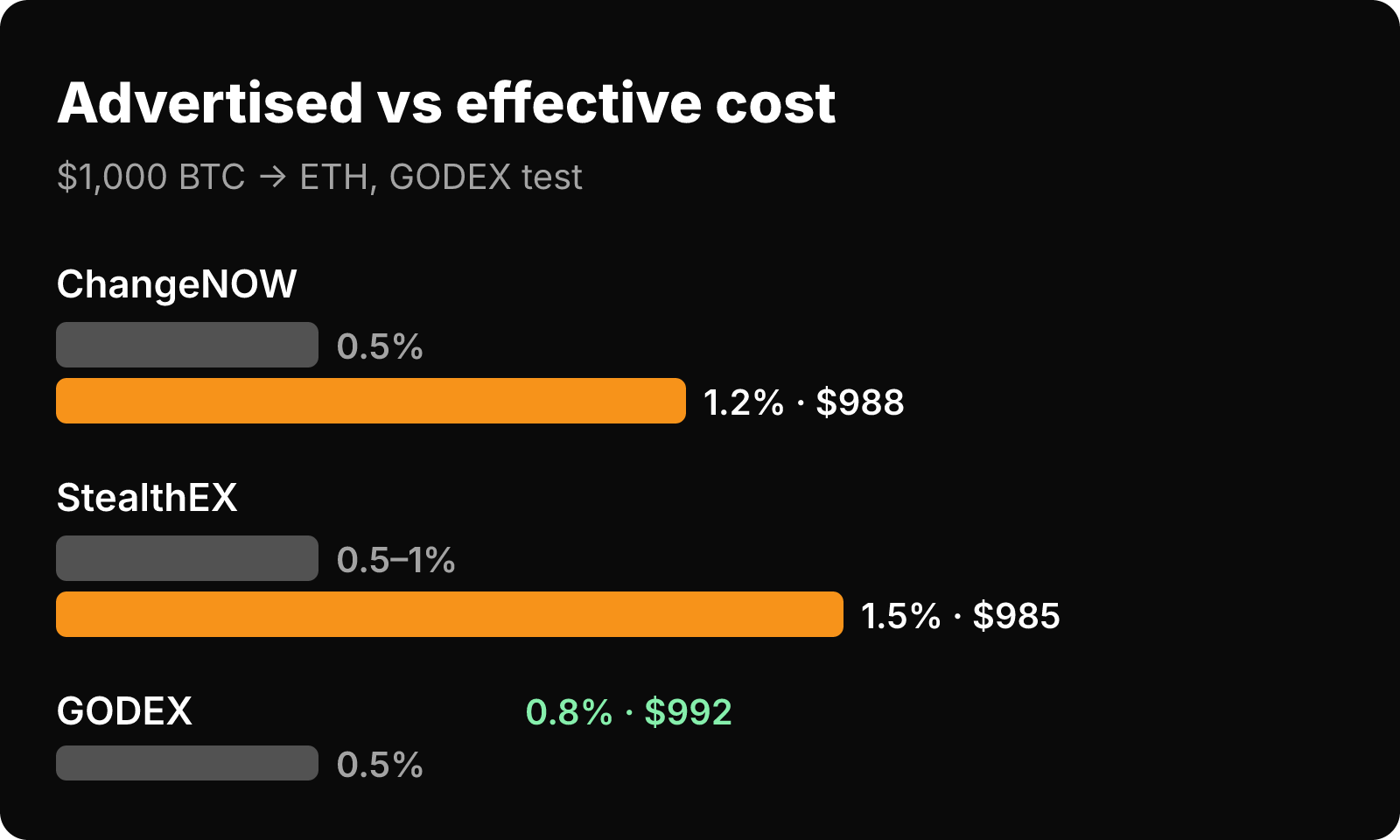
Spread is a major hidden cost at instant swap services. In GODEX's own 2026 test of a $1,000 BTC → ETH swap, ChangeNOW advertised 0.5% but effectively cost about 1.2%, StealthEX advertised 0.5–1% but cost about 1.5%, and GODEX advertised 0.5% and cost about 0.8%. The amounts received were $988, $985 and $992 (GODEX comparison test).
That was one transaction per provider, run by a company that ranked itself first. Treat it as an example rather than proof. Still, the point holds: the advertised fee and the actual cost can be 0.3–1 percentage point apart.
A CEX's 0.05% trading fee is not directly comparable to a swap service's 0.5% for a one-time conversion. With the exchange you also pay to deposit, wait for confirmations, pay a withdrawal fee, and carry custody risk while your coins sit there. Compare sats in versus value out, and nothing else.
4 Routes for the Lowest Fee Swap BTC No KYC
Each route below has a clear best use. Here are the honest trade-offs.
1. Instant Swap Services (GODEX, ChangeNOW, StealthEX, SimpleSwap)
You choose a pair, paste your destination address and send BTC to a deposit address the provider generates. The provider swaps it and sends you the output, usually within 5–30 minutes according to vendor figures.
- Pros: huge asset lists (SimpleSwap claims 2,800+ cryptocurrencies, StealthEX 2,000+), no sign-up, and routes to privacy coins like XMR.
- Cons: spread is built into the rate, no-KYC limits are informal and change (vendor-reported figures range from about €700 to "unlimited"), and funds can be frozen for review. In GODEX's $3,000 test, a ChangeNOW swap froze and asked for an ID upload.
2. Centralized Exchanges (MEXC, KuCoin, Gate.io, HTX)
CEXs have the lowest listed trading fees. MEXC charges 0% maker and 0.05% taker, KuCoin about 0.1%, Gate.io 0.15% and HTX 0.2%.
- Pros: deep liquidity and low per-trade fees for active traders.
- Cons: custodial, so the exchange holds your BTC. No-KYC access is disputed. GODEX lists a 10 BTC/day unverified limit at MEXC, but Coingape's September 2026 review found no usable unverified trading or withdrawal tier. Coingape also found no licenses for MEXC in NYDFS, FCA or MiCA registers.
3. Decentralized Exchanges (Uniswap, PancakeSwap)
DEXs are self-custodial. You trade directly with a liquidity pool from your own wallet. Uniswap v3 pools charge 0.05%, 0.30% or 1% tiers, and PancakeSwap charges about 0.25%.
- Pros: no intermediary, transparent on-chain pricing, no account.
- Cons: DEXs can't receive native Bitcoin. You first need BTC on that chain, which usually means a custodial wrapper or one of the routes above. For how wrapped BTC works, see WBTC to BTC Swap in Minutes: 4 Routes for Beginners. Ethereum mainnet gas adds $15–50 per swap according to GODEX's table.
4. TeleSwap: Native BTC to Tokens, No Middleman
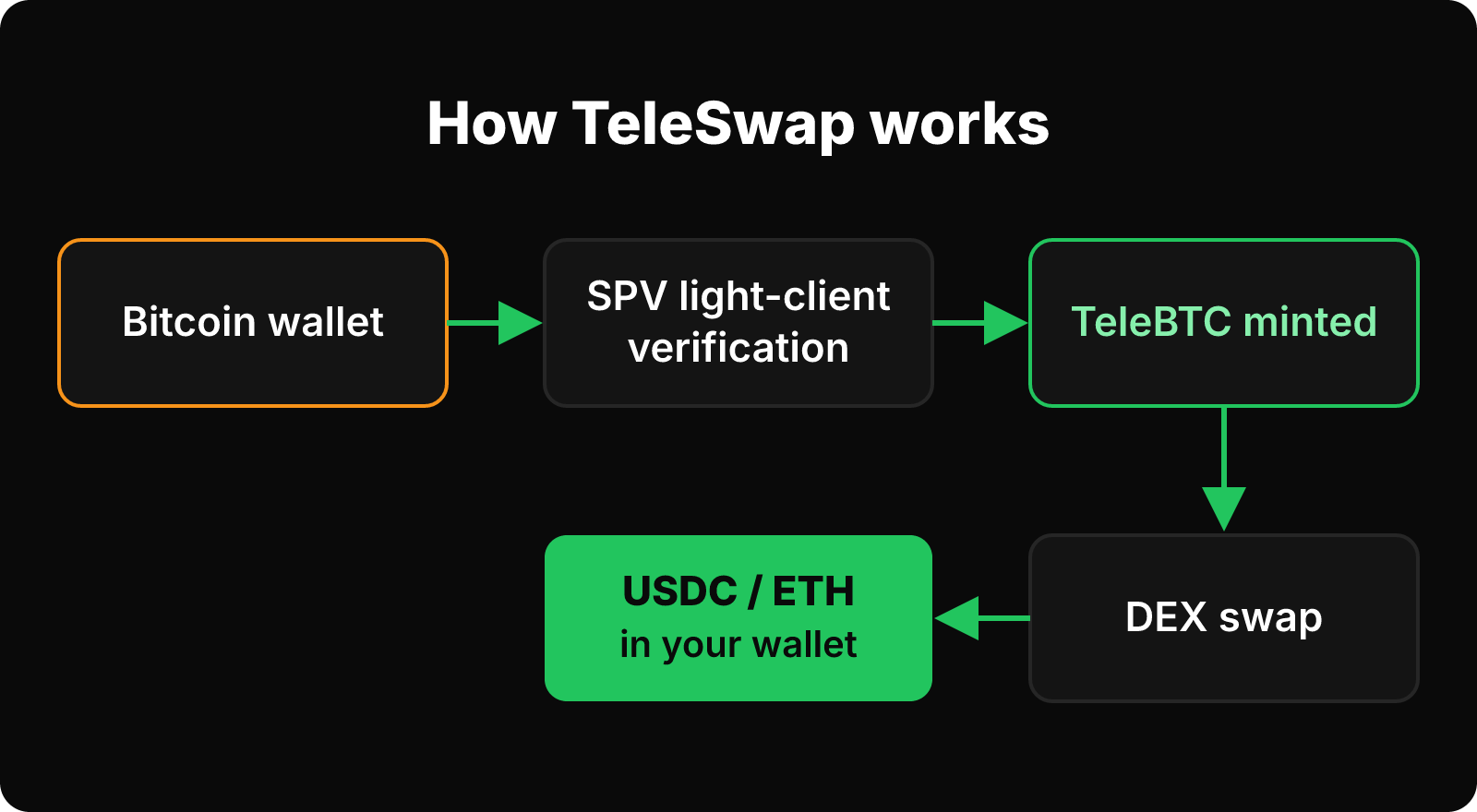
TeleSwap is a trust-minimized Bitcoin bridge and swap protocol that turns native BTC into tokens on EVM chains, TON and Solana in one step. It uses SPV light-client proofs instead of custodians or multisig committees. For background on how that verification works, see How Bitcoin Bridges Work: SPV Light Clients Explained.
When you send BTC, the protocol verifies your Bitcoin transaction on the destination chain. It then mints TeleBTC, a 1:1, collateral-backed representation of BTC, and routes it through a DEX into the token you chose. Nothing is minted without a verified Bitcoin transaction (TeleSwap documentation).
- Pros: start from native BTC in your own wallet, with no account and no exchange custody. All fees are paid in Bitcoin assets, and a Teleporter covers destination-chain gas, so you don't need ETH or BNB first. Fast swaps settle in about 10 minutes. It's permissionless.
- Cons: it only covers BTC ⇄ supported tokens on its networks, so no Monero. The final amount still depends on the Bitcoin network fee and DEX liquidity for your pair.
TeleSwap shows $533.6M in total volume bridged across 565,248 bridge transactions, with $39.6M in the last 30 days (about $1.3M per day, peaking at $2.1M on 2026-10-08), according to TeleSwap network stats.
Compared with other wrapped-BTC designs like WBTC or cbBTC, TeleBTC is verified through a light client that checks the Bitcoin chain directly rather than relying on a custodian or multi-sig committee. For the custody trade-offs, see WBTC Bridge Custody Risk vs Trustless Bitcoin Bridges in 2026. If your reason for avoiding KYC is to avoid trusting a middleman with your coins, this is the main difference.
How to Swap BTC Without KYC in 2026: TeleSwap Walkthrough
Here's a worked example of a BTC swap without KYC in 2026: 0.01 BTC → USDC on Arbitrum, using the BTC to USDC (Arbitrum) route.
Step-by-step
- Open teleswap.xyz and choose BTC as the source and USDC on Arbitrum as the destination. You can also use TeleSwap inside Rango, Rubic or DZap, or through MetaMask and Trust Wallet via the Rango integration.
- Enter your amount (0.01 BTC) and the EVM address that will receive USDC. Check the address twice. Transactions to the wrong address can't be reversed.
- Review the quote. It shows the estimated USDC you'll receive after protocol fees and the DEX swap. Note the minimum-received figure.
- Send the BTC from your Bitcoin wallet as instructed. Choose a network fee that suits how urgent the swap is (check mempool.space).
- Wait for verification. The protocol checks your Bitcoin transaction with an SPV proof, mints TeleBTC and swaps it into USDC. Fast swaps settle in about 10 minutes.
- Receive USDC in your wallet. A Teleporter covered the Arbitrum gas, and you paid for it in Bitcoin assets.
For a broader step-by-step with the same logic, see Trustless BTC Swap: 7-Step No-KYC Guide (2026).
Worked example: how to calculate what you receive
Use this comparison for any route, not just TeleSwap:
| Line item | TeleSwap (0.01 BTC → USDC, Arbitrum) | Instant swap service (same trade) |
|---|---|---|
| Amount sent | 0.01 BTC | 0.01 BTC |
| Bitcoin network fee | Paid once by your wallet (varies with mempool) | Paid once by your wallet (varies with mempool) |
| Provider / protocol fee | Shown in live quote | ~0.5% advertised |
| Spread / pool fee | On-chain DEX pool fee + slippage, reflected in the quote | Built into the rate; ~0.3%–1% extra in GODEX's test |
| Destination gas | Covered by Teleporter, paid in Bitcoin assets (shown in quote) | Included |
| Time | ~10 min (fast swap) | ~5–30 min (vendor-reported) |
| Custody during swap | No company custody: SPV-verified, collateral-backed | Provider holds your deposit |
For reference, if a $1,000 swap lost 1.2% to fees and spread, you would get about $988. That matches the ChangeNOW figure in GODEX's test. Every 0.5 percentage point you save keeps about $5 per $1,000 in your wallet.
To compare fairly, get both quotes for the same amount at the same time. Then compare the final USDC figure.
Prefer ETH? The same steps work for the BTC to ETH (Ethereum) route. On BNB Chain, see BTC to USDT (BNB Smart Chain).
BTC Swap Without KYC 2026: 5 Risks to Check First
- Mid-swap freezes. Custodial swap services can pause your swap for review. Their July 2026 terms allow this (StealthEX terms summary). Test with a small amount first.
- Fake sites and phishing. Copycat swap sites are a known problem. Type teleswap.xyz directly and bookmark it. TeleSwap has no separate app subdomain.
- Wrong network or address. Sending USDC to an address on the wrong chain, or BTC to an old deposit address, usually can't be undone.
- Overestimating privacy. "No account" doesn't mean untraceable. Bitcoin is a public ledger, and swap providers can log both your deposit and destination addresses.
- Custody and licensing. Coingape found no NYDFS, FCA or MiCA licenses for MEXC, Uniswap or GhostSwap as of September 2026 (Coingape). That limits your options if something goes wrong.
Frequently Asked Questions
What is the lowest fee way to swap BTC with no KYC?
The lowest-fee route depends on where you want your BTC to end up. For tokens on EVM chains, TON or Solana, a protocol route like TeleSwap avoids a company holding your deposit and lets you pay fees in Bitcoin assets. For privacy coins like XMR, an instant swap service is the practical option. Always compare the final amount you receive, not the advertised percentage.
Is it legal to swap BTC without KYC?
In many countries, swapping crypto from your own wallet without an account is legal, but the rules depend on where you live. Using a service that doesn't require ID doesn't remove your tax or reporting duties. Check your local regulations before swapping. This article is not legal advice.
Why does a swap advertising a 0.5% fee cost more?
The spread is usually the reason. Instant swap services quote a rate slightly worse than the market price. In GODEX's 2026 test, effective costs were about 0.8%–1.5% for services advertising around 0.5%. On top of that, you pay the Bitcoin network fee.
Are no-KYC centralized exchanges cheaper than swap services?
Their trading fees are lower, but the full cost of a one-time swap often isn't. MEXC lists a 0.05% taker fee, but you also pay deposit and withdrawal costs, your coins sit with the exchange, and sources disagree on whether unverified accounts can trade or withdraw at all.
Does TeleSwap require an account or KYC?
TeleSwap is a permissionless protocol, not an account-based exchange, so there's no account to open. You send BTC from your own wallet, the protocol verifies the Bitcoin transaction with an SPV light-client proof, mints TeleBTC and swaps it into your chosen token. It has processed 565,248 bridge transactions to date according to TeleSwap network stats. See teleswap.xyz/docs for details.
How long does a TeleSwap BTC swap take?
Fast swaps settle in about 10 minutes. The exact time depends on when your Bitcoin transaction confirms, which depends on the network fee you choose.
Can I use TeleSwap from MetaMask or Trust Wallet?
Yes, through the Rango integration. TeleSwap is a Bitcoin swap provider on the Rango, Rubic and DZap aggregators, and MetaMask and Trust Wallet users can reach it through Rango.
Conclusion: Pick the Route, Then Check the Final Amount
The lowest fee swap BTC no KYC route isn't the one with the smallest number on its homepage. It's the one that delivers the most value to your wallet without freezing halfway. Three things to remember:
- Compare the final amount received. Spread can add up to a full percentage point that never shows in the headline fee.
- "No KYC" at a custodial service is conditional. A protocol with no account changes the setup entirely.
- To turn native BTC into USDC, USDT, ETH and other tokens across its 13 supported networks, TeleSwap combines light-client verification, BTC-paid fees and ~10-minute fast swaps (network stats).
Get a live quote for your exact amount and compare it against any other route.