No KYC Bitcoin Trading Limits 2026: Risks & Tax Basics

You can trade Bitcoin without uploading a passport selfie, but the limits depend entirely on the type of platform. Published unverified limits in 2026 run from a few hundred dollars on swap services to 200,000 USDT per day on some custodial exchanges, and those exchanges can still ask for ID later. Sources often disagree, too: one says 5 BTC a day without verification, another says $700.
This guide covers the no KYC bitcoin trading limits 2026 platforms actually publish, why those limits exist, the risks most "best no-KYC exchange" lists skip, and the tax rules that apply whether anyone checks your ID or not. You don't need any crypto background to follow it.
One point first, because it changes how you should read everything below: "no KYC" describes the platform, not you. It means the service didn't verify your identity. Your taxes, your local laws and the public Bitcoin ledger all stay the same.
Key Takeaways:Unverified limits in 2026 range from about 0.002 BTC for a new Bisq buyer to 200,000 USDT per day on XT.com, according to Koinly's August 2026 review.On a centralized exchange, "no KYC" is conditional, and the platform can still ask for verification later before letting you withdraw.Non-custodial tools such as P2P markets, swap protocols and DEXs don't cap you through account tiers, but liquidity, fees and transaction size limit you instead.In the US, trading BTC for another crypto is a taxable event even if the platform never verified your identity, per IRS digital asset guidance.TeleSwap has processed 552,327 bridge transactions and $521.2M in total volume across 13 networks, according to TeleSwap network stats.
Table of Contents
- What does "no KYC" actually mean?
- No KYC bitcoin trading limits 2026: what each platform allows
- BTC trading no KYC: the five models explained
- Why a non-custodial Bitcoin DEX changes the limit question
- The 5 real risks of no-KYC Bitcoin trading
- No KYC crypto tax basics: what still applies
- Walkthrough: swapping BTC to USDC with TeleSwap
- Frequently Asked Questions
- Conclusion
What does "no KYC" actually mean?
KYC stands for "Know Your Customer." It's the identity check that banks, brokers and regulated crypto exchanges run before they let you move money: a photo ID, sometimes a selfie, sometimes a utility bill. It sits under anti-money-laundering (AML) rules.
Think of a centralized exchange as a coat check. You hand over your coat (your Bitcoin), get a ticket, and trust the attendant to give it back. The attendant is legally required to know who is leaving coats, so they ask for ID. Some coat checks will let you drop off a small jacket without ID. If you show up with a fur coat, the questions start.
That's a tiered-KYC exchange: small amounts unverified, larger amounts gated behind ID.
A non-custodial tool works differently. There's no coat check because you keep the coat. You trade straight from a wallet you control, using a "private key," a secret code that only you hold. No company holds your funds, so there's no account to verify.
Coin Bureau's October 2026 analysis notes that custodial platforms can request verification later, while wallet-connected platforms have no account to lock in the first place.
No KYC bitcoin trading limits 2026: what each platform allows
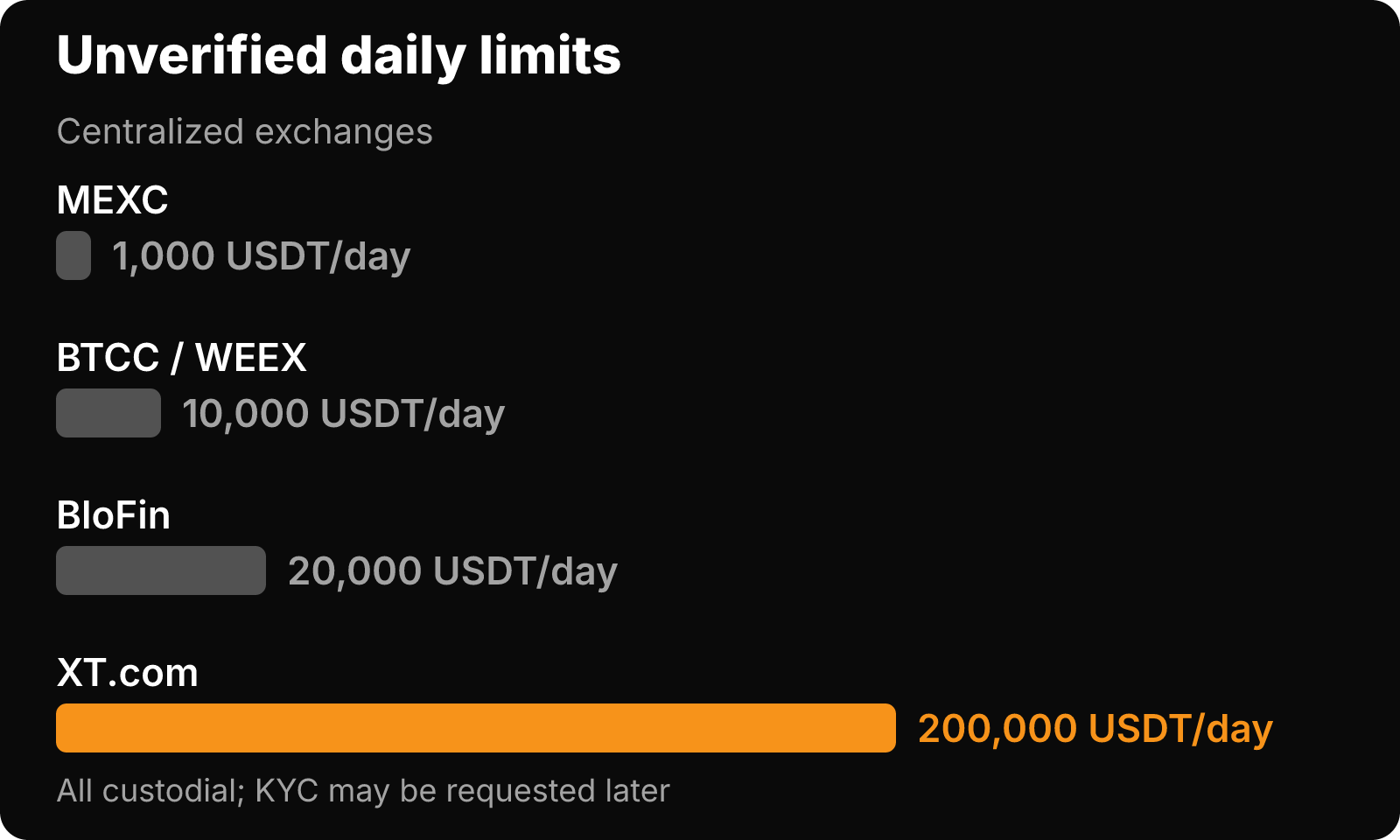
The short answer: it depends on the model, and the spread is huge. Published no KYC bitcoin trading limits in 2026 run from a few hundred dollars to six figures a day. The table below collects figures from reviews published between July and October 2026. These are policies the platforms report, not guarantees, and several sources disagree with each other, so check the platform's own terms before you rely on a number.
| Platform | Model | Reported unverified limit | Who holds your BTC? | Source |
|---|---|---|---|---|
| Bisq | Non-custodial P2P | ~0.002 BTC buy / ~0.0624 BTC sell (new accounts), rising over time | You (escrow during trade) | Koinly |
| RoboSats | Non-custodial P2P (Lightning) | $1,400 per trade | You (escrow during trade) | Koinly |
| StealthEX / ChangeHero | Swap service | ~$700 equivalent | Service, briefly | Baltex |
| ChangeNOW | Swap aggregator | ~$2,000 suggested ceiling | Service, briefly | Godex |
| MEXC | Centralized | 1,000 USDT/day | Exchange | Datawallet |
| CoinEx | Centralized | $10,000/24h; $50,000 rolling 30 days | Exchange | Coin Bureau |
| BTCC / WEEX | Centralized | 10,000 USDT/day | Exchange | Datawallet |
| BloFin | Centralized (futures) | 20,000 USDT/day | Exchange | Datawallet |
| Toobit | Centralized | 5 BTC/24h (50 BTC verified) | Exchange | Coin Bureau |
| XT.com | Centralized | 200,000 USDT/day; KYC may be requested | Exchange | Koinly |
| Uniswap | DEX | No account cap; bounded by liquidity and gas | You | Baltex |
| TeleSwap | Non-custodial Bitcoin bridge + swap | No account tiers; each swap is quoted individually at teleswap.xyz | You at both ends; bridged BTC backed by collateral-backed, slashable Lockers | TeleSwap documentation |
A few patterns stand out once you look past individual numbers:
- The biggest unverified limits are all on custodial exchanges. They can offer high limits because they keep the option to freeze your account and ask for ID before you withdraw.
- P2P limits start very small and grow with reputation. Bisq's buy limit for new accounts is roughly 0.002 BTC, and it rises as the account ages (Koinly).
- Swap service caps are the least consistent. Godex and Baltex give different ceilings for similar services, so treat any single figure as a rough estimate and check current caps.
Bybit is left out on purpose. One source lists a 10 BTC/day unverified limit, another says about 2 BTC/day, and the first also says verification has been mandatory for most features since 2024. If reviewers can't agree, you shouldn't plan around any of those numbers.
BTC trading no KYC: the five models explained
"No-KYC exchange" covers five quite different products. Picking the right one matters more than chasing the highest number. If you want the step-by-step version of the non-custodial route, our 7-step trustless BTC swap guide covers setup in detail.
1. Non-custodial peer-to-peer (Bisq, RoboSats, Peach)
You trade directly with another person, and software holds the Bitcoin in escrow until both sides confirm. Bisq runs over Tor and never holds user funds, per Koinly. It's the closest thing to buying Bitcoin with cash from a neighbor, with a referee involved. The trade-offs are low starting limits, slow trades and a learning curve.
2. Instant swap services (Godex, ChangeNOW, StealthEX)
You send coin A to an address and receive coin B in your wallet. It's simple, but the service controls the funds while the swap is in progress, and per-transaction caps apply.
3. Tiered-KYC centralized exchanges (XT.com, CoinEx, Toobit, MEXC)
You get a normal exchange account with order books and charts, plus an unverified tier with daily withdrawal caps. CoinEx, for example, raises its limit from $10,000 to $1M per 24 hours after Primary verification, according to Datawallet.
4. DEXs and wallet-connect platforms (Uniswap, edgeX)
A decentralized exchange (DEX) is a set of smart contracts, which are programs running on a blockchain. You connect your own wallet and trade against a liquidity pool. There's no account and no signup. The catch for Bitcoin holders is that native BTC doesn't run on Ethereum-style chains, so you need a bridge first. Some bridges still rely on custodians, which is why our WBTC bridge custody risk comparison is worth reading before you pick one.
5. Cash routes (Bitcoin ATMs, in-person P2P)
ATMs often allow small purchases without ID. Baltex reports sub-$1,000 limits, which we couldn't verify, and fees are usually steep.
Why a non-custodial Bitcoin DEX changes the limit question
On a non-custodial Bitcoin DEX, nobody grants you a limit, because nobody has your money to hold back. What limits you is practical: how much liquidity sits in the pool, how much your trade moves the price ("slippage"), and network fees.
A custodial "200,000 USDT/day no-KYC" offer and a non-custodial swap are different promises. The first means "we'll probably let you withdraw." The second means "the code either executes or it doesn't." When a custodial withdrawal gets flagged, your funds stay put until you comply.
Bitcoin adds a complication. Most DEX liquidity lives on chains like Ethereum, Arbitrum, BNB Smart Chain and Base, while your BTC lives on Bitcoin. Historically, crossing that gap meant using a custodial wrapper such as WBTC, which puts a company back in the middle.
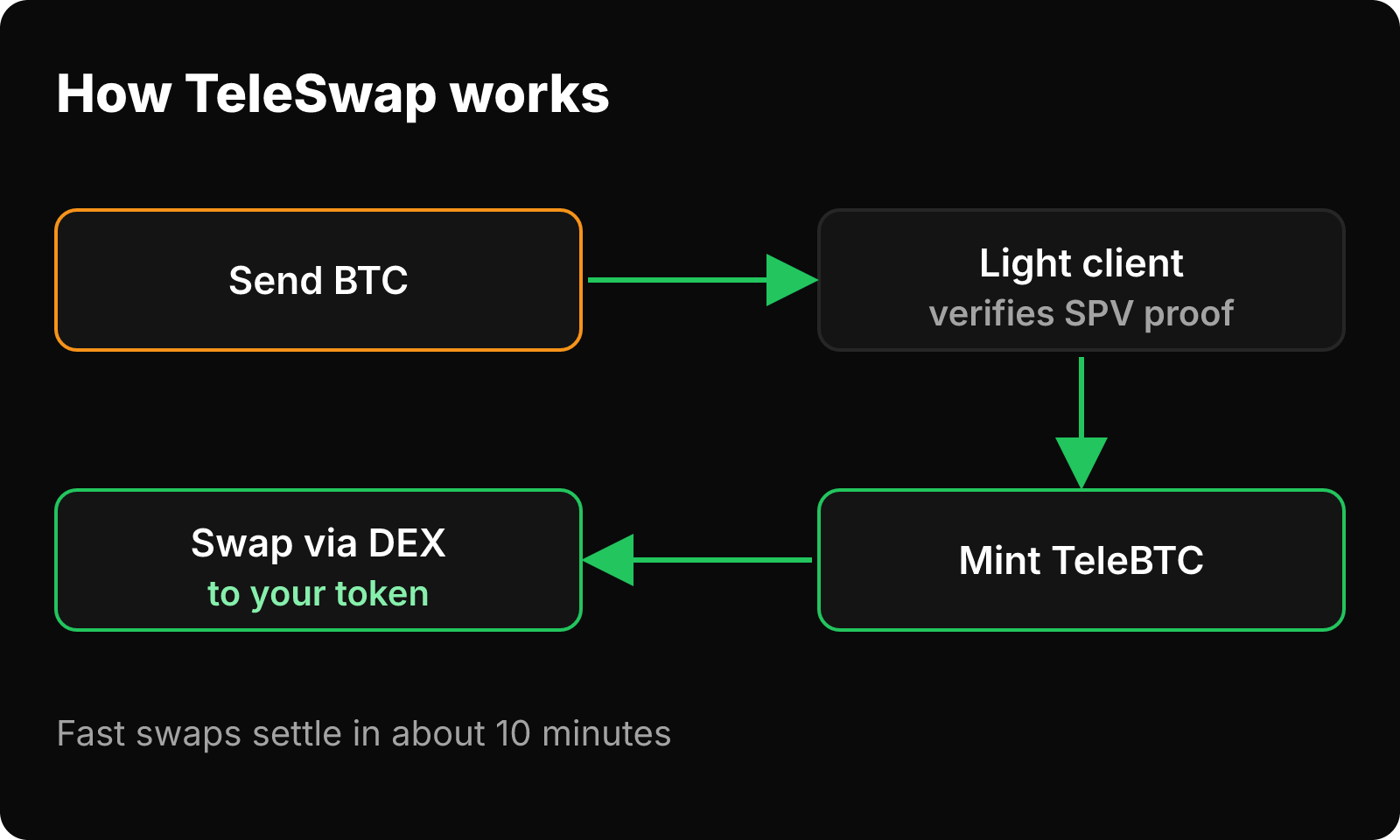
TeleSwap, the non-custodial Bitcoin bridge and swap protocol, is designed to remove that middleman. When you bridge, TeleSwap mints TeleBTC, a 1:1 collateral-backed representation of BTC. Nothing is minted without a verified Bitcoin transaction, which a light client checks with an SPV proof. (SPV, or Simplified Payment Verification, is a way to prove a transaction was included in a Bitcoin block without trusting a third party's word for it.)
TeleSwap can then route that TeleBTC through a DEX in the same step. You go from native BTC to an ERC-20, Jetton or SPL token. Fast swaps settle in about 10 minutes.
How does TeleBTC compare with the other wrapped-Bitcoin options?
| Wrapped BTC | Who secures the BTC | Trust model |
|---|---|---|
| WBTC | Custodian(s) under a merchant/custodian structure | Trust the custodian |
| cbBTC | Coinbase | Trust a single regulated company |
| tBTC | Threshold network signer groups | Trust that a threshold of signers stays honest |
| TeleBTC | Collateral-backed, slashable Lockers; minting gated by SPV light client proofs | Trust-minimized; inherits Bitcoin's security model through SPV verification |
As of October 18, 2026, TeleSwap has processed 552,327 bridge transactions and $521.2M in total volume across 13 supported networks. It bridged $42.2M in the last 30 days, about $1.4M per day, peaking at $2.6M on September 21, 2026, according to TeleSwap network stats.
The 5 real risks of no-KYC Bitcoin trading
The biggest risk of "no KYC" is often misunderstood. It usually isn't regulators. It's assuming you're more private, or more protected, than you actually are.
- Retroactive verification. On custodial exchanges, the no-KYC tier is a policy, not a right. Coin Bureau and XT.com's own terms both say verification can be requested later for AML or withdrawal-risk reasons.
- Counterparty and custody risk. "Not your keys, not your coins." If an offshore exchange freezes withdrawals or fails, an unverified account gives you very little to point to in a legal claim. Proof-of-reserves claims from several platforms are self-reported.
- Bitcoin is pseudonymous, not anonymous. Every Bitcoin transaction is permanently public. Skipping KYC on one platform doesn't erase the chain linking your coins back to a verified exchange you used years ago.
- Regional restrictions. Some platforms exclude certain countries outright. YDFi, for example, excludes the UK and US, per Koinly. Using a platform from a country it excludes can put your account at risk.
- Operational risk on non-custodial tools. Self-custody means you're responsible for everything. P2P trades can involve payment fraud or chargebacks. DEXs carry smart-contract risk and have no customer support to reverse a mistake. Sending to the wrong address is permanent.
The non-custodial route doesn't remove risk. It swaps company risk for personal responsibility. Go in knowing which risk you're taking on.
No KYC crypto tax basics: what still applies
Your tax obligations are the same whether or not a platform verified your identity. This is general education, not tax advice, so check with a qualified professional where you live.
What counts as a taxable event (US)?
The IRS treats digital assets as property. Per IRS digital asset guidance, selling crypto, trading one crypto for another, or spending it can all trigger a gain or loss. In plain terms:
- BTC → USDC: taxable. You "sold" BTC at its dollar value at that moment.
- BTC → ETH: taxable, for the same reason.
- Buying BTC with dollars and holding it: not taxable until you dispose of it.
- Moving BTC between your own wallets: generally not a disposal.
- Bridging BTC into a 1:1 wrapped form: the treatment isn't settled. Ask a tax professional.
How much tax?
According to CoinTracking's 2026 US guide, BTC held more than 12 months is taxed at long-term capital gains rates of 0% to 20%. BTC held 12 months or less is taxed as ordinary income, at 10% to 37% depending on your bracket. Income from staking, rewards or airdrops counts as ordinary income when you receive it. Verify current bracket thresholds before filing.
The 2026 reporting picture
US brokers began reporting digital asset sales on Form 1099-DA for transactions from 2025 onward. Offshore and non-custodial platforms may not issue forms, but you still must report. Check current IRS rules for what applies to you.
The takeaway: a non-custodial or offshore platform may not send you a tax form, and you still have to report. Since nobody is keeping the records for you, keep them yourself.
A simple record-keeping habit
For every swap, write down: date and time, asset sent and amount, asset received and amount, the USD value at the time, fees paid, and the transaction hash. A spreadsheet is fine.
Walkthrough: swapping BTC to USDC with TeleSwap
Say you hold 0.05 BTC in a Bitcoin wallet you control, and you want stablecoins on Arbitrum to use in DeFi.
- Set up both wallets. You need a Bitcoin wallet (where your BTC sits) and an EVM wallet such as MetaMask to receive tokens on Arbitrum. Back up both seed phrases offline.
- Open the route. Go to the BTC → USDC (Arbitrum) page on teleswap.xyz.
- Enter your amount and read the quote. TeleSwap charges fees in Bitcoin terms and shows a fee breakdown in the estimate, per the Fees & Speed docs. Check the amount you'll receive before you confirm.
- Paste your Arbitrum address. This is where the USDC will arrive, in your own wallet.
- Send the BTC. Your Bitcoin transaction is verified by a light client. Only then is TeleBTC minted and swapped into USDC through the DEX. You don't need ETH for Arbitrum gas, because a Teleporter covers destination-chain gas and you pay all fees in Bitcoin assets.
- Receive and record. A fast swap settles in about 10 minutes. Log the date, amounts, USD value and both transaction hashes for taxes.
Going the other way works the same: the USDC (Arbitrum) → BTC route returns native BTC to your Bitcoin address. For a broader look at wrapping and unwrapping costs, see our WBTC to native Bitcoin fee comparison.
You don't have to use the TeleSwap site directly, either. TeleSwap is integrated as a Bitcoin swap provider in the Rango, Rubic and DZap aggregators, and through Rango in MetaMask and Trust Wallet.
Frequently Asked Questions
Is it legal to trade Bitcoin without KYC?
In many countries, using a non-custodial wallet or P2P trade without KYC is legal, but it depends on where you live. KYC rules usually apply to the service provider, not the individual user. Some jurisdictions restrict specific platforms, and you remain responsible for local law and taxes. Check your country's rules before trading.
What is the highest no-KYC Bitcoin trading limit in 2026?
Among centralized exchanges, XT.com reports one of the highest unverified limits at 200,000 USDT per day, and Toobit allows 5 BTC per 24 hours. These figures come from Koinly and Coin Bureau reviews published between August and October 2026. Both platforms are custodial and can ask for verification later, so a high limit doesn't guarantee you can withdraw.
Do I have to pay taxes on no-KYC crypto trades?
Yes. Skipping identity verification doesn't change your tax obligations. In the US, trading BTC for another crypto or a stablecoin is a taxable event. Gains are taxed at 0–20% if held over a year, or at ordinary income rates of 10–37% if held a year or less. Keep your own records, because non-custodial platforms won't send you tax forms.
Is no-KYC trading anonymous?
No. Bitcoin is pseudonymous, not anonymous. Every transaction is recorded permanently on a public ledger, and blockchain analysis can often link addresses back to identities, especially if your coins ever passed through a KYC exchange. No-KYC tools limit how much personal data you hand over. They don't make your activity invisible.
What is a non-custodial Bitcoin DEX?
A non-custodial Bitcoin DEX lets you trade BTC straight from your own wallet without handing control of your funds to a company. Because there's no account holding your money, there are no account-tier withdrawal limits. What limits you is liquidity, slippage and network fees. Protocols like TeleSwap extend this to native Bitcoin by verifying BTC transactions with SPV light client proofs.
How does TeleSwap let me swap BTC without a custodian?
TeleSwap mints TeleBTC, a 1:1 collateral-backed representation of BTC, only after a light client verifies your Bitcoin transaction, then swaps it into your chosen token in one step. You send from your own Bitcoin wallet and receive tokens in your own wallet on the destination chain. Fast swaps settle in about 10 minutes, and fees are paid in Bitcoin assets.
Conclusion
No KYC bitcoin trading limits 2026 cover a huge range, from a few hundred dollars on swap services to six figures a day on custodial exchanges. The headline number matters less than the model behind it. Custodial "no-KYC" limits are a policy that can change when you try to withdraw. Non-custodial tools don't grant you limits at all. What constrains you there is liquidity and your own care.
Whichever route you pick, two things hold: Bitcoin's ledger is public, and your tax obligations still apply. Keep good records and get your own advice.
If you want to move native BTC into DeFi without handing it to a custodian, TeleSwap gives you a light-client-verified route: send from your own wallet, pay fees in Bitcoin assets, and receive tokens in about 10 minutes.
This article is for educational purposes only and isn't financial, legal or tax advice. Platform limits are as reported by third-party reviews between July and October 2026 and may have changed.