Ethereum Staking Explained: What IBKR's Launch Means

On October 13, 2026, one of the world's largest brokerages added a button that, a few years ago, only crypto natives knew how to use. Interactive Brokers announced that eligible clients can now stake Ethereum directly from their brokerage account. If you hold ETH there, you can now earn more ETH on it, much like interest on a savings account.
But what are you actually signing up for? This guide gives you Ethereum staking explained from first principles: what staking is, where the rewards come from, what can go wrong, and what IBKR's launch changes (and doesn't change) for ordinary investors. No prior crypto knowledge is needed.
Key Takeaways:Ethereum staking means locking ETH so it can help secure the network, and the network pays rewards in ETH for that work.Network-wide Ethereum staking rewards run at roughly 2.8–3.3% APR in 2026, according to stakefish.Interactive Brokers launched Ethereum staking on October 13, 2026, with zerohash running the staking infrastructure.IBKR and zerohash share a fee capped at 30% of rewards earned, per 24/7 Wall St.Staking rewards are paid in ETH, so staking increases how much ETH you hold but cannot protect the dollar value of your position if the ETH price falls.
Table of Contents
- What Is Ethereum Staking, in Plain English?
- How Does Ethereum Staking Work Under the Hood?
- Where Do Staking Rewards Come From, and How Much Are They?
- What Is Interactive Brokers Ethereum Staking?
- How Can You Stake ETH Without Running a Node?
- What Does the IBKR Launch Mean for Clients?
- What Are the Risks of Staking ETH?
- A 5-Question Checklist Before You Stake
- Why Can't You Stake Bitcoin the Same Way?
- Frequently Asked Questions
- Conclusion
What Is Ethereum Staking, in Plain English?
Ethereum staking is locking up ETH as a security deposit so you (or someone acting for you) can help verify transactions on the Ethereum network, in exchange for rewards paid in ETH.
Think about how a landlord asks for a security deposit. The deposit doesn't pay the rent. It exists so the tenant has something to lose if they damage the apartment.
Ethereum uses the same idea. Anyone who wants to help run the network has to put up a deposit in ETH. Behave honestly and you get paid. Try to cheat and the network keeps part of your deposit.
That deposit is the "stake." The people (really, computers) who post it are called validators.
Why does Ethereum need this at all? Every blockchain has to answer one hard question: with thousands of strangers keeping copies of the same ledger, who gets to decide which transactions go in next? Bitcoin answers with proof-of-work, where miners burn electricity racing to solve a puzzle. Since September 2022, Ethereum has answered with proof-of-stake: the right to add blocks is tied to how much ETH you have locked up, not how much electricity you burn, as described in Ethereum's official documentation.
The scale is large. Around 37 million ETH, more than 30% of the total supply, was staked across roughly 900,000+ validators in 2026, according to stakefish's State of Ethereum report. The 30% mark was first reported on February 11, 2026, per ChainLabo.
How Does Ethereum Staking Work Under the Hood?
Ethereum staking works by randomly assigning validators two jobs, proposing new blocks and voting on other validators' blocks, and paying or penalizing them based on how well they do those jobs.
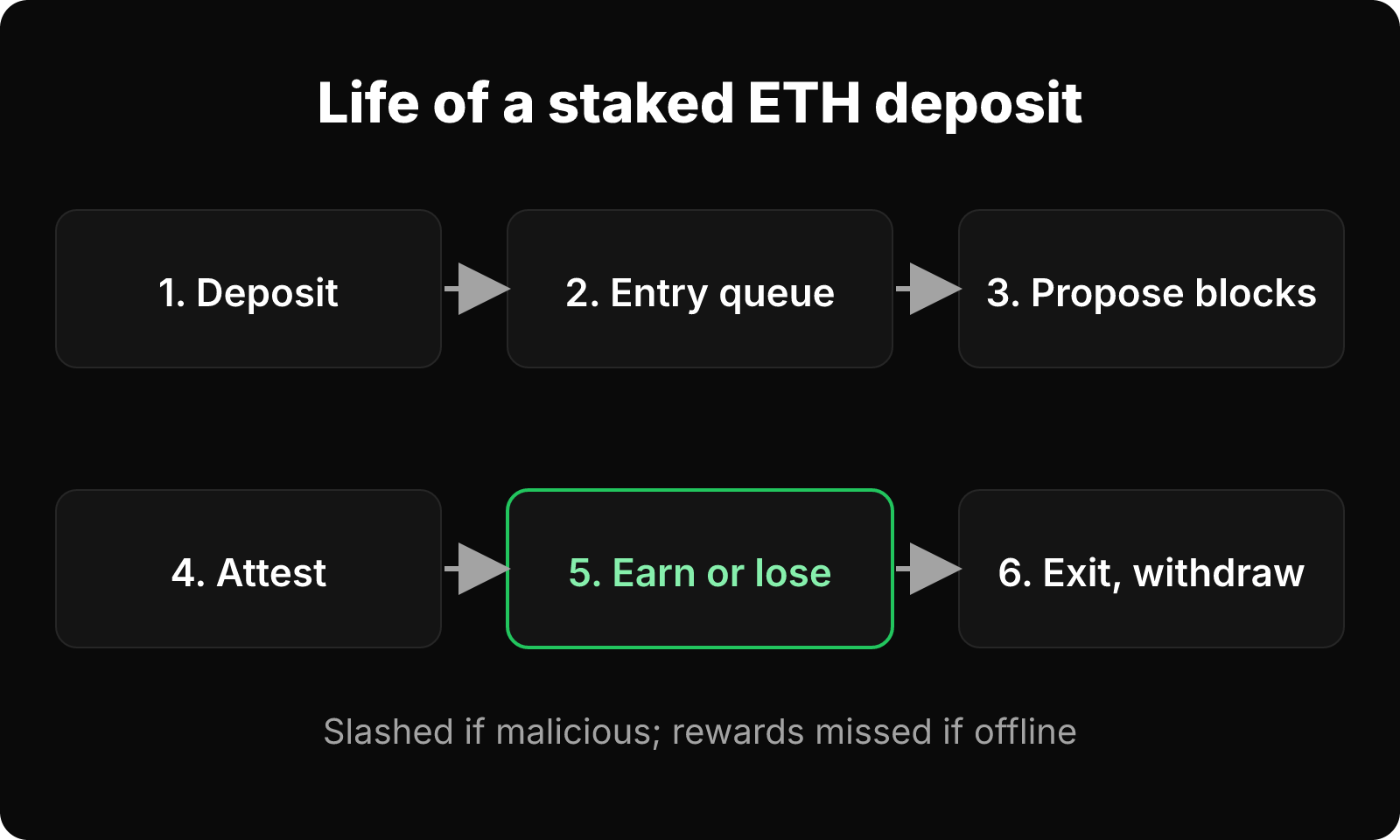
Here's the lifecycle of a staked ETH deposit, step by step:
- Deposit. A validator locks ETH into Ethereum's staking contract. Running your own validator requires 32 ETH, as Data Wallet's staking guide notes.
- Wait in the entry queue. Ethereum only lets so many new validators join at a time, which keeps the validator set stable. When demand spikes, the line gets long. The entry queue peaked at 71 days in February 2026, driven by institutional inflows, according to stakefish.
- Propose blocks. Selected validators propose new blocks, bundling transactions together.
- Attest. Other validators check that block and vote ("attest") that it's valid.
- Earn or lose. Online, honest validators earn ETH. Validators that go offline miss rewards. Validators that behave maliciously get slashed: part of their staked ETH is penalized.
- Exit and withdraw. To get ETH back, a validator joins an exit queue and then waits for the withdrawal to be processed. Like the entry queue, this can stretch out when many people leave at once.
A useful analogy: validators are like a rotating jury. Each round, one juror drafts the verdict and the rest vote on whether it's correct. Jurors who show up get paid, jurors who skip get docked, and jurors caught lying lose their bond.
For a broader view of how Ethereum's protocol changes affect this machinery, see Ethereum Upgrades 2026: What They Mean for Bitcoin DeFi.
Where Do Staking Rewards Come From, and How Much Are They?
Staking rewards come from the protocol, which pays validators in ETH for proposing and attesting to blocks, so they are not funded by new depositors.
That matters. Unlike some "yield" products, staking rewards aren't funded by new depositors or a company's marketing budget. The network itself pays for security.
How much? Network-wide staking APR sits around 2.8–3.3% in 2026, per stakefish. stakefish notes that yield per validator has been falling as more capital enters, so more stakers means smaller slices for each.
Then there's the provider's cut. Unless you run your own validator, someone else does the work and takes a commission. That fee is where the real difference between staking options shows up, as we'll see with IBKR.
What Is Interactive Brokers Ethereum Staking?
Interactive Brokers Ethereum staking is a service, launched October 13, 2026, that lets eligible IBKR clients stake ETH held in their brokerage accounts while zerohash, a crypto infrastructure firm, runs the staking infrastructure.
Here's what we know from the IBKR press release and early coverage:
- Asset: Ethereum only at launch. The release refers to "supported digital assets," but ETH is the only one named.
- Provider: zerohash runs the staking infrastructure.
- Where: A Staking Dashboard in IBKR's Client Portal, where clients submit stake and unstake requests and track pending activity.
- How rewards are paid: Rewards are credited as additional staked crypto, so they can compound while the position stays staked.
- Who: Eligible Interactive Brokers LLC clients. Availability depends on the affiliate and country of residence, so investors outside the U.S. shouldn't assume access, per Investing.com.
- Fees: IBKR and zerohash share a fee capped at 30% of rewards earned, according to 24/7 Wall St.
Just as important is what wasn't disclosed at launch: the reward rate, the minimum stake, and the withdrawal timeline. 24/7 Wall St flagged all three as missing.
IBKR's CEO Milan Galik framed staking as "similar to how our Stock Yield Enhancement Program allows clients to earn additional income on shares they own." That program lends client shares to short sellers. The comparison helps: in both cases, an asset you already hold gets put to work.
How to stake ETH on Interactive Brokers (based on what's public)
- Confirm your account is with Interactive Brokers LLC and that staking is available for your region.
- Buy or hold ETH in your account. IBKR lists crypto commissions of 0.12%–0.18% of trade value with a $1.75 minimum per order, according to its press release.
- Open the Staking Dashboard in the Client Portal.
- Submit a stake request for the amount of ETH you want to stake, and check the terms shown for rate, minimum, and unstaking time before confirming.
- Monitor pending activity in the dashboard.
- To exit, submit an unstake request from the same dashboard and expect a delay before the ETH is free to sell.
How Can You Stake ETH Without Running a Node?
You can stake ETH without running a node by using a custodial platform (like a broker or exchange), a staking pool, a liquid staking protocol, or a staking ETF, each of which trades some control or yield for convenience.
Running your own validator means 32 ETH, a computer online around the clock, and responsibility for every mistake. Most people don't want that. Here's how the alternatives compare:
| Method | Minimum | Who runs validators | Typical cost | Liquidity |
|---|---|---|---|---|
| Solo validator | 32 ETH | You | Hardware + your time; no commission | Locked; protocol exit queue |
| Broker staking (e.g., IBKR via zerohash) | Not disclosed at launch | Provider (zerohash) | Up to 30% of rewards | Platform's unstake process; timeline undisclosed |
| Pooled staking | Smaller amounts | Pool operator | Node operator fees | Varies by pool |
| Liquid staking | Smaller amounts | Protocol's node operators | Protocol fees | Receipt token can be traded or used in DeFi |
| Staking ETF (e.g., BlackRock ETHB) | Not specified in sources | Fund's providers | Distributes 82% of rewards, plus fund costs | Shares trade on an exchange |
Sources: Data Wallet, stakefish, IBKR press release, 24/7 Wall St. BlackRock's ETHB launched March 12, 2026, stakes 70–95% of its ETH, and distributes 82% of staking rewards to investors monthly, according to stakefish.
The ETF passes on 82% of rewards, while IBKR's fee cap means you keep at least 70%. These figures aren't directly comparable, since the ETF's staking ratio and other costs differ and the products hold ETH differently. Still, it's a useful benchmark.
What Does the IBKR Launch Mean for Clients?
For IBKR clients, the launch removes the hardest parts of staking (choosing a provider, managing keys, and running hardware) but adds a fee of up to 30% and leaves key terms undisclosed.
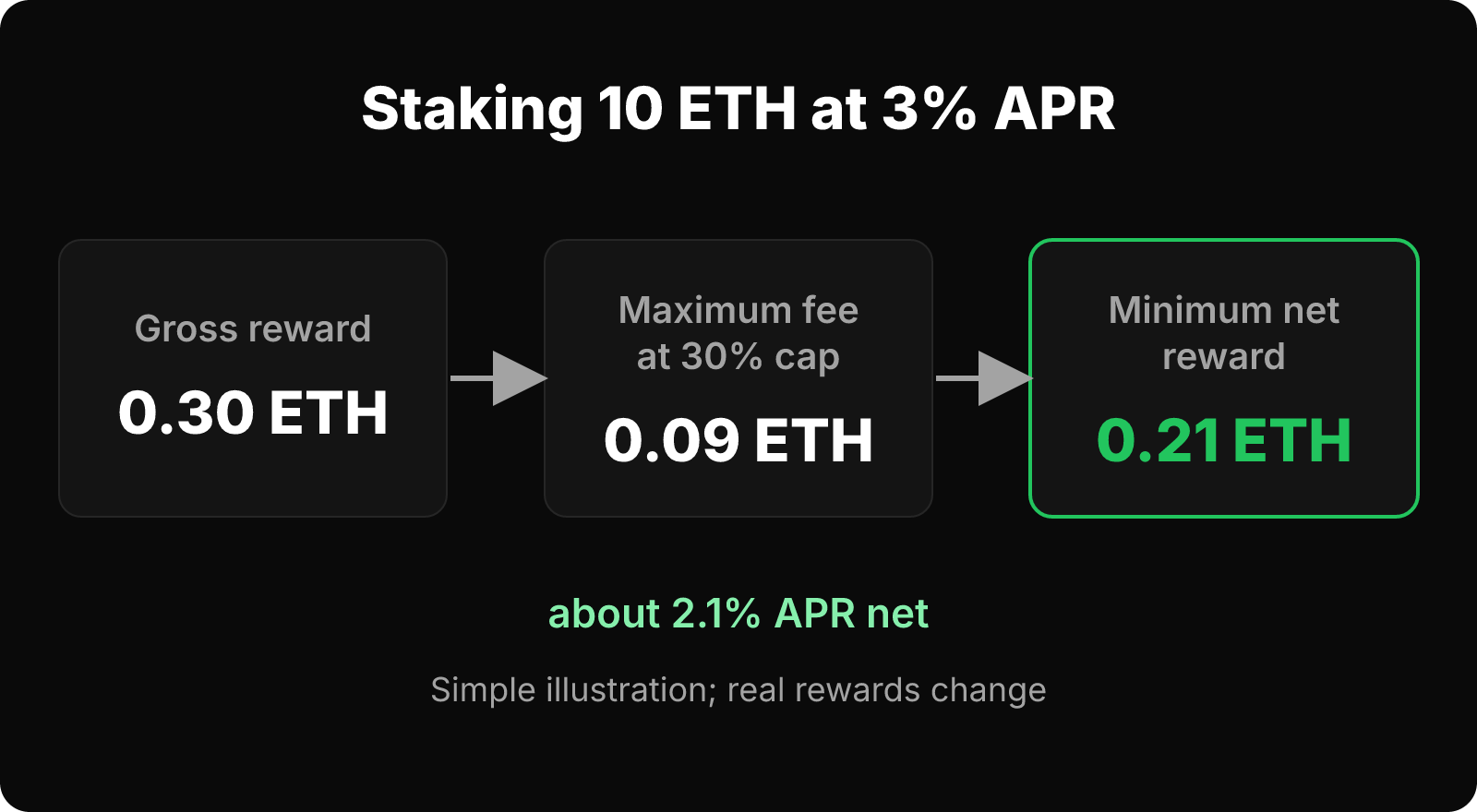
Let's put numbers on it. Say you stake 10 ETH and the network pays 3% APR, the middle of stakefish's 2.8–3.3% range:
- Gross reward over a year: 0.30 ETH
- Maximum fee at a 30% cap: 0.09 ETH
- Your minimum net reward: 0.21 ETH, or about 2.1% APR
That's a simple illustration. Real rewards change, and IBKR hadn't published its rate at launch. 24/7 Wall St cited a 1.56% return figure without a clear basis, so it's unclear what it reflects. Check the rate in your dashboard before you commit.
The 30% cap is a cost of convenience. Specialist staking operators advertise lower commissions. stakefish, for example, reports an average commission of 2.9% (a company claim). What IBKR offers is crypto next to your stocks in one account. For many investors that convenience is worth it, but you should know you're paying for it.
The launch also comes at a calmer regulatory moment. On September 25, 2026, SEC staff stated that staking ETH does not make those tokens securities, as reported by Yahoo Finance. That's staff guidance, not law, and it came ten days after the Senate failed to pass the Clarity Act on September 15, 2026. It helps, but it isn't permanent certainty.
The bigger picture: IBKR joins BlackRock, Grayscale, and the Ethereum Foundation itself (which began staking its treasury on February 24, 2026, targeting 70,000 ETH, per stakefish) in making staking a mainstream financial product. CoinDesk's August 2026 advisor briefing covers how staking is changing for institutions.
What Are the Risks of Staking ETH?
The biggest risk of staking ETH is price risk: rewards are paid in ETH, so if ETH's price falls, your dollar value can drop even while your ETH balance grows.
Investing.com makes the point directly: earning more ETH is not the same as earning a positive dollar return. If ETH falls 10% over a year and you earned 2.1% net in ETH, you're still down roughly 8% in dollar terms. Staking doesn't hedge anything.
The other risks:
- Liquidity risk. Unstaking isn't instant. Ethereum has an exit queue, and IBKR hadn't disclosed its withdrawal timeline at launch.
- Counterparty risk. Your ETH sits with IBKR and its provider zerohash. You're trusting both to run staking properly and to process withdrawals.
- Slashing and downtime. Validators that go offline lose rewards. Validators that misbehave can be penalized. Check how the platform handles slashing losses. For more on validator failure modes, read Ethereum Validator Security & Bitcoin Bridge Risks.
- Regulatory risk. Staff guidance is non-binding and there's no statute yet.
- Centralization risk. As institutions hold a growing share of stake, critics argue Ethereum becomes less decentralized. ChainLabo flags validator concentration as something to monitor.
Liquid staking and restaking (such as EigenLayer) add more layers: extra token and protocol risk and additional slashing conditions, as Data Wallet outlines. The press release doesn't say whether IBKR issues liquid staking tokens.
A 5-Question Checklist Before You Stake
People tend to focus on the headline yield and skip the exit terms. Ask these five questions, in this order:
- How fast can I get out? Find the unstaking timeline. If it isn't disclosed, don't assume it will be quick.
- What's my net rate? Gross APR minus the provider's cut. At IBKR, the fee can be up to 30% of rewards.
- Who holds the keys? Broker, smart contract, or you? Each has a different failure mode.
- What happens if a validator is slashed? Does the provider absorb the loss, or do you?
- Would I hold this ETH anyway? If the answer is no, a 2–3% reward won't fix a position you don't believe in.
Why Can't You Stake Bitcoin the Same Way?
You can't stake Bitcoin natively because Bitcoin runs on proof-of-work, so there's no protocol-level staking yield for holding BTC. Both CoinDesk and 24/7 Wall St point out that Bitcoin treasury holders, unlike Ethereum ones, can't earn native yield on their holdings.
That leaves Bitcoin holders with two choices. Some convert part of their BTC to ETH so they can stake. If you want to do that without a centralized exchange, TeleSwap's BTC → ETH route bridges and swaps native Bitcoin to ETH on Ethereum in one step. Fast swaps settle in about 10 minutes, and nothing is minted without a verified Bitcoin transaction.
Others want their yield to stay in BTC. Earning in BTC isn't the same as staking. On TeleSwap it comes from things like providing wrapped-BTC liquidity or running protocol roles that earn fees. TeleSwap has processed 552,327 bridge transactions and $521.2M in total volume, according to TeleSwap network stats. Those earnings depend on activity and carry their own risks. They aren't guaranteed. For a related look at cross-chain yield, see Cross-Chain Intents Explained: Solana to Ethereum Yield.
Frequently Asked Questions
What is Ethereum staking in simple terms?
Ethereum staking is locking up ETH as a security deposit that helps secure the Ethereum network, in return for rewards paid in ETH. Validators use staked ETH to propose and vote on new blocks. Honest work earns rewards, and misbehavior can cost part of the deposit.
How much can I earn staking Ethereum?
Network-wide Ethereum staking pays roughly 2.8–3.3% APR in 2026, before provider fees, according to stakefish. Your actual return depends on the provider's cut. At IBKR, where fees are capped at 30% of rewards, a 3% gross rate would leave at least 2.1% net.
Is Interactive Brokers Ethereum staking available to everyone?
No. It is available to eligible Interactive Brokers LLC clients, and access depends on the affiliate and country of residence. Investors outside the U.S. shouldn't assume they can use it. Check the Staking Dashboard in the Client Portal to confirm.
Can I stake ETH without running a node?
Yes. You can stake ETH without running a node through a broker or exchange, a staking pool, a liquid staking protocol, or a staking ETF. Running your own validator needs 32 ETH and constant uptime. The other options accept smaller amounts but charge fees and add some counterparty or smart contract risk.
Can I lose money staking ETH?
Yes. You can lose money in dollar terms if the ETH price falls by more than you earn in rewards. Slashing, platform failure, and being unable to unstake quickly during a sell-off are other ways staking can hurt your returns.
How long does it take to unstake ETH on IBKR?
IBKR did not disclose its unstaking timeline at launch. At the protocol level, unstaking involves an exit queue plus withdrawal processing, which can take longer when many validators leave at once. Check the terms in your dashboard before staking.
Is staked ETH a security?
SEC staff stated on September 25, 2026 that staking ETH does not make those tokens securities. This is staff guidance rather than law, and the Clarity Act failed in the Senate on September 15, 2026, so there is still no legal certainty.
Conclusion
Ethereum staking comes down to a simple trade: you lock ETH to help secure the network, and the network pays you roughly 3% a year in more ETH. IBKR's October 2026 launch makes that trade available from a regular brokerage account. In return, you pay up to 30% of your rewards and accept terms that weren't fully disclosed at launch.
Three things to remember: staking grows your ETH balance, not your dollar value. Exit terms matter more than the headline rate. And convenience is a real cost, so make sure it's worth the price for you.
Holding Bitcoin and want ETH to stake, or looking for Bitcoin-native ways to put BTC to work? Explore trustless BTC bridging and swaps at teleswap.xyz.