Bitcoin IRA Explained: How Retirement Accounts Hold BTC

Picture two people who each put $7,500 of Bitcoin aside in 2026 and never touch it. Twenty years later they hold the same number of coins and see the same price chart. Their tax bills can still look completely different, because one of them bought inside a bitcoin IRA and the other didn't.
A bitcoin IRA is an Individual Retirement Account that holds Bitcoin, or a fund that tracks Bitcoin, instead of only stocks and bonds. It runs under the same tax rules as any other U.S. IRA. It still feels the same price swings as the Bitcoin in a normal exchange account. This guide covers how it works, the four ways an IRA can "hold" BTC, what it costs, and the trade-off most beginner guides leave out: the rules that protect your taxes also limit what you can do with your coins.
Key Takeaways:A bitcoin IRA is a Traditional or Roth IRA that holds Bitcoin directly through a specialized custodian or holds a spot bitcoin ETF inside a regular brokerage IRA.For 2026, total contributions across all of a person's IRAs are capped at $7,500, or $8,600 for savers aged 50 and over, according to Wealthfit. Confirm the figure on IRS.gov.Spot bitcoin ETFs began trading on U.S. exchanges in January 2024, so any standard brokerage IRA can now get BTC price exposure without a crypto-specific provider.Crypto IRA providers listed by InvestLane in October 2026 charge roughly 1% to 2% per trade, and some add monthly custody fees of 0.02% to 0.08%.Bitcoin held in an IRA is not covered by FDIC or SIPC insurance, and any custody insurance a provider has does not protect against price declines.
Table of Contents
- What Is a Bitcoin IRA, in Plain English?
- Traditional vs. Roth: How Is a Bitcoin IRA Taxed?
- How Can You Hold Bitcoin in a Retirement Account? The 4 Models
- How Does a Self-Directed IRA for Bitcoin Work?
- What Does a Bitcoin IRA Cost?
- How to Open a Bitcoin IRA: Step by Step
- What Can't You Do With Bitcoin in an IRA?
- What Are the Risks of a Bitcoin IRA?
- Is a Bitcoin IRA Right for You? A 3-Question Framework
- Frequently Asked Questions
- Conclusion
Bitcoin IRA Explained: What It Is in Plain English
A bitcoin IRA is a tax-advantaged retirement account that holds Bitcoin or gives you exposure to its price. "Bitcoin IRA" is a nickname, not a separate legal account type. Under the hood it is an ordinary Traditional or Roth IRA that happens to contain BTC.
Think of an IRA as a box with special tax rules printed on the lid. The box decides how your money is taxed. It has nothing to say about what goes inside. Most people fill it with index funds. A bitcoin IRA fills some or all of it with Bitcoin.
The box changes the tax, not the asset. Bitcoin is a scarce digital currency capped at 21 million coins, and its price can swing sharply. Putting it in an IRA does nothing to that volatility. Business Insider says the same: crypto in a retirement account carries the same market, security and regulatory risks as crypto held anywhere else.
The term covers two quite different products, and they get mixed up a lot. Wealthfit points out that "bitcoin IRA" usually means a self-directed IRA that holds actual BTC through a specialized custodian, but people also use it for buying a spot bitcoin ETF inside a regular brokerage IRA. One gives you coins. The other gives you shares of a fund that owns coins.
A note on the name: "Bitcoin IRA" is also the brand name of one specific provider, a private company based in Las Vegas with about 167 employees, per PitchBook. In this article, "bitcoin IRA" in lowercase means the general concept.
Traditional vs. Roth: How Is a Bitcoin IRA Taxed?
A Traditional bitcoin IRA delays taxes until you withdraw, and a qualified withdrawal from a Roth bitcoin IRA is tax-free. These are the same two flavors that apply to every IRA, and the IRS has no separate crypto rulebook for retirement accounts.
The account wrapper matters so much because outside an IRA, the IRS treats Bitcoin as property. Under its digital asset guidance, selling or swapping BTC at a profit is a taxable event. Inside an IRA, you can buy and sell without owing tax on each trade. The tax only applies, or doesn't, under the account's own rules.
| Feature | Traditional Bitcoin IRA | Roth Bitcoin IRA | Bitcoin in a Taxable Account |
|---|---|---|---|
| Money going in | Often tax-deductible (depends on income and workplace plan) | After-tax dollars | After-tax dollars |
| Trades inside the account | No tax on each trade | No tax on each trade | Each sale or swap can trigger capital gains |
| Withdrawals in retirement | Taxed as ordinary income | Tax-free if qualified (age 59½ and 5-year rule) | Only gains are taxed, at capital gains rates |
| Early withdrawal (before 59½) | Income tax + 10% additional tax unless an exception applies | Contributions can come out; earnings may face tax + 10% | No penalty |
| 2026 contribution limit | $7,500 combined ($8,600 if 50+) | No limit | |
Roth accounts are the ones crypto investors talk about most, and the reason is simple math. If you think an asset could grow a lot over decades, paying tax on the small amount you put in now can beat paying tax on a much larger amount later.
The math cuts the other way too. If the price falls, the tax you paid up front buys you nothing back, and inside a retirement account you generally can't deduct the loss.
One limit people often get wrong: the IRA contribution cap covers all your IRAs together. If you put $5,000 in a Fidelity Roth IRA in 2026, you have $2,500 left for a bitcoin IRA that year, not another $7,500. Rollovers and transfers from existing retirement accounts don't count toward the cap, so many people fund a bitcoin IRA that way.
How Can You Hold Bitcoin in a Retirement Account? The 4 Models
There are four main ways to hold bitcoin in a retirement account, and they differ in one key way: who controls the private keys. A private key is the secret code that authorizes moving Bitcoin. Whoever holds it effectively controls the coins. Bitcoin-focused firm Onramp sorts the market into these four custody models:
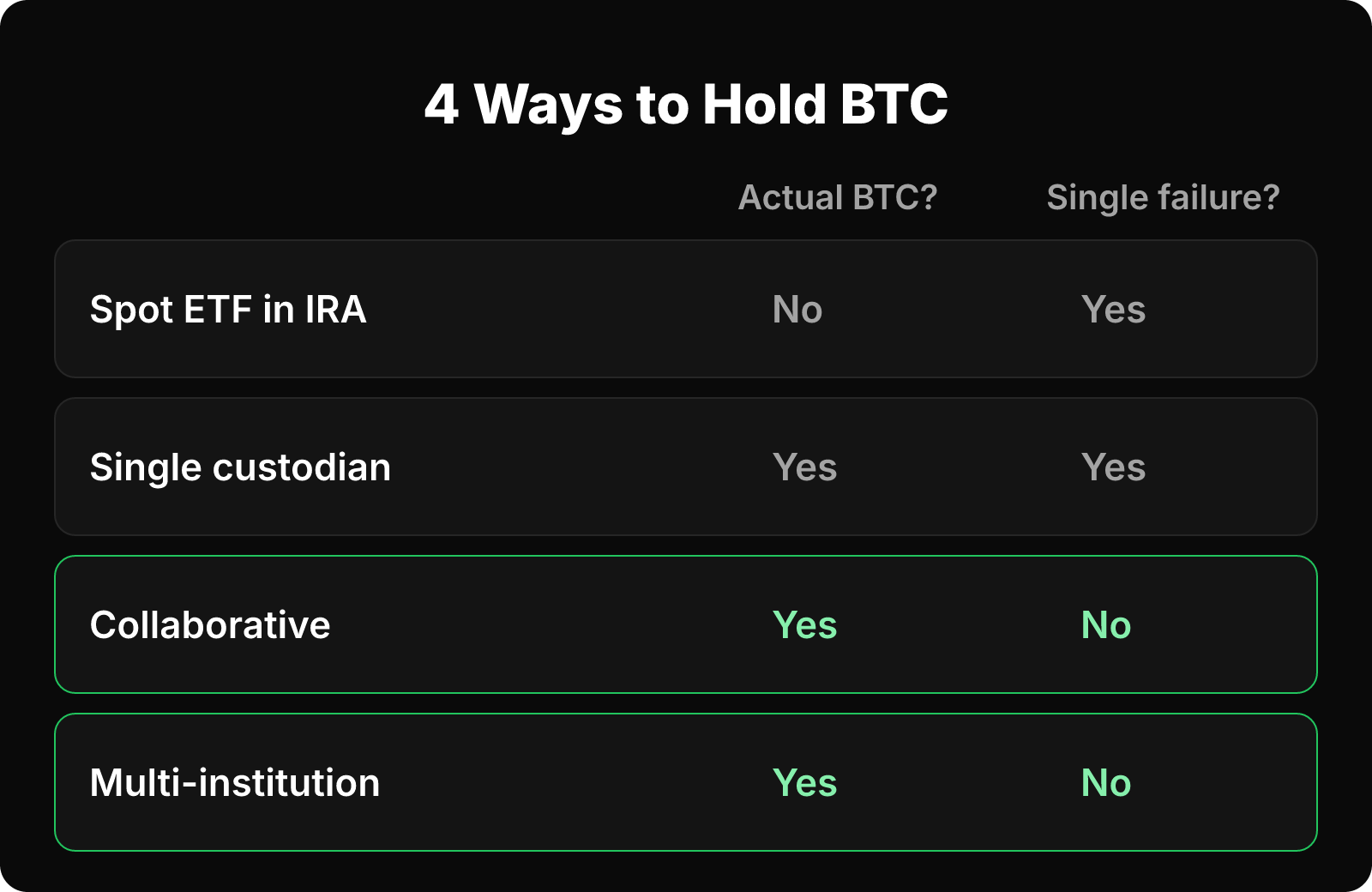
- Spot bitcoin ETF in a standard brokerage IRA. You buy shares of an exchange-traded fund that holds BTC. You never touch a coin or a key, and the fund's custodian does all of that.
- Single-custodian self-directed IRA. You own actual BTC, held by one qualified institution. This is what most crypto IRA providers sell.
- Collaborative custody IRA. The bitcoin sits in a multisig (multi-signature) wallet, which needs several keys to approve a transaction. You hold one key and partners hold the rest.
- Multi-institution custody IRA. Independent institutions each hold one key, and two of three must sign to move funds. No single firm can lose or move your bitcoin alone.
| Model | Do you own actual BTC? | Who holds keys | Single point of failure? | Typical cost profile |
|---|---|---|---|---|
| Spot ETF in brokerage IRA | No (fund shares) | ETF's custodian | Fund custodian | Annual expense ratio; often no trade fee |
| Single-custodian SDIRA | Yes | One institution | Yes | Trading fee + possible custody fee |
| Collaborative custody IRA | Yes | You + partners (multisig) | No | Varies by provider |
| Multi-institution custody IRA | Yes | 2-of-3 independent institutions | No | Varies by provider |
The ETF route got much easier in January 2024, when spot bitcoin ETPs began trading on U.S. exchanges. Before then, getting real BTC exposure in an IRA usually meant opening a specialized self-directed account. Now you can buy a spot bitcoin ETP inside a standard brokerage IRA.
The custody model matters more than the brand. Two providers with similar fees can carry very different risk depending on whether one company holds all the keys or several independent parties share them. It is the same concentration problem that shaped custody risk in wrapped bitcoin bridges. A 2-of-3 multisig setup is built so that no one company becomes that kind of failure point.
How Does a Self-Directed IRA for Bitcoin Work?
A self-directed IRA for bitcoin is an IRA whose custodian allows "alternative" assets such as cryptocurrency, which most mainstream brokerages won't hold. You decide what to buy, and the custodian holds it and keeps the records.
An IRS-approved custodian must hold an IRA's assets, not you personally, according to Wealthfit. That is why a "self-directed" account is self-directed in what you invest in, not in where the assets are held. In practice there are usually three parties:
- The IRA custodian or administrator: the regulated entity that legally holds the account. Bitcoin Well's U.S. product, for example, is administered by Heritage IRA Inc.
- The trading partner: an exchange or liquidity provider that executes your buys and sells. Wealthfit notes trades go through the provider's platform, which works with crypto trading partners.
- The storage provider: the firm or firms that hold the private keys, ideally in cold storage (offline wallets).
A caution from Wealthfit that beginners should take seriously: custodians generally do not check whether your actions follow IRA rules. If you break one, the tax consequences fall on you.
New providers keep arriving. On October 16, 2026, Canadian-listed Bitcoin Well announced a Traditional and Roth bitcoin IRA for U.S. customers that holds real bitcoin. The figures in that announcement, including more than 25,000 registered U.S. customers as of June 2026, come from the company itself and should be read that way.
What Does a Bitcoin IRA Cost?
Most crypto IRA providers charge a trading fee of about 1% to 2% per transaction, and some add a monthly custody fee. These fees look small. Over decades they become one of the biggest factors in what you end up with.
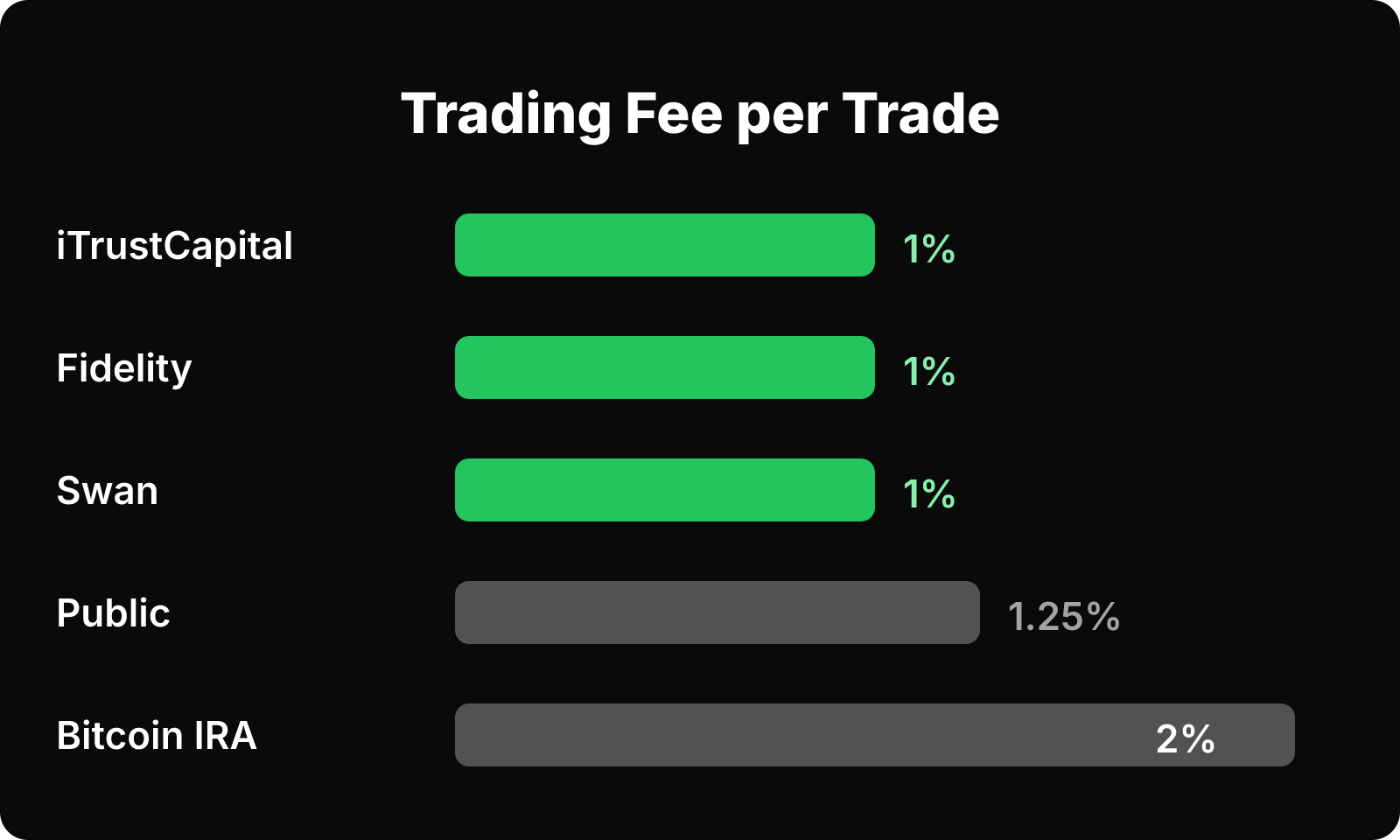
The table below shows fees as published by InvestLane's October 2026 comparison. Fees change often, so check each provider's current schedule before you open an account.
| Provider | Trading Fee | Monthly / Custody Fee | Account Minimum | Assets Offered |
|---|---|---|---|---|
| iTrustCapital | 1% per trade | None | $1,000 | 100+ |
| Bitcoin IRA | 2% per trade | 0.08% ($20 min) | $1,000 | 80+ |
| Public Crypto IRA | 1.25% on trades over $500 | 0.05% | $0 | 40+ |
| Fidelity Crypto IRA | 1% per trade | None | $0 | 4 (BTC, ETH, LTC, SOL) |
| Swan Bitcoin IRA | 1% per trade | 0.02% ($20 min) | $0 | Bitcoin only |
Some quick math (illustrative):
- A 2% trading fee costs $150 on a $7,500 buy, and another 2% when you eventually sell.
- A 0.08% monthly custody fee on a $10,000 balance comes to about $8 a month, or roughly $96 a year, and it grows as the balance grows.
- A 1% trading fee with no custody fee on the same $7,500 costs $75 up front and nothing ongoing.
Spot bitcoin ETFs in a brokerage IRA typically charge an annual expense ratio instead of a per-trade fee, so compare the current figures. If all you want is price exposure, the ETF route is often the simpler and cheaper one.
The extra fees for a crypto IRA buy one thing: ownership of actual coins in a specific custody setup. Whether that's worth paying for depends on how much you value that ownership.
How to Open a Bitcoin IRA: Step by Step
Opening a bitcoin IRA takes five basic steps: choose your model, choose a provider, open the account, fund it, and buy. The steps below walk through each one in order.
- Decide between ETF exposure and direct ownership. If you only want the price, a spot ETF in your current IRA is the simplest choice. If you want actual BTC, you need a crypto IRA provider.
- Choose Traditional or Roth. This depends on your income, your current tax bracket compared with what you expect in retirement, and Roth income eligibility rules.
- Compare custody models and fees. Ask who holds the keys, whether storage is cold, whether multisig is used, what insurance covers, and the full fee schedule including withdrawal fees.
- Fund the account. You can contribute new money (counts toward the $7,500 cap) or roll over or transfer from an existing IRA or old 401(k). Ask the providers involved about their transfer procedures.
- Buy and then leave it alone. Place your order on the provider's platform. Inside the IRA, trades aren't taxed one by one, but trading fees still cut into returns every time.
The PitchBook profile of the company Bitcoin IRA describes the same sequence: set up a digital asset IRA, transfer funds from an existing custodian, trade through an exchange, then move assets into a multi-signature wallet.
What Can't You Do With Bitcoin in an IRA?
Bitcoin in an IRA generally can't be withdrawn to your own wallet or put to work in DeFi without risking a taxable distribution or a prohibited transaction. This is the trade-off most bitcoin IRA explainers skip over.
Bitcoiners like the saying "not your keys, not your coins." IRA rules partly work against it. Because an IRS-approved custodian has to hold the assets, ordinary self-custody of IRA bitcoin on a hardware wallet in your desk drawer isn't allowed. Collaborative custody models get close by giving you one key in a multisig, but you still don't have sole control.
The IRS also has prohibited transaction rules that forbid certain dealings between you and your IRA, such as using IRA assets as security for a personal loan. So moves that are common with taxable Bitcoin, like borrowing stablecoins against it or using it in on-chain lending, are generally off the table inside a retirement account. Check with a tax professional before trying anything unusual.
That is a big difference from Bitcoin held outside an IRA. In a regular account, you can move BTC across chains and use it in DeFi. TeleSwap mints TeleBTC 1:1 against real BTC, secured by SPV light client proofs rather than custodians or multi-sig committees. Swapping or bridging taxable BTC can create its own tax events, though, so it's a separate decision. For a broader look at what bridged BTC can do, see how bridges make BTC spendable.
The point here: an IRA gives you tax shelter in exchange for flexibility. Treat it as a long-term vault, not your active Bitcoin account.
What Are the Risks of a Bitcoin IRA?
The main risks of a bitcoin IRA are price volatility, custodian failure, fees, the illiquidity of retirement money, and changing regulation. Each one is listed below.
- Volatility. Bitcoin has had deep drawdowns in its history. The tax benefits only help if you can hold through those drops.
- Custody risk. Single-custodian setups concentrate counterparty risk. Business Insider notes that crypto isn't covered by FDIC or SIPC, and that provider insurance, such as the up to $250 million BitcoinIRA says its custody partner carries, varies by asset and does not cover price declines.
- Fee drag. Trading fees of 1–2% and ongoing custody fees add up over 20 or 30 years.
- Locked-up money. Withdrawals before age 59½ may incur a 10% additional tax unless an exception applies.
- Regulatory change. Rules for crypto custody, reporting and retirement accounts can change, and a change could affect providers or products.
Business Insider has described crypto IRAs as designed for advanced traders and not recommended for beginners or risk-averse investors. That doesn't rule beginners out. It does mean you should start small and understand what you own.
Is a Bitcoin IRA Right for You? A 3-Question Framework
A bitcoin IRA makes the most sense if you have a long time horizon, want BTC exposure anyway, and can leave the money untouched for decades. To narrow down which version fits you, work through these three questions in order:
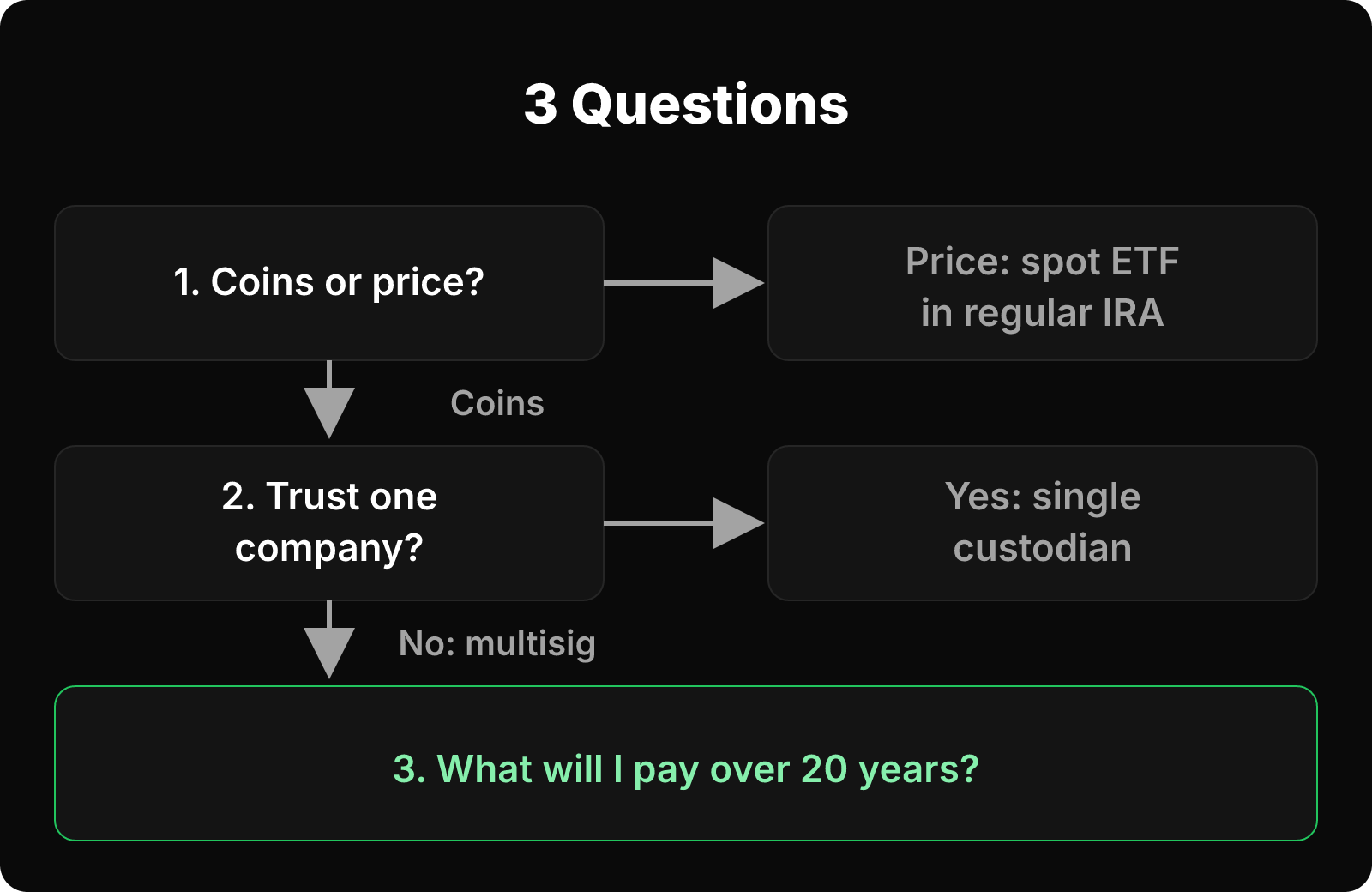
- Do I want coins or just the price? If you just want the price, use a spot ETF in a regular IRA, which is usually simpler. If you want coins, go on to question 2.
- How much do I trust any single company? If you'd rather not depend on one firm, look at multi-institution or collaborative custody. If you're fine with one regulated custodian, a single-custodian SDIRA works and is often easier.
- What will I pay over 20 years? Add up trading, custody, setup and withdrawal fees for your expected balance. Pick the cheapest option that still meets your answers to questions 1 and 2.
Most beginner mistakes come from skipping question 1. Many people pay crypto IRA fees for direct ownership they never actually needed. Others buy an ETF and later realize they wanted real BTC held in multisig. Answer that question honestly first.
Frequently Asked Questions
Is a bitcoin IRA a good idea for beginners?
A bitcoin IRA can work for beginners with a long time horizon who keep their allocation small, but it isn't a low-risk product. The account gives you tax advantages, not protection from price swings. Many beginners start with a spot bitcoin ETF in an existing IRA because it's simpler.
How much can I put in a bitcoin IRA in 2026?
You can contribute up to $7,500 in 2026, or $8,600 if you are 50 or older. That limit covers all of your Traditional and Roth IRAs together. Rollovers and direct transfers from other retirement accounts don't count toward it. Verify the figure on IRS.gov.
Can I hold my own bitcoin keys in an IRA?
Generally no, because an IRS-approved custodian must hold IRA assets. Collaborative custody IRAs come closest by giving you one key in a multisig wallet, but you don't have sole control. Taking full personal custody would normally count as a distribution.
What's the difference between a bitcoin IRA and a bitcoin ETF in an IRA?
A crypto IRA holds actual bitcoin through a specialized custodian, while a bitcoin ETF in an IRA holds shares of a fund that owns bitcoin. Both track BTC's price and get the same IRA tax treatment. ETFs are usually simpler. Direct ownership lets you pick a custody model, such as multisig.
Do I pay taxes when I sell bitcoin inside an IRA?
No, buying and selling bitcoin inside an IRA doesn't trigger capital gains tax. Taxes depend on the account type. Traditional IRA withdrawals are taxed as ordinary income, and qualified Roth withdrawals are tax-free.
Can I roll my 401(k) into a bitcoin IRA?
Often yes, but procedures vary. Ask your current plan administrator and the new IRA custodian about their rollover process before you start, and consider a tax professional's advice.
Conclusion
A bitcoin IRA is an ordinary Traditional or Roth IRA with Bitcoin inside. It changes how you're taxed, not how risky Bitcoin is. The decision that matters most is what kind of exposure you want: shares of a spot ETF, or real coins held by one custodian or several. After that, fees and custody structure will matter more than any provider's marketing.
The other thing to know going in is that IRA bitcoin is meant to sit untouched. It can't easily be pledged, self-custodied or used on-chain. Bitcoin you hold outside a retirement account can do much more, including bridging BTC trustlessly into other ecosystems. To learn how that works, explore more Bitcoin guides in the TeleSwap academy or read the protocol documentation at teleswap.xyz/docs.
This article is educational and is not tax, legal or investment advice. Consult a qualified tax professional before opening or funding a retirement account.