Convert BTC to WBTC on Ethereum: 2026 Wallet Guide

You hold Bitcoin and want to use it on Ethereum: lend it, add it to a liquidity pool, or put it to work in an app that only accepts Ethereum tokens. The problem is that Ethereum can't read Bitcoin directly, so BTC can't just move across. To get there, you need to convert BTC to WBTC on Ethereum. WBTC (Wrapped Bitcoin) is a token on Ethereum that follows Bitcoin's price one-for-one.
Many guides send you through an exchange account, a sell order and a withdrawal, with fees at each step. This guide covers every route a beginner can realistically use, what each one costs, and how to make the swap straight from your own Bitcoin wallet in about ten minutes.
Key Takeaways:WBTC is an ERC-20 token on Ethereum backed 1:1 by Bitcoin held by the custodian BitGo, and it had a market cap of about $9.65B on October 13, 2026, according to MetaMask's WBTC price page.There are four practical ways to turn BTC into WBTC: a centralized exchange, a WBTC merchant, buying on a DEX with other tokens, or a direct cross-chain swap.TeleSwap swaps native BTC to WBTC on Ethereum in one flow, with fees paid in Bitcoin assets, so you don't need ETH in your wallet to receive your WBTC.TeleSwap has processed 551,239 bridge transactions and $520.2M in total volume, according to TeleSwap network stats (retrieved October 17, 2026).WBTC is still a custodial token, so a trust-minimized conversion doesn't make the WBTC you end up holding trustless.
Table of Contents
- What Is WBTC, and Why Wrap Bitcoin?
- 4 Ways to Wrap Bitcoin to WBTC From Your Wallet
- Route Comparison: Speed, Custody and Effort
- How Do You Convert BTC to WBTC on Ethereum? 5 Steps
- Bitcoin to WBTC Conversion Fees in 2026
- WBTC vs TeleBTC vs cbBTC vs tBTC
- 5 Beginner Mistakes to Avoid
- Frequently Asked Questions
- Conclusion
What Is WBTC, and Why Wrap Bitcoin?
WBTC (Wrapped Bitcoin) is an ERC-20 token on Ethereum, and each token is meant to be backed by exactly one real bitcoin held in custody. ERC-20 is the standard format for tokens on Ethereum. Any token that follows it works with Ethereum wallets, exchanges and lending apps.
A coat-check ticket is a good comparison. You hand your coat (BTC) to an attendant (the custodian) and get a ticket (WBTC). The ticket is easy to carry around and trade, and as long as the attendant is honest you can hand it back for your coat.
WBTC launched on Ethereum in 2019, when Bitcoin traded near $3,460, according to MetaMask's WBTC data. By October 13, 2026, about 116,130 WBTC were in circulation at a price of $83,137 each.
Why wrap at all? Bitcoin's network is very secure, but it can't run the programmable apps Ethereum is known for. If you want to use your BTC as loan collateral, earn trading fees in a liquidity pool, or swap it for stablecoins without leaving self-custody, you need a version of BTC that Ethereum understands.
How WBTC is normally minted
In WBTC's official process, a merchant (an approved intermediary) takes your BTC, passes it to the custodian BitGo, and the custodian mints the same amount of WBTC to your Ethereum address. Redemption runs the same steps in reverse: the WBTC is burned (permanently destroyed) and BTC is released.
A DAO (a group of members who vote on decisions) decides which merchants and custodians are approved. This process is explained in this WBTC explainer video.
In practice, most individuals never deal with a merchant. They get WBTC that someone else has already minted, either by buying it or by swapping into it. That matters for the route you pick.
4 Ways to Wrap Bitcoin to WBTC From Your Wallet
You can get WBTC through a centralized exchange, a WBTC merchant, a decentralized exchange, or a direct cross-chain swap from native BTC. The WBTC June 2026 update lists exchange, DEX and atomic-swap-style routes, each with different trade-offs in convenience and ease of use.
1. Centralized exchange (CEX)
You deposit BTC to an exchange such as Binance, Bybit or Bitget, trade it for WBTC, then withdraw the WBTC to your Ethereum wallet. It's familiar, but you need an account with identity checks (KYC), and the exchange holds your coins until you withdraw.
2. WBTC merchant (native mint)
This is the "official" way to mint new WBTC. Merchants mostly serve businesses and large amounts, so it isn't a realistic option for someone converting 0.01 BTC.
3. Decentralized exchange (DEX)
On Uniswap you can swap ETH or USDC for WBTC. This doesn't convert BTC, though. You'd first need to sell your bitcoin for ETH somewhere else. It only helps if you already hold Ethereum assets.
4. Direct cross-chain swap
This route sends BTC from your Bitcoin wallet and delivers WBTC to your Ethereum wallet, with no exchange account in between. TeleSwap works this way, and the WBTC July 2026 update notes that BOB Gateway also enabled direct BTC-to-WBTC swaps. For most self-custody users, this is the shortest path.
If you want a deeper look at the fee side of this route, see BTC to WBTC Swap Without Wrapping Fees: 2026 Technical Guide.
Route Comparison: Speed, Custody and Effort
The table compares the four routes on what matters most to a beginner: whether a third party holds your coins mid-conversion, whether you need an account, and whether you need ETH before you start.
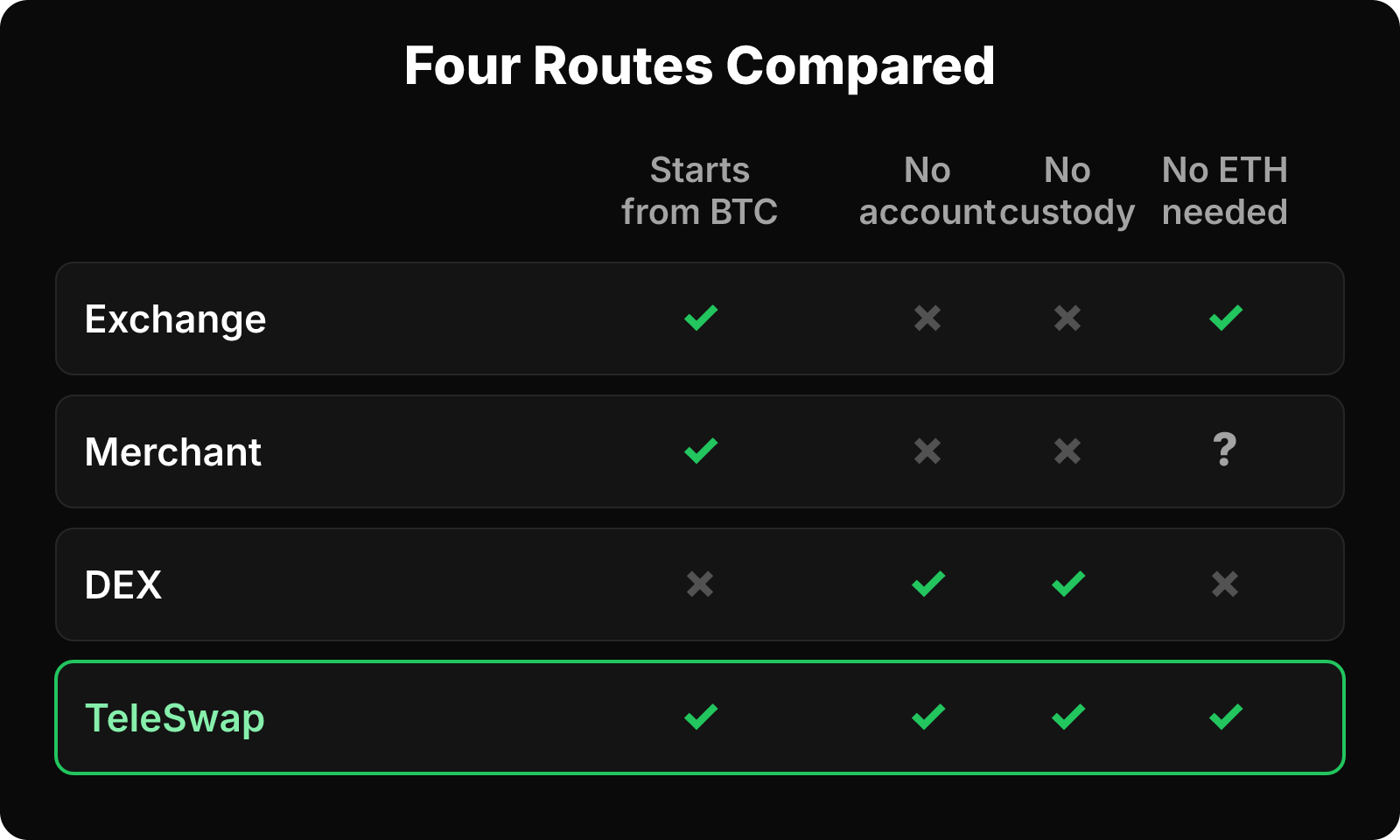
| Route | Starts from native BTC? | Account / KYC? | Third party holds your funds mid-process? | Need ETH to receive? | Typical steps |
|---|---|---|---|---|---|
| Centralized exchange | Yes | Yes | Yes (exchange custody) | No (exchange pays withdrawal gas, charges a fee) | Deposit, trade, withdraw (3+) |
| WBTC merchant | Yes | Yes (business onboarding) | Yes (merchant + custodian) | Varies by merchant | Onboard, send, mint (3+) |
| DEX (e.g., Uniswap) | No (needs ETH/USDC first) | No | No | Yes | Get ETH elsewhere, approve, swap (3+) |
| TeleSwap direct swap | Yes | No | No custodian; verified by a Bitcoin light client | No (a Teleporter covers destination gas) | Quote, send BTC, receive (1 flow) |
Every route ends with you holding WBTC, a token whose backing sits with BitGo. The routes differ in how much trust you place in someone during the conversion.
With a CEX, the exchange holds your funds until the withdrawal completes. TeleSwap's bridge doesn't release anything until a Bitcoin transaction has been cryptographically verified.
How Do You Convert BTC to WBTC on Ethereum? 5 Steps
To convert BTC to WBTC on Ethereum, you need a Bitcoin wallet holding BTC, an Ethereum wallet address to receive WBTC, and a conversion service. TeleSwap combines the conversion into one cross-chain swap. Here is the step-by-step process with TeleSwap.
Before you start: set up your wallets
- A Bitcoin wallet holding the BTC you want to convert, plus a little extra for the Bitcoin network fee.
- An Ethereum wallet address where your WBTC will arrive. MetaMask and Trust Wallet are common choices. Your WBTC will show up at the same address you use for ETH.
- Optional: a small amount of ETH. You don't need it to receive WBTC through TeleSwap, but you will need ETH for gas later when you move or use your WBTC on Ethereum. Gas is the fee paid to Ethereum validators, explained on ethereum.org's gas documentation.
The 5-step walkthrough
- Open the BTC → WBTC route. Go to TeleSwap's swap BTC to WBTC on Ethereum page. The source (Bitcoin) and destination (WBTC on Ethereum) are already set.
- Enter the amount and review the quote. Type how much BTC you want to convert. The quote shows the WBTC you should receive after fees. Fees are paid in Bitcoin assets, so nothing extra comes out of an ETH balance.
- Paste your Ethereum address. Copy it from your wallet, paste it, and check the first and last four characters. Blockchain transactions can't be reversed.
- Send BTC from your Bitcoin wallet. Follow the on-screen instructions to sign and send the Bitcoin transaction. This is the only transaction you sign.
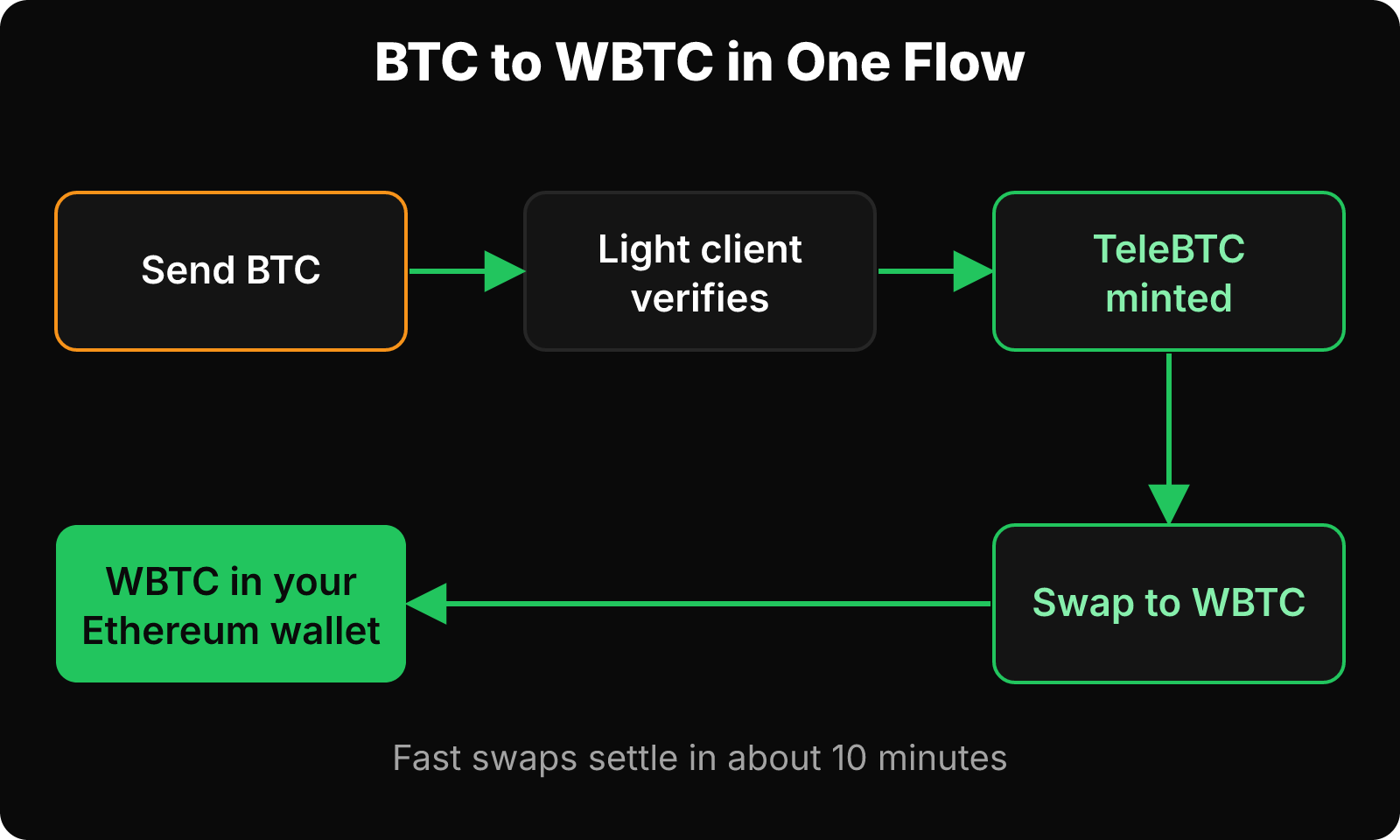
- Receive WBTC. When the Bitcoin transaction is confirmed and verified, TeleBTC (TeleSwap's 1:1 BTC-backed token) is minted and swapped into WBTC on the destination chain, then sent to your address. Fast swaps settle in about 10 minutes, according to the TeleSwap documentation.
What happens behind the scenes
This part explains why the route is trust-minimized. TeleSwap runs a Bitcoin light client on the destination chain. A light client is a small program that checks Bitcoin block headers and SPV proofs, which are short mathematical proofs that a transaction is included in a Bitcoin block.
No TeleBTC is minted until that proof checks out. Nothing is minted without a verified Bitcoin transaction, so the bridge doesn't rely on a committee's signatures.
The BTC is held by Lockers, who post collateral that can be slashed (taken as a penalty) if they misbehave. A Teleporter pays the Ethereum gas for the delivery transaction. That's why you can receive WBTC in a brand-new wallet with zero ETH.
This flow is used heavily: TeleSwap has bridged $520.2M across 551,239 transactions on 13 supported networks, with $44.1M in volume over the last 30 days, according to TeleSwap network stats (retrieved October 17, 2026). For the custody trade-offs behind these designs, see WBTC Bridge Custody Risk vs Trustless Bridges in 2026.
Prefer to stay inside your wallet?
TeleSwap is integrated as a Bitcoin swap provider in the Rango, Rubic and DZap aggregators, and through Rango it's available inside MetaMask and Trust Wallet. If you already use one of those, you may see TeleSwap routes offered when you swap BTC.
Bitcoin to WBTC Conversion Fees in 2026: What You Actually Pay
The cost of converting BTC to WBTC is made up of a Bitcoin network fee, a service or trading fee, and sometimes Ethereum gas, plus the gap between the quoted rate and 1:1. No route is free. The difference is which of these layers you pay, and in what currency.
| Cost layer | CEX route | DEX route | TeleSwap route |
|---|---|---|---|
| Bitcoin network fee | Yes (deposit) | Yes (wherever you first sold BTC) | Yes (one BTC transaction) |
| Service / trading fee | Trading fee + withdrawal fee | Pool fee on the swap | Protocol and swap fees shown in the quote, paid in Bitcoin assets |
| Ethereum gas paid by you | Built into withdrawal fee | Yes, for approval + swap | No (a Teleporter covers destination gas) |
| Rate vs. 1:1 | Order book spread | Pool price impact | AMM price impact, shown before you send |
Fee levels change all the time. Bitcoin fees rise when the mempool (Bitcoin's waiting room for unconfirmed transactions) is busy, and Ethereum gas moves with demand.
The most reliable test is to compare the final "you receive" number, not the headline fee. A route with a low fee and a poor rate can still cost you more.
Wrapped tokens don't always trade at exactly 1 BTC either. CoinGecko data shows Linea-bridged WBTC traded between 0.9976 and 0.9998 BTC from October 11 to 17, 2026. That's a bridged variant rather than canonical Ethereum WBTC, but it shows that the peg isn't guaranteed to be exact.
For small amounts, consider where you'll use the WBTC. Activity on Ethereum mainnet usually costs more in gas than on layer-2 networks. If your target app also runs on Arbitrum, the BTC to WBTC on Arbitrum route may make more sense. For a fee-focused comparison of bridge routes, see BTC to WBTC Bridge: Lowest Fees & Fastest 2026.
WBTC vs TeleBTC vs cbBTC vs tBTC: Which Bitcoin Wrapper?
WBTC is the most widely integrated Bitcoin wrapper on Ethereum, but it relies on a custodian, while TeleBTC relies on Bitcoin's own proofs. Before you commit, it helps to know what you're actually holding.
| Wrapper | Who secures the BTC | How minting is verified | Main strength |
|---|---|---|---|
| WBTC | BitGo custody; DAO approves merchants | Custodian confirms deposit and mints | Deepest DeFi integration (Aave, Spark, Morpho, Uniswap) |
| cbBTC | Coinbase custody | Coinbase confirms and mints | Convenient for Coinbase users |
| tBTC | Threshold Network signer group | Threshold signing by a group of signers | No single custodian |
| TeleBTC | Collateral-backed, slashable Lockers | SPV proofs checked by an on-chain Bitcoin light client | Inherits Bitcoin's security model directly; no custodian or multi-sig committee |
Wrapped-BTC issuers have also been changing. According to Eco's 2026 bridging guide, Circle's cirBTC is live on Ethereum. Eco's view is that larger holders are spreading their BTC across several wrappers to diversify issuer risk.
The nuance most guides skip
From a protocol design standpoint, using TeleSwap to get WBTC makes the conversion trust-minimized. It doesn't make WBTC itself trustless.
Once the swap is done, you hold a BitGo-backed token. That's the right trade-off when the app you want only accepts WBTC, and many of the biggest lending markets work that way.
If you don't specifically need WBTC, holding TeleBTC keeps you on the trust-minimized path from start to finish. The choice depends on what you plan to do. Pick the wrapper your destination app supports, and don't wrap more than you intend to use.
5 Beginner Mistakes to Avoid When Wrapping Bitcoin
- Sending to the wrong network. WBTC exists on several chains, including Ethereum, Solana, TRON and BNB Chain, according to the WBTC June 2026 update. Make sure "Ethereum" is selected if that's where your app runs.
- Forgetting ETH for later. You can receive WBTC through TeleSwap without ETH, but approving, lending or transferring it on Ethereum needs gas.
- Not adding the token to your wallet. If your WBTC doesn't appear, import the token using the official contract address from a trusted source such as CoinGecko or Etherscan. Never use a contract address someone sent you in a DM.
- Judging by the fee alone. Compare the final amount you'll receive across routes, since that number includes spread and price impact.
- Treating yield as guaranteed. Lending or providing liquidity with WBTC adds smart-contract risk on top of custodian risk. Understand how a protocol works before you deposit.
Need to go back the other way? The reverse route, WBTC on Ethereum to BTC, returns native bitcoin to your Bitcoin wallet without a merchant redemption. To compare unwrapping costs first, read Unwrap WBTC to Native Bitcoin: 2026 Fee Comparison.
Frequently Asked Questions
Can I convert BTC to WBTC directly from my Bitcoin wallet?
Yes, a direct cross-chain swap such as TeleSwap lets you send BTC from your own Bitcoin wallet and receive WBTC at your Ethereum address. You don't need an exchange account. You sign one Bitcoin transaction, and the WBTC is delivered after the transaction is verified.
How long does it take to convert BTC to WBTC?
With TeleSwap, fast swaps settle in about 10 minutes. Exchange routes can take longer because deposits, trades and withdrawals each have their own processing steps.
Do I need ETH to receive WBTC?
Not with TeleSwap, because a Teleporter covers the Ethereum gas for delivering your WBTC. You'll still need some ETH later to move, approve or use your WBTC in Ethereum apps, since every Ethereum transaction requires gas.
What is the difference between WBTC and TeleBTC?
WBTC is backed by BTC held by the custodian BitGo, while TeleBTC is backed 1:1 by BTC held by collateralized Lockers and is only minted after an on-chain Bitcoin light client verifies an SPV proof. WBTC is supported by more Ethereum apps. TeleBTC removes custodian and multi-sig committee trust.
Is WBTC always worth exactly 1 BTC?
No, wrapped Bitcoin usually trades very close to 1 BTC, but small deviations happen. CoinGecko data showed Linea-bridged WBTC trading at 0.9976–0.9998 BTC between October 11 and 17, 2026. Always check the final amount you'll receive before you swap.
What fees apply when converting Bitcoin to WBTC in 2026?
Expect a Bitcoin network fee, a service or trading fee, and possibly Ethereum gas, depending on the route. With TeleSwap, fees are paid in Bitcoin assets and shown in the quote before you send. Exchange routes usually add trading and withdrawal fees.
Is it safe to wrap Bitcoin to WBTC?
Wrapping is widely used, but it isn't risk-free. WBTC depends on its custodian keeping 1:1 reserves, and using it in DeFi adds smart-contract risk. Choosing a trust-minimized conversion route lowers risk during the conversion, but the WBTC you receive is still a custodial token.
Conclusion: The Shortest Path From BTC to WBTC
Wrapping Bitcoin used to mean opening an exchange account, waiting on a withdrawal and keeping ETH on hand for gas. In 2026, you can convert BTC to WBTC on Ethereum in one flow from the wallet you already use.
- WBTC is the most widely accepted way to use Bitcoin in Ethereum DeFi, but it's a custodial token. Wrap only what you plan to use.
- A direct cross-chain swap cuts the conversion to one Bitcoin transaction, with no exchange account and no ETH needed to receive.
- TeleSwap checks every deposit with a Bitcoin light client before minting anything, and it has handled 551,239 transactions, according to TeleSwap network stats.
Ready to make your first conversion? Get a live quote and see exactly how much WBTC you'll receive before you send.