Bitcoin Bridge Security in 2026: What Traders Must Know

On September 11, 2026, an attacker found a flaw in a bitcoin bridge and created about 46.1 billion units of "synthetic Bitcoin" out of nothing. That is more than 2,000 times the 21 million BTC that will ever exist. In the weeks that followed, several more cross-chain projects were hit. If you have ever moved Bitcoin onto another blockchain to trade, this matters to you.
This explainer is written for beginners. It covers what happened, why bridges keep failing, who loses money when they do, and what you can check before you bridge your next coin.
Key Takeaways:On September 11, 2026, an exploit in Symbiosis's BridgeV2 contract minted about 46.1 billion synthetic BTC (syBTC) on BNB Chain, according to shattered.io.An October 2026 study of 588 audit reports across 36 bridge projects found 830 vulnerabilities that fall into 11 recurring patterns.Most 2026 bridge losses came from unbacked minting, meaning tokens were created on one chain with no real deposit on the other.The biggest bridge-related loss of 2026 was about $290M–$292M at KelpDAO's LayerZero bridge in April, as reported by 1inch.A trustless bridge checks proof from the Bitcoin blockchain before it mints anything, while a trusted bridge relies on people or committees to say a deposit happened.
Table of Contents
- What Happened to Bitcoin Bridges in Fall 2026?
- What Is a Bitcoin Bridge, in Plain English?
- Why Do Bridges Keep Getting Hacked?
- Who Is Affected When a Bridge Fails?
- Trusted vs. Trustless Bridge: How Do the Models Compare?
- Is a Trustless Bridge Risk-Free?
- What Should Crypto Traders Do Now?
- Frequently Asked Questions
- Conclusion
What Happened to Bitcoin Bridges in Fall 2026?
In short: between September 11 and October 23, 2026, a run of bridge exploits let attackers create tokens with nothing behind them and withdraw funds that were never deposited. The largest single 2026 loss, about $290M–$292M at KelpDAO in April, had already shown that one weak setting can drain hundreds of millions of dollars.
Here is the timeline, built from public incident reports. Some dates are approximate, and they are marked as such.
| Date (2026) | Project | What went wrong | Reported impact |
|---|---|---|---|
| April (exact day disputed) | KelpDAO / LayerZero | Bridge used a single verifier (one DVN) | ~$290M–$292M; ~116,500 rsETH left the bridge |
| Sept 11 | Symbiosis (syBTC) | Message-validation flaw allowed unbacked minting | ~46.1B syBTC minted; ~$336,000 realized |
| ~Sept 24 | Payy Network, Duelbits, Meter Network | Three separate incidents within 24 hours | >$11M combined |
| ~Oct 1 | NEAR Intents | Deposit-system bug | ~$3.8M |
| Oct 17 | Cysic Bridge | Fake mint message created 10M CYS on BNB Smart Chain | ~$727,000 moved to Ethereum |
| Oct 22–23 | WAX Multi-Chain Bridge | Five withdrawals released with no matching WAX payment | 52,986 USDC, 21,558 USDT, plus DAI, WETH, WBTC |
| Oct 23 | Initia | MoveVM flaw minted unbacked bridged assets | ~$2.7M; L1 and bridge halted |
The October incidents come from shattered.io's seven-day bridge hack roundup, with status current as of October 27, 2026. The Symbiosis details come from the same publication's analysis and have not been confirmed against the project's own post-mortem.
Look at the Symbiosis numbers again. The attacker minted billions of fake BTC tokens but realized only about $336,000 by selling about 4.39 WBTC. Symbiosis suspended native Bitcoin routing and recovered about 15 BTC into a multisig wallet.
The real lesson is not the dollar amount. It is that the bridge's code could be convinced to mint "Bitcoin" when no Bitcoin had moved.
What Is a Bitcoin Bridge, in Plain English?
A bitcoin bridge is a system that lets you use the value of your BTC on a different blockchain, such as Ethereum or BNB Chain. Bitcoin can't physically leave its own blockchain, so bridges use a stand-in.
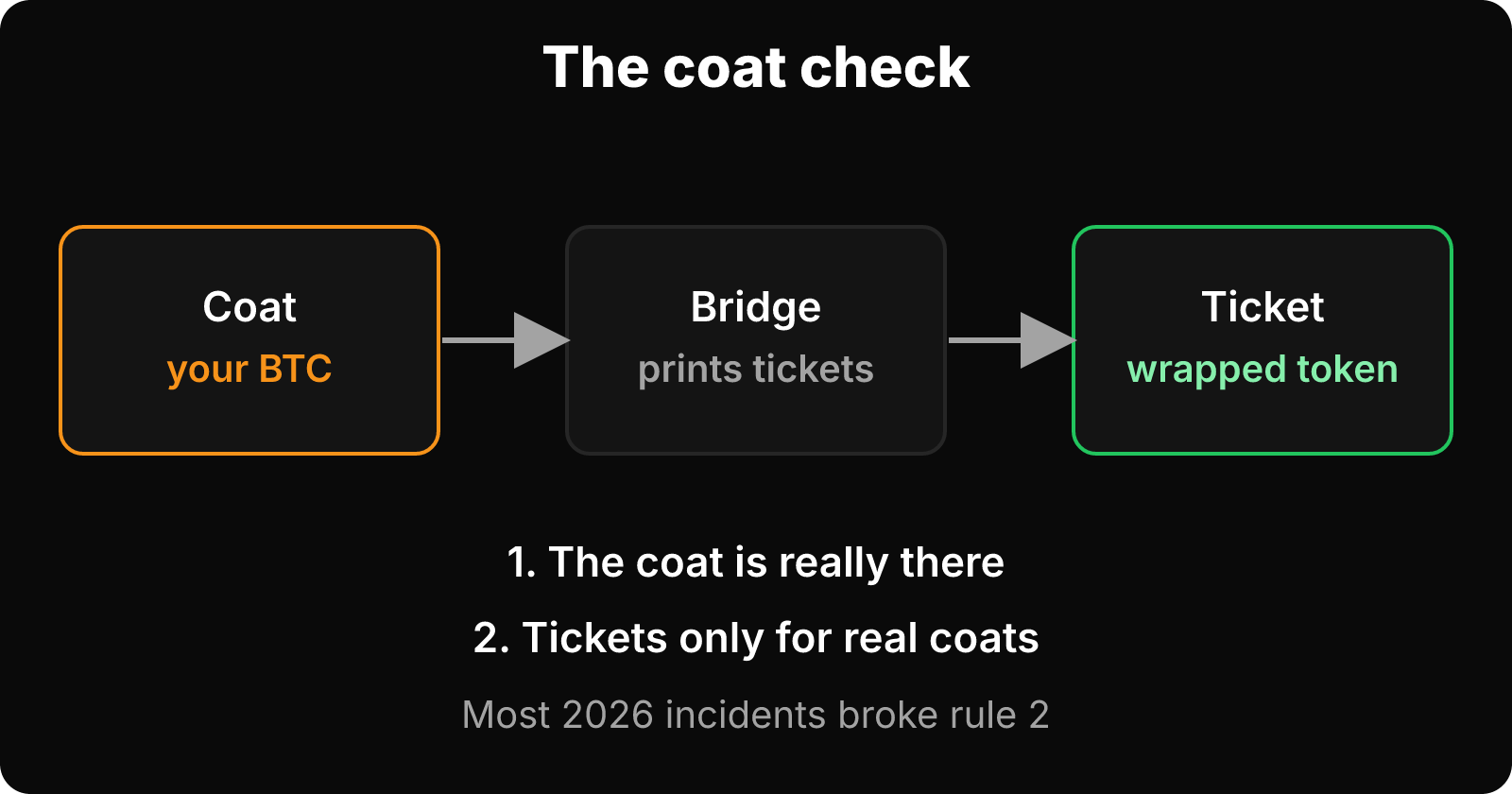
Think of a coat check. You hand over your coat (BTC) and get a numbered ticket (a wrapped token like WBTC, syBTC, or similar). The ticket is only worth something if two things are true:
- The coat is really there. Someone or something has to hold the original BTC.
- Tickets are only printed for real coats. Nobody should be able to print a ticket without handing in a coat.
Most 2026 bridge incidents broke rule #2. In Symbiosis's case the printer was tricked by a fake message. At WAX, assets were released without matching payments.
Most bridges use one of a few designs, so it helps to know the terms:
- Lock-and-mint: BTC is locked on Bitcoin and a token is "minted" (created) on the other chain. Burning the token unlocks the BTC.
- Message-passing: A set of verifiers watches one chain and sends a "this happened" message to the other. LayerZero calls these verifiers DVNs (Decentralized Verifier Networks). Chainlink's version is CCIP, which released version 2.0 on September 28, 2026.
- Intents: You state the result you want ("I want USDC on Ethereum for my BTC"), and a third party called a solver delivers it.
- Light-client verification: The destination chain checks a mathematical proof that the Bitcoin transaction exists, instead of relying on someone's word. For a deeper look, see how Bitcoin bridges work with SPV light clients.
The Grid's hand-verified directory listed 21 bridge projects on or supporting Bitcoin as of October 28, 2026. These designs differ a lot, and so does the way each one can fail.
Why Do Bridges Keep Getting Hacked?
Bridges get hacked because they have to answer a hard question: did something really happen on another blockchain? One chain cannot see another chain directly. Whatever a bridge uses to answer that question is the main target of attacks on cross-chain security.
The largest review of this problem so far was published in October 2026. Researchers went through 588 audit reports covering 36 bridge projects. They found 830 distinct vulnerabilities across 786 contract files, and grouped them into 11 recurring "cross-chain verification vulnerability" patterns, according to shattered.io's summary of the study.
In other words, these were audited projects. Paying for an audit did not stop the same kinds of mistakes from coming back.
The 2026 incidents fall into four failure modes:
- Unbacked minting. Tokens are created with no real deposit (Symbiosis, Cysic, Initia). This was the most damaging pattern of the year.
- Withdrawals with no deposit. Funds are released on one side without a matching payment on the other (WAX, NEAR Intents).
- Weak verifier setup. Too few parties confirm a message. The KelpDAO loss centered on a single-DVN setup. LayerZero reportedly blamed Kelp's configuration, and Kelp disputed that.
- Chain-level halts. The whole network stops (Initia halted its L1, rollups, and bridge flows with no restart date).
The first three share a root cause. The bridge accepted a claim about another chain instead of proof. A signed message, a verifier's vote, or a deposit record in a database can all be faked, misconfigured, or bugged. Bitcoin's proof-of-work chain, by contrast, is very expensive to fake.
This is not new. Back in 2022, bridge hacks accounted for about $2B across 13 incidents, or 69% of all crypto stolen by August of that year, according to Chainalysis. For more history, see our roundup of the biggest crypto bridge hacks.
Who Is Affected When a Bridge Fails?
Everyone who holds the bridge's token is affected, even people who never used the bridge themselves. That catches many beginners off guard.
Here's who can get hurt:
- People mid-transfer. If a bridge pauses, as Symbiosis, Cysic, and Initia did, funds in transit can be stuck for days or longer.
- Holders of the wrapped token. When unbacked tokens flood the market, a bridged asset can lose its backing, and its price can drop sharply.
- Liquidity providers. Attackers sell fake tokens into trading pools and take real assets out, so pool depositors can end up holding the loss.
- Lenders and borrowers. After the KelpDAO exploit, Aave froze affected markets and several major DeFi projects reportedly paused LayerZero OFT bridges, per 1inch's 2026 hack review. People who never touched Kelp still couldn't move their positions.
There is usually no safety net. Crypto deposits aren't FDIC-insured, and stolen funds are often never recovered. Recoveries like Symbiosis's ~15 BTC are partial at best.
Trusted vs. Trustless Bridge: How Do the Models Compare?
A trusted bridge relies on people, companies, or committees to confirm your deposit. A trustless bridge relies on cryptographic proof from the source blockchain. Neither design is bug-proof. The difference is what an attacker has to break.
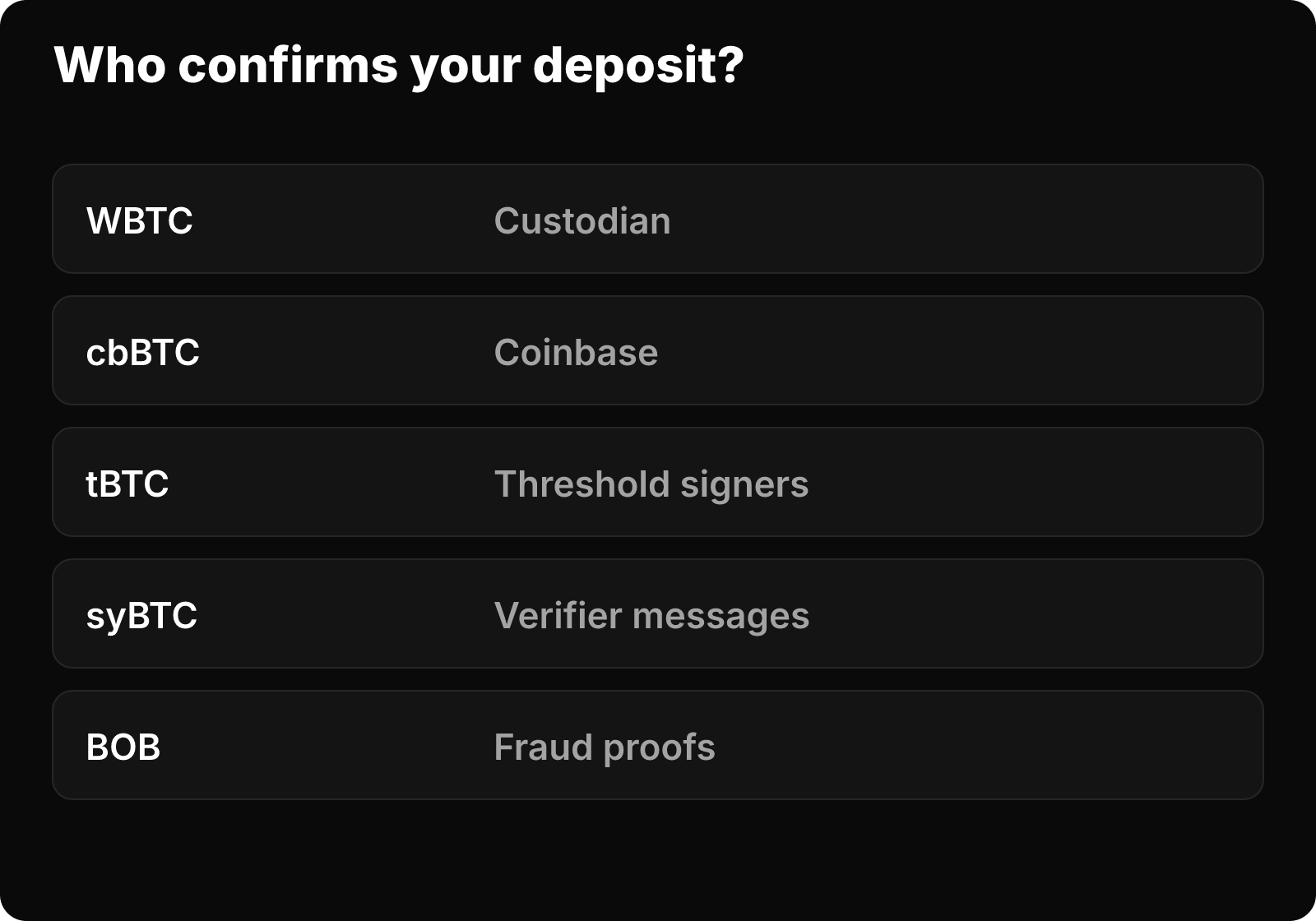
Here's how the main ways of putting BTC on other chains compare:
| BTC representation | Who confirms the deposit? | What an attacker must compromise | Main trust assumption |
|---|---|---|---|
| WBTC | Custodian | Custodian keys or operations | A custodian holds the BTC honestly |
| cbBTC | Coinbase | Coinbase custody | A single exchange holds the BTC |
| tBTC | Group of threshold signers | Enough signers to pass the threshold | A majority of signers stay honest |
| Message-bridge tokens (e.g., syBTC) | Bridge contract plus verifier messages | Message validation or verifier config | Verifiers and contract logic are correct |
| BitVM-based (e.g., BOB, in development) | Fraud proofs with a challenge period | Every honest challenger at once | At least one honest party challenges fraud |
| TeleBTC | Bitcoin SPV light client on the destination chain | Bitcoin's proof-of-work itself (or a contract bug) | Bitcoin consensus; collateral-backed, slashable custody |
The custodial options (WBTC, cbBTC) are simple and widely used, but you are trusting an institution. See WBTC custody risk vs. trustless bridges for more. tBTC spreads that trust across many signers. BitVM approaches such as BOB's are promising: BOB reportedly cut on-chain verification costs by 87% in a December 2025 update, though mainnet deployment was still listed as a 2026 target per CoinMarketCap's project tracker.
TeleSwap, a non-custodial Bitcoin bridge, takes the light-client route. Its token, TeleBTC, is only minted after an SPV proof (a compact cryptographic proof that a transaction is included in a Bitcoin block) confirms a real Bitcoin deposit. The BTC behind it is held under collateral-backed, slashable custody rather than by a custodian or multi-sig committee. In coat-check terms, the ticket printer won't print until it has seen the coat arrive. According to TeleSwap network stats, TeleSwap has handled 566,728 bridge transactions and $535.0M in total volume bridged across 13 supported networks.
Is a Trustless Bridge Risk-Free?
No. "Trustless" means you don't have to trust a person. It does not mean nothing can go wrong. This is the part most bridge marketing leaves out.
Two popular ideas from 2026 deserve pushback:
Myth 1: "Intents remove bridge risk." Intent systems are often described as safer because they have no big bridge contract for attackers to target. Then NEAR Intents lost about $3.8M to a deposit-system bug around October 1. The risk didn't disappear. It moved to the deposit and solver layer.
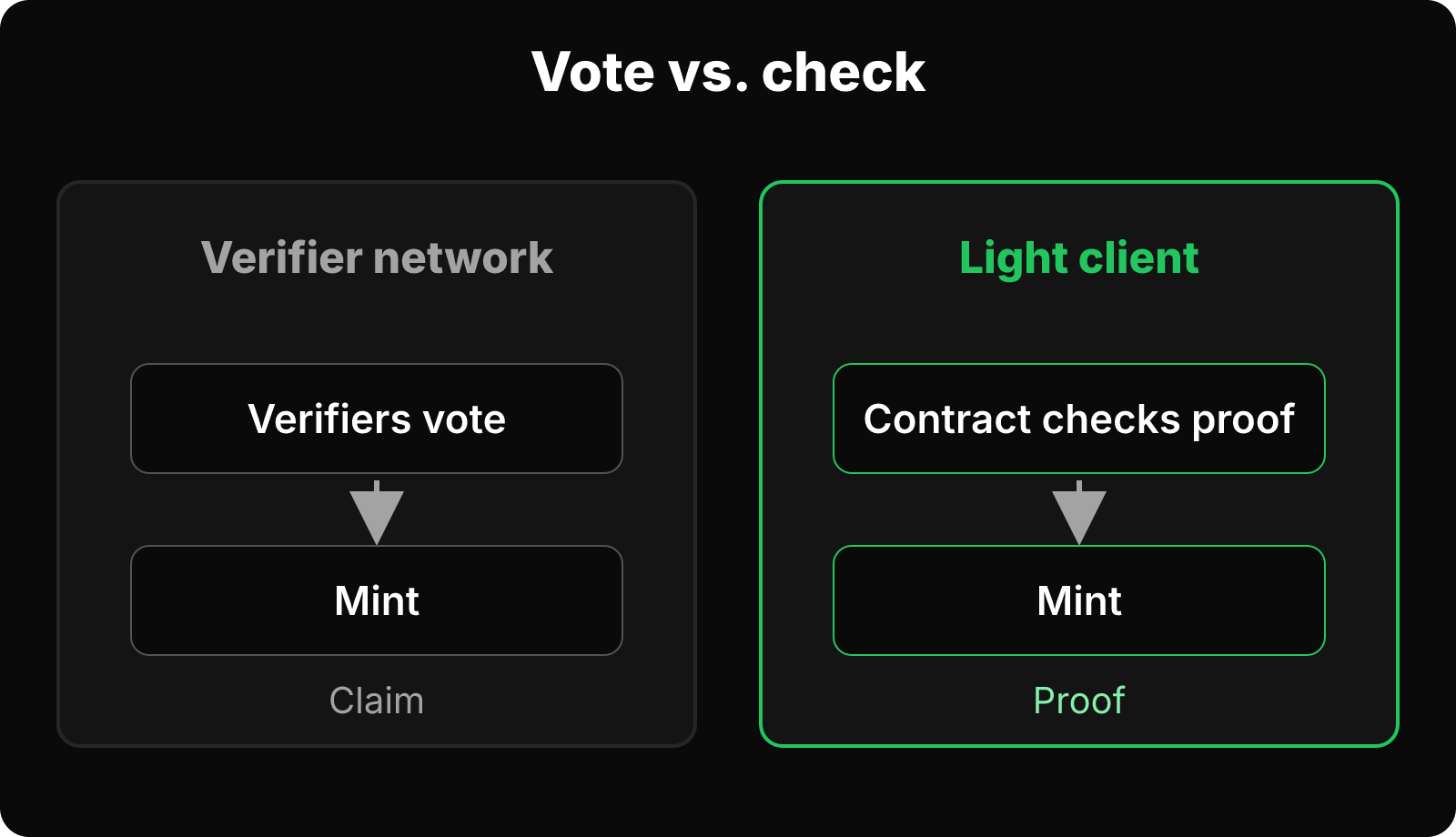
Myth 2: "More verifiers fixes everything." Adding verifiers helps; Kelp's single-DVN setup is a clear example of too few. But a verifier network still votes on what happened. A light client checks it. Those are different kinds of security, and the 2026 unbacked-mint exploits targeted the "vote" or "message" step.
Trust-minimized designs shrink the attack surface. The question stops being "can I bribe or trick the signers?" and becomes "can I fake Bitcoin proof-of-work, or find a bug in the verification code?" The first is extremely expensive. The second is still possible, which is why audits, mint caps, and rate limits matter for every bridge.
Shattered.io argues that mint-cap and time-delay "circuit breakers" could have blunted the Symbiosis exploit. That is an interpretation, not a tested result. WAX, for its part, resumed on October 23 with transfer limits in place.
What Should Crypto Traders Do Now?
Before you bridge, check how the bridge confirms deposits, what limits it uses, and how much you would lose if it failed. This seven-step checklist covers the basics of crypto trading safety for cross-chain moves:
- Ask "who confirms my deposit?" Look in the bridge's docs for whether it uses a custodian, a signer committee, a verifier network, or a light client. If you can't find the answer, treat that as a warning sign.
- Check for mint caps and rate limits. Bridges that limit how much can be minted or withdrawn per hour limit the damage from any bug.
- Read the incident history. Search "[bridge name] exploit" and "[bridge name] post-mortem." How a team handled a past problem tells you a lot.
- Don't park money in wrapped tokens longer than needed. Every day you hold a bridged token, you carry that bridge's risk. If you only need a stablecoin, swap straight into it, for example a direct BTC → USDC on Ethereum route.
- Spread exposure across different trust models. Holding WBTC, cbBTC, and tBTC is not the same as holding three copies of the same risk. Know which one your lending or LP position depends on.
- Watch for pauses. If a bridge or chain halts, don't rush to "buy the dip" on its wrapped token. Wait for an official account of whether the backing is intact.
- Test with a small amount first. Send a small transfer, confirm it arrives, then send the rest. It protects you from address errors and surprises.
Aggregators that route across many bridges are convenient, but they take on the risk of whichever bridge they pick. Check which bridge your route actually uses before you confirm.
Frequently Asked Questions
What is a bitcoin bridge?
A bitcoin bridge is a system that lets you use the value of your BTC on another blockchain by locking BTC on Bitcoin and creating a matching token elsewhere. The token is only as safe as the bridge's process for confirming that real BTC was locked.
What was the Symbiosis syBTC exploit?
On September 11, 2026, an attacker used a message-validation flaw in Symbiosis's BridgeV2 contract to mint about 46.1 billion synthetic BTC on BNB Chain. They sold about 4.39 WBTC for roughly $336,000. Symbiosis paused native Bitcoin routing and recovered about 15 BTC.
What is the difference between a trusted and a trustless bridge?
A trusted bridge relies on a custodian, committee, or verifier network to confirm deposits, while a trustless bridge checks cryptographic proof from the source blockchain itself. Trustless designs remove the need to trust specific people, but their code can still have bugs.
Are audited bridges safe?
An audit lowers risk but does not make a bridge safe. An October 2026 study of 588 audit reports across 36 bridge projects found 830 vulnerabilities in 11 recurring patterns. Look for audits plus mint caps, rate limits, and a clear incident-response record.
What was the biggest bridge hack of 2026?
The largest bridge-related loss of 2026 was the KelpDAO exploit on its LayerZero bridge in April, at about $290M–$292M. LayerZero reportedly pointed to Kelp's single-verifier setup, and Kelp disputed that explanation. Aave froze affected markets after the incident.
Can I get my money back if a bridge is hacked?
Usually not in full. Crypto isn't covered by deposit insurance, and recoveries tend to be partial. Some teams recover part of the funds, but you shouldn't count on it.
How can I reduce my risk when bridging Bitcoin?
Use bridges that verify Bitcoin deposits with proof instead of trust, keep wrapped-token holdings short-term, and test with small amounts first. Also check for mint caps and rate limits, and read the bridge's incident history before sending large amounts.
Conclusion
The fall 2026 wave of bridge exploits came down to one weakness. Bridges accepted claims about other chains without proof, and attackers used that to mint tokens with nothing behind them. Audits didn't stop it; 830 documented flaws across 36 audited projects make that clear. Those hurt were often people who held a wrapped token or sat in a liquidity pool, not just the bridge's direct users.
The most useful habit you can build is one question: "How does this bridge know my Bitcoin is really there?" If the answer is a person, a committee, or a single verifier, size your position with that in mind.
If you want to see what proof-based bridging looks like in practice, read how it works in the TeleSwap docs, then try a small transfer at teleswap.xyz.