Bitcoin Wrapping Without Custodians: Trustless BTC 2026

Trustless bitcoin wrapping mints a token on another chain only after a smart contract has verified a real Bitcoin transaction, so no custodian decides whether you get your BTC back. Every wrapped bitcoin token promises that one token stands for one BTC, but most leave out who decides whether you can redeem. For WBTC that's BitGo and, since 2024, BiT Global. For cbBTC it's Coinbase.
This guide covers bitcoin wrapping with no custodian in the trust path. A light client on the destination chain checks Bitcoin's own proof-of-work and Merkle proofs before it mints anything. You'll learn the mechanism from header to mint, then walk a live route: native BTC in, TeleBTC or a DeFi token out, with the cost and wait of each step.
Key Takeaways:Custodial wrapped BTC such as WBTC and cbBTC depends on a company honoring redemptions, and WBTC's custody arrangement was changed in 2024 to add BiT Global as co-custodian.Trustless bitcoin wrapping replaces the custodian with an on-chain SPV light client that verifies Bitcoin block headers and Merkle inclusion proofs before minting.TeleBTC is minted 1:1 only after a verified Bitcoin transaction, and the Lockers holding the BTC are collateral-backed and slashable.TeleSwap has bridged $534,965,114 across 566,728 transactions on 13 supported networks, according to TeleSwap network stats retrieved on 2026-10-29.A "trustless" bridge still carries trust assumptions: Bitcoin proof-of-work, at least one live relayer, enough Locker collateral, and smart-contract correctness.
Table of Contents
- What is wrapped bitcoin custodian risk, really?
- How does trustless bitcoin wrapping work at the protocol level?
- Lockers, Relayers, Teleporters: who does what
- Wrapped BTC models compared (2026)
- How to wrap BTC without a custodian: step-by-step route
- Common problems and fixes
- What to do with trustless BTC in DeFi
- Frequently Asked Questions
- Conclusion
What is wrapped bitcoin custodian risk, really?
Wrapped bitcoin custodian risk means your token's 1:1 backing depends on one off-chain party, or a small group, that can refuse, delay, or lose the underlying BTC. The token contract on Ethereum can't see Bitcoin. It mints because an authorized address tells it to.
WBTC is the textbook case. Holders deposit BTC with a custodian and merchants mint ERC-20 tokens 1:1, while the wBTC DAO handles governance and reserve management, as described in Coin Bureau's WBTC guide (updated May 8, 2026). That guide also covers the 2024 controversy over BiT Global being added alongside BitGo as co-custodian. For a deeper look, see WBTC bridge custody risk vs trustless bridges.
The scale matters. WBTC's market cap was $9.65B on October 13, 2026, per MetaMask. That's billions of dollars of DeFi collateral whose final settlement depends on a legal agreement and not on a proof.
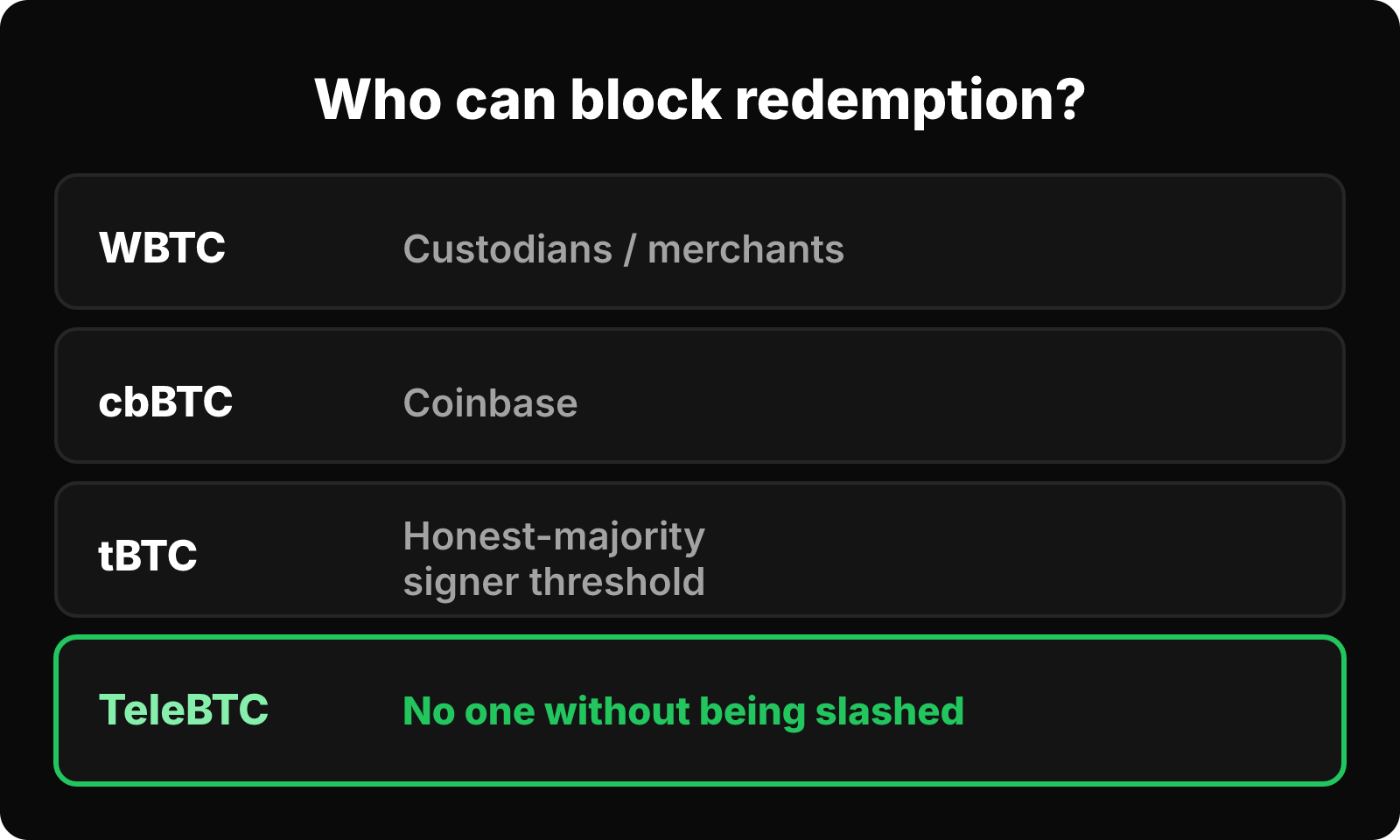
"Who holds the BTC" is the wrong question. Ask "who can say no to my redemption?" A threshold-signature group, a multisig, or a single custodian can all say no. A light-client design swaps that veto for an economic penalty: the BTC holder can misbehave, but the protocol can prove it on-chain and slash their collateral.
How does trustless bitcoin wrapping work at the protocol level?
Trustless bitcoin wrapping works by running a Bitcoin SPV (Simplified Payment Verification) light client inside a smart contract on the destination chain. The contract mints the wrapped token only after it has verified that a specific Bitcoin transaction is buried under enough proof-of-work. This is the verification model described in Section 8 of the Bitcoin whitepaper, executed by a contract instead of a phone wallet. For more, see how Bitcoin bridges work with SPV light clients.
The mechanism has three layers.
1. Header relay: proving the chain exists
Every Bitcoin block has an 80-byte header with six fields: version, prevBlockHash, merkleRoot, timestamp, nBits (the compact difficulty target), and nonce. Relayers submit these headers to the relay contract, which checks three things:
- Proof-of-work:
SHA256(SHA256(header)), read as a 256-bit integer, must be ≤ the target encoded innBits. Faking this means doing real Bitcoin mining work. - Linkage:
prevBlockHashmust match the hash of a header already stored, so each new header extends a known chain. - Difficulty rules: the target may change only at the 2,016-block retarget boundary, which stops an attacker from submitting a cheap low-difficulty fork.
The heaviest valid chain wins, the same rule Bitcoin nodes follow.
2. Merkle inclusion: proving your transaction is in a block
A block's merkleRoot commits to every transaction ID in it through a binary tree of double-SHA-256 hashes. To prove your deposit is included, a prover submits the raw transaction plus the sibling hashes along the path from your txid to the root. For a block with ~4,000 transactions that's only about 12 hashes. The contract recomputes the root and compares it with the stored header.
3. Confirmation depth and request parsing
Inclusion alone isn't enough, because a block can be orphaned in a reorg. The contract therefore requires a minimum number of headers stacked on top of your block before it accepts the proof. It then parses the transaction: which output paid the Locker's Bitcoin address, how much, and what the user asked for (destination chain, recipient address, optional swap target). The request data travels inside the Bitcoin transaction itself, so the mint instruction is committed by the same proof-of-work that secures the payment.
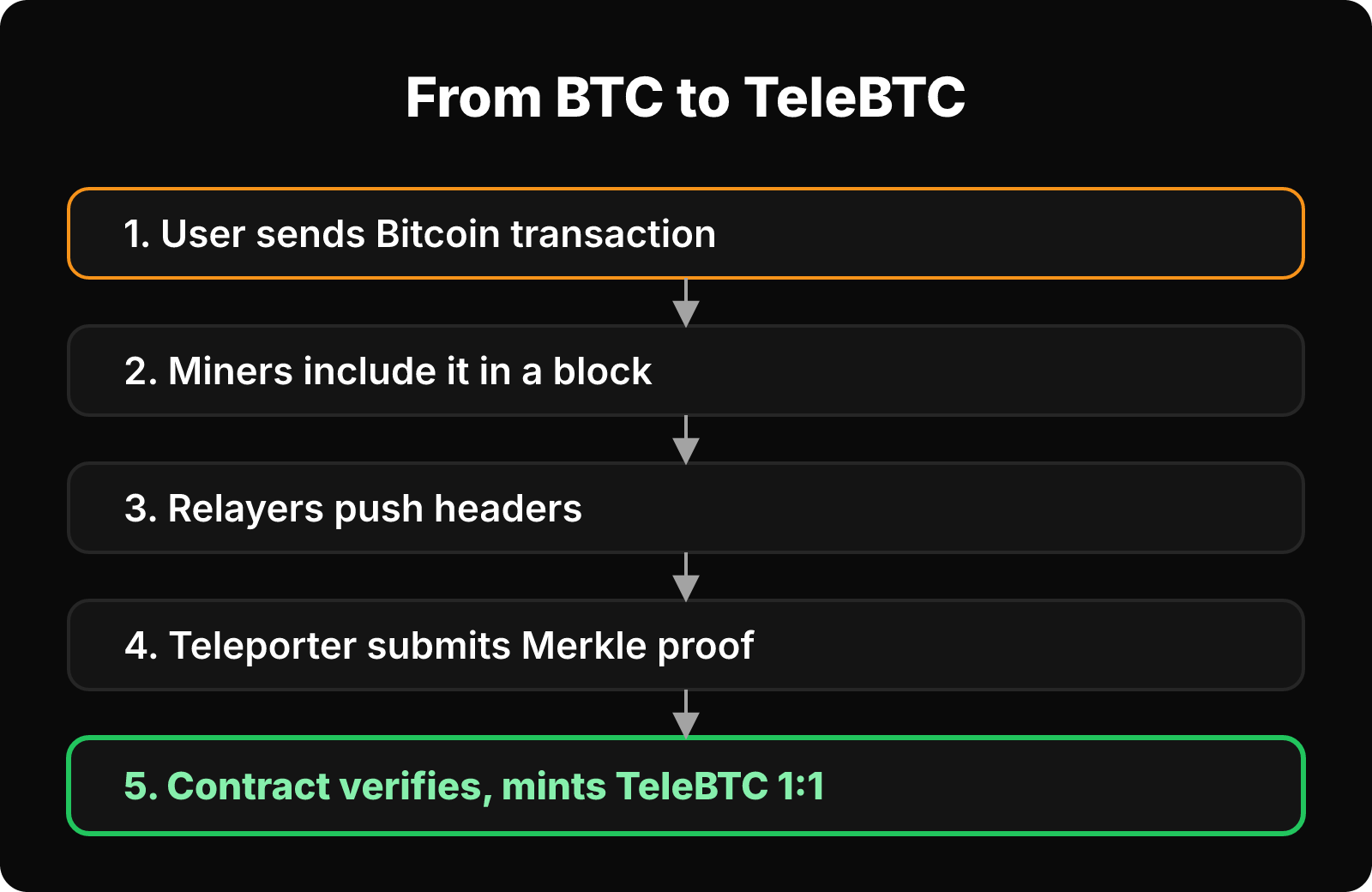
The resulting transaction flow looks like this:
- User broadcasts a Bitcoin transaction paying a Locker address, with request data attached.
- Miners include it in a block (~10 minutes on average).
- Relayers push that block's header, then subsequent headers, to the relay contract.
- A Teleporter submits the transaction plus its Merkle proof to the destination-chain contract and pays the gas.
- The contract verifies inclusion and depth, then mints TeleBTC 1:1 to the recipient. If the user asked for a swap, the contract routes the TeleBTC through an AMM/DEX in the same execution.
TeleSwap documents this architecture in the TeleSwap documentation. The core rule: nothing is minted without a verified Bitcoin transaction.
Lockers, Relayers, Teleporters: who does what in a trustless BTC bridge?
An SPV light client solves minting. Burning (unwrapping) is harder, because a smart contract on Arbitrum can't sign a Bitcoin transaction, so some party has to hold BTC. TeleSwap makes that party accountable through permissionless roles:
- Lockers hold the BTC backing TeleBTC and post collateral on the destination chain. When a user burns TeleBTC, the Locker must send BTC to the user's Bitcoin address. Because the relay contract can verify Bitcoin transactions, it can also detect when a Locker hasn't paid by the deadline, and it slashes the Locker's collateral to compensate the user.
- Relayers keep the on-chain light client synced by submitting Bitcoin headers. One honest, live relayer is enough for liveness, since PoW validity can't be forged.
- Teleporters submit deposit proofs on the destination chain and cover its gas, so users pay all fees in Bitcoin assets and never need ETH, MATIC, or BNB to receive funds.
- Fillers are another permissionless role that earns fees for serving the protocol. See the docs for the current role specifications.
This is a different security model from a multisig. A threshold signer group's security is its honest-majority assumption. A collateralized Locker's security comes from verifiable misbehavior plus a penalty bigger than the gain. That only holds while collateral stays adequate relative to the BTC it backs, so a sharp swing between the collateral asset's price and BTC's is a live risk to monitor. This is why "trustless" is better read as "trust-minimized": the trust moves from a company's goodwill to math and economic incentives you can audit.
Wrapped BTC models compared: custodial vs. trustless BTC DeFi (2026)
The table compares seven Bitcoin-in-DeFi designs. Data comes from eco.com's BTCfi 2026 overview, Coin Bureau, and protocol documentation.
| Model | Who holds BTC | How the deposit is verified | Who can block redemption | Notable facts |
|---|---|---|---|---|
| WBTC | BitGo + BiT Global | Custodian attestation | Custodians / merchants | $9.65B market cap (Oct 13, 2026) |
| cbBTC | Coinbase Custody | Custodian attestation | Coinbase | Launched September 2024 |
| FBTC | Antalpha Prime | Custodian attestation | Antalpha | ~$1.5B+ supply, Mantle distribution |
| cirBTC | Circle | On-chain verifiable reserves | Circle / regulators | Announced; launch status differs by source, subject to regulatory approvals |
| tBTC | Threshold ECDSA signer group | Threshold signer set | Honest-majority signer threshold | ~$500M+ supply |
| Babylon vaults | User (timelocked UTXO) | Bitcoin script | No wrapped-token custodian; subject to slashing rules | Collateral-focused; Aave partnership announced |
| TeleBTC (TeleSwap) | Collateralized, slashable Lockers | On-chain SPV light client (PoW + Merkle proof) | No one without being slashed | $534,965,114 bridged, 13 networks |
Babylon-style native vaults are excellent at collateral, less so at liquidity. Babylon's Aave tie-up lets BTC back a loan "without wrapping or centralized custody," as CoinDesk reported. For uses like swapping or moving BTC value across chains, you need a transferable token, and the question is whether its backing is custodial or proof-verified. TeleBTC is the proof-verified option: it inherits Bitcoin's security model directly instead of a custodian's balance sheet.
How to wrap BTC without a custodian: step-by-step route
What you'll have done by the end: sent native BTC from your own Bitcoin wallet and received either TeleBTC or a swapped token (for example USDC on Arbitrum) at an address you control, with both legs checked on-chain.
What you need:
- A self-custody Bitcoin wallet holding the BTC you want to move plus enough for the Bitcoin network fee. Exchange withdrawals generally can't attach the request data (see troubleshooting).
- A destination address you control (an EVM address for Ethereum, Arbitrum, Base, BNB Smart Chain, Polygon, and so on).
- No destination-chain gas token. A Teleporter covers that.
Step 1: Open the bridge and pick a route
Screen: go to teleswap.xyz, choose BTC as the source, then the destination network and token. Choose TeleBTC for a plain wrap, or any supported ERC-20, Jetton, or SPL token to bridge and swap in one step. Cost: free.
Step 2: Enter the amount and destination address
Screen: a quote panel shows the estimated amount you'll receive. Paste your destination address and check the first and last six characters. The address is written into the Bitcoin transaction's request data, and a confirmed Bitcoin transaction can't be edited. Cost: free.
Step 3: Review the fee breakdown
Screen: the quote itemizes the Bitcoin network fee (set by mempool demand in sat/vB), protocol and role fees, and, for swaps, the expected output and slippage tolerance. Fees vary by route and network conditions, so treat the on-screen quote as authoritative. Cost: shown before you sign, all paid in Bitcoin assets.
Step 4: Sign and broadcast the Bitcoin transaction
Screen: your Bitcoin wallet asks you to sign a transaction with an output to the Locker address and the attached request data. Pick a competitive fee rate, since underpaying is the most common cause of delay. Cost: the Bitcoin network fee. You can watch it on mempool.space.
Step 5: Wait for confirmation and proof
Screen: a status tracker moves from "pending" to "confirmed" to "completed." Behind it, miners include your transaction, Relayers submit headers, a Teleporter submits the Merkle proof, and the contract mints TeleBTC (and executes the swap, if selected). Cost: nothing extra; gas is covered. Time: fast swaps settle in ~10 minutes, and slower blocks or a low fee rate stretch this.
Step 6: Verify on-chain
Screen: open the destination chain's explorer, find the mint (and swap) transaction to your address, and add the TeleBTC token contract to your wallet if needed. Cost: free.
The reverse route works the same way in the other direction. You burn TeleBTC (or swap a token such as WBTC on Ethereum back to BTC), and the assigned Locker must pay native BTC to your Bitcoin address. If it doesn't, the protocol's slashing path compensates you from the Locker's collateral. See also WBTC to BTC swap in minutes.
For developers: the same flow is exposed through TeleSwap's SDK, which returns a BTC → EVM/TON/Solana quote in under a minute and wraps the REST API for plain-HTTP use. Integrators can register a third-party ID to earn a share of fees on the volume they bring. TeleSwap is also integrated as a Bitcoin swap provider in Rango, Rubic, and DZap, and in MetaMask and Trust Wallet through the Rango integration.
Common problems and fixes when you wrap BTC without a custodian
Most failures happen on the Bitcoin leg, not the contract leg.
| Problem | Likely cause | Fix |
|---|---|---|
| Transaction stuck "pending" for an hour or more | Fee rate below current mempool demand | Bump the fee with Replace-By-Fee (RBF) if your wallet signaled it, or use Child-Pays-For-Parent (CPFP) on a change output, as explained in Bitcoin Optech's RBF guide. The request data must stay identical. |
| BTC confirmed but no TeleBTC yet | The required confirmation depth hasn't been reached, or the proof is still being relayed | Wait for more blocks. Track the status on teleswap.xyz before escalating. |
| Received less than quoted on a swap | DEX price moved within your slippage tolerance | Use a tighter slippage setting for large trades, or wrap to TeleBTC first and swap separately. |
| Sent BTC straight from an exchange | Exchange withdrawals usually can't attach custom request data | Always send from a self-custody wallet. Contact support with the txid if this already happened. |
| Can't see tokens in wallet | Token contract not added, or wrong network selected | Switch to the destination network and import the token contract from the explorer. |
What to do with trustless BTC in DeFi
Once you hold TeleBTC, it's a standard token on its chain. TeleSwap's Earn pillar keeps everything denominated in BTC. You can stake TST for fee rewards, deposit into the TeleBTC pools for BTC yield (since 2026-10-14 you can deposit native BTC directly from a Bitcoin wallet in one transaction, with no EVM wallet), or run a protocol role such as Locker or Relayer for fees. Yields come from protocol fees and pool activity, so they vary and aren't guaranteed.
According to TeleSwap network stats, the protocol processed $39.6M in the last 30 days, about $1.3M per day, with a peak of $2.1M on 2026-10-08. Overall it has bridged $534,965,114 across 566,728 transactions on 13 supported networks.
One compliance note: whether wrapping counts as a taxable disposal is unsettled in the US. Count on Sheep's 2026 analysis sets out both conservative and aggressive positions. Ask a tax professional. This article isn't tax or financial advice.
Frequently Asked Questions
Is TeleBTC custodial?
No. TeleBTC is minted only after an on-chain SPV light client verifies a real Bitcoin transaction, and no custodian or multisig committee authorizes mints. The BTC sits with Lockers who post slashable collateral, so if one fails to honor a redemption, the protocol can prove it on-chain and compensate the user from that collateral.
How is trustless bitcoin wrapping different from WBTC?
WBTC relies on custodians (BitGo and BiT Global) to hold the BTC, while trustless wrapping has a smart contract verify Bitcoin's proof-of-work and a Merkle inclusion proof itself. The practical difference is who can block redemptions. With WBTC it's the custodians. With a light-client design, a misbehaving BTC holder gets slashed.
What happens if a Locker doesn't send my BTC back?
The Locker's collateral is slashed to compensate you. The relay contract can verify Bitcoin transactions, so it can determine that no qualifying payment reached your address within the deadline, and then it triggers the penalty.
How long does it take to wrap BTC with TeleSwap?
Fast swaps settle in about 10 minutes. The main variable is the Bitcoin leg: a low fee rate can leave your transaction in the mempool, and the contract waits for enough confirmations to protect against reorgs before minting.
Do I need ETH or another gas token to receive wrapped BTC?
No. A Teleporter pays the destination-chain gas, and you pay all fees in Bitcoin assets. That means you can bridge BTC to a fresh EVM address with a zero balance and still receive TeleBTC or a swapped token.
Is a "trustless" bridge completely risk-free?
No. It's trust-minimized, not risk-free. The remaining assumptions are Bitcoin's proof-of-work security, at least one live relayer, Locker collateral that stays adequate relative to BTC, and correct smart-contract code. Those risks can be audited, which isn't true of a custodian's internal controls.
Conclusion: bitcoin wrapping that doesn't ask for your trust
Custodial wrapped BTC put Bitcoin into DeFi, but it brought back counterparty risk. Proof-verified bitcoin wrapping turns that into checkable mechanics: header relay, Merkle proofs, confirmation depth, and slashable collateral.
TeleSwap runs that model in production, with $534,965,114 bridged across 13 networks. Fast swaps settle in about 10 minutes, fees are paid in Bitcoin assets, and you don't need gas on the destination chain. Start with a small amount, verify both legs on-chain, and scale up from there.