BTC to USDT No KYC: Swap Without an Account in 2026

You can swap BTC to USDT with no KYC by sending Bitcoin from your own wallet through a non-custodial swap and receiving USDT at an address you control. No account is needed. On TeleSwap, fast swaps settle in about 10 minutes.
The usual alternative is an exchange account: a passport upload, a selfie, an approval wait, then sending your BTC to a company that holds it for you. A btc to usdt no kyc swap skips all of that. This guide covers each step, what it costs, how long it takes, and what to do when something looks wrong.
One thing first. "No KYC" is the feature people search for, but what protects you is who holds your coins during the swap. We'll keep coming back to that.
Key Takeaways:A non-custodial BTC to USDT swap sends Bitcoin from your wallet and delivers USDT to your own address, so no company ever holds your funds in an account.TeleSwap swaps native BTC into USDT on several chains in one step, and its fast swaps settle in about 10 minutes.According to TeleSwap network stats, the protocol has processed $536.9M in volume across 568,493 bridge transactions as of 2026-10-30.Picking the wrong USDT network, such as sending to a Tron address when you chose Ethereum, is the most common mistake that can't be undone."No KYC" doesn't mean "no rules": taxes and local regulations still apply to you, and USDT itself can be frozen by its issuer.
Table of Contents
- What You'll Have Done by the End (and What You Need)
- What Does BTC to USDT No KYC Actually Mean?
- Non-Custodial BTC to USDT Swap Options Compared
- How to Swap Bitcoin to USDT Without KYC: 7 Steps
- What It Costs and How Long It Takes
- Common Problems and How to Fix Them
- Frequently Asked Questions
- Conclusion
What You'll Have Done by the End (and What You Need)
By the end of this guide you'll have turned BTC in your own Bitcoin wallet into USDT (ERC-20) in your own Ethereum wallet. No sign-up, no ID upload, and no exchange balance to withdraw from later.
Here's the checklist before you start:
- A Bitcoin wallet that holds your BTC. Any self-custody wallet works: one where you have the recovery phrase. If your BTC is on an exchange right now, it isn't in your wallet yet.
- A little extra BTC for the miner fee. Bitcoin transactions pay a small fee to the network. It changes with demand, and you can check the current rate on mempool.space.
- An Ethereum address to receive USDT. MetaMask or Trust Wallet are common choices. It's the address starting with
0x. - About 15–20 minutes. Most of that is waiting for Bitcoin to confirm.
You do not need ETH for gas on the receiving side. On TeleSwap, a Teleporter (one of the protocol's permissionless roles) covers destination-chain gas for you, and fees are paid in Bitcoin assets. You'll still need a little ETH later if you want to move that USDT on Ethereum.
What Does BTC to USDT No KYC Actually Mean?
KYC stands for "Know Your Customer." It's the identity check regulated exchanges run before you can trade: name, ID document, sometimes proof of address. A btc to usdt no kyc swap skips that step, but services skip it in two very different ways.
Custodial "no KYC" vs. non-custodial swaps
Think of a currency exchange booth at an airport. You hand over your cash, they count it in the back, and they hand you back euros. A custodial instant exchange works the same way: you send BTC to their address, they hold it, then they send you USDT. Many say "no KYC" but may ask for ID if a transaction gets flagged, and your coins stay with them until you comply.
A non-custodial swap works more like a vending machine wired to a public rulebook. You put coins in, and code that anyone can inspect decides what comes out. There's no back office deciding whether to release your funds.
The account-free part is nice, but the custody model decides whether you get your money. A custodial service with no KYC can still freeze you. A trust-minimized protocol has no account to freeze in the first place.
The part most guides skip: every route has "Bitcoin in disguise"
Bitcoin and Ethereum can't talk to each other directly. So most BTC-to-ERC-20 routes use some token that stands for BTC on the other chain partway through. Boltz's Lightning-to-USDT0 route, launched on 18 March 2026, passes through Threshold's tBTC on Arbitrum, as reported by CryptoRank. Uniswap needs you to already hold WBTC. TeleSwap uses TeleBTC.
The useful question isn't "is there a wrapped token?" It's "what keeps that token honest?" For more, see our explainer on wrapping Bitcoin without custodians.
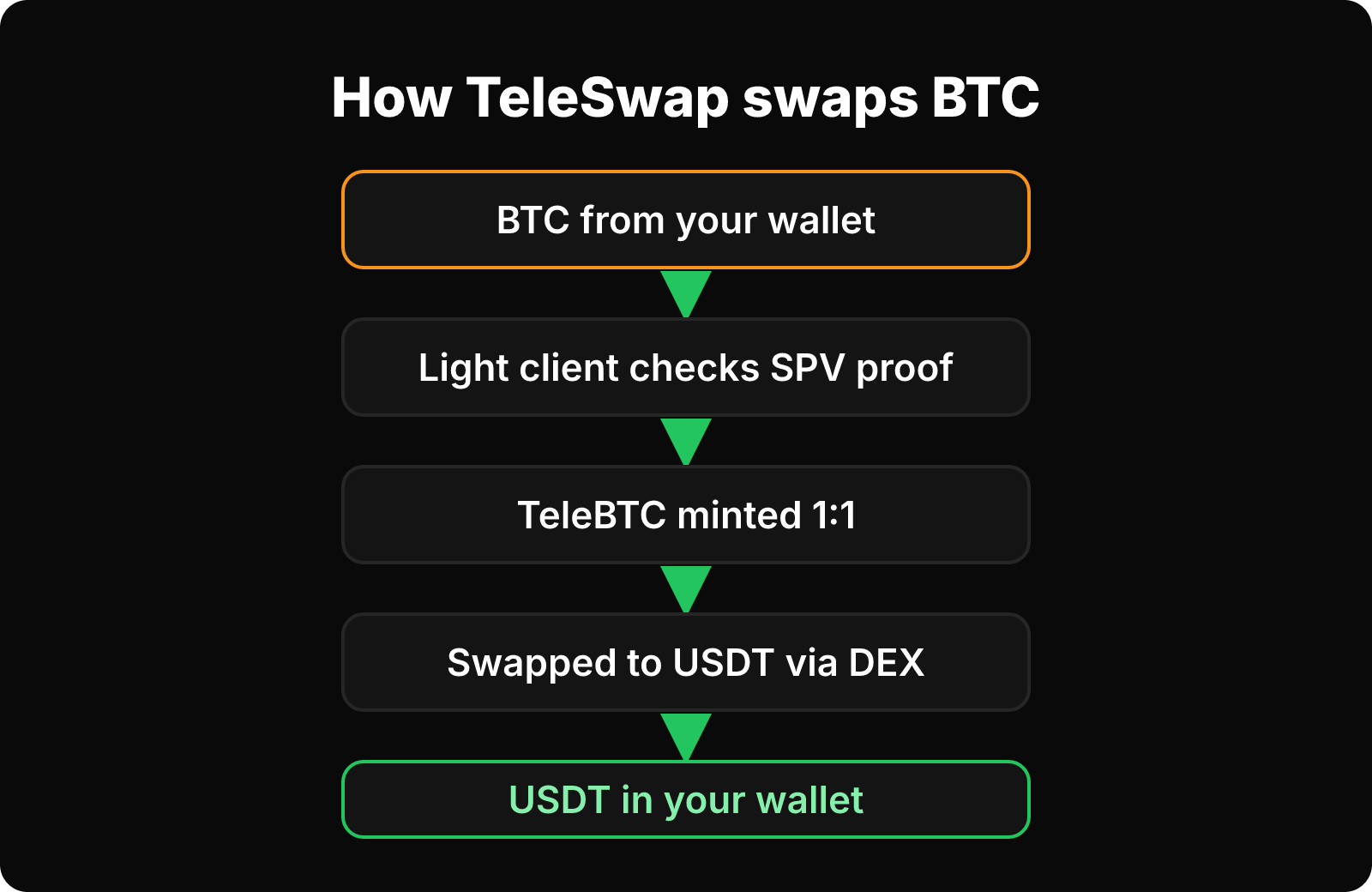
TeleBTC is backed 1:1 by real BTC. Instead of trusting a custodian or a multi-signature committee, the TeleSwap bridge uses a light client that checks SPV proofs (Simplified Payment Verification: a compact way to prove a Bitcoin transaction was included in a block). Nothing gets minted unless a real Bitcoin transaction is verified, and custody is collateral-backed and slashable. See the TeleSwap documentation. Learn more in How Bitcoin Bridges Work: SPV Light Clients Explained.
In a swap you never actually hold TeleBTC. It's minted, swapped to USDT through a DEX, and the USDT lands in your wallet, all in one flow.
Non-Custodial BTC to USDT Swap Options Compared
We compared six ways to swap Bitcoin to USDT without KYC. Timing figures come from each provider's own published data where available. Treat vendor numbers as self-reported.
| Option | You send | Who holds funds mid-swap | Account / KYC | USDT networks | Typical time |
|---|---|---|---|---|---|
| TeleSwap | Native BTC | No custodian; light-client verified, collateral-backed | No account sign-up | Ethereum, Tron, Arbitrum, Polygon, BNB Chain, Optimism | ~10 min (fast swaps) |
| Symbiosis | Native BTC | Non-custodial router, relies on liquidity providers | No account | Tron (for USDT) | ~9 min median (Symbiosis, 90 days to 29 Sep 2026) |
| Boltz | Lightning sats | Atomic swap via tBTC | No account | USDT0 on Arbitrum | Not stated in sources |
| Instant exchanges (FixedFloat, SideShift, etc.) | Native BTC | The exchange, briefly | Optional; can be requested if flagged | Varies | Roughly 5–15 min, varies |
| Uniswap | WBTC (must already own) | Smart contract | None | Ethereum | Needs ETH for gas |
| Centralized exchange | Native BTC | The exchange | Full KYC required | Many | Deposit confirmations, then withdrawal |
For context on price: Symbiosis quoted 1,014 USDT on Tron for 0.012 BTC on 6 Oct 2026, with $12.10 in combined fee and gas and an estimated ~562 seconds, per its swap page. Always compare live quotes for your amount, because prices change by the minute. For more on fees, see Lowest Fee Swap BTC No KYC: 4 Options Compared.
TeleSwap's combination is native BTC in, USDT out on your choice of several networks, no custodian in the middle, and no gas token needed on arrival. TeleSwap network stats show $40.2M in volume over the last 30 days, averaging about $1.3M a day, across 13 supported networks. TeleSwap is also available through Rango (including inside MetaMask and Trust Wallet), Rubic and DZap.
How to Swap Bitcoin to USDT Without KYC: 7 Steps
This walkthrough uses TeleSwap's BTC → USDT (Ethereum) route. The interface may get small design updates, but the flow stays the same.
- Open the right page, and check the URL. Type
teleswap.xyzyourself or bookmark it. Don't click swap links from social media replies or DMs, since phishing copies of swap sites are common. The direct page to swap BTC to USDT on Ethereum already has the pair selected.What you see: a swap panel with BTC on top and USDT on Ethereum below. Cost: nothing. Time: 10 seconds. - Enter how much BTC you want to swap. Type the amount in the top field.What you see: the estimated USDT you'll receive, plus an estimated delivery time. Cost: nothing yet. Time: a few seconds.
- Read the quote carefully. Look at the output amount, the fee breakdown, and any minimum-received figure. That figure protects you: if the price moves too much before your swap runs, you won't get less than that.Tip: on very small amounts, fixed costs make up a bigger share. If the fees look high relative to what you're swapping, try a larger amount or wait for a calmer Bitcoin mempool.
- Enter your Ethereum receiving address. Paste the
0x…address from MetaMask, Trust Wallet, or whichever Ethereum wallet you use. Check the first and last four characters against your wallet. Clipboard-hijacking malware exists, and it swaps addresses quietly.What you see: the address field shows your destination, and the network is labeled Ethereum. Time: 30 seconds. - Send the BTC from your Bitcoin wallet. Follow the on-screen instructions exactly. Don't change the amount, and don't send from an exchange account, where you can't control the transaction details.What you see: your wallet's confirm screen showing the amount and a Bitcoin miner fee. Cost: the miner fee, set by network demand (check mempool.space). A "medium" or "fast" fee helps your transaction get into a block quickly. Time: 1 minute.
- Wait while the protocol does its work. Your Bitcoin transaction gets mined into a block. Relayers keep the light client fed with Bitcoin block headers, so it can verify your transaction with an SPV proof. Then TeleBTC is minted 1:1, swapped to USDT through a DEX, and sent to your address, with the Teleporter covering Ethereum gas.What you see: a status tracker moving from "waiting for Bitcoin" to "completed." Time: fast swaps settle in about 10 minutes. It can take longer if Bitcoin blocks are slow or your miner fee was low.
- Confirm the USDT arrived. Open your Ethereum wallet. If you don't see USDT, add it as a token using the official contract address,
0xdAC17F958D2ee523a2206206994597C13D831ec7, which you can confirm on Etherscan's USDT page.What you see: a USDT balance. You've swapped Bitcoin to USDT without KYC and without an account.
Should you pick Ethereum or another USDT network?
Choose the network based on where you'll use the USDT, not just which swap looks cheapest today. USDT on Ethereum works with the most DeFi apps, but every later transfer costs ETH gas. USDT on Tron is widely used for payments, with about $83.9B of supply as of 17 March 2026, per CryptoRank. If that's where you're headed, TeleSwap also has a route to swap BTC to USDT on Tron, and the steps are the same except you paste a Tron address (starting with T). See also USDT TRC20 to BTC for the reverse direction.
What It Costs and How Long It Takes
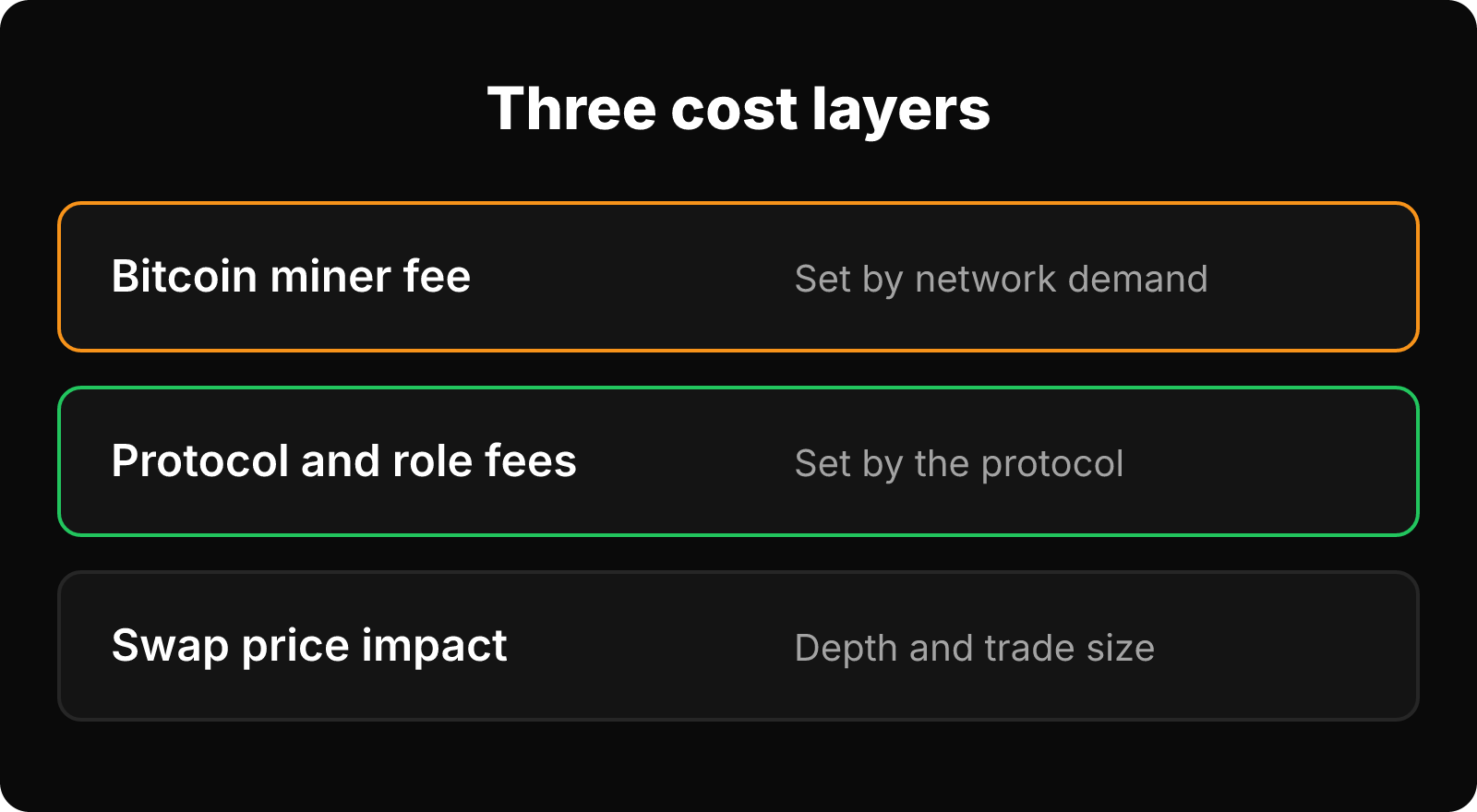
A non-custodial BTC to USDT swap has three cost layers. Knowing them makes any quote easier to read.
| Cost layer | What it is | Who sets it | Where you see it |
|---|---|---|---|
| Bitcoin miner fee | Payment to get your BTC transaction into a block | Bitcoin network demand (mempool.space) | Your Bitcoin wallet's confirm screen |
| Protocol and role fees | Pays the bridge and the roles that run it (Lockers, Teleporters, Relayers) | The protocol | The TeleSwap quote |
| Swap price impact | The gap between the market price and your fill on the DEX | Liquidity depth and trade size | Built into the quoted output and minimum received |
Beginners often compare the "fee" line between providers and miss the output line. Some services show a low fee and a worse exchange rate. Compare the final USDT you receive for the same BTC amount.
On timing, Bitcoin confirmation is the slow part on every route. Symbiosis reports a ~9-minute median, and TeleSwap's fast swaps settle in about 10 minutes. Anyone promising "instant" BTC settlement is either holding your coins on credit or rounding generously.
Common Problems and How to Fix Them
"It's been 30 minutes and nothing has arrived."
Most likely your Bitcoin transaction is still unconfirmed. Paste your transaction ID into mempool.space. If it's pending with a low fee, your wallet may support Replace-By-Fee (RBF) to bump it. Don't send a second transaction to "push" the first one.
"The swap finished but my wallet shows zero USDT."
Your wallet probably isn't displaying the token yet. Add USDT using the official contract address above, and make sure the wallet is set to Ethereum Mainnet.
"I pasted a Tron address into an Ethereum swap."
Prevention is the only real fix here. Ethereum addresses start with 0x, and Tron addresses start with T. Always match the network label to your wallet before you send BTC.
"I received less USDT than the first quote."
The price moved between the quote and the execution. BTC trades around the clock. If what you got is above the minimum-received figure, the swap worked as designed.
"Someone from 'support' messaged me offering to help."
It's a scam. Real support will never DM you first or ask for your recovery phrase. Nobody needs your seed phrase to finish a swap.
"Is no-KYC legal where I live?"
It depends on your jurisdiction, and you're responsible for knowing. Swapping from your own wallet doesn't remove tax obligations, and swapping BTC for USDT is a taxable disposal in many countries, so check your local rules. Also remember that Tether can freeze USDT addresses, as its terms of service describe. A stablecoin is a claim on its issuer, not a bearer asset like BTC. More in No KYC Bitcoin Trading Limits 2026: Risks & Tax Basics.
Frequently Asked Questions
Can I swap BTC to USDT with no KYC?
Yes, non-custodial swap protocols let you swap BTC to USDT with no KYC and no account. You send Bitcoin from your own wallet and receive USDT at your own address. Custodial instant exchanges may also skip KYC but can request ID later if a transaction gets flagged, holding your funds until you comply.
How long does a non-custodial BTC to USDT swap take?
Usually around 10 minutes, mostly waiting for Bitcoin to confirm. TeleSwap's fast swaps settle in about 10 minutes, and Symbiosis reports a ~9-minute median. A low miner fee or slow blocks can stretch that out.
Do I need ETH to receive USDT on Ethereum?
Not with TeleSwap, because a Teleporter covers the destination-chain gas for you. You will need a small amount of ETH later if you want to send or use that USDT on Ethereum.
Is TeleSwap custodial?
No. TeleSwap is a trustless protocol that verifies Bitcoin transactions with an SPV light client rather than relying on a custodian or multi-sig committee. TeleBTC, the token used in the middle of the swap, is backed 1:1 by BTC, and custody is collateral-backed and slashable. According to TeleSwap network stats, the protocol has handled $536.9M in total volume across 568,493 bridge transactions.
Which USDT network should I choose?
Choose the network where you plan to use or send the USDT. Ethereum has the widest DeFi support but higher gas costs. Tron is popular for payments. Arbitrum, Polygon, BNB Chain, and Optimism are other options, and TeleSwap has BTC → USDT routes for all of these.
What happens if I send BTC to the wrong address?
Bitcoin transactions can't be reversed, so funds sent to a wrong or mistyped address are usually lost. Always copy addresses from the official interface, check the first and last characters, and confirm the network label before you approve.
Conclusion
A btc to usdt no kyc swap isn't a loophole. It's what happens when the swap runs on verifiable code instead of a company's back office. Three things to remember:
- Custody beats "no KYC." Pick routes where no one holds your coins mid-swap.
- Compare final output, not fee labels. The USDT that lands in your wallet is the real price.
- Match the network. Ethereum address for Ethereum USDT, Tron address for Tron USDT, every time.
TeleSwap brings this together: native BTC in, USDT out on the network you choose, light-client verification instead of custodians, and destination gas covered for you. Have your Bitcoin wallet and your receiving address ready.