USDT TRC20 to BTC: Swap Tron USDT for Native BTC (2026)

You have USDT in a TronLink wallet. Maybe a client paid you in it, maybe you use it for cheap transfers, or maybe it's where you keep your savings. Now you want actual Bitcoin: coins on the Bitcoin blockchain at an address starting with bc1, not a token that only follows BTC's price. A USDT TRC20 to BTC swap does exactly that. It converts Tether's dollar-pegged token on Tron into native Bitcoin, which exists only on the Bitcoin blockchain.
If you already know what you want, you can open the route now. The live quote shows the exact BTC you'll receive and the full fee breakdown before you sign anything.
If you're new to this, keep reading. Searching for this swap turns up exchanges that ask for your passport, sites that give you a "Bitcoin" token that never leaves Tron, and quotes that can't all be right. This guide covers what you're actually swapping, what it costs, and how long it takes. Then it walks through the trip from TronLink to native BTC without handing your coins to a custodian.
Key Takeaways:USDT TRC20 is a dollar-pegged token on Tron and native BTC lives only on Bitcoin, so the conversion is a cross-chain swap, not a simple trade.TeleSwap charges a 0.1% Locker fee plus a Bitcoin network fee on payouts to Bitcoin, per the TeleSwap fees documentation.Sending USDT on Tron usually costs about $1–$3 in TRX resources, according to Eco's 2026 TRC-20 guide.Fixed network fees take the biggest share of small swaps, while percentage fees and spread matter most on large ones.TeleSwap has bridged $540.9M across 572,864 transactions on 13 supported networks, per TeleSwap network stats (retrieved 2 November 2026).
Table of Contents
- USDT TRC20 to BTC: What Are You Actually Swapping?
- Why Native BTC Instead of a "Bitcoin Token" on Tron?
- USDT Tron to BTC: 4 Routes Compared
- TRC20 to BTC Fee: What Will You Actually Pay?
- How Long Does a TRC20 to BTC Swap Take?
- How to Swap USDT TRC20 to BTC: Step-by-Step From TronLink
- How Do You Convert TRC20 USDT to BTC Without a Custodian?
- USDT to BTC With No KYC: What It Really Means
- 5 Mistakes That Cost People Money
- Frequently Asked Questions
- Conclusion
USDT TRC20 to BTC: What Are You Actually Swapping?
Think of blockchains as separate countries. Each has its own currency and its own rules, and coins can't simply walk across the border.
USDT TRC20 is Tether's US-dollar stablecoin issued on the Tron blockchain. "TRC20" is Tron's token standard, the rulebook every Tron token follows. Moving it uses Tron network resources called bandwidth and energy. You pay for those in TRX (Tron's native coin) or get them by staking TRX, as Eco's TRC-20 guide explains.
Native BTC is Bitcoin on the Bitcoin blockchain itself. Proof-of-work mining secures it, and supply is capped at 21 million coins. Once native BTC is in your own wallet, its existence doesn't depend on anyone else behaving honestly.
That means swapping Tron USDT to bitcoin is really two jobs:
- A price conversion: turning dollars into Bitcoin at the market rate.
- A chain crossing: moving value off Tron and onto Bitcoin.
Every route below handles both jobs. They differ in who handles them and how much you have to trust that party.
Why Native BTC Instead of a "Bitcoin Token" on Tron?
This is a common beginner trap. Tron has Bitcoin-like tokens of its own. One of them, BTCT (Bitcoin TRC20), traded between 0.9927 and 1.0058 BTC from 15 to 21 October 2026, according to CoinGecko data.
That's close to 1:1. It still isn't Bitcoin.
A Bitcoin token on Tron is a separate asset that lives on Tron. You can't send it to a bc1 address, a Bitcoin node has no record of it, and its value depends on whoever backs it. The public sources we reviewed don't make BTCT's backing mechanism clear.
From a protocol design standpoint, the question that matters most is this: who can stop me from getting my Bitcoin back? If you hold native BTC in your own wallet, nobody can. If you hold a wrapped token, whoever controls the backing can.
That question is why TeleSwap built its own wrapped asset, TeleBTC, differently. TeleBTC is backed 1:1 by real BTC, and nothing is minted until an SPV light client has verified a real Bitcoin transaction. An SPV light client is a compact on-chain verifier that checks Bitcoin block headers and transaction proofs, so no multi-sig committee or company has to vouch for the backing. On the route in this guide you never hold TeleBTC. You end up with native BTC.
USDT Tron to BTC: 4 Routes Compared
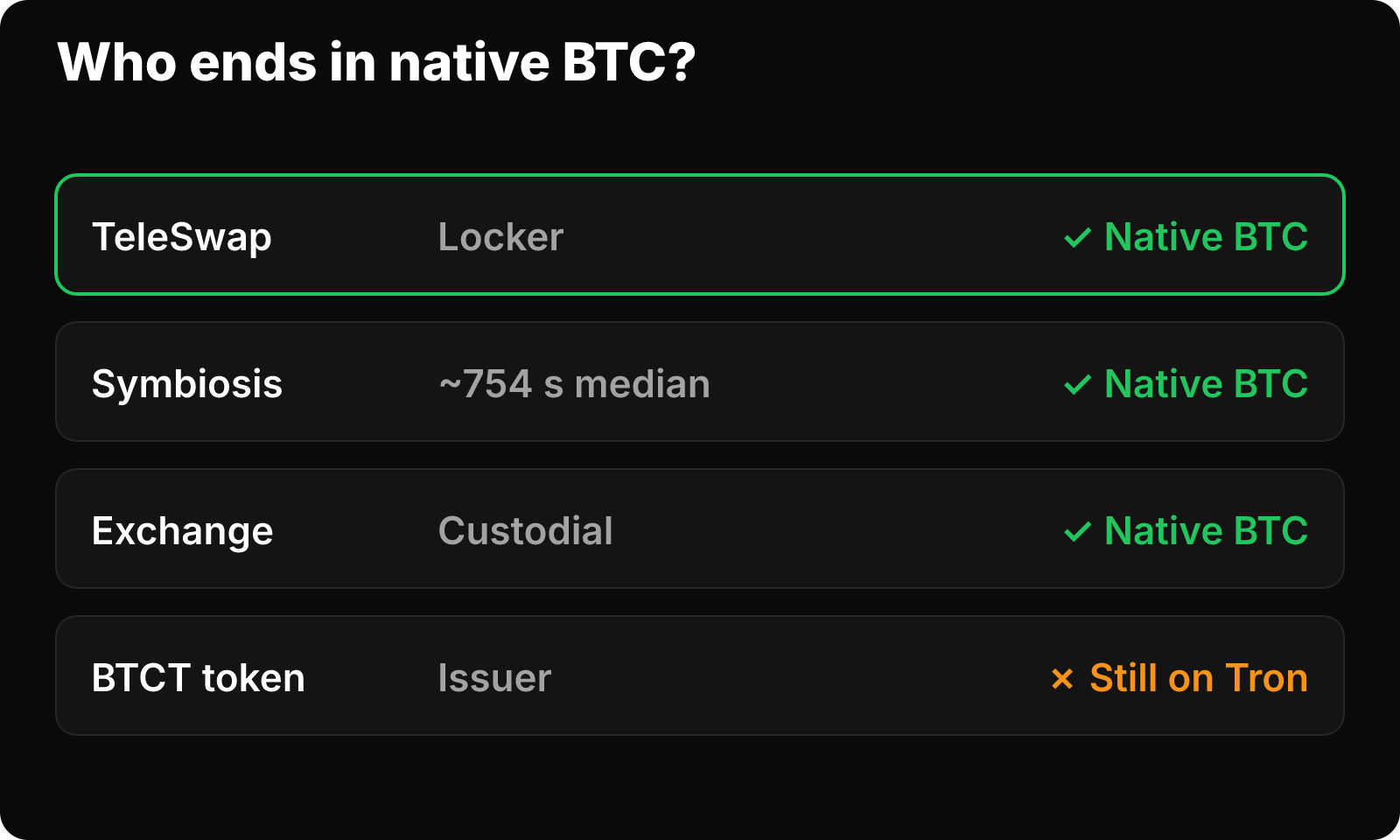
In 2026 you have three practical ways to convert TRC20 USDT to BTC, plus one that only looks like a fourth. Here's how they compare, using published, dated data where it exists.
1. Centralized exchange (CEX)
You deposit USDT TRC20 on an exchange like Binance or Kraken, sell it for BTC, and withdraw the BTC to your own wallet. It's familiar and it works. While your funds sit there, though, the exchange holds them, and you'll almost always need to verify your identity. Withdrawal minimums also apply: Eco's May 2026 survey lists TRC-20 USDT minimums from 1 USDT at Coinbase to 10 USDT at Binance, Bybit and MEXC.
2. Cross-chain swap services and instant converters
These services take USDT on Tron and deliver BTC on Bitcoin in one flow. Symbiosis's published data showed a median Tron-route delivery time of about 754 seconds. Its 6 October 2026 quote for 1,000 USDT from Tron returned 0.01167 BTC, with $9.14 in fees and gas. Instant converters such as GhostSwap list a minimum of about 31 USDT TRC20. The sources we reviewed don't describe how these services settle internally.
3. A trust-minimized bridge: TeleSwap
TeleSwap is a Bitcoin bridge and swap protocol built on Bitcoin-level verification. Its Tron route sends USDT from a Tron wallet straight to a native Bitcoin address. A Locker pays out the BTC. Lockers are participants whose custody is backed by collateral that can be slashed, meaning the protocol can penalize them if they misbehave.
4. A Bitcoin token on Tron (the one that isn't really a route)
Buying BTCT on a Tron DEX gives you Bitcoin price exposure. You stay on Tron, though, so it doesn't answer "how do I get native BTC?"
| Route | Who holds your funds mid-swap | Published cost data | Typical time | Account / KYC | Ends in native BTC? |
|---|---|---|---|---|---|
| TeleSwap (Tron → BTC) | Protocol contracts; payout by a collateral-backed, slashable Locker | 0.1% Locker fee + Bitcoin network fee (docs) | Payout broadcast within minutes, then Bitcoin confirmations | Wallet connection, no exchange account | Yes |
| Symbiosis (Tron → BTC) | Not described in public sources | $9.14 fees + gas on 1,000 USDT (6 Oct 2026) | ~754 s median (~12.6 min) | None claimed | Yes |
| Instant converter (e.g., GhostSwap) | Not described in public sources | Rate spread; ~31 USDT minimum | Varies | Marketed as no KYC | Yes |
| Centralized exchange | The exchange (custodial) | Tron fee ~$1–$3 + trading fee + BTC withdrawal fee | Transfers plus trading and verification time | Usually required | Yes, after withdrawal |
| Bitcoin token on Tron (e.g., BTCT) | Token issuer / backing entity | DEX spread on Tron | Varies | Varies | No, still on Tron |
Our take: if you want Bitcoin you control, the last row drops out. Among the rest, the real decision is about trust and verification. A couple of dollars' difference on one quote matters much less.
In Symbiosis's own data, Tron was its most expensive source chain for USDT → BTC, at $9.14 versus $3.34 from Arbitrum on the same day. That doesn't mean you should move your USDT to another chain first. The extra hop adds its own fees and its own failure point.
For a broader look at moving value from Tron to Bitcoin, including the TRX and general variant of this swap, see our general Tron to native BTC guide. This article sticks to the USDT TRC20 route.
TRC20 to BTC Fee: What Will You Actually Pay?
Every swap from Tron USDT to Bitcoin carries two kinds of cost. Beginners usually notice only one of them.
Fixed costs (the same whether you swap $50 or $50,000)
- Tron transaction cost: about $1–$3, closer to $1 if you've staked TRX for resources (Eco).
- Bitcoin network fee: the fee that gets your BTC payout into a Bitcoin block. On TeleSwap it's charged in Bitcoin terms and listed in the fee breakdown. It rises and falls with congestion and isn't a percentage of your amount. You can check current levels on mempool.space.
Percentage costs (these grow with swap size)
- Locker fee: 0.1% of the bridged amount on TeleSwap (TeleSwap documentation).
- Price spread / slippage: the gap between the quoted rate and the rate you actually get. Symbiosis, for example, sets a 2% default slippage tolerance (Symbiosis). That's the most the final rate is allowed to fall short of the quote, not a fee you're guaranteed to pay.
The two-fee rule in practice
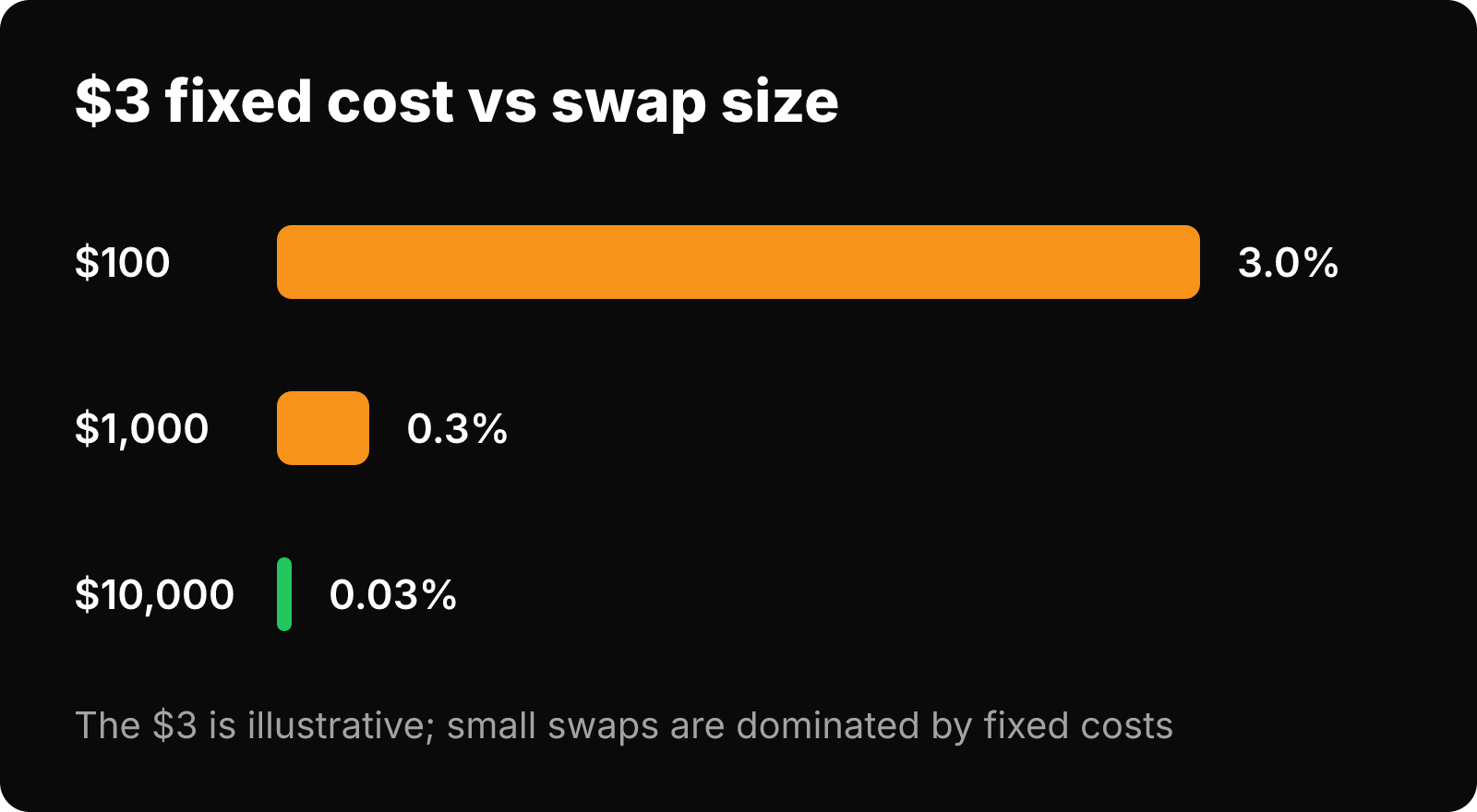
| Swap size | 0.1% Locker fee | $3 fixed cost as % of swap | What dominates |
|---|---|---|---|
| $100 | $0.10 | 3.0% | Fixed costs |
| $1,000 | $1.00 | 0.3% | Roughly balanced |
| $10,000 | $10.00 | 0.03% | Percentage fees and spread |
The $3 is an illustrative fixed cost. Your actual Bitcoin network fee depends on congestion when you swap.
The lesson runs against intuition: splitting a big conversion into many small swaps usually costs more, not less. Each extra swap pays the fixed fees again. On a $50 conversion, network fees alone can take a painful share.
Don't rely on rate snapshots in articles, this one included. Third-party pages we checked implied BTC prices ranging from about $73.5k (ChangeZilla, 1 Nov 2026) to about $86k (Symbiosis, 6 Oct 2026). Some of that gap is market movement and some may be stale data. The live quote you sign is the only number that matters.
How Long Does a TRC20 to BTC Swap Take?
Plan for roughly 10–25 minutes, though this is an estimate, not a guarantee. Most of that is waiting for Bitcoin, not Tron.
- Tron side: your USDT transaction usually shows up on Tronscan within seconds and confirms quickly.
- Payout: on TeleSwap, the Locker broadcasts your BTC payout once the Tron transaction confirms. It typically appears in the Bitcoin mempool within a few minutes (TeleSwap docs).
- Bitcoin confirmations: Bitcoin targets one block every 10 minutes on average. Individual blocks can come faster or much slower.
For comparison, Symbiosis reported a median of about 13 minutes across its USDT → BTC routes over the 90 days to 29 September 2026. Its 50,000 USDT example landed in about 21 minutes (Symbiosis).
How to Swap USDT TRC20 to BTC: Step-by-Step From TronLink
This walkthrough covers a USDT TRC20 to BTC swap on TeleSwap, starting from nothing but a TronLink wallet that holds USDT.
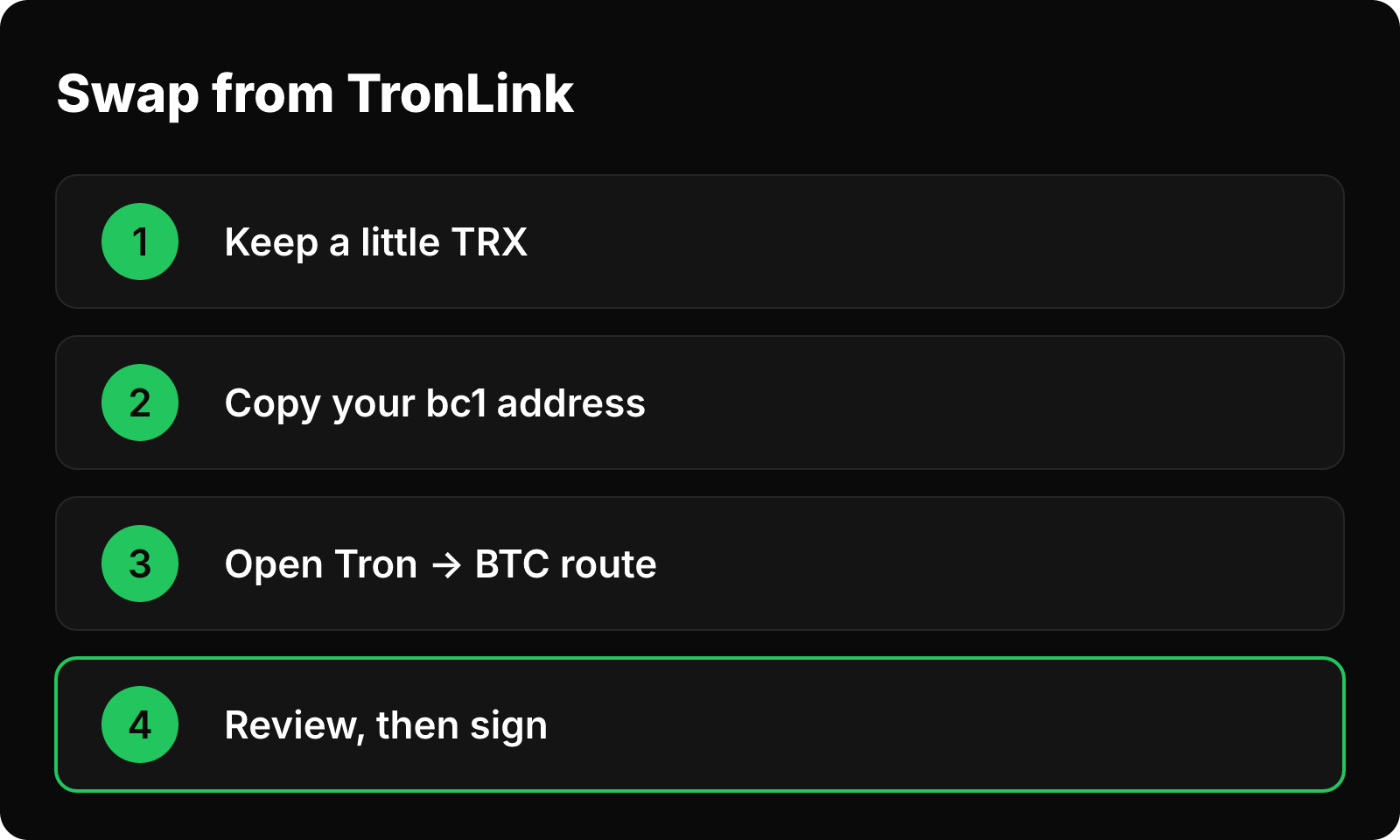
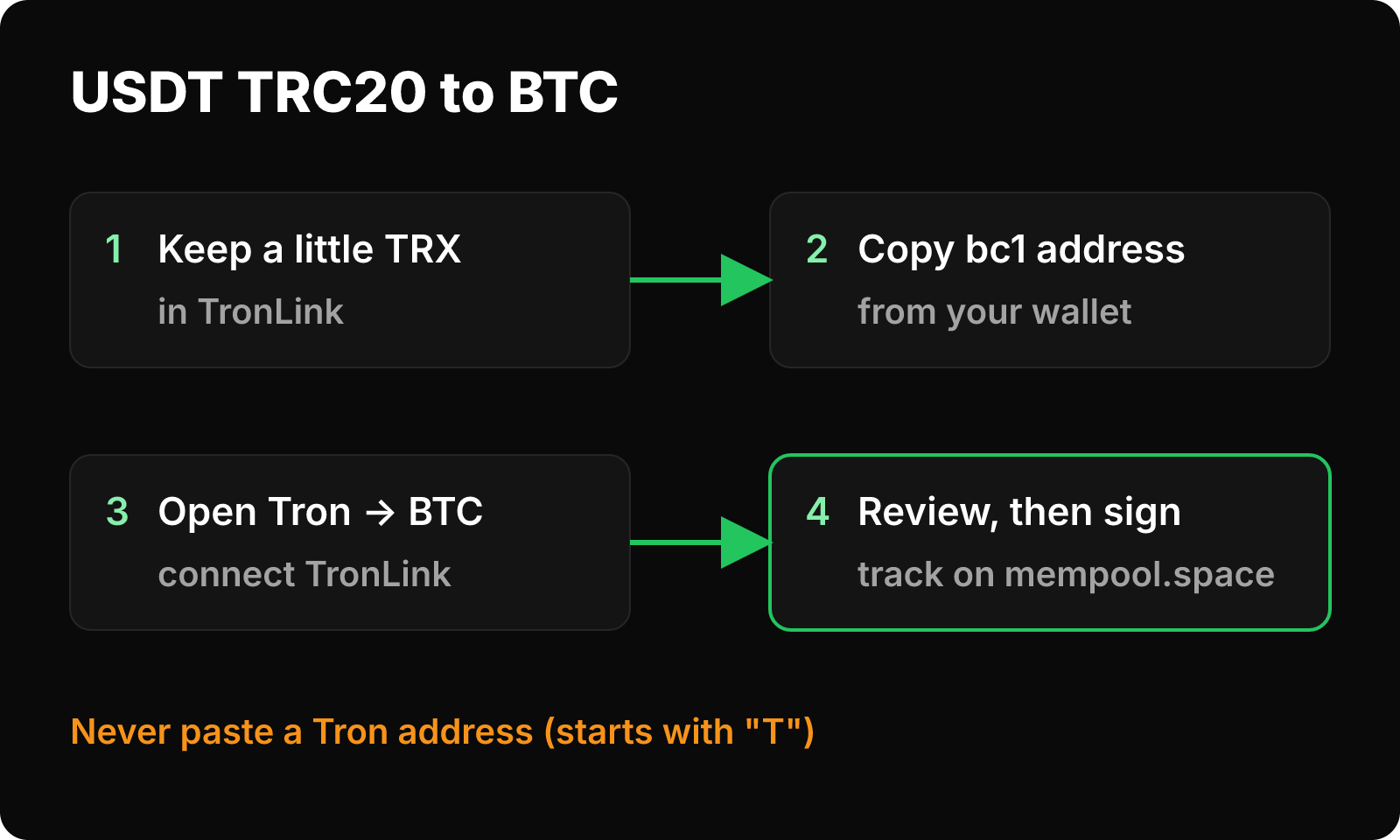
Step 1: Keep a little TRX
USDT transfers on Tron use energy and bandwidth. If you have no staked TRX and not enough TRX to pay for them, the transaction fails. Keep a few dollars' worth of TRX in the same TronLink account. You can check your resources on Tronscan.
Step 2: Get a native Bitcoin address
Open a Bitcoin wallet you control (a hardware wallet or a reputable mobile or desktop wallet) and copy a receiving address. Native SegWit addresses start with bc1q and Taproot addresses start with bc1p. Older formats start with 1 or 3. Never paste a Tron address (starting with "T") here.
Step 3: Open the Tron → BTC route
Go to TeleSwap's USDT (Tron) to BTC swap page on teleswap.xyz. The source and destination are already set: USDT on Tron in, BTC on Bitcoin out.
Step 4: Connect TronLink and enter your amount
Connect TronLink, enter the amount of USDT, and paste your Bitcoin address into the destination field. You'll see an estimate of the BTC you'll receive, along with the fee breakdown.
Step 5: Review, then sign
- Check that the BTC address matches your wallet exactly. Compare at least the first and last six characters.
- Check that the estimated BTC output makes sense at today's price.
- Check that the fees make sense for your swap size (see the two-fee rule above).
Your wallet may ask for a token approval. Approve only the amount you're swapping.
Step 6: Track it to your Bitcoin wallet
Your Tron transaction appears on Tronscan within seconds. Once the BTC payout is broadcast, paste your bc1 address into mempool.space to watch it arrive and confirm.
Worked example (illustrative): you swap 1,000 USDT. The 0.1% Locker fee is the BTC equivalent of about $1. On top of that come the Bitcoin network fee for the payout and roughly $1–$3 of TRX on the Tron side. Before you sign, the live quote shows the exact BTC amount after all of these. Compare it with the market rate, not with a screenshot from last month.
Want to go the other way later? The reverse route, BTC to USDT on Tron, is also available.
How Do You Convert TRC20 USDT to BTC Without a Custodian?
"Trustless" gets used loosely. Here's what it means in practice on this route.
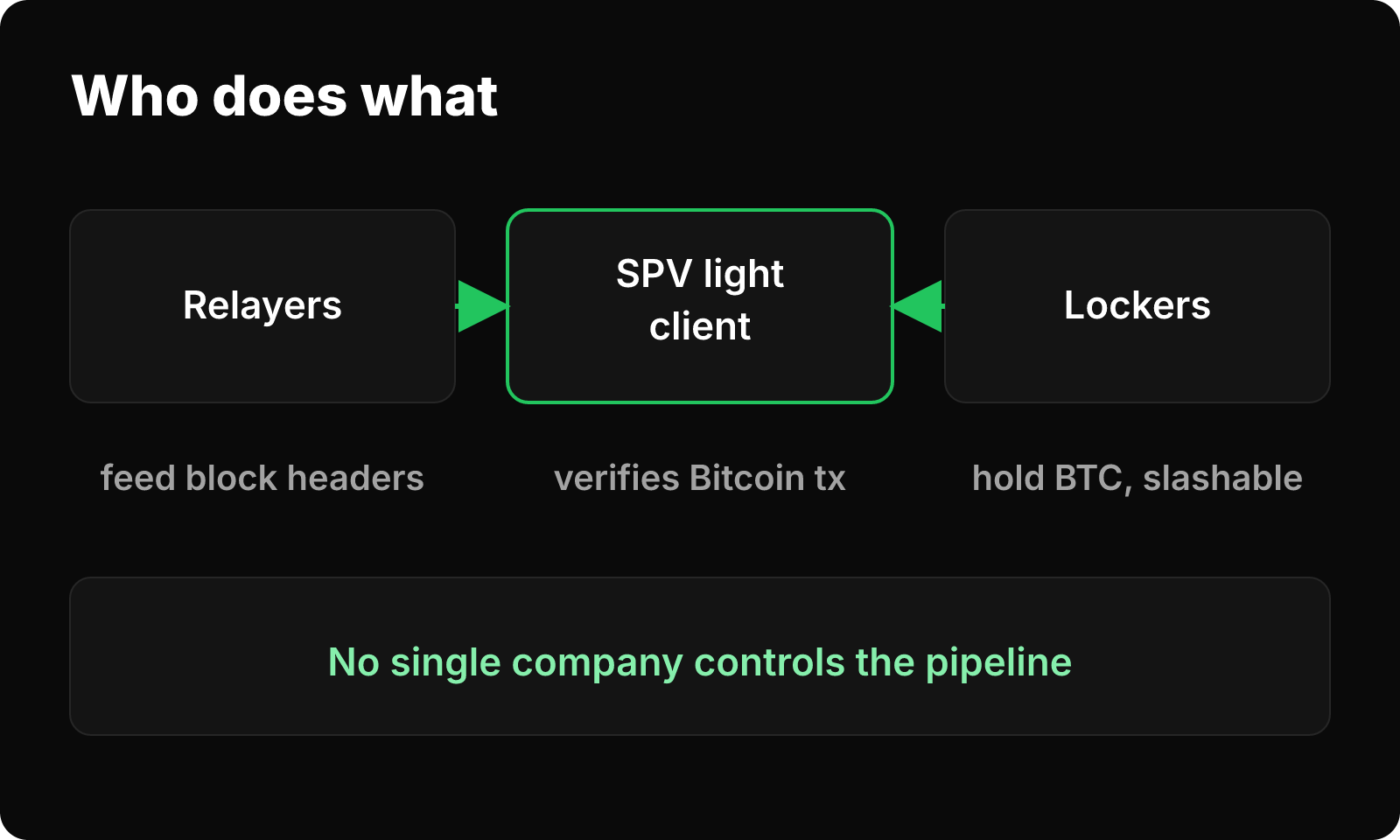
Think of an armored-car service. On a normal exchange, you hand your cash to the company and hope it delivers. In TeleSwap's design, the courier (the Locker) has to post collateral first. If it fails to deliver, the protocol can seize, or slash, that collateral.
According to the TeleSwap documentation, the system works like this:
- Lockers hold BTC backed by slashable collateral and earn the 0.1% Locker fee for that work.
- Relayers feed Bitcoin block headers to the on-chain light client, so the protocol can verify Bitcoin transactions itself instead of trusting someone's word.
- The light-client bridge ensures nothing is minted without a verified Bitcoin transaction. That's the property that separates TeleBTC from custodial wrapped BTC such as WBTC or cbBTC.
- The roles are permissionless. Anyone can run them, so no single company controls the pipeline.
For a closer comparison of custody models, see WBTC Bridge Custody Risk vs Trustless Bridges in 2026.
The caveat: "no custodian" doesn't mean "no risk." Smart contracts can have bugs, and Tether can freeze USDT at specific addresses. What a trust-minimized design removes is the single point of failure: one company whose collapse or decision takes your coins with it. Multichain's shutdown in 2023, which Eco notes, shows why that matters.
The track record is public. As of 2 November 2026, TeleSwap had bridged $540.9M across 572,864 transactions on 13 supported networks. Over the previous 30 days it handled $39.7M, about $1.3M per day, with a daily peak of $2.1M on 8 October 2026, according to TeleSwap network stats.
USDT to BTC With No KYC: What It Really Means
Plenty of people search "usdt to btc no kyc," and the honest answer comes down to custody, not secrecy.
KYC ("Know Your Customer") is the identity check centralized exchanges run because they hold customer funds. A non-custodial swap like TeleSwap's works differently. You never deposit into an account. You sign a transaction from your own wallet, and BTC arrives at an address you control. Converters such as GhostSwap also market themselves as no-KYC, but their custody model isn't described in public sources.
Three honest caveats:
- Your obligations stay the same. Swapping USDT for BTC can be a taxable event in many jurisdictions, so keep records. See No KYC Bitcoin Trading Limits 2026: Risks & Tax Basics.
- Blockchains are public. Anyone can look up transactions on Tronscan and on Bitcoin explorers. Non-custodial doesn't mean invisible.
- Interfaces vary. TeleSwap is also integrated as a Bitcoin swap provider in aggregators such as Rango, Rubic and DZap, and each app may apply its own policies.
For more non-custodial routes that skip account sign-ups, read BTC to USDT No KYC: Swap Without an Account in 2026.
The real benefit isn't anonymity. It's that your funds never sit in someone else's account, where they could be frozen, delayed, or lost if that company fails.
5 Mistakes That Cost People Money
- Running out of TRX. Without energy or bandwidth, your USDT transaction fails, and you can still pay for the failed attempt.
- Pasting the wrong address. Clipboard malware can quietly replace a copied address with an attacker's. Always check the first and last characters.
- Buying a Tron "BTC" token by accident. If the "BTC" shows up in TronLink instead of your Bitcoin wallet, you didn't get native BTC.
- Swapping tiny amounts. Below about $100, fixed fees take a large percentage, and some converters set minimums around 31 USDT (GhostSwap).
- Trusting stale quotes. Third-party rate pages contradict each other, and some refresh only quarterly. Use the live quote in the app you're actually swapping on.
Frequently Asked Questions
Can I swap USDT TRC20 directly to native BTC?
Yes, a cross-chain swap can take USDT TRC20 to native BTC in one flow. On TeleSwap, you sign one swap from your Tron wallet and the BTC payout goes to the Bitcoin address you provide. You don't need an exchange account.
What is the TRC20 to BTC fee?
You pay a Tron transaction cost, a Bitcoin network fee, and the provider's fee. Tron transfers usually cost about $1–$3 in TRX. On TeleSwap, the Locker fee is 0.1% of the bridged amount, and the Bitcoin network fee changes with congestion.
How long does a TRC20 to BTC swap take?
Usually about 10–25 minutes, as an estimate. On TeleSwap, the payout is broadcast within a few minutes of the Tron confirmation, and then you wait for Bitcoin blocks, which average 10 minutes each.
Is TeleSwap custodial?
No, TeleSwap is a trust-minimized protocol, not a custodial exchange. Lockers with slashable collateral handle BTC custody, and TeleBTC is minted only after an SPV light client verifies a real Bitcoin transaction.
Can I swap USDT to BTC with no KYC?
Non-custodial swaps like TeleSwap don't use exchange accounts, so there's no exchange-style sign-up or identity check. You still have to follow your local tax and reporting rules, and every on-chain transaction is publicly visible.
Is a Bitcoin token on Tron the same as native BTC?
No, a token like BTCT is a separate asset that lives on Tron. It may trade near 1 BTC, but you can't send it to a Bitcoin address, and its value depends on whoever backs it.
Conclusion
A USDT TRC20 to BTC swap comes down to three decisions. First, make sure you end up with native BTC, not a Tron token. Second, size the swap so fixed network fees don't eat into it. Third, pick a route where no single company can freeze or lose your funds along the way.
TeleSwap handles the third decision by design. Payouts come from collateral-backed, slashable Lockers, verification relies on a Bitcoin light client instead of a custodian, and the fees are stated up front: a 0.1% Locker fee plus a Bitcoin network fee. The public record on TeleSwap network stats shows 572,864 transactions and $540.9M bridged across 13 networks.
Keep some TRX handy, copy your bc1 address, and check the live quote:
This article is for educational purposes only and isn't financial advice. Crypto prices are volatile, so always check live quotes and do your own research.