Ethereum Staking Explained: How It Works in 2026

More than 43 million ETH was locked in staking as of September 23, 2026. That's roughly 35% of all ether in existence, according to Upshift's analysis of ethereum.org and Staking Rewards data. About a third of the second-largest cryptocurrency is sitting still on purpose, and its owners are being paid for it.
Why would that many people lock up their money? If you've seen "earn yield on your ETH" banners on exchanges and wondered what's behind them, this guide gives you Ethereum staking explained from scratch. We'll cover what staking is, how the rewards are produced, what you can realistically earn in 2026, the risks people tend to skip, and how staking ETH compares with putting Bitcoin to work in DeFi.
We build cross-chain Bitcoin infrastructure, so we also point out where the usual "passive income" story leaves things out.
Key Takeaways:Ethereum staking means locking ETH so it can help secure the network, and the protocol pays you newly issued ETH plus transaction fees in return.About 43.46M ETH, roughly 35% of supply, was staked as of September 23, 2026, according to Upshift citing ethereum.org.Network-level staking yield was about 2.5% per year in September 2026, while providers such as Lido (2.27%) and Coinbase (1.69%) paid less after their fees.Running your own validator takes 32 ETH, while pooled, exchange, and liquid staking let you start with much smaller amounts.Staking rewards fall as more ETH gets staked, because Ethereum's issuance formula spreads a limited reward pool across more validators.
Table of Contents
- What Is Ethereum Staking, in Plain English?
- How Does Ethereum Staking Work Step by Step?
- How Much Can You Earn? ETH Staking Rewards in 2026
- What Are the 5 Ways to Stake ETH?
- What Are the Risks of Staking ETH?
- Ethereum Staking vs Bitcoin DeFi: What's the Difference?
- A Practical Checklist Before You Stake
- Frequently Asked Questions
- Conclusion
What Is Ethereum Staking, in Plain English?
Ethereum staking is the act of locking up ETH as a security deposit so you can help verify transactions on the Ethereum network, and you earn rewards for doing it honestly. If you break the rules or neglect the job, you can lose part of that deposit.
A useful comparison is an apartment security deposit. The landlord (the network) holds your money. Keep the place in good shape and you get the deposit back, plus a small payment. Cause damage and some of it is kept.
The reason this exists goes back to a basic problem every blockchain must solve: who decides which transactions go into the next block? Bitcoin uses Proof-of-Work (PoW). Miners spend electricity solving SHA-256 puzzles, and the winner adds the next block and currently earns a 3.125 BTC block reward after the April 2024 halving.
Ethereum used the same model until September 2022, when it switched to Proof-of-Stake (PoS) in an upgrade called "The Merge". Everstake's staking guide documents the change. Under PoS, you earn the right to produce blocks by putting capital at risk instead of burning electricity. The people who do this are called validators.
Hold onto one idea for the rest of this article: staking is a job, not a savings account. The yield pays you for providing security, and that shapes how the rewards behave.
How Does Ethereum Staking Work Step by Step?
Ethereum staking works by randomly selecting validators to propose new blocks, while other validators vote ("attest") on whether those blocks are valid, and the protocol pays everyone who does their part correctly. Here is the lifecycle of one validator:
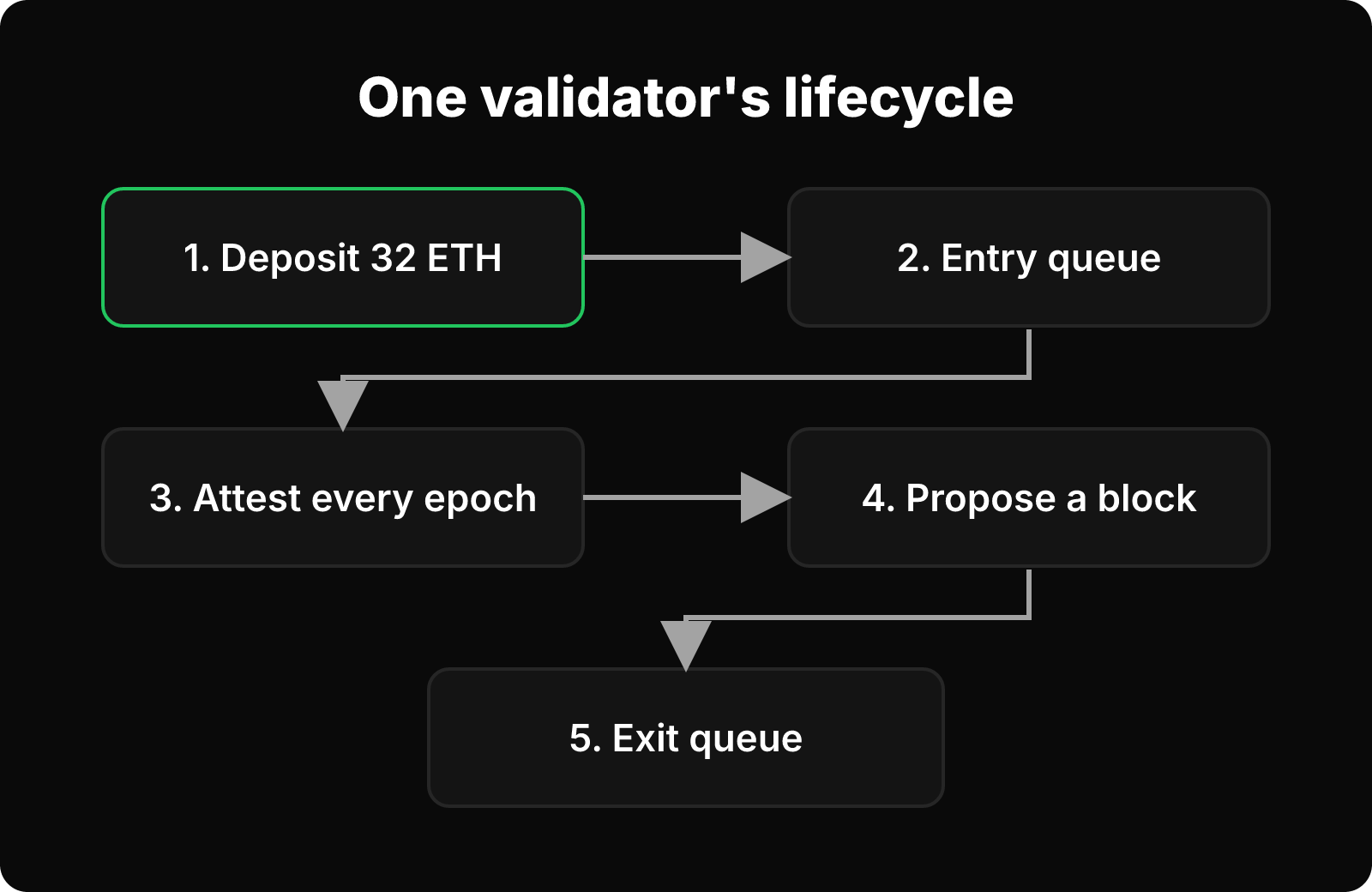
- Deposit 32 ETH. One validator requires 32 ETH sent to Ethereum's deposit contract, and larger operators run many validators.
- Wait in the entry queue. Ethereum limits how quickly new validators can join so the network stays stable. On September 23, 2026, the entry queue held 1.69M ETH, about a 29-day wait, per validatorqueue.com data cited by Upshift.
- Run validator software 24/7. Once active, your validator stays online, checking blocks and casting votes.
- Attest every epoch. Activity is organized into "epochs." Each epoch, your validator votes on the state of the chain and earns a small reward for voting correctly.
- Occasionally propose a block. When randomly chosen, you build the next block and collect its transaction tips on top of the normal rewards.
- Exit when you're ready. Exits also go through a queue. On September 23, 2026, that queue held 155,232 ETH, around 2 days and 17 hours.
Where do the rewards actually come from?
Validators earn from three sources:
- Issuance: newly created ETH the protocol pays for honest participation.
- Transaction fees (priority tips): paid to whoever proposes a block. BlackRock's iShares research found these fees added only about 0.1% to rewards on average over the past month it studied in 2026.
- MEV (Maximal Extractable Value): extra income from how transactions are ordered inside a block. It's real but hard to predict.
What happens if a validator misbehaves?
Two kinds of penalty apply. A validator that goes offline or is misconfigured misses its duties and sees reduced returns.
Slashing is the serious penalty. It applies to protocol violations such as double-signing. Part of the 32 ETH is destroyed and the validator is forced out. Ryder's 2026 staking guide states that most historical slashing traces to misconfigurations rather than attacks, according to Ryder, a hardware wallet vendor.
How Much Can You Earn? ETH Staking Rewards in 2026
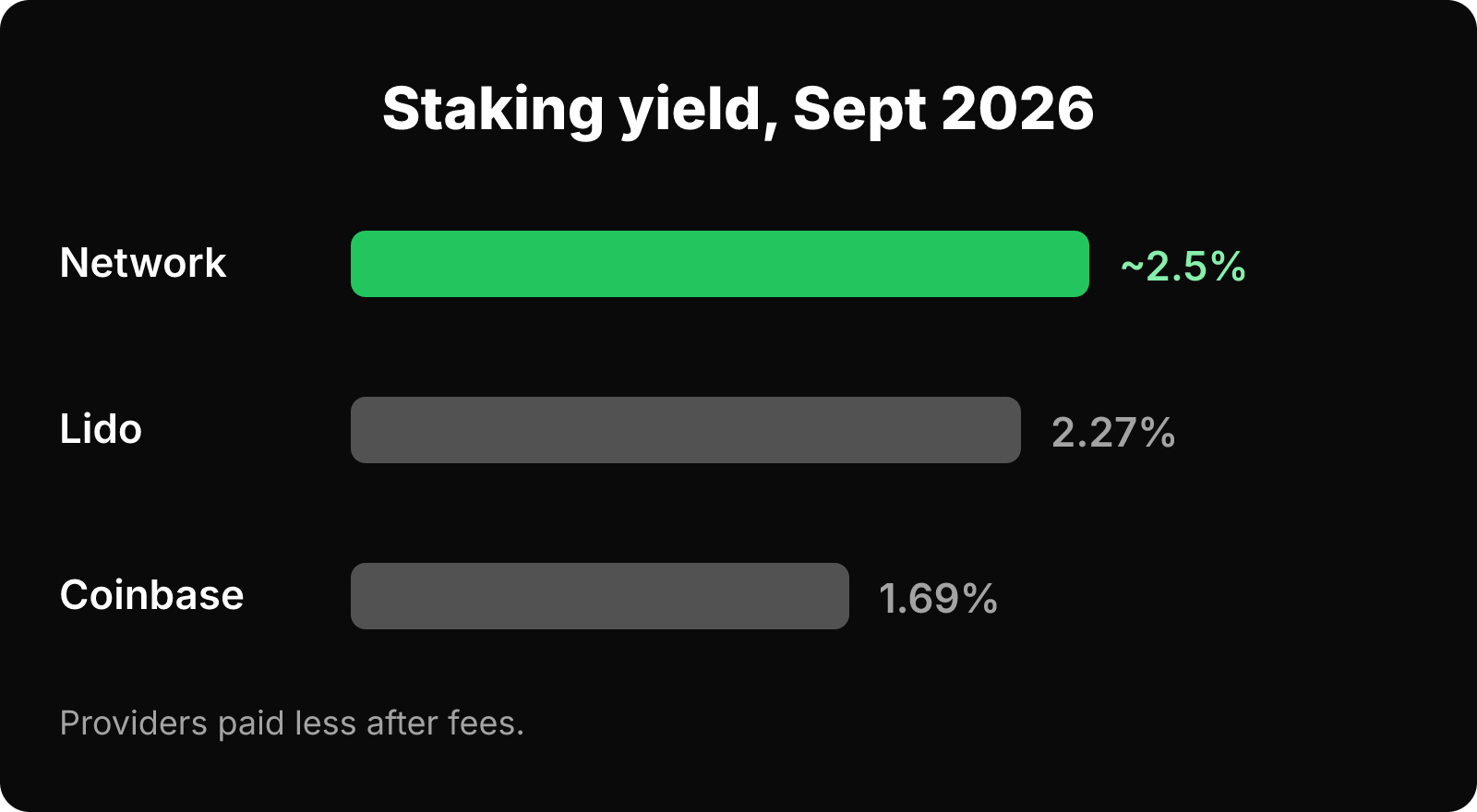
The network-wide staking yield was about 2.5% per year in September 2026, and people staking through a provider generally received between 1.7% and 2.6% after fees. Here are the figures with their sources and dates:
| Metric | Value | Date | Source |
|---|---|---|---|
| Network staking yield | ~2.5% (ethereum.org); 2.55% (Staking Rewards) | Sept 23, 2026 | Upshift |
| Lido (stETH) APY | 2.27% | Sept 2026 | Upshift |
| Coinbase APY | 1.69% | Sept 2026 | Upshift |
| iShares ETHB, gross | 3.1–3.3% | 2026 | Ryder |
| iShares ETHB, net to shareholders | 1.9–2.6% | 2026 | Ryder |
| Total ETH staked | ~43.46M ETH (~35% of supply) | Sept 23, 2026 | Upshift |
As a worked example, staking 10 ETH at 2.5% for a full year leaves you with about 10.25 ETH. That rate will almost certainly change, though. APY is a snapshot of current conditions, not a promise.
Why do ETH staking rewards fall as more people stake?
Rewards are protocol-defined, so yield falls as more ETH is staked: each staker's share of the reward pool shrinks. Staked supply was about 39M ETH early in 2026 per Everstake and 43.46M by September, though sources use different dates and methods, so treat the comparison as rough.
Staking partly protects against dilution
A good share of staking "yield" isn't new wealth. It's new ETH paid to stakers, and that issuance dilutes everyone who doesn't stake. iShares notes that if all ETH is staked, issuance equals staking rewards.
A non-staking holder is therefore gradually ceding some of their share of the network to people who stake. Comparing a 2.5% staking yield to a 2.5% bank interest rate is misleading for this reason.
What Are the 5 Ways to Stake ETH?
You can stake ETH in five main ways: solo staking, pooled staking, exchange staking, liquid staking, or buying a staked-ETH fund. Each one trades off yield against convenience and control.
| Method | Minimum | Who holds your keys? | Typical yield (2026) | Main trade-off |
|---|---|---|---|---|
| Solo staking | 32 ETH | You | Full network rate (~2.5%) | Technical skill, 24/7 uptime, slashing risk on you |
| Pooled staking | Provider-set (e.g., 0.01 ETH at Everstake) | Varies | Network rate minus operator fee | Trust in the node operator |
| Exchange staking | Provider-set | The exchange | e.g., 1.69% at Coinbase | Custody and solvency risk, higher fees |
| Liquid staking | Provider-set | You, via a token | e.g., 2.27% for Lido stETH | Smart contract and depeg risk |
| Staked-ETH fund (ETHB) | One share | Fund custodian | 1.9–2.6% net | Fund fees; no on-chain use |
Solo staking
You run your own validator with 32 ETH. You keep all the rewards and carry all the responsibility. It's the best option for Ethereum's decentralization, but it suits people comfortable maintaining servers. For a broader primer, see Ethereum Staking Explained: What IBKR's Launch Means.
Pooled and exchange staking
You combine your ETH with other people's, and an operator runs the validators. Minimums are set by the provider, not the protocol. Everstake, for example, cut its minimum from 0.1 ETH to 0.01 ETH in June 2026. Exchanges make this the easiest route, but you're trusting the exchange to stay solvent.
Liquid staking
You deposit ETH and receive a token, such as Lido's stETH, that represents your staked position. You can trade it or use it in DeFi without waiting in the exit queue. The catch: if markets for that token dry up during a crash, it can trade below the value of the ETH behind it.
Staked-ETH funds
BlackRock's iShares Staked Ethereum Trust (ETHB) launched on Nasdaq on March 12, 2026. It stakes 70–95% of its holdings and pays monthly distributions. The gap between its gross and net yield shows how much the fund wrapper costs. Institutional interest is growing: CoinDesk reported in August 2026 that institutional staking is expanding.
What Are the Risks of Staking ETH?
The main risks of staking ETH are price volatility, slashing, withdrawal delays, smart contract failures, and losing access to funds when a custodian fails. They are listed roughly by how likely they are to affect a typical beginner:
- Price risk. A 2.5% yield won't offset a large drop in ETH's dollar price. Rewards are paid in ETH, not dollars.
- Counterparty risk. With exchange staking, an insolvent exchange can freeze your coins. You're trusting its balance sheet.
- Smart contract risk. Liquid staking protocols and vaults depend on code. Audits lower the risk but can't remove it.
- Liquidity and queue risk. In September 2026 the exit queue was under 3 days. During high exit demand, withdrawals can take days or weeks.
- Slashing and penalties. This mainly concerns solo stakers and depends on operator quality. It's low-risk for well-maintained setups but not zero. For more on validator failure modes, see Ethereum Validator Security & Bitcoin Bridge Risks.
- Concentration risk. A more distributed validator set is described as more resistant to censorship. Ethereum's upcoming Glamsterdam upgrade includes enshrined proposer-builder separation (ePBS), which CoinDesk describes as intended to reduce reliance on off-chain intermediaries in block production. Protocol changes like this are covered in Ethereum Upgrades 2026: What They Mean for Bitcoin DeFi.
Be skeptical of "best staking platform" rankings. Many are written by affiliates or by the providers themselves. Check any headline APY against an independent dashboard before trusting it.
Ethereum Staking vs Bitcoin DeFi: What's the Difference?
Ethereum staking produces yield natively from the protocol, while Bitcoin has no built-in yield, so BTC holders must move it into DeFi through a bridge or wrapped token to earn. CoinDesk notes that BTC holdings produce no native yield, whereas ETH treasury companies can earn on-chain staking rewards.
That doesn't mean Bitcoin holders have to sit out. It means the yield comes from a different place and carries different risks.
| Factor | Ethereum staking | Bitcoin DeFi |
|---|---|---|
| Where yield comes from | Protocol issuance, fees, MEV | Trading fees, liquidity provision, protocol roles |
| Native to the base chain? | Yes | No; BTC must be bridged or wrapped |
| Main new risk | Slashing, queues, provider risk | Bridge and wrapper security |
| Who sets the rate? | Ethereum's issuance formula | Market demand for liquidity |
| Asset you hold | ETH (or a liquid staking token) | A BTC representation on another chain |
Why the bridge matters most in Bitcoin DeFi
For Bitcoin, the key question isn't how high the yield is. It's what your BTC becomes once it leaves the Bitcoin chain. Wrapped-BTC designs differ in who you have to trust, and the trade-offs are compared in WBTC Bridge Custody Risk vs Trustless Bridges in 2026.
TeleSwap takes a trust-minimized approach. Its TeleBTC is backed 1:1 by real BTC, secured by SPV light client proofs, and nothing is minted without a verified Bitcoin transaction. Custody is collateral-backed and slashable. It inherits Bitcoin's security model directly instead of adding a new trusted party.
On TeleSwap, BTC holders can earn in BTC without selling it. Options include providing wrapped BTC (WBTC, BTCB) liquidity, staking TST for fee rewards, or running a permissionless protocol role such as Locker, Teleporter, Relayer, or Filler. These are market-driven mechanisms, not fixed rates. According to TeleSwap network stats, the protocol has bridged $523.1M ($523,088,064) across 554,634 transactions and 13 supported networks.
Some Bitcoin holders who want Ethereum exposure swap part of their BTC into ETH. TeleSwap offers a BTC → ETH route; compare fees and custody models against other options first.
A Practical Checklist Before You Stake
If you're thinking about staking ETH, work through these six questions in order:
- Do you plan to hold ETH for at least a year anyway? If not, a 2.5% yield is small next to price swings, and staking may not be worth the extra complexity.
- Who will hold your keys? It could be you, a smart contract, an exchange, or a fund custodian. Each carries a different risk.
- What's the net yield? Subtract the provider's fee from the network rate. Coinbase's 1.69% against a ~2.5% network rate is a gap of about a third.
- How fast can you get out? Check the current exit queue, and if you're using a liquid staking token, how easily it trades.
- Has the provider been audited, and has it operated for a while? Check whether audit reports are public and how the protocol handled past market stress.
- How will rewards be taxed where you live? Rules differ by country, so consult a local tax professional.
Start small. A small stake and a test withdrawal will teach you more than any guide, this one included.
Frequently Asked Questions
What is Ethereum staking in simple terms?
Ethereum staking means locking up ETH to help secure the Ethereum network in exchange for rewards. Validators put ETH down as a deposit, check and propose blocks, and earn newly issued ETH plus fees. Dishonest or careless validators can lose part of that deposit.
How much ETH do I need to start staking?
You need 32 ETH to run your own validator, but pooled, exchange, and liquid staking let you start with a fraction of one ETH. Providers set their own minimums. Everstake, for example, lowered its minimum to 0.01 ETH in June 2026.
What are ETH staking rewards in 2026?
The network-level ETH staking yield was about 2.5% per year as of September 23, 2026. After provider fees, people usually received less. Lido paid about 2.27% and Coinbase about 1.69% at that time, according to Upshift. Rates change and are not guaranteed.
Can I lose money staking Ethereum?
Yes, you can lose money staking ETH, mainly if ETH's price falls, but also through slashing, smart contract bugs, or a custodian failing. Staking rewards are paid in ETH, so they won't protect you from losses measured in dollars.
How long does it take to unstake ETH?
Unstaking ETH depends on Ethereum's exit queue, which was about 2 days and 17 hours on September 23, 2026. When many validators exit at once, the wait can stretch to weeks. Liquid staking tokens can be sold right away, but only at the prevailing market price.
Can you stake Bitcoin like Ethereum?
No, Bitcoin uses Proof-of-Work and has no native staking. BTC holders earn yield by moving their bitcoin into DeFi through a bridge or wrapped token, which makes bridge security the most important risk to evaluate.
Is liquid staking better than regular staking?
Liquid staking is more flexible but not strictly better. You get a tradeable token you can use in DeFi and can skip the exit queue. In exchange, you take on smart contract risk and the possibility that the token trades below the ETH behind it during a market crash.
Conclusion
Ethereum staking comes down to a few points. Validators put ETH at risk to secure the network, and the protocol pays them for it, about 2.5% a year at the network level as of September 2026. How much you keep depends on how you stake: solo, pooled, exchange, liquid, or through a fund. Each option trades yield against convenience and custody. Staking also partly offsets the dilution issuance causes, so it isn't free money.
If you're a Bitcoin holder, the same questions apply to your BTC: where the yield comes from, who holds the keys, and what security model you're trusting. To explore light-client-verified bridging and BTC-denominated earning options, visit teleswap.xyz.