Chainflip vs TeleSwap: Native BTC Swaps Compared (2026)

You have native BTC in a Bitcoin wallet and you want USDC on Arbitrum or ETH on Base. You don't want to sign up for a centralized exchange first. Two protocols handle this route very differently, and that's why people search for chainflip vs teleswap. Both take a real Bitcoin transaction and deliver a token on another chain, but they disagree on where trust should sit while your BTC is in flight.
Chainflip keeps deposits in a vault whose key is split across a staked validator set, using threshold signatures. TeleSwap has the destination chain check the Bitcoin transaction itself using an SPV light client, then mints TeleBTC against collateral-backed Lockers. This guide walks through both designs using public documentation, then shows a full BTC-to-USDC swap.
Key Takeaways:Chainflip keeps native BTC in vaults controlled by threshold signatures from a staked validator set, as described in the Chainflip documentation.TeleSwap checks each Bitcoin deposit on the destination chain with SPV light client proofs before it mints any TeleBTC.Chainflip charges a 0.1% network fee per swap and uses it to buy and burn FLIP, according to Chainflip's own guide.TeleSwap has processed $526.0M in bridged volume across 557,522 transactions on 13 supported networks, per TeleSwap network stats.Neither model is "trustless" with no conditions, so the useful question is which failure mode, validator collusion or light-client and contract correctness, you would rather underwrite.
Table of Contents
- What is a native BTC cross-chain swap?
- How does Chainflip execute a Bitcoin swap?
- How does TeleSwap execute a Bitcoin swap?
- Chainflip vs TeleSwap: which security model fits you?
- Chainflip Bitcoin swap fees vs TeleSwap fees
- Side-by-side comparison table
- Walkthrough: BTC to USDC on Arbitrum with TeleSwap
- When TeleSwap is the right Chainflip alternative
- Frequently Asked Questions
- Conclusion
What is a native BTC cross-chain swap?
A native BTC cross-chain swap starts from an ordinary Bitcoin transaction that you sign in your own Bitcoin wallet. You don't need to hold a pre-wrapped token like WBTC first. On the other side, the output is a token you receive on another chain.
The difficulty is that Bitcoin's scripting language can't see other chains, and other chains can't see Bitcoin unless someone tells them what happened. Every native BTC protocol needs an answer to one question: who attests that a Bitcoin payment happened, and who controls the BTC afterwards?
There are three main answers in production today:
- Custodial attestation. A company or multisig confirms the deposit and holds the coins. This is the model behind WBTC.
- Validator-set attestation with threshold custody. A staked group of validators reaches consensus that the deposit happened, and the BTC sits in an address whose key is split among them. Chainflip and THORChain use variants of this model.
- Cryptographic attestation through a light client. The destination chain checks Bitcoin proof-of-work and a Merkle inclusion proof itself. TeleSwap uses this model.
The Bitcoin whitepaper already describes the third approach in its section on Simplified Payment Verification (Nakamoto, Bitcoin whitepaper, §8). A verifier that stores only block headers can confirm that a transaction is buried under a given amount of proof-of-work.
How does Chainflip execute a Bitcoin swap?
Chainflip runs its own application-specific blockchain, the State Chain, and a staked validator set operates it. Those validators watch external chains, run an AMM, and jointly sign outgoing transactions with threshold cryptography. Here is the flow for BTC → USDC, based on the Chainflip documentation.
Step 1: Opening a deposit channel
The user, usually through a broker such as a wallet front-end, requests a swap. The broker opens a deposit channel on the State Chain, which produces a deposit address tied to the swap parameters (destination asset, destination address, minimum price).
Step 2: Witnessing the deposit
The user sends BTC to the deposit address. Each validator runs a client that watches Bitcoin. Once the deposit reaches the required confirmation depth, validators submit witness extrinsics to the State Chain. The deposit counts as real when enough validators agree, which is a consensus threshold rather than an on-chain proof-of-work check. Chainflip also offers a "Boost" option, where liquidity providers front the deposit before it is fully confirmed in exchange for a fee; see the Chainflip docs for current parameters.
Step 3: AMM execution
The swap runs on the State Chain against Chainflip's just-in-time (JIT) AMM, in which market makers can update their orders right before a batch executes. Chainflip's 2026 recap lists USDT and USDC routes across most of its networks.
Step 4: Threshold-signed egress
To release funds on the destination chain, the active validators produce a threshold signature. No single validator holds the full private key, and a signature is produced only when enough key-share holders take part. When the validator set rotates, the vault key is handed over to the new set.
The security assumption: fewer than the signing threshold of validators collude, and the value at risk stays economically below the stake that could be slashed. Chainflip's guide describes this as an economically secured validator network, with swaps paid in the input asset and no need to hold FLIP (Chainflip guide).
Chainflip reports roughly $9B in cumulative volume in its 2026 year-in-review. It lists Bitcoin, Ethereum, Solana, Polkadot Assethub, Arbitrum and TRON as live, with TRON added in June 2026.
How does TeleSwap execute a Bitcoin swap?
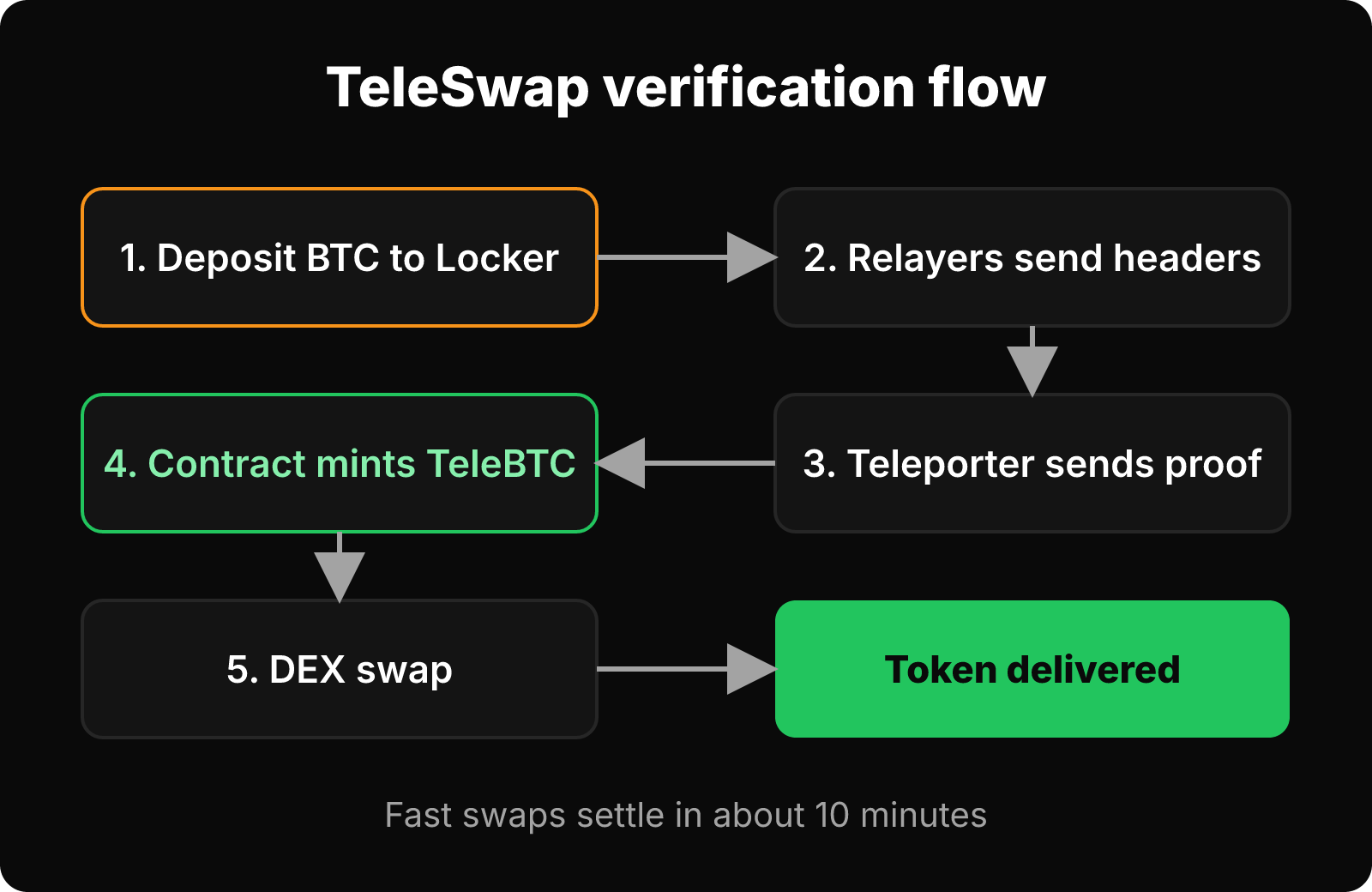
TeleSwap is a Bitcoin bridge and swap protocol that uses SPV light client proofs. A smart contract on the destination chain checks each Bitcoin deposit itself and only then mints TeleBTC, a 1:1 collateral-backed representation of BTC. No validator committee votes on whether a deposit happened. The full architecture is in the TeleSwap documentation.
The roles
- Lockers receive BTC on the Bitcoin side and post collateral on the destination chain. Custody is collateral-backed and slashable.
- Relayers submit Bitcoin block headers to the on-chain relay contract, which acts as the light client.
- Teleporters submit the user's transaction and its inclusion proof to the destination chain and cover the destination gas. That's why users can pay every fee in Bitcoin assets.
- Fillers are a further role that earns fees. The docs explain where each role sits in the flow.
All of these roles are permissionless, so anyone can run them.
The verification pipeline
- Deposit. The user sends BTC to a Locker's Bitcoin address, with the swap request encoded in the transaction.
- Header relay. Relayers submit Bitcoin block headers to the relay contract, which verifies them against Bitcoin's proof-of-work rules.
- Inclusion proof. A Teleporter submits the transaction and a Merkle proof. The contract checks it against a stored header and confirms enough blocks have been built on top.
- Parsing and minting. The contract confirms the BTC was paid to a registered Locker and mints the matching amount of TeleBTC.
- Swap. If the user asked for a token other than TeleBTC, the router swaps TeleBTC through an on-chain AMM/DEX and delivers the output, enforcing the user's minimum. Fast swaps settle in about 10 minutes.
The reverse direction, token → BTC, swaps the token to TeleBTC and burns it. A Locker then pays out native BTC, backed by its slashable collateral.
The important design property: nothing is minted without a verified Bitcoin transaction. Relayers and Teleporters can stall the process by going offline, but they cannot forge a deposit.
Chainflip vs TeleSwap: which security model fits you?
In the chainflip vs teleswap comparison, both protocols remove the single custodian, but they place the remaining trust in different components. Describing either one as simply "trustless" hides the assumptions that matter. For a broader view of custodial and trustless designs, see WBTC Bridge Custody Risk vs Trustless Bridges in 2026.
Where each model concentrates trust
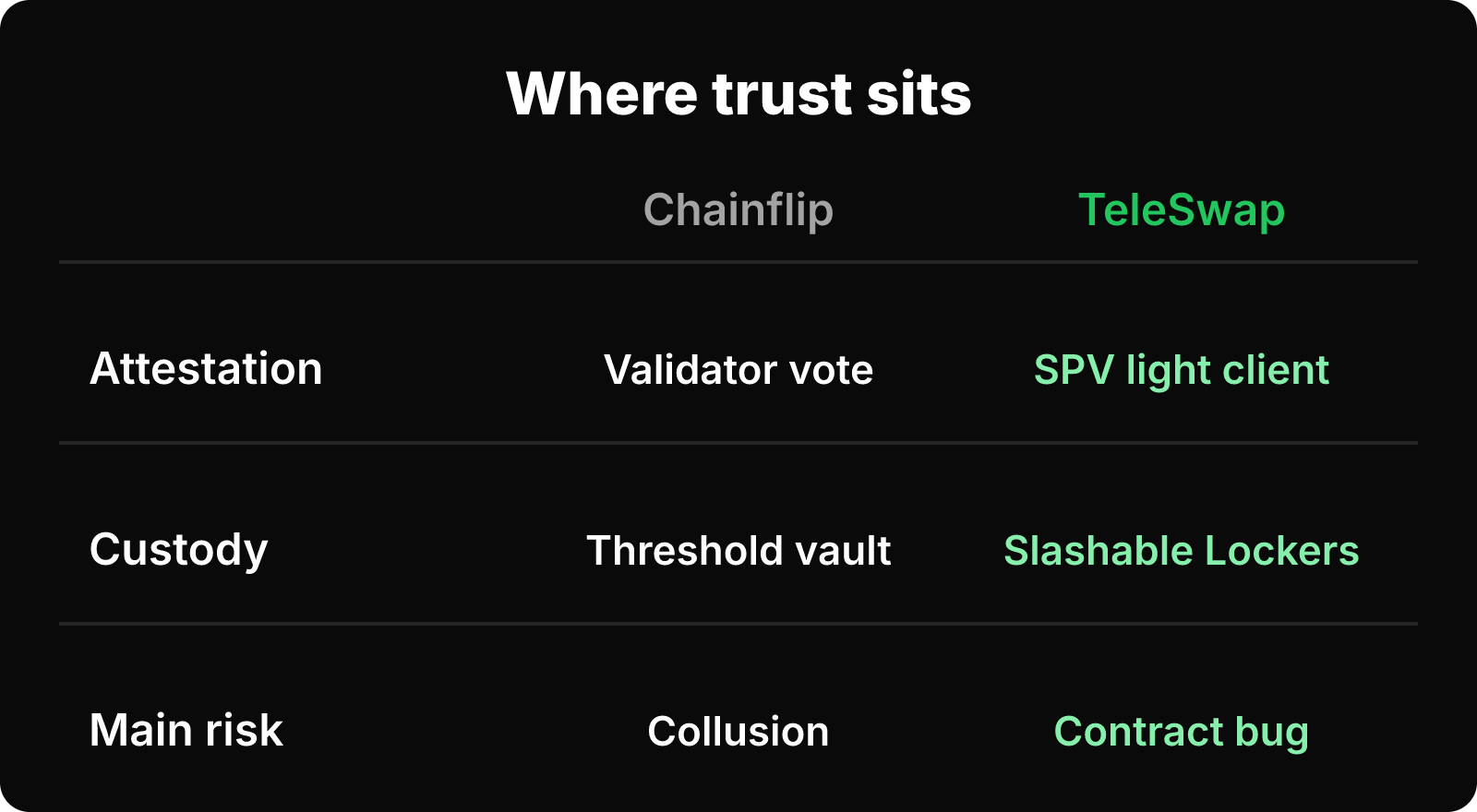
- Chainflip: trust sits in a staked validator majority. Deposit attestation and BTC custody are handled by the same set. The guarantee is economic: stake can be slashed.
- TeleSwap: trust is split in two. Attestation comes from Bitcoin proof-of-work through the light client, so no committee vote is involved. Custody sits with collateral-backed, slashable Lockers. The remaining assumptions are that the relay and verifier contracts are correct and that headers are kept current.
The two models fail differently
In a threshold-signature vault, the main failure mode is validator collusion or key compromise above the threshold. Under SPV verification, the main failure modes are a relay or verifier contract bug, or reorg handling at the chosen confirmation depth. Contract-level bugs are a risk for every bridge design, light-client bridges included; see Cross-Chain Bridge Security: NEAR Intents Hack Breakdown for how such failures play out.
Speed is bounded by Bitcoin's roughly 10-minute block interval (Bitcoin whitepaper). Faster settlement means someone, such as a liquidity provider using Chainflip's Boost, takes on the reorg risk.
Chainflip Bitcoin swap fees vs TeleSwap fees
Chainflip Bitcoin swap fees combine a 0.1% network fee, the AMM price impact, and the Bitcoin and destination-chain transaction costs. The 0.1% is used to buy and burn FLIP, according to Chainflip.
One third-party comparison puts the all-in cost of 0.05–2 BTC trades on Chainflip at around 0.20–0.30% (Paragraph analysis). The author doesn't publish a methodology, so treat that range as indicative.
TeleSwap's costs fall into four parts:
- Bitcoin miner fee for your deposit transaction, set by mempool conditions.
- Protocol and Locker fees for minting TeleBTC; current rates are listed at teleswap.xyz/docs.
- Teleporter fee, which covers destination gas so you never need gas tokens up front. It is paid in Bitcoin assets.
- DEX price impact when you swap TeleBTC into the target token.
Price impact and Bitcoin miner fees often matter as much as headline protocol fees, and both change with trade size and timing. The most reliable comparison is a live quote for the same amount on both protocols, close together in time.
Side-by-side comparison table
| Dimension | Chainflip | TeleSwap |
|---|---|---|
| Deposit attestation | Validator consensus (witnessing) on the State Chain | SPV light client: PoW header chain + Merkle inclusion proof |
| BTC custody | Threshold-signature vault held by the validator set | Collateral-backed, slashable Lockers |
| Representation on destination | Delivers the native destination asset from vaults | Mints TeleBTC 1:1, then swaps to the target token through a DEX |
| Liquidity model | JIT AMM on the State Chain | On-chain AMM/DEX on the destination chain |
| Protocol fee | 0.1% network fee (buy-and-burn FLIP) | Protocol/Locker fee + Teleporter fee, paid in Bitcoin assets |
| Typical speed | ~2–15 min (Paragraph) | ~10 min for fast swaps |
| Networks | 6 live: Bitcoin, Ethereum, Solana, Polkadot Assethub, Arbitrum, TRON (recap) | 13 supported networks (network stats) |
| Cumulative volume (self-reported) | ~$9B (2026 recap) | $526.0M across 557,522 transactions |
| Destination gas | Handled by the protocol at egress | Covered by a Teleporter, paid in Bitcoin assets |
| Integrations | SafePal, Phantom, MetaMask, Trust Wallet and others (per Chainflip) | Rango, Rubic, DZap; MetaMask and Trust Wallet via Rango |
| BTC yield | Native-BTC-collateral lending | Native BTC or WBTC/BTCB deposits into TeleBTC pools; TST staking; protocol roles |
On activity: TeleSwap moved $40.4M over the last 30 days, about $1.3M per day, with a peak of $2.1M on 2026-10-08 (TeleSwap network stats). Chainflip reports more total volume. TeleSwap lists more destination networks, including Base, Optimism, Unichain, Polygon and BNB Smart Chain.
Walkthrough: BTC to USDC on Arbitrum with TeleSwap
Here is what a native BTC cross-chain swap looks like from the user's side. Example route: BTC → USDC on Arbitrum. For a step-by-step version without account setup, see Trustless BTC Swap: 7-Step No-KYC Guide (2026).
- Get a quote. Open teleswap.xyz and choose BTC → USDC (Arbitrum). Enter the amount and your Arbitrum address. The quote sets a minimum output.
- Connect a Bitcoin wallet and sign. You sign one Bitcoin transaction paying a Locker address, with your swap request encoded in it. You don't need gas tokens on Arbitrum.
- Wait for the Bitcoin block. Once your transaction is mined, Relayers push the header to the relay contract on the destination chain.
- Proof submission. A Teleporter submits your transaction and its Merkle proof. The contract verifies inclusion and mints TeleBTC.
- Swap-out. The router swaps TeleBTC to USDC and sends it to your address, enforcing your minimum output.
- Done in roughly 10 minutes on the fast route. You can track the transaction on Arbitrum like any other token transfer.
To go the other way, use the USDC (Arbitrum) → BTC route. Your USDC is swapped to TeleBTC and burned, and a Locker releases native BTC to your Bitcoin address. You can also go to ETH through BTC → ETH.
For developers: the TeleSwap SDK returns a BTC → EVM/TON/Solana quote in under a minute. It wraps the REST API, so the same flow is also available over plain HTTP. Integrators can register a third-party ID and earn a share of fees on the volume they bring.
When TeleSwap is the right Chainflip alternative
This isn't a case of one protocol being better and the other worse. The right choice depends on your route and on which assumptions you're comfortable with. TeleSwap may fit better when:
- Your destination is an EVM L2 or a chain outside Chainflip's current list. Examples are Base, Optimism, Polygon, BNB Smart Chain, Unichain or Robinhood Chain. TeleSwap supports 13 networks, per TeleSwap network stats.
- You want attestation that inherits Bitcoin's security model. Deposit validity comes from proof-of-work checked on-chain, not from a validator vote.
- You don't hold gas tokens. A Teleporter pays destination gas, and you pay every fee in Bitcoin assets.
- You want to keep earning on the BTC afterwards. You can deposit native BTC straight from a Bitcoin wallet into the TeleBTC pools with a single Bitcoin transaction and no EVM wallet (live since 2026-10-14), or stake TST for fee rewards. Yield comes from protocol activity and isn't guaranteed.
If you are also weighing a THORChain-based route, ThorSwap vs TeleSwap: Bitcoin Bridge Fees & Speed 2026 compares fees and speed for that pairing.
Chainflip remains a strong choice for routes it already covers well, such as Solana or Polkadot Assethub. It also suits users who prefer an economically secured validator network and want access to its native-BTC lending. Many experienced users keep both protocols available and compare quotes for each trade.
Frequently Asked Questions
What is the main difference in chainflip vs teleswap?
The main difference is how a Bitcoin deposit gets verified. Chainflip's staked validators witness the deposit and hold BTC in a threshold-signature vault. TeleSwap verifies the deposit on the destination chain with SPV light client proofs before minting TeleBTC, and collateral-backed Lockers hold the BTC.
Are Chainflip Bitcoin swap fees higher than TeleSwap's?
It depends on trade size, route and market conditions, so compare live quotes. Chainflip charges a 0.1% network fee plus AMM price impact and network costs. One third-party estimate puts its all-in cost at about 0.20–0.30% for 0.05–2 BTC. TeleSwap's total is made up of protocol and Locker fees, a Teleporter fee and DEX price impact, all paid in Bitcoin assets.
Is TeleBTC a custodial wrapped Bitcoin like WBTC?
No, TeleBTC is not custodial. TeleBTC is minted only after a smart contract has verified the Bitcoin deposit with an SPV proof. It is backed 1:1 by BTC held by collateral-backed, slashable Lockers, not by a single custodian or a multisig committee.
How long does a native BTC cross-chain swap take?
Usually about 10 to 15 minutes, because both protocols have to wait for a Bitcoin block. TeleSwap fast swaps settle in roughly 10 minutes. Third-party reporting puts Chainflip at about 2–15 minutes, depending on confirmation requirements and whether Boost is used.
Which chains does TeleSwap support?
TeleSwap supports 13 networks, according to its live network stats. These include EVM chains such as Ethereum, Arbitrum, Base, Optimism, Polygon, BNB Smart Chain and Unichain, plus Tron and Robinhood Chain routes. Check teleswap.xyz for the current list of pairs.
Can I use TeleSwap from MetaMask or Trust Wallet?
Yes, through TeleSwap's integration with Rango. TeleSwap is a Bitcoin swap provider inside the Rango, Rubic and DZap aggregators, and MetaMask and Trust Wallet users reach it through the Rango integration.
Do I need gas tokens on the destination chain to use TeleSwap?
No. A Teleporter submits your proof and pays the destination-chain gas, and you pay every fee in Bitcoin assets. You only sign one Bitcoin transaction.
Conclusion
The chainflip vs teleswap decision comes down to one architectural choice. Chainflip secures native BTC with a staked validator set and threshold signatures, and reports a large volume record. TeleSwap has each destination chain verify Bitcoin proof-of-work directly through an SPV light client, mints TeleBTC only against verified deposits, and backs custody with slashable Locker collateral. It has bridged $526.0M across 557,522 transactions on 13 networks, per TeleSwap network stats.
If you want Bitcoin-level attestation, fees paid entirely in Bitcoin assets, and coverage across the main EVM L2s, compare a live TeleSwap quote against your current route.
This article describes protocol mechanisms and is not financial advice. Fees, routes and supported assets change, so check live quotes and the TeleSwap documentation before transacting.