Bitcoin to Robinhood Chain Bridge: No-KYC BTC to ETH 2026

Robinhood Chain went live on mainnet on July 1, 2026, and it has no native BTC. Its gas token is ETH, its dollar is USDG, and its DeFi runs on EVM contracts. If you hold bitcoin in a self-custody wallet and want to use it there, you need a bitcoin to Robinhood Chain bridge. TeleSwap is a decentralized, no-KYC Bitcoin bridge that swaps native BTC to ETH or USDG on Robinhood Chain in one Bitcoin transaction, in about 10 minutes on the fast path.
This guide covers that conversion at the protocol level. It explains how Bitcoin block headers become a light client inside a smart contract, how a Merkle proof shows your payment happened, how TeleSwap mints TeleBTC and routes it through an AMM into ETH or USDG, and how the reverse route pays you back in native BTC. It ends with a practical walkthrough and real sample quotes.
Key Takeaways:Robinhood Chain is an Ethereum Layer 2 built on Arbitrum technology that uses ETH for gas and has no native BTC, according to 1inch's Robinhood Chain guide.TeleSwap is a decentralized, no-KYC Bitcoin bridge that swaps native BTC to ETH or USDG on Robinhood Chain in one Bitcoin transaction, with fast swaps taking about 10 minutes and normal swaps about 20.TeleSwap mints TeleBTC only after an on-chain SPV light client verifies the Bitcoin transaction's proof-of-work and Merkle inclusion, so no custodian or multi-sig committee has to attest to it.In a sample quote, 0.001 BTC returned 0.03363 ETH on Robinhood Chain with a TeleSwap fee of 0.00000135 BTC.TeleSwap has bridged $525,025,211 across 556,461 transactions on 13 supported networks, per TeleSwap network stats (retrieved 2026-10-21).
Table of Contents
- Why Is There No Native BTC on Robinhood Chain?
- How Does a Bitcoin to Robinhood Chain Bridge Work at the Protocol Level?
- The Reverse Route: ETH or USDG Back to Native BTC
- Decentralized Bitcoin Bridge Options for Robinhood Chain, Compared
- What Does It Cost to Swap BTC to ETH on Robinhood Chain?
- Step-by-Step: Swap BTC to ETH on Robinhood Chain With TeleSwap
- BTC to USDG on Robinhood Chain: When the Stablecoin Route Wins
- The Trust Assumptions You Should Actually Model
- For Developers: Quoting Robinhood Chain Routes Programmatically
- Frequently Asked Questions
- Conclusion
Why Is There No Native BTC on Robinhood Chain?
Robinhood Chain can't hold native BTC because Bitcoin's ledger and an EVM rollup's state are separate systems that can't read each other. A bitcoin is an unspent transaction output (UTXO) locked by a script on the Bitcoin blockchain. Robinhood Chain is a permissionless Ethereum Layer 2 built with Arbitrum technology that uses ETH as its gas token and Ethereum for data availability and security, according to Cryptonews' Robinhood Chain explainer. No EVM contract can spend a Bitcoin UTXO, and Bitcoin Script can't look at Robinhood Chain state.
Every way of getting "BTC" onto the chain therefore does one of three things:
- Custodial wrapping. Someone holds the BTC and issues an IOU token, as with cbBTC, which Coinbase is bringing to Robinhood Chain using Chainlink CCIP as its exclusive cross-chain infrastructure, per TronWeekly's report on cbBTC.
- Intent or liquidity-network fills. A relayer fronts tokens on the destination chain and gets repaid later. This is fast, but these networks generally start from EVM assets, not native BTC.
- Light-client verification. A smart contract on the destination chain checks Bitcoin's proof-of-work itself and acts only once a Bitcoin transaction is proven. TeleSwap uses this model.
Demand for a proper route is real. Robinhood Chain's public testnet processed 4 million transactions in its first week, according to The Block as cited by 1inch. DEX volume on the chain passed $560M on July 8, 2026, per Cryptonews.
How Does a Bitcoin to Robinhood Chain Bridge Work at the Protocol Level?
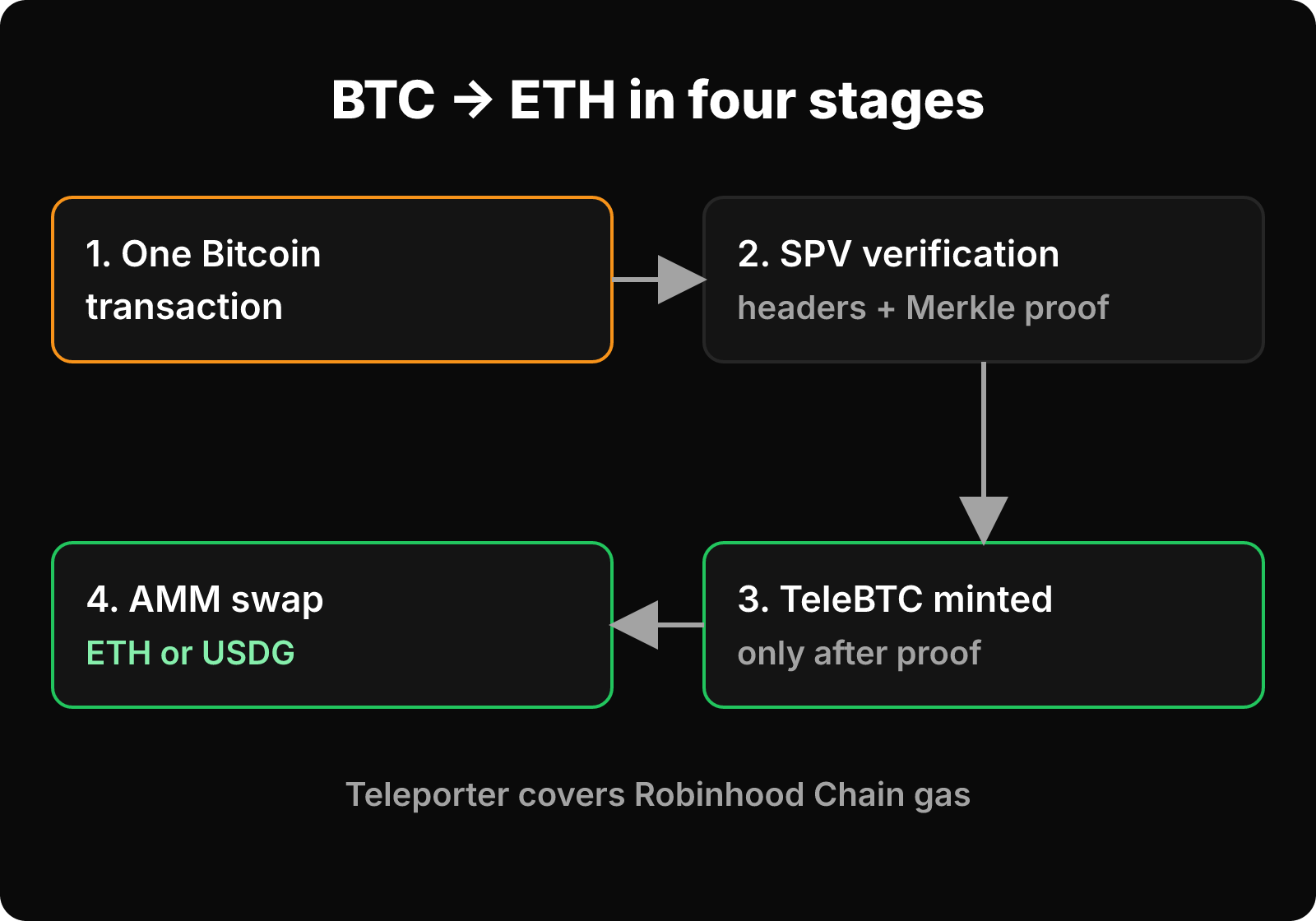
A light-client bitcoin to Robinhood Chain bridge works by proving, inside a smart contract, that a specific Bitcoin transaction is buried under enough proof-of-work, and only then minting and routing the destination asset. This is TeleSwap's design, as described in the TeleSwap documentation. A BTC → ETH swap moves through four stages.
Stage 1: One Bitcoin transaction carries the request
You start with one ordinary Bitcoin transaction from your Bitcoin wallet. It pays BTC to a Locker, which is a TeleSwap protocol role that holds BTC backed by slashable collateral. The swap parameters travel with the transaction: destination chain, recipient EVM address, output token, and minimum output. The exact encoding is in the TeleSwap docs.
The transaction itself is the instruction, so you don't need an EVM wallet signature to start the swap. You only need an EVM address to receive funds.
Stage 2: SPV verification, with headers and Merkle proofs
Simplified Payment Verification (SPV), described in Section 8 of the Bitcoin whitepaper, lets a verifier confirm a payment without downloading full blocks. A smart contract does it in two checks:
- Header-chain validity. Every Bitcoin block header is 80 bytes: version, previous-block hash, Merkle root, timestamp,
nBits(the compact difficulty target), and nonce. The light-client contract stores relayed headers and checks three things. First, the double SHA-256 hash of each header must be numerically at or below the target encoded innBits. Second, each header must commit to its parent's hash. Third, difficulty must adjust correctly at each 2,016-block retarget boundary. A forged header would need real hashpower behind it, so the light client inherits Bitcoin's proof-of-work security. - Transaction inclusion. The contract gets the raw transaction and a Merkle branch, which is the list of sibling hashes from the transaction's leaf up to the root. It computes the txid (double SHA-256 of the non-witness serialization), hashes up the branch, and checks the result against the Merkle root in a header already on the stored chain. For a block with n transactions the branch is only about log₂(n) hashes, which is roughly 12 for a block of 4,000 transactions. That's why on-chain verification is affordable on an EVM.
The contract also requires a confirmation depth: the header holding your transaction must have a set number of headers stacked on top of it. That's the defense against chain reorganizations. It's also why inbound BTC swaps are measured in minutes and not seconds.
For technical readers: Bitcoin's Merkle tree has a known ambiguity in which a crafted 64-byte transaction can look like an inner node (CVE-2017-12842). Any serious SPV verifier has to parse and validate the transaction structure, not just hash-chain it.
Stage 3: TeleBTC is minted only after verification
Once the proof passes, the protocol mints TeleBTC, a 1:1 collateral-backed representation of BTC. Nothing is minted without a verified Bitcoin transaction. TeleBTC differs from cbBTC or WBTC in that no custodian signs off and no multi-sig committee votes on it: the trigger is Bitcoin's own proof-of-work, checked by code.
The Locker that receives the BTC posts collateral that can be slashed, so the backing is enforced by economics as well as by reputation. For a broader comparison of custody models, see WBTC Bridge Custody Risk vs Trustless Bridges in 2026.
Stage 4: AMM swap into ETH or USDG, with gas covered
Freshly minted TeleBTC goes straight through destination-chain AMM/DEX liquidity into your chosen token, which on Robinhood Chain is ETH or USDG. If the output would fall below your minimum, the swap doesn't execute at a bad price.
A Teleporter covers the Robinhood Chain gas, so you don't need ETH there first. Many bridging guides for Robinhood Chain tell you to hold ETH on the destination chain for gas before you start. With TeleSwap, all fees are paid in Bitcoin assets.
The Reverse Route: ETH or USDG Back to Native BTC
Going from Robinhood Chain back to Bitcoin, TeleSwap swaps your ETH or USDG into TeleBTC and a Locker pays out native BTC to your Bitcoin address. In TeleSwap's sample quotes this takes about 2 minutes on the normal path. The mechanics are described in the TeleSwap docs.
The two directions have different speeds:
- BTC → Robinhood Chain: the slow part is Bitcoin finality. The EVM side can't act until Bitcoin proof-of-work has buried your transaction.
- Robinhood Chain → BTC: your action finalizes quickly on the L2, and the payout is a Bitcoin transaction from a Locker whose collateral backs the obligation.
Decentralized Bitcoin Bridge Options for Robinhood Chain, Compared
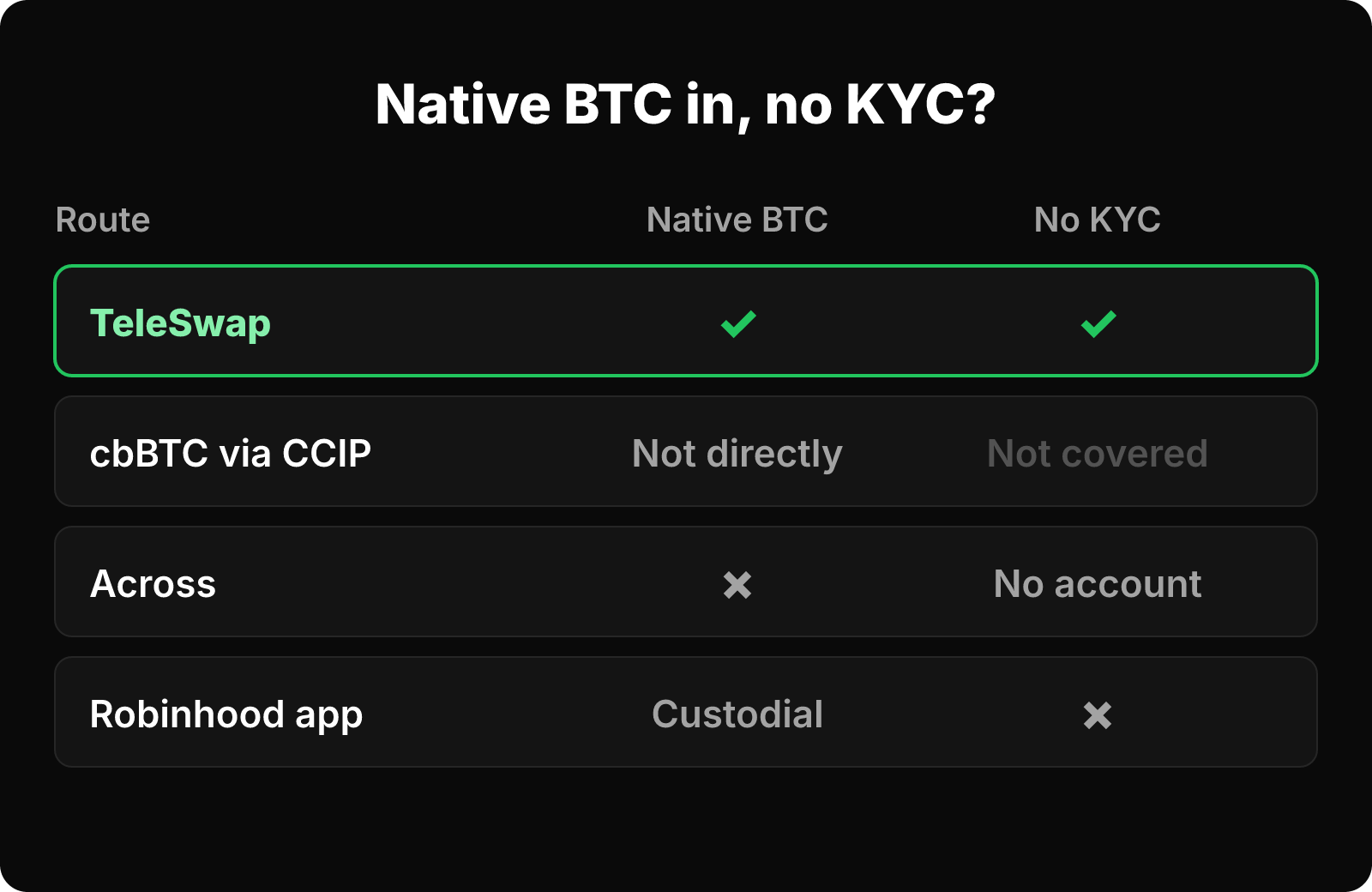
TeleSwap combines native BTC input, light-client verification, and no KYC for Robinhood Chain. The table compares six routes that research for this article turned up. Details for other providers come from their own pages and may change.
| Route | Accepts native BTC? | Trust model | KYC | Arrives on Robinhood Chain as | Typical timing |
|---|---|---|---|---|---|
| TeleSwap | Yes, one Bitcoin transaction | SPV light client plus collateral-backed, slashable Lockers | No | ETH or USDG (both directions) | ~10 min fast / ~20 min normal in; ~2 min out |
| cbBTC via Chainlink CCIP | Not directly; BTC must first become cbBTC | Coinbase-issued wrapped BTC plus CCIP messaging (TronWeekly) | Not covered in sources | cbBTC | Not covered in sources |
| Across | No, EVM origin chains | Relayer fills, repaid via UMA optimistic settlement (Across) | No account described | ETH; USDC arrives as USDG | ~2 s fills, per Across |
| Symbiosis | Yes, via syBTC routing | Cross-chain AMM with its own BTC representation | No account described | Route-dependent | 1–12 min (Symbiosis) |
| RocketX | Lists BTC → ETH (Robinhood) route | Aggregator; inherits the underlying route's model | Claims none | ETH | Route-dependent |
| Robinhood app (CEX) | Custodial balance | Custodial brokerage | Requires a Robinhood account | ETH withdrawn to chain | Platform-dependent |
Across is a strong choice if your capital is already USDC or ETH on another EVM chain, and it claims ~2-second fills. Its design doesn't address the native BTC problem, though.
cbBTC gives you BTC exposure on Robinhood Chain but relies on a custodial issuer. For a decentralized Bitcoin bridge to Robinhood Chain that starts from a UTXO you control, TeleSwap's light-client model is the trust-minimized choice.
What Does It Cost to Swap BTC to ETH on Robinhood Chain?
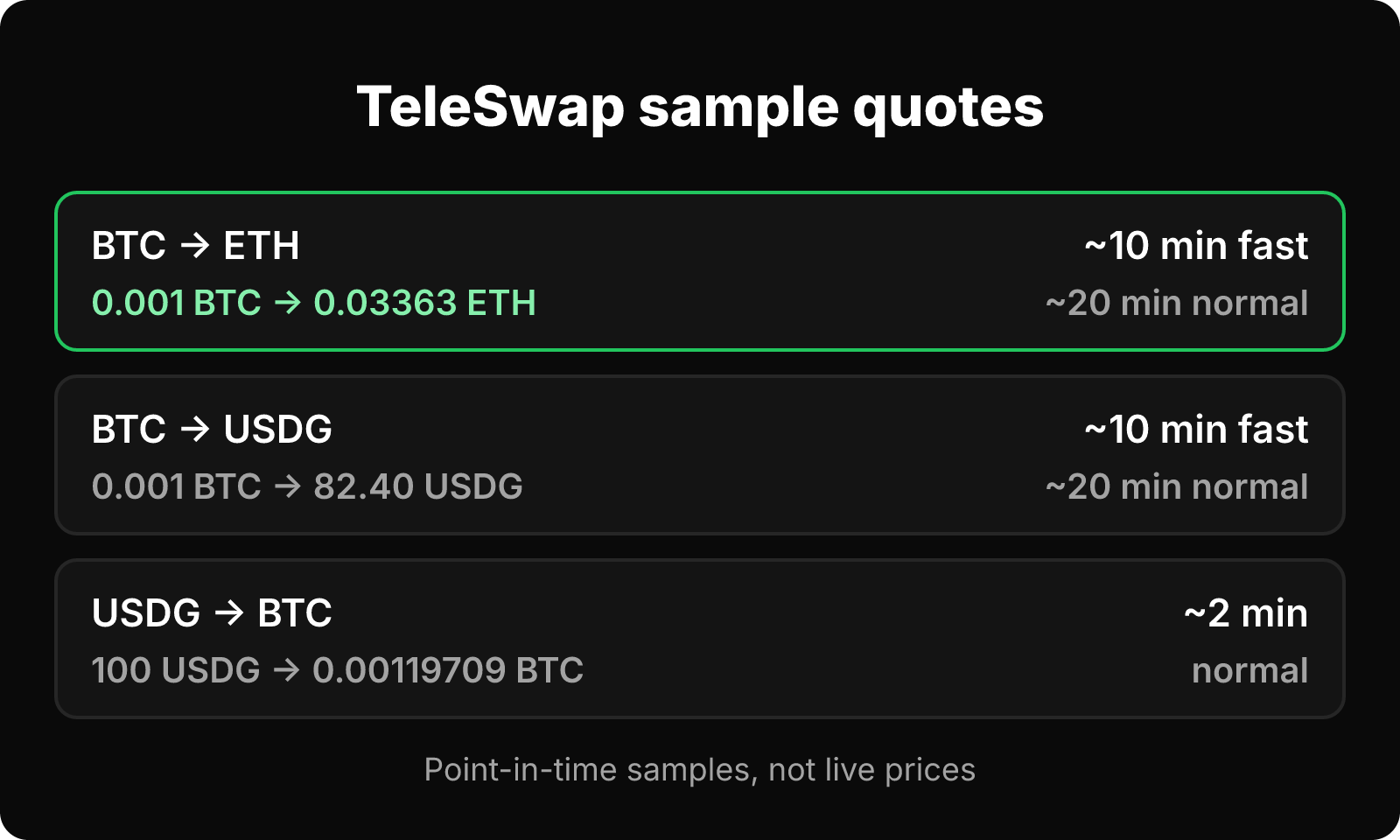
In TeleSwap's sample quote, swapping 0.001 BTC to ETH on Robinhood Chain returned 0.03363 ETH, and the TeleSwap fee was 0.00000135 BTC, about 0.135% of the input. These are point-in-time samples, not live prices. Rates move with the market and with AMM liquidity.
| Route | Sample input → output | TeleSwap fee (BTC) | Time (normal) | Time (fast) |
|---|---|---|---|---|
| BTC → ETH (Robinhood Chain) | 0.001 BTC → 0.03363 ETH | 0.00000135 | ~20 min | ~10 min |
| BTC → USDG (Robinhood Chain) | 0.001 BTC → 82.40 USDG | 0.00000135 | ~20 min | ~10 min |
| ETH → BTC | 0.040811 ETH → 0.00119792 BTC | 0.00000721 | ~2 min | n/a |
| USDG → BTC | 100 USDG → 0.00119709 BTC | 0.00000720 | ~2 min | n/a |
The outbound TeleSwap fee is larger as a share of the trade, at roughly 0.6% of the BTC received in the sample. Always check the "minimum received" line in the quote before you sign.
For scale, TeleSwap has processed $525,025,211 in total volume across 556,461 bridge transactions on 13 supported networks. Over the last 30 days it handled $41.2M, averaging about $1.4M per day, with a peak of $2.1M on 2026-10-08, per TeleSwap network stats (retrieved 2026-10-21).
Step-by-Step: Swap BTC to ETH on Robinhood Chain With TeleSwap
To swap BTC to ETH on Robinhood Chain, open TeleSwap, set Bitcoin BTC as the source and Robinhood Chain ETH as the destination, enter your EVM address, and send one Bitcoin transaction. New to the process? The Trustless BTC Swap: 7-Step No-KYC Guide (2026) covers the general flow. The full sequence for this route:
- Open the route. Go to TeleSwap's page to swap BTC to ETH on Robinhood Chain. Source: Bitcoin / BTC. Destination: Robinhood Chain / ETH.
- Enter the amount. The interface returns a quote showing expected ETH out and the TeleSwap fee in BTC.
- Paste your recipient address. Any EVM address you control works, for example a MetaMask account. Add Robinhood Chain as a network in your wallet when you want to see or spend the balance.
- Pick a speed. Fast takes about 10 minutes and normal about 20. See the docs for each mode's specifics.
- Sign the Bitcoin transaction. Connect your Bitcoin wallet and approve. This is the only transaction you send. There's no EVM wallet transaction and no gas top-up.
- Track the lifecycle. Bitcoin transaction broadcast → confirmations accrue → SPV proof verified → TeleBTC minted → AMM swap → ETH delivered.
- Verify on-chain. Check the delivery on a Robinhood Chain block explorer. Your ETH is immediately usable as gas.
Going back: connect your EVM wallet on Robinhood Chain, choose ETH (or USDG) → BTC, enter a Bitcoin address you control, and sign. Expect native BTC in about 2 minutes on the normal path, based on the sample quotes above. If you want ETH on Ethereum mainnet instead, you can swap BTC to ETH on Ethereum.
BTC to USDG on Robinhood Chain: When the Stablecoin Route Wins
Choose BTC to USDG on Robinhood Chain when you want dollar-denominated liquidity without ETH price exposure. TeleSwap's sample quote turned 0.001 BTC into 82.40 USDG. USDG (Global Dollar, issued by Paxos) is the chain's main dollar unit. Across, for example, delivers USDC from other chains as USDG on Robinhood Chain, per Across.
In practice, the stablecoin route is useful when:
- You're moving BTC to deploy into dollar-based DeFi positions on the chain and don't want to stack a second volatile asset on the first.
- You want a clean exit: USDG → BTC settled in about 2 minutes in the sample (100 USDG → 0.00119709 BTC).
The mechanics are the same as the ETH route; only the AMM leg changes. Use the dedicated BTC to USDG on Robinhood Chain page to start.
The Trust Assumptions You Should Actually Model
The most important thing to understand about any BTC route onto Robinhood Chain is this: the chain's speed doesn't change how long Bitcoin takes to finalize. 1inch cites ~0.1-second block confirmations for Robinhood Chain (1inch). That's a vendor claim, and it changes nothing about Bitcoin finality.
Any service that credits you "BTC-backed" value in seconds has either fronted capital and absorbed Bitcoin reorg risk itself, or relied on a custodian's promise. You should know which one you're trusting.
Here's what each layer of a TeleSwap swap depends on:
- Bitcoin proof-of-work: forging an inclusion proof would require out-mining honest hashpower over the confirmation depth.
- Locker collateral: the BTC backing TeleBTC sits with Lockers whose collateral is slashable if they misbehave.
- Smart-contract correctness: as with every bridge, a bug can undo a sound design.
- The L2 itself: Robinhood Chain is built with Arbitrum technology, so its own security and withdrawal properties are those of that stack and its configuration.
- AMM liquidity: large swaps can move price. Set a sensible minimum output.
A note on "no KYC": the Robinhood Chain network is permissionless and anyone can deploy contracts, but the Robinhood app is a brokerage account. TeleSwap's route goes from your self-custodied Bitcoin wallet to your self-custodied EVM address with no account at any point.
For Developers: Quoting Robinhood Chain Routes Programmatically
TeleSwap's SDK returns a BTC → EVM/TON/Solana quote in under a minute, and it wraps a REST API, so the same BTC ⇄ ETH and BTC ⇄ USDG routes on Robinhood Chain can be integrated over plain HTTP. Wallets and dApps can offer "deposit with native BTC" without running any Bitcoin infrastructure themselves.
Integrators can register a third-party ID to earn a share of fees on the volume they bring. TeleSwap is already integrated as a Bitcoin swap provider in the aggregators Rango, Rubic, and DZap, and through Rango in MetaMask and Trust Wallet. Start with the TeleSwap documentation for the SDK reference and request formats.
Frequently Asked Questions
Can I bridge native Bitcoin to Robinhood Chain without KYC?
Yes. TeleSwap bridges native BTC to ETH or USDG on Robinhood Chain without KYC or an account. You send one Bitcoin transaction from your own wallet to an EVM address you control, and an SPV light client verifies the payment on-chain before anything is minted or swapped. For the broader no-KYC context, see Cross Chain BTC Swap Without KYC: 2026 DeFi Guide.
How long does it take to swap BTC to ETH on Robinhood Chain?
About 10 minutes on TeleSwap's fast path and about 20 minutes on the normal path. Most of that time goes to waiting for Bitcoin confirmations. The reverse route, ETH or USDG to BTC, took about 2 minutes in TeleSwap's sample quotes.
Do I need ETH on Robinhood Chain for gas before swapping?
No. A TeleSwap Teleporter covers the Robinhood Chain gas for the delivery, and fees are paid in Bitcoin assets. The ETH you receive can then be used as gas for later transactions.
What is TeleBTC and how is it different from cbBTC or WBTC?
TeleBTC is TeleSwap's 1:1 collateral-backed representation of BTC, minted only after an SPV light client verifies a real Bitcoin transaction. cbBTC and WBTC rely on custodial issuers. TeleBTC's minting is triggered by Bitcoin proof-of-work checked in a smart contract, with slashable collateral behind the Lockers that hold the BTC.
Can I swap BTC to USDG on Robinhood Chain?
Yes. TeleSwap supports BTC ⇄ USDG on Robinhood Chain in both directions. In a sample quote, 0.001 BTC returned 82.40 USDG with a 0.00000135 BTC TeleSwap fee, and 100 USDG returned 0.00119709 BTC.
Is the Robinhood app the same as Robinhood Chain?
No. Robinhood Chain is a permissionless Ethereum Layer 2 built on Arbitrum technology. The Robinhood app is a brokerage account. On-chain swaps need a self-custody wallet and smart-contract interaction, not a brokerage login.
How much volume has TeleSwap processed?
TeleSwap has bridged $525,025,211 across 556,461 transactions on 13 supported networks, per TeleSwap network stats retrieved on 2026-10-21. Over the prior 30 days it processed $41.2M, averaging about $1.4M per day.
Conclusion
Robinhood Chain gives Bitcoin holders a fast, ETH-gassed L2, but there's no native BTC on it. Many routes fill that gap with custody or fronted capital. A light-client bitcoin to Robinhood Chain bridge fills it with proof-of-work verification instead.
- TeleSwap turns one Bitcoin transaction into ETH or USDG on Robinhood Chain in about 10–20 minutes, with no KYC and no gas top-up.
- TeleBTC is minted only after an SPV proof checks the Bitcoin header chain and Merkle inclusion, with no custodian or multi-sig committee involved.
- The reverse route pays native BTC in about 2 minutes in the sample quotes.
Review the TeleSwap documentation for protocol details before you send funds. If you have BTC in your own wallet and want it working on Robinhood Chain, the next step is a single transaction: