Garden Finance vs TeleSwap: BTC Bridge Comparison 2026

Garden Finance and TeleSwap both move native BTC to other chains, but on different designs. Garden settles through hash time-lock contracts (HTLCs) filled by off-chain solvers. TeleSwap verifies Bitcoin deposits on the destination chain with an SPV light client and mints TeleBTC, a 1:1 collateral-backed representation of BTC. That is the core of garden finance vs teleswap: the question is which set of assumptions you accept for a given trade, not which one is "better".
This comparison works through both protocols from public documentation: how each settles, what each asks you to trust, which chains it covers, how fees and limits work, and what the 2026 incident record shows. We build TeleSwap, so read our claims about it with that in mind. We have tried to describe Garden as accurately as our own protocol.
Key Takeaways:Garden Finance runs intent-based swaps: off-chain solvers compete to fill orders, and settlement uses hash time-lock contracts (HTLCs) that refund the user after a timeout.TeleSwap checks Bitcoin transactions on the destination chain with an SPV light client, then mints TeleBTC 1:1 only after a Merkle proof against a proof-of-work-verified block header succeeds.Garden's two reported breaches (about $11.4M in October 2025 and about $450K on 26 July 2026) both started in solver infrastructure, and Garden says its contracts were not affected (Cointelegraph).TeleSwap has bridged $526.0M across 557,522 transactions on 13 supported networks, according to TeleSwap network stats (retrieved 22 October 2026).HTLC swaps limit losses to solver inventory but depend on solver liquidity and liveness, while light-client bridges remove the counterparty from verification but depend on correct collateral sizing and header relaying.
Table of Contents
- Garden Finance vs TeleSwap: Two Architectures, One Goal
- How Does Garden's Atomic Swap Bitcoin Bridge Work?
- How Does TeleSwap's SPV Light-Client Bridge Work?
- Trust Models Compared: Solvers vs Lockers
- BTC Bridge Comparison Table: Chains, Fees, Limits
- What Does the 2026 Security Record Show?
- Walkthrough: Bridging BTC to USDC on Ethereum with TeleSwap
- Is TeleSwap a Good Garden Bridge Alternative?
- Frequently Asked Questions
- Conclusion
Garden Finance vs TeleSwap: Two Architectures, One Goal
Every Bitcoin bridge has the same basic problem. Bitcoin's scripting language can't read Ethereum's state, and Ethereum can't natively read Bitcoin's. One side has to learn what happened on the other, and each design solves that differently.
- Avoid cross-chain verification altogether. Both parties lock funds on their own chains, and the same cryptographic secret unlocks both locks. This is the atomic swap model, and Garden builds on it.
- Teach the destination chain to verify Bitcoin. You store Bitcoin block headers in a smart contract, check their proof-of-work, and accept Merkle proofs that a given transaction is in a given block. This is the SPV (Simplified Payment Verification) model, which Satoshi described in section 8 of the Bitcoin whitepaper. TeleSwap builds on it.
Everything else follows from this choice: who holds liquidity, what you end up holding, what can fail, and who pays when it does.
How Does Garden's Atomic Swap Bitcoin Bridge Work?
Garden Finance is an intent-based cross-chain swap protocol. A user broadcasts an intent, a signed statement of what they want ("1 BTC in, at least X USDC out on Arbitrum"). Independent solvers quote on it, and the winning solver fills it from its own inventory. Settlement uses HTLCs according to BOB's 2026 native-BTC bridge review, which also describes Garden's refund path as a timelock the user controls.
The HTLC primitive, precisely
A hash time-lock contract is a script with two spending paths:
- Hashlock path: the counterparty can spend if they provide a preimage
ssuch thatSHA256(s) = H, plus a valid signature. - Timelock path: the original funder can take the funds back after a relative or absolute timeout, enforced with
OP_CHECKSEQUENCEVERIFYorOP_CHECKLOCKTIMEVERIFY.
A generic, simplified Bitcoin script looks like this:
OP_IF OP_SHA256 <H> OP_EQUALVERIFY <solver_pubkey> OP_ELSE <timeout> OP_CHECKSEQUENCEVERIFY OP_DROP <user_pubkey> OP_ENDIF OP_CHECKSIG
Garden's exact script layout and timeout values aren't in the sources we reviewed, so check its developer docs before relying on specific parameters.
Transaction flow for a BTC → USDC swap
In a generic HTLC atomic swap, the flow is:
- The user generates a secret
sand computesH = SHA256(s). - The user locks BTC in an HTLC on Bitcoin, payable to the solver with
s, refundable to the user after timeoutT1. - The solver sees the lock confirm and locks USDC in an HTLC on the destination chain, payable to the user with
s, refundable to the solver after a shorter timeoutT2 < T1. - The user redeems the USDC, which publishes
son the destination chain. - The solver reads
sand uses it to claim the BTC beforeT1.
The ordering T2 < T1 carries the security. If the user waits until the solver's refund window opens, the solver gets its USDC back and the user still has time to reclaim the BTC. Neither party can end up holding both legs.
What the HTLC design implies
- No wrapped token is minted by the swap. The user receives whatever asset the solver locked.
- Capacity is limited by solver inventory. A swap can only be as large as what a solver is willing to lock on the other side.
- Liveness matters. The user (or software acting for them) has to redeem before
T2, and the solver has to claim beforeT1. - The free-option problem. Whoever holds the secret gets a short window in which they can choose to finish or walk away depending on price moves.
Garden announced on 23 September 2026 that it powers routing for the strkBTC bridge, with API and SDK live (Garden on X). It also reported "$2b bridged" in October 2025, a self-reported figure.
How Does TeleSwap's SPV Light-Client Bridge Work?
TeleSwap is a Bitcoin bridge-and-swap protocol. It moves BTC to EVM chains, TON and Solana by checking Bitcoin transactions on-chain with SPV light-client proofs, rather than relying on a custodian or multi-sig committee. Bridging mints TeleBTC, a 1:1 collateral-backed representation of BTC, and TeleSwap can then route it through a DEX into the token you want (TeleSwap documentation).
The light-client contract
A Bitcoin light client on an EVM chain is a smart contract that stores the Bitcoin header chain. Each 80-byte header contains the previous block's hash, a Merkle root of its transactions, a timestamp, the difficulty target (nBits) and a nonce. For each submitted header, the contract:
- Computes
SHA256(SHA256(header))and checks that the result is below the target encoded innBits. This is the proof-of-work check. - Checks that the header's
prevHashlinks to a header it already stores. - Enforces Bitcoin's difficulty-adjustment rules at retarget boundaries.
Relayers submit these headers. It's a permissionless role, so anyone can relay. Forging a header would mean doing Bitcoin-scale proof-of-work, which is why TeleSwap describes its security as inherited from Bitcoin rather than granted by a committee.
Wrap and swap flow (BTC → token)
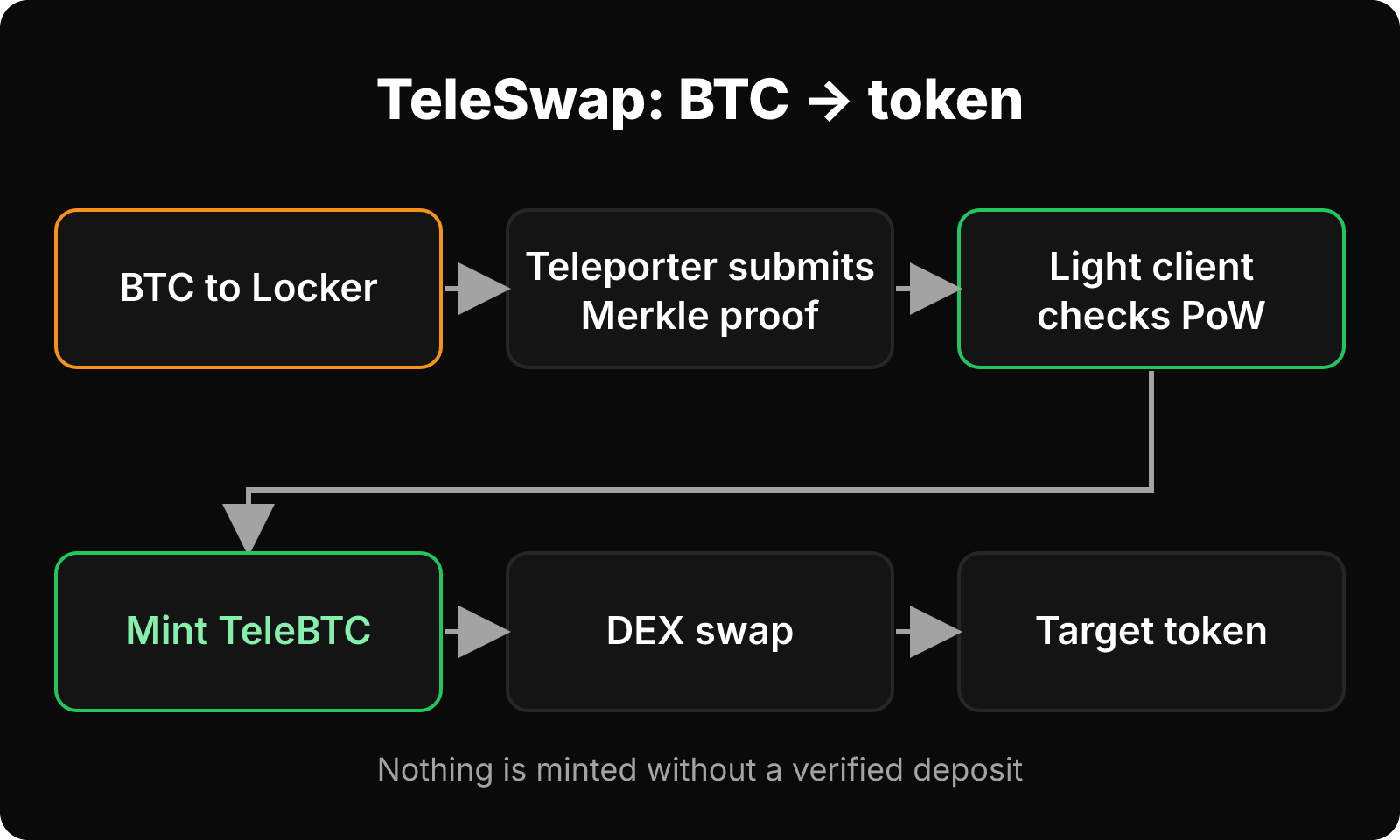
- The user sends BTC to a Locker's Bitcoin address, with the request (destination chain, recipient, target token, fee parameters) encoded in the transaction.
- After enough confirmations, a Teleporter submits the raw transaction and a Merkle inclusion proof to the destination-chain contract.
- The contract checks the proof against the Merkle root in a stored header and confirms the BTC went to a registered Locker.
- Only then does the contract mint TeleBTC 1:1. If the request asks for a swap, TeleBTC is routed through the DEX into the target token (ERC-20, Jetton or SPL token).
- A Teleporter covers destination-chain gas. The user pays fees in Bitcoin assets and doesn't need ETH, BNB or SOL first.
Fast swaps settle in about 10 minutes, per the TeleSwap documentation.
Unwrap flow (token → BTC) and slashing
The reverse direction is where collateral matters. The user burns TeleBTC and names a Bitcoin address, and the assigned Locker has to send the BTC. Lockers post collateral that is slashed for dishonest behavior. Nothing is minted without a verified Bitcoin transaction. See the documentation for current deadlines and slashing parameters.
Trust Models Compared: Solvers vs Lockers
The real question isn't "trustless or not". It's which failure mode you are exposed to, and who pays for it.
Garden: losses stay with solvers, but uptime depends on them
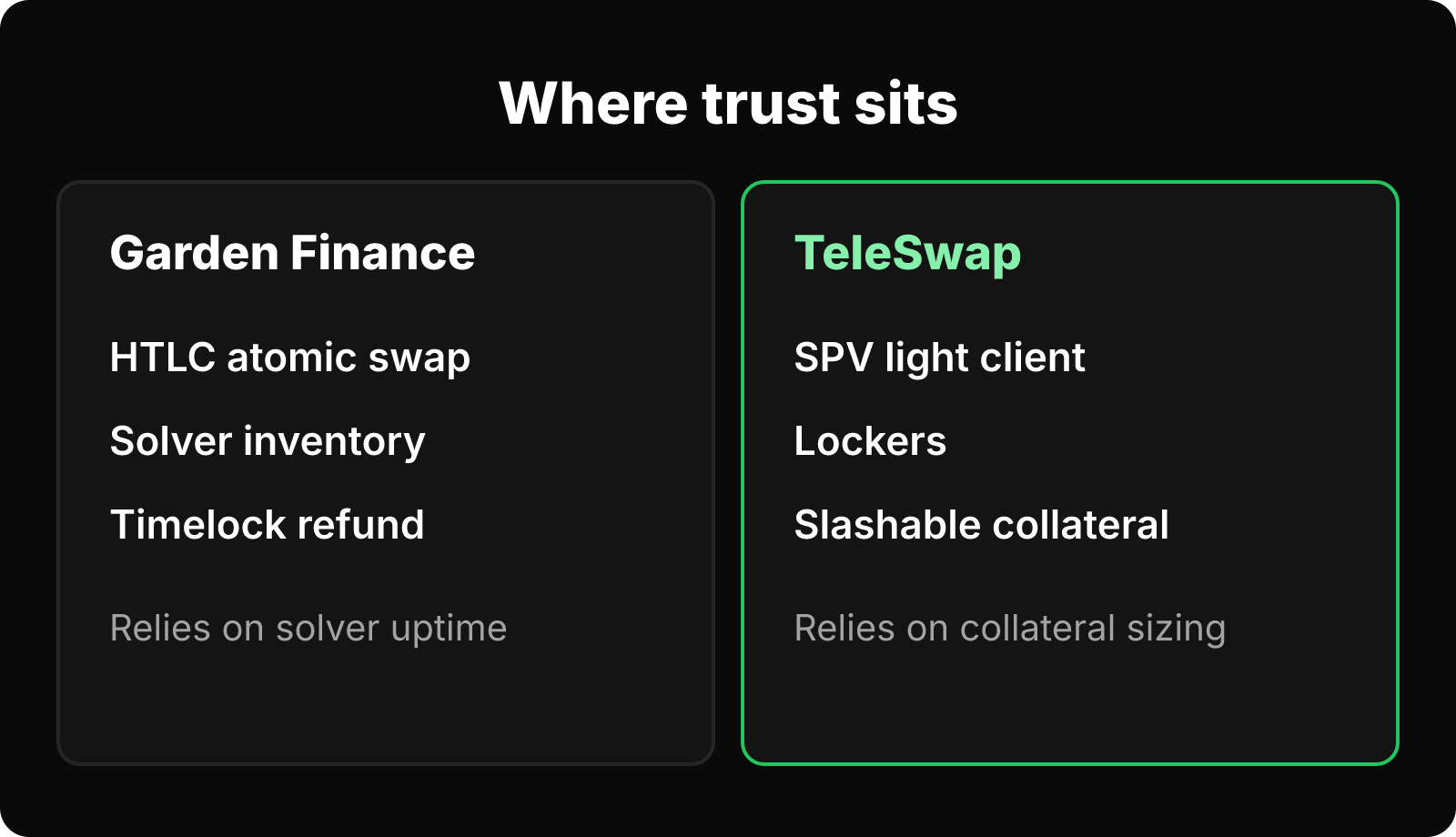
With correctly built HTLCs, a user's funds can't be spent without the secret, and they come back after the timeout. Both reported breaches hit solver-owned funds and solver infrastructure, not user escrow, according to Garden's statements reported by Cointelegraph.
Keeping losses away from users and keeping the service available are different properties. When a solver's off-chain database was compromised in July 2026, Garden took the whole app offline. HTLCs protect the principal; they don't keep the service running when the actors who supply liquidity are compromised.
TeleSwap: verification is trust-minimized, safety rests on collateral
TeleSwap moves trust in the other direction. No off-chain actor decides whether a deposit happened, because the light client checks it against proof-of-work. The remaining assumption sits with Lockers, which hold BTC between wrap and unwrap, backed by posted collateral that can be slashed. So the questions to ask are about collateral sizing and whether header relaying stays live. The TeleSwap documentation is the source for current parameters.
Two edge cases apply to any SPV design: a Bitcoin reorg deeper than the confirmation threshold, and a stall in header relaying, which delays settlement but doesn't let anyone forge a deposit.
Where each sits in the wrapped-BTC landscape
Compared with custodial wrappers like WBTC and cbBTC, which depend on a company holding keys (see our WBTC custody risk vs trustless bridges breakdown), or committee-based tBTC, which uses threshold signer wallets as described in BOB's review, TeleBTC is the trust-minimized option: its minting rule is a proof-of-work check, not a signature from a custodian. Garden mostly avoids issuing its own wrapper and leaves the user holding whatever asset the solver delivers.
BTC Bridge Comparison Table: Chains, Fees, Limits
The table below comes from public sources as of October 2026. Where a figure isn't published, we say so rather than guess.
| Dimension | Garden Finance | TeleSwap |
|---|---|---|
| Core model | Intent-based, solver competition | Bridge + swap via SPV light client and DEX routing |
| Settlement primitive | HTLC atomic swap (hashlock + timelock) | Merkle proof against a PoW-verified Bitcoin header |
| Who decides a deposit happened | Each chain's own consensus; no cross-chain verification | Light-client contract on the destination chain |
| Liquidity source | Solver inventory | Lockers (collateral-backed) + DEX liquidity |
| User refund / recourse | Timelock refund under user control | Locker collateral is slashable |
| Asset received | Destination asset locked by solver | TeleBTC or swapped token (ERC-20, Jetton, SPL) |
| Supported networks | 11 listed, incl. Ethereum, Arbitrum, Base, Solana, Berachain, Starknet (The Grid) | 13 (TeleSwap network stats) |
| Destination gas | Not specified in reviewed sources | Covered by a Teleporter; fees paid in Bitcoin assets |
| Pricing | Solver auction; 5.0 bps avg gap from best quote in a 14 Sep 2026 test (BOB benchmark, competitor-run) | Quote shown before confirmation; see docs |
| Speed | Not specified in reviewed sources | Fast swaps ~10 minutes |
| Per-swap limits | No fixed public cap found | No fixed public cap found |
| Usage | "$2b bridged" (self-reported, Oct 2025) | $526.0M bridged, 557,522 transactions (Oct 2026) |
| Developer access | API + SDK (per Sep 2026 strkBTC announcement) | SDK wrapping a REST API; third-party ID for fee share |
We deliberately don't quote a fee percentage for either protocol. Quotes change with liquidity, Bitcoin mempool conditions and destination gas, so compare live quotes for your actual size. TeleSwap is integrated as a Bitcoin swap provider in Rango, Rubic and DZap, and through Rango in MetaMask and Trust Wallet.
Usage snapshot
Over the last 30 days TeleSwap processed $40.4M in volume, averaging about $1.3M a day, with a peak of $2.1M on 8 October 2026 (TeleSwap network stats, retrieved 22 October 2026). We found no comparable rolling 30-day figure for Garden, so we don't put the two side by side.
What Does the 2026 Security Record Show?
2026 has been a hard year for bridges. Decripto counted seven bridge attacks in a single month. THORChain halted trading after a 15 May 2026 exploit drained about $10.7M from one vault, and Symbiosis paused its Bitcoin bridge after an 11 September 2026 exploit, both per BOB.
Garden's record, as reported:
- October 2025: a breach of one solver's operating environment led to about $11.4M stolen. Garden said its protocol contracts were not affected.
- 26 July 2026: an attacker compromised an independent solver's off-chain database and drained about $450,000 of solver-owned funds, per Blockaid. Garden took its app offline and said its contracts and user funds were unaffected (Cointelegraph).
- 14 September 2026: Garden returned quotes in all five of BOB's benchmark tests, so service had resumed by then.
Both Garden incidents were operational-security failures in off-chain solver systems, not reported smart-contract bugs. That is a fair point in Garden's favour. It also shows that solver key management is part of the real attack surface.
Our advice applies to every bridge, including ours. Read each protocol's audits and incident disclosures yourself, start with a small test transaction, and don't treat any project's own blog (this one included) as an independent security review.
Walkthrough: Bridging BTC to USDC on Ethereum with TeleSwap
Here's what the SPV flow looks like from the user's side, for a BTC → USDC (Ethereum) swap. For a broader step-by-step, see our 7-step trustless BTC swap guide.
- Open teleswap.xyz and pick BTC as the source and USDC on Ethereum as the destination.
- Enter the amount and your Ethereum address. The quote shows the expected output. You don't need ETH in the receiving wallet because a Teleporter covers gas.
- Send BTC from your Bitcoin wallet. The interface builds the transaction with the request data.
- Wait for confirmations. A Teleporter then submits the proof, the contract verifies it, and TeleBTC is minted and swapped into USDC in the same flow.
- Receive USDC. Fast swaps settle in about 10 minutes.
Other routes work the same way, such as BTC → ETH on Arbitrum. If you want BTC yield rather than a swap, TeleSwap's Earn side has accepted native BTC deposits straight from a Bitcoin wallet since 14 October 2026. That takes one Bitcoin transaction and no EVM wallet, though yield depends on pool activity and isn't guaranteed.
For developers
The TeleSwap SDK returns a BTC → EVM/TON/Solana quote in under a minute and wraps a REST API, so you can also call it over plain HTTP. Integrators who register a third-party ID earn a share of fees on the volume they bring. See the TeleSwap documentation.
Is TeleSwap a Good Garden Bridge Alternative?
Yes, for users who care most about how deposits are verified. It's less of a fit if you need a chain only Garden supports. A neutral way to decide:
- Choose Garden if you want an HTLC refund path you control, need a chain in its solver network that TeleSwap may not cover, and are comfortable with solver liquidity and uptime.
- Choose TeleSwap if you want deposits checked by Bitcoin proof-of-work on-chain rather than by an off-chain counterparty, want to pay all fees in Bitcoin assets with destination gas covered, or need routes such as BTC → USDC on Ethereum.
- Compare both if you trade size. Live quotes through an aggregator are the most reliable way to find the best price on a given day.
Frequently Asked Questions
What is the main difference between Garden Finance and TeleSwap?
Garden uses solver-filled HTLC atomic swaps, while TeleSwap verifies Bitcoin deposits with an SPV light client and mints TeleBTC. Garden never needs one chain to verify the other because a shared secret ties the two locks together. TeleSwap's destination-chain contract checks Bitcoin proof-of-work and Merkle proofs directly.
Is Garden Finance an atomic swap Bitcoin bridge?
Yes, per BOB's review Garden settles cross-chain swaps with hash time-lock contracts, the standard atomic swap primitive. Funds can be claimed only with a secret preimage, and return to the user after a timeout if the swap doesn't complete.
Were user funds lost in Garden's 2025 and 2026 incidents?
According to Garden, no. Both incidents drained solver-owned funds and did not affect its contracts or user funds. About $11.4M was taken in October 2025 and about $450,000 on 26 July 2026, and the second incident led Garden to take its app offline.
How does TeleSwap verify Bitcoin transactions without a custodian?
TeleSwap uses an on-chain Bitcoin light client that checks block-header proof-of-work and Merkle inclusion proofs. Relayers submit headers, a Teleporter submits the transaction proof, and TeleBTC is minted only if the proof checks out.
How many networks does TeleSwap support?
TeleSwap supports 13 networks, according to its live network stats as of 22 October 2026. These include EVM chains such as Ethereum, Arbitrum, Base, BNB Smart Chain, Polygon and Optimism.
Which is cheaper, Garden or TeleSwap?
It depends on trade size, route and market conditions, so compare live quotes. Garden prices through solver competition. TeleSwap shows a quote before you confirm, with fees paid in Bitcoin assets and destination gas covered by a Teleporter. Aggregators like Rango, Rubic and DZap let you compare routes.
How long does a TeleSwap BTC swap take?
Fast swaps on TeleSwap settle in about 10 minutes. Bitcoin confirmations are required before the light client accepts the deposit proof.
Conclusion
The garden finance vs teleswap question comes down to where each design puts its trust. Garden's HTLCs keep losses away from users but rely on solver liquidity and solver operational security, which its 2025 and 2026 incidents showed. TeleSwap takes off-chain parties out of verification by checking Bitcoin proof-of-work on-chain, and backs its Lockers with slashable collateral. According to TeleSwap network stats, it has bridged $526.0M across 557,522 transactions.
If you want deposits verified by Bitcoin itself, all fees paid in Bitcoin assets, and fast swaps that settle in about 10 minutes, try a small transaction and see how it works for you.