Crypto Hack Explained: How the $6.3B Binance Hack Happened

No private key leaked. That's the strangest part of the biggest theft crypto has ever seen.
On 29 October 2026, attackers moved roughly $6.3 billion out of Binance wallets across ten blockchains, most of it in about 20 minutes, according to TRM Labs via NPR. Binance's preliminary explanation is that a DevOps engineer's laptop was compromised, which gave the attacker access to a service container that could submit withdrawal transactions. This article walks through the crypto hack, explained as it happened: step by step, at the level of withdrawal pipelines, signing services and authorization layers. We also cover who lost what and which defenses actually hold up when the attacker never needs your keys.
One caveat before we start. As of 31 October 2026, Binance has not published a full technical post-mortem. We separate what the company and blockchain-intelligence firms have confirmed from what is inference. Inference is labeled as such.
Key Takeaways:Attackers drained about $6.3 billion from Binance on 29 October 2026, across ten blockchains, with most funds moved in about 20 minutes, per TRM Labs as reported by NPR.Binance's preliminary finding is that a compromised engineer's laptop led to a service container that submitted unauthorized withdrawal transactions, with no evidence of a private key leak.Roughly $3 billion of the stolen funds had been frozen on-chain by 29–30 October 2026, helped by Tether and Circle, according to Reuters.TRM Labs attributes the attack to North Korea with "high confidence," and Chainalysis calls the TraderTraitor group the "likely" perpetrator.The core lesson is that protecting keys is not the same as protecting authorization: a system that signs any valid-looking internal request can be drained without its keys ever leaving the vault.
Table of Contents
- What Happened in the Binance Hack?
- How Did the Attack Work, Step by Step?
- Why Didn't Key Security Stop It?
- Who Lost What?
- How Does It Compare to 2026's Other Exploits?
- What Are the Bitcoin Bridge Hack Security Lessons?
- How Do You Protect Crypto Assets From Exploits?
- Frequently Asked Questions
- Conclusion
What Happened in the Binance Hack?
In two sentences: An attacker who compromised an internal Binance machine used the exchange's own withdrawal infrastructure to send about $6.3 billion in assets to attacker-controlled addresses on ten chains. Binance says no private keys leaked and has promised to cover all user losses, and blockchain-intelligence firms link the attack to North Korea.
Here is the timeline that Coinpedia's incident report reconstructed from on-chain data:
- 28 October 2026: On-chain activity first appears from wallets that were later linked to the attack.
- 29 October 2026: Large suspicious transfers start on the XRP Ledger. Solana, Bitcoin, Tron and Ethereum-linked wallets follow, including a large ETH/USDT transaction.
- 29 October 2026, evening: Tether, Circle and other market participants start freezing or restricting assets.
- 30 October 2026: Binance issues a public statement. It later says further investigation found additional "points of breach," NPR reported.
Estimates vary a little. Binance puts the impact at about $6.3 billion. TRM Labs and the Wikipedia entry on the incident give $6.36 billion. Both figures make it the largest crypto theft on record. It is roughly four times the $1.5 billion Bybit hack of February 2025, which the FBI attributed to North Korea's TraderTraitor group.
How Did the Attack Work, Step by Step?
To follow the attack, you need a rough picture of how a large exchange processes withdrawals. Binance has not disclosed its architecture, so the model below is a general one used by many custodians. It is illustrative, not confirmed for Binance.
The generic withdrawal pipeline
- Hot wallet: An address whose signing keys can be used automatically by online systems, so withdrawals settle in minutes rather than hours. "Hot" describes how the keys can be used, not where they are stored. The keys can sit inside a hardware security module (HSM) and still count as hot.
- Withdrawal service: An internal microservice, usually running in a container (an isolated, packaged process managed by an orchestrator like Kubernetes). It builds unsigned transactions from approved user requests.
- Signing service: The component that holds or controls keys. It might be an HSM, or an MPC/TSS cluster where several parties each hold a key share and jointly produce one signature, so the full key never exists in one place. It signs whatever arrives through an authenticated channel, as long as the policy layer allows it.
- Policy layer: Rules such as per-asset velocity limits, destination allowlists and multi-party approval for large amounts. The key design question is where these rules are enforced: upstream in the service, or inside the signer itself.
The six-step attack flow
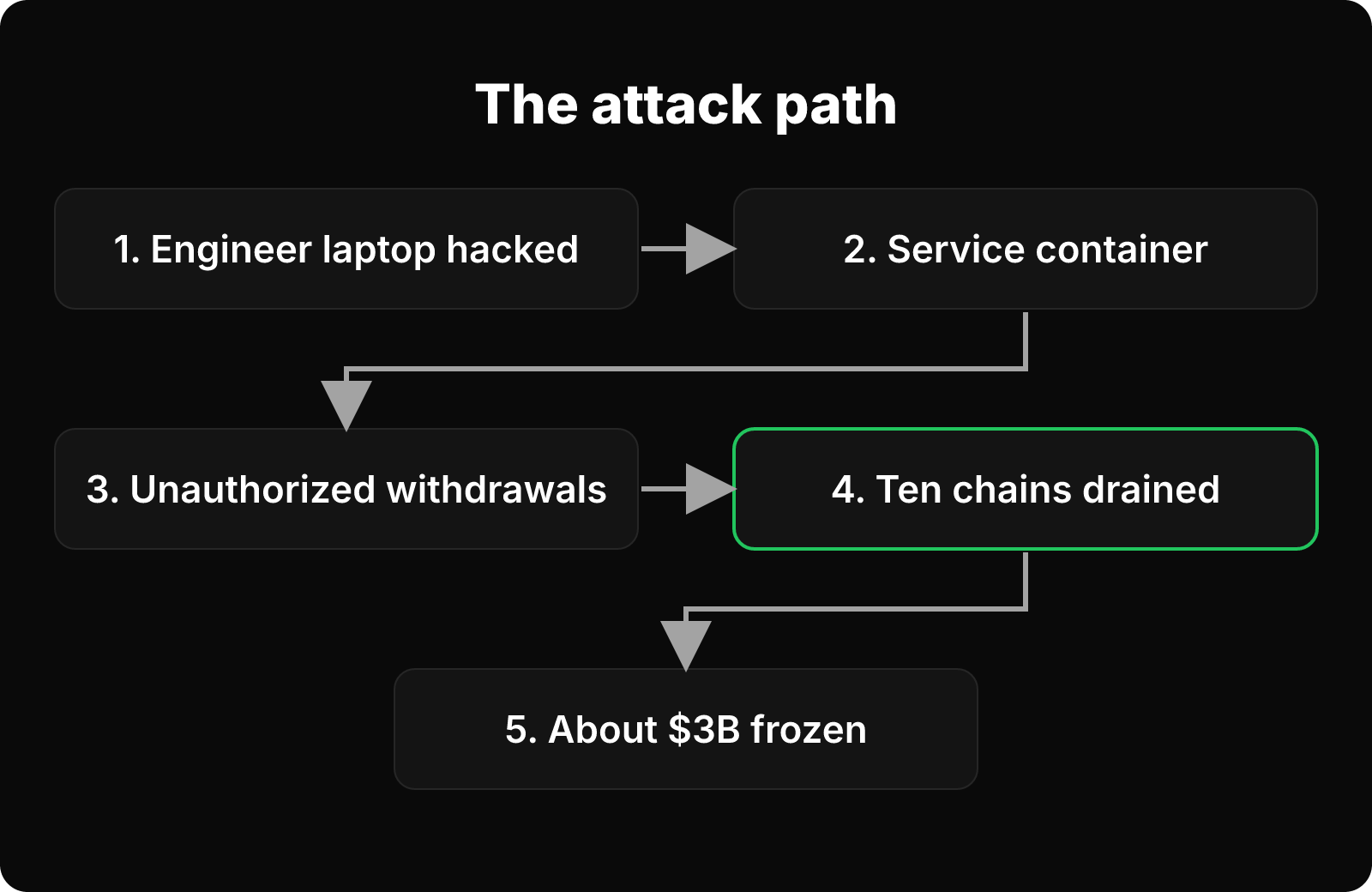
- Endpoint compromise. According to Binance's preliminary statement, as quoted by DW News and others, a DevOps engineer's laptop was compromised. Binance has not said how. DPRK-linked groups have historically favored targeted social engineering of developers, but the method used here is not confirmed.
- Credential and session harvesting (inferred). A DevOps laptop usually holds cloud CLI credentials, cluster configs, SSH keys and live SSO sessions. Stealing a valid session token lets an attacker skip MFA completely, because MFA was already satisfied when the session started.
- Pivot into a service container. Binance says the attacker reached a service container. From there, requests come from inside the trust boundary. To the signer, they look exactly like the withdrawal service doing its normal job.
- Unauthorized withdrawal submission. The attacker submitted unauthorized withdrawal transactions. Binance says it has found "no evidence of any wallet private key leak," per CNBC. That fits this model: the keys signed exactly as designed, just for the wrong person. NyxLab CEO Kok Tin Gan told NPR it "looks like one signature that gave the attacker a never-expiring, full-access token to a Binance hot wallet." That is an analyst hypothesis, not a confirmed finding.
- Automated multi-chain sweep. Funds left on ten chains, mostly within about 20 minutes. Nobody does that by hand. It points to pre-written scripts that knew the wallet layout, fee settings and destination addresses for each chain. The 28 October activity may have been staging or test transfers, but that is our inference, not a finding.
- Laundering versus freeze race. Once funds are on-chain, the attacker races to move assets out of reach, while issuers race to freeze them. About $3 billion was frozen by 29–30 October, according to Reuters.
Why Didn't Key Security Stop It?
Because key security answers the wrong question. HSMs, MPC and multisig answer "who can produce a valid signature?" The attack exploited a different question: "who decides what gets signed?"
This is the nuance most coverage misses. Exchanges have spent a decade hardening key storage, and Binance reports no evidence of a key leak. But a signer that trusts its callers becomes a signing oracle: anyone who can reach the caller can effectively spend from the wallet. Chainquiry's analysis puts it well. The core problem is making sure "only the right transactions reach the signing stage."
From a protocol design standpoint, three controls could plausibly have limited the damage. None of them involve keys:
- Policy enforced inside the signer. If velocity limits and destination allowlists run inside the HSM or MPC quorum, an attacker in an upstream container can't get past them. If the limits live only in the service code, whoever controls the service controls the limits.
- Request binding to user intent. Each withdrawal should carry cryptographic proof that a real, authenticated user request started it, such as a signed request hash tied to the user's session and 2FA event. A container with no user can't forge that proof.
- Short-lived, scoped credentials. A "never-expiring, full-access token," if that description proves accurate, breaks least-privilege access at the root. Tokens that last minutes and only cover one asset would limit the damage.
Fast exchange withdrawals and strict signer-side policy pull in opposite directions. Hot wallets exist because users want withdrawals in minutes. Every cap and approval step you add makes the product slower.
Who Lost What?
The losses are spread across several groups, and the final accounting is still open.
| Party | Exposure | Status (as of 31 Oct 2026) | Source |
|---|---|---|---|
| Binance users (335M registered) | Assets in affected wallets; withdrawals suspended | Binance pledges full coverage via SAFU and corporate funds | Reuters |
| Binance (corporate) | ~$6.3B, with >$6.3B of its own funds set aside | Has begun recovering some assets | CNBC |
| Stolen funds frozen | ~$3B | Frozen on-chain, with Tether and Circle contributing | Reuters |
| Remaining funds | ~$3.3B | Status not disclosed | Reuters |
| Wider market | BTC, ETH and majors fell sharply | Also under pressure from rates and softer ETF demand | Reuters |
Some details conflict. CNBC describes the SAFU (Secure Asset Fund for Users) as about $1 billion. Reuters describes it as a reserve held entirely in bitcoin. Binance's statement that it has set aside more than $6.3 billion is what supports its full-coverage promise. Deposit status also differs by source: Binance's statement said deposits and withdrawals were suspended, while NPR reported that deposits were unaffected. Check Binance's official channels directly.
For scale, Binance reported about $162.8 billion in assets under custody in its 2025 annual report, per Reuters. Whether reserves can cover losses at current prices has not been verified.
How Does It Compare to 2026's Other Exploits?
Binance is the biggest 2026 incident by far, but the pattern behind it isn't new. We grouped the year's major exploits by where trust broke down. Data comes from BlockchainBreaches' 2026 index and Coinpaper's hack coverage.
| Incident (2026) | Loss | Failure class | Mechanism |
|---|---|---|---|
| Binance | ~$6.3B, 10 chains | Authorization layer | Compromised laptop → service container → unauthorized withdrawals |
| Bitget | ~$387.5M, 8 chains | Authorization layer | Compromised wallet backend spoofed withdrawals |
| KelpDAO rsETH | $292M unbacked rsETH | Bridge verification | 1-of-1 LayerZero DVN (single verifier) configuration |
| Verus–Ethereum bridge | $11.58M | Bridge verification | No source/destination value-binding check |
| THORChain Asgard vaults | ~$10.8M, 9 chains | Threshold signatures | Suspected GG20 TSS flaw exploited by a malicious node operator |
| Echo Protocol eBTC | 1,000 unbacked eBTC; ~$821K extracted | Admin key | Admin key compromise used to mint unbacked eBTC |
| Wasabi Protocol | $5M, 4 chains | Admin key / upgrades | Compromised deployer EOA with sole ADMIN_ROLE allowed UUPS upgrades |
Look at the failure-class column. Per the sources, none of these losses came from breaking ECDSA or Schnorr. Each came from a component accepting an unbacked or unauthorized action as valid. That could be a backend, a single verifier, a weak value check or one admin key.
Some terms used above:
- DVN (Decentralized Verifier Network): In LayerZero, the set of verifiers that must attest to a cross-chain message. A 1-of-1 configuration means a single attestation is enough to approve it.
- Value-binding check: A check that the amount locked on the source chain matches the amount released or minted on the destination chain. Verus lacked it on both sides, and an attacker submitted a 0.02 VRSC export.
- UUPS proxy: An upgradeable contract pattern where the upgrade logic sits in the implementation contract. Whoever holds the upgrade role can replace the code completely.
- GG20: A threshold ECDSA protocol used in MPC wallets. THORChain's incident is suspected to involve a flaw in it.
What Are the Bitcoin Bridge Hack Security Lessons?
Bridges hold the same kind of pool of value an exchange hot wallet does. They face the same question too: what has to be true before value is released or minted? The table above shows two weak answers, "a single verifier said so" and "an admin key said so." The strong answer is "the source chain itself proves it happened." For more background, see our guide to Bitcoin bridge security in 2026 and our roundup of the biggest crypto bridge hacks.
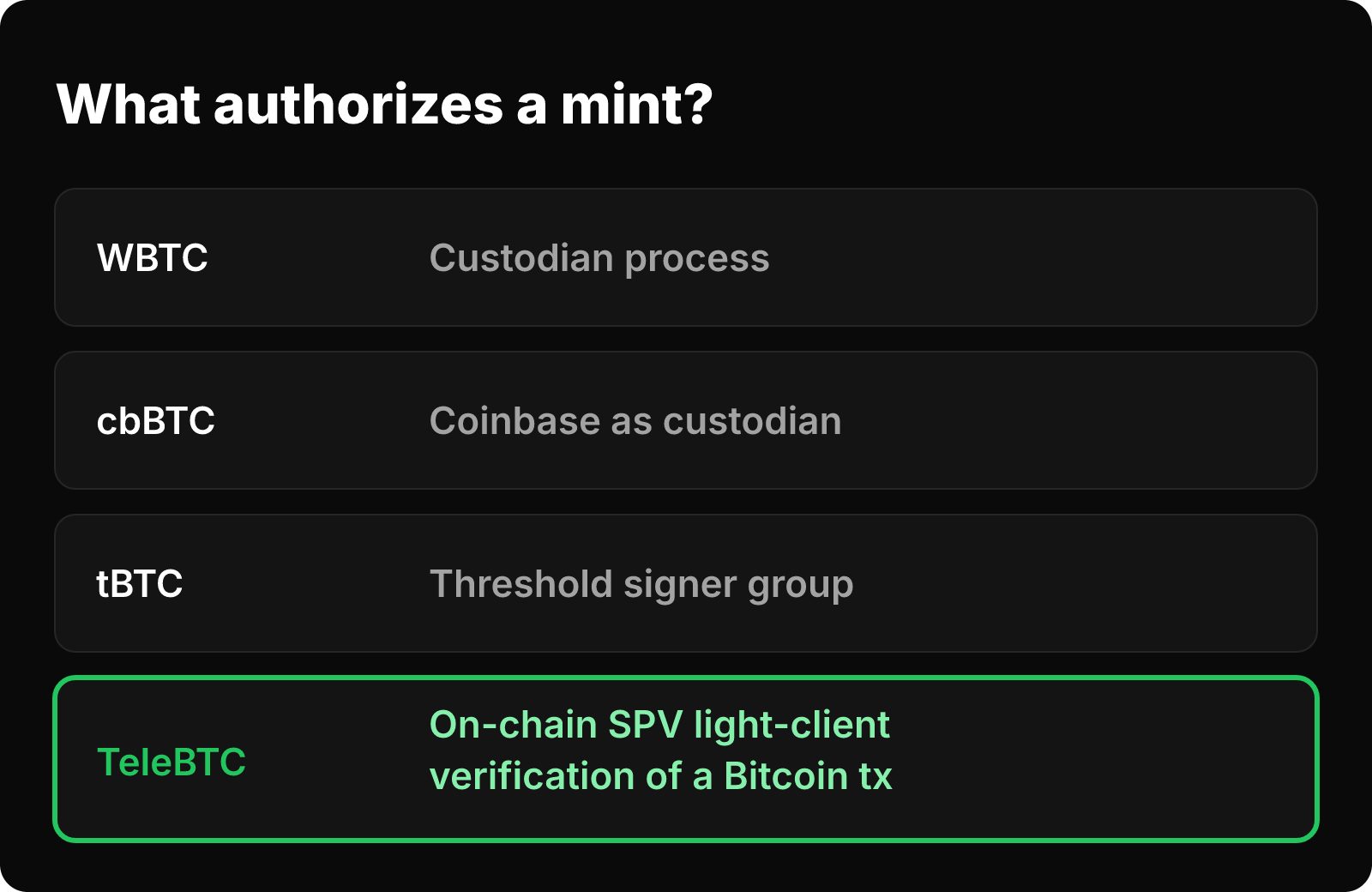
That is the logic of SPV (Simplified Payment Verification), described in Section 8 of the Bitcoin whitepaper. A light client stores Bitcoin block headers and checks that each one meets the proof-of-work target. It then confirms a transaction using a Merkle proof that links the transaction to a header's Merkle root. A bridge contract that runs this check on-chain doesn't trust a server's claim that a deposit happened. How SPV light-client bridges work covers the mechanics in more depth.
TeleSwap uses this design. Bridging mints TeleBTC, a 1:1 collateral-backed representation of BTC, and nothing is minted without a verified Bitcoin transaction. Custody is collateral-backed and slashable (see the docs). TeleSwap has bridged $538.3M in total volume across 570,135 transactions on 13 supported networks, per TeleSwap network stats. If you move BTC on-chain to buy stablecoins, a route like BTC → USDC on Ethereum doesn't require parking funds on an exchange.
No design removes risk entirely. Light-client bridges still depend on correct smart contract code, on relayers staying live, and on collateral being sufficient. The difference is the type of trust: code you can audit and Bitcoin's proof-of-work, not an operator's internal network staying clean.
| Wrapped BTC model | Mint authorized by | Main trust assumption |
|---|---|---|
| WBTC | Custodian process | Custodian operations and keys |
| cbBTC | Coinbase as custodian | A single centralized custodian |
| tBTC | Threshold signer group | A threshold of signers behaving honestly |
| TeleBTC | On-chain SPV light-client verification of a Bitcoin tx | Verified Bitcoin proofs; collateral-backed, slashable Lockers; smart contract correctness |
How Do You Protect Crypto Assets From Exploits?
You can't patch Binance's container setup. You can control how much of your money depends on it. Here is a checklist built from this incident and the 2026 exploits above.
If you hold funds on exchanges
- Hold only trading balances on exchanges. Treat an exchange like a checking account, not a vault. CNBC points to FTX in 2022: its terms said customer assets belonged to customers, and that didn't stop them being misused.
- Turn on withdrawal address allowlisting and time locks. These won't stop an internal breach like this one. They do help against account takeover.
- Check Proof of Reserves after remediation. Binance has said it will publish an updated PoR once remediation is complete.
- Use official channels during an incident. Phishing commonly spikes after big hacks, so avoid unsolicited "compensation" links.
How to avoid crypto bridge exploits
- Find out what authorizes a mint. Ask: "What has to be true for this bridge to release funds?" If the answer is a single verifier, a small multisig or an admin key, size your position for that risk. KelpDAO's 1-of-1 DVN is the warning case.
- Check upgrade and admin rights. Look for timelocks on upgrades, multisig-held admin roles and public upgrade histories. Wasabi lost $5M after a compromised deployer account with sole admin rights pushed upgrades.
- Revoke stale token approvals. The Limit Break incident, at least $2.8M in 2026, drained users through stale approvals on a flawed contract. Review approvals regularly with a revocation tool.
If you self-custody
- Use a hardware wallet and protect your seed offline. Self-custody takes away exchange risk but makes recovery entirely your job. A lost recovery phrase can't be recovered by anyone, as CNBC notes. Keep your signing device away from machines you use for development or downloads, because a compromised laptop was the first domino here.
Frequently Asked Questions
How did the $6.3B Binance hack happen?
According to Binance's preliminary findings, a DevOps engineer's laptop was compromised, giving the attacker access to a service container that submitted unauthorized withdrawal transactions. The funds, about $6.3 billion, moved across ten blockchains on 29 October 2026, mostly within about 20 minutes. Binance later said it found additional points of breach, and a full post-mortem is still pending.
Were Binance's private keys stolen?
Binance says there is no evidence of any wallet private key leak. The attacker appears to have used Binance's own infrastructure to submit withdrawals, though the full mechanism is unconfirmed. That's why the incident looks like an authorization failure rather than a key-custody failure.
Who was behind the Binance hack?
Blockchain-intelligence firms attribute the attack to North Korea. TRM Labs says it has "high confidence" and notes similarities to the February 2025 Bybit hack. Chainalysis says the TraderTraitor group is the "likely" perpetrator. No FBI statement on this incident appeared in our sources.
Will Binance users get their money back?
Binance says it will cover all user losses through its SAFU fund and corporate funds, and has set aside more than $6.3 billion. About $3 billion of the stolen assets had been frozen by 29–30 October, and Binance says it has started recovering some assets. Withdrawals were suspended at the time of reporting.
What is the biggest security lesson from this crypto hack?
Securing keys is not enough. You also have to secure what decides which transactions get signed. Velocity limits, destination allowlists and proof of user intent should be enforced inside the signing layer, so a compromised upstream service can't push the signer into draining the wallet.
Are Bitcoin bridges safer than exchanges?
It depends on how the bridge authorizes a mint. Bridges that rely on one verifier, a small multisig or an admin key have a single point of failure much like an exchange hot wallet. Bridges that check Bitcoin transactions on-chain with SPV light-client proofs remove that operator trust, but they still carry smart contract and collateral risk.
Conclusion
The Binance hack of 29 October 2026 appears to be a trust-boundary failure rather than a cryptography failure. Per Binance's preliminary account, one compromised laptop led to a container that the withdrawal system trusted, and about $6.3 billion moved in minutes with no evidence of a private key leak. Roughly $3 billion was frozen, and Binance says it will cover user losses.
The lesson for anyone holding crypto: keep exchange balances small. For any bridge or protocol, ask what actually authorizes value to move, and prefer designs where the answer is a cryptographic proof, not an operator's word. If you want to move BTC on-chain through an SPV-verified bridge, try teleswap.xyz.