Earn Yield on Native Bitcoin: No Wrapping, No Custodian

You can earn yield on native Bitcoin by sending one Bitcoin transaction from your own wallet to TeleSwap's teleBTC pools. The yield comes from swap fees, is paid in BTC, and is variable, not guaranteed.
Most Bitcoin just sits there. The usual ways to make it earn mean handing it to a lender, wrapping it into a token a company holds, or setting up a wallet on a new chain and paying gas in a coin you don't own. We'll cover what you earn, where it comes from, the deposit options (native BTC first), the risks, and how to get in and out.
Key Takeaways:TeleSwap's Earn pools pay liquidity providers a share of swap fees, paid out in BTC, and the rate changes with trading volume.You can deposit native BTC from a Bitcoin wallet in one Bitcoin transaction, with a 0.0001 BTC minimum on your first deposit, per TeleSwap Earn.As of 2026-11-06, the 7-day average APR was 10% for WBTC/TeleBTC on Polygon and 18.52% for BTCB/TeleBTC on BNB Smart Chain, and both figures are variable.Both sides of each pool are Bitcoin and trade close to 1:1, so the impermanent loss that hits BTC/stablecoin pools largely doesn't apply, according to the TeleSwap documentation.Claiming fees and withdrawing are Bitcoin transactions too, and the BTC comes back to your own Bitcoin address.
Table of Contents
- Why Has Bitcoin Yield Always Meant Trusting Someone?
- What Do You Earn, and Where Does It Come From?
- Three Ways to Earn BTC on Bitcoin with TeleSwap
- Non-Custodial Bitcoin Yield vs. the Alternatives
- What Are the Risks?
- How to Earn Yield on Native Bitcoin, Step by Step
- How to Collect Fees and Withdraw
- Frequently Asked Questions
- The Bottom Line
Why Has Bitcoin Yield Always Meant Trusting Someone?
Bitcoin was built to move value securely without a middleman. Its scripting language is kept simple on purpose, which helps security but means Bitcoin can't run lending markets or trading pools on its base layer.
Until recently, getting a return on BTC meant one of two compromises:
- Hand it to a company. Centralized lenders took deposits and promised interest. BlockFi, Celsius and Voyager all collapsed, as this Eco overview of BTCFi in 2026 recaps.
- Wrap it. You turn BTC into a token on another blockchain, such as WBTC on Ethereum. The BTC behind WBTC is held by a custodian (BitGo), so your token is only as good as that custodian. For a deeper look, see our guide to Bitcoin wrapping without custodians.
The Bitcoin Foundation's BTCFi guide puts the core problem well: "Returns often hide their true source." So ask of any Bitcoin yield: who is paying me, and why?
What Do You Earn, and Where Does It Come From?
Think of an airport currency booth that keeps a small fee on each trade. Now imagine you could fund part of its cash drawer and keep a share of those fees. That's how TeleSwap's Earn pools work.
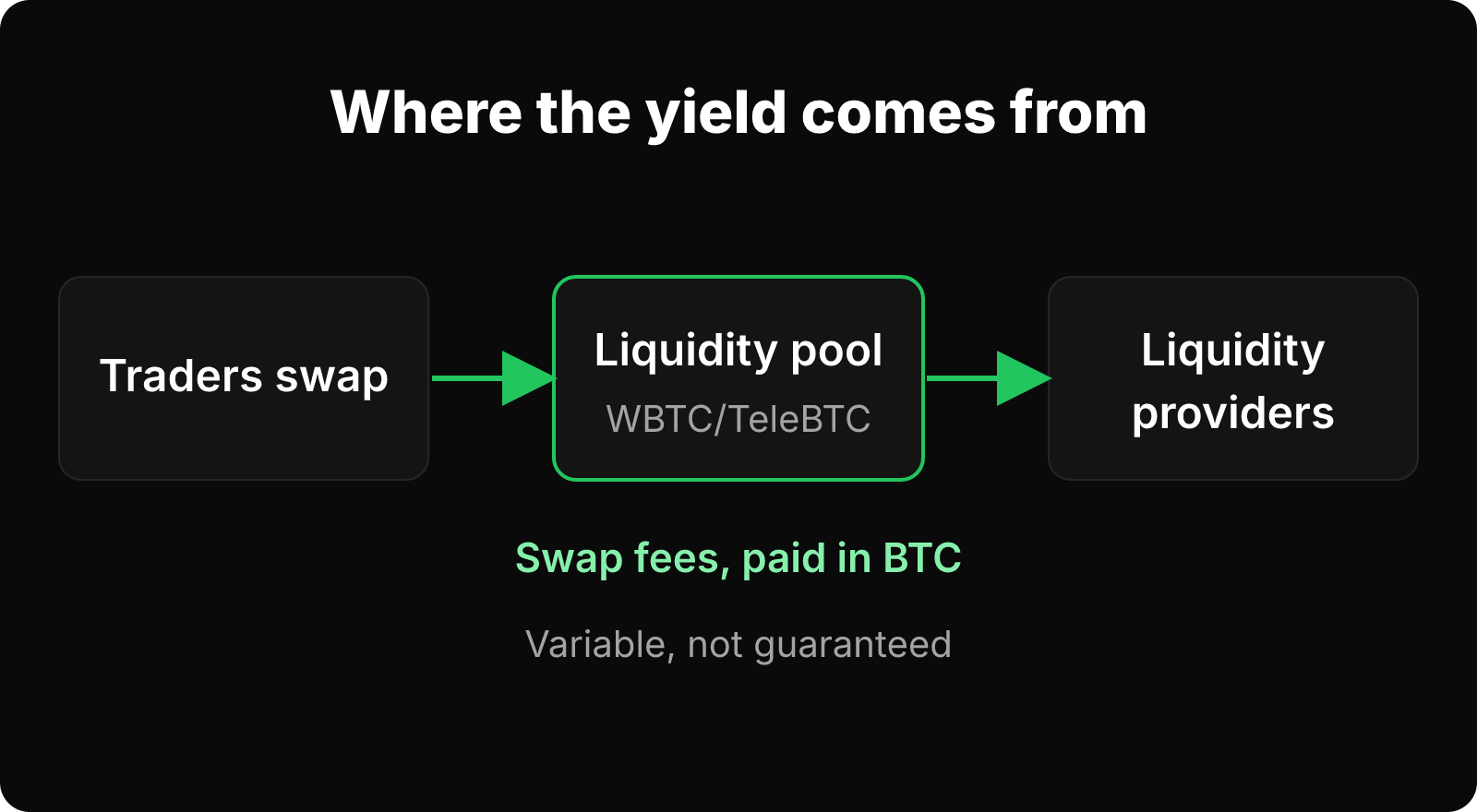
When people swap between Bitcoin assets on TeleSwap, those trades go through liquidity pools. A liquidity pool is a shared pot of two assets that traders swap against. The people who fund it are liquidity providers, and they split the swap fees. The TeleSwap Earn documentation puts it simply: traders trade against these pools, and liquidity providers earn a share of the fees.
Three things to know about this yield:
- It comes from swap fees. If nobody swaps, nobody earns.
- It's paid in BTC. You're adding to your Bitcoin, not collecting a reward token you'd have to sell.
- It's variable. It rises when trading is busy and falls when it's quiet. It is not a fixed rate, and it's not protocol staking.
According to TeleSwap network stats (retrieved 2026-11-06), the protocol has bridged $548.5M across 580,250 bridge transactions on 13 supported networks. Over the last 30 days it handled $41.0M, about $1.4M a day on average, with a peak of $2.1M on 2026-10-08.
Why both sides of the pool being Bitcoin matters
In most pools, like BTC/USDC, the two assets move independently. When BTC's price swings, the pool rebalances and liquidity providers can end up worse off than if they had just held. This is called impermanent loss.
TeleSwap's Earn pools pair TeleBTC with another form of Bitcoin (WBTC or BTCB), and the pair trades in a very narrow range around 1:1. Because the two assets track each other, the docs note there's effectively no impermanent loss. Returns still depend on trading volume and aren't guaranteed.
Three Ways to Earn BTC on Bitcoin with TeleSwap
The TeleSwap Earn page offers three ways in. Start with the one that matches what you already hold.
1. Native BTC from a Bitcoin wallet (bitcoin yield without wrapping)
This is the simplest option if you hold plain Bitcoin. Since 2026-10-14, you can deposit BTC directly from a Bitcoin wallet:
- One Bitcoin transaction. No EVM wallet, no gas, no token approvals.
- Destination: the TeleBTC pools on Polygon and BNB Smart Chain.
- Minimum: your first deposit must be at least 0.0001 BTC.
- Fees: a 0.1% locker fee, a 0% protocol fee, plus the Bitcoin miner fee.
- Exit: claiming fees and withdrawing are also Bitcoin transactions, and the BTC arrives at your Bitcoin address.
To make the fee concrete: on a 0.01 BTC deposit, the 0.1% locker fee comes to 0.00001 BTC, plus whatever the Bitcoin network charges that day. The locker fee goes to Lockers, the operators who hold the BTC backing TeleBTC and post collateral that can be slashed.
A nuance most guides skip: "without wrapping" describes what you have to do, not magic that keeps BTC on the base chain while it trades. Inside a pool on Polygon, your position is TeleBTC. TeleBTC is minted only after a verified Bitcoin transaction, it's backed 1:1, and it's secured by an SPV light client, not a custodian or a multi-sig committee. You never manage a wrapped token yourself. For how that verification works, see how Bitcoin bridges work with SPV light clients.
2. WBTC on Polygon
If you already hold WBTC on Polygon in an EVM wallet like MetaMask, you can add it to the WBTC/TeleBTC pool. The 7-day average APR was 10% as of 2026-11-06, per TeleSwap Earn. That's a backward-looking average, it changes, and it isn't a promise. You'll need a little POL for gas. If you hold BTC and want WBTC first, you can do a trustless BTC to WBTC swap on Polygon.
3. BTCB on BNB Smart Chain
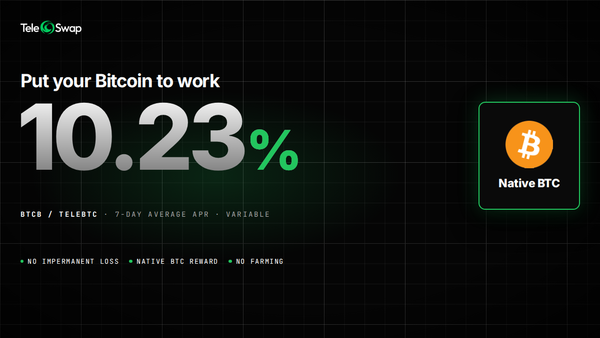
BTCB is Binance's Bitcoin token on BNB Smart Chain. The BTCB/TeleBTC pool's 7-day average APR was 18.52% as of 2026-11-06, and it's also variable. You'll need BNB for gas. To get BTCB from native BTC, use the BTC to BTCB route.
Don't chase the higher number on its own. APR comes from fees divided by pool size, and new deposits dilute it. A 7-day average tells you about last week, not next week.
The rest of TeleSwap Earn: you can also stake TST for fee rewards, or run a protocol role (Locker, Teleporter, Relayer, Filler) for fees. Those are different products with different risks and aren't covered here.
Non-Custodial Bitcoin Yield vs. the Alternatives
There's no single "best" way to earn on Bitcoin. The useful question is how far your BTC moves from Bitcoin's own security model, and who you trust along the way.
| Option | What you deposit | Who holds the BTC | Yield source | Paid in | Extra wallet or token needed? |
|---|---|---|---|---|---|
| TeleSwap Earn (native BTC) | BTC, 1 Bitcoin tx, 0.0001 BTC min. | Collateral-backed, slashable Lockers. TeleBTC verified by SPV light client | Swap fees (variable) | BTC | No |
| TeleSwap Earn (WBTC / BTCB) | WBTC (Polygon) or BTCB (BNB Smart Chain) | Your EVM wallet. The pool pairs your asset with TeleBTC | Swap fees. 10% / 18.52% 7-day avg APR as of 2026-11-06 | BTC | EVM wallet + gas token |
| Stacks Bitcoin Staking | BTC timelocked on L1 + STX locked ~6 months | You (own keys) | Proof-of-Transfer rewards | BTC | STX tokens. Described in a May 13, 2026 whitepaper as a proposed upgrade; sources conflict on whether it is live |
| Babylon staking / Lombard LBTC | BTC | Staking protocol and liquid-token issuer | Securing proof-of-stake chains | Varies | Varies by product |
| WBTC lending on Ethereum | WBTC | Centralized custodian (BitGo) | Borrower interest | WBTC | EVM wallet + ETH gas |
| Centralized lenders (historical) | BTC | The platform | Lending, often opaque | BTC | Account. BlockFi, Celsius, Voyager collapsed |
The TeleSwap native route has one feature that's easy to miss: every step a beginner touches stays on Bitcoin. You deposit, claim and withdraw with Bitcoin transactions. The cross-chain part happens behind the scenes, verified by light-client proofs of Bitcoin's proof-of-work.
What Are the Risks?
No yield is risk-free. Here's what can go wrong, in plain words.
- The yield can shrink. If swap volume drops, fees drop, and so does your return. The APR is a 7-day trailing average, not a forecast.
- Smart contract risk. The pools run on code on Polygon and BNB Smart Chain. Code can have bugs, even when audited.
- Bridge and Locker risk. TeleBTC relies on its light-client verification and on Lockers whose collateral can be slashed. That's a different trust model from a single custodian, but it's still a system you're relying on. Read the TeleSwap documentation to see how it works. For wider context, see Bitcoin bridge security in 2026.
- The partner token's risk. Each pool pairs TeleBTC with WBTC or BTCB, which depend on their own issuers. If one lost its 1:1 peg, the pool could leave liquidity providers holding more of the weaker asset. The near-zero impermanent loss only holds while both sides track BTC.
- Price risk in dollars. You earn in BTC. If BTC's price falls, your position is worth fewer dollars.
- Bitcoin network timing and fees. Deposits, claims and withdrawals wait for Bitcoin confirmations and pay miner fees, which rise when the mempool is busy. On small amounts, fees can take a real bite out of earnings.
A sensible approach: start with an amount you're comfortable having exposed to these risks, go through one claim and one withdrawal, and only then decide whether to add more.
How to Earn Yield on Native Bitcoin, Step by Step
This walkthrough covers the native BTC route, which doesn't need an EVM wallet.
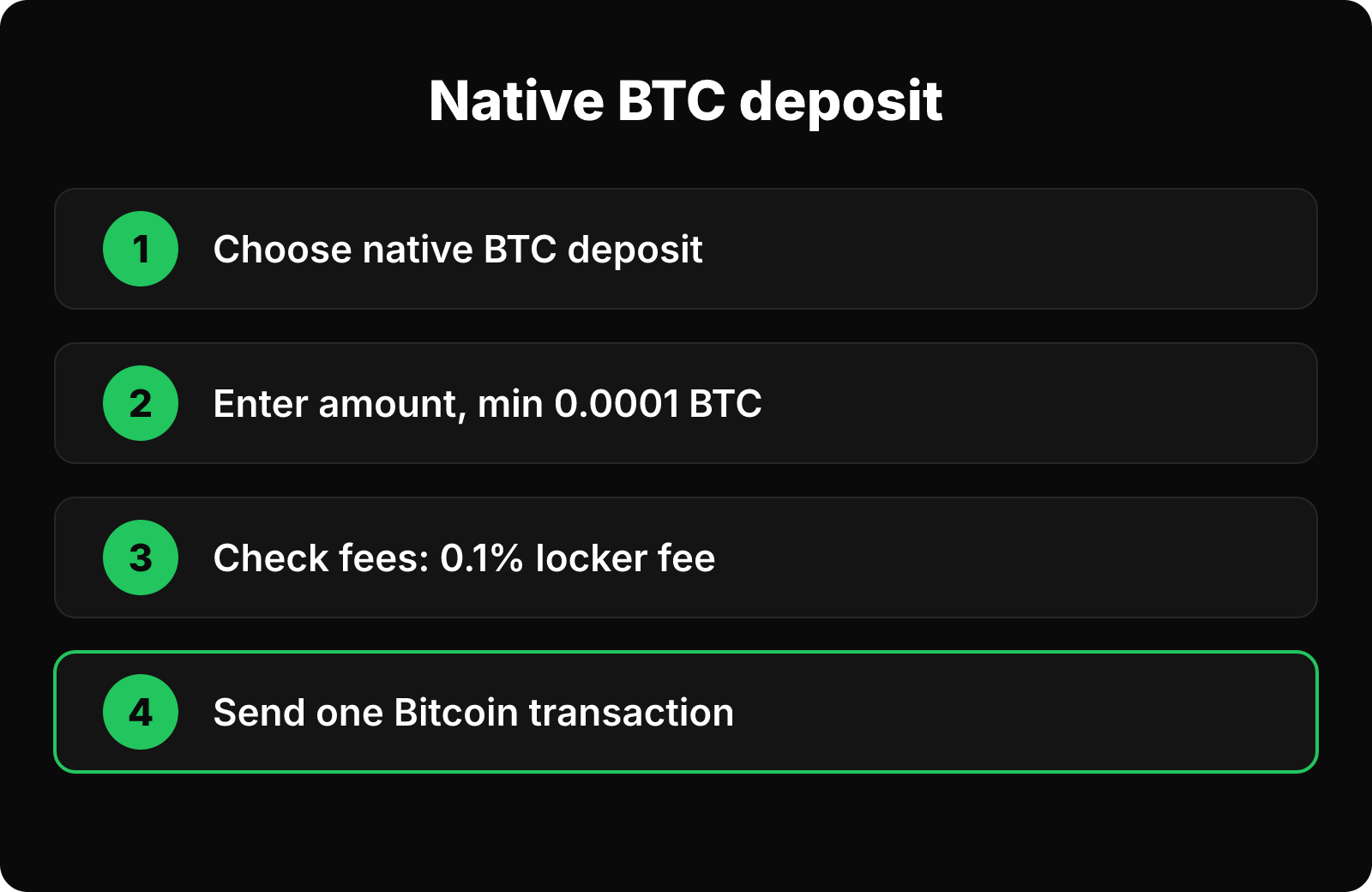
- Go to the Earn page. Open teleswap.xyz/liquidity and check the URL is
teleswap.xyz. - Choose to deposit native BTC. Pick the Bitcoin-wallet option, not the WBTC/BTCB EVM option.
- Enter your amount. Your first deposit needs to be at least 0.0001 BTC.
- Check the fees. Expect a 0.1% locker fee, a 0% protocol fee, and the Bitcoin miner fee. Compare the miner fee to your deposit size.
- Send one Bitcoin transaction. Sign it from your own Bitcoin wallet. No approvals, no gas tokens.
- Wait for confirmation. Once the Bitcoin transaction is verified, your position goes into the TeleBTC pool and starts earning a share of swap fees.
- Keep an eye on it. The Earn page shows the pool's APR, total liquidity, and your liquidity.
Using WBTC or BTCB instead? Connect an EVM wallet, select the pool on Polygon or BNB Smart Chain, and use the Add Liquidity tab. You'll approve the token and pay a small gas fee on that chain. New to swapping BTC without an account? See our trustless swap walkthrough.
How to Collect Fees and Withdraw
Getting out works like getting in, with Bitcoin transactions for native BTC positions.
- Claim your fees. For native BTC positions, claiming is a Bitcoin transaction, and your earned BTC goes to your Bitcoin address. EVM users use the Collect Fees tab, per the Earn docs.
- Withdraw your position. For native BTC, withdrawing is also a Bitcoin transaction, and the BTC arrives at your Bitcoin address. EVM users use Remove Liquidity.
- Factor in miner fees. Each claim and withdrawal pays a Bitcoin network fee, so claiming small amounts often can cost more than it earns. Check the confirmation screen for exact fees before you sign.
Frequently Asked Questions
Can I really earn yield on native Bitcoin without wrapping it myself?
Yes. With TeleSwap you deposit plain BTC from a Bitcoin wallet in one Bitcoin transaction and never handle a wrapped token. Inside the pool, your position is TeleBTC, a 1:1 representation minted only after a verified Bitcoin transaction and secured by SPV light-client proofs rather than a custodian. Claiming and withdrawing are Bitcoin transactions back to your own address.
Where does the yield come from?
The yield comes from fees paid by people swapping through TeleSwap's TeleBTC pools. Liquidity providers share those fees, which are paid out in BTC, so the return goes up and down with trading volume.
How much can I earn?
The rate varies, and no specific return is guaranteed. As of 2026-11-06, the 7-day average APR was 10% for the WBTC/TeleBTC pool on Polygon and 18.52% for the BTCB/TeleBTC pool on BNB Smart Chain. These are past averages that change with volume and pool size, not forecasts.
What is the minimum deposit and what fees apply?
Your first native BTC deposit must be at least 0.0001 BTC. Fees are a 0.1% locker fee and a 0% protocol fee, plus the standard Bitcoin miner fee.
Is this non-custodial Bitcoin yield safe?
It avoids a single custodian but not every risk. You still face smart contract risk, reliance on the light-client bridge and collateral-backed Lockers, peg risk on the paired WBTC or BTCB, BTC price swings in dollar terms, and Bitcoin miner fees. Start small and test a withdrawal first.
What is TeleSwap?
TeleSwap lets you bridge, swap and earn on Bitcoin, secured by SPV light-client verification of Bitcoin transactions. It moves BTC to EVM chains, TON and Solana, swaps it into tokens on those chains, and lets holders earn BTC yield. Per TeleSwap network stats, it has bridged $548.5M across 580,250 transactions on 13 networks.
Do I need MetaMask or another EVM wallet?
Not for the native BTC route. A Bitcoin wallet is enough. You only need an EVM wallet and a gas token (POL or BNB) if you deposit WBTC on Polygon or BTCB on BNB Smart Chain.
The Bottom Line
For years, the price of Bitcoin yield was trust: in a lender, in a custodian, or in a stack of wallets and tokens most holders never wanted. With TeleSwap's Earn pools you can earn yield on native Bitcoin from swap fees, paid in BTC, by sending a single Bitcoin transaction, and you get your coins back the same way.
Keep three things in mind. The yield is variable. Both sides of the pool are Bitcoin, which mostly removes impermanent loss. And the remaining risks (code, bridge and partner-token peg) call for a small first deposit and a test withdrawal.