tBTC to BTC: How to Redeem Threshold Bitcoin in 2026

You have tBTC sitting in an Ethereum wallet, maybe left over from a lending position or a liquidity pool, and you want real bitcoin back: a UTXO on the Bitcoin chain that you control with your own keys. Going from tBTC to BTC sounds like one step. At the protocol level it is several: an ERC-20 burn, a redemption request stored in a bridge contract, an off-chain threshold signing round among staked operators, a Bitcoin transaction, and an SPV proof sent back to Ethereum to close the loop.
This guide covers each of those steps. It explains who actually controls the BTC behind tBTC, how the official redemption path works in the contracts, what you pay, and how long it takes. It also covers the alternative: swapping out through a liquid wrapped-BTC route and settling to native BTC with a light-client bridge such as TeleSwap.
Key Takeaways:tBTC is backed 1:1 by BTC held in Bitcoin wallets whose keys are split among a randomly selected group of staked operators, which Threshold describes as a 51-of-100 threshold signer model.Official tBTC redemption is permissionless and needs no KYC or merchant, unlike WBTC, which traditionally routes redemptions through authorized merchants.A tBTC redemption is not instant, because the operator wallet has to batch requests, run a threshold signing round, and wait for Bitcoin confirmations before an SPV proof finalizes it on Ethereum.For smaller amounts, swapping tBTC into a deep wrapped-BTC pair and settling through TeleSwap can be faster than waiting for the redemption cycle.According to TeleSwap network stats retrieved on 2026-11-05, TeleSwap has processed $546.5M in bridge volume across 578,062 transactions on 13 supported networks.
Table of Contents
- What Is tBTC and Who Holds the BTC Behind It?
- How Does tBTC Redemption Work at the Protocol Level?
- tBTC to BTC Step by Step: The Official Redemption Path
- What Does It Cost to Redeem tBTC, and How Long Does It Take?
- tBTC vs WBTC vs cbBTC vs TeleBTC: Trust Models Compared
- The Swap Route: Convert tBTC to Bitcoin via TeleSwap
- Which Exit Path Should You Use?
- Frequently Asked Questions
- Conclusion
What Is tBTC and Who Holds the BTC Behind It?
tBTC is Threshold Network's ERC-20 representation of bitcoin, minted 1:1 against BTC deposited into Bitcoin wallets controlled by threshold signer groups rather than by a single custodian. It started life as the first application on Keep Network. Keep later merged with NuCypher to form Threshold, and the token was rebuilt as tBTC v2. CryptoRank's tBTC asset profile records that history.
Threshold signers, defined by mechanism
A threshold signature scheme splits one private key into n shares so that any t shareholders can cooperate to produce a valid signature. No party ever reconstructs the whole key. In tBTC, a group of operators is randomly selected from the staked operator pool. The group runs a distributed key generation (DKG) protocol and ends up with one secp256k1 public key, which becomes a Bitcoin wallet. Each operator holds only a share. When the wallet has to spend, enough operators run an interactive signing protocol and the output is an ordinary ECDSA signature. A Bitcoin node cannot tell it apart from a single-key signature.
Threshold's launch announcement for its Bitcoin liquidity app, distributed via Chainwire on TradingView, calls this a "51-of-100 threshold signer model": 100 operators per wallet, with a 51-signer majority needed to move funds. A third-party comparison from Eco describes the requirement as "typically a supermajority." The on-chain wallet parameters are the authoritative source, so check them in the Threshold docs before relying on either figure. [VERIFY]
Operators stake T tokens, and that stake can be slashed for going offline, colluding, or signing malicious transactions. Signer sets also rotate over time, which limits how long any single group controls a given set of reserves. Eco's comparison describes both mechanisms.
Scale, with dates
- Minted supply: Threshold reports that cumulative tBTC minted passed 30,000 in August 2026, according to its tBTC basics post. The unit is presumably tBTC. [VERIFY]
- Bridge volume: tbtc.network shows $5.2B in total bridge volume. The figure is undated, and Threshold's Chainwire release gives ~$5.1B.
- Chain footprint: Direct minting reached Base and Arbitrum in 2025, Starknet was announced in June 2025, and Sui went live in July 2025. Gasless minting and direct redemptions shipped in November 2025, per the same Threshold post.
How Does tBTC Redemption Work at the Protocol Level?
To redeem tBTC, you burn it on Ethereum. That burn creates an on-chain redemption request, which instructs a specific threshold wallet to pay you native BTC, and the payout is then proven back to Ethereum with an SPV proof. Four components take part:
- TBTC token and vault. The ERC-20 you hold. Redeeming "unmints" it, so total supply drops by the redeemed amount.
- Bridge contract. The Ethereum contract that tracks every threshold wallet, its main UTXO (the wallet's consolidated Bitcoin output), and the queue of pending redemption requests.
- Off-chain operator clients. Staked nodes that watch the Bridge for redemption events, build the Bitcoin transaction, and run the threshold signing round.
- Bitcoin relay. An on-chain record of Bitcoin block headers and proof-of-work difficulty. The Bridge uses it to check SPV proofs.
An SPV proof (Simplified Payment Verification) is a Merkle branch showing that a transaction is included in a Bitcoin block header, plus a chain of subsequent headers whose accumulated proof-of-work meets a difficulty target. A smart contract can confirm that a Bitcoin transaction happened without running a full node and without trusting anyone's say-so.
Here is the main point from a protocol design standpoint. tBTC also uses SPV verification on the Ethereum side. Generic wrapped-BTC comparisons tend to miss this. What separates tBTC from a light-client bridge like TeleSwap is not whether the contracts verify Bitcoin. Both do. The difference is who holds the BTC between mint and redeem. In tBTC, the BTC sits in honest-majority threshold wallets backed by staked T. TeleSwap's TeleBTC uses collateral-backed, slashable custody, and nothing is minted without a verified Bitcoin transaction. These are two different answers to the same custody question.
tBTC to BTC Step by Step: The Official Redemption Path
This is what happens on each layer when you redeem tBTC through the official Threshold app or call the contracts directly. Function names follow the public tBTC v2 contracts. Check them against the deployed version in the Threshold documentation before you integrate. [VERIFY]
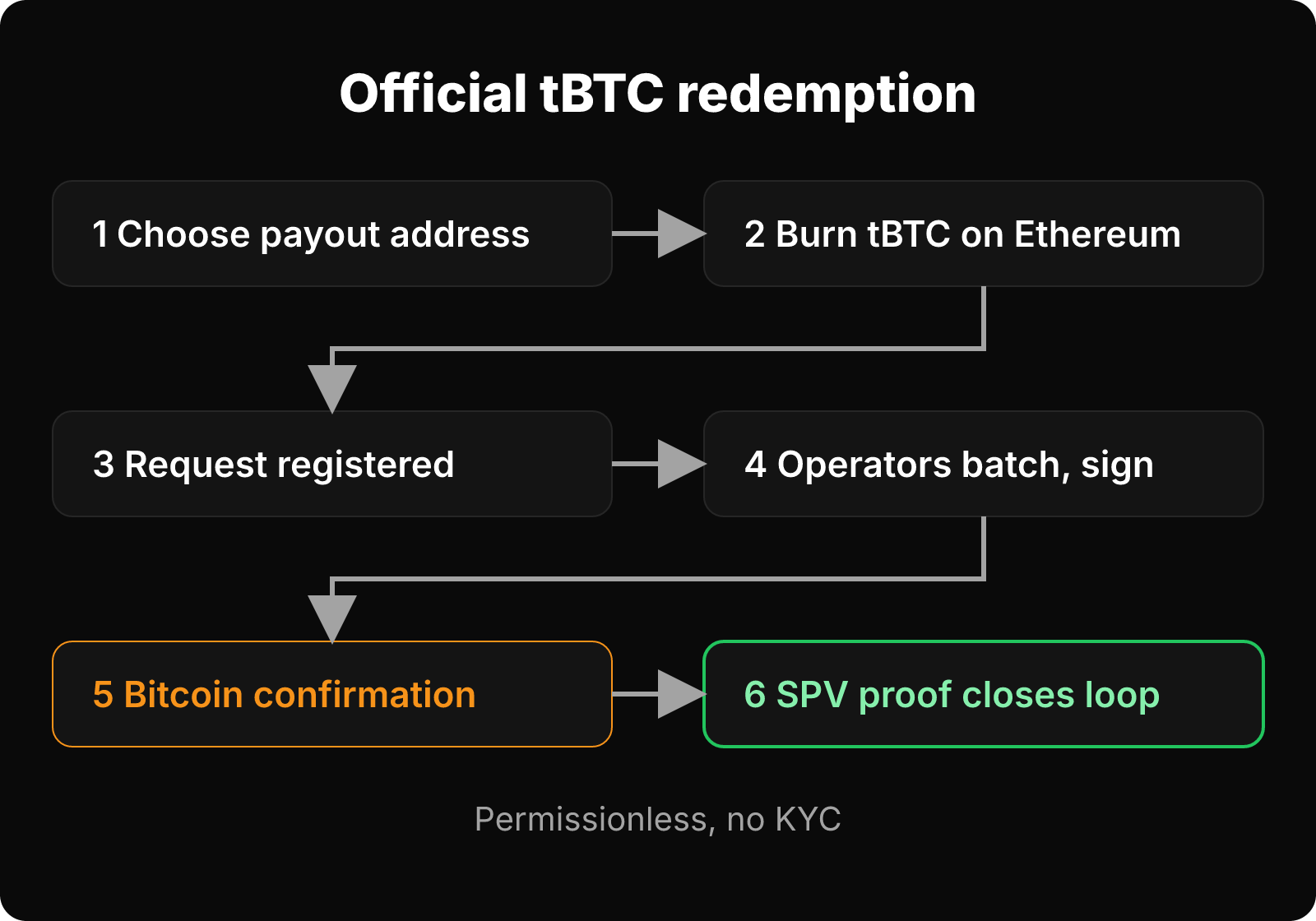
- Choose the payout address and amount. You give a Bitcoin address you control. The Bridge stores the redeemer output script (the locking script of your address), so it only accepts standard script types. Historically those were P2PKH, P2WPKH, P2SH, and P2WSH. Confirm whether Taproot (P2TR) addresses are accepted before you use one. [VERIFY]
- Burn tBTC on Ethereum. The app calls
approveAndCallon the TBTC token, sending your tBTC to the vault with the redemption parameters encoded inextraData. The vault unmints the tokens and forwards the equivalent balance to the Bridge. - Redemption request is registered. The Bridge picks a target wallet with enough reserves, deducts the treasury fee, sets a maximum Bitcoin miner fee you can be charged, and emits a
RedemptionRequestedevent. The request is keyed to the wallet's public key hash plus your output script. - Operators batch and sign. The wallet's operator clients collect pending requests and build one Bitcoin transaction. It spends the wallet's main UTXO, pays each redeemer, and returns the change to the wallet as the new main UTXO. A threshold of signers then runs the signing protocol. Large redemptions may be split across several wallets, because each wallet holds only part of the reserves, as the Threshold blog notes.
- Bitcoin confirmation. The signed transaction is broadcast, enters the mempool, and confirms. Your native BTC has arrived at this point. It is spendable after confirmation, regardless of what happens on Ethereum.
- SPV proof closes the loop. A maintainer submits the transaction, its Merkle proof, and the headers to the Bridge, for example via
submitRedemptionProof. The Bridge checks the proof against the relay, marks the requests fulfilled, and updates the wallet's main UTXO.
What if the signers never pay?
If a request is not proven fulfilled within the redemption timeout window, anyone can call the timeout notification function. The redeemer's balance is returned, and the responsible wallet's operators face slashing of their staked T. The wallet is then pushed into a state where it must move its remaining funds to a new wallet. [VERIFY: current timeout length] This is the protocol's liveness backstop. It is also why redemption is permissionless: no merchant, account, or KYC is involved, as the tbtc.network FAQ confirms.
Redeeming tBTC held on an L2 or non-EVM chain
The Bitcoin reserves and the Bridge contract live on Ethereum. Before November 2025, tBTC on chains like Arbitrum or Base generally had to be bridged back to Ethereum before it could be redeemed. Threshold's November 2025 app update added "direct redemptions," and its newer router spans Bitcoin, Ethereum, Arbitrum, Base, Sui, and Starknet. Check in the app whether your chain supports a one-step redemption or still bridges behind the scenes, because that changes both gas and time.
What Does It Cost to Redeem tBTC, and How Long Does It Take?
A tBTC redemption has three cost components: a governance-set treasury fee, a share of the Bitcoin miner fee for the payout transaction, and gas for the request on the source chain. The Chainwire launch release says eligible T stakers have redemption fees waived automatically in the Threshold app.
| Cost / time component | Where it's charged | What sets it | Current value |
|---|---|---|---|
| Treasury (redemption) fee | Deducted from the redeemed amount | Threshold governance parameter | Check app quote [VERIFY]; waived for eligible T stakers |
| Bitcoin miner fee | Deducted from your BTC payout | Bitcoin fee market; capped per request by contract | Varies with mempool conditions |
| Source-chain gas | Paid by you in ETH (or L2 gas) | Network congestion | Varies |
| Minimum amount | Contract-level | Governance | Mint minimum is 0.01 BTC per tbtc.network; redemption minimum [VERIFY] |
| Time to native BTC | End to end | Wallet batching + signing + confirmations | Not published as a guarantee; commonly hours [VERIFY] |
Time is the part most people underestimate. Bitcoin block time averages ~10 minutes, but it is not what holds things up. Most of the wait comes from the operator wallet collecting requests into a batch and coordinating a 100-member signing group. For comparison, minting tBTC takes roughly 1–2 hours depending on Bitcoin confirmations, according to the tbtc.network FAQ. Treat a redemption as a process measured in hours, not minutes.
The fee structure also makes very small redemptions relatively expensive. A wallet's Bitcoin transaction pays miner fees per byte, and each redeemer output adds bytes, so a 0.005 BTC redemption carries roughly the same absolute miner-fee share as a 5 BTC one. That fee is a far larger percentage of the small redemption.
tBTC vs WBTC vs cbBTC vs TeleBTC: Trust Models Compared
The main difference between tBTC and WBTC is who controls the reserves. tBTC uses a rotating group of staked threshold signers, while WBTC is issued by BitGo and redemptions traditionally go through authorized merchants. The table below compares the four wrapped-BTC designs readers ask about most, using public descriptions from each project and from Eco's 2026 comparison.
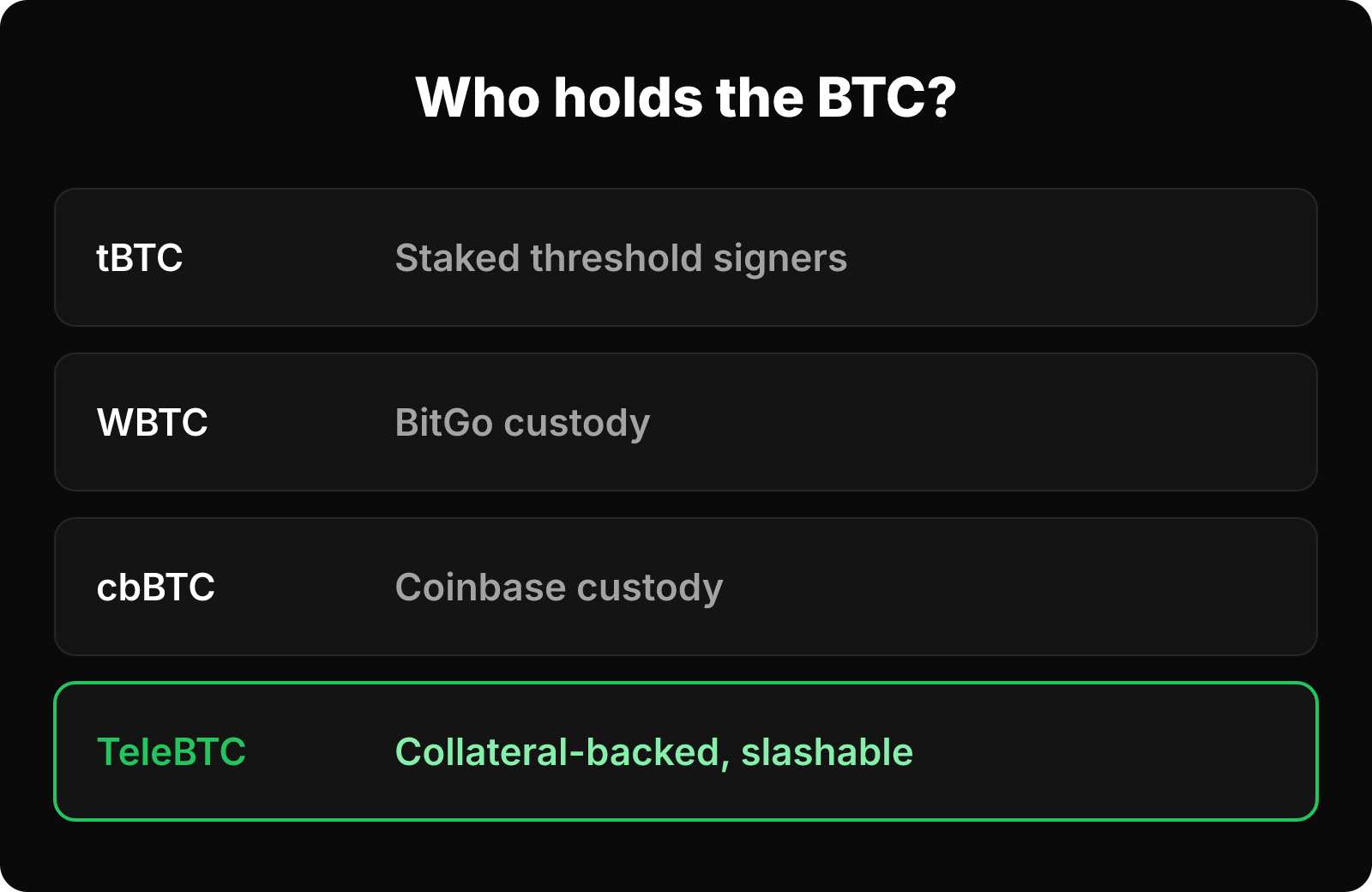
| Token | Who holds the BTC | How mint/redeem is verified | Redemption access | Native-BTC exit |
|---|---|---|---|---|
| tBTC | Threshold signer groups (51-of-100 per Threshold), staked T, slashable | SPV proofs checked against an on-chain Bitcoin relay | Permissionless, no KYC | Burn → threshold-signed BTC payout; hours |
| WBTC | BitGo custody | Custodian attestation | Via authorized merchants [VERIFY current process] | Merchant redemption, or swap out |
| cbBTC | Coinbase custody | Custodian attestation | Through Coinbase | Coinbase account, or swap out |
| TeleBTC | Collateral-backed, slashable custody; trust-minimized, no custodian or multisig committee | SPV light client proofs; nothing minted without a verified Bitcoin transaction | Permissionless | Swap any supported token → native BTC through TeleSwap |
Our view is that tBTC and TeleBTC both have strong redemption guarantees, but the thing that sets the price you actually get when exiting is secondary-market liquidity. CryptoRank notes that tBTC trades on markets such as Kraken, where its price can drift from BTC. Redemption is the arbitrage anchor that pulls the price back. Most holders never redeem directly, though. They exit through whichever wrapped-BTC pair has the deepest liquidity on their chain, and that is why the swap route below matters.
The Swap Route: Convert tBTC to Bitcoin via TeleSwap
TeleSwap is a non-custodial Bitcoin bridge that uses SPV light client proofs to move value between Bitcoin and EVM, TON, and Solana chains, and it can settle supported tokens back to native BTC in one flow. TeleSwap does not list a direct tBTC pair. The practical route is to swap tBTC into a liquid asset TeleSwap supports, then use TeleSwap to settle to a Bitcoin address. In practice, this is how most cross-chain users already exit wrapped BTC, because DEX pools for tBTC/WBTC and tBTC/ETH are usually where the liquidity sits.
Usage figures matter when you pick an exit route. According to TeleSwap network stats (retrieved 2026-11-05), TeleSwap has bridged $546,496,582 across 578,062 transactions on 13 supported networks. Over the last 30 days it handled $40.9M, averaging ~$1.4M per day, with a peak of $2.1M on 2026-10-08.
Walkthrough: 0.25 tBTC on Ethereum → native BTC
- Check the tBTC pool depth. Get a quote for tBTC → WBTC, tBTC → cbBTC, and tBTC → ETH on a DEX aggregator. Pick the route with the lowest price impact. For BTC-denominated pairs it is often close to 1:1 minus the pool fee.
- Swap tBTC into that asset. One Ethereum transaction.
- Open the matching TeleSwap route. Use WBTC (Ethereum) → BTC, cbBTC (Ethereum) → BTC, or ETH → BTC.
- Enter your Bitcoin address and review the quote. TeleSwap's estimate API returns the fee breakdown in Bitcoin terms, as described in the fees and speed documentation, so you see what arrives in BTC before you sign.
- Sign once and track. On the protocol side, the input is routed through the AMM into TeleBTC, the TeleBTC is burned, and native BTC is paid out to your address by the protocol's collateral-backed, slashable custody. TeleSwap's fast swaps settle in ~10 minutes.
If you already work inside another app, TeleSwap is integrated as a Bitcoin swap provider in the Rango, Rubic, and DZap aggregators. Through the Rango integration it is also available in MetaMask and Trust Wallet. Developers can use the TeleSwap SDK, which wraps the REST API, to get a quote programmatically. Integrators can register a third-party ID to earn a share of fees on the volume they bring.
Once you hold native BTC, you can also put it to work without wrapping it again. TeleSwap lets you deposit native BTC straight from a Bitcoin wallet into the TeleBTC pools in a single Bitcoin transaction, and depositors earn a share of swap fees paid in BTC. This has been live since 2026-10-14; see Earn BTC in the TeleSwap docs. Returns depend on swap volume and are not guaranteed.
Which Exit Path Should You Use?
Redeem directly if you hold a large amount, can wait hours, and want an exact 1:1 burn with no market exposure. Swap out if the amount is small or mid-sized, time matters, or your tBTC sits on a chain where redemption would need extra bridging.
| Scenario | Better path | Why |
|---|---|---|
| Multi-BTC position, no rush | Official tBTC redemption | Exactly 1:1 minus fees; no slippage on a large size |
| You stake T and qualify for the fee waiver | Official tBTC redemption | Treasury fee waived, per Threshold's app release |
| Small amount (miner fee would be a large %) | Swap + TeleSwap | Pool fee is proportional; quote shown in BTC terms upfront |
| Need BTC within the hour | Swap + TeleSwap | No wallet batching or threshold signing wait; fast swaps ~10 min |
| tBTC trading at a discount to BTC | Official redemption | Redemption captures the full 1:1 value |
| tBTC trading at a premium | Swap out | The market pays more than redemption |
Check the market price before you commit to either path. A tBTC discount of even 0.3% on a large position is worth waiting hours to redeem. A premium means redeeming is the worse choice.
Frequently Asked Questions
How do I convert tBTC to BTC?
You either burn tBTC through Threshold's redemption flow, which pays native BTC to your Bitcoin address, or swap tBTC into a liquid asset and settle to BTC through a bridge like TeleSwap. Redemption gives an exact 1:1 amount minus fees and takes hours. The swap route depends on pool pricing but avoids the signing and batching wait.
Do I need KYC to redeem tBTC?
No. tBTC redemption is permissionless. According to the tbtc.network FAQ, there is no authorized merchant, account, or identity check. You burn tBTC and supply a Bitcoin address you control.
How long does it take to redeem tBTC?
Plan on hours, not minutes. The operator wallet has to batch requests, run a threshold signing round among its signers, and broadcast a Bitcoin transaction that then needs to confirm. Threshold does not publish a guaranteed completion time, and if a request times out, the redeemer is reimbursed and the operators can be slashed.
What is the difference between tBTC vs WBTC?
tBTC reserves are controlled by rotating groups of staked threshold signers, while WBTC reserves are held by BitGo. tBTC redemption is permissionless. WBTC redemption has traditionally gone through authorized merchants, so most retail holders exit WBTC by swapping rather than redeeming.
Can I redeem tBTC from Arbitrum, Base, or Sui?
Threshold says direct redemptions shipped in its app in November 2025, and its router covers Arbitrum, Base, Sui, and Starknet. The Bridge contract and BTC reserves are anchored on Ethereum, so check in the app whether your chain redeems in one step or bridges behind the scenes. That affects gas and timing.
Does TeleSwap support tBTC directly?
TeleSwap does not list a direct tBTC pair, but you can swap tBTC into WBTC, cbBTC, or ETH and use TeleSwap to settle to native BTC. TeleSwap verifies Bitcoin transactions with SPV light client proofs, shows fees in Bitcoin terms before you sign, and its fast swaps settle in ~10 minutes. Per TeleSwap network stats, it has processed 578,062 bridge transactions to date.
Is the 51-of-100 signer threshold a simple majority?
Yes. 51 of 100 is a simple majority, which is how Threshold's own launch release describes the model. A third-party comparison from Eco describes signing as "typically a supermajority," so check the current wallet parameters in Threshold's documentation if the exact threshold matters for your risk model.
Conclusion
Getting from tBTC to BTC works because of three pieces: threshold wallets held by staked operators, a Bridge contract that tracks redemption requests, and SPV proofs that confirm the payout happened. Direct redemption is permissionless and exactly 1:1, and it is the best choice for large positions or when tBTC trades at a discount. It also takes hours and carries a fixed miner-fee component, which hits small amounts hardest.
When speed matters or the amount is modest, swap into a liquid wrapped-BTC or ETH pair and settle through TeleSwap. Its light client verifies every Bitcoin transaction, fees are quoted in BTC upfront, and the route has handled $546.5M in volume according to TeleSwap network stats.