USDG to BTC: Swap Robinhood Chain USDG for Native Bitcoin

To swap USDG to BTC, connect an EVM wallet on Robinhood Chain to TeleSwap, enter a Bitcoin address, and confirm the swap. Native BTC arrives at your own address, and TeleSwap's fast swaps settle in about 10 minutes.
This guide covers the USDG to BTC route from Robinhood Chain to Bitcoin. You'll know what each screen shows, where the fees come from, how long each stage takes, and what to do when something goes wrong. If you're new to crypto, we explain each idea before we use it.
Key Takeaways:USDG (Global Dollar) is a US-dollar stablecoin issued by Paxos and is the native stablecoin of Robinhood Chain.A USDG to BTC swap on TeleSwap happens in one flow: your USDG is swapped into TeleBTC on Robinhood Chain, and that TeleBTC is redeemed for native BTC sent to your Bitcoin address.TeleBTC is backed 1:1 by real BTC and verified by an SPV light client, so the bridge doesn't depend on a centralized custodian or a multi-sig committee.Your total cost has four parts: Robinhood Chain gas, the DEX swap, the bridge fee, and the Bitcoin network fee. The number to compare across providers is the amount of BTC you actually receive.As of 2026-11-03, TeleSwap had processed $542.6M in volume across 574,559 bridge transactions, according to TeleSwap network stats.
Table of Contents
- What is USDG, and why is it on Robinhood Chain?
- How does a USDG to BTC swap actually work?
- What you need before you swap USDG to Bitcoin
- Step by step: USDG Robinhood Chain to BTC on TeleSwap
- What does it cost, and how long does it take?
- USDG stablecoin to native BTC: comparing your options
- Common problems and how to fix them
- Frequently Asked Questions
- Conclusion
What is USDG, and why is it on Robinhood Chain?
USDG, short for "Global Dollar," is a stablecoin: a token designed to stay worth one US dollar. It's issued by Paxos, a regulated financial institution. Paxos describes it as fully backed and redeemable 1:1 for US dollars; check Paxos's own disclosures for reserve details.
Think of a stablecoin as a casino chip that always cashes out for exactly $1. It's useful for moving value around on a blockchain, but it is not meant to be worth more than a dollar.
USDG is described as the native stablecoin of Robinhood Chain, and Robinhood's official contract list is in the Robinhood Chain documentation. TrustSwap reports that the chain held roughly $575M in stablecoins in early August 2026, mostly USDG, according to its Robinhood USDG guide. That figure comes from a single secondary source.
So why leave a stable dollar for a volatile asset? People usually want to hold BTC in self-custody, take profits back to the base layer, or pay someone in BTC. The reason doesn't change the route, but it should change how carefully you check the destination address.
How does a USDG to BTC swap actually work?
USDG lives on Robinhood Chain and BTC lives on Bitcoin, and those two blockchains can't read each other directly. A cross-chain swap needs something in the middle that one side can trust about the other. Where that trust sits is the real difference between providers.
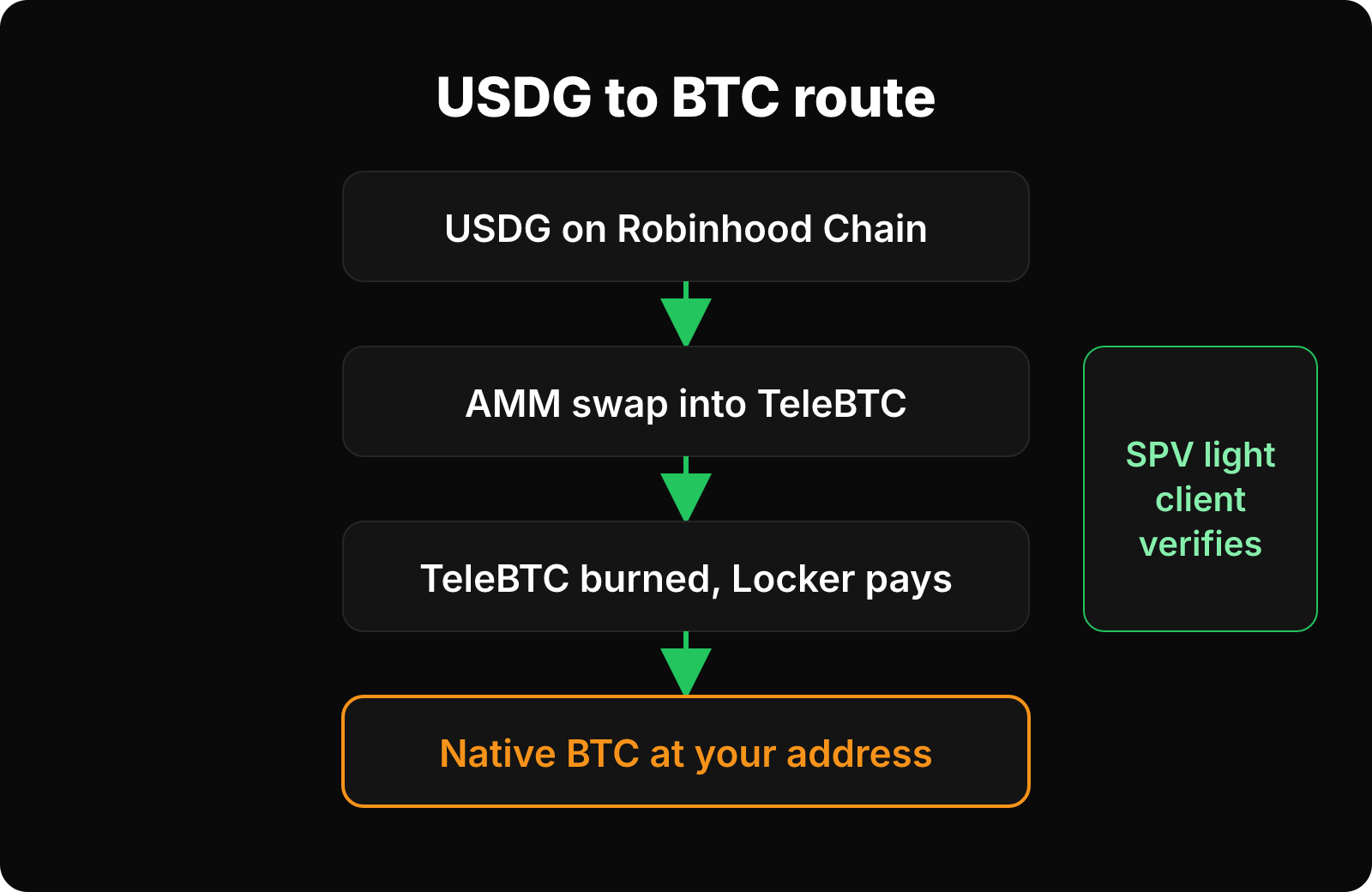
TeleSwap's route has two legs that you approve as a single action:
- Swap leg (on Robinhood Chain): Your USDG goes through an automated market maker (AMM), which is a smart-contract exchange that prices trades from a pool of tokens. There it's swapped into TeleBTC.
- Bridge leg (Robinhood Chain → Bitcoin): That TeleBTC is burned (destroyed) on Robinhood Chain, and the equivalent native BTC is sent to the Bitcoin address you entered. The BTC comes from a Locker, a collateral-backed operator that holds the BTC behind TeleBTC, as described in the TeleSwap documentation.
TeleBTC is a 1:1, collateral-backed representation of BTC, and nothing is minted without a verified Bitcoin transaction. The check is done by an SPV light client, a compact on-chain verifier that confirms Bitcoin transactions using block headers and Merkle proofs. This is the "Simplified Payment Verification" method from section 8 of the Bitcoin whitepaper. Lockers post collateral that can be slashed, meaning taken away, if they misbehave. For more, see how Bitcoin bridges work with SPV light clients.
On the exit direction (stablecoin → BTC), you don't hold TeleBTC for months. It exists only between the swap and the redemption, and you end up holding plain bitcoin.
What you need before you swap USDG to Bitcoin
Collect these five things before you open the swap page. It prevents most of the problems in the troubleshooting section below.
- An EVM wallet with Robinhood Chain added. MetaMask works, and so do other browser or mobile EVM wallets. "EVM" means the wallet speaks the same language as Ethereum and chains built like it.
- USDG on Robinhood Chain. Make sure it's the real token. Copycat USDG tokens exist, so check the contract address against Robinhood's official contract list.
- A small amount of the gas token on Robinhood Chain. Check the wallet's network settings for which token the chain uses for gas. You'll sign two transactions at most: an approval and the swap.
- A Bitcoin address you control. Use a hardware wallet or a reputable self-custody wallet. Avoid exchange deposit addresses where you can. Most use the native SegWit format that starts with
bc1. - About 15–30 minutes. Most of that is waiting for Bitcoin blocks, not clicking.
Step by step: USDG Robinhood Chain to BTC on TeleSwap
Here's the full route on TeleSwap. For each step we cover what you'll see, what it costs, and how long it takes. The direct page for this pair is swap USDG to BTC on TeleSwap.
Step 1: Open the USDG → BTC page and connect your wallet
What you'll see: A swap form with Robinhood Chain USDG as the "from" asset and Bitcoin BTC as the "to" asset, plus a "Connect wallet" button. Approve the connection in your wallet pop-up. If your wallet is on a different network, it will ask to switch to Robinhood Chain.
Cost: Free. Connecting doesn't send a transaction.
Time: Under a minute.
Step 2: Enter the USDG amount and read the quote
What you'll see: Type how much USDG you want to swap. The form then shows an estimate of the BTC you'll receive, with the fees and estimated time.
Cost: Free to view.
Time: A few seconds. The quote refreshes as the price moves.
Read the "you receive" figure, not the fee line. You'll use it to compare against any other provider.
Step 3: Paste your Bitcoin receiving address
What you'll see: A destination address field. Paste your BTC address, then check the first four and last four characters against your wallet. Clipboard-hijacking malware is a real threat, and Bitcoin transactions can't be reversed.
Cost: Free.
Time: 30 seconds. Take longer if you're double-checking, and you should be.
Step 4: Approve USDG spending (first time only)
What you'll see: An "Approve" button, then a wallet pop-up asking you to let the TeleSwap contract move your USDG. This is a standard ERC-20 approval. It gives a smart contract permission to move a token. It doesn't send any funds by itself.
Cost: A small Robinhood Chain gas fee.
Time: Usually seconds.
Step 5: Confirm the swap
What you'll see: A final summary showing the amount in, the estimated BTC out, and your destination address. Then a wallet pop-up to sign the transaction.
Cost: One more Robinhood Chain gas fee. The swap, bridge, and Bitcoin payout fees are reflected in your quote.
Time: Seconds to confirm on Robinhood Chain.
Step 6: Track the swap until BTC arrives
What you'll see: A status view that moves through the stages: swap confirmed on Robinhood Chain, TeleBTC burned, and BTC sent. When the BTC transaction is broadcast, you can paste its transaction ID into a block explorer like mempool.space and watch it confirm.
Cost: Nothing more.
Time: TeleSwap's fast swaps settle in about 10 minutes. The Bitcoin leg depends on block times, which average about 10 minutes, and on how busy the mempool is.
Delays usually come from the Bitcoin leg, not from Robinhood Chain. A fee spike in the Bitcoin mempool slows confirmations for everyone, whichever bridge you use.
What does it cost, and how long does it take?
A USDG to BTC swap has four cost parts, and the quote screen combines them into one "you receive" figure. Here's where each one comes from:
| Cost component | Where it's paid | What drives it | Typical time |
|---|---|---|---|
| Approval gas | Robinhood Chain | Gas price; only on your first swap | Seconds |
| Swap gas | Robinhood Chain | Gas price | Seconds |
| DEX price impact | Inside the quote | Trade size compared with pool liquidity | Same transaction |
| Bridge + Bitcoin network fee | Inside the quote | Protocol fee and current Bitcoin fee rates (mempool.space) | ~10 min for fast swaps; longer when Bitcoin is congested |
A worked example with real October 2026 rates
Swapspace listed 200 USDG = 0.00254373 BTC on November 1, 2026, a rate of about 0.0000127 BTC per USDG, according to its USDG/BTC converter. At that rate, 1,000 USDG would be worth about 0.0127 BTC before fees. Your actual output will be lower after the costs in the table, and you see the exact figure in Step 2 before you sign anything.
Don't plan around a rate you read in an article, including this one. Between October 18 and 24, 2026, the USDG/BTC rate moved between 0.00001190 and 0.00001238 BTC per USDG, according to CoinGecko's USDG/BTC data. That swing comes from bitcoin's price moving, not from USDG losing its dollar peg. Once your swap settles, you hold that volatility yourself.
Swap size affects price impact more than speed, since Bitcoin confirms blocks, not dollar amounts.
USDG stablecoin to native BTC: comparing your options
TeleSwap is not the only way to get from USDG to bitcoin. Here's how four routes compare. Provider descriptions come from their own public materials.
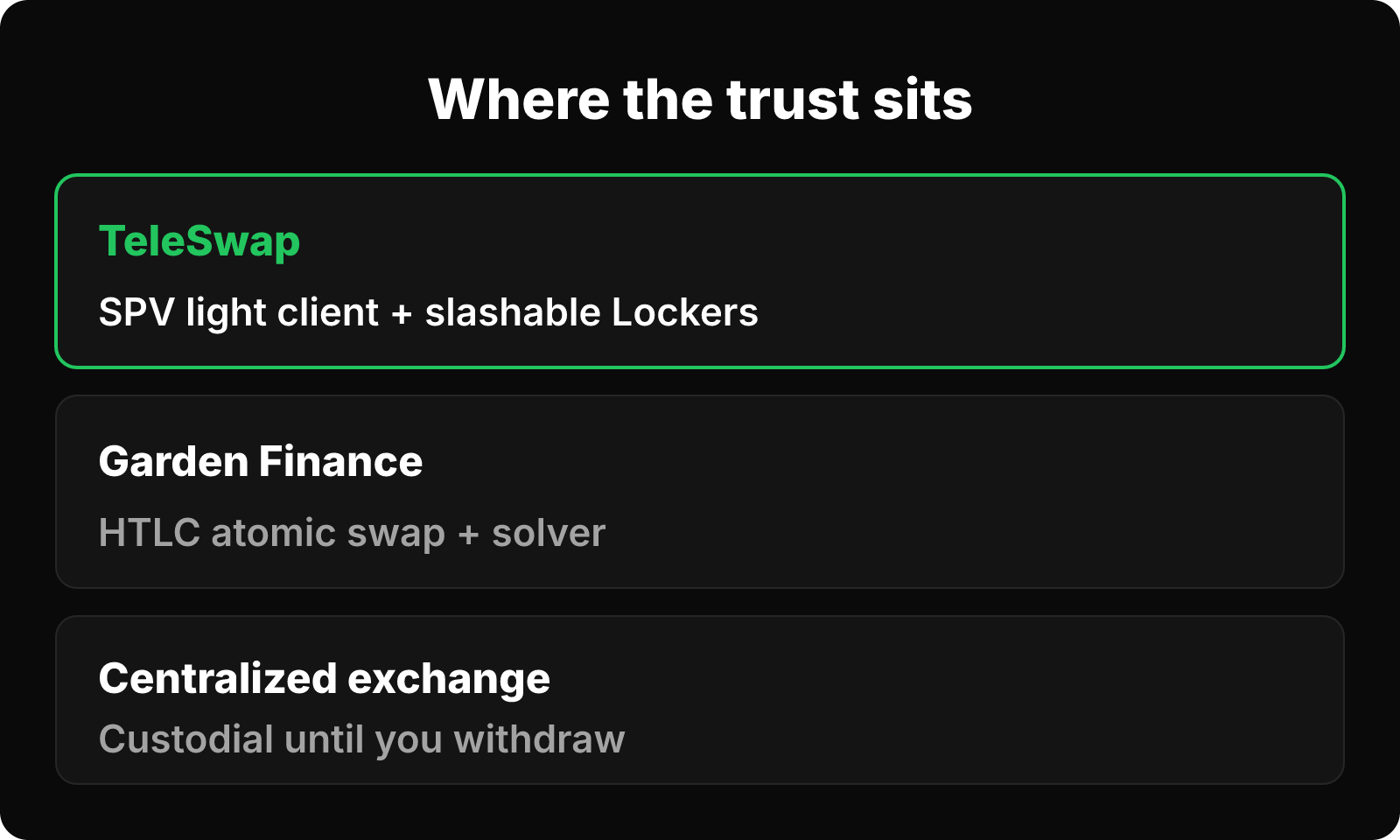
| Route | What you receive | Trust model | Account needed? | Notes |
|---|---|---|---|---|
| TeleSwap | Native BTC at your own address | SPV light-client verification; collateral-backed, slashable Lockers | No. Connect a wallet | One flow from USDG to BTC; also available inside Rango, Rubic and DZap |
| Garden Finance | Native BTC | HTLC atomic swap with a solver as counterparty, per Garden's blog | Wallet connection | Swaps complete in full or refund through a timelock, per Garden |
| SideShift | BTC to the address you paste | Exchange-style: you send to a deposit address (SideShift route page) | Not stated on route page | Check the custody terms before you send |
| Centralized exchange | BTC in your exchange account | Custodial until you withdraw | Typically yes, with KYC | Extra withdrawal step and fee to reach self-custody |
If your goal is BTC in your own wallet with no account in between, the choice comes down to TeleSwap or an atomic-swap provider. They put the trust in different places. In an atomic swap you rely on a solver providing liquidity. With TeleSwap you rely on Bitcoin's proof-of-work, checked by a light client, plus collateral behind each Locker. For a deeper look, read Garden Finance vs TeleSwap.
TeleBTC also differs from other wrapped bitcoin. WBTC and cbBTC rely on custodians holding the BTC. TeleBTC is the trust-minimized alternative: it inherits Bitcoin's security model directly through SPV proofs, and custody is collateral-backed and slashable. See WBTC bridge custody risk vs trustless bridges.
As of 2026-11-03, TeleSwap network stats show $542.6M in total volume bridged across 574,559 transactions on 13 supported networks. Volume over the past 30 days was $40.1M, about $1.3M per day, with a peak of $2.1M on 2026-10-08.
Common problems and how to fix them
Most failed or stuck swaps come from a short list of causes. Here they are, with fixes:
- "My wallet doesn't show Robinhood Chain." Add the network to your wallet using the details in the Robinhood Chain docs, then reload the swap page.
- "I have USDG but the transaction fails." You're likely out of gas. Add a small amount of the chain's gas token to the same wallet and try again.
- "My USDG balance shows 0 on the swap page." You might hold a copycat token. Compare the token contract in your wallet with Robinhood's official list. If they don't match, the token isn't real USDG.
- "The approval went through but nothing happened." Approval and swap are two separate transactions. Go back to the form and click confirm to sign the second one.
- "The quote changed before I confirmed." The BTC price moved. Quotes refresh, so read the new "you receive" figure and confirm it if you're happy with it.
- "It's been 30+ minutes and no BTC." Look up the BTC transaction ID on mempool.space. If it's waiting in the mempool, Bitcoin is congested and it should confirm as fees clear. If no BTC transaction exists yet, check the status view and contact TeleSwap support with your Robinhood Chain transaction hash.
- "I pasted the wrong Bitcoin address." If you haven't confirmed yet, fix it. If you already have, no bridge can reverse a Bitcoin payment. That's why Step 3 tells you to check the address twice.
Frequently Asked Questions
Can I swap USDG to BTC directly without a centralized exchange?
Yes. TeleSwap lets you swap USDG on Robinhood Chain into native BTC at your own Bitcoin address, with no exchange account. You connect an EVM wallet, sign the swap, and the BTC is sent to the address you enter.
How long does a USDG to BTC swap take?
TeleSwap's fast swaps settle in about 10 minutes. The Robinhood Chain transactions confirm quickly. The rest of the time is the Bitcoin leg, which can take longer when the Bitcoin mempool is congested.
What fees will I pay to swap USDG to Bitcoin?
You pay Robinhood Chain gas for the approval and swap, plus DEX price impact, a bridge fee, and the Bitcoin network fee. The last three are reflected in the quote, so the "you receive" figure shown before you sign is the BTC you should expect, adjusted for any price movement before you confirm.
Is USDG the same as USDC or USDT?
No. USDG is a separate dollar stablecoin issued by Paxos. It aims for the same $1 value, but it has a different issuer and reserves. On Robinhood Chain, USDG is the native stablecoin.
Do I receive wrapped bitcoin or real BTC?
You receive native BTC on the Bitcoin blockchain. TeleBTC appears briefly inside the route on Robinhood Chain, but it's burned and redeemed for real BTC sent to your address. You end up with no wrapped token.
Is TeleSwap custodial?
No. TeleSwap verifies Bitcoin transactions with an SPV light client rather than a custodian. The BTC behind TeleBTC is held by Lockers who post slashable collateral, so the system doesn't rely on a single custodian or a multi-sig committee. Details are in the TeleSwap documentation.
Can I go the other way, from BTC to USDG?
Yes. TeleSwap supports the reverse route from native BTC to USDG on Robinhood Chain. You send one Bitcoin transaction and receive USDG on Robinhood Chain. A Teleporter covers the destination-chain gas, so you don't need gas tokens there first. Use the BTC to USDG route page.
Conclusion
Going from USDG to BTC doesn't require an exchange account or a wrapped token you have to keep trusting. Check that your USDG is the real token, keep a little gas in your wallet, and check your Bitcoin address twice. After that, it's six steps and roughly a 10-minute wait for a fast swap.
Compare providers on the BTC you receive, not on the advertised fee. Delays nearly always come from the Bitcoin leg. And with TeleSwap, the wrapped step lasts only minutes and is verified through SPV proofs, so you finish with native BTC in self-custody.
Ready to move your Robinhood Chain dollars to the base layer?
This article is educational and not financial advice. Converting a stablecoin to BTC exposes you to bitcoin's price volatility.