Earn Yield on Bitcoin Natively: No Impermanent Loss (2026)

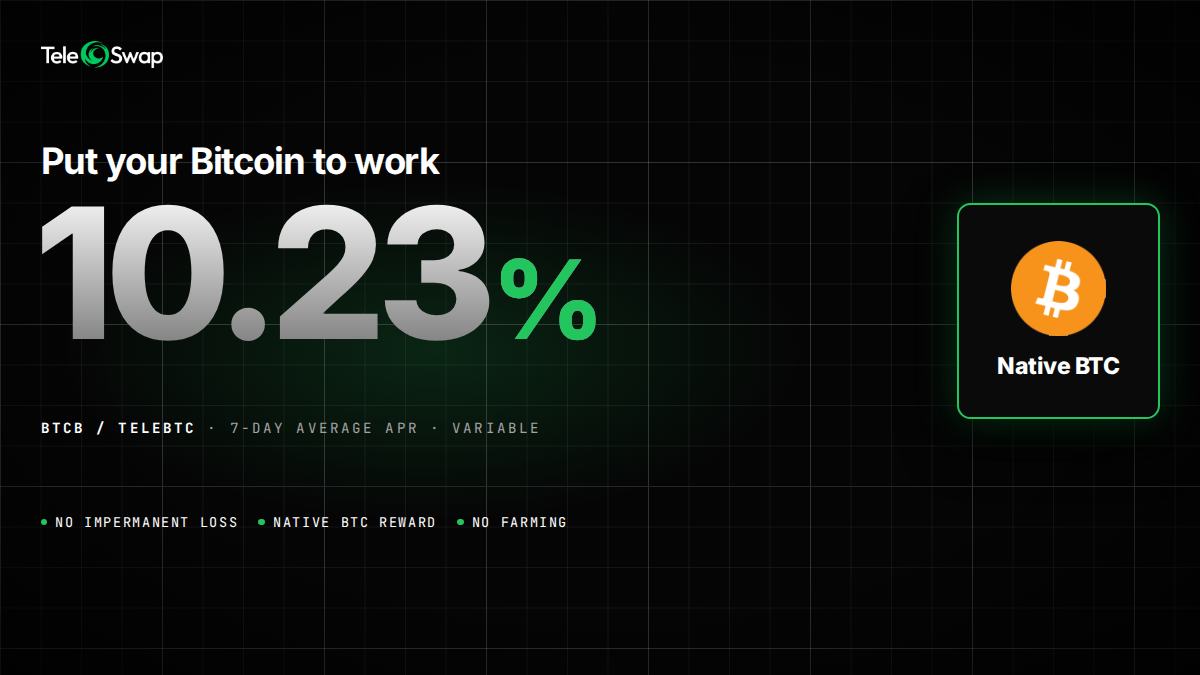
You can earn yield on Bitcoin without leaving your Bitcoin wallet. TeleSwap's native BTC Earn takes one Bitcoin transaction and pays swap-fee yield in BTC from TeleBTC pools. Most guides start differently: you wrap your BTC, approve a contract from an EVM wallet you had to fund with gas, and put the result in a pool.
This article explains at the protocol level how native BTC can earn swap-fee yield paid in BTC. You need no EVM wallet. The pools pair TeleBTC with another BTC-pegged asset, so the impermanent-loss term stays near zero while the pegs hold. We cover SPV verification, Locker collateral, constant-product math and the exact fee schedule, so you can judge the design yourself.
Key Takeaways:TeleSwap's native BTC Earn has been live since October 14, 2026, and lets you deposit BTC into its TeleBTC pools with a single Bitcoin transaction, with no EVM wallet, gas or token approval.The pools pair TeleBTC with WBTC on Polygon and BTCB on BNB Smart Chain, so both sides track 1 BTC and the constant-product impermanent-loss term stays near zero while the pegs hold.The yield comes from fees on swaps routed through the pool, not from token emissions or farming, and it is paid out in BTC to your Bitcoin address.As of November 3, 2026, the 7-day average pool APR was 9.27% for WBTC/TeleBTC on Polygon and 14.6% for BTCB/TeleBTC on BNB Smart Chain, according to TeleSwap's liquidity page; both rates change over time.A native BTC deposit costs a 0.1% locker fee, a 0% protocol fee and a 600-sat network fee plus the Bitcoin miner fee, and the first deposit must be at least 0.0001 BTC.
Table of Contents
- What does "native Bitcoin yield" actually mean?
- How do you earn yield on Bitcoin without a custodian?
- Under the hood: SPV proofs, Lockers and TeleBTC
- Why a BTC/BTC pair has no impermanent loss (the math)
- Native BTC yield options compared
- What about WBTC staking yield?
- Walkthrough: depositing native BTC on TeleSwap
- Fee math: when does a deposit make sense?
- Risks that remain
- Frequently Asked Questions
- Conclusion
What does "native Bitcoin yield" actually mean?
A yield product is native-BTC when it meets three tests:
- Entry: you fund it with an ordinary Bitcoin L1 transaction from a wallet you control.
- Exit: principal and rewards come back as L1 BTC to a Bitcoin address.
- Denomination: the yield is paid in BTC, not in a governance token, points or a stablecoin.
Few products pass all three. Hermetica's hBTC vault on Stacks takes native BTC and returns native BTC, but in between it converts your BTC to sBTC, borrows against it and stakes a synthetic dollar for funding-rate yield. The Stacks Bitcoin yield guide advertises that vault at "up to 8% APY (variable, not guaranteed)." Stacks also says its own BTC-paid yield model is still in development.
Babylon uses timelocked BTC outputs for entry. It describes its direction as "programmable native Bitcoin collateral," as quoted by this BTCfi strategies overview (April 23, 2026).
Our view: the denomination test matters most. If you hold Bitcoin because you want more Bitcoin, a yield paid in a token that loses value against BTC can leave you behind, whatever the dashboard shows.
How do you earn yield on Bitcoin without a custodian?
You earn from a fee source that already exists, and you run the custody step through a verifiable, collateralized mechanism instead of a trusted company. TeleSwap's Earn product works this way.
TeleSwap lets you bridge, swap and earn on Bitcoin. It moves BTC to EVM chains, TON and Solana by minting TeleBTC, a token backed 1:1 by BTC. TeleBTC is minted only after an SPV light client on the destination chain has verified the Bitcoin deposit, with no multisig committee or corporate custodian. TeleSwap has processed $542.6M in total volume across 574,559 bridge transactions on 13 supported networks, including $40.1M in the last 30 days, per TeleSwap network stats (retrieved November 3, 2026).
Those swaps need liquidity, and the Earn product lets you supply it. Swaps routed through a TeleBTC pool pay fees to its liquidity providers. This is single-sided liquidity in the pools, not protocol staking:
- Single-sided liquidity: you supply only BTC. You never need to source the other asset.
- Real yield: rewards come from swap fees paid by users, not from token emissions or farming.
- BTC-denominated payouts: rewards are paid in BTC, and native depositors claim them to a Bitcoin address.
On November 3, 2026, the TeleSwap liquidity page showed these 7-day average APRs:
| Pool | Chain | 7-day avg APR (Nov 3, 2026) | Native BTC deposit? | EVM deposit asset |
|---|---|---|---|---|
| WBTC / TeleBTC | Polygon | 9.27% (variable) | Yes | WBTC |
| BTCB / TeleBTC | BNB Smart Chain | 14.6% (variable) | Yes | BTCB |
These rates follow swap volume. If routing activity drops, so does the APR. Treat them as a record of recent pool performance, not a forecast.
Under the hood: SPV proofs, Lockers and TeleBTC
To trust a yield position, you first have to trust the asset inside it. Here is how a Bitcoin payment becomes TeleBTC without a custodian vouching for it. For more depth, see how Bitcoin bridges work with SPV light clients.
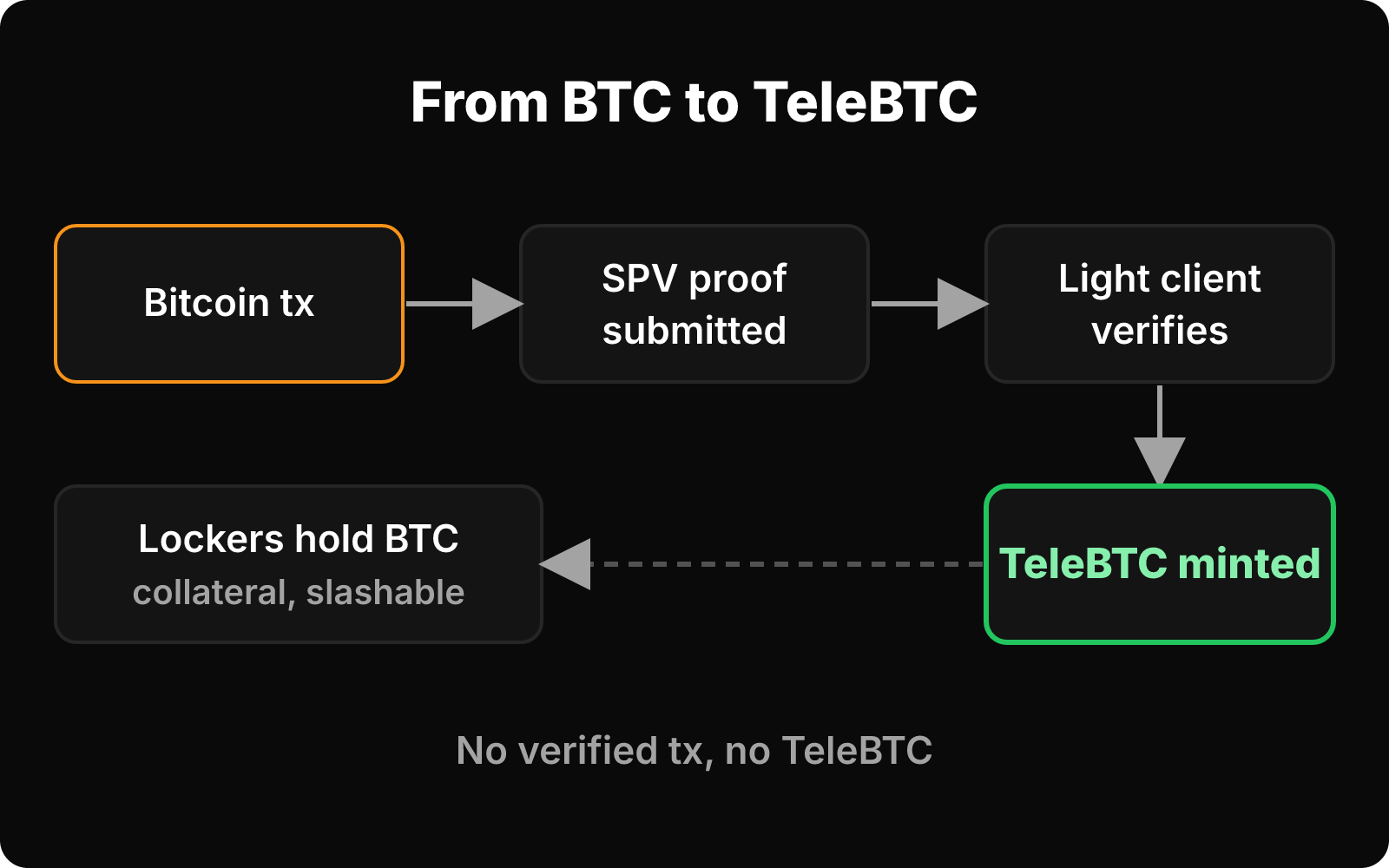
Simplified Payment Verification (SPV)
SPV is the light-client method from Section 8 of the Bitcoin whitepaper. A verifier stores only 80-byte block headers, not full blocks. Each header contains:
- the hash of the previous header, which links headers into a chain;
- a Merkle root committing to every transaction in the block;
- the
nBitsdifficulty target, a timestamp and a nonce.
A header is valid only if its double-SHA-256 hash is below the target encoded in nBits, so forging one means doing real proof-of-work. To prove inclusion, a prover supplies the transaction and a Merkle branch: the roughly log2(n) sibling hashes needed to rebuild the Merkle root. For a block with 4,000 transactions that is about 12 hashes. The verifier checks the result against a header it has already accepted, and checks that the header has enough confirmations.
The on-chain light client
TeleSwap runs this verifier as a smart contract on the destination chain. Relayers, one of the protocol's permissionless roles, keep it supplied with Bitcoin block headers. A mint request carries an SPV proof that the destination contract checks itself. No TeleBTC is minted without a verified Bitcoin transaction. See the TeleSwap documentation for the full component breakdown.
Lockers: collateral-backed, slashable custody
The BTC itself is held by Lockers, permissionless operators whose custody is collateral-backed and slashable. This is the key difference from WBTC (BitGo custody) or cbBTC (Coinbase custody), where the peg depends on a company. Here, it depends on proof-of-work verification plus economic penalties enforced on-chain. For more, read WBTC bridge custody risk vs trustless bridges.
Why a BTC/BTC pair has no impermanent loss (the math)
Impermanent loss (IL) is how much less an AMM liquidity position is worth than simply holding the same assets, caused by the pool rebalancing as relative prices move. In a constant-product pool (x · y = k), if the price ratio of the two assets changes by a factor r, the LP's value relative to holding is:
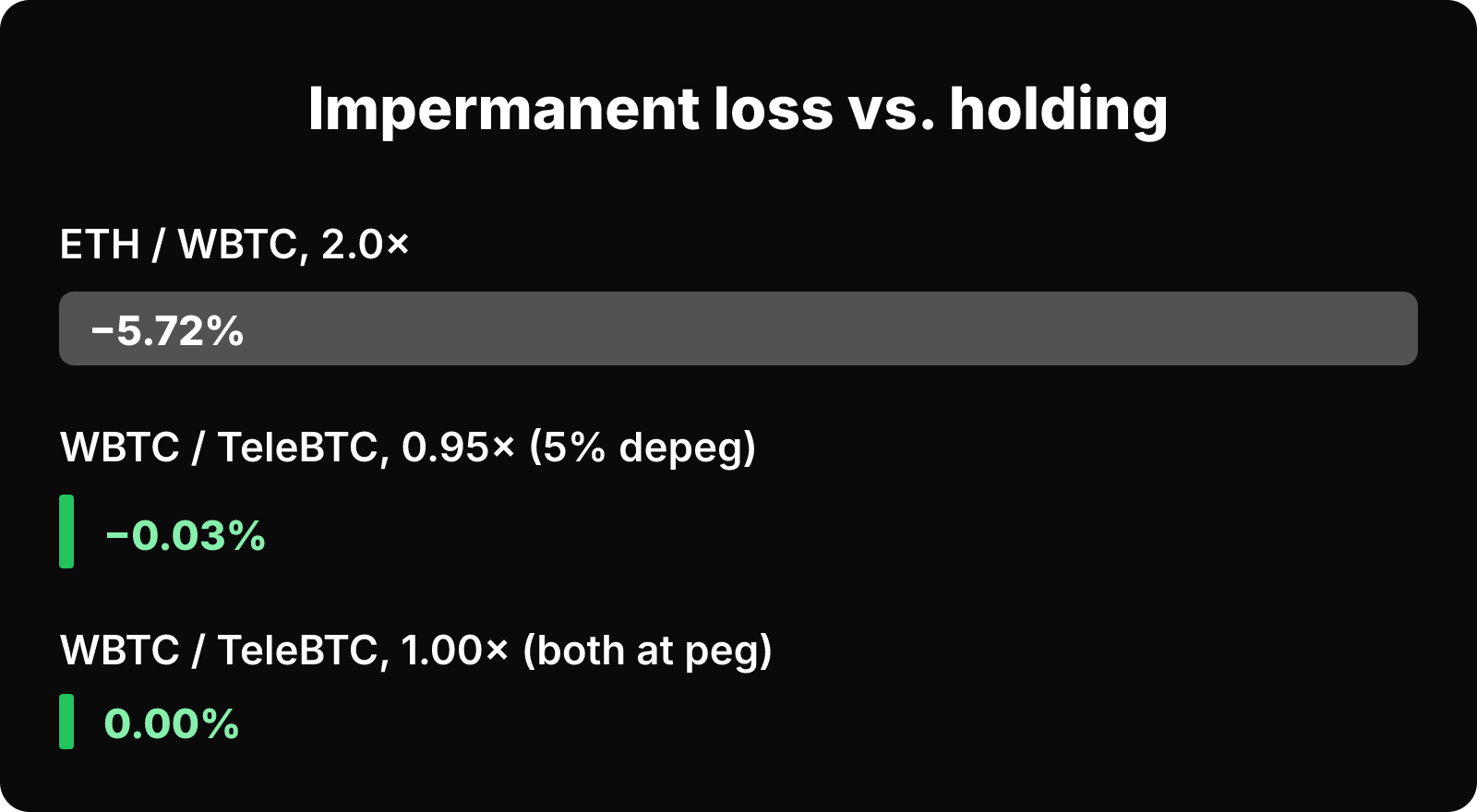
IL(r) = 2√r ⁄ (1 + r) − 1
This is the standard result covered in Uniswap's documentation on LP returns. Plug in some numbers:
| Pair | Relative price move (r) | Impermanent loss vs. holding |
|---|---|---|
| ETH / WBTC | 2.0× (ETH doubles vs. BTC) | −5.72% |
| ETH / WBTC | 0.5× (ETH halves vs. BTC) | −5.72% |
| WBTC / TeleBTC | 0.95× (5% depeg) | −0.03% |
| WBTC / TeleBTC | 0.99× (1% depeg) | −0.00% |
| WBTC / TeleBTC | 1.00× (both at peg) | 0.00% |
IL is a function of relative price, and in WBTC/TeleBTC or BTCB/TeleBTC both legs are claims on one bitcoin. Their ratio stays near 1, so the IL term stays near zero. Fees accrue on every swap either way.
One nuance: "no impermanent loss" is a result of the pair, not a guarantee of the protocol. A large, lasting depeg of one leg would cost you through the asset itself. That is why the backing of each leg matters more than the APR. Curve's StableSwap paper uses similar reasoning for pegged-asset pools.
Native BTC yield options compared
We compared six common ways to earn on Bitcoin in 2026. The labels draw on eco.com's 2026 BTCfi overview, the Stacks guide and TeleSwap's live data.
| Option | Enter with native BTC? | Custody model | Yield source | Paid in | IL exposure |
|---|---|---|---|---|---|
| TeleSwap native BTC Earn | Yes — one Bitcoin tx | SPV-verified, collateral-backed Lockers | Swap fees (real yield) | BTC | Near zero while pegs hold (BTC/BTC pair) |
| Babylon staking | Yes — timelocked output | Non-custodial timelock | Proof-of-stake security rewards | Varies by chain | None |
| Hermetica hBTC (Stacks) | Yes, via sBTC | sBTC peg + lending + synthetic dollar | Lending rewards + funding rates | BTC (advertised "up to 8%") | No AMM IL, but liquidation and funding-rate risk |
| Aave / Morpho WBTC lending | No — needs WBTC/cbBTC | BitGo / Coinbase custody | Borrower interest | WBTC/cbBTC | None |
| ETH/WBTC AMM LP | No | Custodial wrapper | Swap fees, sometimes plus emissions | Mixed | High (−5.7% at 2× move) |
| CeFi earn (e.g. GoMining Simple Earn) | Deposit to platform | Counterparty custody | Undisclosed | BTC (every 4 hours) | N/A |
GoMining's Simple Earn launched on February 10, 2026, according to its Chainwire release via Investing.com. The release does not say where the yield comes from, which makes the product hard to assess.
What the table shows: among these options, TeleSwap's native BTC Earn meets all three native tests (BTC in, BTC out, BTC-paid yield) and also uses a BTC/BTC pair with a fee-based yield source. Other products can beat it on a single dimension, such as advertised rate.
What about WBTC staking yield?
Strictly speaking, WBTC cannot be staked. It is an ERC-20 token with no consensus role. "WBTC staking yield" usually means lending WBTC on a money market or supplying it to an AMM pool.
If you already hold WBTC on Polygon or BTCB on BNB Smart Chain, you can deposit it directly into the matching TeleSwap pool from an EVM wallet and earn the same swap-fee yield. If your BTC is still on Bitcoin, skip the wrapper and deposit BTC directly. You can also bridge first, using the BTC to WBTC (Polygon) route or the BTC to BTCB (BNB Smart Chain) route. To unwrap later, see the WBTC to BTC guide.
Walkthrough: depositing native BTC on TeleSwap
Native BTC deposits went live on October 14, 2026. This is the first time TeleSwap users can earn on native Bitcoin without touching an EVM wallet. Here is the full flow:
- Open the Earn page. Go to teleswap.xyz/liquidity and choose native BTC as the deposit asset.
- Pick a pool. Choose WBTC/TeleBTC on Polygon or BTCB/TeleBTC on BNB Smart Chain. Compare the current 7-day APRs; both change.
- Enter an amount. Your first deposit must be at least 0.0001 BTC (10,000 sat).
- Sign one Bitcoin transaction. Send from your Bitcoin wallet. You need no EVM wallet, no gas token and no approval.
- Wait for processing. The app estimates about 30 minutes after you send the deposit.
- Accrue fees. Your position earns a share of fees from swaps routed through the pool.
- Claim or withdraw from Bitcoin. Both start with a Bitcoin request transaction (paying 600 sat to process). The BTC payout goes to your Bitcoin address.
Fee math: when does a deposit make sense?
The full native BTC fee schedule, per TeleSwap:
| Action | Fee |
|---|---|
| Deposit — locker fee | 0.1% |
| Deposit — protocol fee | 0% |
| Deposit — network fee | 0.000006 BTC (600 sat) + Bitcoin miner fee |
| Claim/withdraw — request transaction | 0.000006 BTC (600 sat) + its miner fee |
| Claim/withdraw — BTC payout | 0.000009 BTC (900 sat) + 0.1% |
| Minimum payout | 0.00003 BTC (3,000 sat) |
Worked example (0.01 BTC, 1,000,000 sat):
- Deposit: 1,000 sat locker fee + 600 sat network fee = 1,600 sat, plus miner fee.
- Full withdrawal: 600 sat request + 900 sat + about 1,000 sat (0.1%) = about 2,500 sat, plus miner fees.
- Round trip: about 4,100 sat (≈0.41%) before miner fees.
For scale, the Polygon pool's 9.27% 7-day average on November 3 would be roughly 254 sat per day on 0.01 BTC if the rate held, and it won't stay fixed. Fixed costs dominate short holding periods and small balances. This product suits BTC you plan to leave in place. Larger deposits shrink the 600- and 900-sat fixed fees as a percentage.
Risks that remain
No yield is risk-free. Here is what you are still exposed to:
- Variable yield: APR depends on swap volume through the pool. It can fall sharply in quiet markets.
- Peg risk on the paired leg: WBTC relies on BitGo custody and BTCB is issued by Binance. A lasting depeg of either would affect the pool's BTC value.
- Smart contract risk: the light client, pool and Locker contracts are code, and code can have bugs.
- Bitcoin fee spikes: deposits and withdrawals are L1 transactions. Congestion, as during Babylon's staking launch (reported via Yahoo Finance), raises the miner-fee part of your costs.
Not on the list: liquidation (you are not borrowing), funding-rate reversal (no perpetuals) and governance-token dilution (no emissions).
Frequently Asked Questions
Can I earn yield on Bitcoin without wrapping it myself?
Yes. TeleSwap's native BTC Earn takes BTC directly from a Bitcoin wallet in one transaction. The protocol mints TeleBTC behind the scenes after SPV verification and adds it to a TeleBTC pool. Claims and withdrawals are also Bitcoin transactions, and the BTC arrives at your Bitcoin address.
Why is there no impermanent loss in the TeleBTC pools?
Both assets in each pool track 1 BTC, so their price ratio stays near 1 and the IL formula gives roughly zero. Impermanent loss comes from relative price movement between the two pooled assets. Even a 5% depeg produces only about 0.03% IL under constant-product math. The real residual risk is a lasting depeg of one leg.
What APR does TeleSwap's Bitcoin pool pay?
As of November 3, 2026, the 7-day average APR was 9.27% for WBTC/TeleBTC on Polygon and 14.6% for BTCB/TeleBTC on BNB Smart Chain. These rates move with swap volume through each pool and are not guaranteed. Check teleswap.xyz/liquidity for current figures.
Is TeleBTC custodial like WBTC?
No. TeleBTC is minted only after an on-chain SPV light client verifies a real Bitcoin transaction, and the BTC is held by collateral-backed, slashable Lockers. WBTC relies on BitGo as custodian. TeleBTC relies on Bitcoin's proof-of-work and economic penalties enforced on-chain.
What are the minimums and fees for native BTC deposits?
The first deposit must be at least 0.0001 BTC, and deposits cost a 0.1% locker fee, 0% protocol fee and a 600-sat network fee plus the Bitcoin miner fee. Claims and withdrawals need a request transaction paying 600 sat. The payout carries a 900-sat + 0.1% fee, with a 3,000-sat minimum payout.
How long does a native BTC deposit take?
The app estimates about 30 minutes after you send the deposit. The actual time depends on Bitcoin confirmations.
Conclusion
The best way to earn yield on Bitcoin is to apply three tests: BTC in, BTC out, and yield paid in BTC from a real fee source. TeleSwap's native BTC Earn meets all three. It uses SPV light-client verification instead of a custodian, BTC/BTC pairs that keep impermanent loss near zero, and swap fees instead of farm emissions. Its fees are published, so the fee math above tells you whether your balance and holding period make sense.
Deposit native BTC on teleswap.xyz/liquidity?asset=btc