DAI to BTC: Swap DAI for Native Bitcoin in ~2 Minutes

Say you have 1,000 DAI in MetaMask and you want real Bitcoin in a wallet you control. You don't want an IOU on Ethereum, and you don't want to sit on a sign-up form at an exchange. Most guides to swapping DAI to BTC send you one of two ways: deposit to a centralized exchange and withdraw later, or swap into WBTC and stop there, which leaves you holding an Ethereum token instead of Bitcoin.
This guide walks the direct route. By the end you will have sent DAI from an Ethereum wallet and received native BTC at your own Bitcoin address, with no custodian holding your funds along the way. You'll know what each screen shows, what you pay, and roughly how long it takes.
Here's what you need before you start:
- An Ethereum wallet holding DAI (MetaMask, Trust Wallet, Rabby, or similar).
- A small amount of ETH in the same wallet to pay Ethereum gas for the transactions you sign.
- A Bitcoin receiving address from a wallet you control (a hardware wallet, Sparrow, BlueWallet, or the Bitcoin account in a multi-chain wallet).
- About five minutes, including the time it takes to read each screen properly.
Key Takeaways:A DAI to BTC swap on TeleSwap sends native Bitcoin to your own address, and according to TeleSwap's route announcement it typically arrives in around 2 minutes.Native BTC lives on the Bitcoin blockchain, while WBTC is an ERC-20 token on Ethereum backed by custodied BTC, so the two are not interchangeable.On this route you pay Ethereum gas in ETH for the transactions you sign, and TeleSwap's own fees are charged in Bitcoin terms and itemized in the quote, per the TeleSwap fees and speed docs.As of 2026-11-04, TeleSwap had processed $544.7M in total bridged volume across 576,385 transactions, per TeleSwap network stats.The most expensive mistake on this route is pasting the wrong kind of address, so always check that the destination is a Bitcoin address.
Table of Contents
- What does "native BTC" mean, and why does it matter?
- How does a DAI to BTC swap work without a custodian?
- How to swap DAI to Bitcoin: 6 steps
- What a DAI to BTC swap costs and how long it takes
- 5 ways to convert DAI to native BTC, compared
- Common problems and how to fix them
- DAI to BTC with no KYC: what that does and doesn't mean
- Frequently Asked Questions
- Conclusion
What does "native BTC" mean, and why does it matter?
Native BTC is bitcoin recorded on the Bitcoin blockchain itself, held at a Bitcoin address whose private keys you control. You don't need anyone's permission to spend it, and no company has to stay solvent for it to stay yours.
Think of it like cash versus a casino chip. A casino chip says "$100" on it, but it's only worth $100 while the casino is open and willing to cash it out. Wrapped Bitcoin tokens such as WBTC work the same way: an ERC-20 token on Ethereum backed 1:1 by BTC that a custodian holds. As HackerNoon's explainer on cross-chain swaps puts it, an asset being called BTC does not necessarily mean it is BTC on the Bitcoin network. For a deeper look, see our guide to WBTC custody risk versus trustless bridges.
DAI sits on the other side of the trade. It's a decentralized stablecoin on Ethereum, designed to track the US dollar and backed by over-collateralized crypto deposits rather than a bank account (see ethereum.org's stablecoin overview). In October 2026 it stayed close to its peg: CoinMarketCap recorded 1 DAI = 0.00001296 BTC at the October 30, 2026 daily close.
Why would someone convert a stable dollar token into a volatile asset? Usually it's one of three reasons. They want long-term Bitcoin exposure in self-custody. They're taking DeFi profits off Ethereum. Or they want to pay someone who only accepts BTC. In all three cases, ending up with a wrapped token defeats the purpose.
Note: this is an explanation of mechanics, not investment advice. BTC is volatile. Fortune reported BTC at $83,759 on October 7, 2026, down about 31% from a year earlier.
How does a DAI to BTC swap work without a custodian?
TeleSwap is a non-custodial Bitcoin bridge and swap protocol. It connects Bitcoin to EVM chains, TON and Solana using SPV light-client proofs instead of a custodian or a multi-sig committee. That design is why a DAI to BTC swap can finish in your own Bitcoin wallet rather than in an exchange account.
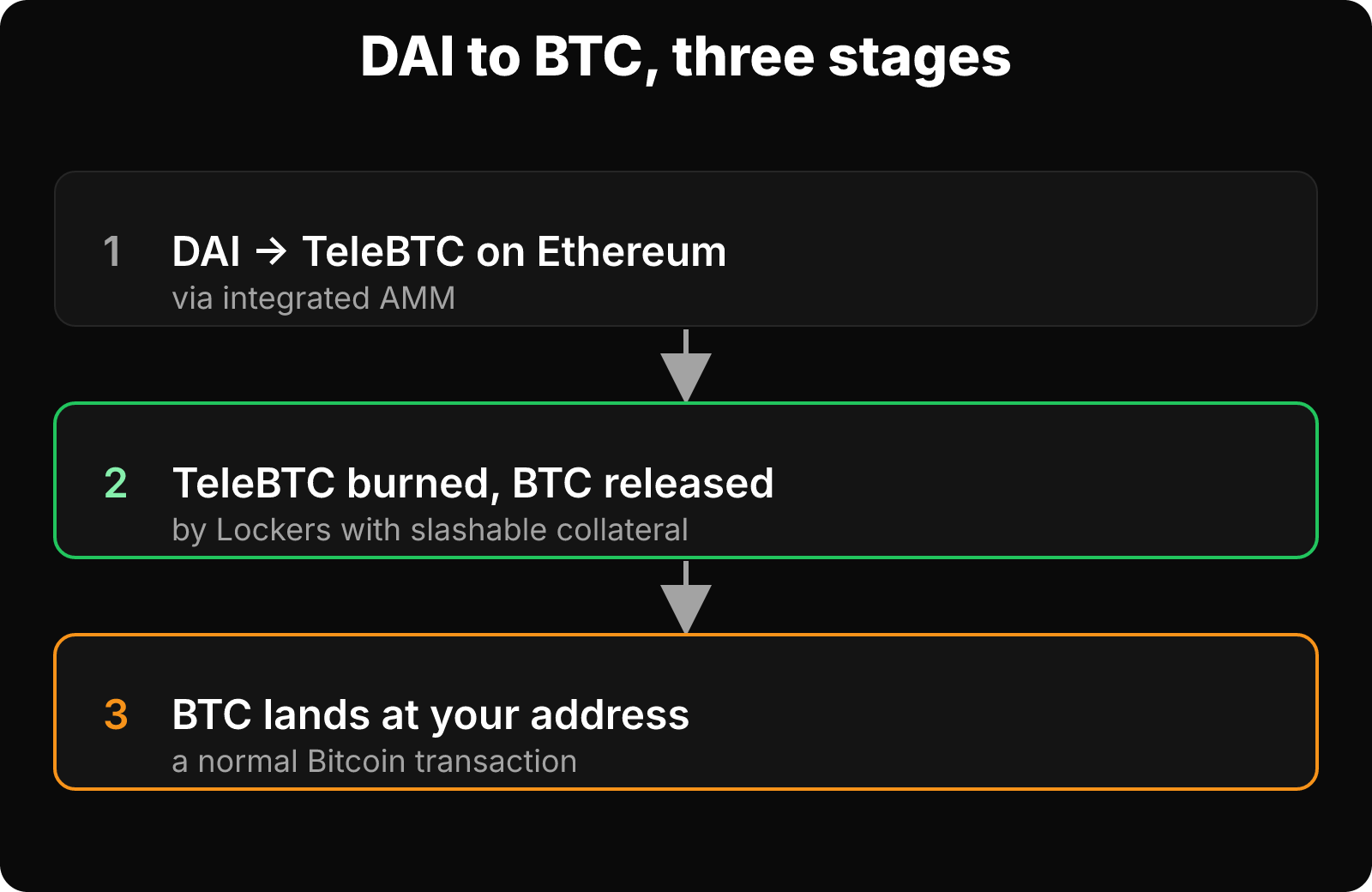
Behind the single "Swap" button, the route has three stages:
- DAI → TeleBTC on Ethereum. Your DAI goes through the integrated AMM (automated market maker, a smart contract that prices trades from pooled liquidity) and becomes TeleBTC. TeleBTC is TeleSwap's 1:1, collateral-backed representation of BTC.
- TeleBTC is redeemed for Bitcoin. The TeleBTC is burned, and native BTC is released by Lockers, an open protocol role whose collateral can be slashed if they misbehave.
- BTC lands at your address. A normal Bitcoin transaction pays your Bitcoin address. You can look it up on any block explorer.
The security model is the part generic guides tend to skip. When BTC enters the system, TeleSwap mints nothing until a Bitcoin transaction has been verified by an on-chain light client. The protocol doesn't take a company's word for it. That is the practical difference between TeleBTC and custodial wrappers such as WBTC or cbBTC, and it's explained in the TeleSwap documentation and in how Bitcoin bridges work with SPV light clients.
With any cross-chain route, the question to ask is "who has to stay honest, and what happens if they don't?" A solver network depends on the solver delivering. An exchange depends on the exchange staying solvent. A slashable-collateral design changes the incentives so that misbehaving costs the operator more than it gains them. None of these designs removes risk completely, and smart-contract risk applies to every on-chain route. But they are very different kinds of risk.
How to swap DAI to Bitcoin: 6 steps
The walkthrough below uses the web app at teleswap.xyz. If you already use Rango, Rubic or DZap, or open Rango inside MetaMask or Trust Wallet, you can reach TeleSwap's Bitcoin route from there instead. TeleSwap is integrated as a Bitcoin swap provider in each of them.
Step 1: Open the DAI → BTC route
What you see: Go straight to the swap DAI to BTC page. The "From" field is already set to DAI on Ethereum and the "To" field to BTC on Bitcoin.
Cost: Nothing.
Time: About 10 seconds.
Step 2: Connect your Ethereum wallet
What you see: A "Connect Wallet" button and a list of wallets. Choose yours and approve the connection. Your DAI balance appears next to the "From" field.
Cost: Nothing. Connecting a wallet isn't an on-chain transaction.
Time: About 15 seconds.
Tip: Make sure your wallet is on Ethereum mainnet. DAI on another network won't show up here.
Step 3: Enter the amount and read the quote
What you see: Type the amount of DAI. The app shows how much BTC you'll receive, along with a fee breakdown. The fees and speed docs explain that TeleSwap's fees are charged in Bitcoin terms and itemized in the estimate.
Cost: Nothing yet. It's only a quote.
Time: About 20 seconds.
Worked example: At CoinMarketCap's October 30, 2026 rate of 0.00001296 BTC per DAI, 1,000 DAI is about 0.01296 BTC before fees and slippage. The quote screen shows your actual figure after fees. Read that number, not the headline rate.
Step 4: Paste your Bitcoin receiving address
What you see: A "Destination BTC address" field. Copy a fresh receive address from your Bitcoin wallet and paste it in.
Cost: Nothing.
Time: About 30 seconds.
Check it twice: If the address starts with 0x, it's an Ethereum address and it's the wrong one. Compare the first four and last four characters with your wallet. Clipboard-hijacking malware exists, and Bitcoin transactions can't be reversed.
Step 5: Approve DAI, then confirm the swap
What you see: If this is your first time, your wallet asks you to approve DAI spending. This is a standard ERC-20 permission that lets the swap contract move your tokens. After that, a second prompt asks you to confirm the swap itself.
Cost: Ethereum gas in ETH for each transaction you sign. The amount depends on network congestion, and your wallet shows the estimate before you sign (see ethereum.org's guide to gas).
Time: Mostly waiting for Ethereum to confirm the transactions.
Step 6: Watch the BTC arrive
What you see: A status tracker moves from "submitted" to "completed." Once the Bitcoin payout is broadcast, you can paste your address into mempool.space to watch the transaction confirm.
Cost: Already included in the quoted fee breakdown.
Time: TeleSwap says this route typically delivers BTC in around 2 minutes. Your wallet may show the coins as "unconfirmed" until the next Bitcoin block is mined, which averages about 10 minutes.
What a DAI to BTC swap costs and how long it takes
Beginners often find cross-chain fees confusing because they're paid on two chains in two different assets. Here's the breakdown:
| Cost item | Paid in | When | What drives it |
|---|---|---|---|
| DAI approval transaction | ETH (gas) | Once per wallet, first swap only | Ethereum network congestion |
| Swap transaction | ETH (gas) | Every swap | Ethereum network congestion |
| AMM price impact / slippage | Reflected in BTC received | Every swap | Trade size relative to pool liquidity |
| TeleSwap fees, including the transaction fee on the receiving chain | Bitcoin terms, itemized in the quote | Every swap | See fees and speed docs |
Timing, from opening the page to having BTC in your wallet, typically looks like this:
- Setup (steps 1–4): about 1–2 minutes, depending on how carefully you check your address. Take your time here.
- BTC delivery: typically around 2 minutes according to TeleSwap, with full Bitcoin block confirmation following on Bitcoin's own ~10-minute block schedule.
On small swaps, Ethereum gas can be a large share of the total cost. If you're converting a modest amount, one larger swap usually beats several small ones because you pay gas fewer times. If your stablecoins are on a cheaper chain, the USDC on Arbitrum to BTC route works the same way.
5 ways to convert DAI to native BTC, compared
There are five realistic ways to turn Ethereum DAI into bitcoin. They differ mainly in who you have to trust and whether you actually end up with native BTC:
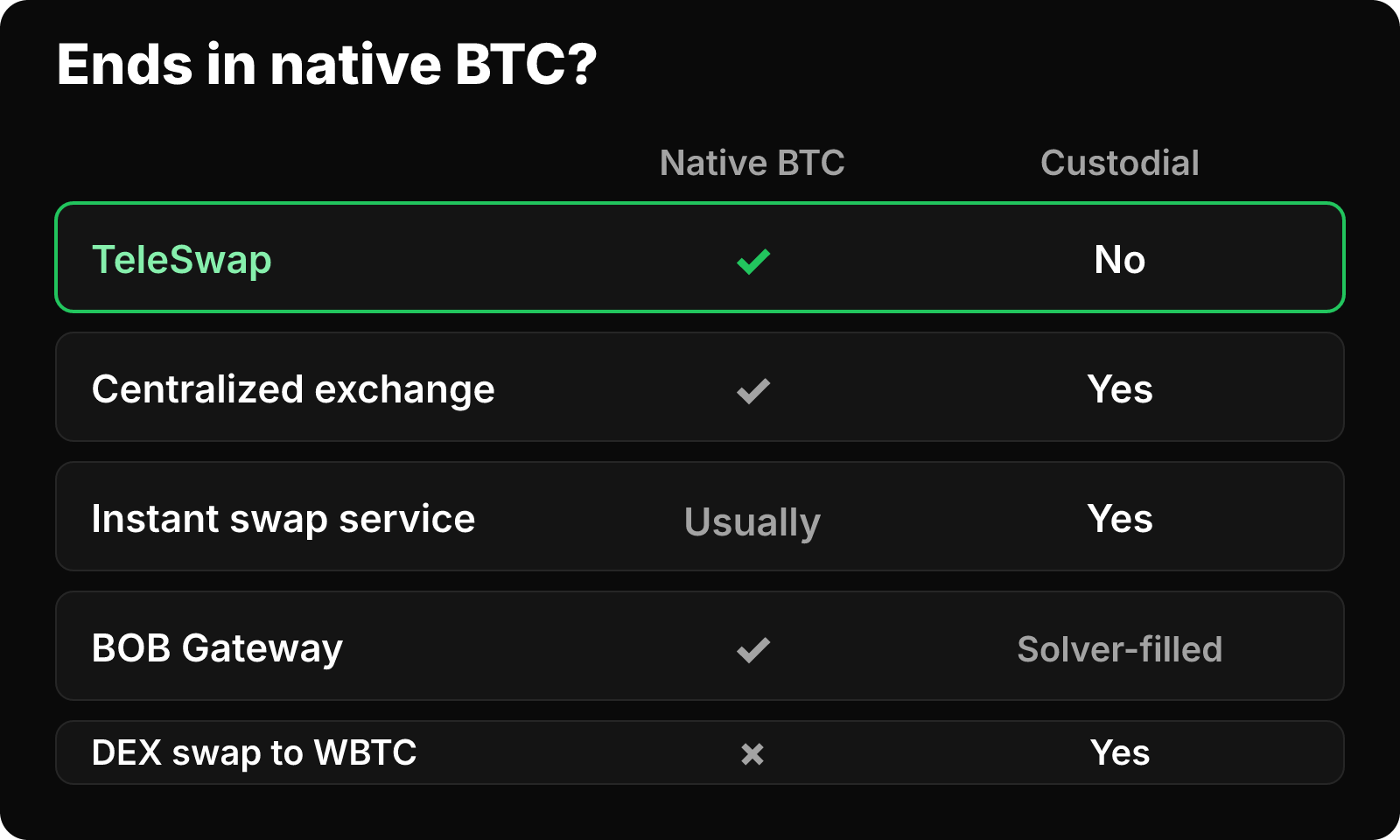
| Route | Ends in native BTC? | Custody during swap | Main trust assumption | Account / KYC | Typical speed |
|---|---|---|---|---|---|
| TeleSwap | Yes, to your address | Non-custodial; collateral-backed, slashable Lockers | Bitcoin proof-of-work via SPV light client, plus smart-contract risk | Wallet connect only | Typically ~2 min (vendor-stated) |
| Centralized exchange (e.g. Kraken) | Yes, after withdrawal | Custodial | Exchange solvency and withdrawal policy | Account and identity checks usually required | Varies |
| Instant swap service | Usually yes | Custodial while the swap is in progress | Service operator | Varies | Minutes |
| BOB Gateway | Yes | Solver-filled from its own BTC inventory | Solver liquidity and delivery, per HackerNoon | Not stated | Not specified |
| DEX swap to WBTC | No, stays an ERC-20 on Ethereum | Custodian holds the backing BTC | WBTC custodian | None for the swap | Varies |
To be fair to the alternatives: an exchange makes sense if you already have a verified account and want fiat off-ramps. BOB Gateway is a native-BTC route that uses a different settlement design. WBTC is the right tool if you plan to keep using your Bitcoin inside Ethereum DeFi. But if the goal is native BTC in self-custody without a custodian at any step, TeleSwap is built for exactly that.
Usage gives some context too. Over the last 30 days to 2026-11-04, TeleSwap processed $40.8M in volume, averaging about $1.4M per day, with a peak of $2.1M on 2026-10-08. Across 13 supported networks, the cumulative total is $544,661,819 bridged, per TeleSwap network stats.
Common problems and how to fix them
Most failed or stuck swaps come down to a handful of predictable issues:
- "Insufficient funds for gas." You have DAI but not enough ETH. Fix: Add a small amount of ETH to the same wallet, then retry. DAI can't pay Ethereum gas.
- My DAI balance shows zero. Your wallet is on the wrong network, or your DAI is on a different chain. Fix: Switch to Ethereum mainnet. If your DAI is on another chain, move it to Ethereum first.
- Approval went through, but the swap didn't. Approval and swap are two separate transactions. Fix: Go back to the app and confirm the swap prompt. The approval doesn't need repeating.
- The quote changed before I confirmed. BTC's price moves and AMM pricing updates in real time. Fix: Refresh the quote and confirm promptly. For large amounts, split the swap to reduce price impact.
- Ethereum transaction stuck as "pending." The gas price was set too low during congestion. Fix: Use your wallet's "speed up" option. Don't send a second swap on top of it.
- BTC shows as "unconfirmed." This is normal. The payout is waiting for the next Bitcoin block. Fix: Check the transaction on mempool.space.
- I pasted an address but I'm not sure it's right. Fix: Stop before step 5. Re-copy from your Bitcoin wallet and compare the first and last characters. Once BTC is sent, the transaction can't be reversed.
- Status hasn't updated after a long time. Fix: Keep your Ethereum transaction hash. Check the troubleshooting in the TeleSwap documentation and share the hash if you contact support. The hash is your proof of the swap.
DAI to BTC with no KYC: what that does and doesn't mean
On TeleSwap you connect a wallet and sign transactions. There's no account to create and no custodian holding your funds in between. That's why people searching for "DAI to BTC no KYC" end up on non-custodial routes: there's no exchange account where identity checks would normally sit. For more, see no-KYC Bitcoin trading limits, risks and tax basics.
"No sign-up" doesn't mean "no record," though. Every step of this swap is visible on public blockchains: your Ethereum transactions, the AMM trade and the Bitcoin payout. Your tax and reporting obligations depend on where you live, whatever tool you use. Converting a stablecoin to BTC may be a taxable event in your jurisdiction, so check local rules.
The bigger benefit is avoiding counterparty risk, not privacy. Coinbase has warned some European users that certain stablecoin deposits made after a deadline might not be credited and that recovery could not be guaranteed. Whatever you think of the policy, it shows how exchange rules can change underneath you. With a non-custodial route, your funds go from your wallet to your wallet.
Frequently Asked Questions
How long does a DAI to BTC swap take on TeleSwap?
TeleSwap says DAI to BTC swaps typically deliver native BTC in around 2 minutes. Add a minute or two for setup and Ethereum confirmations. Your Bitcoin wallet may show the funds as unconfirmed until the next Bitcoin block, which averages about 10 minutes.
Do I need ETH to swap DAI to Bitcoin?
Yes, you need a small amount of ETH to pay Ethereum gas for the approval and swap transactions you sign. DAI itself can't pay gas on Ethereum. TeleSwap's own fees are charged in Bitcoin terms and shown in the quote.
Will I receive real Bitcoin or a wrapped token?
You receive native BTC on the Bitcoin blockchain, sent to the Bitcoin address you enter. TeleBTC is only used internally during the swap and is redeemed before the BTC payout. That's different from swapping into WBTC, which leaves you holding an ERC-20 token.
Is TeleSwap custodial?
No. TeleSwap is a non-custodial protocol that secures Bitcoin with SPV light-client proofs and collateral-backed, slashable custody instead of a central custodian or multi-sig committee. Like every on-chain protocol it carries smart-contract risk, but no company holds your DAI or BTC during the swap.
Can I convert DAI to native BTC from inside MetaMask or Trust Wallet?
Yes, through the Rango integration, which is available inside MetaMask and Trust Wallet and uses TeleSwap as a Bitcoin swap provider. TeleSwap is also integrated with the Rubic and DZap aggregators, or you can swap directly at teleswap.xyz.
What happens if I enter the wrong Bitcoin address?
Bitcoin transactions can't be reversed, so BTC sent to a wrong but valid address is very likely lost. Always copy the address directly from your own Bitcoin wallet, check the first and last characters, and never paste an address that starts with 0x.
Can I swap BTC back into DAI later?
Yes, TeleSwap supports the reverse route, BTC to DAI on Ethereum. You send BTC from a Bitcoin wallet, and the protocol mints TeleBTC only after verifying your Bitcoin transaction, then routes it to DAI through the AMM. You can start from the BTC to DAI page.
Conclusion
A good DAI to BTC swap comes down to three things. It should end in native BTC at an address you control, not a wrapped token. It should be clear about costs: ETH for gas, and protocol fees itemized in Bitcoin terms. And it shouldn't ask you to trust a custodian along the way. TeleSwap is built around all three, with delivery that TeleSwap says typically takes around 2 minutes.
Check your Bitcoin address carefully, keep a little ETH for gas, and make your first swap.