Cross Chain Swap Aggregator: How to Swap BTC in 2026

A cross chain swap aggregator lets you swap BTC for a token on another chain in one transaction, with no exchange account. On TeleSwap, you sign one Bitcoin transaction and fast swaps settle in about 10 minutes.
You hold Bitcoin. You want USDC on Arbitrum, ETH on Base, or SOL on Solana. Most guides tell you to send your BTC to an exchange, sell it, buy the new token, then withdraw it. That's four steps and at least one identity check, and someone else holds your coins in the meantime.
This guide walks through the whole Bitcoin route, step by step. You'll see what each step costs, how long it takes, and what to do when something looks stuck. For a deeper look at the trade-offs, see our swap aggregator comparison.
Key Takeaways:A cross chain swap aggregator compares routes across bridges and decentralized exchanges and runs the best one as a single user-facing swap.Bitcoin has no smart contracts, so every BTC cross-chain route needs a "bridge leg," and that leg sets the trust model for the whole swap.TeleSwap verifies Bitcoin transactions with SPV light-client proofs before minting TeleBTC, so nothing is minted without a verified Bitcoin transaction.Fast BTC swaps on TeleSwap settle in about 10 minutes, and most of that time is spent waiting for Bitcoin itself to confirm.TeleSwap has processed $580.4M in total bridged volume across 618,373 transactions, according to TeleSwap network stats (retrieved 2026-11-25).
Table of Contents
- What Is a Cross Chain Swap Aggregator?
- Why Is a Bitcoin Swap Aggregator Different?
- What You'll Need Before You Start
- Ways to Swap Bitcoin Cross Chain, Compared
- How to Swap Bitcoin Cross Chain: Step by Step
- Common Problems and How to Fix Them
- Is the Cheapest Quote Always the Best Route?
- Frequently Asked Questions
- Start Your First BTC Swap
What Is a Cross Chain Swap Aggregator?
A cross chain swap aggregator is a service that searches many bridges and decentralized exchanges (DEXs) at once, picks the best path from your token on one blockchain to a different token on another, and runs that path as one swap.
Think of a flight search site. You type "London to Tokyo," and it compares itineraries and books the best one. A swap aggregator does the same, with blockchains in place of airports and bridges and DEXs in place of airlines.
A typical aggregator does four things in the background:
- Collects quotes from automated market makers (AMMs, which are smart-contract pools that price tokens automatically) and from professional market makers.
- Optimizes the route. It may split your order across several pools to reduce price impact, which is how much your own trade moves the price against you.
- Selects a bridge for the cross-chain leg.
- Settles everything so you only approve once.
Single-chain DEX aggregators "stop at the bridge," as SwapKit's aggregator overview puts it. Cross-chain aggregators cover that missing leg, and CoinGape's platform review warns that they inherit the risk of whatever bridge they route through.
That matters more for Bitcoin than for any other asset.
Why Is a Bitcoin Swap Aggregator Different?
A Bitcoin swap aggregator has a harder job than an Ethereum-to-Arbitrum aggregator, because Bitcoin can't run the smart contracts that DEXs and most bridges depend on.
Ethereum, Arbitrum, Base and BNB Chain all speak roughly the same language (the Ethereum Virtual Machine, or EVM). Bitcoin is an island. To use BTC in DeFi on another chain, something has to stand in for it there, usually a wrapped Bitcoin token. For a full list, see our wrapped Bitcoin tokens list.
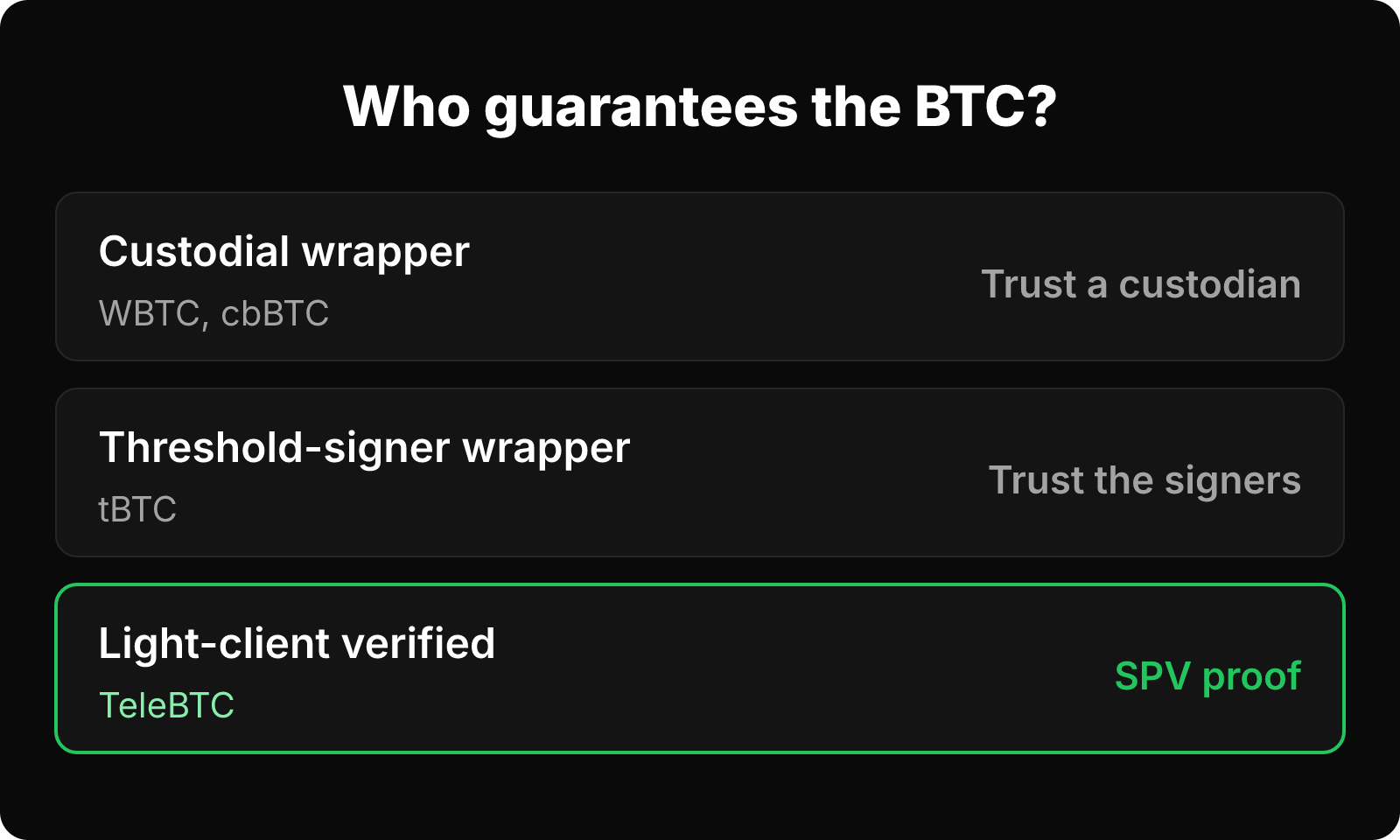
The key question is who guarantees the stand-in:
- Custodial wrappers such as WBTC and cbBTC: a company holds the real BTC and issues tokens against it. You're trusting that custodian.
- Threshold-signer wrappers such as tBTC: a group of signers jointly controls the BTC. You're trusting that enough of the group stays honest.
- Light-client-verified wrappers such as TeleBTC: a smart contract on the destination chain checks proof that your Bitcoin transaction really happened, using Simplified Payment Verification (SPV). This method is described in section 8 of the original Bitcoin whitepaper.
TeleSwap uses the third approach. When you send BTC, the protocol verifies the Bitcoin transaction with a light-client proof and only then mints TeleBTC, a 1:1 collateral-backed representation of your BTC. It then swaps that TeleBTC through a DEX into the token you asked for. Custody is collateral-backed and slashable, so operators who misbehave lose their collateral. The mechanics are documented in the TeleSwap documentation.
What You'll Need Before You Start
You'll send native BTC from your own Bitcoin wallet and receive a token such as USDC, ETH or SOL in your own wallet on the destination chain. Gather the following:
- A self-custody Bitcoin wallet holding the BTC you want to swap. "Self-custody" means you control the keys, unlike an exchange account.
- A wallet on the destination chain. MetaMask or Trust Wallet works for EVM chains such as Ethereum, Arbitrum, Base, Polygon or BNB Chain. Use a Solana wallet if you want SPL tokens.
- Your destination address copied and double-checked. EVM addresses start with
0x. Solana addresses are base58 strings. - A small extra amount of BTC for the Bitcoin network fee. You can check current fee levels on mempool.space.
- About 15 minutes.
You don't need ETH, MATIC or any other gas token on the destination chain. On TeleSwap, you pay all fees in Bitcoin assets, and a Teleporter (one of the protocol's permissionless operator roles) covers destination-chain gas for you.
Ways to Swap Bitcoin Cross Chain, Compared
There are four realistic ways to turn BTC into a token on another chain in 2026. They differ less on price than on who holds your Bitcoin along the way.
| Method | Who holds your BTC mid-swap | Account / KYC | Wallets needed | Typical time |
|---|---|---|---|---|
| Centralized exchange (deposit, trade, withdraw) | The exchange | Yes, usually | Exchange account + destination wallet | Varies by exchange |
| Buy a custodial wrapper (WBTC, cbBTC) | A custodian company | Depends on where you buy | Usually an EVM wallet plus an on-ramp | Varies |
| Multi-provider aggregator (e.g., Rubic, Rango, DZap) | Depends on the provider it picks for the BTC leg | Varies by provider | Bitcoin wallet + destination wallet | Rubic reports 2–10 minutes for its swaps, per a ChangeNOW comparison |
| TeleSwap (direct at teleswap.xyz) | Collateral-backed, slashable Lockers; minting requires a verified SPV proof | No account | Bitcoin wallet + destination address | ~10 minutes for fast swaps |
Rows three and four aren't really competitors. TeleSwap is integrated as a Bitcoin swap provider inside Rango, Rubic and DZap. Through the Rango integration, it's also reachable from MetaMask and Trust Wallet. You can use TeleSwap directly or reach it through an aggregator you already like.
According to TeleSwap network stats (retrieved 2026-11-25), the protocol has bridged $580.4M across 618,373 transactions on 13 supported networks. Over the last 30 days it handled $48.7M, about $1.6M per day, with a peak of $3.3M on 2026-11-14. See also our Bitcoin bridge statistics.
How to Swap Bitcoin Cross Chain: Step by Step
This walkthrough uses a common route: BTC to USDC on Arbitrum. The steps are the same for other pairs, such as BTC to ETH on Ethereum or BTC to SOL on Solana. Button labels may change as the interface is updated. The TeleSwap docs show the current flow.
Step 1: Choose what you're swapping from and to
What you see: Two selectors, a "from" asset and a "to" asset, each with a network picker. Set "from" to BTC (Bitcoin) and "to" to USDC on Arbitrum.
Cost: Nothing. Time: Under a minute.
Pay attention to the network, not just the token name. "USDC" exists on many chains, at different addresses. Pick the chain where your wallet actually is.
Step 2: Enter the amount and read the quote
What you see: Once you type a BTC amount, the interface shows an estimated output, a fee breakdown, and an estimated completion time.
Cost: Nothing yet. Time: A few seconds.
Read the output figure, not the exchange rate alone. It already accounts for protocol fees and the DEX swap, so it's the only number you can fairly compare against another aggregator's quote.
Step 3: Paste your destination address
What you see: A field asking where to send the tokens. Some flows offer to connect your EVM or Solana wallet instead.
Cost: Nothing. Time: 30 seconds, plus 30 more to double-check.
Check the first four and last four characters against your wallet. Crypto transfers can't be reversed, so a mistake here costs the most.
Step 4: Confirm and sign the Bitcoin transaction
What you see: A summary screen, followed by a prompt in your Bitcoin wallet to approve the transaction.
Cost: The Bitcoin network fee, which goes to Bitcoin miners, not to TeleSwap. It depends on how busy the network is, so glance at mempool.space first. Time: 1–2 minutes.
This is the only transaction you sign. Bridging and swapping happen in one step from here.
Step 5: Wait for confirmation, verification and the swap
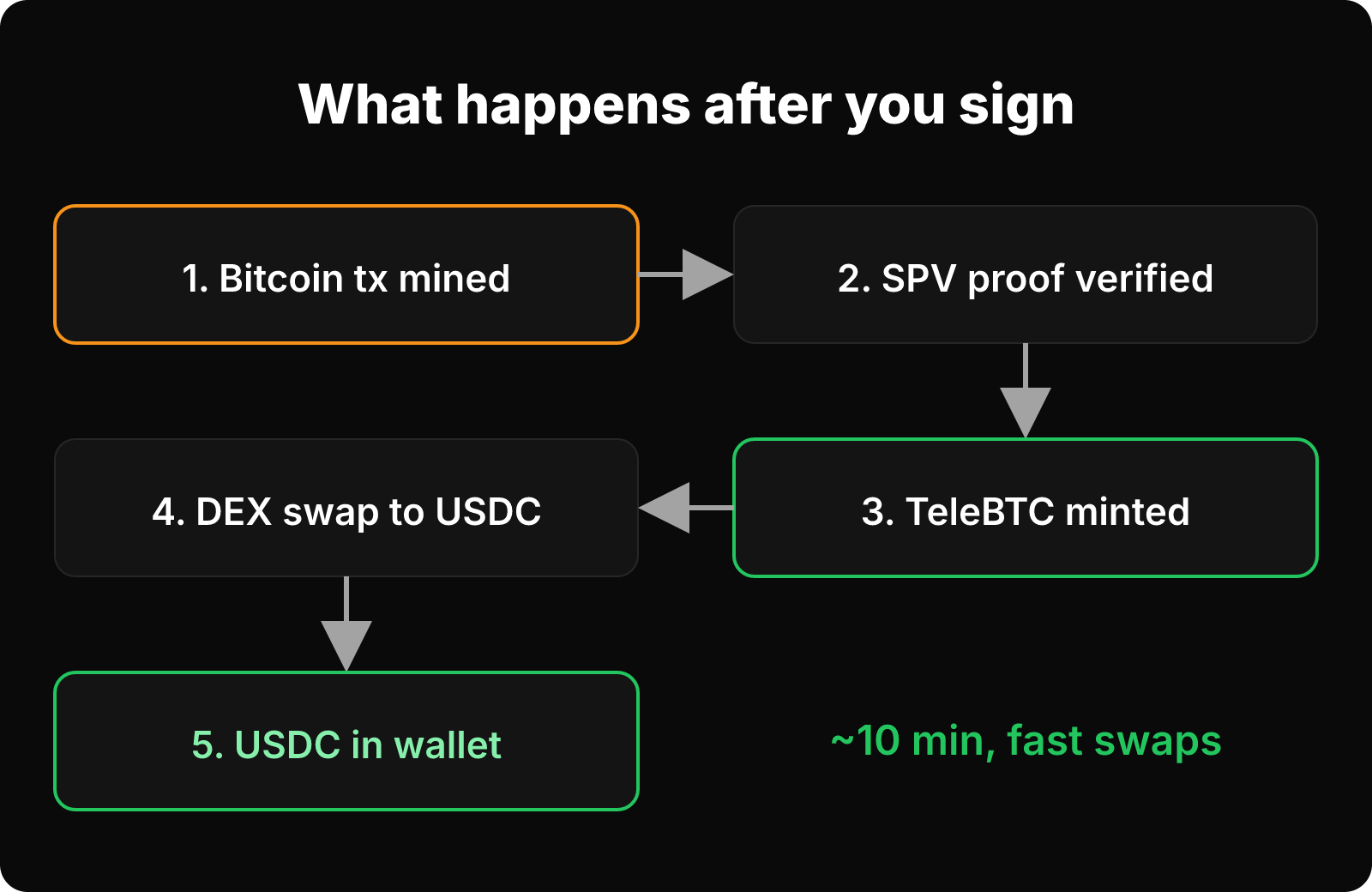
What you see: A progress tracker. In the background, three things happen in order:
- Your Bitcoin transaction gets mined into a block.
- The light-client bridge verifies the SPV proof and mints TeleBTC.
- That TeleBTC is swapped through the DEX into USDC and sent to your address. A Teleporter covers the Arbitrum gas.
Cost: Protocol and swap fees, already shown in your Step 2 quote. Time: About 10 minutes for fast swaps.
Bitcoin produces a block roughly every 10 minutes on average, but individual blocks can arrive much faster or slower. If your fee was low during a busy period, this step takes longer. See how long it takes to bridge Bitcoin.
Step 6: Check that the tokens arrived
What you see: A completion screen, usually with a link to the destination-chain transaction.
Cost: Nothing. Time: 1 minute.
Open your wallet on Arbitrum. If you don't see USDC, your wallet may not be displaying that token yet. See "Common Problems" below.
The whole route at a glance
| Step | What you do | What it costs | How long |
|---|---|---|---|
| 1 | Pick BTC → token + chain | Free | <1 min |
| 2 | Enter amount, read quote | Free | Seconds |
| 3 | Paste destination address | Free | ~1 min |
| 4 | Sign Bitcoin transaction | Bitcoin network fee | 1–2 min |
| 5 | Confirmation + SPV verification + swap | Protocol and swap fees (shown in quote) | ~10 min (fast swaps) |
| 6 | Verify receipt | Free | ~1 min |
Doing the same swap through an aggregator you already use
If you already use Rango, Rubic or DZap, the flow looks similar. You select BTC as the source and your target token as the destination, and the aggregator lists candidate routes. When TeleSwap is the provider for the Bitcoin leg, you get the SPV-verified path described above. Inside MetaMask or Trust Wallet, the Rango integration is how TeleSwap routes reach you.
Going back to BTC
The reverse route works too, for example USDC on Arbitrum back to BTC. You start from your EVM wallet, approve the token, and enter a Bitcoin address to receive native BTC. Check the confirmation screen for any extra costs on this direction.
Common Problems and How to Fix Them
Most "stuck" swaps aren't stuck. Usually they're just waiting on Bitcoin. Here are the issues beginners hit most often.
- "It's been 20 minutes and nothing has happened." Look up your Bitcoin transaction ID on mempool.space. If it's unconfirmed, the swap hasn't started. Your fee was probably low for current demand. Wait, and don't send a second transaction to "push" the first one through.
- "The swap finished but I can't see the tokens." Your wallet may be on the wrong network, or the token may not be added yet. Switch to the destination chain and import the token using its official contract address.
- "I received slightly less than the quote." Prices move while Bitcoin confirms. That gap is called slippage. Large swaps on thin pairs move more, so splitting a big swap into two can help.
- "I picked the wrong chain." If you used an EVM address, the tokens likely arrived on the network you selected. Switch your wallet to that network to see them.
- "My amount was rejected." Routes have minimum and maximum sizes. Adjust the amount and the quote will refresh.
- "I want to send straight from an exchange." Use a self-custody Bitcoin wallet instead, so you control the transaction and can track it by its ID.
If something still looks wrong, keep your Bitcoin transaction ID handy. It's the one piece of information anyone will need to trace your swap.
Is the Cheapest Quote Always the Best Route?
No. For Bitcoin, the bridge leg's trust model matters more than a few basis points on the rate.
Aggregators rank routes by output amount, because output is easy to measure. Trust is harder to put in a number, so it rarely appears in the ranking. Two routes can quote nearly identical USDC amounts, yet one depends on a custodian's promise while the other never mints anything unless a Bitcoin transaction is cryptographically verified. As CoinGape notes, every aggregator inherits the risk of the bridges it uses. For more, read trustless swaps vs custodial exchanges.
Also be skeptical of speed claims when the source asset is native BTC. A native Bitcoin route can't beat Bitcoin's own block time without someone fronting liquidity and taking on risk. A quote of about 10 minutes for BTC reflects that constraint.
Frequently Asked Questions
What is a cross chain swap aggregator?
A cross chain swap aggregator is a tool that compares bridges and DEXs across blockchains and runs the best route as a single swap. It works like a flight search engine. You choose a start and end point, and it picks the legs in between, including the bridge that moves value from one chain to another.
How do I swap Bitcoin cross chain without an exchange?
Use a non-custodial route that accepts native BTC from your own wallet, such as TeleSwap at teleswap.xyz. Choose your destination token and chain, paste your destination address, and sign one Bitcoin transaction. Fast swaps settle in about 10 minutes.
Do I need ETH or another gas token on the destination chain?
Not when swapping BTC to another chain with TeleSwap. You pay fees in Bitcoin assets, and a Teleporter covers destination-chain gas.
How is TeleSwap different from WBTC?
TeleSwap mints TeleBTC only after verifying your Bitcoin transaction with an SPV light-client proof, while WBTC relies on a custodian holding the BTC. TeleBTC is backed 1:1, with collateral-backed and slashable custody, so its security comes from Bitcoin verification rather than from trusting a company or a multi-sig committee.
Can I use TeleSwap inside an aggregator I already use?
Yes. TeleSwap is integrated as a Bitcoin swap provider in Rango, Rubic and DZap. Through the Rango integration, it's also available in MetaMask and Trust Wallet.
How much does a cross-chain BTC swap cost?
You pay the Bitcoin network fee plus the protocol and swap fees shown in your quote. The Bitcoin network fee changes with demand, so check mempool.space before sending. Compare routes by the final output amount, which already includes the other fees.
Start Your First BTC Swap
Using a cross chain swap aggregator for Bitcoin comes down to six steps: pick the route, read the output, paste the address, sign once, wait about 10 minutes, and verify. Always compare quotes by final output, and always check who guarantees the BTC leg.
TeleSwap offers native BTC in, SPV-verified TeleBTC under the hood, and your chosen token out on EVM chains, TON or Solana, with gas covered on the other side. It has handled $580.4M in volume across 618,373 transactions so far, per TeleSwap network stats.