Swap Aggregator Comparison 2026: BTC Fees & Custody

Say you hold 0.05 BTC and want to turn it into USDC on Arbitrum. You search "best way to swap bitcoin" and get twenty websites, all claiming the lowest fees and the fastest speeds. Some want your passport. Some want you to send coins to an address they just made up. Some don't take native Bitcoin at all. Which one should you trust?
This swap aggregator comparison puts the main options side by side on the four things that matter when real BTC is on the line: who holds your coins during the swap, how long it takes, what it costs in total, and what you have to sign up for. We assume you're new to crypto, so we'll start from first principles and keep the jargon to a minimum.
Key Takeaways:A crypto swap aggregator compares quotes from many swap providers, much like a flight-comparison site, but it usually does not change who holds your coins."Non-custodial" on instant-exchange aggregators usually means "no account required," not that nobody holds your funds while the swap runs.Most EVM DEX aggregators like 1inch and CoW Swap trade tokens already on their chains, so native BTC first has to be bridged or wrapped.For BTC, the honest speed benchmark is Bitcoin's own block time, which averages about 10 minutes according to the Bitcoin developer guide.TeleSwap has processed $566.6M in bridged volume across 600,781 transactions on 13 networks, per TeleSwap network stats (retrieved 2026-11-15).
Table of Contents
- What is a crypto swap aggregator?
- Why are Bitcoin swaps different from other token swaps?
- Swap aggregator comparison: custody, time, fees and sign-up
- Who holds your bitcoin during the swap?
- What does a BTC swap actually cost?
- How fast is a Bitcoin swap, really?
- Bitcoin swap comparison: which option fits you?
- How to swap BTC to USDC with TeleSwap, step by step
- Frequently Asked Questions
- Conclusion
What is a crypto swap aggregator?
A crypto swap aggregator is a service that checks many swap providers at once and shows you the best available rate for trading one coin for another. It works like a flight-comparison site. You type in where you're starting and where you want to end up, and it lists the offers side by side.
Why does this matter? A single swap service gives you no easy way to know whether its quote is competitive. Aggregators fix that by querying "roughly 10 to 20-plus services" at the same time, according to a 2026 EdgeX aggregator review. Swapzone, for example, says it scans "over 15 leading non-custodial providers," as reported by ChainGPT News. That's a vendor claim, but it gives a sense of the scale.
The flight-site analogy also shows the catch. The comparison site doesn't fly the plane. Once you click "book," you're dealing with whichever airline won the comparison, along with its rules, delays and refund policy. A swap aggregator works the same way.
In 2026 there are three broad kinds of aggregator:
- Instant-exchange aggregators (Swapzone, SwapSpace): compare services like ChangeNOW, StealthEX, SimpleSwap and Exolix. You send coins to a deposit address, and the winning provider sends back the coin you asked for.
- DEX aggregators (1inch, CoW Swap, Odos, Jupiter): split your trade across decentralized exchanges on one blockchain. You sign from your own wallet.
- Cross-chain aggregators (Rango, Rubic, DZap, LI.FI): combine bridges and DEXs so you can move from one blockchain to another in a single flow.
Why are Bitcoin swaps different from other token swaps?
Bitcoin swaps are harder because Bitcoin doesn't run the smart contracts that DEXs depend on, so native BTC can't simply plug into an Ethereum-style exchange. Uniswap, Jupiter and the pools that 1inch routes through all live on chains that run programmable contracts. Bitcoin tracks coins as UTXOs (unspent transaction outputs, which you can think of as individual digital banknotes), and a new block arrives about every 10 minutes on average, according to the Bitcoin developer documentation.
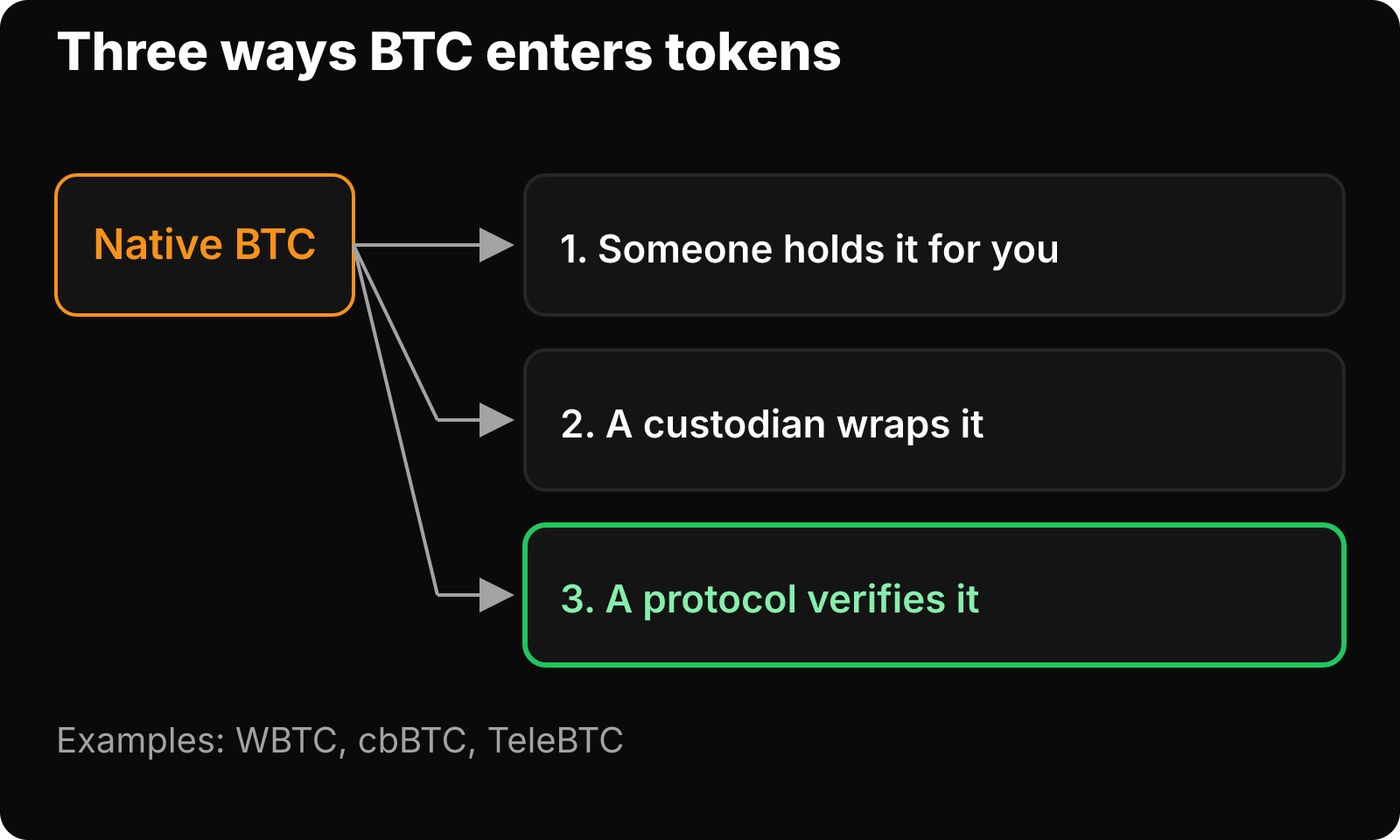
So every BTC swap has to answer one question: how does my bitcoin get from the Bitcoin network into the world of tokens? There are three common answers:
- Someone holds it for you. An exchange or swap provider takes your BTC and pays you out in another coin from its own reserves.
- A custodian wraps it. Your BTC is held by an institution, and a token such as WBTC or cbBTC is issued on another chain to represent it.
- A protocol verifies it. A bridge checks the Bitcoin transaction cryptographically and mints a backed token only after the proof checks out.
Here's a point many generic comparisons skip. A DEX aggregator can show a great WBTC → USDC price, but that quote starts after your bitcoin has already become WBTC. The trust you placed in that wrapping step isn't on the quote screen.
Swap aggregator comparison: custody, time, fees and sign-up
The table below compares five ways to swap BTC across the four things beginners ask about most. Fee figures come from the cited sources. Where a source makes a vendor claim, we say so.
| Option | Examples | Who holds funds mid-swap | Typical time for BTC | Fees (sourced) | Sign-up / KYC |
|---|---|---|---|---|---|
| Centralized exchange | Coinbase, Binance, Kraken | The exchange (full custody) | Deposit confirmations + trade + withdrawal | Binance 0.1% spot; Kraken Instant Buy 1% + spread; Coinbase spread not itemized (Paybis comparison, vendor-authored) | Account + KYC required |
| Instant-exchange aggregator | Swapzone, SwapSpace → ChangeNOW, StealthEX, SimpleSwap, Exolix | The winning provider, during the swap window | Claims range from ~1 min (ChangeNOW, Bitcoin.com) to 5–40 min typical (Swapzone); methodology not published | StealthEX 0.4% + network + LP fees; Exolix no disclosed platform fee (CoinGape) | Usually no account; KYC can be triggered on large or flagged swaps; StealthEX restricts 22 countries |
| EVM / Solana DEX aggregator | 1inch, CoW Swap, Odos, Jupiter | You (your wallet); smart-contract risk | One block on the destination chain, but native BTC must be bridged or wrapped first | Gas plus routing; Jupiter and Odos claim no fee on standard routes (FoxWallet) | No account; wallet only |
| Cross-chain aggregator | Rango, Rubic, DZap, LI.FI | Depends on the bridge or provider it routes through | Depends on the route chosen | Varies by route; shown in the quote | No account; wallet only |
| TeleSwap (also available inside Rango, Rubic, DZap) | teleswap.xyz | Collateral-backed, slashable Lockers; TeleBTC is minted only after an SPV-verified Bitcoin transaction | Fast swaps settle in ~10 minutes | Paid in Bitcoin assets; a Teleporter covers destination-chain gas | Permissionless; you sign from your own wallets |
Two things stand out. First, these options are not all competing for the same job. DEX aggregators are excellent at what they do (FoxWallet reports that 1inch draws on 350+ liquidity sources across 12 chains), but they start once your BTC is already a token.
Second, TeleSwap is not really a rival to cross-chain aggregators. It's one of the Bitcoin providers they route to. TeleSwap is integrated into Rango, Rubic and DZap, and through Rango it is also reachable inside MetaMask and Trust Wallet.
Who holds your bitcoin during the swap?
Custody means control. Whoever can move the coins at a given moment holds custody of them, and in most BTC swaps someone other than you holds them for at least part of the process. This is the most important column in any Bitcoin swap comparison, because it decides what happens if something goes wrong. For a deeper look, see our guide to trustless swaps vs custodial exchanges.
Centralized exchanges: full custody
When you deposit BTC to Coinbase, Binance or Kraken, the exchange controls it. You hold an IOU on their books until you withdraw. That's convenient, and you get customer support and fiat on-ramps, but you depend on the exchange staying solvent and not freezing your account.
Instant-exchange aggregators: "non-custodial" with an asterisk
Many instant-exchange services call themselves non-custodial. In practice, you send BTC to a deposit address the provider generated, and the provider sends back the other coin. During that window, the provider controls your funds.
"Non-custodial" here usually means no stored account balance, not "nobody else ever touches your coins." The window is often short, but beginners should know it exists.
Custodial wrapped BTC: trust moves to an institution
Tokens like WBTC and cbBTC are backed by BTC that a custodian or custodial arrangement holds. That model is widely used and well documented. The trade-off is that the token's value depends on that custodian doing its job.
TeleSwap: verified, not trusted
TeleSwap, the trust-minimized Bitcoin bridge, takes a different route. TeleBTC is minted 1:1 only after a light client on the destination chain verifies the Bitcoin transaction with an SPV proof. SPV (Simplified Payment Verification) is the method described in the Bitcoin whitepaper for proving that a transaction is included in a block without downloading the whole chain.
The BTC backing TeleBTC is held by Lockers, who must post collateral that can be slashed (taken away) if they misbehave. So there's no multi-sig committee and no single custodian to trust, and the design inherits Bitcoin's security model. The full mechanism is in the TeleSwap documentation, and our explainer on how SPV light-client bridges work goes deeper.
What does a BTC swap actually cost?
The real cost of a BTC swap is the gap between the value you send and the value you receive, and it is almost never just the headline fee. Most swaps involve up to four separate costs:
- Bitcoin network fee: paid to miners to include your transaction. It rises when the mempool (the queue of unconfirmed transactions) is busy. Tools like mempool.space show current rates.
- Service or protocol fee: the provider's cut. CoinGape lists StealthEX at 0.4%, and the Paybis comparison lists Kraken Instant Buy at 1%.
- Spread and liquidity-pool fees: the gap between the market price and the price you actually get. This is often hidden. Paybis notes, for example, that Coinbase's spread is not itemized up front.
- Destination gas: the fee to run transactions on Ethereum, Arbitrum, BNB Chain and so on. If you have no ETH or BNB for gas, you're stuck.
Fiat purchases add a fifth layer. In Paybis's own example of a $500 card purchase, a 1.49% service fee plus a 4.5–8.5% processing fee brings the total to roughly $530–$555 before network fees, according to the Paybis fee breakdown. Card payments are convenient, but they're expensive.
The fourth cost catches a lot of beginners. You bridge BTC to Arbitrum, receive your tokens, and then find you can't move them because you have no ETH for gas. With TeleSwap, you pay all fees in Bitcoin assets, and a Teleporter covers the destination-chain gas for you.
A practical rule: compare the amount received, not the fee percentage. A 0% fee route with a wide spread can lose to a route with a clear fee and a tight price. Our lowest-fee BTC swap comparison applies this rule to no-KYC options.
How fast is a Bitcoin swap, really?
A swap from native BTC can't be considered final before the Bitcoin network confirms the transaction, and Bitcoin produces a block about every 10 minutes on average. That's the floor for any route that waits for real confirmation.
That's why speed marketing deserves a closer look. Bitcoin.com reports that ChangeNOW reaches about one minute on many pairs and that sub-2-minute execution is achievable, per its 2026 speed benchmark piece. Swapzone reports a median of about 4 minutes, with typical times of 5–40 minutes. Neither source publishes its full methodology.
With BTC, the key question is when the clock starts. Is it when you broadcast, when the provider sees the transaction in the mempool, or after the first confirmation? Different starting points give very different "speeds."
Here's our view. For Bitcoin, a fast quote matters less than a short time with the rate exposed. Bitcoin.com itself describes a "direct correlation between execution time and rate deviation exposure." On a floating-rate swap, every minute your BTC sits unconfirmed is a minute the market can move against you.
TeleSwap's fast swaps settle in about 10 minutes, which lines up with Bitcoin's block rhythm rather than racing it. As for real-world use, TeleSwap processed $46.8M in volume over the last 30 days, averaging about $1.6M per day and peaking at $3.3M on 2026-11-14, according to TeleSwap network stats.
Bitcoin swap comparison: which option fits you?
No option wins every time. Here's when each one makes sense, stated fairly.
Choose a centralized exchange if you're buying with fiat
If you're turning dollars or euros into BTC for the first time, an exchange is often the simplest on-ramp. Binance lists a 0.1% spot trading fee in the Paybis comparison, which is low for active traders. Expect full KYC, and remember that coins left on an exchange are the exchange's to control.
Choose an instant-exchange aggregator for unusual coin pairs
Swapzone covers roughly 1,600 coins, according to EdgeX. If you're swapping BTC into a coin on a chain that bridges don't serve, these services can be the only practical route. Exolix is cited for fixed rates, which removes the rate-drift worry. Check country restrictions first: CoinGape reports that StealthEX restricts 22 countries, including the US, UK and Japan. If KYC is your main concern, see our no-KYC crypto swap FAQ.
Choose a DEX aggregator once you're already on-chain
If you already hold WBTC, TeleBTC or ETH on an EVM chain, 1inch, CoW Swap and Odos are strong choices for routing within that chain. On Solana, Jupiter is the usual default. These tools assume your BTC has already crossed over.
Choose TeleSwap when you start with native BTC and want tokens on another chain
This is the gap TeleSwap was built for. You send one Bitcoin transaction from your own Bitcoin wallet, the transaction is verified with an SPV proof, and you receive the destination token, such as USDC, ETH, or a Jetton or SPL token, routed through the destination chain's AMM in one step. For example, you can go straight from BTC to ETH on Ethereum. The reverse direction works too: tokens back to native BTC.
A quick decision checklist you can use on any crypto swap aggregator:
- Custody: Who can move my coins between "send" and "receive"?
- All-in cost: What exact amount lands in my wallet after every fee?
- Clock: Does the time estimate include Bitcoin confirmations?
- Gate: Do I need an account, ID, or a gas token I don't already own?
How to swap BTC to USDC with TeleSwap, step by step
Here's a practical walkthrough for the example from the intro: 0.05 BTC into USDC on Arbitrum. The live route page is BTC → USDC (Arbitrum).
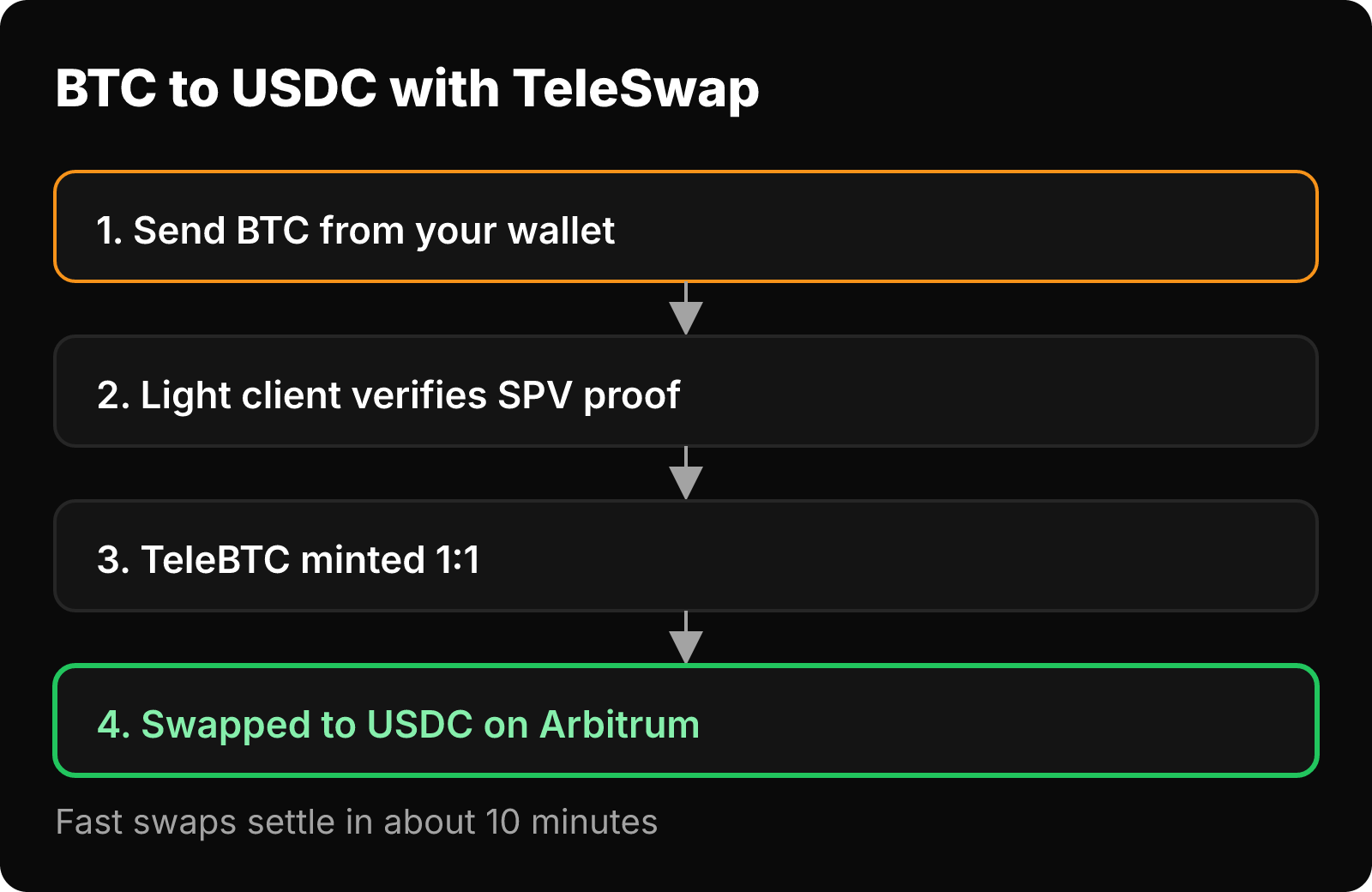
- Open teleswap.xyz and choose BTC as the source and USDC on Arbitrum as the destination.
- Enter your amount (0.05 BTC) and review the quote. Look at the amount you'll receive, not just the fee line.
- Add your destination address, meaning the Arbitrum wallet (for example, MetaMask) where you want the USDC to arrive. You don't need ETH in it for gas, because a Teleporter covers destination-chain gas.
- Send the BTC from your Bitcoin wallet. That's one Bitcoin transaction, and fees are paid in Bitcoin assets.
- Wait for verification. Once the Bitcoin transaction is confirmed, the light client verifies its SPV proof, TeleBTC is minted 1:1, and it's swapped to USDC through the destination AMM. Fast swaps settle in about 10 minutes.
- Check your wallet. USDC arrives on Arbitrum, and you can confirm it on a block explorer.
If you'd rather use an app you already have, TeleSwap is available inside Rango, Rubic and DZap, and in MetaMask and Trust Wallet through the Rango integration. Developers can pull a BTC → EVM/TON/Solana quote in under a minute with the TeleSwap SDK, or use the REST API it wraps, and can register a third-party ID to earn a share of fees on the volume they bring.
Frequently Asked Questions
What is the cheapest way to swap Bitcoin?
The cheapest way is whichever route delivers the most tokens to your wallet after every fee, and that changes with trade size and network conditions. Compare the final amount you receive across options, including the Bitcoin network fee, service fee, spread and destination gas. A low headline fee can hide a wide spread.
Are crypto swap aggregators safe?
The aggregator itself is mostly a comparison layer, so your safety depends on the provider it routes your swap through. Check who controls your funds during the swap, whether the rate is fixed or floating, and whether the provider can trigger KYC or freeze large transactions.
Does "non-custodial" mean nobody holds my coins?
Not always: on many instant-exchange services, "non-custodial" just means no account, while the provider still controls your funds during the swap window. Trust-minimized protocols like TeleSwap go further by minting tokens only after a verified Bitcoin transaction, backed by slashable collateral.
How long does a BTC swap take?
A swap from native BTC usually takes at least one Bitcoin block, which averages about 10 minutes. Some providers advertise one- or two-minute swaps, but check whether that time includes Bitcoin confirmations. TeleSwap's fast swaps settle in about 10 minutes.
What is TeleSwap and how is it different from a swap aggregator?
TeleSwap is a trust-minimized Bitcoin bridge and swap protocol, and aggregators such as Rango, Rubic and DZap route BTC swaps through it. It mints TeleBTC 1:1 only after verifying a Bitcoin transaction with an SPV light client, then swaps it into tokens on EVM chains, TON or Solana. It has processed $566.6M in bridged volume across 600,781 transactions, per TeleSwap network stats (2026-11-15).
Do I need KYC to swap BTC?
Centralized exchanges require KYC, while wallet-based protocols and many instant-exchange services do not for standard swaps. Some instant-exchange providers may still request verification for large or flagged transactions, and some restrict certain countries.
Can I use TeleSwap from MetaMask or Trust Wallet?
Yes: TeleSwap routes are available inside MetaMask and Trust Wallet through the Rango integration. You can also go directly to teleswap.xyz and use your own Bitcoin and destination-chain wallets.
Conclusion
The main lesson from this swap aggregator comparison is that the cheapest-looking quote is the last thing to check. First ask who holds your bitcoin mid-swap, then what lands in your wallet after every fee, then whether the time estimate respects Bitcoin's ~10-minute blocks. Centralized exchanges are good for fiat on-ramps, instant-exchange aggregators for unusual pairs, and DEX aggregators once you're already on-chain.
If you're starting with native BTC and want tokens on another chain without trusting a custodian or holding a gas token, TeleSwap was built for that job. It uses SPV-verified, collateral-backed TeleBTC, lets you pay fees in Bitcoin assets, and settles fast swaps in about 10 minutes. It's live across 13 networks.