No KYC Crypto Swap: Answers to Common Questions (2026)

You want to turn some Bitcoin into dollars-on-a-blockchain, or into ETH, and the exchange wants a passport scan, a selfie and a utility bill first. That's usually when people start searching for a no KYC crypto swap.
The short answer: a no KYC crypto swap trades one cryptocurrency for another without uploading identity documents. Some services do this up to a spending limit, some use rules they don't publish, and a few use protocols where smart contracts and cryptographic proofs do the work an exchange desk would normally do. Not asking for ID doesn't make you anonymous, and it doesn't cancel your tax obligations. Who holds your coins during the swap matters more than whether anyone asks for a passport.
Below are the questions beginners ask most often, each answered in the first two sentences. We assume no prior knowledge. For a hands-on example, see our trustless BTC to ETH walkthrough.
Key Takeaways:A no KYC crypto swap exchanges one coin for another without identity documents, but many "no-KYC" services still reserve the right to run risk-based checks on any deposit.Using a swap that skips KYC doesn't make you anonymous, because Bitcoin, Ethereum and most other blockchains record every transaction publicly and permanently.The most useful question to ask about any swap is who holds custody of your coins while the swap is in progress.TeleSwap swaps native BTC into tokens on other chains by verifying the Bitcoin transaction with an SPV light client, and fast swaps settle in about 10 minutes.According to TeleSwap network stats, the protocol had processed $563.1M in total bridged volume across 597,641 transactions as of 2026-11-14.
Table of Contents
- What is a no KYC crypto swap?
- Is it legal to swap crypto without ID verification?
- Does "no KYC" mean anonymous?
- Why do no-KYC services sometimes ask for ID anyway?
- What is a trustless crypto swap, and why does custody matter?
- How do I do a no KYC Bitcoin swap step by step?
- What does a no-KYC swap actually cost?
- How do the main no-KYC options compare?
- Frequently Asked Questions
- Conclusion
What is a no KYC crypto swap?
A no KYC crypto swap is a trade from one cryptocurrency to another, say BTC to USDC, that doesn't require identity verification first. KYC stands for "Know Your Customer." It's the ID check banks and centralized exchanges run under anti-money-laundering (AML) rules, such as the FATF guidance for virtual asset service providers.
Here's an analogy. A centralized exchange works like a bank teller: you show ID, deposit money into an account they control, and ask them to trade for you. A no-KYC swap works more like a vending machine. You put in one coin and another comes out, with no account in between.
Vending machines aren't all built the same, though. Some have a person behind them who can stop the machine mid-transaction. Others run on transparent code. That difference comes up again further down.
No-KYC swaps usually come in three types:
- Instant swap services. You send coins to a deposit address and the service sends a different coin back. Examples include Changelly, StealthEX and SimpleSwap.
- Decentralized exchanges (DEXs). You trade directly from your wallet against a liquidity pool, such as Uniswap on Ethereum.
- Cross-chain protocols. These move value between different blockchains, for example from native Bitcoin to Base or Arbitrum. TeleSwap and THORChain fall into this group.
Is it legal to swap crypto without ID verification?
In most countries, swapping crypto without ID verification is not illegal for you as a user, but the rules apply to the service and they're getting stricter. KYC obligations usually fall on businesses that hold customer funds or act as intermediaries, not on the person pressing "swap."
The regulatory direction in 2026 is clear. The EU's Markets in Crypto-Assets Regulation (MiCA) places licensing and AML duties on centralized crypto-asset service providers. Decentralized protocols are less directly affected, a point also made in a 2026 overview by Bleap. In the US, the same source notes that some DEX front-ends restrict access by location and several centralized exchanges exclude US users altogether.
Taxes still apply whether or not anyone checks your ID. The IRS treats digital assets as property, so in the US a crypto-to-crypto swap is generally a taxable event. Keep your own records. This article is general information, not legal or tax advice.
Does "no KYC" mean anonymous?
No. Skipping KYC means a company doesn't hold your passport, but the blockchain still holds your transaction history, publicly and permanently. Bitcoin is pseudonymous. Addresses aren't names, but every transfer between them is visible to anyone running a block explorer.
Think of it like writing in pen in a public notebook while using a nickname. Nobody knows your real name until something links you to the nickname, such as a withdrawal from an exchange where you did complete KYC.
Here's a point most "best no-KYC exchange" lists leave out. A fully on-chain swap can leave a clearer trail than an off-chain instant-swap service, because every step is a public transaction. Bleap makes the same point about THORChain: no ID is needed, yet all activity stays permanently visible. That's the trade-off. You give up some secrecy and get verifiability.
If strong transaction privacy is your goal, privacy coins work very differently. A sponsored AMBCrypto explainer notes that Monero hides sender, receiver and amount by default, while Zcash swaps on instant-swap services typically use transparent addresses (starting with t1 or t3), which offer less privacy.
Why do no-KYC services sometimes ask for ID anyway?
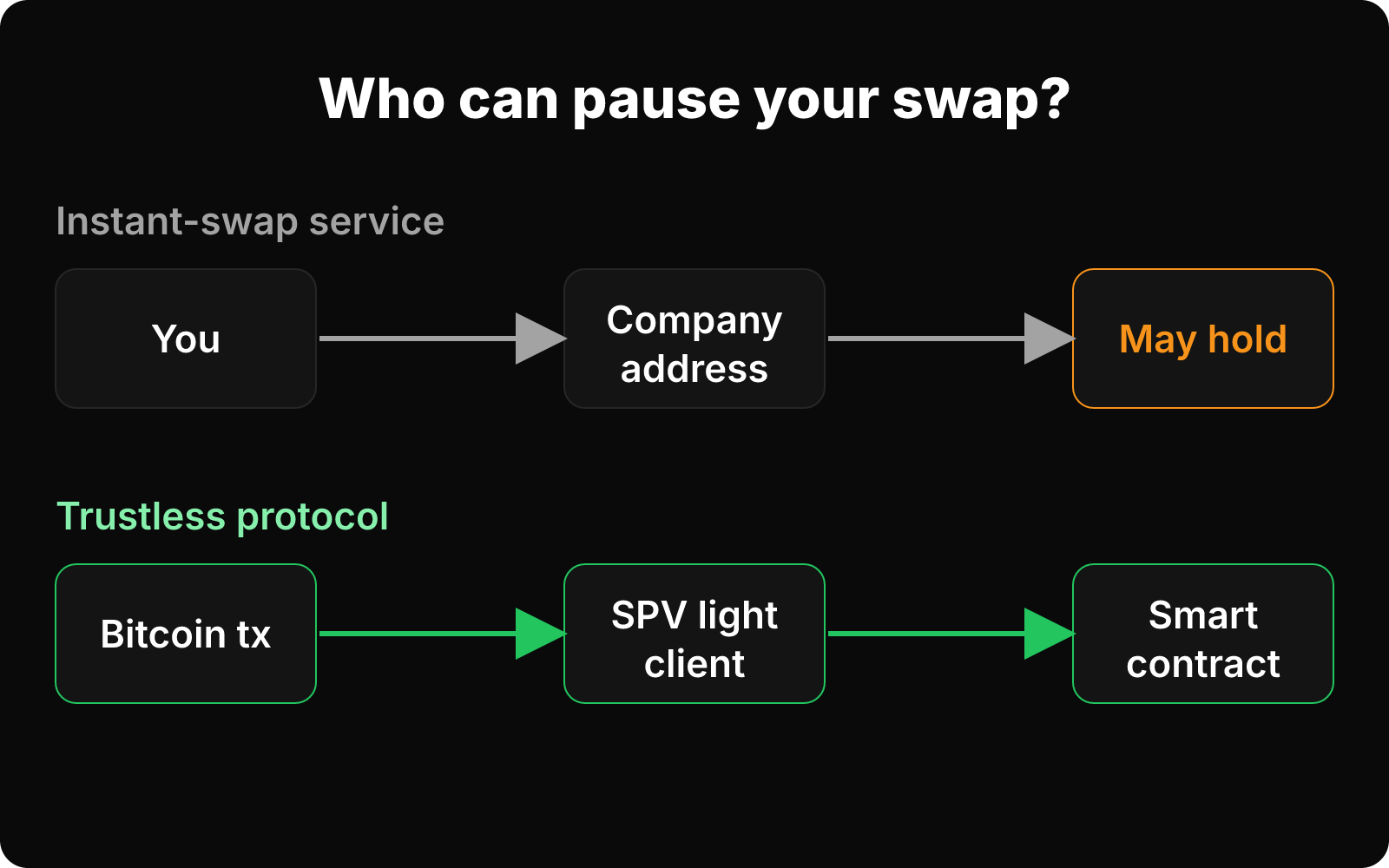
Most "no-KYC" services only skip KYC up to a point. Above a threshold, or when a deposit gets flagged, they can freeze the swap and ask for documents. This is the biggest surprise for beginners, and it usually happens with the money already sent.
A Godex analysis of no-KYC exchange limits sorts services into three models. Godex is itself a competitor and these figures are not independently verified, so treat them as indicative:
- Published ceilings. Changelly is cited at €10,000 per 48 hours for crypto swaps before verification. StealthEX and ChangeHero are cited at roughly $700 for fiat purchases, and StealthEX's July 2026 Terms reportedly allow risk-based checks on any swap.
- Discretionary. ChangeNOW and SimpleSwap are described as verifying "at their discretion," with no published limit. That makes it impossible to plan around.
- No-account. No account, email or ID for standard swaps, but risk-based AML checks still apply.
The pattern is the same in all three. When an intermediary holds your coins between the deposit and the payout, it can pause the swap. Coingape's listing notes that GhostSwap, for example, can hold a flagged deposit until identity or source-of-funds information is provided. Our trustless swap vs custodial exchange comparison goes deeper on this.
What is a trustless crypto swap, and why does custody matter?
A trustless crypto swap is one where you don't need to trust a company to hold your coins and send the other side back. Code and cryptographic proofs enforce the result. "Trustless" doesn't mean risk-free. It means the risks are in code you can inspect rather than in a company's discretion.
For Bitcoin, this is harder than it sounds. Bitcoin can't natively "see" Ethereum, Base or Arbitrum, so to use BTC on those chains you need a wrapped version: a token on the other chain that represents real BTC. Who backs that token, and how, is what separates the options:
- WBTC is backed by BTC held by a custodian.
- cbBTC is backed by BTC held in custody by Coinbase.
- tBTC uses a rotating group of signers who jointly control deposits under a threshold scheme.
- TeleBTC, TeleSwap's wrapped Bitcoin, is backed 1:1 by real BTC and verified with an SPV light client rather than a custodian or multi-sig committee.
What is an SPV light client? SPV ("Simplified Payment Verification") is described in Section 8 of the Bitcoin whitepaper. It lets a program confirm that a Bitcoin transaction is buried in the proof-of-work chain by checking block headers and a Merkle proof, without downloading the entire blockchain. TeleSwap runs this check on the destination chain, so no TeleBTC is minted unless a real Bitcoin transaction has been verified.
Custody is collateral-backed and slashable, which means the parties holding BTC (called Lockers) put up collateral they lose if they misbehave. The TeleSwap documentation covers the full design, and How Bitcoin Bridges Work: SPV Light Clients Explained is a gentler introduction.
Back to the vending machine. An instant-swap service has a person behind the glass. A trustless crypto swap shows you the gears through transparent glass, and they turn the same way for everyone.
How do I do a no KYC Bitcoin swap step by step?
With TeleSwap, a no KYC Bitcoin swap means sending native BTC from your own Bitcoin wallet and receiving a token such as USDC or ETH at your own address on another chain, in one flow. Fast swaps settle in about 10 minutes, and fees are paid in Bitcoin assets. You don't need ETH for gas first, because a Teleporter covers destination-chain gas for you.
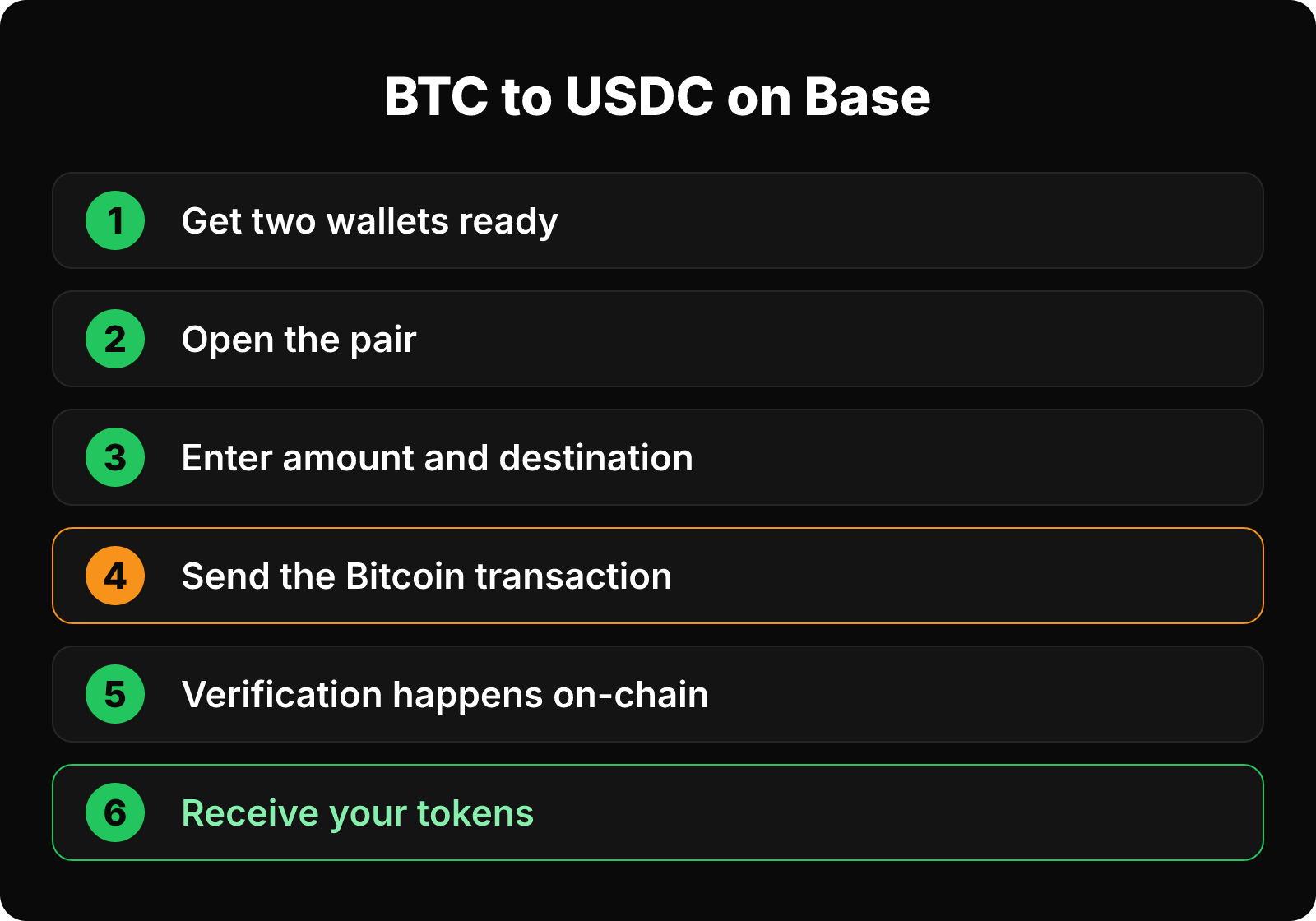
Here's a practical example: swapping BTC to USDC on Base.
- Get two wallets ready. You need a Bitcoin wallet holding your BTC and a destination address on Base, such as a MetaMask address. Both wallets are yours. No exchange account sits in between.
- Open the pair. Go to BTC → USDC on Base on teleswap.xyz.
- Enter the amount and destination. Type how much BTC to swap, paste your Base address, and review the quote, including the fees.
- Send the Bitcoin transaction. Sign it from your Bitcoin wallet. This is the one action that moves your funds.
- Verification happens on-chain. The light client verifies your Bitcoin transaction, TeleBTC is minted 1:1, and it's routed through a DEX into USDC.
- Receive your tokens. USDC arrives at your Base address. When you want to go back, the reverse route, USDC (Base) → BTC, returns native BTC.
The same flow works for other routes, for example BTC → ETH on Arbitrum. If you already use another app, TeleSwap is integrated as a Bitcoin swap provider in the Rango, Rubic and DZap aggregators, and it's reachable from MetaMask and Trust Wallet through the Rango integration.
Because TeleSwap is a protocol, it doesn't hold a balance on your behalf the way an exchange account does. Wallet apps and aggregators that integrate it may set their own access rules by region, so check the terms of whatever interface you use.
What does a no-KYC swap actually cost?
You usually pay four things: the exchange spread, the platform fee, the payout fee, and your own network fee for sending the deposit. The first three should appear in one quote. The network fee usually doesn't, which is why people end up surprised.
Network fees vary a lot by chain. Median USDT transfer fees measured on 23 September 2026 and reported by AMBCrypto (a sponsored post, so treat as indicative) were:
| Network | Median USDT transfer fee (23 Sep 2026) |
|---|---|
| Solana | $0.00059 |
| Polygon PoS | $0.0020 |
| BNB Smart Chain | $0.0021 |
| Arbitrum One | $0.0025 |
| TON | $0.0026 |
| Ethereum | $0.18 |
Rate type matters too. A fixed rate locks your price for a window (SimpleSwap's lock is reported at 20 minutes). A floating rate moves with the market until the swap completes. On TeleSwap, fees are paid in Bitcoin assets and the Teleporter covers destination-chain gas, so you don't have to buy ETH just to receive a token on Ethereum or an L2. For a fee-focused comparison, see Lowest Fee Swap BTC No KYC: 4 Options Compared.
How do the main no-KYC options compare?
No single option wins on every measure. The right choice depends on whether you care more about custody, privacy, asset range or simplicity. In practice, the clearest dividing line is whether a company holds your coins during the swap.
| Option | ID required? | Who holds funds mid-swap | Native BTC in? | Main caveat |
|---|---|---|---|---|
| Centralized exchange (Binance, KuCoin) | Yes, tiered | The exchange | Yes | Full KYC; account-level freeze risk |
| Instant swap with published ceiling (Changelly, StealthEX) | Above threshold | The service, briefly | Yes | Thresholds and terms can change |
| Instant swap, discretionary (ChangeNOW, SimpleSwap) | At provider's discretion | The service, briefly | Yes | No published limit to plan around |
| DEX (Uniswap) | No | You (smart contract pool) | No, needs wrapped BTC | Requires a wallet and native gas token |
| THORChain | No | Protocol node network | Yes | Fully public on-chain trail |
| Bisq (P2P) | No | Peer-to-peer escrow | Yes | Depends on finding counterparties |
| TeleSwap | Protocol flow from your own wallet | Collateral-backed, slashable Lockers; minting gated by SPV proof | Yes | Public on-chain trail; front-end terms vary by region |
Scale tells you something about reliability. Per TeleSwap network stats (retrieved 2026-11-14), TeleSwap has bridged $563.1M across 597,641 transactions on 13 supported networks. Over the last 30 days it handled $44.4M, averaging about $1.5M per day, with a peak of $3.0M on 2026-11-13.
Frequently Asked Questions
Can I swap crypto without ID verification in 2026?
Yes, through DEXs, cross-chain protocols and instant-swap services, though many instant-swap services can still request ID above limits or on flagged deposits. Read each service's terms before sending funds, because once your coins are deposited, the service decides what happens next.
Is a no KYC crypto swap safe?
It can be, but safety depends mostly on custody and smart contract design, not on whether ID is required. Check who holds your funds mid-swap, whether there's a refund path, and whether the service has a track record you can verify. Start with a small test amount.
Does TeleSwap require an exchange account?
No. TeleSwap is a protocol, not an exchange account: you start a swap from your own Bitcoin wallet and receive tokens at your own address on the destination chain. Bitcoin transactions are verified by an SPV light client, and TeleBTC is minted only after that verification. Third-party interfaces may apply their own regional rules.
What is TeleBTC?
TeleBTC is TeleSwap's wrapped Bitcoin token, backed 1:1 by real BTC and secured by SPV light client proofs rather than a custodian or multi-sig committee. It's the asset a swap passes through when you go from native BTC to tokens like USDC or ETH on EVM chains, TON or Solana.
How long does a no KYC Bitcoin swap take?
On TeleSwap, fast swaps settle in about 10 minutes. Instant-swap services advertise anywhere from a few minutes to around half an hour, depending on Bitcoin confirmations and congestion on the destination chain.
Do I still pay taxes on a no-KYC swap?
Yes. Tax obligations don't depend on whether you completed KYC. In the US, the IRS treats digital assets as property, so crypto-to-crypto swaps are generally taxable. Keep records of dates, amounts and values, and consult a tax professional for your situation.
Conclusion
A no KYC crypto swap is easy to find in 2026. Knowing what you're actually getting takes more care. Three points to remember:
- "No KYC" is often conditional. Many services can hold a deposit and ask for documents once your funds are already with them.
- No KYC doesn't mean anonymous. Public blockchains record everything, and your tax obligations still apply.
- Custody matters most. A trustless crypto swap backed by verifiable proofs takes the intermediary's discretion out of the process.
If you hold native Bitcoin and want USDC, ETH or another token on a different chain, TeleSwap lets you do it from your own wallet. Your Bitcoin transaction is verified by an SPV light client, the swap is routed in one step, and destination gas is covered.