7 Ways to Earn Yield on Bitcoin in 2026 (and the Risks)

Bitcoin pays no interest, so every one of the ways to earn yield on bitcoin means lending, locking or providing your BTC to someone who pays you for it. This guide covers seven options available in November 2026, each with its custody model, the source of its yield and its main risk.
Bitcoin has no dividend and no built-in staking reward. Miners secure the network with proof-of-work and earn the block reward (3.125 BTC since the April 2024 halving). Holders don't earn it.
The asset doesn't change from one product to the next. What changes is who you hand it to, who pays you, and what goes wrong if things break. Dated rates are included wherever a reliable figure exists.
Key Takeaways:Bitcoin has no native yield, so every BTC yield product pays you for lending, locking, or providing your coins to someone else.Advertised Bitcoin yields often far exceed realized ones: Lombard's LBTC targeted a net 2.5% or more but averaged roughly 0.4% in the 30 days to October 25, 2026, according to DefiLlama data cited by EarnPark.Nexo's headline "up to 5.5%" BTC rate (October 2026) requires a balance above $5,000 and Platinum loyalty status, which means holding NEXO tokens worth at least 10% of your portfolio, per EarnPark's review of Nexo's terms.A yield paid in BTC keeps your exposure in Bitcoin, while a yield paid in a separate network token adds that token's price risk on top.Before you deposit, ask three questions: who holds the keys, who is paying the yield, and what is it paid in.
Table of Contents
- Where Does Bitcoin Yield Actually Come From?
- 1. Centralized Earn Accounts
- 2. DeFi Lending With Wrapped BTC
- 3. Bitcoin Staking and Security Delegation
- 4. Liquid Staking Tokens
- 5. DEX Liquidity Pools and Yield Farming
- 6. BTC-Paired Liquidity Paid in BTC
- 7. Covered Calls and Automated Vaults
- How Do BTC Yield Options Compare?
- How Should a Beginner Choose?
- Frequently Asked Questions
- Conclusion
Where Does Bitcoin Yield Actually Come From?
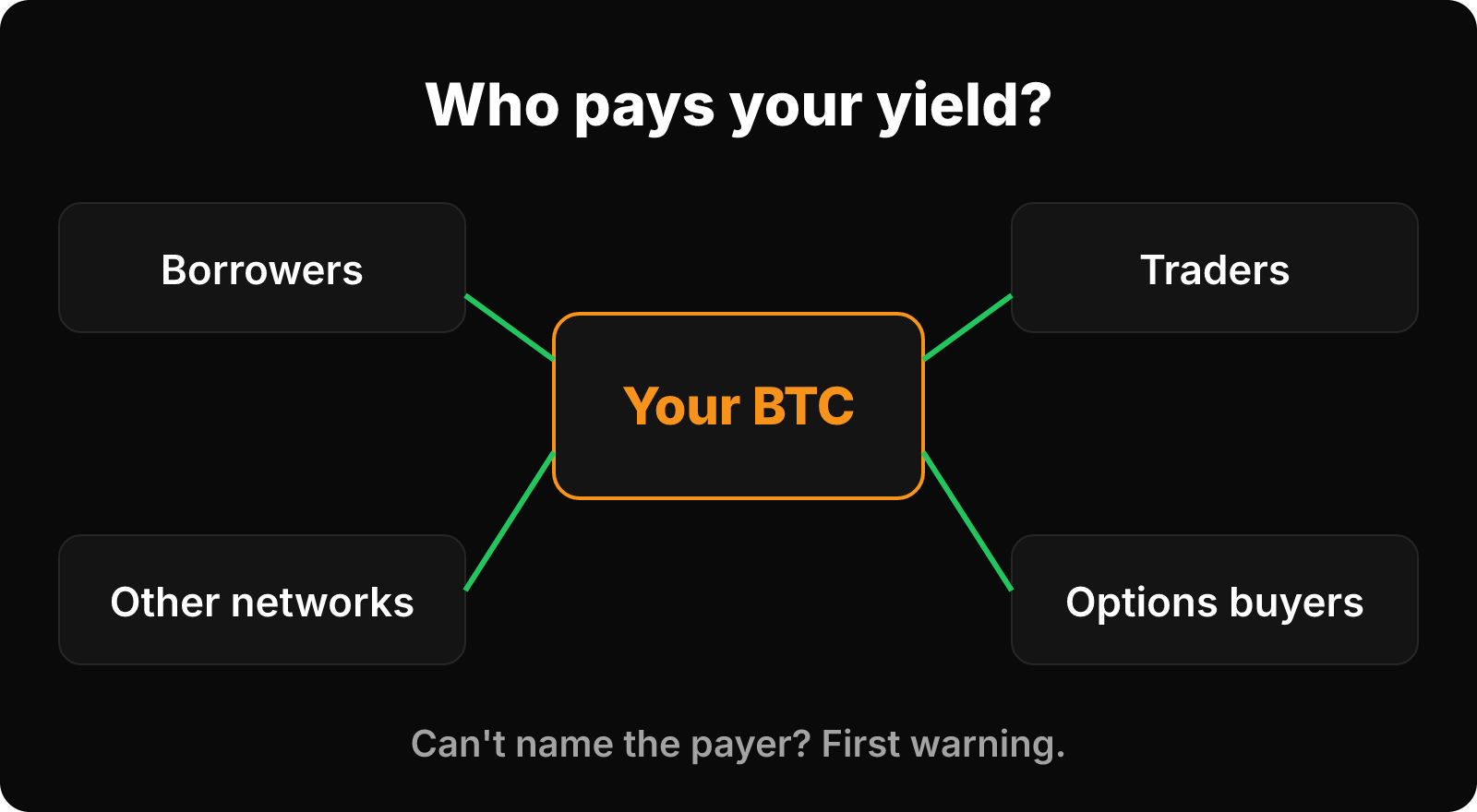
Bitcoin yield comes from one of four sources: borrowers paying interest, traders paying swap fees, other networks paying for security, or options buyers paying premiums. If a product can't tell you which of these is paying you, treat that as your first warning.
Think of your BTC like a spare room. You can rent it to a tenant (lending), run it as a short-stay rental where each guest pays a fee (liquidity pools), lease it to a neighbour who needs it as backing (staking or security delegation), or sell someone the option to buy the house at a set price later (covered calls). Each arrangement earns money in a different way and goes wrong in a different way.
The Bitcoin Foundation's 2026 BTCFi overview says risk "hides in custody, liquidity, protocol design, and complexity." That's a useful lens: whoever holds the coins matters as much as the strategy.
1. Centralized Earn Accounts: How Do You Earn Interest on Bitcoin at an Exchange?
How it works: You deposit BTC with a company such as Binance or Nexo. The company lends it out or runs strategies on it, and pays you a share. It's the closest thing to a bank savings account, and the easiest way to earn interest on bitcoin with a few clicks.
Custody model: Custodial. The company holds your keys, so your BTC is legally and practically in their hands.
What it pays: Usually less than the headline rate. As of October 25, 2026, Binance Simple Earn paid roughly 0.02% base on BTC, plus a 0.25% bonus limited to the first 0.01 BTC, according to EarnPark's snapshot of Binance's page. Nexo advertised "up to 5.5%," but the top rate requires the Platinum tier, which means holding NEXO tokens worth at least 10% of your portfolio. BTC-only holders get the lower base rate.
Main risk: Counterparty risk: the company fails, freezes withdrawals, or shuts the product down. Even well-run firms change course: Ledn retired its BTC Growth accounts in 2025 and now focuses on loans, according to EarnPark. When a custodial product closes, you follow the company's timeline, not yours.
2. DeFi Lending With Wrapped BTC
How it works: DeFi lending markets are run by smart contracts, programs that execute automatically on a blockchain. Ethereum-based apps can't hold native BTC, so you first convert it into a "wrapped" token such as WBTC or cbBTC. You then supply that token and borrowers pay interest to use it. On Stacks, protocols like Zest let you lend sBTC.
Custody model: You keep your own wallet, but your coins sit inside a smart contract, and the wrapped token is only as good as whatever backs it.
Main risk: There are two layers. The first is smart contract risk: a bug can drain the pool. The second is wrapper risk, which beginners often miss: custodial wrappers depend on someone holding the real BTC, and if that fails, the token can lose value even when the lending app works perfectly. Zest reports zero bad debt since its March 2024 launch, per Eco citing Crypto Briefing. This is a company-reported figure.
The wrapper decision matters at least as much as the lending app. TeleBTC, for example, is minted 1:1 only after a Bitcoin transaction is verified by an SPV light client, which checks Bitcoin's own proof-of-work headers. Its backing is collateralized and slashable, so it doesn't rely on a custodian or a multi-sig committee. For more, see Bitcoin wrapping without custodians.
3. Bitcoin Staking and Security Delegation
How it works: Bitcoin itself can't be staked. Newer systems let you lock BTC to help secure another network, which pays you for the security. Babylon and Stacks are the best-known examples. Stacks Bitcoin Staking went live in 2026 and is described as self-custodial, with STX providing the staking capacity, according to Eco.
Custody model: Mostly self-custodial. Your BTC is time-locked under rules you and the protocol agree to.
What it pays: UTXO Management, a Nakamoto Inc. subsidiary that joined Stacks staking in September 2026, targets roughly 3% BTC-denominated yield with self-custody, per Eco (citing Stacks' Q2 2026 ecosystem report). That's a target, not a guarantee.
Main risk: Slashing. On Babylon, misbehaviour by the validator you delegate to can cost you part of your stake, as crypto.news notes. A second risk is the reward currency. Babylon and Core pay rewards in their own network tokens, so the yield can shrink if that token falls. Stacks offers BTC-denominated rewards, a difference that matters more than most rate tables show.
4. Liquid Staking Tokens
How it works: Staked BTC is normally locked. A liquid staking token (LST) gives you a receipt token that represents your staked position, keeps earning, and can still be moved or used. Stacking DAO's stBTC is one example: you deposit BTC or sBTC and receive a token that auto-compounds, meaning rewards are added to the token's value over time. Eco lists stBTC's target at roughly 2.6% net.
Custody model: Smart-contract-based. You hold the receipt token, and the protocol holds the underlying stake.
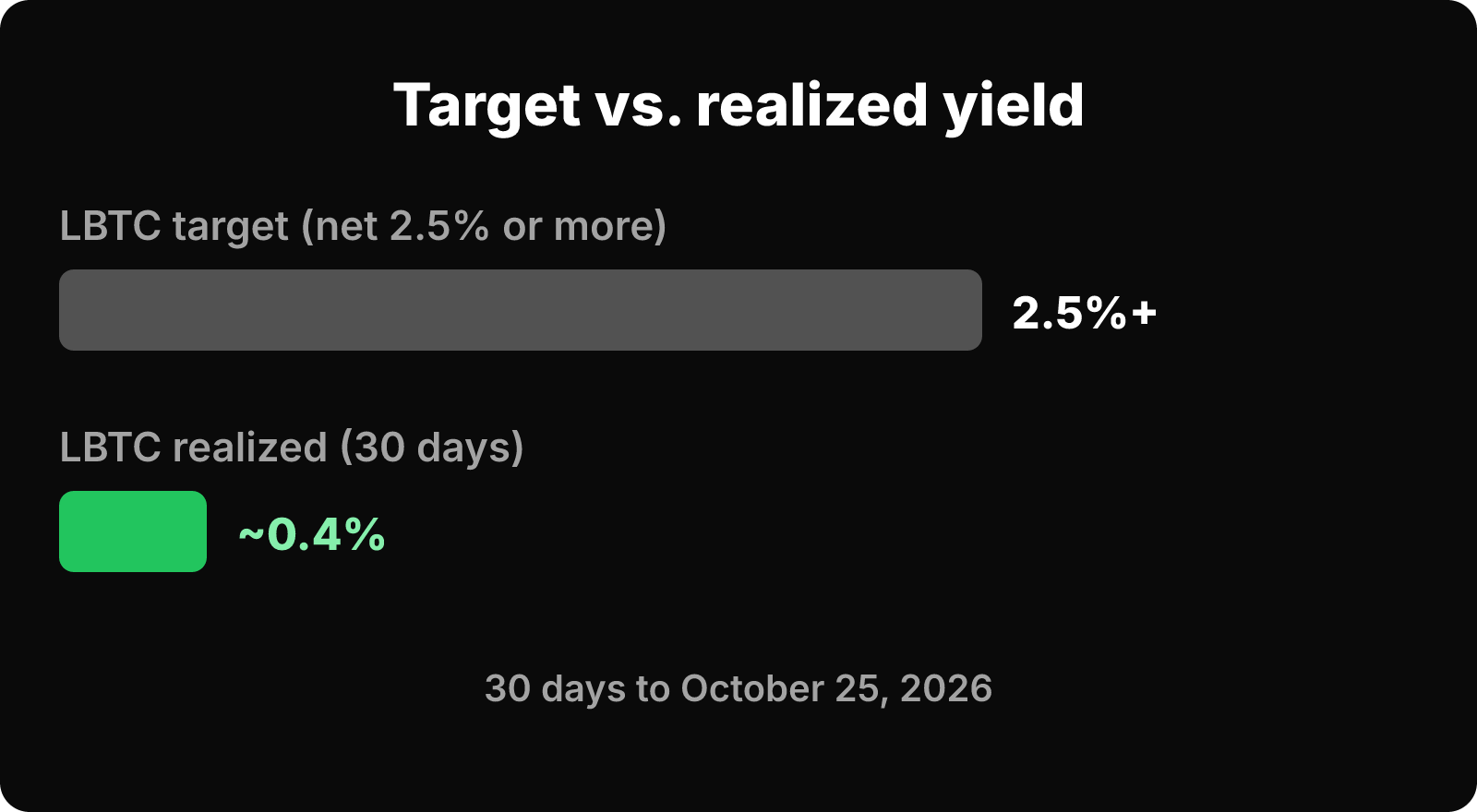
Main risk: Depeg risk, where the receipt token trades below the value of the BTC behind it, plus the risk of the underlying staking protocol. Strategies can also change under you. Lombard's LBTC started as a liquid Babylon staking token, then in August 2026 switched to a Bitwise-run covered call strategy targeting a net 2.5% or more. In the 30 days to October 25, 2026, it averaged around 0.4%, according to DefiLlama data cited by EarnPark.
5. DEX Liquidity Pools and Yield Farming
How it works: Decentralized exchanges (DEXs) like Uniswap, Curve, and PancakeSwap don't use order books. Traders swap against pools of two tokens, and the liquidity providers (LPs) who supply them earn a share of every swap fee. "Yield farming" or "liquidity mining" adds extra rewards in the protocol's governance token.
Custody model: Smart contract. While your tokens are deposited, they sit in the pool.
Main risk: Impermanent loss. If you pair BTC with a stablecoin and BTC's price surges, the pool sells some of your BTC along the way, and you end up with less BTC than if you'd held it. LiteFinance explains that this loss becomes permanent if you withdraw while prices are still diverged. Farming rewards add a second risk, because governance tokens can lose value quickly.
6. BTC-Paired Liquidity Paid in BTC
How it works: This is a variation on option 5 where both sides of the pool are Bitcoin assets. TeleSwap's Earn feature supplies single-sided liquidity to teleBTC pools, and you earn the fees paid by swaps through the pool, paid out in BTC. It's variable fee income, not a fixed rate and not protocol staking.
Custody model: You can deposit native BTC straight from a Bitcoin wallet in one Bitcoin transaction, with no EVM wallet, gas or approval needed. Claiming and withdrawing are also Bitcoin transactions, and the BTC arrives at your Bitcoin address. Native deposits go into the pools on Polygon and BNB Smart Chain. The first deposit must be at least 0.0001 BTC, with a 0.1% locker fee, a 0% protocol fee, and the Bitcoin miner fee. If you already hold WBTC on Polygon or BTCB on BNB Smart Chain, you can deposit from an EVM wallet instead (or get BTCB with a BTC to BTCB swap).
What it pays: As of November 8, 2026, the 7-day average APR was 6.39% for the WBTC/TeleBTC pool on Polygon and 17.56% for the BTCB/TeleBTC pool on BNB Smart Chain, per the live Earn page. These numbers are variable and move daily, so don't read them as a forecast. The fees come from usage: TeleSwap network stats show $551.4M in total volume bridged across 583,800 bridge transactions and 13 supported networks, including $40.1M in the last 30 days.
Main risk: Because both sides track BTC, classic impermanent loss is likely smaller than in a BTC/stablecoin pool, but if one token loses its peg you can end up holding more of the weaker asset. Smart contract risk applies as in any pool, and fee income falls when swap volume falls. The full mechanics are in the documentation. For a deeper walkthrough, see earning yield on native Bitcoin.
7. Covered Calls and Automated Vaults
How it works: A covered call means selling someone the right to buy your BTC at a set price by a set date. You collect a premium up front. If BTC stays below that price, you keep the premium and your BTC. If it rises above, your upside is capped. Binance's BTC Yield product and Lombard's LBTC both use this approach. Automated vaults go further: Zest's zvstBTC, launched in mid-September 2026, "loops" by posting stBTC as collateral, borrowing sBTC, staking it into more stBTC, and repeating, targeting 6–8%, per Eco.
Custody model: It varies. Binance is custodial, while LBTC and Zest are smart-contract-based.
Main risk: With covered calls, you give up your biggest gains in exchange for small premiums. Binance's BTC Yield averaged 0.51% as of October 25, 2026, per its own product page cited by EarnPark. With looped vaults, leverage means a depeg or price shock can trigger liquidation, the forced sale of your collateral. Zest capped zvstBTC at 10 BTC of initial capacity while it stress-tests the strategy, a sign it isn't yet proven at scale.
How Do BTC Yield Options Compare?
The table below sets out the seven options side by side. Rates are dated snapshots or stated targets, not expected returns.
| Option | Who holds the keys | Who pays you | Paid in | Example rate (date, type) | Main risk |
|---|---|---|---|---|---|
| 1. CeFi earn account | The company | Borrowers / platform strategies | BTC (or platform token for top tier) | Binance Simple Earn ~0.02% base (Oct 25, 2026); Nexo up to 5.5% (Oct 2026, gated) | Counterparty failure |
| 2. DeFi lending | Smart contract + wrapper custodian | Borrowers | Wrapped BTC | Varies by market | Contract bugs, wrapper failure |
| 3. Bitcoin staking | You (time-locked) | Network being secured | BTC or network token | ~3% BTC target, UTXO Management (Sept 2026, target) | Slashing, reward-token price |
| 4. Liquid staking token | Smart contract | Network / strategy | Token value accrual | stBTC ~2.6% (2026, target); LBTC ~0.4% (30 days to Oct 25, 2026, realized) | Depeg, strategy changes |
| 5. DEX liquidity pool | Smart contract | Traders (swap fees) + token emissions | Pool tokens + governance token | Varies by pool | Impermanent loss, emission-token volatility |
| 6. BTC-paired liquidity (BTC-paid) | Smart contract; native BTC in/out via Bitcoin transactions | Traders (swap fees) | BTC | 6.39% Polygon / 17.56% BNB Smart Chain (7-day avg, Nov 8, 2026, variable) | Peg risk, contract risk, volume swings |
| 7. Covered calls / vaults | Custodial or smart contract | Options buyers / leverage | BTC or vault token | Binance BTC Yield 0.51% (Oct 25, 2026); zvstBTC 6–8% (Sept 2026, target) | Capped upside, liquidation |
Wherever a realized figure exists next to a target, the realized figure is lower. EarnPark reached the same conclusion: for retail products, "realised figures sit well below their targets." Compare realized rates, not marketing targets.
How Should a Beginner Choose? A Three-Question Framework for Bitcoin Passive Income in 2026
Before you deposit any BTC anywhere, answer these three questions in writing:
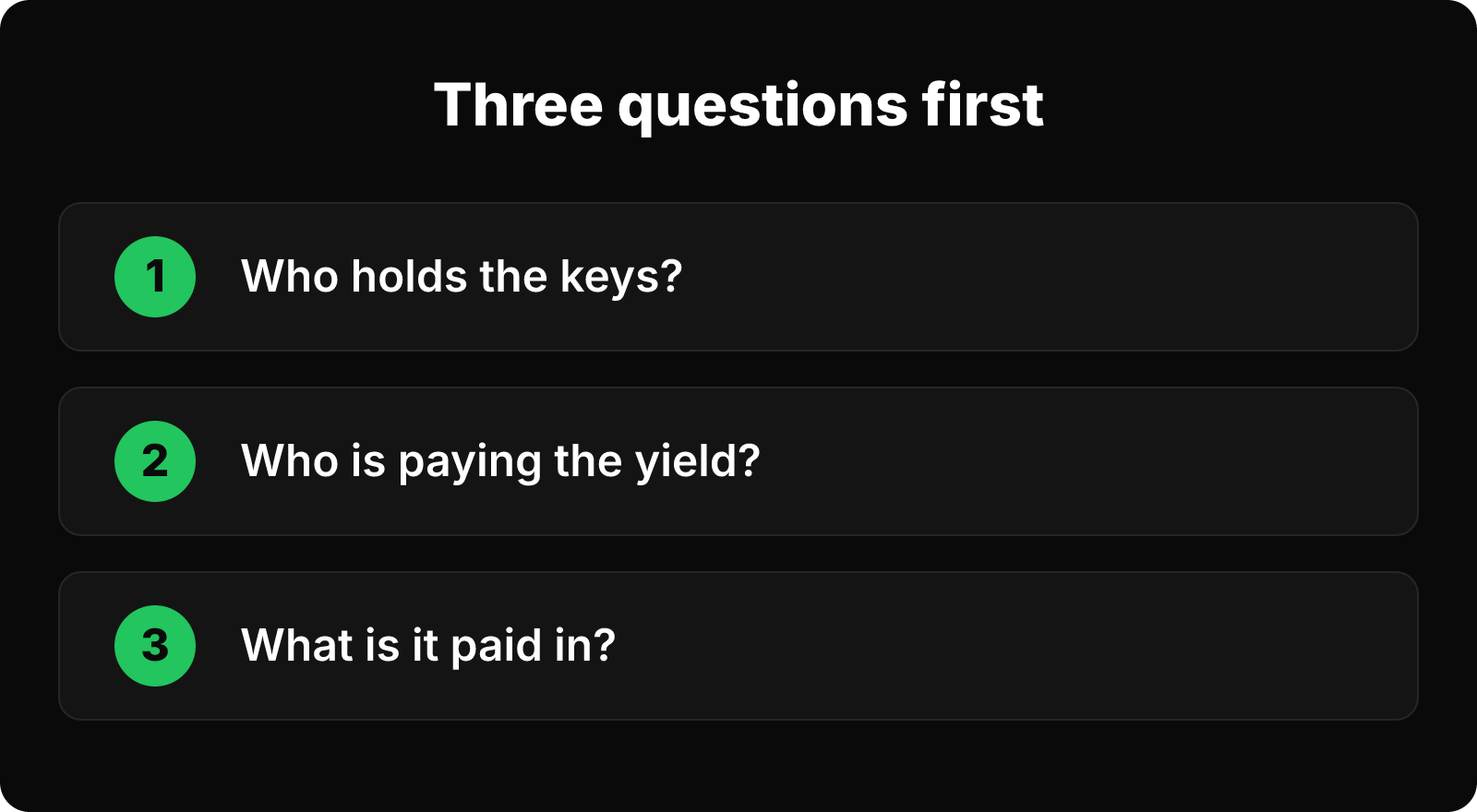
- Who holds the keys? If it's a company, you're trusting its balance sheet. If it's a smart contract, you're trusting its code and any wrapper behind it. If it's you, ask what the time-lock or slashing rules are.
- Who is paying the yield, and why? Name the payer: borrowers, traders, a network, or options buyers. If you can't, the yield may be coming from new deposits or token emissions, which don't last.
- What is it paid in? BTC-denominated yield keeps you in Bitcoin. Yield paid in a separate token is a second investment you didn't plan to make.
Some practical habits to follow:
- Start small. Test any product with an amount you'd be fine losing, and complete one full deposit-and-withdraw cycle before adding more.
- Read the tier terms. EarnPark calls gated headline rates "the first thing to check on any CeFi rate."
- Watch for strategy drift. LBTC's August 2026 change shows a product can turn into something else after you buy it.
- Don't stack risks without meaning to. A leveraged vault built on a liquid staking token built on a wrapped asset carries three layers of risk, not one.
- Remember that holding is a valid choice. Self-custody with zero yield is a real option, not a missed opportunity.
The highest-risk option isn't always the one with the highest rate. A 0.5% custodial account can still lose your entire balance if the company fails. Judge each option by how it can fail, not by its number.
Frequently Asked Questions
Can you earn interest on Bitcoin without giving up custody?
Yes, though the closest you'll get to full self-custody is time-locked staking or protocols that verify deposits on Bitcoin directly. Stacks Bitcoin Staking is described as self-custodial, and TeleSwap Earn accepts native BTC from a Bitcoin wallet and pays withdrawals back to your Bitcoin address. Most DeFi options still place your coins in a smart contract while they're deployed, so you trade custodian risk for code risk.
What is the safest way to earn yield on Bitcoin?
No Bitcoin yield option is risk-free. The only zero-risk choice is to hold BTC in your own wallet and earn nothing. Every yield product adds at least one risk: counterparty, smart contract, slashing, depeg, impermanent loss, or liquidation. Choose the risk you understand best and size your position to match.
Why are advertised Bitcoin yields higher than what people actually earn?
Advertised rates are often targets, tier-gated maximums, or include bonuses that apply only to tiny balances. For example, Lombard's LBTC targeted a net 2.5% or more but averaged about 0.4% in the 30 days to October 25, 2026, according to DefiLlama via EarnPark. Nexo's "up to 5.5%" requires holding its token. Always look for realized, dated figures.
What is impermanent loss in a Bitcoin liquidity pool?
Impermanent loss is the shortfall you suffer compared with simply holding your tokens, caused by the pool rebalancing when the paired assets' prices move apart. If you pair BTC with a stablecoin and BTC rallies, you end up with less BTC. Pools where both sides track BTC should reduce this effect, as long as both tokens hold their peg.
Is Bitcoin staking the same as Ethereum staking?
No. Bitcoin uses proof-of-work and has no native staking, so "Bitcoin staking" means locking BTC to secure a different network. Systems like Babylon and Stacks pay you for providing that security. Rewards may come in BTC or in the other network's token, and some designs include slashing penalties.
How does TeleSwap's Earn feature pay yield on Bitcoin?
It pays a share of the swap fees generated in its teleBTC pools, and the payouts arrive in BTC. You can deposit native BTC in a single Bitcoin transaction (minimum 0.0001 BTC for the first deposit, 0.1% locker fee, 0% protocol fee, plus the miner fee) or deposit WBTC on Polygon or BTCB on BNB Smart Chain. The rate is variable. As of November 8, 2026, the 7-day average APRs were 6.39% (Polygon) and 17.56% (BNB Smart Chain).
Conclusion
None of the seven ways to earn yield on bitcoin is free money. Each one rents out your BTC on different terms. Centralized accounts are simple but put a company between you and your coins. Staking and liquid staking tokens depend on another network's rules and, often, its token. Pools and vaults rely on code, pegs, and trading volume. The highest rates on a marketing page are usually targets, and realized numbers tend to come in lower.
Run every option through the three questions: who holds the keys, who pays, and in what currency. If a BTC-denominated, fee-based yield with native Bitcoin deposits and withdrawals fits your answers, compare the live, dated pool rates on the TeleSwap Earn page. Start with a small amount and go through one full deposit-and-withdraw cycle before you commit more.