What Is Robinhood Chain? FAQ for Bitcoin Holders (2026)
Short answer: Robinhood Chain is a blockchain built by Robinhood on top of Ethereum. It is an "Ethereum Layer 2" made for trading tokenized stocks, stablecoins and other crypto assets. Gas fees are paid in ETH, and its public mainnet went live on July 1, 2026, according to Robinhood's newsroom. Bitcoin doesn't run on it natively, so if you hold BTC you need a bridge or a cross-chain swap to use it there.
If you're asking what is Robinhood Chain because you hold Bitcoin and keep seeing it in the news, the next question is usually "can my BTC go there, and should it?" This guide answers that in plain English, with sources and dates, and it's honest about the parts that are still unproven.
Key Takeaways:Robinhood Chain is an Ethereum Layer 2 built on Arbitrum technology, and its public mainnet launched on July 1, 2026.Robinhood Chain has no native token of its own; transaction fees are paid in ETH.Native Bitcoin cannot exist directly on Robinhood Chain, so BTC holders must use a bridge or cross-chain swap to get ETH, USDG or a wrapped BTC token there.Total value locked on Robinhood Chain first crossed $1 billion on September 22, 2026, according to Cryptoticker.Robinhood runs the chain's single sequencer, so "permissionless" means anyone can use it, not that it's decentralized.
Table of Contents
- What is Robinhood Chain, in plain English?
- How does Robinhood Chain work?
- What tokens are on Robinhood Chain?
- Can I hold Bitcoin on Robinhood Chain?
- How do I move native BTC onto Robinhood Chain?
- How do I get back to native BTC?
- Is Robinhood Chain safe? What are the risks?
- How does Robinhood Chain compare to Bitcoin?
- What should a Bitcoin holder actually do?
- Frequently Asked Questions
- Conclusion
What Is Robinhood Chain, in Plain English?
Robinhood Chain is a public blockchain run by Robinhood, the US trading app, and it's designed for buying, selling and holding tokenized assets such as stock tokens and stablecoins. Anyone with a compatible crypto wallet can use it. You don't need a Robinhood brokerage account.
Here's an analogy. Think of Ethereum as a big, secure city courthouse where every important record is filed. Lots of people want to file records there, so it's slow and expensive. Robinhood Chain is like a busy branch office down the street. It handles the day-to-day paperwork quickly and cheaply, then sends compressed summaries to the main courthouse.
The timeline is short:
- 2025: Robinhood started issuing 200+ tokenized US stocks and ETFs to EU customers on Arbitrum One, planning to move them later to its own chain, per Cryptoticker.
- February 10, 2026: The public testnet (a practice version using worthless tokens) launched, Robinhood announced.
- July 1, 2026: Mainnet (the real, live network) launched at a keynote in London, with Chainlink adopted as its official data and cross-chain oracle, according to PR Newswire.
Legally, the chain is offered through Robinhood Digital Assets, LLC, which describes itself as a software provider, not a regulated financial adviser. Using the chain is not the same as using the Robinhood brokerage app.
How Does Robinhood Chain Work? Robinhood Chain Explained
Robinhood Chain is a "rollup": it processes transactions on its own fast network, then bundles them and posts the records to Ethereum. It's built with Arbitrum's technology, the same software stack behind Arbitrum One.
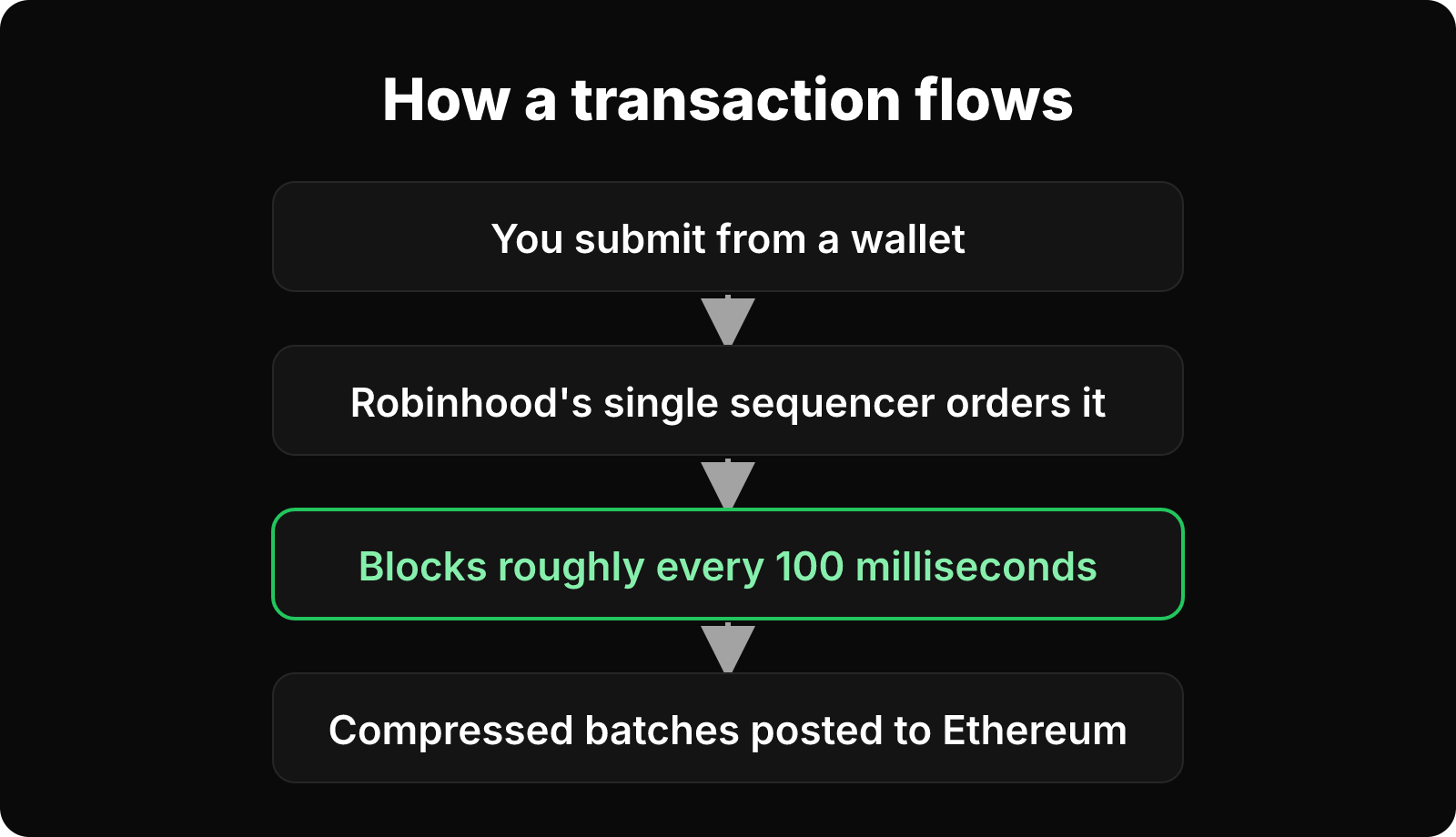
Here are the moving parts, in beginner terms:
- You submit a transaction from a wallet, for example a swap from ETH to a stablecoin.
- The sequencer puts it in order. A sequencer is the computer that decides which transaction goes first. On Robinhood Chain there's a single sequencer, run by Robinhood, that orders transactions strictly by arrival time, according to DataWallet.
- Blocks are produced roughly every 100 milliseconds, so confirmations feel almost instant.
- Batches are compressed and posted to Ethereum. That's where the chain inherits its security.
Because the chain is "EVM-compatible" (it runs the same kind of smart contracts as Ethereum), wallets like MetaMask or Rabby can connect to it once you add the network details from Robinhood's official support page. And because fees are paid in ETH, you'll usually need a small ETH balance on the chain before you can do anything.
What Tokens Are on Robinhood Chain?
The main Robinhood Chain tokens a Bitcoin holder will care about are ETH (used for gas fees) and USDG (a US-dollar stablecoin), plus tokenized stocks and a large, volatile memecoin market. There is no official "Robinhood Chain coin." Treat any token that claims to be one, or promises an airdrop, as a likely scam.
ETH: the fuel
Every transaction on Robinhood Chain pays a small fee in ETH, the same asset that powers Ethereum. Robinhood subsidized gas through a 90-day program that ended around September 29, 2026, DataWallet reports. Since then, users have paid the fees themselves.
USDG: the digital dollar
USDG ("Global Dollar") is a dollar stablecoin issued by Paxos. It aims to stay worth $1. For a Bitcoin holder, USDG is the simplest way to hold dollar-denominated value on Robinhood Chain without taking on crypto price swings, though like any stablecoin it carries issuer and reserve risk.
Stock tokens and everything else
Stock Tokens like NVDA, GOOG and AAPL are issued as standard ERC-20 tokens, per the Chainlink launch release. Whether you can access them depends on where you live. Robinhood also says it doesn't vet tokens deployed on the chain, just as no one vets tokens on Ethereum, Cryptoticker notes. A token being on Robinhood Chain doesn't mean Robinhood endorses it.
Can I Hold Bitcoin on Robinhood Chain?
Not native Bitcoin. Robinhood Chain is an Ethereum-based network, and real BTC can only live on the Bitcoin blockchain. What you can hold on Robinhood Chain is a token that represents BTC, or something you got by swapping BTC, such as ETH or USDG.
"Bitcoin on Robinhood" can mean two very different things:
- BTC in the Robinhood brokerage app. Robinhood holds it for you (custodial). It doesn't sit on Robinhood Chain in your own wallet.
- BTC exposure on Robinhood Chain. A token in a self-custody wallet that's either backed by BTC held somewhere else (a "wrapped" token) or is a different asset you swapped your BTC into.
Every BTC on a non-Bitcoin chain is a claim on BTC held elsewhere, so the useful question is "who or what stands behind the claim?" WBTC relies on a custodian network, and cbBTC relies on Coinbase. TeleBTC is minted only when a Bitcoin transaction is verified on-chain with SPV light-client proofs, and it is backed 1:1 by collateral-backed, slashable custody rather than a custodian or multisig committee. Before you bridge, check which wrapped BTC tokens actually have liquidity on Robinhood Chain.
| Option | What you end up holding | Who controls the keys | Route back to native BTC |
|---|---|---|---|
| Buy BTC in the Robinhood app | Custodial BTC (off-chain) | Robinhood | Withdraw to a Bitcoin wallet, where supported |
| Sell BTC on an exchange, then withdraw ETH/USDG to Robinhood Chain | ETH or USDG | You (once withdrawn) | Reverse the process through an exchange (KYC, two transfers) |
| Wrapped BTC from Ethereum + bridge | A wrapped BTC token | You, plus the wrapper's custodian or issuer | Bridge back, then unwrap through the issuer |
| Cross-chain swap from native BTC | ETH or USDG directly | You | Single reverse swap to a Bitcoin address |
How Do I Move Native BTC Onto Robinhood Chain?
The most direct way is a cross-chain swap: you send BTC from your Bitcoin wallet and receive ETH or USDG at your Robinhood Chain address, with no exchange account in between. Otherwise you'd sell BTC on a centralized exchange and withdraw, which usually means KYC and handing over custody for a while.
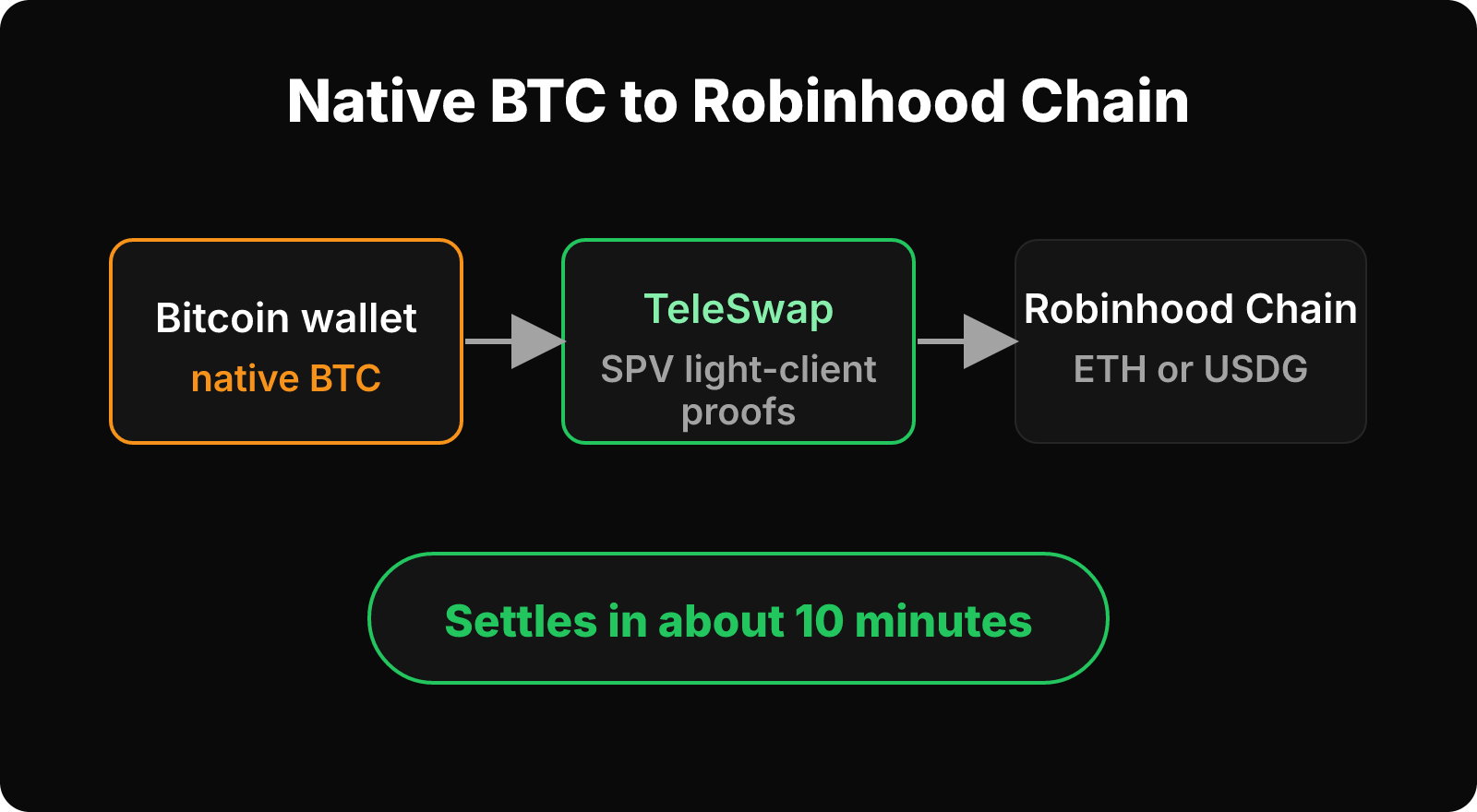
TeleSwap, a Bitcoin bridge that verifies Bitcoin transactions with SPV light-client proofs, offers two direct routes: BTC → ETH on Robinhood Chain and BTC → USDG on Robinhood Chain. For a step-by-step walkthrough, see our Bitcoin to Robinhood Chain bridge guide. The typical flow:
- Add Robinhood Chain to your wallet. Use Robinhood Wallet, which supports it natively, or add the network to MetaMask/Rabby using the official network details. Never copy RPC settings from a random website.
- Pick your target token. Choose ETH if you want to pay gas and explore apps. Choose USDG if you want dollar-stable value.
- Enter your Robinhood Chain address as the destination and check the quote.
- Send BTC from any Bitcoin wallet. Fees are paid in Bitcoin assets, and a Teleporter covers the destination-chain gas, so you don't need ETH first.
- Wait for settlement. Fast swaps settle in about 10 minutes.
For context, this infrastructure isn't new. It has processed $551.4M in total volume across 583,800 bridge transactions on 13 supported networks, including $40.1M in the last 30 days, according to TeleSwap network stats.
Do a small test swap first. Most failed cross-chain transfers come from a wrong address or network.
How Do I Get Back to Native BTC From Robinhood Chain?
Do a reverse swap: send ETH or USDG from your Robinhood Chain wallet and receive native BTC at a Bitcoin address you control. The USDG → BTC route turns the stablecoin back into bitcoin in one step, and there is a matching ETH → BTC route. Our USDG to BTC guide covers it in detail.
Many people find it easy to get onto a new chain and painful to leave. If your only exit is "bridge to Ethereum, sell on an exchange, withdraw," you pay gas on two chains plus trading fees. Know your exit before you go in.
Two checks before you swap back:
- Keep a little ETH on Robinhood Chain in case you need it for gas.
- Use a Bitcoin address type your wallet supports and double-check it character by character.
Is Robinhood Chain Safe? What Are the Risks?
Robinhood Chain inherits settlement security from Ethereum, but it has real centralization and market risks that Bitcoin holders should understand. "Built by a big public company" doesn't mean "risk-free."
1. One company orders the transactions
Robinhood runs the only sequencer, so it controls transaction ordering and uptime. "Permissionless" describes access. It says nothing about control, which is far from Bitcoin's model.
2. The headline numbers are mostly memecoins
TVL (total value locked) first crossed $1 billion on September 22, 2026 and was about $1.15B by October 22, per Cryptoticker. But tokenized assets' share of that TVL fell from about one-third on July 7 to around 6% by mid-August. Daily perpetual-futures volume rose from $13.5M in late July to $353.96M on September 1, 2026, according to DefiLlama data cited by DataWallet. Both sources say memecoins drive most activity.
3. Subsidies flattered early activity
Weekly chain fees fell about 68% in the four weeks after the gas subsidy ended, Cryptoticker reports. Robinhood's Q3 earnings are expected to be the first with a full quarter of mainnet data.
4. Scams and fake tokens
No native token has been confirmed. Never enter your seed phrase into a "faucet," "airdrop checker," or bridge site.
How Does Robinhood Chain Compare to Bitcoin?
Bitcoin is built for maximum decentralization and slow, final settlement. Robinhood Chain is built for speed and trading, and accepts a central operator to get it. They solve different problems.
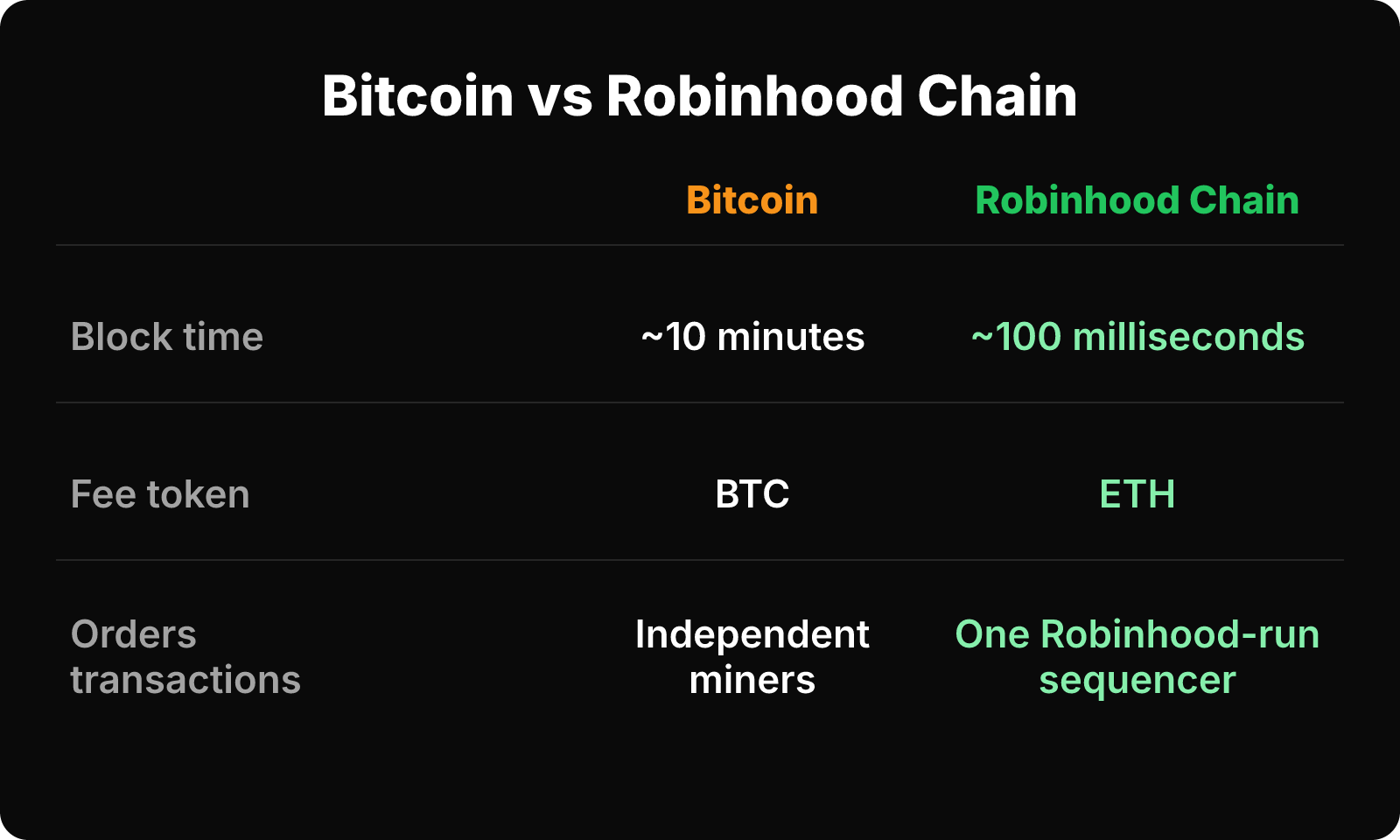
| Feature | Bitcoin | Robinhood Chain |
|---|---|---|
| Type | Layer 1, proof-of-work | Ethereum Layer 2 (Arbitrum-based rollup) |
| Mainnet launch | January 2009 | July 1, 2026 |
| Block time | ~10 minutes | ~100 milliseconds |
| Fee token | BTC | ETH |
| Who orders transactions | Independent miners | One Robinhood-run sequencer |
| Native token | BTC, capped at 21 million | None |
| Main use | Store of value, final settlement | Tokenized stocks, stablecoins, memecoins, perps |
Plenty of people use both: long-term savings in native BTC, and a small slice on a fast chain for trading or apps. If you do, keep your exit route back to native BTC simple.
What Should a Bitcoin Holder Actually Do?
Start small, decide why you're going there, and plan your way back before you move any BTC. Here's a five-point checklist:
- Define the goal. Stock-token exposure, stablecoin holding, or app exploration? That decides USDG or ETH.
- Check eligibility. Stock Tokens aren't available in every country.
- Get network details from the official source on robinhood.com, not from search ads or social posts.
- Test with a small amount, both in and out.
- Know what backs any BTC-like token. Ask who can freeze it, who redeems it, and whether there's liquidity to exit.
Frequently Asked Questions
Does Robinhood Chain have its own token?
No, Robinhood Chain has no native token, and gas fees are paid in ETH. No official token or airdrop has been confirmed in the sources we reviewed. Treat any token claiming to be the "official" Robinhood Chain coin as a likely scam.
Is Bitcoin in the Robinhood app the same as Bitcoin on Robinhood Chain?
No, BTC in the Robinhood app is held by Robinhood on your behalf and doesn't live on Robinhood Chain. To use BTC value on the chain, you need a self-custody wallet and either a wrapped BTC token or a swap from BTC into ETH or USDG.
Do I need a Robinhood account to use Robinhood Chain?
No, Robinhood Chain is a public, permissionless network that anyone with a compatible wallet can use. Robinhood Wallet supports it natively, and other EVM wallets like MetaMask can add it manually. Some products, such as Stock Tokens, may still have regional eligibility rules.
Is Robinhood Chain the same as Arbitrum?
No, Robinhood Chain is a separate blockchain built with Arbitrum's technology, not part of Arbitrum One itself. They share a software stack, but Robinhood Chain has its own Robinhood-run sequencer and its own ecosystem.
How long does it take to move BTC to Robinhood Chain?
A fast TeleSwap swap from native BTC settles in about 10 minutes. Exchange-based routes can take longer, depending on deposit confirmations, KYC and withdrawal processing.
Are fees on Robinhood Chain still free?
No, Robinhood's 90-day gas subsidy ended around September 29, 2026, so users now pay fees in ETH. You need some ETH on the chain to transact directly, though TeleSwap's Teleporter covers destination gas for swaps into the chain.
Conclusion
So, what is Robinhood Chain? It's a fast Ethereum Layer 2 that Robinhood operates, live since July 1, 2026. It runs on ETH for gas, and so far it's driven more by memecoins and perps than by tokenized stocks. Bitcoin can't live there natively, so you either swap into ETH or USDG or hold a token that represents BTC.
Plan your route back to native BTC before you leave. If you want a direct path in both directions, you can swap native BTC to ETH or USDG on Robinhood Chain, and back again, at teleswap.xyz.