Bitcoin Bridge Volume Statistics: 582k TeleSwap Swaps

Most published bitcoin bridge volume statistics come from someone else's dashboard. These come from our own. On 7 November 2026, the TeleSwap network stats API reported $550,152,280 in total volume bridged across 582,106 bridge transactions on 13 supported networks. Over the previous 30 days, the protocol moved $40.5M, about $1.4M per day, and the busiest day was $2.1M on 2026-11-05.
Below, each figure gets its own section, along with what the protocol does on-chain for a BTC deposit and how every number was computed. We give no market-share estimates and no third-party volume figures. The only usage numbers here are the ones our API returned.
Key Takeaways:TeleSwap had bridged $550,152,280 in total volume as of 7 November 2026, according to TeleSwap network stats.TeleSwap had processed 582,106 bridge transactions across 13 supported networks as of 7 November 2026.Total volume divided by transaction count gives an average of about $945 per TeleSwap bridge transaction.TeleSwap moved $40.5M in the 30 days before 7 November 2026, about 7.4% of its lifetime volume.TeleSwap's busiest day in that window was $2.1M on 2026-11-05, about 1.5× the 30-day daily average of roughly $1.4M.
Table of Contents
- What Counts as One Bridge Transaction?
- Finding 1: How Much Native BTC Cross-Chain Volume Has TeleSwap Moved?
- Finding 2: What Do 582,106 Transactions Say About Usage?
- Finding 3: How Did Activity Look in the Last 30 Days?
- Finding 4: Where Does the Volume Go Across 13 Networks?
- How Should Developers Read Bitcoin Bridge Volume Statistics in 2026?
- Methodology
- Frequently Asked Questions
- Conclusion
What Counts as One Bridge Transaction?
In TeleSwap, a BTC-in bridge transfer starts with a real Bitcoin transaction and finishes only after a smart contract verifies that transaction on the destination chain. In a light-client bridge, nothing is minted on a promise. The API reports a "bridge transactions" total but does not publish a more detailed counting definition, so we describe the mechanism and not the counter's internals.
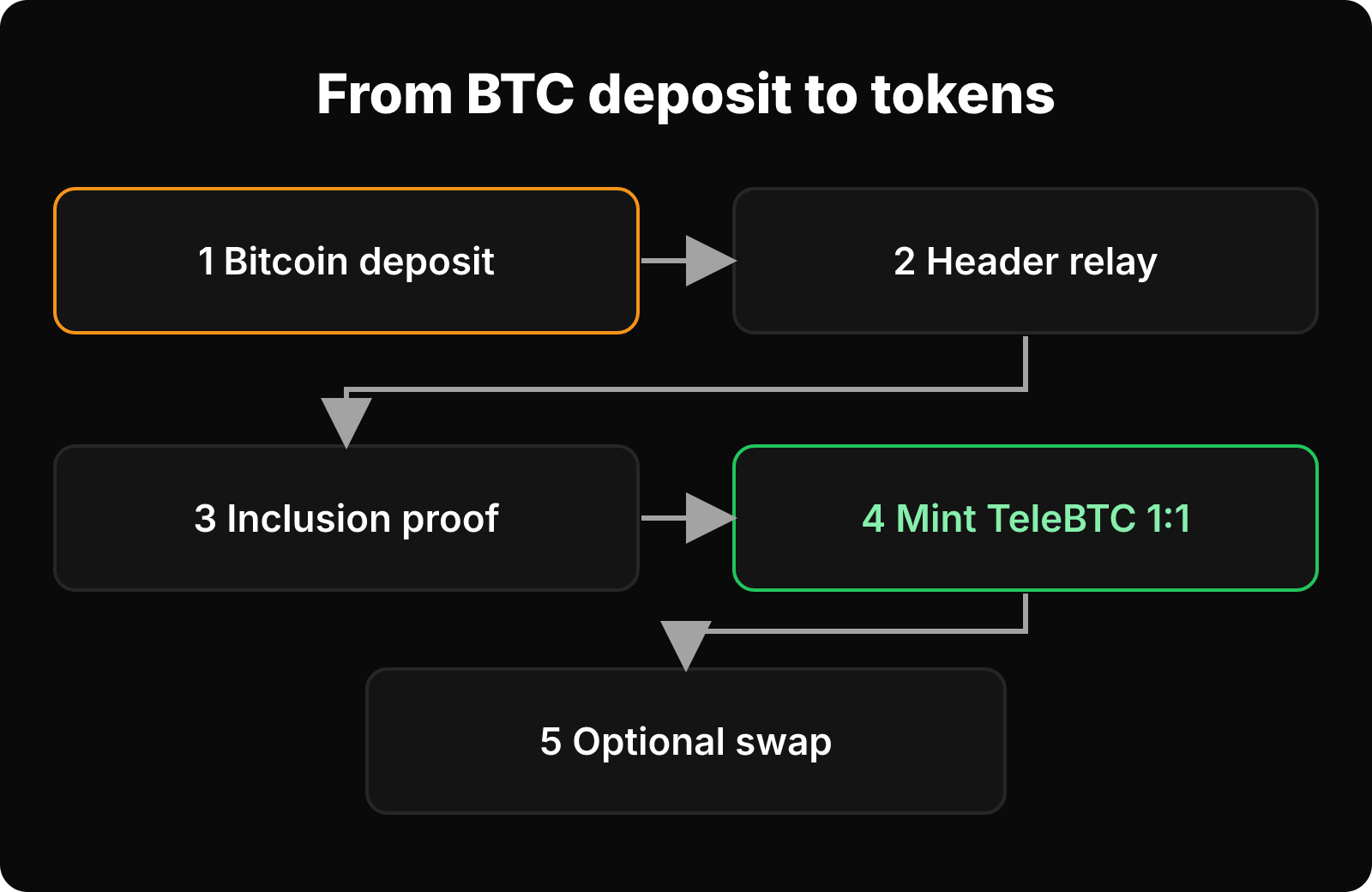
The mechanism is Simplified Payment Verification (SPV), which Satoshi Nakamoto described in section 8 of the Bitcoin whitepaper. An SPV verifier keeps only the chain of block headers, and each header commits to every transaction in its block through a Merkle root. To prove inclusion, you supply the transaction, the path of sibling hashes up to the Merkle root (a Merkle proof), and the header that holds that root. The header structure is set out in the Bitcoin developer reference for block headers. For a deeper walkthrough, see How Bitcoin Bridges Work: SPV Light Clients Explained.
The on-chain flow behind each counted swap
- Bitcoin deposit. The user sends BTC to a Locker. A Locker is a protocol custodian role backed by slashable collateral. The Bitcoin transaction carries the request: destination chain, recipient, and target token.
- Header relay. Relayers submit Bitcoin block headers to the light-client contract on the destination chain. The contract checks that each header links to the previous one and meets the proof-of-work target, so it needs no oracle for this step.
- Inclusion proof. A Teleporter submits the transaction along with its Merkle proof. The contract recomputes the Merkle root and matches it against a stored header.
- Mint. Once verification passes, the contract mints TeleBTC 1:1. TeleBTC is a collateral-backed representation of the BTC the Locker received.
- Optional swap. If the user asked for a different token, the TeleBTC is routed through the AMM/DEX. The user receives an ERC-20, Jetton, or SPL token. The Teleporter covers destination-chain gas, and the user pays fees in Bitcoin assets.
The reverse direction runs the other way. The user burns TeleBTC on the destination chain, and a Locker has to release native BTC. Locker collateral is slashable, which is what makes the custodian role safe to open to anyone. Full contract-level detail is in the TeleSwap documentation.
Finding 1: How Much Native BTC Cross-Chain Volume Has TeleSwap Moved?
TeleSwap has bridged $550,152,280 in total volume, according to TeleSwap network stats retrieved on 7 November 2026. This is a lifetime cumulative figure, reported by the API in US dollars.
| Metric | Value | Retrieved |
|---|---|---|
| Total volume bridged (exact) | $550,152,280 | 2026-11-07 |
| Total volume bridged (rounded) | $550.2M | 2026-11-07 |
Here's one way to read it. For bridges that rely on a multisig committee or a centralized custodian, a volume figure tells you how much people trusted the signers. For an SPV bridge, BTC-in volume reflects Bitcoin transactions that a contract verified before any TeleBTC existed.
The contrast with other wrapped-BTC designs is concrete. WBTC relies on a custodian holding the BTC, tBTC on a threshold-signer group, and cbBTC on Coinbase as custodian. TeleBTC is minted only after a verified Bitcoin transaction, and the Locker holding the BTC has posted slashable collateral. It inherits Bitcoin's proof-of-work security for the verification step instead of depending on a committee's honesty. For more, see Bitcoin Wrapping Without Custodians.
Finding 2: What Do 582,106 Transactions Say About Usage?
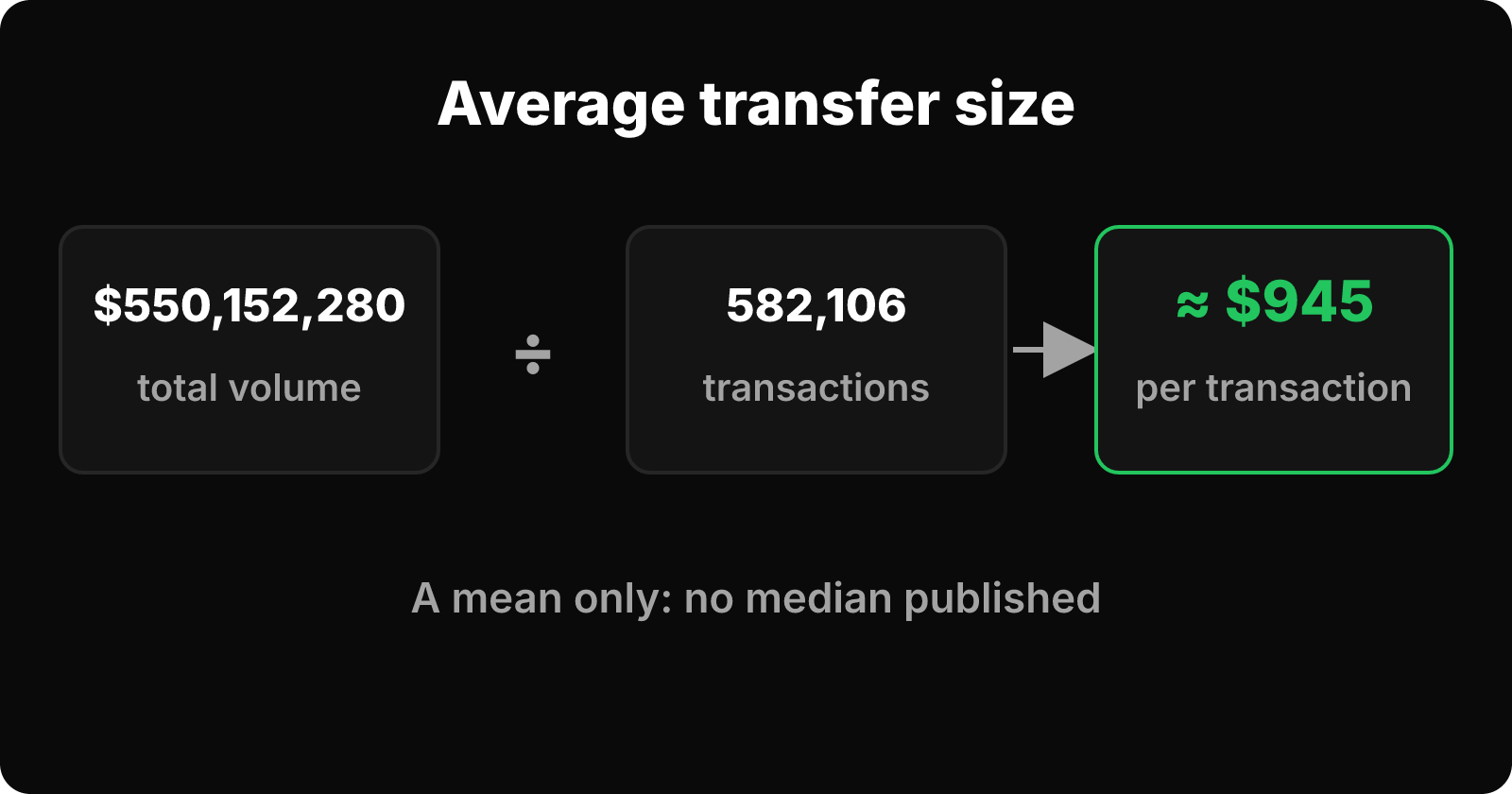
TeleSwap has processed 582,106 bridge transactions, according to TeleSwap network stats, which works out to an average of about $945 per transaction. We got the average by dividing the exact volume figure by the transaction count. The API does not report it directly.
| Metric | Value | How derived |
|---|---|---|
| Total bridge transactions | 582,106 | Reported by API |
| Average volume per transaction | ≈ $945.11 | $550,152,280 ÷ 582,106 |
A mean of about $945 suggests many mid-sized transfers rather than a handful of whale transfers, but we'd be careful with that conclusion. A mean hides the distribution, and a few large transfers can sit next to many small ones. The API exposes no median or percentiles, so we haven't invented any.
In an SPV bridge, verification work per transfer (one Merkle proof, one header lookup, one mint) does not grow with the amount transferred. Because a Teleporter covers destination-chain gas and users pay fees in Bitcoin assets, users don't need to hold native gas on the destination chain. That helps small transfers stay practical.
Finding 3: How Did Activity Look in the Last 30 Days?
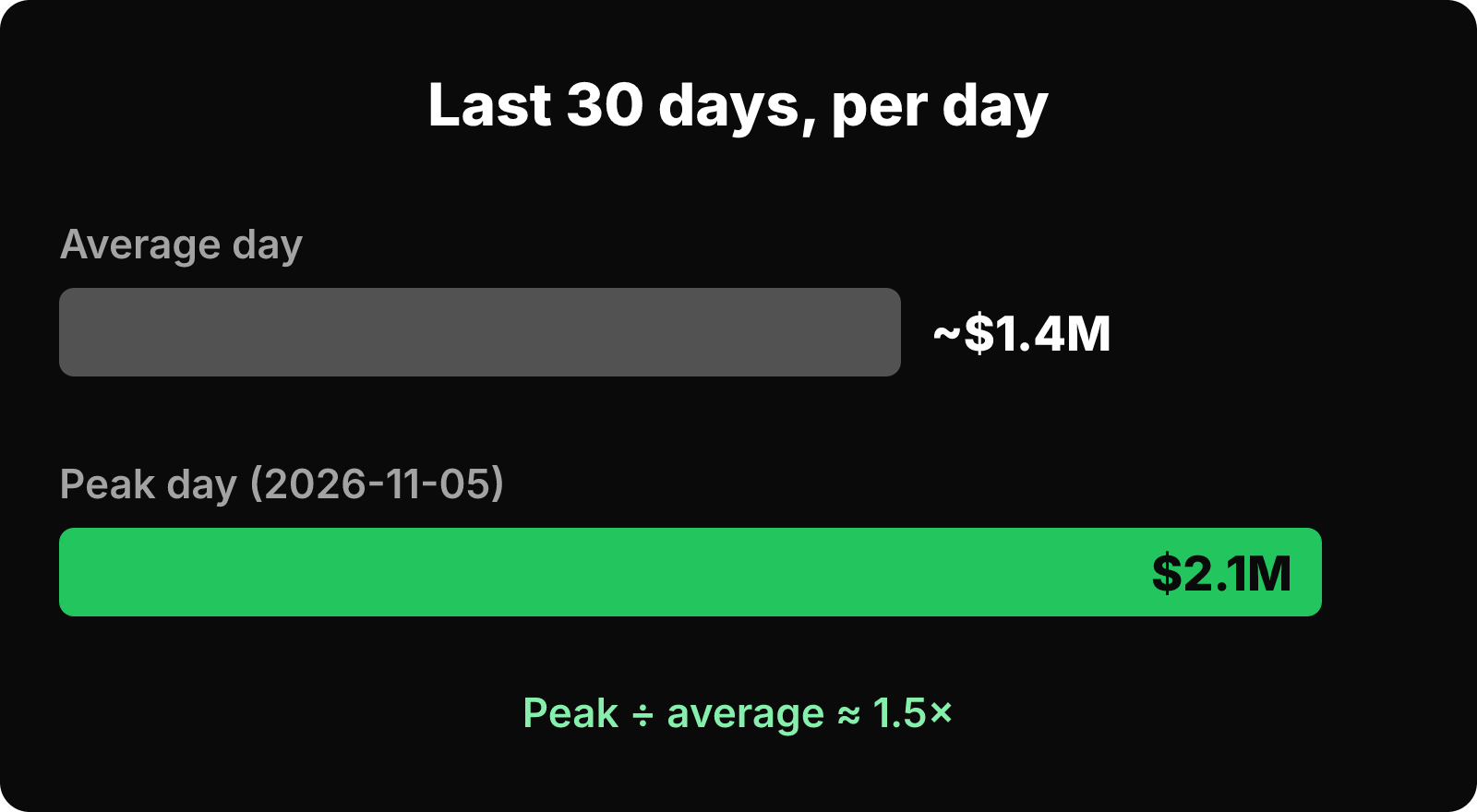
TeleSwap moved $40.5M in the 30 days to 7 November 2026, averaging about $1.4M per day, with a single-day peak of $2.1M on 2026-11-05, per TeleSwap network stats. This is the only time-series view the data block provides, so it is our only measure of change.
| Metric (last 30 days) | Value | Source / derivation |
|---|---|---|
| Total volume | $40.5M | Reported by API |
| Average daily volume | ~$1.4M | Reported by API |
| Peak day | $2.1M (2026-11-05) | Reported by API |
| Peak ÷ average | ≈ 1.5× | $2.1M ÷ $1.4M |
| 30-day share of lifetime volume | ≈ 7.4% | $40.5M ÷ $550.2M |
| Lifetime volume expressed in days at 30-day pace | ≈ 393 days | $550.2M ÷ $1.4M |
Two things stand out.
First, the peak day was only about 1.5× the daily average. That means the peak was not an extreme outlier, and the 30-day total came from sustained daily flow rather than one day carrying the month.
Second, the last 30 days account for about 7.4% of everything the protocol has ever moved, a rough measure of how current the activity is. We are not projecting forward. The "393 days" row is arithmetic, not a forecast, and past volume says nothing about future volume.
One nuance: this 30-day window overlaps the launch of native BTC deposits into the TeleBTC pools on 2026-10-14, which take one Bitcoin transaction and no EVM wallet. The data block doesn't split volume by product, so we can't attribute any of the $40.5M to that launch. We note the overlap so readers don't draw the link without evidence.
Finding 4: Where Does the Volume Go Across 13 Networks?
TeleSwap reports 13 supported networks, according to TeleSwap network stats. The data block we used does not break volume down by chain or route. We are saying this plainly instead of filling the gap with estimates.
What we can show without guessing is where routes exist. The table lists destination chains that have BTC swap pair pages on teleswap.xyz, with example routes. It describes availability, not volume.
| Destination chain | Token standard | Example BTC routes |
|---|---|---|
| Ethereum | ERC-20 | USDC, USDT, ETH, WBTC, cbBTC, XAUt, DAI |
| Arbitrum | ERC-20 | USDC, USDT, ETH, WETH, WBTC |
| Base | ERC-20 | USDC, ETH, WETH, cbBTC |
| Optimism | ERC-20 | USDC, USDT, ETH, WETH, WBTC |
| Polygon | ERC-20 | USDC, USDC.e, USDT, MATIC, WETH, WBTC |
| BNB Smart Chain | BEP-20 | USDC, USDT, BNB, BTCB, ETH |
| Unichain | ERC-20 | USDC, ETH, WETH |
| Robinhood Chain | ERC-20 | ETH, USDG |
| Tron | TRC-20 | USDT |
The bridge also connects BTC to TON (Jettons) and Solana (SPL tokens). Every listed pair page has a route in both directions. Because the bridge-plus-AMM design routes through TeleBTC, a single verified TeleBTC supply on each chain can be swapped into that chain's tokens.
How Should Developers Read Bitcoin Bridge Volume Statistics in 2026?
Bitcoin bridge volume is only comparable across protocols if you first check what each protocol counts and what its trust model is. Public aggregators such as DefiLlama's bridge dashboard are useful, but they put very different designs side by side on one leaderboard. Before comparing a figure, ask four questions:
- What settles the transfer? It could be a verified Bitcoin transaction (SPV), a signer quorum (multisig/MPC), or a solver's promise (intents). Volume backed by verification is not the same as volume backed by trust.
- Is it native BTC or BTC-denominated? Moving WBTC between EVM chains is not native BTC cross-chain volume.
- Are both legs counted? A round trip (BTC → USDC → BTC) can be counted once or twice depending on the indexer. Ask before comparing.
- Is the metric cumulative or windowed? Lifetime totals keep rising. A 30-day window shows whether activity is current.
Our opinion: for Bitcoin specifically, verified volume per unit of trust is a better health metric than raw volume. A bridge that depends only on Bitcoin's proof-of-work and slashable collateral carries a different risk profile from one behind a committee's keys. See Bitcoin Bridge Security in 2026 for the trade-offs.
Practical takeaways
- Pull live figures, don't copy them. These counters grow as transactions settle, so older articles will show smaller totals. Cite the network-stats page with a retrieval date.
- Build quotes programmatically. The TeleSwap SDK returns a BTC → EVM/TON/Solana quote in under a minute and wraps a plain REST API.
- Earn on volume you route. Integrators can register a third-party ID to earn a share of fees on the volume they bring. Rango, Rubic, and DZap integrate TeleSwap as a Bitcoin swap provider, and MetaMask and Trust Wallet users can reach it through the Rango integration.
Methodology
Every TeleSwap usage figure in this article comes from one source: the TeleSwap network-stats API, retrieved on 7 November 2026. We took no usage numbers from third-party dashboards, earlier articles, or estimates.
| Figure | Period | Computation |
|---|---|---|
| $550,152,280 total volume | Lifetime to 2026-11-07 | API field, USD as reported; not re-priced by us |
| 582,106 bridge transactions | Lifetime to 2026-11-07 | API field, as reported |
| 13 supported networks | As of 2026-11-07 | API field, as reported |
| $40.5M 30-day volume | 30 days to 2026-11-07 | API field, as reported |
| ~$1.4M/day average | Same 30 days | API field, as reported |
| $2.1M peak | Single day, 2026-11-05 | API field, as reported |
| ≈ $945 average transaction | Lifetime | Our derivation: exact volume ÷ transactions |
| ≈ 7.4% recent share | 30 days vs lifetime | Our derivation: $40.5M ÷ $550.2M |
| ≈ 1.5× peak ratio | 30 days | Our derivation: $2.1M ÷ $1.4M |
Limitations. The snapshot has no per-chain, per-route, or per-direction breakdown, so we report none. It has no median or distribution data, so the average transaction size is a mean only. It is a single retrieval, so the only change we measure is the 30-day window against lifetime.
The counters are live, so totals quoted elsewhere will differ depending on when they were captured. We deliberately leave out TVL. Nothing here is a forecast or investment advice.
Frequently Asked Questions
How much volume has TeleSwap bridged?
TeleSwap had bridged $550,152,280 in total volume as of 7 November 2026, according to its network-stats API. This lifetime cumulative figure is reported in US dollars and covers 582,106 bridge transactions across 13 supported networks.
How many transactions has TeleSwap processed?
TeleSwap had processed 582,106 bridge transactions as of 7 November 2026. Dividing total volume by that count gives an average of about $945 per transaction. The API does not publish a median.
What was TeleSwap's volume over the last 30 days?
TeleSwap moved $40.5M in the 30 days to 7 November 2026, averaging about $1.4M per day. The peak day in that window was 2026-11-05, with $2.1M in volume.
Why do different articles show different TeleSwap stats?
The network-stats counters are live and grow over time, so any figure captured on an earlier date will be lower. Always cite teleswap.xyz/network-stats together with the date you retrieved it.
Does TeleSwap publish bitcoin bridge volume statistics by chain?
The network-stats data used for this report gives totals and a 30-day window but not a per-chain or per-route breakdown. We therefore report only network count and route availability, not chain-level volume.
How does TeleSwap verify a Bitcoin transaction before minting TeleBTC?
A light-client contract on the destination chain checks a Merkle inclusion proof against Bitcoin block headers that Relayers have submitted. TeleBTC is minted 1:1 only after the Bitcoin transaction is verified, so no custodian or multisig committee has to vouch for it.
Is a higher bridge volume a sign of a safer bridge?
No. Volume measures usage, not security. A bridge's security depends on what settles its transfers, whether that is an SPV proof, a signer quorum, or a solver, so compare trust models before you compare volume.
Conclusion
As of 7 November 2026, TeleSwap had moved $550.2M across 582,106 transactions on 13 networks, including $40.5M in the last 30 days, with no single day dominating. The average transfer is under $1,000, and every BTC-in transfer is verified on-chain through SPV before any TeleBTC is minted.
Check the live numbers yourself on TeleSwap network stats, then try a route such as BTC → USDC on Arbitrum at teleswap.xyz to see the light-client flow end to end.